Reading Resolution Update: After Action Report

My 2022 reading resolution: Read or DNF every novel that has won a Hugo or a Nebula award, and acquire all the good ones.

Earlier this month, I finished my last Hugo/Nebula book and ordered the last two ones that I hadn’t yet acquired. The first of those (Powers by Ursula K. Le Guin) arrived just this morning, and the other one (Way Station by Clifford D. Simak) is supposed to arrive next week, so I think that now is a good time to do a retrospective and share some of my thoughts.

There were 104 books in total, including the most recent award winners (I decided not to count the retro-Hugos midway through the year). Of those, I’ve read 35 through from start to finish, and decided that 24 were worth keeping. The rest of them (69, or almost exactly two thirds) I DNFed.

Finishing one in three books is actually about on par for me. I’ve found that if I don’t allow myself to DNF books early and often, I just don’t read. Also, it doesn’t really surprise me that nearly one third of the books I read all the way through didn’t really impress me. What can I say—I’ve a very opinionated man.

Of the 28 books that have won both a Hugo and a Nebula, I finished 12 (or about two-fifths) and found that eight (or a little over a quarter) were worth keeping. So not much different than the overall totals.

Of the 45 books that won only a Hugo, I finished 18 (exactly two-fifths) and found that 14 (about a third) were worth keeping. So my personal taste seems to be tilted more toward the Hugo than the Nebula. The difference becomes even more stark when you take out the 20 books that were nominated for (but did not win) a Nebula, a whopping 16 of which I DNFed. Excluding those, we’re left with 25 books, 14 (or more than half) of which I finished, and 11 (or just under half) I thought were worth keeping.

The contrast becomes even sharper when we look at the Nebula-only winners. Out of the 31 books that didn’t win a Hugo but did win the Nebula, I finished only five (less than one-sixth) and found that only two were worth keeping. Both of those were books that weren’t even nominated for the Hugo. When we look at the 16 Nebula-winners that were nominated for a Hugo but didn’t win, I finished only two of them (one-eight) and didn’t think that any of them were worth keeping.

So the best predictor that I wouldn’t like a book is if it won a Nebula and was nominated for a Hugo, but didn’t win. In other words, if the SFWA crowd (which is mostly authors) said “this is the best novel published this year!” and the denizens of Worldcon said “yeah… no,” that almost guaranteed I would hate it. In fact, just getting nominated for a Nebula is enough to make a book suspect.

This is why, earlier in the year, I posited the theory that SFWA has done more to ruin science fiction than any other organization. I saw this trend coming all the way back in the spring, when I was only halfway through the reading list. In the early years, SFWA was all about politicizing science fiction, and in the last few years, it’s basically turned into a nasty bunch of mean girls all trying to get a Nebula for themselves.

I tracked a few other awards just to see if there were any correlations. For the 18 books that placed in any category in the Goodreads Awards, there were only four books that I finished and two that I thought were worth keeping. Network Effect by Martha Wells received 22,971 votes in the Science Fiction category in 2020, which came to 9.69%. Blackout by Connie Willis gained only 337 votes in 2010, but that was 9.19% back then. Both of those books were keepers. The only other book that got a higher percentage for its year was Redshirts by John Scalzi, with 4,618 votes at 10.82%, but I DNFed that one. Most Hugo/Nebula winning books didn’t even clear the 5% threshold in the Goodreads Choice Awards, and in my experience anything under 10% that doesn’t immediately jump out to me probably isn’t worth reading.

Of the six Hugo/Nebula books that were nominated for a Dragon Award, the only one I even really finished was Network Effect by Martha Wells. But that makes sense, since it’s no great secret that the Hugo/Nebula crowd is trying to sabotage the Dragons by pulling exactly the same shenanigans that they accused the Sad Puppies of doing. Accusation is projection is confession, after all. As of 2022, there has never been a Hugo/Nebula winning book that has also won a Dragon, and while part of me hopes that it stays that way, another part of me is very curious to read the first book that does.

Almost all of the 104 Hugo/Nebula winning books placed somewhere in the various Locus recommended reading lists, which isn’t surprising since those lists are generally regarded as feeders for the Hugos and Nebulas (and used to get more people voting in them, too). Of the seven books that weren’t on a Locus list, the only one I finished was They’d Rather Be Right by Mark Clifton and Frank Riley, which also has the distinction of being the most difficult book to find.

(A lot of people think They’d Rather Be Right was the worst book to ever win a Hugo, but I actually enjoyed it. Unlike most Hugo/Nebula books, it was remarkably anti-Malthusian, which is probably why it’s so hated. As for the worst book to ever win a Hugo, I personally grant that distinction to Dreamsnake by Vonda N. McIntyre.)

There were only ten Hugo/Nebula books that won or were nominated for a World Fantasy Award, and I only finished two of them (and didn’t think either were worth keeping). Perhaps that means that makes it the actual best predictor that I’ll hate a book, but ten is a pretty small sample size, so I’m holding off judgment for now.

The best two decades for me were the 50s (7 books, 4 keepers) and the 00s (16 books, 6 keepers), though the 80s came in close with five keepers out of sixteen books—and let’s be honest, Blackout and All Clear by Connie Willis are basically two halves of the same book. In contrast, the worst two decades were the 70s (only one keeper out of 13 total books) and the most recent decade, the 10s (15 books, 2 keepers).

So far, the 20s aren’t shaping up to be much better. In fact, I think it’s entirely fair to say that given the state of fandom since the election of President Trump (and the general state of insanity in this post-Trump era), a Hugo or a Nebula should count as a mark against a book, rather than for it. That is, the primary value of these awards is to tell you which books to avoid. Perhaps this will change at some point in the future, like it did after the madness of the 70s or the malaise of the 90s (not a good decade for science fiction, apart from books published by Baen), but I’m not holding my breath.

So that was my reading resolution for 2022. If I hadn’t allowed myself to DNF, I can guarantee that I never would have accomplished it. As it stands, though, I’m pretty satisfied with how it turned out.

What sort of reading resolution should I set for 2023?
Rethinking some things

So I had an extremely vivid dream last Friday night where I got cancer and learned that I had only a month to live. Among other things, I found myself asking: “What am I going to do about my writing career? Who is going to finish all these books? Are they going to fade into obscurity, or will someone promote them so that my family will benefit from them after I’m gone?”

The whole thing made me feel like the race was suddenly over, and I hadn’t finished it, but had to hand off the baton to someone else who would. So instead of spending that final month of my life writing, I would have to spend it outlining things in such a way that the person who carried it all after me would be able to do it right.

(And then, hilariously, when I told my friend and cowriter Scott Bascom that I had terminal cancer, his response was: “So what? Get back to writing.” And when I told him IRL about that dream, his reaction was: “Well, was I wrong?”)

Obviously, it was an incredibly sobering and emotional dream, for reasons that had nothing to do with my writing. But it also got me to thinking about some things I’ve taken for granted about my writing process, and how I ought to change them or at least experiment with other ways of doing things.

For example, for the last fifteen years—really, since I started writing professionally—I’ve just sort of assumed that I would 1. work on one novel WIP at a time, and 2. write that novel sequentially from start to finish, rather than hopping around.

In the early years, I experimented with doing things differently and decided that I just wasn’t wired that way. But that was also when I thought I was a 100% discovery writer and didn’t have any sort of outlining process. Basically, I tried to keep the whole novel in my head, a nearly impossible task even for a veteran writer.

Now, I have a much more rigorous outlining process that divides each novel WIP into chapters and scenes, so that instead of trying to keep an entire novel in my head, I can eat the elephant one small bite at a time. So I’ve actually got the infrastructure in place right now to experiment with those things, in a way that I didn’t before.

Another thing that I’ve always taken for granted is that in order to be a working professional, I need to set strict deadlines for each project and schedule those deadlines at least a year in advance. Never mind that I have never kept an original deadline that I’ve made for a project, or kept to those schedules. Instead of finding a better way, however, those deadlines and schedules always just keep getting pushed back.

I’ve also been trying to find a way to write a novel all the way through from start to finish, without getting stuck in the middle and feeling like I need to put it aside for a while (on the “back burner,” as I used to say). In fact, that was one of the main reasons why I developed my outlining process in the first place. But even with a well-developed outline that still has some flexibility to adapt to a changing story, I still can’t write a novel straight through without having to take a break.

Another thing I’ve always failed at is hitting my daily word count goals consistently. Instead, I typically write in starts and fits, especially when I’m in the messy middle of whatever novel WIP I’m working on at the moment. However, I did have some success with those nanowrimo challenges where I worked on short stories—in other words, where I hopped from project to project.

Also, until this year, I could never manage to read very consistently. I’d go through phases where I’d read a lot, followed by long reading droughts where I’d read almost nothing. But then, I discovered some reading hacks that completely changed everything, and now I’m reading between one and two dozen books a month (most of them just the first and last chapters, but about 6-10 of them all the way through).

One of those reading hacks was—wait for it—reading more than a dozen books simultaneously and hopping from book to book. And the thing that made that possible was my reading log, which provides some structure and helps me to see how much I need to read from each book to not just totally drop the ball.

So why don’t I try something similar with my writing? What if, instead of working on one novel WIP at a time, I used these outlines to break them all up into scenes and just skipped around, writing whatever stands out as the most interesting thing to write at the moment? The outlines will help to keep it all straight, so I don’t have to keep an entire novel in my head. And when I inevitably get stuck with one WIP, I don’t have to lay it aside for months on end—instead, I can jump to something else, since I’m already jumping around in the first place.

It sounds kind of crazy, but I’ve found that my ADHD brain actually works better that way, at least when it comes to reading. So why not writing as well? It’s worth a shot, at least. And maybe one of the upsides will be that I won’t have to angst so much about those deadlines. If the focus is on hitting daily word count instead of staying on deadline for my current WIP, then solving the first problem will ultimately solve the second one, once I hit my stride.

So that’s what I’m going to experiment with: hopping from project to project, with a goal of hitting my daily word count goal rather than advancing a single project to an arbitrary deadline.

In order to do that, I need to make some outlines. Here are all of my unfinished novel(ish) WIPs that I haven’t trunked yet:

  • The Sword Bearer (Twelfth Sword Trilogy #2)
  • The Sword Mistress (Twelfth Sword Trilogy #3)
  • Captive of the Falconstar (Falconstar Trilogy #2)
  • Lord of the Faconstar (Falconstar Trilogy #3)
  • Children of the Starry Sea (Outworld Trilogy #2)
  • Untitled (Outworld Trilogy #3)
  • A Brotherhood of Swords (First Sword Trilogy #1)
  • Untitled (First Sword Trilogy #2)
  • Untitled (First Sword Trilogy #3)
  • The Lifewalker Chronicles (standalone)
  • Starship Lachoneus (standalone, may be a collection)
  • The Justice of Zedekiah Wight (collection)
  • The Mercy of Zedekiah Wight (collection)
  • Christopher Columbus, Interstellar Explorer (collection)

Of those, only Children of the Starry Sea and Captive of the Falconstar are fully outlined. So I’ve got a lot of work to do.

Instead of taking time off to outline all of these, however, I’m going to prioritize hitting word count, and work on the outlines on the side, in my voluminous spare time </sarc>. It’ll probably take a while, but I’ll eventually get it done—and that will provide some extra motivation to hit word count each day.

Also, I plan to outline all of them, even the book 3s where book 2 still hasn’t been written. The reason for that is so that I’ll have something to hand off to another writer, in case that crazy dream comes true. I don’t think that it will, but I’m gonna go sometime, so it’s better to get into the habit of doing that now. Besides, it may be helpful to skip ahead to the next book and write a few scenes: give me something to write toward.

TL;DR: I’m going to be doing a lot of experimentation in the next couple of months, skipping around in all of my WIPs instead of focusing on one at a time. It’s going to be crazy, but hopefully in a productive way. And a fun way too.

Bowing Out

Back at the end of August, I blogged about how I was going to do a writing challenge in September to produce more short stories to fill out my publishing queue. At the time, I had a couple of stories that looked like they were going to be picked up by one of the major magazines: the editor had expressed interest in buying them, and we were going back and forth with an editorial discussion about the series.

Well, to make a long story short, all of that fell through, and it looks like I’ll be self-publishing those stories after all. I’m not really sure what changed, but to give you an idea of what kind of a short story market this is, it’s been around for decades and regularly gets written up in Locus Magazine’s year-in-review. The editor said that things had gotten crazy on his end, then didn’t respond for about a month, and when I sent a polite followup email asking for an update on the status, he gave me the standard “I’m going to pass on this one, but send me your next story.” Which strikes me as kind of weird, given how our previous correspondence led me to believe that the contract was just a formality and he’d be sending one over soon, but whatever.

So now that these stories are back in the publishing queue, I no longer need to write a bunch more to fill it out. In fact, I’ve actually got enough stories to publish one a month through next April, and after I finish the third Christopher Columbus story, I’ll have enough to get through June (one of my older stories comes out of exclusivity in May 2023). Here is the schedule as of right now:

  • OCT 2022: “Blight of Empire”
  • NOV 2022: “Christopher Columbus, Wildcatter”
  • DEC 2022: “The Freedom of Second Chances”
  • JAN 2023: “The Body Tax” (needs to be revised, but it’s already been workshopped)
  • FEB 2023: “Christopher Columbus, Treasure Hunter”
  • MAR 2023: “The Library of Fate”
  • APR 2023: “Hunter, Lover, Cyborg, Slave” (needs to be workshopped and revised)
  • MAY 2023: “Christopher Columbus, Wormhole Mechanic” (partially written, needs to be finished)
  • JUN 2023: “In the Beginning” (still under exclusivity, though I got a special exception to publish it in my third short story collection, The Stars Our Destination.)

Given that I have enough stories to fill out the next nine months, I’m going to bow out of the September Shorts challenge. This is really good for two reasons: first, it allows me to focus more attention on my current novel WIP, the sequel to Star Wanderers; and second, because I’ve fallen really behind on the Zedekiah Wight stories for my J.M. Wight pen name, and this should give me some space to work on the next few of those.

So that’s the plan: refocus on Children of the Starry Sea and work on Zedekiah Wight stuff on the side.

Searching for a routine

Just a quick update post. My parents came over to visit last week, and we’ve all come down with a mild cold, so our family routine has been more or less up-ended. That’s just the nature of routines, though: they work until they’re inevitably disrupted, at which point you need to reassess and adapt to the new circumstances.

In our case, the big thing we need to adapt to is our two year-old daughter. Currently, I watch her in the morning and my wife watches her in the evening (we both work from home). Which works out pretty nice, especially since she’s just started taking one long nap (usually in the morning) instead of two shorter ones.

I’ll have to talk with Mrs. Vasicek about how we want to adjust our schedules because of that. But before we do that, I suppose I should break down the elements of what I need to accomplish, and figure out how best to do those:

Writing

My daily writing goal is to hit at least 1k new words, and 2.5k words on what I call the daily index. Basically, new words count 1x and words revised or other words (such as what I’m writing now for this blog) count .5x. So I could hit the daily index by writing 2.5k new words in my WIP, or 1k new words and 3k words revised.

It’s a fairly modest goal, but I’ve found it quite challenging to hit it consistently. For that reason, I allow myself one admin day (for doing all the mindless work and/or refilling the creative well) per week, but I really do need to hit those daily writing goals more regularly. And I’ve found through sad experience that the longer I put off doing the writing, the harder it gets to actually do.

So what I really need is to start writing first thing in the morning. If I can get 500 words in before breakfast, that would be fantastic. But the trouble with that is that I’m the one watching the baby while Mrs. Vasicek makes breakfast, and the baby is always—always—super hangry when she wakes up. I know we’re supposed to minimize screen time, but I usually put on something for her to watch to keep her happy. But that’s usually either piano music or Tabernacle Choir, so I suppose I could write on my other monitor while the video plays on the other one. And sometimes I get lucky and the baby wanders off to the kitchen to get a piece of whatever Mommy is cooking. So I could probably fit in some writing that way.

The other obvious time to fit in some writing time is during her nap. I usually need at least a little time to decompress first (putting the baby down can be an ordeal) but if I set a timer, that would probably help keep the down-time from taking up all of naptime. Also, it would probably help if I read a book instead of browsing the internet. Reading is much better for decompressing than vegging out on the latest clickbait trash.

If I can hit 500 words before breakfast and another 500 words during naptime, it should be much easier to hit word count later. The first couple hundred words are always the hardest. After hitting 1k words, it’s surprisingly easy to write another thousand. So getting those words in early is the key.

Publishing

In my experience, there are four kinds of publishing tasks, forming a 2×2 grid:

Takes very little brainspaceTakes a lot of brainspace
Tend to enjoy
Tend to procrastinate

Tasks that require a lot of brainspace are things like writing a blog post, or writing a book description, or responding to fan mail. Tasks that take very little brainspace are things like crunching numbers, typesetting a print book, or submitting books for promotions.

The procrastination angle is a bit more personal. I imagine the kinds of things I tend to procrastinate are very different from the things that other people procrastinate. But the big danger here is that the tasks I actually enjoy will become the excuse for procrastinating something else—like writing. For that reason, I try to limit myself to only 1 hour of publishing tasks per day.

But when is the best time to fit in that hour? If I do it first thing to get it out of the way, there’s a very good chance I’ll just keep working through the timer and end up having an admin day. On the other hand, if I put it off to the end of the day, then writing tends to fill up that space instead—which isn’t terrible, but these publishing tasks do need to get done sometime.

What I probably need to do is set a time in the middle of the day, maybe around 3pm when we start intermittent fasting. That should be late enough not to turn the day into an admin day, but early enough that I still have time and energy. Besides, for me writing isn’t usually a continuous thing: instead, it tends to happen in creative bursts with a little bit of necessary downtime in between. So setting 3pm as the publishing tasks time shouldn’t interrupt my writing time too badly—and if I happen to be in the flow, I’ll just push on to the next stopping point and do publishing tasks then.

I have a pretty good accountability system in place to maximize the productivity of that hour, so I’m not concerned about needing more time or dropping the ball on the important-but-not-urgent tasks. However, I will procrastinate some of those important-but-not-urgent tasks if I’m not mindful enough. So this is probably the best way to handle all that:

Takes very little brainspaceTakes a lot of brainspace
Tend to enjoyLeave for the next admin day.Pay closer attention to the time.
Tend to procrastinateStart first, then listen to podcasts.Plan it out ahead.

Of course, this will change depending on how urgent/important the task is. The mindless enjoyable tasks tend to be neither urgent nor important, but that isn’t always the case. And by “start first, then listen to podcasts,” what I mean is to start it off with a good amount of focus, then switch on a podcast in the background after I’ve hit my stride.

Reading

Reading is something that I enjoy, but it isn’t a mindless activity, so if I’m not careful I’ll end up filling my free time with useless things like playing a phone game. So reading time needs to be scheduled.

My wife and I have found that reading before bed tends to work really well, so long as we don’t put off going to bed. The key to that is to turn off the computer before getting the baby down, which means accomplishing all of my work (including personal stuff) before about 7pm. Also, on the nights when it’s my turn to do the dishes, it helps to do those sometime during the afternoon, to keep the rest of the evening free.

We also do a fair amount of reading in the early morning (theoretically, we wake up at 5am, though we haven’t been as good about that lately), but when the baby gets up, it’s usually time to start the morning routine, so it isn’t good to rely on that time.

I could probably also fit in some reading time while watching the baby. The key here is to cut back on podcasts, which probably would be a lot healthier, considering how many political podcasts I listen to. Also, as I mentioned above, reading would be a great way to decompress after putting the baby down for a nap.

So that’s pretty much what I have in mind: start off each day with writing time, carefully schedule and limit publishing time, and be more deliberate about reading time. Hopefully that works.

Print vs. Ebook vs. Audiobook: When To Own

In last week’s post, I tried to make a comprehensive list of all the pros and cons associated with the various book formats. The purpose of that exercise was to figure out when to acquire a book in print, in audio, in ebook form, or some combination of all three. It’s long been my goal to build a magnificent personal library, and with the upsides (and downsides) of each format in mind, I think I’ve developed some personal guidance toward that end.

For the purpose of this exercise, I think it’s best to consider first what the platonic ideal would be, if money or availability were no object. So assuming that every book is available in every format, at a price that I can afford, this is what I would do.

If a book is worth owning, it’s worth owning in print.

For all the advantages of digital format, print is still better in enough ways that if I’m going to own a book, I want to own it in print. This really comes down to the rule of thumb that if you don’t hold it, you don’t own it. Also, the fact that print books are immutable, more private, and so much easier to share.

However, my calculation would be different if I hadn’t married and settled down. Back when I was a global nomad, ebooks were so much better than print, and even when I was a student my print books were more of a liability than anything. I moved so much in my college years that for most of the time, my books just sat in cardboard boxes under my bed. When I left on my internship, I ended up giving most of them away.

But now that I’ve settled down, print books are definitely the way to go. As for hardbacks vs. trade paperbacks vs. mass-market paperbacks, or used vs. new, I still have to figure that out. Personally, I prefer MMP to the other print formats, but that’s mainly because it’s what I grew up with and because I don’t really care if it gets banged up. For the purpose of building a personal library, the calculus is probably quite different.

If a book is worth rereading, it’s best to have a digital copy too.

There are a lot of reasons to own a book even if you’re probably not going to reread it—for example, if you want to share it with your friends, or display it prominently on your shelf. But if money were no object, I would want to own at least one digital format of every book I plan to reread. That way, if something happens to the print copy, I have another one to fall back on.

More than that, though, I think it would be interesting to change up the reading experience by rereading it in another format. Does a book hold up in audio as much as it does in print? How about ebook? Maybe it would be fun to see which passages other people have highlighted and shared the most.

Also, if I’m planning to reread a book at the same time as my wife or my friends are reading it, it would be great to have a digital copy so that they can borrow the print one. Or maybe they get the digital copy, and I keep the print one.

For all these reasons, multiple formats seems like the way to go, provided that money is no object. But then, the question becomes whether to get the ebook, the audiobook or both? To figure that out, here are the questions I need to ask:

Do I want to find and share my favorite passages?

One of the biggest advantages of ebooks that make that format unique is that the text of an ebook is searchable. That is no small thing for the kind of books that I want to go back through and pick out certain passages. Print books are better for flipping through, but they aren’t text-searchable in the way that ebooks are.

Another unique advantage of ebooks is that you can share passages that stick out to you, or see what passages other people have highlighted and shared. So if it’s the kind of book that I want to go back and think about, or reread certain passages in greater depth, the best digital format for that is probably ebook.

Do I want to read it quickly, without too much depth?

The biggest advantage of audiobooks is that your eyeballs can be elsewhere while you read. So with audiobooks, you can fit more reading time into the interstitial parts of your day, like commuting or doing chores, but it comes at a tradeoff because you’re not going to be concentrating all that much.

However, that probably won’t be as much of a problem on a reread, since you’re already familiar with the story. But it will be a different reading experience, one where your attention is not as concentrated. For that reason, I lean more toward owning a book in audiobook if it’s the kind of think I want to reread for enjoyment, not for depth.

But I can’t buy it all!

Okay, so all of this is great if money is no object, but few if any of us live in that world. I certainly don’t, and some of these formats—especially the audiobooks—can get to be quite expensive. So, what’s the best thing to do?

Since I tend to be more of a spreadsheet guy, my solution is to make a list of all the books I want to own, in each format. Some of these books will end up on various wishlists, and will probably come my way as gifts. For others, I just need to keep an eye out for good deals—it’s surprising how many excellent books come through the local thrift stores, some of them in rare or signed copies.

But the key here is patience. If you’re time-rich and money-poor, learn how to wait and keep an eye out for good deals. Books tend to come and go, just like so many other things in life.

So that’s how I plan to acquire books going forward. What about you? What’s your personal guidance on when to own a book?

Spring Shorts 2022 #4: The Freedom of Second Chances

I’m really happy with how this short story turned out. It pushes the edge in a lot of interesting ways, with the main character having to choose between duty and honor and doing what is right, and a forced abortion situation that puts the lie to the “women’s right to choose” insanity. It will probably get me blacklisted at a few more magazines, but at this point I really don’t care.

Once again, I used the Mythulu cards to come up with this story. Here are the ones I used:

  • CLONE: Many available forms, including: duplicate, twin, rebirth, alternative life path manifested, time traveler overlap, actor, understudy, etc. Can even mean a second chance or a relapse.
  • ABANDONED: Indicates a severe problem in the environment that prior ihabitants were unable to solve. Draw +1 Habitat.
    • COASTAL: Peaceful threshold where the ocean meets land. Known for caves, karsts, and dunes. Represents unsolvable relationship problems.
  • ERODED: Extensive, exponential deterioration of a foundation due to long-neglected defense.
  • MARRIAGE OF HONOR: A permanent relationship initiated to help someone else avoid shame or discredit.
  • TATTOO: Marked to identify, warn, or remember.
  • GUILTY: Responsible for the worst thing that has happened recently to everyone around them.
  • BODYGUARD: Primary purpose is to protect something else, at any cost.
  • VELVET: Labor-intensive weave of fabric that mimics the soft fur on a young buck’s antlers. Worn to inspire reverence or respect.
  • BLOOD: Represents the energy invested to keep something alive. The only element which affects the soul beyond mortality. Can taint or purify.
  • SLIPPERY: Wants freedom and is hard to hold onto. Often enjoys the chase.
  • BUREAUCRAT: Keeps others in bondage with words. Diverts enemies toward illusions to exhaust them into giving up.
  • CATALYST: Initiates or accelerates a chemical reaction without itself being affected. Gifted at getting things moving.
  • NECRO: Things that were once living, but no longer are. Draw again to decide what died. Draw +1 Habitat or Element.
    • PET: Healthy codependence with a clear heirarchy, usually between members of different species.
  • TORN: Forcibly separated parts, which often continue to exist separately. Indicates a lost privilege or reduction in status. Symbol of anger.
  • SIGIL: Symbols that have power to force or bind. Used in communities to rally groups together.

I’m going to keep going through until I’ve used all of the Mythulu cards in a story at least once. So far, they’ve proven to be an interesting way to not only generate story ideas, but to send my stories off in different and interesting directions. It usually takes me a little while (or sometimes a couple of different draws) to figure out how to fit everything into a coherent story, but I’m getting the hang of it, and the process is actually pretty fun.

As for the spring shorts challenge, it’s Memorial Day today, which means that the challenge is basically over. I only ended up writing four stories, which is a lot less than what I’d hoped to write, but I think these will turn out really well after I rework them a bit, so I’m counting it as a partial success.

For June, I plan to write two more short stories in order to fill up the buffer. My writing group meets once a month, so with two more stories to critique in June, that will give me a buffer of six months by the time July rolls around. I also plan to fix up all four of these spring shorts stories and put them on submission for the next few months, before I publish them as free singles.

I will try to do a new short story each month, in order to keep the buffer at six months, but I may do another short story nanowrimo this year if it turns out that I need more. As far as other WIPs are concerned, though, after I write these next two stories in June, I’m going to go back to novels. My plan right now is to write the first three chapters of The Sword Bearer and Captive of the Falconstar by the fourth of July, then decide whether to go on with one of those or to keep working on Children of the Starry Sea.

Refining my short story strategy

I’ve blogged several times about my short story strategy. To restate it briefly, I’ve found that it works best to self-publish all of my short story singles for free, and to take them down when I have enough of them (+40k words, usually about 10 stories) to bundle into a collection. I earn more this way than I do from selling the singles at 99¢, since all of the free stories help me to sell the collections. Also, I get better engagement from my fans and better discoverability with new readers, since when time is the only cost for reading a story, readers tend to prefer something short.

I’ve also found that with just a little bit of a marketing push, consisting mostly of my newsletter, reddit, free promotion sites, and group promotions such as Book Funnel and Story Origin, I can get my stories out to as many readers as most of the professional and semi-prozines. This was surprising to me, but when I compare my download numbers to the magazine circulation numbers published annually in Locus Magazine, there’s actually not much of a disparity. With a more aggressive marketing push, I can probably exceed those numbers.

Partly because of this, and partly because of how batshit crazy insane woke most of the traditional and award-winning SF&F short story markets have become, I no longer prioritize selling my short stories to the traditional markets, and am just fine self-publishing them first, even if that means forfeiting the couple hundred bucks they might have earned by selling them to a traditional market first. Many of my stories have languished on my hard drive for years while I was pursuing that path, and since time is money, I find it more worthwhile to publish them now. However, I do like to take at least a few months to submit them to the markets that aren’t insanely woke, and occasionally make a sale.

But still, I’ve been struggling lately with some of the finer details of this plan. How often should I publish my short story singles? How long should I keep them on submission before self-publishing them? Should I self-publish all of the stories that will eventually go in the next collection, or should I hold a few back so as to give my readers a reason to buy it? How long should each story be available as a free short story single?

From September 2021 through March 2022, I self-published at least two new titles every month. The purpose of the experiment was to see how this would impact overall sales. My sales did go up quite a bit by the end of this period, but that may have also been because of a few lucky BookBub Featured Deals that I got.

(It was a lot harder to get BBFDs back in 2021, largely because traditional publishing dumped all of the books that were in the production process when covid hit, so there was a lot more competition for spots. But now, it appears that there’s a bit of a drought of trad-published books, since all of the stuff coming out now was acquired during the time when they were still adjusting to all of the pandemic lockdown measures, and weren’t nearly as productive.)

However, the experiment was useful in demonstrating just how difficult it is to maintain such a rigorous self-publishing schedule for a lengthy period of time. I think that at least part of the reason I’m going through something of a creative slump right now is because of how much energy and mental space it took to publish 14 new titles in 7 consecutive months. Perhaps when I was still single, I could have kept up that pace indefinitely, but not with a wife and a baby daughter who deserve my attention. I can still occasionally publish more than one title per month, but not for multiple consecutive months without suffering some detrimental consequences.

At the same time, I do think there’s something to be said for consistency. For a long time in my early career, I would publish only intermittently, sometimes with several months going by before I put out another title. If instead, I’d spent the last ten years putting out a new free short story once a month, in the first week of the month, I’d probably not only have more fans right now, but more loyal fans.

So the plan from now on is to publish a new free short story each month, on the first Saturday of the month, and to publish it under my Joe Vasicek name (stories published under any of my pen names don’t count, even if they’re under an open pen name).

But at the same time, I don’t want to have more than six free short stories out at a time. Six, because 1. that’s how many stories appear at a time on the series carousel on Amazon, at least with a wide screen monitor, and 2. I don’t want to have more than half of the stories I plan to bundle together out at the same time. Since I’m never going to put less than ten stories in a collection, and one of the six free singles is always going to be “Paradox of Choice” (it’s published under a CC BY 4.0 license, so there’s no sense in ever unpublishing it), six is the magic number.

As for whether or not to hold some stories back, so long as no more than half of the stories in the next collection are available as free singles at the same time, I think it’s okay to put them all out there. My loyal fans will have already downloaded all of the stories when they were free, but they’re also my loyal fans, and that seems like a good way to reward their loyalty. Besides, some of them will probably go ahead and buy the collection anyway, both to support me and to get the author’s note.

What about putting stories on submission? How much of a buffer should I keep to ensure that each story gets sent out to all of the markets that I’m willing to sell it to?

I think a buffer of six months is enough. It might require doing some simultaneous submissions, but a lot more markets allow simultaneous submissions nowadays. And with a six month buffer, if I sell a couple of them, I won’t be scrambling to write new stories to fill up the next publishing slot—not unless all six of them sell within a few days of each other.

If a story sells to a traditional market, I’ll probably just put it straight in the next collection when the exclusivity period expires, rather than putting it on the schedule to publish as a free short story single. But it depends on what’s going on at the time, and whether it’s more important to get that collection out or to refill the buffer. I won’t put out the next collection until I have at least six other short stories to fill out the free singles.

So that’s the plan. Maybe it makes sense to you, maybe it’s clear as mud, but the important things are 1. I’m going to put out a new free short story each month on the first Saturday of the month, come hell or high water, and 2. I’m only going to have six free short stories available at a time. And all of the stories in my collections will appear first either as a free short story, or in one of the magazines/anthologies. Sometimes both.

A reading hack for the ADHD-addled brain

I’ve got a mild case of ADHD. As a kid, I took ritalin from grade 3 through about grade 8, and as an adult, I occasionally self-medicate with caffeine (usually in the form of soft drinks, since I don’t drink coffee or tea). I can function all right without treating it, but I am more prone to getting distracted when I don’t. But leaving it untreated also makes it easier for me to make interesting connections between seemingly unrelated subjects, which improves my creativity, so it’s more of a trade-off between being more productive vs. being able to make leaps of logic and switch between subjects more easily.

In terms of reading, ADHD makes it very difficult for me to finish long books, unless I’m hooked all of the way through, which is rare. I’ll often start books but drift away from them without either finishing them or making the conscious decision not to finish them. Over time, this makes me less enthusiastic about reading, since I’ve got a huge pile of unfinished books behind me that I can’t easily get back into, because I’ve forgotten what was happening in them.

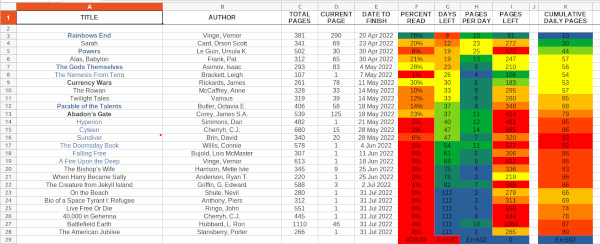
Well, I recently found a new reading technique (or rather, a new reading accountability technique) that helps me to hack my ADHD to read more, not less. It starts with keeping a reading log on a separate spreadsheet, with columns to track total pages, pages already read, and the date to finish reading, among other things.

Most importantly, it has a column for “cumulative daily pages,” which is just the sum of all the pages you have left to read up to a certain date, divided by the number of days left. In the spreadsheet above, the formula is “=(SUM(C$3:C[current row]-SUM(D$3:D[current row]))/G[current row]”.

What the cumulative daily pages tells you is how many pages you have to read each day, not just of the given book, but of all the books before it, in order to finish that book by the given date. So in the screenshot above, if I want to finish Sundiver by May 28th, I need to read 93 pages per day across any of the books listed above it. I can read all 93 of those pages in Sundiver and still stay on goal, or I can read 93 pages of Cyteen instead, or I can spread them out by reading 7-8 pages of each of the 14 books with a “due” date before May 28th. Or any other combination.

Changing the “due” date also changes the cumulative daily pages, so I can also bring that number down by extending the deadline and reordering the books in descending order by “due” date. I’ve also color coded the pertinent columns using conditional formatting, but that’s just for personal convenience. The redder a number is, the more I need to bring it down (or up, in the case of percent read). For daily cumulative pages, I like to keep the half-dozen books with the soonest “due” date pretty low, so that I don’t have to focus on them exclusively.

And that’s where the ADHD hack comes in. Because instead of trying to read just one book from start to finish, the reading log allows me to skip from book to book without losing track of which ones I still have to read. That way, when one book begins to feel like a slog, I read to the end of the chapter and skip to the next book. My ADHD-addled brain says “Oh look! Something new!” and I get excited about reading again. And I don’t fall into the trap of feeling like I’m not making any progress, because I can see it all there on the spreadsheet.

Of course, the big danger is that when I think back on what I’ve read, I’ll remember an epic tale about how rabbits colonized Mars and uplifted dolphins while the dark lord raised the cauldronborn and killed vampires for the government. In space. But hey, at least I’m reading lots of books now!

Slight Change of Direction

I’m currently a little over 54k words into the rough draft of Children of the Starry Sea, the sequel to Star Wanderers and second book in the Outworld Trilogy. Most of my novels fall somewhere between 40k and 80k words, so if this was a typical WIP, I would be pretty close to finishing it. However, I expect that this novel will turn out to be somewhere north of 140k in the final draft, and the rough draft is already shaping up to be at least 160k. So I’ve still got a long way to go before this one is finished.

I was hoping to release this book by the end of the year, but I also want to release book 2 and book 3 within two months of each other, with book 3 already set up for preorder by the time I release book 2. That seems to be the best way to launch the later books in a trilogy, especially in conjunction with a price promotion on the first book. Launching book 2 without book 3 anywhere in sight, it’s much more difficult to make a splash. So I don’t want to publish Children of the Starry Sea until at least the rough draft of book 3 (which doesn’t even have a title yet, let alone an outline) is done.

So with all of that in mind, I’m looking at my publishing schedule for the rest of the year, and without Children of the Starry Sea and the yet unnamed book 3, it looks pretty sparse. I’ve got my fourth short story collection coming out in May, another short story later this month, two short stories sometime in the summer, a J.M. Wight short story that I’m workshopping through my writing group this month, and two more J.M. Wight projects that I haven’t even written yet. And that’s it.

I would like to publish at least one new title every month, preferably two if they’re both short. Also, I would like to have enough short stories in production so that I can keep them on submission for a while, preferably at least six months.

At this point, it seems that the best solution to this problem is to take some time off from my WIP to write short stories, fill up the publishing schedule from now to the end of the year, and go back to writing Children of the Starry Sea and its untitled sequel. To do that, I need to write ten short stories in addition to the two unfinished J.M. Wight works. One of those is going to be a novella, so I’ll probably have to take an extra couple of weeks for that, but I should be able to write about two short stories per week.

So my new goal is to write a dozen stories between now and Memorial Day. That will be more than enough to fill up the publishing schedule through the end of the year, especially if I have enough stories to bundle into another short story collection (which I almost certainly will). It’ll also give me something to blog about, which should be fun.

I wish I were the kind of writer who could write five secret novels on top of everything else I’m doing. Heck, I wish I were the kind of writer who could write three or four novels a year, instead of just one or two. Perhaps in time I’ll get to that point, but for now all I can do is strive to make incremental improvements, and I do think that writing more short stories will help me to be a better writer. And I’m not putting Children of the Starry Sea completely aside, just on the back burner for now. Hopefully that helps me to finish it faster when I do make it my primary WIP again.

Unpublishing The Other Side of Reality

It’s been a good run, but I think it’s time to take this one down. It was always more of a fun side project, a cute little story written more for myself than for anyone else. It’s gotten to the point where I think I have too many free short story singles out, and I need to take a few of them down to make room for the new ones.

My next short story collection, Beyond World’s End, is scheduled to release in May 2022, and it will include this story. I was originally going to hold a couple of stories in reserve and never release them as short story singles, just to incentivize people to pick up the collection. But now, I think it will be better to reward my faithful followers by releasing all of the stories as free singles first.

With that said, I don’t want to have all of these stories out at the same time, so that the month before the collection comes out, a person can just download all of them for free with one click. So moving forward, I’ll be putting up and taking down these free singles fairly frequently, and never have all of them up at the same time together.

So yeah, if you want to pick up this one as a free short story single, now’s the time to do it. By the end of the week, it will be gone.