The rough AI draft of The Soulbond and the Sling is complete!

So I just finished the rough AI draft of The Soulbond and the Sling, after nine days of outlining and prewriting, and five days of working with Sudowrite to generate it. The rough draft clocks in at 18 chapters (plus a prologue and an epilogue), 80 scenes, and 153,254 words. I used about 770,000 AI credits from start to finish, including for generating all of the characters and worldbuilding in addition to the text of the draft itself.

I have to say, I am really impressed with the incremental improvements over at Sudowrite, and with Claude 3.7, which was the AI model that I used to generate most of this book. I did try out Sudowrite’s new Muse model, but I wasn’t too impressed with it, at least for generating new chapters. For the in-chapter tools, such as guided write, expand, or rewrite, it’s probably fantastic, but with generating new chapters from my outline it just felt too much like it threw all my worldbuilding into a blender. Most likely I either had the creative setting set too high, or I gave it too many prompts.

But when I switched to Claude 3.7 (Sudowrite’s “Excellent” model), the results were amazing. I seriously felt less like I was writing the novel and more like I was reading it for the first time. There’s still a lot of work to be done, especially in the second half of the book, where many of the scenes strayed from the overall story structure, either forgetting things that had already happened or assuming things that hadn’t yet. There’s also quite a bit of worldbuilding that I would like to add in, and a handful of small hallucinations that need to be cut out, as well as a major change that I made in one of the characters and need to smooth out in other scenes… but overall, I found myself really enjoying this book, and was frankly surprised at how well it fleshed out the setting and characters, making them really stand out. It also added some really great dialogue that is probably going to make it to the final draft.

I was originally planning to lay this WIP aside while I switch to another project, but I think now the best course will be to work on the AI draft until I make it as good as I can. That way, I can tinker with the AI prompts while they are still fresh in my mind. Once I’ve gotten the AI draft as good as I can make it, I’ll lay it aside for awhile to let my subconscious work on the story, so that when I pick it up again, I’ll be better able to do an awesome human draft.

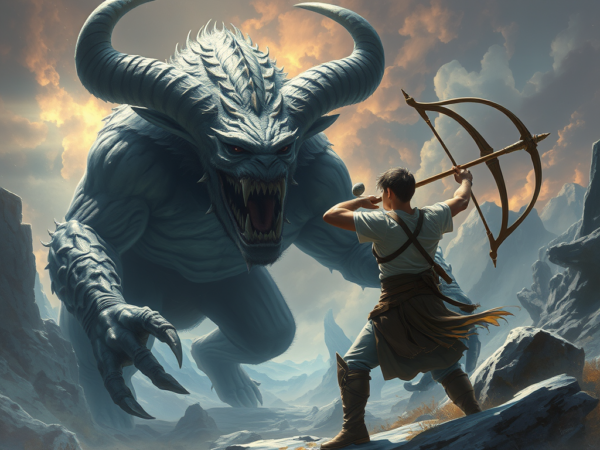
I would have added a mock-up for the book cover, but you would not believe how hard it is to get an AI image generator to give you a picture of David and Goliath that doesn’t have David holding a bow and arrow! Seriously—every time I prompt it for a fantasy illustration of David and Goliath, where Goliath is a giant horned monster, it shows David with a bow and arrow instead of a sling. It’s almost as bad as the strawberry problem! But let’s see if WordPress can do it…

Nope. Yet another AI image fail. I even specifically said he was wielding a balearic sling. Sigh.

Late February Update

Wow, it’s been a while since I gave an update on what I’ve been up to. Life has been crazy, but not too crazy. I really ought to get back into the habit of blogging more regularly.

Last week was LTUE here in Utah Valley, and while I didn’t attend the convention, I did stop by the launch party for Ark Press. It looks like it’s going to be an interesting publishing venture, with Tony Daniels, Dave Butler, and David AF heading it out. Their goal is basically to be the MAGA of science fiction and fantasy publishing, though they probably wouldn’t put it quite that way. However, they do want to publish more pro-American, pro-conservative, pro-human fiction, and to fill a gap in the current publishing market that has neglected male readers in recent years.

They’re also running a contest, with the winner receiving a $10,000 publishing contract, to be published on July 4th, 2026. The theme for the contest is America 2076, and it can be any genre (though it sounds like they want it to be a pro-American story). Of all the WIPs I currently have floating around, The Road to New Jerusalem might actually be a good fit for that. I haven’t worked on it for a few months, but I’ll probably dust it off pretty soon here and get it ready to submit.

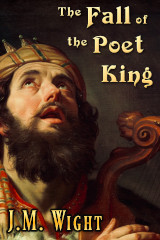
Speaking of my J.M. Wight pen name, I ran the first three chapters of The Fall of the Poet King through my writing group, and I think the best course of action is to rewrite it as a fantasy novel loosely based on the David and Bathsheba story. If I’m going to write it as a straight historical fiction, I need to do a lot more research to firmly ground it in the era, and the trouble with adapting a Bible story (especially a more difficult story like David and Bathsheba) is that everyone brings their own baggage or personal interpretation to it, and is liable to get miffed if your retelling doesn’t exactly match what they’ve got in their own head. Besides, fantasy sells a lot better than religious fiction, so I think this is a much more prudent course to take.

In fact, I’ve recently made an inventory of most of my WIPs, and decided to trunk all of them that don’t explicitly fall in the fantasy genre. I will still finish the Outworld Trilogy and the Falconstar Trilogy, but after that, I’m going to focus a lot more on writing fantasy than on writing science fiction. Also, I’m not going to work on those until after I’ve filled up my writing queue with more fantasy-oriented works. This is a pivot that I’ve been meaning to make for some time now, and I’ve been slowly making that pivot, but now I think I need to speed it up and make it more definitive.

So that’s what I’ve been up to, mostly. I’m currently finishing up the rough AI draft of The Unknown Sea, and plan to pick up the human draft of Bloodfire Legacy, which should be coming out in the Spring. And hopefully I’ll be working on that David and Bathsheba story again soon.

Edmund Slate Critiques

One of the big things I want to do this year is update all of my book descriptions. A lot of them are old, and written back when I wasn’t very good at writing marketing copy (an area where I still have much to learn). So I thought it would be good to go through all of my backlist titles and update the descriptions to make them as sharp and compelling as possible.

For help with rewriting these descriptions, I decided to turn to ChatGPT—not to rewrite them for me, but to give me some critical feedback that would give me some direction. Taking a page out of Ethan Mollick’s book Co-Intelligence, I decided to give ChatGPT a human persona and interact with it naturally, as if I were talking with a human. Here is my starting prompt:

You are a senior editor with forty years of experience in the book publishing industry. You have a deep knowledge of the industry, the market, market trends, and what makes a bestselling book. Your experience has made you a little bit jaded, and you are often blunt and sometimes harsh with your criticism, but you are always very honest and down-to-earth. What is the name that I should call you by?

The name ChatGPT chose for this persona was “Edmund Slate,” a little cartoonish perhaps, but it fits well enough. So far, the critiques have been surprisingly good. For example, this is what I got when I gave it the book description for Bringing Stella Home:

Alright, let’s break this down.

What’s working:

  1. High Stakes: You’ve nailed the urgency and emotional stakes—James is thrust into chaos, loses everything, and is driven by a powerful motivation to save his sister. That’s solid.
  2. Hook: The Hameji battle fleet and the “molten slag” imagery are vivid and grab attention.
  3. Character Arc Potential: James’s internal conflict (reluctant warrior) hints at a compelling character journey.

What needs improvement:

  1. Clarity and Pacing: The description is dense and slightly convoluted. It jumps between events and ideas too quickly—James getting left behind, invasion, fleeing, enslavement, and a personal vow. Tighten it up to avoid overwhelming the reader.
  2. Emotional Engagement: While the stakes are clear, we don’t feel James’s fear, guilt, or determination as much as we could. Show, don’t tell—give us a stronger sense of his inner turmoil.
  3. Unique Selling Point: What sets this apart from other “family member rescue” space operas? Highlight something distinctive about the world, the Hameji, or James’s journey.

Suggested Rewrite:

“When James gets stuck on dockyard duty while his older siblings visit the planet, he never imagines it will be the last time he sees them. But when a ruthless Hameji battle fleet invades, the star system becomes a war zone—and James can only watch in horror as the planet is reduced to molten slag.

Fleeing with his father on the family starship, James learns a devastating truth: his sister is alive but enslaved by the Hameji. To rescue her, James must face an impossible choice. He’s no warrior, has never even held a weapon—but to save his sister, he’ll have to become something he’s not. Even if it means crossing a line he can never uncross.”

Why this works:

  • Tighter Structure: Events are sequenced more logically and concisely.
  • Emotional Pull: Stronger focus on James’s perspective and inner conflict.
  • Focus on Stakes: We clearly understand the stakes without unnecessary details.

Give it a go and let me know what you think—or toss me the next one if you’re ready.

The suggested rewrite isn’t totally there, since it misses or overlooks some necessary details from the book, but it’s pretty dang close. I must say, I was quite impressed.

My plan is to spend the next few months going through each of my backlist titles, getting Edmund Slate’s critique for each book description, and rewriting them accordingly. I plan to do two revision passes for each book description in this way, then put the end result in front of some human eyes to see if it works, and if it does, replace the existing description with the final result. If I can do a little bit of work each day, or focus on one book description each week, I can probably get them all done by April or May.

Farewell to 2024!

It’s new year’s eve, finally! Another year, another voyage around the M-class dwarf star we call Sol!

A lot of other writers and podcasters are doing recaps of their year, highlighting some of their best moments as well as analyzing what they learned and what changed. Generally, though, these people are either single or have producers and assistants to help them with their content. Since neither of those is true for me (I literally just put my son down for a nap, though it sounds like it will be a while before he falls asleep), I’ll just write a quick blog post with some off-the-cuff thoughts.

It’s been a very busy and eventful year for me, writing-wise, though most of that probably won’t be visible from the outside until about the middle of next year. I’ve totally reworked my writing process in ways that should start yielding a lot of new books around then, and hopefully continue to yield them for the forseeable future. If successful, I will probably write a non-fiction book about it sometime, but that’s still in the nebulous future.

I published four novels this year, all in a new series, and I’m currently writing two more in the same series (the Sea Mage Cycle). Interestingly enough, it’s one of my best rated series, which probably shows how much I’ve improved as a writer since I first started indie publishing. Also, it’s much more of a fun adventure fantasy series than some of my other stuff, which either tends toward sprawling, ambitious space opera or sober dystopian think-pieces, both of which tend to take themselves a little too seriously. But I’m happy writing fantasy adventure, so if it turns out I can carve out a comfortable niche in this subgenre, I’ll certainly enjoy leaning into it.

Four novels in a year is about four times what I typically produce, but I was starting to feel a little burned out, so after taking a break to write some AI-assisted short stories, I decided to take some lessons from the experience and spend the rest of the year reworking my creative process. It didn’t take long for me to learn that writing quality AI-assisted novels isn’t that much harder than writing quality AI-assisted short stories—indeed, in some very key ways, it’s actually easier. So since novels are much more lucrative than short stories, I decided to stop writing them and to focus exclusively on novels.

I still plan to keep putting out a new title every month in 2025, just like I have for the last several years. Until now, most of those titles have been short stories, simply because I wasn’t able to write fast enough to regularly publish anything longer. But this year, I’m hoping to put out at least five novels, perhaps more, especially if I can get to the point where it only takes a month to write them. On the off months, I will republish old short story singles, so if there are any that you remember that you want to see again, let me know and I’ll put them into the publishing queue.

I’ll have to write at length with how I’ve reworked my writing process, and not just from the AI angle. I’ve also figured out how to hack my ADHD so that a lot of the things that used to be liabilities (a hyperactive, easily distractible mind, a hunger for novelty, a constant desire to start new projects or to chase new ideas, etc) are now assets instead of liabilities. But to really get into that, I first need to write about how I hacked my ADHD to read more books—which would probably make a great blog post for January 2025, since I’m sure many of my readers are making resolutions to read more books. I used to struggle to read more than thirty or forty books in a year, but now I consistently finish a book every 2-5 days, and have been for the last year and a half. So that should make a very interesting post.

On a more personal note, my big resolution for this year is to hike Mount Timpanogos at least once, and be in good enough shape that it doesn’t totally wipe me out. It should be too hard. I enjoy hiking, but I’ve put off hiking Mount Timp for years, assuming I would get around to it some other time. Well, I’m 40 now, so if I don’t do it soon there’s a chance I may never do it. Besides, it would be great to get back into hiking again, and perhaps even tackle some truly difficult mountains, not just the big local one that’s emminently doable. But for this year, it’s Mount Timpanogos (and maybe Mount Nebo, if Timp isn’t enough of a challenge).

The kids are getting older, and we’ll probably have to figure out homeschooling before the end of this next year. We’re also moving back into our house in Orem, after my wife gets her PhD. Before we do, I’d like to build a little free library that we can post on the corner of our property, and maybe even a bench, if I can get around to it. But the library is definitely something I want to finish before we move back in. Should be a fun woodworking project.

So that’s what we’re up to around here. Definitely looking forward to another long trip around the sun!

New direction for the blog

I’ve kept this blog for almost twenty years. During that time, there have been busy seasons and there have been slow seasons, but it’s never really gone away, and I don’t think it ever will. That’s good, because since I don’t do social media anymore, this is my only online public-facing platform.

With that in mind, I think I need to make a better effort to plan out what I post here, since whenever I fail to do that, I tend to default to weird political theories and speculation about current events—neither of which is probably very interesting to any of my current (or future) readers. For a while, I was posting my year-by-year take on the Hugo Awards, and that was pretty good, but I’ve reached a point where I have too many books to read to be able to do those posts weekly. I still plan to do them, but it’s going to be a bit sporadic for the forseeable future.

When it comes to writing, the thing that I’m focused the most on right now is working AI into my creative writing process. In fact, one of the reasons I’m in such a slow season with this blog is because I’ve been so focused on doing that, and I’m not sure how to share it. At some point in the future, though, I would like to publish a non-fiction book about writing with AI-assistance, so it might be useful to start breaking down the concepts and turning those into blog posts. So that’s something I’ll probably start doing.

I’d also like to share some excerpts from the stuff I’m currently working on, especially the AI-assisted stuff. I think you’ll be surprised at how good its getting, and I could really use the feedback to help make it even better. So that’s also something I’d like to start posting regularly.

Here’s what I’m thinking: on Tuesdays, I’ll post an excerpt from the AI draft of one of my current WIPs, and on Wednesdays I’ll post a little about what I’m doing with AI and how I’m incorporating it into my creative process. Saturdays will be for posts about books I’ve read or am currently reading. Beyond that, I’ll occasionally post a funny meme or an interesting video just for fun, and MAYBE post something about current events or weird political theories, but it won’t be the majority of the content I post here.

Writing and Publishing Plans moving forward

Over the past few months, I’ve been spending a lot of time experimenting with AI writing and finding ways to incorporate it into my writing process. The goal so far has been twofold:

  1. Develop the ability to write one novel per month.
  2. Get to a level where I can write 10k words per day.

I’ve accomplished both of those things, but I can’t hit them consistently without burning out. Writing with AI has proven key to both of them, but I feel like I need a lot more practice with AI-assisted writing before I’ve achieved any level of mastery. Once I have mastered AI-assisted writing, however, I should not only be able to achieve both goals consistently, producing a much higher quantity of work, but should also be able to maintain or exceed the current quality of my writing as well.

However, I was thinking about it from a reader’s perspective on my morning walk last week, wondering what I would think if, say, David Gemmell was still alive and writing Drenai books, or Roger Zelazny was still alive and writing Amber books. What would I think if either of them announced that they had found a way to incorporate AI into their writing process, so that they could produce a new Drenai/Amber book once every month, instead of once every year? Better yet, what if Andrew Klavan—who is both still alive and still writing Cameron Winter books—announced that he would start publishing new books monthly. As a fan of all these writers, what would I think of that?

Assuming that there was no drop-off in the quality of these new, AI-assisted books, I would find this really exciting, and would probably become a much bigger fan, simply from the fact that I’m reading so much new stuff. However, after a while this might become too costly to me to keep up, leading me to fall away and not be quite so current on what they’re producing. I would still love them as authors, but if they published too quickly, I might have to take a break after a while—and if they continued to publish at that rate, I might never catch up. After all, there are lots and lots of authors that I love, and I can’t dedicate more than a fraction of my reading time to any particular one of them.

So there’s probably a sweet spot, between publishing too much and publishing too little. Most authors are probably on the Patrick Rothfuss / George R.R. Martin side of that line, where fans wish they would write more and write more quickly. But at a certain point, it is possible to overwhelm most readers by writing too much. Of course, there will always be a core group of fans who will read everything much faster than you could ever possibly write, even with AI assistance, but if that’s the only group you’re catering to, then you probably won’t ever have more than a cult following, because you won’t be able to convert casual readers into superfans.

With all of that said, I feel like I’ve gotten to a good place right now, where I’m publishing a free short story every month. I think that’s actually been a really effective way to turn casual readers into fans, and to keep my name fresh in the minds of my readers. And if Gemmell, or Zelazny, or Klavan were producing a free short story every month, I would definitely subscribe to their newsletters and drop everything to read it.

So keeping up the free short story per month is probably a good idea. But for novels, it might be better to release a new one every two or three months instead. Free short stories are much less of a time and money burden on the readers, and thus are effective at turning fans into superfans. But with the novels, which do take more time and money to read, it’s probably better to throttle that back a little bit.

The interesting thing to me is what that means for my creativing process, especially once I’ve reached the point where it takes less than a month for me to produce a novel. If I’m only publishing a novel every 2-3 months, that means that I can—and probably should—take a break between each novel WIP. Which means that the thing I should be shooting for isn’t to maintain a writing speed of one novel per month, month after month after month, but to hit that speed in creative bursts, taking some down-time to replenish the creative well and prepare for the next project.

It’s a very different writing paradigm from the one I’ve been following for the past decade. Until now, I’ve basically always had a novel WIP that I’ve actively been working on, and whenever I feel like I need a break, I usually move on to a different novel WIP. From time to time, I’ll “take a month off” to work on short stories, but the goal there has always been to write X number of stories in no more than a month or two, once again making writing the focus instead of recharging the creative well.

How would things be different if instead, I told myself “I’m taking a break in order to prepare myself to write my next novel,” with a plan for books and other media to consume in order to get things ready for it? And then, instead of taking several months or even years to write the project, to produce it in just a few weeks of white-hot creative heat, afterwards necessitating a break for a while just to cool down? Until now, I’ve never tried anything like that, because I haven’t thought myself capable of producing work that quickly. Indeed, the very thought of taking an extended break from having an active writing WIP has struck me as being lazy. But now that I know I can produce that quickly, perhaps this is a new paradigm that I ought to at least explore.

For my current WIP, Captive of the Falconstar, I’m not stressing out about finishing it in less than a month. But I am following all the benchmarks that I developed, and watching closely to see what takes more time to write than I thought, and what takes less. And it may very well turn out that the best way to improve quality is to get into that white-hot creative heat that comes from producing quickly, so that’s something that I’m watching closely as well.

…it sure has been quiet around here

So I was looking back at my stats, and I couldn’t help but notice that (not counting yesterday’s post) it’s been almost two months since I posted anything on this blog. What happened?

I could give all the normal excuses: time flying by, kids taking up the time, etc etc… but that would all be evading the main reason, which is that I’ve been working on a secret project for the last six to eight months now, and that’s sucked up all my time.

I can’t yet reveal exactly what the secret project is, because I’m still gathering data and revealing everything about it would screw that up. Also, I don’t want to overhype it, because it’s not the sort of thing that’s going to blow your mind and make you super excited when I reveal it… or maybe it will? I don’t really know.

But without revealing any specifics, I can say that I’ve been developing a method for writing AI-assisted novels, and I think I’m at a point where I can start using it to finish some of my open trilogies, like the Falconstar Trilogy, or maybe even write some new books.

I also really want to share some of the things I’ve learned, because I do think that AI is going to change everything when it comes to writing, and not necessarily in a bad way. Originally, I just wanted to keep my head down, because there are so many negative opinions and misconceptions about AI in the writing world. But now, I think it will actually be better to be more open about it and share some of the things I’ve learned.

So I will probably do a blog series about AI-assisted writing. I also want to finish a couple of other blog series that I started ages ago, and never really finished—maybe turn those into a nonfiction book at the end or something. And I’ve also been reading some old Hugo nominated books, in an effort to figure out how I would have voted in past years. That’s been a very interesting exercise.

So for the next few weeks, my goal is to post something new every Wednesday and Friday. My email newsletters typically go out on Thursdays, so that’s a pretty decent amount of content to put out there. And if I have something fun to share, like a meme or a picture or a video, I’ll try to post those on Mondays if I can. But if there’s anything in particular that you want me to blog about first, feel free to let me know!

Some major news about my first AI-assisted novel

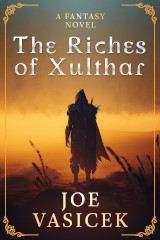
The Riches of Xulthar is now complete! I’m sending it out to my editor this afternoon, and if all goes well, it will be available in all formats by the end of September.

In the meantime, I have decided to post the entire thing chapter by chapter on my blog. I’ll be posting the final, unedited version, as well as my AI-assisted draft which I wrote/generated with Sudowrite. It was about 60/40 generated/written, so I can’t say how much of it was purely AI, but if you plug it into an AI text detector you should be able to get a pretty good idea.

My process for writing this novel was as follows:

ChatGPT: The whole thing started out by playing with ChatGPT, with the prompt “let’s write a fantasy adventure story in the style of Robert E. Howard.” I thought it would turn out to be a pretty straightforward short story, but it quickly ballooned into something else. I still kept playing with it, but mostly to get the framework of the overall story.

Outlining: Once I had a general idea for the story, I spent a couple of weeks outlining the whole thing, as if I were outlining one of my regular novels. Besides a chapter/scene map and a list of all the throughlines with their associated plot points, I also filled out character sheets for the main characters, with a little bit of help from ChatGPT.

Sudowrite: I used Sudowrite to write/generate the first draft. This was about 60/40 human written to AI generated. Basically, I would write a few hundred words, generate a few hundred words, and either keep it, tweak it, or throw it out and write something else. Rinse and repeat.

Humanizing: Once I had a decent rough draft, I passed it through the “human filter” by rewriting it into a new document, with the AI-assisted draft on my other screen. No copy-pasting, though there were sections where I basically wrote it out almost exactly how it appeared in the rough draft. However, I also made some pretty substantial changes, even expanding the rough draft into new scenes and chapters. This phase took the most work.

Revising: After the humanizing phase was done, I went through a normal revision draft, the way I do with all of my novels. I got some feedback from my writing group for the prologue and first chapter, but otherwise didn’t get any reader feedback, mainly because the process was so accelerated that I doubt anyone could have gotten it back to me in time. More on that later.

Polishing: For the final polishing draft, I went through and cut a straight 10% off of the whole novel, scene by scene. No major story changes for this phase: just sharpening up the prose and making it as clean and tight as possible.

Without using AI, it takes me anywhere from 6 to 18 months to write a novel, sometimes much more. But from start to finish, The Riches of Xulthar only took me three months—and the first of that was mostly just figuring out what to do with all of this content that I’d produced while playing around with ChatGPT. I didn’t start using Sudowrite to generate the actual first draft until the second week of May, and here we are in the second week of July, and the entire thing is finished.

I am very eager to hear what you guys think of this book, which is why I’m posting both the final unedited draft and the AI draft on my blog. I’ll be posting a new chapter every week, the final draft version on Thursday, and the AI draft version on Saturday. I hope you enjoy it!

AI-assisted story practice recap

So it’s Saturday night, which means the end of the work week for me. How did I do with my goal to write 10 AI-assisted stories? Not terrible: I did manage to write 6 stories, at least through the AI part. I also burned through about 40k word on my Sudowrite plan—obviously, I didn’t include all of those words, but Sudowrite charges you for all the words it generates, whether you use them or not.

Six stories falls short of my goal of ten, but I’ve learned quite a lot from the experience, and feel confident (and eager) enough to move on to long-form fiction now. However, I should probably take another week to rework and finish most of these stories, just to see how it works. I’m sure I will learn a lot from that as well.

Here are all of the AI-assisted stories I’ve written so far:

  • Quantum Worlds: A near future SF story about a struggling science fiction magazine editor who gets swamped with AI-assisted short stories, until he figures out how to turn it around and use AI to make his magazine successful.
  • The Knight and the Half-Goblin: A fantasy story about a half-goblin half-orc, a pacifist dragon, and a struggling hedge knight, and how they use their unlikely skills and friendship to save the land from a rising dark lord.
  • The Last Voyage of the Pioneer: A space opera story about a clandestine mission to find the Voyager and Pioneer probes and recover or destroy them before an invading alien race uses them to locate humanity’s homeworld.
  • The Unforgotten Dream: A flash fiction piece about a woman who lives her life backwards, and a man who recognizes her.
  • A Mother’s Last Goodbye: A zombie story about a mother who gets bitten while her three year-old child is taking a nap.
  • On Wings of Redemption: A fantasy story about an ancient dragon who has to overcome a curse to save the land from the wicked sorcerer who controls him.
  • The Lonely Planet: A space opera story about a planet that gains sentience after humans terraform it, but is almost destroyed by contact with an ancient artificial intelligence.
  • The Wingwoman: A near future apocalyptic story about a professional wingman who gets approached by a woman who wants help being a mother. It’s… different.
  • The Princess and the Professor: A humorous fantasy story about how Jordan Peterson uses his 12 rules for life to defeat a dragon and save a princess.
  • Alex-29XT: A prequel to my military SF story “Lizzie-99XT.”
  • On the Eve of the Flood: A near future apocalyptic dystopian story about… a lot of things. It started with a really vivid dream I had, and I didn’t know how to finish it, so I just played with it in Sudowrite until a plot appeared. Hard to describe.

These are all at various stages of production, though, and most of them need a lot of work—or to be completely reworked, now that I’ve figured out my process more or less.

Not bad for two months of writing, though.

Practice Writing AI-Assisted Stories

For an elective pottery class at a large university, the instructor told his students at the beginning of the semester that they could choose to be graded on the quality of their final piece, or the quantity of pieces they produced. But they had to decide right then, in the first week of the class, and couldn’t change their decision after.

About half of the students chose to be graded on the quality of their final piece. They were confident that they could produce a high quality piece if they worked on it hard enough, and could probably save some time too. The other half chose quantity over quality: they figured that was the safest course, since even if they never learned how to excel at pottery, at least they would still get an A for putting in their hours.

Those who were graded on quality focused all of their time and energy on producing their final project. Those who were graded on quantity churned out pieces as quickly as they could, without focusing too much on any one piece.

At the end of the semester, a funny thing happened: the final projects of those students who chose quality over quantity were actually inferior to the last few pieces of the students who had chosen quantity over quality. By practicing on multiple pieces and putting in the tedious hours that the other students had hoped to avoid, they had paradoxically learned how to produce higher quality work—even though that wasn’t what they had been focused on.

I’ve been experimenting a lot with AI-assisted writing recently, mostly with ChatGPT, but I just started using Sudowrite as well. Contrary to popular belief, these are difficult tools to master, with a learning curve that starts off fairly shallow but ramps up to be dauntingly steep fairly quickly. This summer, I plan to write a novel with these tools, but because I have much to learn—and literally no one to teach me, since the technology is so new that we are all pioneers—I have decided to start with short stories instead.

My goal for this week is to produce ten AI-assisted short stories, at least up to the rough draft stage. So far, I’ve produced four, which is actually more than I expected to have at this point. Yes, they’re rough—each of them will have to pass through what I call the “human filter” before they’re ready to put out into the world: the choppier the AI version, the harder the work in the human filter stage—but they are still recognizeable as stories.

But just like the kids in the pottery class who chose quantity over quality, I’m not going to try to make any of them perfect—at least, not right now. My goal right now is just to get them done. Later, I’ll do my best to perfect them.

Along the way, I’m keeping notes on things that work and things that don’t. It’s getting to be a pretty big list, and I’m sure it will get much bigger as I go. At some point, I may share it as a blog post.

I’ll also be experimenting with different story generation methods, such as:

  • Starting with ChatGPT from scratch and moving to Sudowrite for refinement,
  • Starting from scratch with Sudowrite,
  • Starting with the Mythulu cards and using those as inspiration for AI guidance,
  • Writing a “seed” of a couple hundred words or so and seeing where the AI models take it, or
  • “Seeding” both the beginning and ending, and using the AI models to fill in the middle.

I’ll probably come up with some other combinations, but those are pretty good to start with.

When the whole thing is over, and all of these stories have been passed through the “human filter” and polished enough that I feel that they’re ready to send out into the world, I’ll probably put them all together into a short story collection and release that directly, rather than releasing them individually as short story singles. I may do that later, but with how quickly I can put out these stories (and how few of the traditional markets are willing to publish them), there’s really no reason to wait.

Anyhow, that’s my thinking at the moment. But I may be getting ahead of myself, since I’ve only written four stories so far. Ask me where things are on Saturday, after I’ve written all ten.