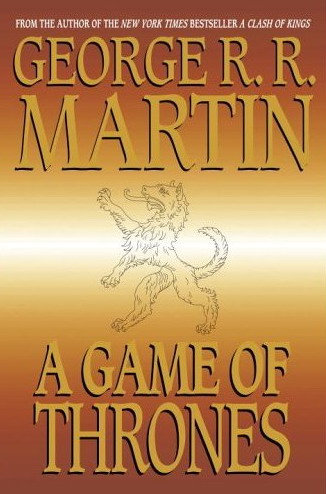
Why I don’t like George R.R. Martin

I was thinking today about George R.R. Martin’s A Game of Thrones and the fact that I’ve more or less given up on the series after reading the first book.  A lot of my friends are rabid-at-the-mouth crazy about it, both the books and the TV miniseries, but I’m just not all that into it.

Don’t get me wrong—I can see why other people like it so much.  The story is engaging, the political intrigue is deliciously complex, the world building is wonderful and immersive, and the fantasy tropes are played quite well.  I enjoyed a lot of things about the first book, and intended to read the rest of the series after finishing it.  After all, it’s one of the most important works of epic fantasy to come out in the last few decades, with people calling George R.R. Martin an American Tolkien.

But the truth is, I just wasn’t all that into it.  And the more I think about it now, the more I’ve realized that this isn’t the kind of series I would enjoy at all.

The strange thing is, I’m a HUGE fan of David Gemmell, who writes almost the exact same sort of thing.  Immersive fantasy worlds, dark and gritty characters, shades of gray, lots of fighting, lots of sex, lots of brutality, the realization that anyone can die off at any time … the list goes on and on.  And yet, there’s something about David Gemmell’s books that turns me rabid-at-the-mouth and has me squeeing like an otaku fangirl, whereas with George R.R. Martin, all I can manage is “meh.”

I think the reason for this is that Martin’s characters basically fall into one or both of two camps: victim or victimizer.  There isn’t any middle ground—at least, none that anyone can stand on for long without dying in some horrific and brutal way.  The story requires the characters to all become monsters, and anyone who isn’t willing to do that meets a horrible, tragic end.

There were only two characters in A Game of Thrones that I really cared about: Arya and Ned Stark.  Ned was the only character who really tried to stand for something, and Arya was just a spunky little girl who resisted all the stupid girly stuff in favor of more practical stuff like street smarts.

<spoilers ahoy>

The trouble was that Ned was a complete idiot, trusting in the honor of a guy who explicitly said “do not trust me” and making stupid decisions that ended up getting half of House Stark killed or captured.  It’s almost as if Martin purposefully set him up to be a straw man character—that he wanted this one character to represent all the goody-goodies of the world, and knocked him off in the most brutal way possible.  It’s like Martin killed him off to make a point, and had the story drive the character rather than the character drive his own story.

And Arya … I forget exactly what happened to her, but she basically became a victim in such a horrible, twisted way that I could tell she’d be scarred for the rest of the series.  If she didn’t die off herself, she’d probably become a dirty street rat—the slit-your-throat-for-a-copper kind, not the Disney version.  So yeah, I pretty much gave up on her.

Jon Snow was okay, but he was so far removed from everything else in the story that I just got bored with him.  Tyrion was funny, but he was also a pervert, and all the reasons to sympathize with him basically revolved around “I’m a dwarf, everyone mistreats me”—again, the victim vs. victimizer thing.  Lady Catelyn was pretty cool, but I always saw her as more of a supporting character, and while I found myself rooting for Daenerys at the end, it was only out of frustration with all of the other douchebags in Westeros—I just wanted her to come over the sea and claim the throne so that everyone else would die.

It was a pretty good book, I’ll admit—other than the fact that I didn’t really like any of the characters, everything else was quite enjoyable.  It certainly held my attention long enough to finish the thing.  But I didn’t really feel compelled to read the next one because I frankly didn’t care what happened to any of the characters.  You could give me a list of all of the ones who die off, and I would just shrug and say “oh well.”

In contrast, with every David Gemmell book I’ve read, I fall in love with the characters after reading just a paragraph or two in their viewpoint.  Drenai or Nadir, civilized or barbarian, I not only like the characters, I fall deeply in love with them.  I care about them right from the outset, even the ones with a dark past, like Skilgannon or Waylander.  In fact, Waylander is probably my favorite of them all.

The fact that I know that some of these guys are going to die only makes me more invested, because even though Gemmell kills of most of his characters in any given book, the main characters’ deaths almost always mean something.  Maybe they have some awful secret that they finally are able to give up, or maybe they’ve been running from a fate that they finally gather the courage to face.  Or maybe they just happen to be in a circumstance that requires them to give up their lives, and they rise to meet the occasion.  Not every death is cathartic, but Gemmell never kills off a character merely for the sake of killing off a character, whereas with Martin, I get the sense that that’s sometimes the only reason.

But the biggest difference between the two is that with Gemmell, the victim vs. victimizer paradigm just doesn’t exist.  Gemmell’s books are all about unlikely heroism—characters in situations that require them to be something more, or do something beyond looking out for just themselves.  Anyone can be a hero, because a hero is nothing more than someone who does something heroic.  No matter your past, no matter your fears, no matter your weaknesses, when the chips are down, we’re not all that different.

The counter argument I’ve heard is that all of this heroism stuff is superfluous, and Martin is trying to get beyond it, kind of like the 19th and 20th century philosophers who were trying to get beyond morality.  The thing is, if that’s the case, then Martin has to have the darkest and most depressing view of human nature of almost any fantasy writer alive.  If his point is that there’s nothing intrinsically heroic about anyone, that being a hero is just a matter of rising to a role and becoming a figure in one of the stories that people tell to make sense of the world—if his point is to show that every hero is really just a douchebag, there’s something about the world that he’s really missing.

In Gemmell’s books, there are douchebags who rise to the heroic roles required of them—but in the act of filling that role, something about them changes, and you see that they’re really not as evil as you thought they were.  Because in Gemmell’s view, people are essentially good and everyone is redeemable, even the rapists and murderers.  One of his darkest characters, Skilgannon the Damned, learns at the end of his story that the difference between salvation and damnation is allowing yourself to receive the light—that the only thing damning you is yourself.  Whether or not you agree with that, you have to admit that’s a pretty optimistic way of seeing the world.

In the end, that’s why I love David Gemmell’s books so much—not just because anyone can die, but because anyone can be redeemed too, sometimes at the very same time.  From what I’ve read of George R.R. Martin, it seems that he redeems no one—that to the extent I’m rooting for any one character, it’s only because I can’t wait for them to kill or brutalize all the other horrible monsters in the book.  And frankly, I find that pointless and tiresome.

There are moments in almost every David Gemmell book I’ve read that stand out to me with great clarity, so that sometimes while I’m standing in line at the grocery store, or walking down the street to the library, they pop into my head completely unbidden.  With George R.R. Martin, that has never happened to me, even for the books of his that I’ve enjoyed.

I dunno.  Everyone is different.  Maybe George R.R. Martin really strikes a chord in you, so that you feel for him like I do for David Gemmell.  Maybe you actually like some of the characters whom I’ve dismissed as douchebags.  Or maybe you don’t read fantasy for the same things I do.  This post isn’t to knock you for that, it’s just to point out and analyze why I don’t like George R.R. Martin’s stuff as much as most other fantasy fans seem to.  And if you do feel about this the same way that I do, then my point is to declare that that’s all right.  You can still be a fantasy geek and not like A Sword of Ice and Fire or anything else by George R.R. Martin, no matter how much it’s hyped.  That’s perfectly okay.

I’m writing an epic fantasy right now, and it’s not going to be anything like A Sword of Ice and Fire.  It’s probably not going to be much like any of David Gemmell’s books either, but Gemmell is certainly a bigger influence on me than Martin.  We’ll have to see how it turns out.

New Kindle! And some new old projects as well

So I came out to Tbilisi today, because MY NEW KINDLE PAPERWHITE JUST ARRIVED!

Okay, sorry for the all-caps shouting, but I’m really happy that it finally got here.  My old kindle broke down a few months ago, leaving me stranded in my tiny village without any books.  With the weather getting worse and the power outages becoming more frequent, cabin fever has started to become a problem.  So really, it couldn’t have come at a better time.

It shipped out almost a month ago, but Georgia (the country, not the state) is a fairly remote place, so it’s taken a looong time to get here.  The wait has definitely been worth it, though.  I love this device, especially the cover browsing function.  And the backlight is going to be very, very useful, what with all the power outages we get in the village.

So I’m about 100 pages into The Sword Keeper, my latest project, and I realized that I need to do a lot more worldbuilding before I can continue.  I’ve got a good handle on the characters and have more or less figured out the plot, but there are still a lot of holes in the setting.  This new project is a fantasy novel, and it seems to be leaning more towards epic than heroic, so I probably should take the time to really build the world before trying to finish the story.

I’ve been drawing a lot of inspiration from my experience here in Georgia, but right now, I feel like I’m too close to it to really take it in the right direction.  The time I spent in Jordan was a huge influence in Desert Stars, but I didn’t start it until I came home (and didn’t finish the first draft until almost two years later).  Ideas are like wine: sometimes, you just need to let them sit in the back of your head and age for a while.

So long story short, I’ve decided to put The Sword Keeper on the back burner for a while.  I’m  sure I’ll come back to it, though–the story is far too interesting to let go.  Magical thinking swords that meld with the minds of those who wield them, ancient prophecies and a secret order of warrior monks–and that’s just the backdrop.  The characters themselves are much more interesting–I have got to tell their story!

But for now, I’m going to revisit the Gaia Nova universe and finish the revisions for Heart of the Nebula.  This one is a direct sequel to Bringing Stella Home, and while it definitely still needs work, I feel like it’s almost there.  The first draft had some major problems and needed to be revamped, especially toward the end.  If all goes well, I should finish this pass before the end of November, with enough time to write another Star Wanderers story before the end of the year.

Stars of Blood and Glory is still with my first readers, but if they give it the green light, I hope to publish it sometime in February.  This one is also a direct sequel to Bringing Stella Home, with Danica, Roman, Stella, and Stella’s son Abaqa, and a couple of characters from Desert Stars as well.  I’m really excited about this story, but I figure it’s best to get some more feedback first before putting it out.

Which brings me to Star Wanderers: Homeworld (Part IV).  I can’t promise that it will be out before the end of November, but that’s what I’m shooting for.  Of course, I’m not going to put it out until I’m satisfied that it represents my best work, but even my first readers do come back with problems, I’m 99% confident I can fix them all by December at the latest.  There is nothing–absolutely nothing–like the feeling you get when you finish a story where everything just comes together.  I may not be the best judge of my own work, but I know that feeling.  You can definitely expect to see this story come out before the end of the year.

That’s about all for now.  Internet is spotty out in the village, but I’ve got a couple of interesting posts brewing in the back of my mind.  I’ll probably write them up in the next few days, and post them the next time I get a chance.  Until then, see you around!

Guest post: Developing Characters in a Fantasy Setting

Nathan Major is a friend and fellow writing who, like me, has taken the epublishing route for his first novel, Paradise Seekers. I met him through our mutual friend Charlie at Brandon Sanderson’s English 318 class.  His book is pretty good; I’m only partway through it right now, but he’s playing with some interesting fantasy concepts and I’m definitely looking forward to seeing how he pulls it off.

I recently appeared on his blog with a guest post on how I develop my characters; for his appearance here, I decided to throw the question back at him.  Like a true fantasy author, he answered it with a multi-part epic that is probably only the first installment of a trilogy.  He makes some good points, though, and it’s definitely worth reading (and not just for the snarkiness, heh).

On a tangentially related note, I also appeared recently on Charlie’s blog with a post on ebook formatting and book DIY.  When you’re finished here, be sure to check it out!

And now, I give you Nathan Major…

================================================
When you think of fantasy, what is the first thing that comes to your mind? Mystical worlds populated with elves, dwarfs, and other magical races? Kingdoms and castles, dark lords and noble heroes? Perhaps you entertain a world that is more supernatural and more interesting than our own, one that would allow you to escape to its enchanted forests and sweeping vistas.

The fantasy genre differs from other forms of fiction (except perhaps science fiction) in that the worlds they take place in tend to be the stars of the stories. Middle-earth and Prydain. Oz and Earthsea. And within these worlds, a classic clash of good vs evil is expected. The characters and story can often take a backseat, with many authors spending years of their lives crafting the perfect magic system, most precise system of fantastical government, and the means to make their elves the best damn elves you’ve ever seen.

This drives me crazy.

I’ve been reading fantasy my entire life, but it wasn’t until a few years ago that I got fed up with the whole thing. I loved The Hobbit and The Lord of the Rings, but as I dug deeper and picked up more modern fantasy, it all seemed to start blending together. Here is our noble hero, beating the odds to fight against a nameless, oft-hidden dark lord. Here is his spunky princess sidekick slash love interest, his old mentor who dies in act two, and the hardened warrior with a dark secret. While not all books contained these tropes, the main issue still persisted: I wasn’t seeing any new characters.

That was actually what drove me to writing. After reading through a particularly popular fantasy book that was also atrociously generic, I remember tossing the book on the couch and thinking, “I could do better than this!” So I set out to try my damnedest to write a fantasy novel that, yes, was in a fantastic worlds that we wish we could live in, but was populated by people just as interesting and well-developed as the world.

Since I’m severely ADHD, I’m going to break this up into a few key ideas that (hopefully) will get my point across. These aren’t just applicable to fantasy, but it’ll be my main focus.

1) Plan your characters first, before you plan the world.

Simple enough, right? When speaking with most other fantasy authors on the subject of brainstorming, the first things they say are, “Oh, I got the coolest idea for a magic system!” or “This world is going to be amazing…it’s made entirely out of White Chedder Cheese-its!” To which I say, “Ok, but what’s the story? And who are the people influenced by the story?” This is usually met with a, “I don’t know, I’ll figure it out later!” Then I defriend them on Facebook and pretend they never existed.

Ok, so the last part was an exaggeration. But the point still stands: you may have the greatest world ever devised, but so do map-makers, and theirs looks better. What is actually in the book is the plot and the characters, and the world is just what it takes place in. You might have the greatest appendix ever at the end explaining how the Haku-Bula Wolf Tribe’s language is actually a combination of grunts and Swedish, but that doesn’t matter to the average reader. Figure that stuff out after you’ve got a story, because it’s less important.

2) Don’t fall into cliches.

This is a hard one, as discovered by me when writing my third book, Where Gods and Mortals Dance. If you’ll excuse a moment of self-indulgence, when writing this book I had a female princess as the main character. She was a strong character, but due to circumstances beyond her control she was thrust into a situation that was almost impossible for her to fix. I remember trying to design her as strong but still fragile, as parts of her past haunted her and made her ability to rule difficult.

Then I took her to writing group, where the group was divided. Half said she was the, “generic, strong, masculine princess who takes charge,” and the other half felt she was the “weak, needy, spoiled princess” who has everything done for her.

It frustrated me, but also proved a point.

I was relying on two cliches and stereotypes to design my character. I drew from both in an attempt to be original, but that didn’t work. This happens all the time in fantasy. We have the old warrior, somehow inferior to our spunky young farmhand who picked up a weapon for the first time yesterday. We have a dark lord who never actually does any fighting or has any coherent plans, he just sort of sits on his throne of skulls and knives (which is probably black and on fire) and waits for farmhands to come and kill him.

Even in the most original novels, these cliches can become evident. They might not be as blatant as the ones said above, but keep them in mind when writing. Your book doesn’t have to star a teenager. It could star a forty-year-old man who wants to save the world. There doesn’t have to be a Dark Lord at all; the enemy could be something completely different. Stay the hell away from elves, dwarfs, or anything that Tolkien used. And taking Orcs, changing them slightly, and calling them “Orks” doesn’t count as being original, it counts as being a cop-out. Fight the cliché. Make your characters deep and unique.

3) Remember: Everyone is a hero in their own story

Sympathetic villains are a rarity in fantasy. Most of the time we have a group that is distinctly bad, and a group that is distinctly good. You can usually tell by how they live. If they live in trees, clouds, or anything that communes with nature: good. If they live in filth, a swamp, or basically anywhere that looks like it’s under the constant duress of a smoke-machine: evil. Usually bad-guy motives are just “they are bad and hate the good guys,” which is a freaking awful excuse. Oh, and don’t get me started on the “he’s insane, that’s why he wants to destroy the world!” villains. That’s the biggest cop-out of them all and if you use it I want to punch you in the face right now. You are cheapening your characters and your story to make things easier for you. Here’s a revelation: good books aren’t easy. It took Tolkien how long to craft the novel that essentially invented modern fantasy? I’m not saying you should take two decades to make your book, but you should at least have to take more than one sentence to describe your villain’s motives.

The best part about the above expression (which is probably my motto when it comes to developing characters) is that it changes the way you look at your book. Life isn’t black and white: it’s a whole lot of gray. You might see something in black and white, but if you were given a chance to enter someone else’s head, perhaps your view would switch entirely. Nothing is scarier than a completely sane, totally competent villain whose goals just so happen to be the exact opposite of our hero’s. In fact, it makes the reader uncomfortable, because many of them will no longer know who to root for. If you are doing it right, your villain’s motives and values should be just as convincing as the hero’s, which means the reader should be second-guessing their loyalties throughout the book. It makes for a hell of an engaging read, let me tell you.

But this little ditty isn’t just for main characters. Side characters also need to be their own heroes. Sam didn’t just tag along with Frodo because it was a fun thing to do. He knew what had to be done (probably even better than Frodo) and fulfilled that personal quest. Your side characters need to have their own motives and motivations, depth and personality. Don’t’ drag them to Mt. Doom with the only reason being “because the hero was heading that direction anyway.” They should be just as deep (or at least close to the level of depth) as your hero. Make them interesting, and your reader will love them even more.

4) For your characters to be successful, you must know them better than they know themselves

Wow, that’s a long one, and it is sort of off the theme of “broad, overgeneralizing statements” that these bullet points have been so far. At any rate, I’ll try and be brief with this one because it seems self-explanatory.

I have a friend author who, upon designing a character, takes an online “100 questions personality test.” While I’m not saying this is the “go-to” answer for everybody, it can be an extremely helpful tool in understanding a character better. What do they like to eat? What is their taste in women (or men)? If they magically appeared in our world and wanted to hang out, what would you do? These are questions that’ll maybe never be addressed in the story, but you should know these answers. If a character has a name and is in the book for more than a single chapter, you should know everything about them.

This can be hard work, especially if you like having a billion characters. But even if you just have one or two, you really need to be in their heads. Know them. Be them. Imagine them in other situations besides in your novel. And once you really understand what makes your spunky farmhand tick, then you’ll be able to write him in both a convincing and believable way.

5) Write characters you’d like to read about

Figured I’d end this on a simple one. It’s very easy when writing to get the rose-tinted glasses put on, and all of a sudden everything in your book seems perfect. Your characters are a little cliched, but whose aren’t? Your dark lord doesn’t really have a idiom, but he does have a badass axe carved from the ashen bones of the long-lost race of dragons. Who wouldn’t like this book?

Take a step back and think. And if you can’t think of yourself, think of me. A cynical, jaded red-head who writes fantasy only because most of the fantasy currently out there pisses him off. I am your audience. I am biased, blatant, and unbelievably good looking. What would I say?

If you know your characters (see #4!), and you know them well enough then this step shouldn’t be an issue. You’ll like them regardless, because any author gets attached to a character they know every aspect of. In my current novel, Effulgent Corruption, one of the viewpoint characters is complete scum. My initial development of him was a murderous, rampaging madman whose only reason for existence was to kill and destroy. However, as I dug deeper and began to understand the character, he became sympathetic. I realized the man’s goals, what emotional pains he’s been through, and what hurts him now. I knew who he relied on, and what parts of himself he hated.

He quickly became my favorite character.

This should happen with you. You should love your villains, and hope that, should this whole “world-saving hero” thing blow over, their goals will be accomplished. Your side characters should be entertaining and fun, people you’d want to hang out with, just like your hero does. You should know everybody and at least have a shred of sympathy for them. Then, you’ll have great characters.

This, of course, isn’t a complete guide to developing good fantasy characters. Hell, it isn’t really even a very specific one. But I’m almost 100% sure that, should you take these ideas to heart, you can beat the odds and write a fantasy novel that is as interesting in its ideas about elven politics as it is with its elaborate, three-dimensional characters. Fantasy as a genre deserves better, and you (yes, you!) can be the one to do it. So go forth, young author, and write the epic that will shake the Barnes and Nobles across the land!

Plus, it’ll increase your chances that I’ll actually read it, which is a perk in and of itself.

Copyright (c) 2011 by Nathan Major
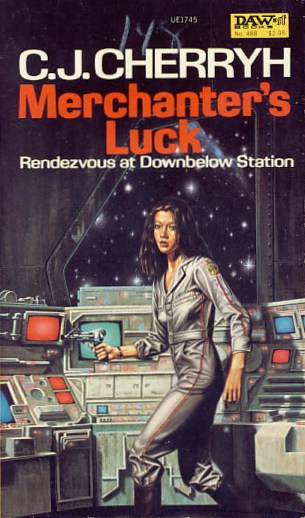
Merchanter’s Luck by C. J. Cherryh

He was a down and out merchanter, the captain, crew, and sole proprietor of a run-down bucket of bolts spacecraft.  She was a daughter of one of the finest starfaring clans, with seven hundred cousins standing between her and the one thing she wanted more than anything else: command of a starship.

They met at Pell during the height of the Company War–the key strategic point on the border between Union and Earth.  Their fateful meeting would affect not only the outcome of the war, but the course of their own lives–for the starship Lucy of Wyatt’s Combine was not at all what she seemed to be.

Before I review this book, I need to issue a disclaimer: you probably aren’t going to enjoy it very much unless you’ve already read Downbelow Station.  Cherryh isn’t the best at easing her readers into her worlds, and without the background on Union, Alliance, and the Company War, you’ll probably be hopelessly lost.

That said, I absolutely loved this book.

The premise is so awesome.  Space adventure hardcore, with a beautiful love story set amidst an epic interstellar war, where alliances are constantly broken and no one can be trusted…oh man, I LOVED this book!

While the premise seems pretty standard, C. J. Cherryh transcends the well-worn tropes and cliches of her genre by intimately developing her characters and working their motivations into the story until they are the ones driving the plot, and not the other way around.

Every character is unique, and though they act in ways that may seem strange to our modern sensibilities, there are always reasons for everything they do, cultural or otherwise.  As windows into their far-future spacefaring culture, they give the reader a wonderful view of Cherryh’s unique and marvelously constructed universe.

The thing that surprised me the most, however, was the sharp contrast between this book and Downbelow Station. While Downbelow Station traces the epic arc of the Company War through the viewpoints of a large cast of characters, much like Tolkien or Dune, Merchanter’s Luck focuses more on the characters themselves, in much the same way as David Gemmell or Ursula K. Le Guin.  In other words, while Downbelow Station is comparable to “high” or epic fantasy, Merchanter’s Luck would fall closer to “low” fantasy or sword & sorcery.

The interesting self-realization I took from the book was that I’m much more interested in the intimately personal stories than the sweeping epic tale of the Rise and Fall of cultures and civilizations.  I suppose that’s why I’m more of a David Gemmell nut than a Tolkien fanatic, and perhaps why I’m more into space opera and military sf than epic fantasy.  In all of my novels, the focus is always on the individual characters and their personal conflicts, and whenever I get sidetracked and focus too much on the overworld story, it always falls apart. 

Merchanter’s Luck definitely doesn’t get sidetracked, and that’s why I loved it so much.  I fell in love with the characters almost from the very first page–from the blurb on the back cover, even.  And most of all, I fell hopelessly in love with the starship Lucy:

You know you’re doing science fiction right when your readers bemoan the fact that they weren’t born in the 26th century, when they could command their own spaceship.  C. J. Cherryh is an amazing writer, and if I had the chance, I would teleport into her Union-Alliance universe in a heartbeat.

If you love well-crafted far-future worlds and stories about the people that live in them, check out Downbelow Station (or really, just the first chapter–that’s all you need for a solid grounding) and read this book!

A Game of Thrones by George R. R. Martin

Almost twenty years have passed since the fall of the Targaryen dynasty–twenty years since the last of the dragons was seen in the Land of the Seven Kingdoms.  Now, the libertine Robert Baratheon sits on the Iron Throne, blind to the conspiracies and secret combinations that surround him.

In this dangerous time, Ser Jon Arryn, the King’s Hand, dies of mysterious causes.  Most of the realm accepts the official story that the death was natural, but when Arryn’s wife Lysa sends a letter to her sister, Catelyn and her husband Ser Eddard Stark immediately suspect that the death was orchestrated by the Lannisters.  Only one thing remains: to travel to King’s Landing and uncover the proof.  Soon, King Robert calls on Ser Eddard to become his new Hand, giving them the perfect opportunity to do this.

Little does Ser Eddard know, the intrigue goes much deeper than any of them realize.  For the Lannisters are gathering an army, and Queen Cersei and her brother, Ser Jaime, harbor a secret that would tear the realm apart.  Meanwhile, the last of the Targaryens bears a child prophesied to rule the world, while far to the North, an ancient evil bides its time, waiting to sweep the seven kingdoms with horror the likes of which has not been seen in a thousand years.

Winter is coming–and the people of the Seven Kingdoms are ill prepared to face it.

Everyone seems to be talking about George R. R. Martin’s Song of Ice and Fire series these days–next to The Wheel of Time, it’s probably the biggest epic fantasy line of the last ten or fifteen years.  Martin is well known for killing off his characters and writing in shades of gray, so I thought it would be good to give this series a try.

As soon as I picked up the book, I was hooked.  Martin knows how to craft a beautiful, engrossing fantasy world.  In order to leave no doubt on that point, observe:

Yeah, that pretty much sums up what Martin did with his Land of the Seven Kingdoms. It’s an awesome fantasy world, and I found myself lost in it from the first page.

I must admit, however, after hearing so much about the Song of Ice and Fire series, I was surprised at how few characters died in this book. That’s not to say everyone survived–in fact, Martin killed my favorite character, which made me feel HORRIBLE–but I was expecting there to be more. However, this is the first book in the series, so I assume that the really crazy stuff happens later.

While overall I loved A Game of Thrones, I admit I did have a few misgivings about the book. Martin really does write in shades of gray, and while that makes the story unpredictable and surprising, it also makes things very dark and austere. Martin seems to have no interest in redeeming his characters, and when any of them try to be noble, he cuts them down at every turn.

Personally, I don’t care for that. Flawed characters may be more relateable, but seriously flawed characters (or characters with no interest in overcoming their flaws) turn me off. In this way, Martin is practically the antithesis of David Gemmell; whereas Gemmell makes you love his characters despite their flaws, Martin keeps you reading in spite of the fact that you hate all his characters.

How does he do it? By creating a beautiful, wondrous world. By crafting a masterful story full of intricate twists and turns. By making you hate some of the characters so #%$^! much that you have to stick around and see how they die. It’s all entertaining and extremely engrossing, but at the end of it all, I didn’t come away with any real love for Martin’s characters–except perhaps for a couple of Eddard’s kids, who are still young enough to be somewhat innocent.

I suppose it’s all a part of this new non-conciliatory movement in fantasy. Don’t get me wrong; A Game of Thrones is an EXCELLENT book, but it’s very…non-conciliatory. If that’s your thing, more power to you, but I personally prefer stories about redemption, where romance still lives and even the most unlikely character can be a True Hero, if only for a few fleeting, glorious moments.

World Fantasy Day 3

Saturday at the World Fantasy convention was awesome. Tons of amazing panels, with excellent advice and some very interesting insights.

First, I attended “The Story Cycle vs. The Novel,” which was moderated by L.E. Modesitt.  The panelists talked about the evolution of a series and the difference between a cycle of novels vs. a continuation.  In a story cycle, there may be many books, but one ending, whereas in a more loose series, every novel is a standalone with an ending.  In another panels someone used the analogy of an avalanche vs. skipping stones, which I found quite useful.

Next, I attended “The Continued Viability of Epic Fantasy.” The panel started out by defining epic fantasy (as opposed to heroic / sword & sorcery), which they more or less agreed has the following characteristics:

  • Takes place in an alternate world
  • Is large in scope, rather than personal
  • Involves characters who are trying to save the world
  • Has a multi-strand plot with many viewpoints
  • Has an extended story arc

David Drake then blew the premise of the panel out of  the water by arguing that epic fantasy is still selling well–in fact, that the market has been expanding over the past ten years.

Drake also pointed out, however, that when you’re successful, the normal commercial rules don’t apply; first, you have to prove your chops, realizing that the publishers will lose money on your first couple of books.  That’s just a fact, and anyone who denies it is arrogant and stupid.

The next panel was “Slaughtering the Evil Hordes,” about the barbaric hordes trope in fantasy and whether it’s disturbing or a good thing.  I asked the question: “how can you have the hordes win and still make it work?” and Tom Doherty pointed to Modesitt’s Magic of Recluse as a good example of this.  Basically, you have to show the good in each side, sometimes by a shift that makes the reader suddenly and unexpectedly see the hordes in a new light.

Next, I attended “The Moral Distance Between the Author and the Work.” This panel was quite fascinating.  One of the interesting questions that was raised was whether you can deduce an author’s morals from reading their work.  At first, the panelists said that in good art, you can’t, but then Scott Edelman and Eric Flint pointed out that if you read an artist’s whole corpus, usually you can.  Nancy Kress compared artists to dandelions; over time, you grow and mature, but when you send out work, where it goes and what happens to it has nothing to do with you as the artist.

One of the best panels, however was “Authors and Ideas,” which happened the next hour.  The panelists started by agreeing that as an author, your most deeply held personal beliefs will always show up in your work, whether or not you know you believe it.  The stuff we believe most firmly, we never even think to question because it is invisible to us.  Most aliens in sci fi are less alien than the Japanese, and our own great great grandparents are more alien to us than anything else.

The panel then got on to how writing is a collaboration between the author and the reader, where the writer has no control over what the reader will take from it.  Even though your art will contain your beliefs, in order to be great it must also convey what you don’t believe–the “opposition in all things” element.  Done well, the author “shakes hands with the reader over the character’s head.”

After the panels, I had dinner at the con suite–and let me just say, the convention organizers went WAAAAY out of their way to make the con suite awesome.  They literally provided every meal, and enough of it to feed everyone who came in, which really surprised me.  A huge thanks to everyone who volunteered with organizing and running the con.

Anyway, I got into a HUGE discussion at dinner with an amazing couple who runs a used book business out of Massachusetts.  We talked about artificial intelligence, the physical limits of computer circuits, and whether it’s possible for us to one day emulate the human brain on a computer system.  Gained some very interesting insights for my novel Genesis Earth, as well as just a general fun time.  Conversations like this are one of the things I treasure about these events.

And then I bounced around the parties for the rest of the night.  Had fun, talked with Tom Doherty and a handful of authors (though not as many as last year), but probably most importantly made a bunch of awesome writer friends, with whom I will be keeping in touch after the convention.

I might not have met a bazillion agents and editors this year, but I did make a ton of friends among the aspiring writers and editors, and that definitely counts for something.  I look forward to staying in touch and supporting everyone as we break in and make our mark; we’re the next generation of an awesome literary tradition, and we’re definitely going to keep it going!

Dinner with friends

I had dinner tonight with one of my classmates from English 318 last year, who is a frequent commenter on this blog.  He and his wife were kind enough to invite me over to their apartment, where we ate, talked, hung out, and had a general good time.

It was great to see an old friend from Sanderson’s class!  We talked a lot about writing, and that was way cool–I haven’t been around people who can talk writing since I left Provo (not counting the IM conversations I have with Chuck every other day).  At one point, his wife had to stop and say “wait, let’s put this conversation on pause and let me get to know this guy”!

He showed me this interesting online compendium of Wheel of Time characters, which blew me away; I haven’t read the Wheel of Time series yet, but just looking at how many characters are in the books, I have no idea how anyone could write something like that.  I guess that’s the direction Fantasy is going in–enormous worlds, long books, dozens and even hundreds of characters.

We talked about all kinds of other things, too–school and work, career decisions, future plans, social pressures, life in general, etc.  It was great being with interesting people who are genuinely interested in what you have to say.  I tend to be a little self-conscious about the fact that I talk too much, but they got me to talk a lot–about how I decided to be a writer, how I wrote Genesis Earth from story idea to the latest draft, my future goals as a writer, etc etc.  It was a lot of fun.

We also talked about my current project (working title: Bringing Stella Home), and I shared the 30 second story blurb.  I then asked them what they think the title should be, and together we came up with an interesting title idea: Saving Ben and Stella.

What do you think of it?  I kindof think it has a nice ring to it.  Mentions Ben and Stella, which shows that Ben’s storyline is important as well as Stella’s. Then again, it’s not much of a change from the previous one.

In any case, I had an awesome time with Stephen and his wife.  It’s great to have friends wherever you travel, and meet up with old classmates after graduating from college.  Thanks guys!