Fantasy from A to Z: N is for Noblebright

In the grim darkness of the far future, there is only war.

While the quote comes from Warhammer 40k, a science fiction franchise, it very soon became applied to the “darker and edgier” fantasy that started coming out in the 80s and 90s. Indeed, the quote itself spawned the term “grimdark” for a fantasy subgenre that became very popular in the 00s, with the rise of George R.R. Martin’s Song of Ice and Fire and subsequent Game of Thrones TV series.

Grimdark combines the scope and feel of epic fantasy with the savagery and moral greyness of sword & sorcery, ramping up the violence and savagery to levels that would have made even Robert E. Howard blush. It often features twists that subvert the old fantasy tropes, such as killing off the “chosen one” hero who would typically be the protagonist, or presenting a horrifying dystopia of a world that is the utter antithesis of an escapist fantasy.

In part, I think the grimdark phenomenon was a reaction to the Tolkien formula that dominated fantasy for so long. After J.R.R. Tolkien’s Lord of the Rings became wildly popular, his publishers tried to replicate that success by explicitly creating a formula that they wanted their writers to follow. This resulted in a bunch of Tolkien clones, such as Terry Brooks’s Shannara series and David Edding’s Belgariad series. For a couple of decades, these dominated the fantasy shelves, until writers began to revolt, and their books began to take off. After all, Game of Thrones was originally published in 1996.

But while there’s some truth to that theory, I don’t think it’s sufficient to explain the rise of grimdark. After all, Stephen R. Donaldson was rebelling against the Tolkien formula back in the 70s, and while his Thomas Covenant books were quite successful, they didn’t spawn a new subgenre (though arguably, they paved the way for later writers like Martin and Abercrombie). Instead, I think there’s something generational about the grimdark subgenre—that it’s the sort of thing that only could have arisen in the 90s and 00s, because of how the generational cycle works.

I wrote a lengthy blog post about this, which remains one of my more popular posts. My basic thesis is that the fantasy genre goes through generational cycles just like history goes through generational cycles. In its simplest form, the cycle looks something like this:

  • Hard times create strong men.
  • Strong men create good times.
  • Good times create weak men.
  • Weak men create hard times.

During the hard times, we tend to resonate more with stories that feature grim characters and dark fantasy worlds—hence, the rise of grimdark. But during the good times, we tend to resonate more with noble characters and bright fantasy worlds. 

(It’s a little more complicated than that, of course. The fantasy cycle is offset just a little, since we tend to resonate less with darker stories as we become exhausted from living in a darker world. Indeed, the yearning for the next phase of the cycle drives us to tell more hopeful stories, which in turn drive us to build a more hopeful world. But to read the full analysis, go check out my original post.)

So what is noblebright fantasy, then? It’s basically the antithesis of grimdark—a backlash against the backlash. And while it hasn’t yet manifested as a distinct subgenre, with a George R.R. Martin or a Joe Abercrombie to champion it, I think it’s only a matter of time before we see an author who rides this cultural wave to massive literary success. And as soon as that happens, I think we’ll have a much better idea of what “noblebright” actually is.

In other words, noblebright fantasy is currently in the process of being born—and after it has emerged fully formed into the world, it will probably take a different name. Indeed, “noblebright” as a term is itself merely a knee-jerk reaction to “grimdark.” To subvert the original Warhammer 40k quote: 

In the Noble Brightness of the far future, there is only HIGH ADVENTURE!” 

Currently, there are only a handful of writers who are explicitly labeling their books as “noblebright fantasy.” I am not one of them, though I suspect that my books (and my readers) have a lot of overlap. As it exists right now, noblebright is characterized by heroic quests and the triumph of good over evil, with an emphasis on hope, virtue, and making a positive difference in the world. It’s also very common for these authors to include Christian themes, though from what I can tell, the books aren’t explicitly religious.

While I haven’t yet joined the pioneers of this budding new subgenre, I expect that I will in the not-too-distant future. I’m currently working on an epic fantasy trilogy based loosely on the life of King David, which features many of these noblebright tropes and themes. But it’s going to be a while before I release the first book, since I want to publish the books of the first trilogy all within a month of each other. Since these books are going to fall in the 150k to 200k word range, a lot of things can change between now and then. Perhaps the term “noblebright” will have been abandoned, with people looking down on it as a passing fad of the early 20s.

But I don’t think the broader trend toward brighter, more hopeful fantasy is going to reverse course anytime soon. In fact, I think it’s generational. Whether or not it takes the name “noblebright,” I think that we’re going to see a new subgenre of fantasy emerge very soon. It’s starting right now as a backlash to grimdark, but as the wave crests and it begins to gain some staying power, I expect that it will stop defining itself by the thing it opposes and start to define itself in a more independent way.

I’m really hoping to catch this wave, and I think that my Soulbound King series has some real potential to do so. But whether or not I catch it, I know that this is the kind of stuff I like to write, and I hope to be able to write it for a long time to come.

Fantasy from A to Z: E is for Epic

What is the ideal length of a fantasy novel? Of a fantasy series?

Fantasy, as a genre, is known for being big. Big stakes, big emotions, big battles—and big books. It isn’t unusual for a single fantasy novel to run well over 200,000 words. Authors like Brandon Sanderson regularly turn in doorstoppers, with Words of Radiance clocking in at over 400,000 words, longer than the entire Lord of the Rings trilogy combined. And of course, there’s J.R.R. Tolkien himself, whose influence looms large over the genre. The Lord of the Rings helped establish the idea that a fantasy story needs room to breathe—and to expand.

Series length is no different. Some of the most beloved and influential fantasy series are also some of the longest. Steven Erikson’s Malazan Book of the Fallen spans ten main volumes and several more side novels. Robert Jordan’s Wheel of Time ran for fourteen massive books (fifteen, if you count the prequel). These stories require commitment, but for many readers, that’s part of the appeal. Once they find a world they love, they want to spend as much time there as possible.

But not all fantasy needs to be long.

Robert E. Howard, one of the foundational voices in the genre, wrote mostly short stories. His Conan tales, often published in pulp magazines like Weird Tales, rarely ran longer than a few thousand words. Yet they endure. David G. Hartwell, in “The Making of the American Fantasy Genre,” points out that Howard and Tolkien were arguably the two most successful fantasy authors of the twentieth century. Before The Lord of the Rings took off in the 1970s, most fantasy readers thought of the short story as the natural format for the genre. That pulp tradition carried strong into the mid-century, where fantasy shared shelf space with science fiction in magazines and anthologies.

That clearly isn’t the case anymore. In today’s market, a 90,000-word fantasy novel is often considered short. Readers are more than happy to put up with a bit of filler or extra padding if it means they get to linger in the world a little longer. And to be fair, there is something immersive about a book that takes its time. When done well, it can feel less like reading a story and more like living inside another world.

That said, I still believe in the value of economy of words. Economy of words doesn’t mean writing short—it means writing lean. It means using only as many words as the story needs. Louis L’Amour is a great example of this. His prose is tight, clear, and evocative. Most of his novels are quick reads, but they pack a punch. He could sketch a character in half a page and make you care about them. That’s not to say all of his books were short—The Walking Drum is a long and sprawling novel—but even there, his style is efficient. Every scene does something. Every word earns its place.

So why does epic fantasy run so long? Does it always have to be padded with extra filler? Not when it’s done well. One of the defining features of epic fantasy is that the world itself becomes a character. Tolkien mastered this. Middle-earth isn’t just a setting; it has a history, a culture, and an arc. The long travelogues, the deep lore, the songs and genealogies—they help build a sense of depth that makes the final conflict in The Return of the King resonate on a mythic level. You’re not just watching Frodo destroy a ring; you’re watching the curtain fall on an entire age.

And when the world has that kind of weight—when it grows, transforms, and carries the burden of history—it’s no surprise that a single book often isn’t enough. That’s one of the reasons epic fantasy so often stretches into multi-volume series. If the world is a character, it needs space for its own arc to unfold. A hero might only need three acts to complete their journey, but a world? That can take a bit longer.

Still, there’s more than one way to structure a series. Take Louis L’Amour again. He wrote mostly short standalone novels, but many of them followed the same families—like the Sacketts or the Chantrys—so that readers who wanted more could get it. You didn’t have to read them in order. You could pick up whichever one you found first and still get a complete story. That’s a far cry from most modern fantasy series, where the series itself is a single, complete work that must be read in order. After all, try starting The Wheel of Time at book five or A Song of Ice and Fire at book three, and you’ll be utterly lost.

My copy of The Lord of the Rings is a single-volume edition, the way Tolkien originally intended it. The main reason it was split into multiple books was to save on printing costs (Tolkien himself split the book into six parts, but the publisher turned it into a trilogy). Frankly, I think it works better that way. When a series beings to sprawl, the middle books often sag, and readers can definitely feel that. Just look at Crossroads of Twilight (Book 10 of The Wheel of Time) and how much the fans hate that book. I also remember when A Dance with Dragons first came out, with a 2.9-star average on Amazon that held for several years. (That rating has since improved, but I suspect that a large part of it is due to review farming by the publisher.)

Another risk inherent in writing a long, sprawling series is that the author will never finish it. George R.R. Martin is the most infamous example here—fans have been waiting for The Winds of Winter for over a decade, with no firm release date in sight. Patrick Rothfuss has faced similar criticism, with readers growing increasingly frustrated over the long delay between The Wise Man’s Fear and the long-promised third book in the Kingkiller Chronicle. And Orson Scott Card has yet to finish his Alvin Maker series. Seventh Son was published when I was just four years old, and though I enjoyed the first two books in that series, I refuse to read the rest of it until Card finishes the damned series.

I’m not alone. Many readers, burned one too many times, now refuse to even begin a new fantasy series until it’s complete. I can’t blame readers for feeling this way, but it does create a real challenge for new and midlist authors trying to break into the genre. Without the benefit of an established readership, it’s hard to convince readers to invest in book one of a planned trilogy or longer series. And if readers don’t start the first book, the rest may never see publication.

Right now, I’m writing an epic fantasy series based loosely on the life of King David. According to my outline, it’s a seven book series, but I’ve decided instead to split it into two trilogies (each with a complete arc) and a bridge novel (kind of like what Frank Herbert intended for the Dune books, though he died before he could finish the final book of the second trilogy). My plan is to wait until the first trilogy is totally written, publish the first three books within a month of each other, and promote that trilogy while I write the bridge novel and sequel trilogy.

In the meantime, I’ve been having a blast writing short fantasy novels in the Sea Mage Cycle, in-between drafts of my larger books. With The Sea Mage Cycle, I’m following a series structure that’s much closer to what Louis L’Amour did with his Chantry and Sackett books. Each book is a standalone, and the books can be read in any order, but they all tie together with recurring characters/families. As with all epic fantasy, the world itself is something of a character, but each book is more like a single thread in the tapestry of that wider story.

Not every epic needs to be long. Not every story benefits from being part of a massive, sprawling series. But when done well—when every word pulls its weight, when the world itself becomes a living character, when the structure supports the arc instead of smothering it—epic fantasy becomes something truly special.

It becomes epic, in every sense of the word.

Fantasy from A to Z: C is for Conan

Before there was J.R.R. Tolkien, there was Robert E. Howard. And before there was Middle Earth, there was Conan the Barbarian and the Hyborian Age.

Robert E. Howard had an amazingly prolific writing career, cut tragically short by his suicide. When I think of all the books and stories we could have had if Howard had not shot himself in grief after the death of his mother, it fills me with a profound sense of loss (and makes me want to rewatch the excellent biopic about him—or more accurately, his girlfriend—The Whole Wide World). I love Howard’s fantasy stories—not just the ones about Conan and his adventures, but the ones about Bran Mak Morn, Kull of Atlantis, Solomon Kane… honestly, he wrote so many stories that I have yet to exhaust them all. 

But my favorite are the stories about Conan the Barbarian, who is undoubtedly his most famous literary creation. Over the course of the last century, Conan the Barbarian has taken on a life of his own, with dozens of writers taking a stab at writing stories in the Cimmerian’s world. My favorite of these is probably John Maddox Roberts, though I have a soft spot for L. Sprague de Camp. Harry Turtledove also wrote an excellent Conan novel, Conan of Venarium. 

In a lot of ways, Robert E. Howard’s Conan stories set the standard for modern fantasy—or at least for the sword & sorcery strain for it. Tolkien later established the epic fantasy strain, and you can make a solid argument that every other successful fantasy book is derivative of one or the other (or both). Where the epic fantasy strain tends run super long, with novels in the 200k word to 400k word range, the sword & sorcery strain tends to run much shorter, with many of the original Conan stories clocking in at under 10k words. In fact, from what I’ve gathered, until Lord of the Rings became popular in the 60s and 70s, most readers thought that the natural length of a fantasy story was under 10k words.

For the Conan stories, that’s probably true—or at least, under 40k words, since many of Howard’s original novellas are quite good. My favorite of his is probably either “The Tower of the Elephant” (perhaps the most classic Conan story) or “The Black Stranger,” which had a very interesting Mexican standoff between three stranded pirate captains that Conan totally blows up. I also really enjoyed “Iron Shadows in the Moon,” mostly because the female love interest gets an interesting and satisfying character arc. The crucifixion scene from “A Witch Shall Be Born” was really great, too, and of course, the brutal savagery of “Red Nails” made a really big impact—though since that was the last Conan story Howard wrote before he shot himself, it has a very dark edge to it.

Howard only wrote one Conan novel, and to tell the truth, I wasn’t particularly impressed by it—it just felt like a generic Conan story, padded with a bunch of filler to increase the length. But I did really love Conan the Marauder by John Maddox Roberts, where Conan rises through the ranks of a horde of nomadic tribesmen, starting as their slave and eventually becoming the right-hand man of the Hyborian age’s Genghis Khan. The two major villains of that book had exceptionally satisfying deaths, and the writing was almost as pulpy and glorious as Howard’s writing itself.

After you’ve read all the original Conan stories, you really should watch The Whole Wide World. It’s a wonderful film about the only woman Howard ever loved, his on-again off-again girlfriend Novalyne Price, and their turbulent relationship. As a writer, I really appreciated the glimpse that the movie gives into the life of the author himself—and on how some of his eccentricities as a writer mirror my own. Thankfully, though, my family life has been much more stable. I don’t blame Novalyne Price for rejecting Howard, but I am very thankful for my own wife and children. My own writing changed dramatically when I became a husband and father. I can only imagine what wonderful stories we would have had if Robert E. Howard’s life had taken a similar path.

The book I’ve written that comes closest to matching the mood, theme, and action of a typical Conan story is probably The Riches of Xulthar. It isn’t nearly as good as the original Conan stories, but I do think it compares favorably against some of the later knock-offs. The idea for it came when I was playing around with ChatGPT and asked it to write me a fantasy adventure story in the style of Robert E. Howard. Things took off from there. Riches of Xulthar was my first AI-assisted novel, though after using AI to generate the rough draft, I rewrote the whole book to put it in my own words, which is the process I use for all of my AI-assisted books. If you’re interested, you can do a side-by-side comparison between the AI draft and the human draft on my blog. 

Should I split my epic fantasy series into two trilogies?

So I’m working on the first book in a new epic fantasy series, called the Soulbound King. It’s basically a fantasy retelling of the life of King David, loosely adapted from the biblical stories about his life. I’ve already outlined the first book and generated a rough AI draft, which came in at 153k words. The final draft will likely be longer than that, but I think it’s very likely that I will be ready to publish it before the end of the year.

The question I’m currently grappling with is whether to keep it as a seven book series, or to release it as two trilogies with a bridge novel in the middle. Frank Herbert did a similar thing with his Dune books: the first three books (Dune, Dune Messiah, and Children of Dune) were a trilogy, and the next book, God Emperor of Dune, was supposed to be a bridge novel setting up the second trilogy—except he died before finishing the last book, so his son Brian Herbert got together with Kevin J. Anderson to write it, and then they blew it up into a franchise… point being, stuff like this has been done before.

Now, I’m reasonably confident that I’m not going to die before finishing the last book. In fact, I’ve already made a 7-point outline for all seven books, so I know exactly where they start and end, with the inciting incident, midpoint, climax, etc. I’m also writing these books with AI assistance, which is making it possible for me to write these books much faster than I otherwise would have been able to write them. For the first book, The Soulbond and the Sling, I anticipate that it will only take between six to nine months of total work to go from story idea to finished draft.

But the trouble with writing a seven book epic fantasy series is that a lot of readers aren’t going to bother picking it up until all seven books are out. This is because so many readers have been burned by authors like George R.R. Martin and Patrick Rothfuss, who have not and likely will never finish their bestselling series. I can’t really blame the readers for that (though I can and do blame the authors), but it creates a market reality that I need to anticipate and plan for.

So here’s what I’m thinking: instead of making it a seven book series, I’ll make it two trilogies with a bridge novel in-between. The first three books will complete one arc, and the last three books will complete another arc. I’ll wait to release the first book until after I’ve completed the AI draft of the third book, so that way I can release all of the books in the first trilogy within 1-3 months of each other. And after the first trilogy is complete, I’ll market it as a trilogy while working on the last four books, probably releasing each of those a year apart, as I finish them.

The reason I’m thinking about this now is because a strategy like this is going to influence how I write all of these books. If I’m going to split the series into two trilogies, the last thing I want to do is end the first trilogy on a cliffhangar. It has to hold together as a complete story, with only one or two loose threads. But since I’m still in the early writing stages of the first book, I still have enough room creatively to make that kind of adjustment. I just have to decide if that’s truly the plan.

By the way, the first trilogy ends with the fantasy equivalent of the Battle of Mount Gilboa, where the Saul and Jonathan characters die in an epic battle and the David character becomes king (I know that in the Bible, there was a gap of several years between those two events, but I’m combining them for purposes of this book). So it is a rather natural stopping place, even if it does end on a massive downer, followed by a false victory (the second trilogy begins with David and Bathsheba).

Anyways, what do you think of this plan? Does it sound like a good idea, or is there a compelling reason I haven’t thought of yet for why I shouldn’t do it?

What does it mean that Brandon Sanderson is woke?

I’ve been thinking a lot about Brandon Sanderson lately, and his recent turn toward including more woke content in his books, especially Wind and Truth. I haven’t read it (I’ve only read the first book in the Stormlight Archive), but I have read excerpts from it, and heard from other people that it includes a great deal of woke content, including a gay romance that is central to the story. Most notably, Brandon himself wrote a blog post addressing this, in which he very politely said that his conservative readers are wrong, and that anyone who objects to the gay romance on the basis of Biblical morality is not living up to Christ’s teachings about showing love and compassion. Which is, of course, one hell of a way to gaslight a large chunk of your readership. You can read more of my thoughts on that here.

I really hope Brandon pulls back from the position he’s now staked out for himself, but sadly, I don’t think that he will. From what I can tell, as a local Utah author with several direct (through his class) and indirect (through members of his writing group who are close family friend) connections to Brandon, the roots of this transformation run very deep, possibly before his debut novel, Elantris, was picked up by Tor. After all, Brandon has always surrounded himself with people who are on the extreme left side of the political spectrum, from his early days as an unpublished author working the convention circuit to get picked up by a New York publisher, all through the descent of his Writing Excuses podcast into woke madness, and most recently, to Wind and Truth itself. For a very long time, he has surrounded himself with these people. Clearly, their association has had a deep and lasting impact on him.

So what comes next? Here are some of my thoughts and predictions.

Prediction 1: Brandon will not teach English 318R at BYU after the current academic year.

For the last two decades, Brandon has taught a creative writing class at BYU as a visiting professor. Both my wife and I have taken this class. Ever since the pandemic, he has posted his lectures online on YouTube, and they have become quite popular. His class has become something of an institution at this point.

However, Brigham Young University is a religious institution, and the new president, President Reese, is rumored to have a mandate from the church leadership to clean house. From my vantage point here in Provo, there is a great deal of truth in these rumors. My wife is currently applying to be a professor at BYU, and we were asked some pointed questions about our belief in the teachings of the Family Proclamation in our General Authority interview.

What I suspect will happen is that the university leadership will talk with Brandon privately and inform him that he will not be teaching this class in the future. Brandon, being classy, will not make a big stink out of this, but he will announce at the end of the semester that the time has come for him to “move on,” or something like that, without making a big fuss. It might take another year before he gets the axe, but I will be very surprised if he continues to teach his class at BYU after the ’25-’26 academic year.

Prediction 2: Over the next few years, Brandon will lose a significant portion of his readership.

From what I’ve heard, Brandon Sanderson has somewhere between 800,000 to 900,000 true fans who buy just about every book he puts out. I don’t know what portion of those fans are conservative enough to be bothered by his turn toward the woke, but a large number of his fans do live here in Utah, judging from the massive turnout he gets at local signings and launch parties. In mingling with more conservative readers, I’ve also come to see that he has a large following in things like homeschool circles, where his turn toward wokeness is sure to be viewed with alarm.

Over the next few years, I think that most of these conservative fans are going to quietly stop buying or reading his books. They probably aren’t going to make a lot of noise as they do so—conservatives are very used to keeping their opinions to themselves. But I do think that many of these readers will see Brandon’s embrace of woke ideas and woke stories as a betrayal, and will lose confidence in him generally.

This is not a thing that we can measure very well from the outside, but from the inside, I suspect that Brandon’s publishers will be able to measure a drop in his sales. It may not be more than a dip, and he’ll still sell better than 99.99% of other authors for quite some time, but I suspect that his sales have already hit their high water mark, and we’ve already seen “peak Brandon.” People will deny it, but a large portion of this decline will be from conservative readers quietly deciding not to buy his books.

Prediction 3: Brandon’s fanbase will become increasingly toxic.

I’ve already experienced a degree of this on my other posts, but I expect it will become even more pronounced as time goes on. Brandon already has a rabid online fanbase that can descend like hyenas on anyone who posts something critical of him, especially on places like BookTube. But as more conservative readers start to pull away from his fanbase, the ones who remain will likely become even more toxic, as the remaining fans feel an obligation to defend him.

This is not to say that Brandon will encourage any of this. Brandon himself has always been remarkably classy toward his critics, and I don’t think that will change at all. He may, in fact, find it necessary to reign in his fanbase and ask them not to be so toxic. Whether or not they will listen, however, is something else entirely.

Prediction 4: Large multi-volume epic fantasy will die out with the ending of the Stormlight Archive.

By “large multi-volume epic fantasy,” I mean the kind of fantasy series where each book is upwards of 400k words, and there are at least three volumes—but usually, more like a dozen. Stuff like Wheel of Time, Sword of Shannara, Song of Ice and Fire, etc. I think we’ve already seen the high water mark for these kinds of books, and that they will no longer be considered commercially viable after the Stormlight Archive has finished.

The big trouble is that of the three major authors who are currently known for large multi-volume epic fantasy, two of them (George R.R. Martin and Patrick Rothfuss) have failed to finish their series, and probably never will. The third is Brandon Sanderson, and he became famous for finishing Robert Jordan’s Wheel of Time after the author died… again, leaving the series unfinished.

Many readers feel betrayed by this failure of the author to deliver, and as a result, many readers won’t pick up a new series until it is already complete. But this creates a chicken and egg problem, where new epic fantasy authors find it very difficult to break into the genre, since it takes a lot of time and effort to write even one +400k word epic, let alone a whole series of them.

Because of this, there really aren’t a lot of midlist or up-and-coming authors waiting in the wings to take the baton from Brandon, Martin, or Rothfuss. Also, if you calculated the Gini coefficient for fantasy book sales right now, it would probably be very high, indicating that Brandon has the lion’s share. That’s not a good sign of health for a genre—think of the western, where Louis L’Amour is just about the only author who still sells worth a damn. I love L’Amour and westerns, but it’s not what I’d call a thriving genre.

Brandon will probably never become to fantasy what Louis L’Amour has to westerns, but that’s only because people still read Tolkien, the grandfather of epic fantasy to whom every fantasy author owes an incalculable debt. Also, I’d like to point out that Tolkien didn’t write a multi-volume epic: my copy of Lord of the Rings is in a single volume, as the author originally intended.

There will probably always be a small subset of readers who prefer the sprawling +400k word multi-volume epic fantasy series to everything else, as well as a small subset of independently wealthy authors who can afford to sink their whole lives into writing this sort of thing. But I strongly suspect that the format will morph into something more serialized, along the lines of The Wandering Inn, with shorter individual works (that might not even be “books,” necessarily) released much more frequently. I don’t think this subgenre will be commercially viable after the end of Stormlight Archive—at least, not in the traditional book format.

Short-form vs. long-form fantasy

For the last month, I’ve been doing a lot of research into the fantasy genre, rereading all of the original Conan the Barbarian stories by Robert E. Howard and a bunch of the other ones too, by authors like L. Sprague De Camp, Lin Carter, Bjorn Nyberg, Robert Jordan, etc. I’ve also been reading a lot of epic fantasy, like the Wheel of Time series by Robert Jordan and the Stormlight Archive by Brandon Sanderson. And I’ve also read some essays on the genre, most notably “The Critics, the Monsters, and the Fantasists” by Ursula K. Le Guin, and “The Making of the American Fantasy Genre” by David Hartwell. Oh, and opening a bunch of chats with ChatGPT, though those are of limited usefulness (for some reason, ChatGPT hallucinates like crazy when you ask it to recommend any noblebright fantasy that isn’t more than two or three decades old).

From what I’ve gathered, there are basically two camps or schools within secondary-world fantasy: the heroic / sword & sorcery camp, based off of Howard’s Conan the Barbarian, and the epic fantasy camp, based off of Tolkien’s Lord of the Rings. According to David Hartwell, those are the only two franchises to achieve breakout success: everything else has either achieved only moderate commercial success in its time before petering out, or gained only a niche audience. Apart from Conan, the fantasy genre as a whole didn’t really take off until Terry Brooks immitated Tolkien with his Shannara series, thus launching a wave of Tolkienesque epic fantasy in the 70s and 80s that morphed into Grimdark in the 90s, 00s, and 10s.

So for a while, I was looking into all the various tropes and archetypes that make Conan and LOTR tick, and trying to use those to differentiate the two. But lately, I’ve been wondering if maybe I’ve been overthinking all of this, and the real difference between the two is that Tolkien mastered long-form fantasy, and Howard mastered short-form fantasy. In other words, what if the defining difference between the two camps doesn’t have to do with tropes so much as with the length of the actual story?

I suspect that short-form fantasy is poised to make a resurgence, especially with all of the challenges associated with writing and selling long-form fantasy in the 2020s. Larry Correia is right: Rothfuss and Martin have ruined the epic fantasy field for new authors by failing to finish their series in a reasonable timeframe. Unless you are independently wealthy or already have a large and loyal following of readers, it just doesn’t make commercial sense to write a lengthy series of +200k-word fantasy epics. Better to write shortier, punchier 40k-word novels instead, especially if you can churn them out every other month or so. That seems to be the model that works best for indies, at least in adjacent genres like urban fantasy and paranormal.

Anyway, that’s my current thinking on the subject. What’s your take on it?

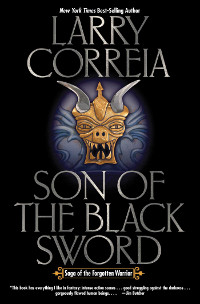
Son of the Black Sword by Larry Correia

This was a damn good book. One of the best epic fantasy books I’ve read. I started listening to it on the Baen Free Radio Hour, where it’s currently being serialized, and decided to pick up a copy. It did not disappoint.

This book reminds me of Brandon Sanderson’s Mistborn, in the sense that it takes place in a dystopian fantasy world where things didn’t turn out all that well after the hero of prophecy saved the world. It’s not difficult to imagine that after hearing Brandon pitch his book, Larry turned to the guy next to him and said “hold my beer.”

That said, Son of the Black Sword is very different from Mistborn. For one, it’s brutal and violent in a way that Mistborn never was. I wouldn’t exactly call it grimdark, since there is still an underlying sense of honor, and even a fair bit of optimism if you dig deeply enough.

However, you really can tell that Larry gets the kind of person who does terrible, violent things for a living. He knows how those people think, he knows how they see the world, and he knows how they interact with each other. He also knows what world dominated by those people looks like, which is definitely the world of Son of the Black Sword.

More than that, Larry understands and respects the relationship that exists between a warrior and his weapon. My favorite character was the sword Angruvadal, and I didn’t even realize it until the end. Angruvadal is a magic sword with a mind of its own, but it never really speaks or has any independent thought, other than whether its bearer is worthy and how best to serve its bearer if he is.

For me, the thing that makes or breaks a good fantasy book is whether the story is meaningful. I don’t really care for books that preach, but I don’t like books that are nihilistic and cynical either, which is why I never really got into George R.R. Martin’s A Song of Ice and Fire. Son of the Black Sword scratches that same itch for dark and gritty fantasy, but there’s still a sense of meaning beneath it all. Good doesn’t always triumph over evil, but the author still acknowledges that good and evil exist within the hearts of the characters.

I am so freaking excited to read the next book!

Trope Tuesday: Only the Chosen May Wield

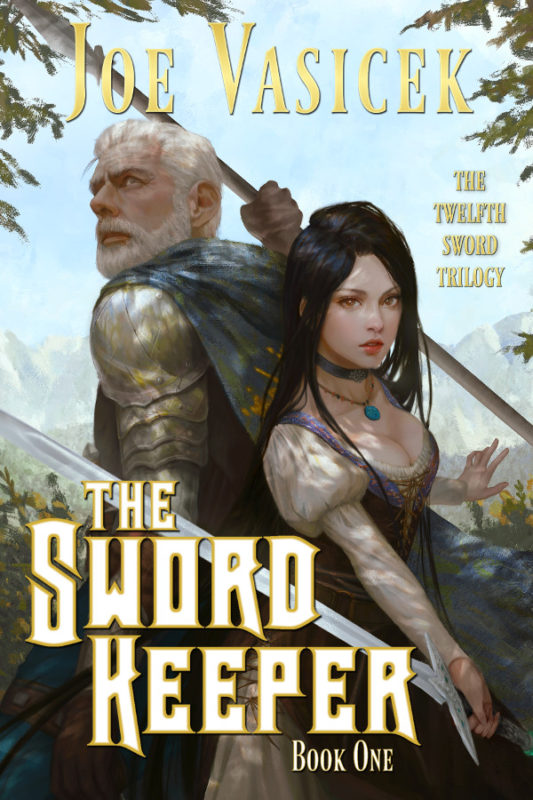
So I’m bringing back the Trope Tuesday posts, but with a little twist: instead of talking about the trope itself and what I like / don’t like about it, I’m going to talk about how I used that trope in one of my books. And since The Sword Keeper is currently up for preorder, I’m going to spend the next few weeks using examples from it.

Perhaps the most central trope in the book is Only the Chosen May Wield. In the first chapter, Tamuna Leladze discovers that she is the Chosen One when a mysterious stranger arrives at her aunt’s tavern, carrying a cool sword. Unbeknownst to her, the sword is enchanted and carries the skills and memories of all the people who have wielded it. She soon learns that she is the last sword bearer of prophecy—which comes as a huge shock, since as a common tavern girl, she’s really not cut out to be a warrior.

While the book mostly plays this trope straight, there are a couple of other complications that give it some depth. First, the sword itself is an actual character. It speaks to Tamuna through the psychic link that she establishes with it, and when she sleeps, it carries her to a mountain sanctuary where she’s able to talk with it like another person. The sword becomes something of a mentor to her, sharing skills and memories as quickly as she is able to receive them (which is never quickly enough).

Second, while Tamuna never wanted to be the Chosen One, one of the members of her party did, and struggles with feelings of jealousy because of it. This becomes especially complicated because this character’s chief motivation is honor, and he’s put in a position where he has to act as a trainer/bodyguard for Tamuna until she comes into her own. It doesn’t help that he’s only a few years older than her.

I suppose there is a third complication: the fact that Tamuna can’t (or shouldn’t) wield the sword until she has been physically trained for it. Several times, Imeris tells her that he can’t share all of his knowledge of swordplay with her, because she isn’t yet strong enough. Otherwise, she’s liable to injure herself, because her body isn’t capable of executing all of the strikes and parries and ripostes that she knows how to execute in her mind. So, while no one else can wield the sword Imeris, the one person who can isn’t yet capable of doing so.

It makes for an interesting dynamic. Stories tend to get boring when things are too easy for the Hero, and in The Sword Keeper, very little comes easy for Tamuna. In fact, one of the recurring questions she asks is how in the heck she became the Chosen One in the first place. I won’t spoil it for you by revealing whether or what she discovers by the end.


The Sword Keeper comes out in twenty-five days! Preorder it now!

The Sword Keeper

The Sword Keeper

$12.99eBook: $4.99
Author: Joe Vasicek
Series: The Twelfth Sword Trilogy, Book 1
Genres: Epic, Fantasy
Tag: 2017 Release

Tamuna Leladze always dreamed of adventure, but never expected to answer its call. That changes when a wandering knight arrives at her aunt's tavern. He is the keeper of a magic sword that vanished from the pages of history more than a thousand years ago. The sword has a mind and a memory, and it has chosen Tamuna for purpose far greater than she knows.

More info →

The Sword Keeper 1.0 is finished!

It’s been roughly four and a half years since I wrote the first word in The Sword Keeper, and now the first draft is finally complete! I finished it on Monday and promptly came down with the flu, which is why I’m only writing about it now.

This is my first complete fantasy novel, which is kind of a weird thing to realize. I started writing fantasy back in high school, but I never actually finished anything until college, and by then I was writing science fiction almost exclusively. Of course, the line between fantasy and science fiction is pretty fuzzy, especially the science fiction I tend to write, but still it’s a different set of tropes and a different kind of story.

In terms of other fantasy books, this one is pretty light. It’s just under 100k words, which makes it about 1/3 to 1/4 the size of a Brandon Sanderson novel. There’s magic, and it does drive the story, but the magic system itself isn’t the main driving factor of the plot. No elves, no dwarves, no dragons.

Instead, there’s an ancient order of magic sword bearers, a secret brotherhood of dark mages, a prophecy about saving the world, and a tavern girl (not a farmboy) who turns out to be the chosen one. About half of the fighting happens in the Void between the mortal and immortal realms. Oh, and the cost of magic is death.

There’s no question that this book needs a lot of work before it’ll be ready to publish. That said, I’m really excited about it. If all goes well, I expect it to be out sometime next year.

Short stories and switching to Fantasy

Sorry to drop off the face of the Earth for the past couple of weeks. My parents were in town, and between spending time with them, introducing my girlfriend, celebrating my sister’s birthday, and a whole bunch of other family-related things, my blogging has kind of fallen by the wayside.

But don’t worry–I’m still writing! I finished the first draft of Strangers in Flight (Sons of the Starfarers: Book III) in the first week of July and sent it out to my first readers. With luck, I’ll be hearing back from them in time to make any necessary revisions and publish that book in August. The first series omnibus (books I-III) will be out six weeks later in September, and book IV will be out … well, it will be out after I’ve written it.

In the meantime, I’ve started a couple of short stories and been making some good progress on those. The first one should be finished in the next day or so: it’s titled “The Gettysburg Paradox” and involves a time tourist at Gettysburg realizing in horror that most of the combatants on both sides are actually time travelers.

The other one is an orc story partially inspired by my friend Sarah’s orc story. This one, though, is less of a love story and more a brutally violent tale of orcs being orcs. It’s probably going to go long, perhaps up to novelette length, though not any further–I’ll trim it fairly aggressively if it does.

Besides short stories, I’ve picked up work on The Sword Keeper again. This is the epic fantasy novel with the enchanted swords, which I started while I was living in Georgia. I haven’t worked on it much since coming back to the States, but last month I basically told my girlfriend the whole story arc of the trilogy, and she really got into it. So that’s my current WIP now, and I hope to finish it before the end of the summer (famous last words, right?).

There are other things I’d like to blog about, but I’ll save those for later. Here are some of my ideas for blog posts:

  • Gods and Generals by Jeff Shaara
  • Why I quit Facebook
  • Thoughts on character development and likability
  • Thoughts after watching Divergent
  • Dating someone on the autism spectrum (I’ll have to run that one by my girlfriend first!)
  • Y Mountain hike
  • Random poetry
  • Places I like to write

Goodnight!