Streamlining

About a month ago, I decided to make some changes to my writing process. I’d noticed that a lot of time was passing between book releases, and that even though I was writing almost every day, there wasn’t much to show for it.

My old process tended to go in one of two ways:

ONE

“I have the coolest idea for a story! Ima drop everything and write it now!”

Writes the first chapter.

“Okay, it’s not quite as cool as I’d imagined, but I can work with this.”

Writes another chapter or two.

“Hmm, this story is starting to have issues. Maybe it’s not as cool as I thought it was.”

Gets writer’s block for a couple of days. Struggles to do anything productive.

“Dammit, why isn’t this story coming together? I should be doing 2k words a day, but I can barely manage 500. If this story is really that bad, then maybe it’s not the project I should be focusing on right now. Maybe I shouldn’t even be writing it at all.”

Gets discouraged and takes off a couple of days.

“I have the coolest idea for a totally different story! Ima drop everything and write it now!”

TWO

“It’s been forever since I actually finished anything, so I am going to stick with this project until it is DONE.”

Writes productively for a week or two.

“Yes! The story is coming together just like I knew it would!”

Reaches a difficult scene.

“Why am I not as productive as I was last week? I can do better than this! Words, dammit! Words!”

Struggles to finish the difficult scene. Loses all momentum and enthusiasm.

“Okay, that was pretty tough, but at least it’s finished. I am really, really, really excited about this random shiny story idea that came to me yesterday, but I have to stick with my current work in progress until it is DONE.”

Procrastinates for hours every day. Watches in dismay as productivity falls.

“WHAT THE HELL IS WRONG WITH ME??”

Tries for weeks to regain enthusiasm for the project. Invariably fails.

“Maybe I should work on something else.”

It went on like this for the better part of a year, which is why I haven’t published anything for the last six months (until Friends in Command, that is). And honestly, it’s not a lot of fun. When you feel like you should be more productive but don’t seem to really be getting anywhere, it’s very easy to lose touch with the passion that made you want to be a writer in the first place.

So back in May, while hiking in the mountains, I thought about it for a while and asked myself: what is the 20% of what I do that produces 80% of the results?

The answer, interestingly enough, wasn’t “butt in chair, hands on keyboard.” I’d been doing that for months, and all I had was a dozen unfinished projects to show for it. For me at least, merely showing up to work is not enough to produce results.

In 2014, one of my resolutions was to publish a new release every six weeks. I didn’t keep that resolution perfectly, but I did keep a regular release schedule right up to the holiday season. At that point, I ran into some troubles with Friends in Command and pushed the publication date back (which in retrospect was definitely the right thing to do). I abandoned my release schedule (which was not the right thing to do) and fell into the traps I mentioned above.

When I write without a goal beyond a daily word count, I tend to spin my wheels. In contrast, when I write with a set of goals for a project timeline, such as deadlines for finishing the first draft, sending it out to first readers, making revisions, and preparing the finished project for publication, I tend to get stuff done.

So I streamlined my writing process by giving myself more structure: a WIP log with writing deadlines and publishing schedules. And this is how it works now:

ONE

“I’m really excited about my next project! I’ve been thinking about it for weeks, ever since I put it on the schedule, and now I can finally work on it! Yay!”

Writes for a week. Gets the coolest idea for a totally different story.

“I have the coolest idea for a totally different story! Ima put it in the WIP log and schedule it for… let’s see… two months from now. That should give me something to write while I’m getting project X ready for publication.”

Continues to work on current WIP.

TWO

“It’s time to finally finish this thing so that I can publish it six months from now.”

Writes productively for a week or two. Reaches a difficult scene.

“This story is not coming together, and my deadline is coming up. I don’t know if I’ll reach my deadline. I’d better swap places with this and project Y in the publishing schedule to make sure I have something to publish.”

Keeps writing anyway. Begins to lose momentum and enthusiasm.

“Well, I’m not going to finish this project by my deadline. However, I have enough time that I can take another shot at it six weeks from now, after finishing project Z. I’ll write what I can by the deadline, then box it up so that I can approach it with fresh eyes when the time comes.

Writes until the deadline and sets unfinished project aside. Starts next project with renewed enthusiasm.

In June, I spent most of my time working on Captives in Obscurity (Sons of the Starfarers: Book V). I hoped to finish the project by the first week in July, but I hit a really difficult scene about midway through. Instead of forcing myself to stick with it, though, I pushed on until the deadline and left it unfinished so that I could pick up the next WIP on the schedule.

I think that was the right thing to do, because changing it up has helped to keep things fresh, both for Captives in Obscurity and my current WIP, Heart of the Nebula. Instead of bringing heaps of baggage to the next project, I’m starting clean, and things are going quite well. With luck, Heart of the Nebula should be up for pre-order in September and published over Thanksgiving week. As for Captives, I’ll come back to it in September with fresh eyes, which will not only help me to fix what was broken, but finish the first draft in a few weeks, rather than taking months to agonize over it.

So that’s what I’ve been up to. Hopefully it will lead to lots and lots of books in the coming months and years!


Towards a new measure of writing productivity

When I decided back in college that I wanted to write professionally, I made a point of tracking my daily word counts. I even made graphs with the data, showing both my daily count and a seven-day rolling total (some of you may remember how I used to post those graphs on this blog). Tracking my daily word count like that was very helpful when I first started out. It helped me to develop the discipline to write daily, and gave me the encouragement I needed to push ahead even when I didn’t feel like writing. It also gave me a lot of satisfaction to see how much I had written over time.

But then I started to notice some problems with that system. For one thing, it didn’t track revisions very well. I eventually decided to count progress on a revision the same as counting new words, but that meant that whenever I revised something, my word count shot up dramatically. Consequently, I focused more on revising old stuff than on writing new words, since that was the fastest way to boost my word count. Also, because I didn’t feel as much pressure to push forward, I sometimes spent months at a time on revisions that should have taken just a couple of weeks.

Then I went overseas, and everything about the old system threw me into a funk. Adjusting to a new culture can be difficult and exhausting, not to mention that it takes up a lot of mental headspace. These made writing extremely difficult, but because of the daily word count tracking, I didn’t feel like I could take a break. But when I tried to write, it didn’t come out well because of all the stress I was going through. Of course, the more I failed to meet my word count expectations, the worse I felt for it. The thing that had been such a great motivator at the start of my career now threatened to drag me down.

So I did what all good creative people do and abandoned the routine that wasn’t working. And it helped–it really did. Without all the useless pressures and misplaced incentives, I wrote a novella in little less than a month.

But then I started to feel lost. Without those word counts, I had no way of measuring my productivity. The pressures were gone, sure, but so was any sense of orientation. I had no idea whether I was writing as much as I could reasonably expect to, or whether I was falling behind. My daily rhythms would fall out of whack at the slightest interruption. The self-imposed deadlines that I thought would keep me in line instead gave me one more thing to procrastinate about–and I am a master of procrastination.

So I looked for other metrics that I could use to gauge my productivity. For a while, I tried using a timer, with the idea that measuring time spent writing would be better than measuring raw word count. That experiment ended in disaster. It added even more pressure than the word counts did, and drove me so hard to busywork that my creativity was almost stifled. For some people, the clock might be a good source of motivation, but for me it was absolutely horrible.

I looked around for something better than word count, and never really found it. Eventually, I learned how to do my work without a direct way to measure it. When writing is your calling, you can’t not write, so I learned how to listen to my own creative rhythms and nurture them. That worked pretty well when I was excited about a project, but when I ran into a block, everything took a hit. And even when everything was going well, I still felt kind of lost without a concrete way to measure my productivity.

Last month, I ran into a pretty big block with Strangers in Flight (Sons of the Starfarers: Book III). I had expected to finish that book by the end of May, but instead I ran into some problems and had to go back and rewrite a few chapters. That should have taken two or three days, but instead it took two or three weeks. And during those weeks, I figured that I needed to change things up a bit.

I decided to base my new system on word count, since that seems to be the most reliable and objective measure of writing productivity. Instead of measuring it quantitatively, though, I decided to set a daily minimum word count, and mark on a calendar the days where I reach it. For new words, that minimum is 2,000, and for revised words, it’s 4,000. That seems to work with my natural rhythms–just enough so that I have to push myself, but not so much that I put it off and procrastinate instead.

So far, the new system seems to be working. As soon as I implemented it, progress on Strangers in Flight took off, to the point where it should be finished in just a couple of days. This past week, my daily routine was thrown off a bit from getting Comrades in Hope ready for publication, but even while I was busy with formatting and uploading, I managed to get 2k words written (on the author’s note and a short story). That surprised me, and makes me wonder if maybe the next time I publish a book, I can still manage to keep my writing routine intact.

The really nice thing about having a concrete way to measure your daily productivity is that it helps you to separate your work life from your personal life. When you’re self-employed, the two tend to blend into each other a lot, so that you’re always wondering if you should be spending your time doing something work related. But by keeping a daily minimum word count, I can say to myself “all right, today’s work is done–time to go play” and not feel guilty about it.

The danger, of course, is that the daily minimum will become a ceiling instead of a floor, holding me back from being as productive as I could be instead of pushing me to do that last little bit. However, I think I have a way around that. On the calendar that I’m using to keep track of all this, I’ll mark down not only the days where I hit my minimum word count, but the days where I double (or even triple) it. That way, if I hit the 2k mark a little early, I’ll still have incentive to push farther. Besides, that 2k minimum isn’t set in stone. I plan to review it each month, and change it accordingly.

In any case, that’s my new system. If you guys want an update in a month or two on how it’s working, let me know–I’d be happy to share any insights I might have. But blog posts don’t count toward my daily word count, and since the rest of my afternoon is wide open, I’d better get cracking at it!

Back to novels again

So yesterday I finished the rough draft of Sons of the Starfarers: Brothers in Exile.  It needs work, but at least I’ve got something to work with.  Of course, before I can do that, I need to take a break and work on something else.

For my next project, I’m going to do a massive revision of a novel I wrote almost three years ago.  Heart of the Nebula is a direct sequel to Bringing Stella Home, and features James McCoy as the main character.  He’s older and (somewhat) wiser, with a lot more responsibility resting on his shoulders as an officer in the Civil Defense Corps of the Colony.  With the Hameji occupation driving them into famine and poverty, the stakes are a lot higher than the first book, and the dangers and intrigue a lot more complex.  Not only are there pirates and criminals to deal with, but the Patrician is playing his own game, and James soon gets caught up in it.

Currently, this book is a real mess.  I’ve attempted numerous revisions of it before, but finished none of them.  The first part of the book is probably pretty close to where it needs to be, but then there are a bunch of broken subplots, characters who were excised from certain sections and left in others, scenes and chapters out of order, and relationships that develop either way too fast or hardly at all.

Before I dive in, I’m reading through the whole draft and making notes on a scene by scene basis.  I’ve got a map set up for where all the scenes need to go, and I’m putting together a checklist of all the changes I have to make.  I did the same thing when I wrote Bringing Stella Home and Genesis Earth (come to think of it, Desert Stars as well).  Hopefully, this will help the revision to go quickly and to fix all the broken elements without watering down or polishing out the good stuff.

Probably the most important thing about revision notes is that they help me to separate my critical mind from my creative mind.  When I’m looking at the book in my critical mind, I want to throw out the stuff that isn’t perfect and make lots of changes to the story.  However, that can be a lot more destructive than constructive, since it’s the creative mind that really makes the good stuff.  By writing a set of notes before diving into revisions, I can keep my critical mind from making too many changes to the actual story, and identify the problems so that when I go back to make the changes, I can switch the critical mind off and keep the creative mind on.  And often, instead of making the changes I told myself to make (or rather, the changes my critical mind told me to make), my creative mind comes up with something else that puts the story on a much better path.

That’s the theory, anyway.  We’ll see how it goes.  The revision notes are going pretty quickly now, and even though things are going to get more complicated deeper into the book, I don’t think it will take me more than three or four days to finish them (unless I get called in to a job somewhere). Once that’s done, I’ll dive right into the book, probably tossing half of it and rewriting from scratch.

Thing is, it’s been a long time since I’ve worked on a novel this way.  All last year, I’ve been writing novellas, and while some of them have required overhauls, it’s never been too complicated.  With novels, though, it can be a mess.  I’m sure I can do it, but I’m not sure how long it will take me.  Hopefully no longer than a month, but I’m not going to stress it.  The important thing is to do it right, and to really immerse myself back into this world.

So that’s what I’m working on now.  I hope these updates on my writing projects aren’t too boring.  They’re really helpful in writing the Author’s Notes at the end of each book, because I can go back to my blog, drill down the categories by book title, and see what I was working on at various different times when other stuff was happening in my life.  For a book like Heart of the Nebula, that’s going to be important, because it’s been almost three years in the making.  For most of that time, it was just sitting on the back burner (or, more accurately, the fridge), but it’s out again now and I’m focusing on it again.  We’ll see how it goes.

Nanowrimo anyone?

November is coming up, and with it, nanowrimo.  I’ve always wanted to participate, but every time it rolls around, it seems like I’ve got another project going on that’s more important.

This year is no exception, but I think I have a way around that.  The goal for nanowrimo is just to write something–it doesn’t have to be any good.  I’ve got a bunch of projects I’m currently working on, including Star Wanderers: Deliverance (Part VIII) which I hope to publish by Thanksgiving, but I think I can still do a just-for-fun sort of thing on the side, with the understanding that it doesn’t have to be serious.

What I think I’ll do is write a story where all of the characters from all of my previous books get caught up in some sort of a weird time-space dimensional warping thing, so that they end up in books where they don’t belong and universes where they never existed.  It should be a fun way to revisit some of them, especially the ones from the Gaia Nova books, which I haven’t really done much with in a while.

It’s probably not going to make much sense to anyone who hasn’t read my books, but who cares?  That’s not the point.  I may or may not put it up somewhere for people to read, but it may have some stuff from projects that are either unfinished or unpublished, so it might be a little obtuse even for the fans.  However, it seems like a really fun project, one that I can really run with, and that’s all that really matters for nanowrimo.

As far as my other projects go, right now I’m working on a heroic fantasy novel that’s a prequel of sorts to The Sword Bearer.  I have no idea where it’s going to go, but I’m taking a page from my favorite writer of all time (David Gemmell), with lots of violence, lots of blood, and lots of true grit and heroism.

At the same time, I’m still working on Sons of the Starfarers off and on, though I may end up putting that one on hold for a while as I figure things out with this heroic fantasy story.  It will get done, though–it’s definitely a story I’m itching to tell.  In a couple of reviews and emails, readers have asked whether I’ll ever write an origin story for the Hameji.  Well, that’s what Sons of the Starfarers is going to be, though the connection might not happen until well into the series.

There’s a couple of other Gaia Nova books I’ve been meaning to write for a long, long time, but I don’t know if I’ll be able to get to them anytime soon.  This nanowrimo project might spark something, though, since I’ll be revisiting a lot of those old characters.  And even if the nanowrimo novel itself is pretty bad, if it gets those projects on the back burner simmering again, then that will definitely be something.

Dang, I really want to get started with nanowrimo now!  So many wacky ideas … it’s like writing fanfiction for one of your own books!  In any case, I’d better get back to writing before I get too excited.  Don’t want to spend so much time thinking about writing that it becomes hard when I actually sit down to do it.

Later!

When something you’ve written moves you

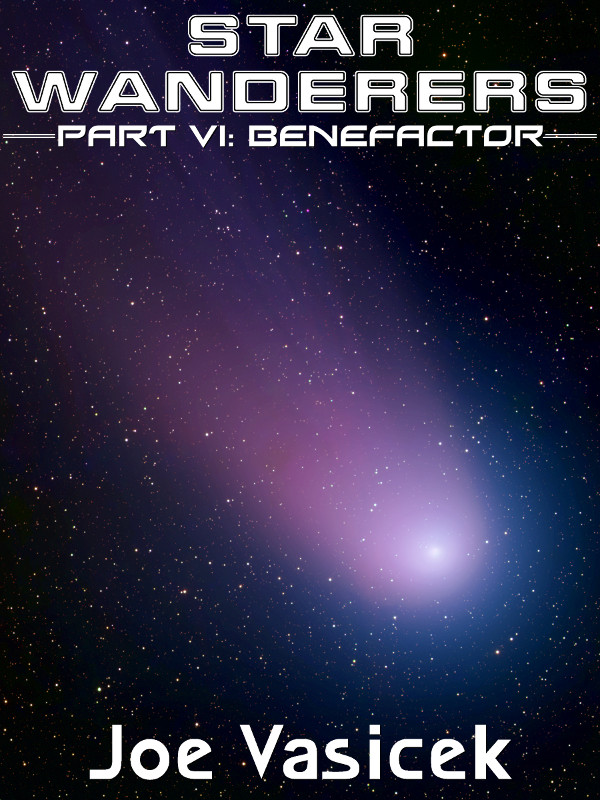
SW-VI Benefactor (thumb)So I had an interesting experience today as I was revising Star Wanderers: Benefactor (Part VI), and I’m not sure how to describe it without sounding like “that guy” who gushes far too much about his books.  At the risk of being “that guy,” here goes.
As writers, it’s far too easy for us to write something in the heat of a creative passion, only to dismiss it later.  Perhaps we’re so afraid of screwing up that we yearn to fall back on the story that’s safe rather than the story that rings true, or perhaps we realize just how much of ourselves we’ve put into it that it scares us to death that someone might actually read it.  Too often, something else that’s broken about the story distracts us from the stuff that’s actually good, so we end up throwing it all out together.  Our critical minds work so differently from our creative ones that when the fires of creative passion turn to smoldering embers, it’s not unusual to feel like we’ve been left completely naked and need to scramble desperately to cover ourselves.

For that reason, I’ve made myself a rule not to revise a story without first making a set of bullet points, chapter by scene, of what I’m going to do.  My critical mind has full domain of that list of bullet points, but I will not let him carve up my story.  The list contains a series of instructions for my creative mind, who can actually revise quite well when given a little direction.  But when he thinks that the direction is wrong, he’s not afraid to push back.

The revision notes for my books always read like a back-and-forth argument between my critical and creative minds.  Once I’m finished writing up the bullet point list of revisions, I turn on track changes and cross them off one by one as I complete them.  But whenever I get to a point where my creative mind disagrees, I’ll cross it off and write down the reasons why it’s better to go in a different direction.  Some of the more recent notes for Benefactor include:

It’s not as much of an issue as you think.

Eh, the dialog works pretty well.

Already there.  Better to keep it subtle.

Why?  This is good.

No, it works very well with what’s already here.  Don’t change it.

So with that as a preface, I got to a scene in Benefactor today where one of the characters has a major life crisis upon learning that his wife is pregnant.  The pregnancy catches him completely by surprise, and makes him wake up and wonder if his life is really heading in the direction that he wants.  He feels like he’s stumbling into his future blindly, tripping over his feet without knowing where he’s going, and that frightens him.

I’d made some notes to add some stuff for clarification at the end of the scene, but I must have only been skimming it when I made the revision notes because all of that stuff was already there, and expressed more poignantly than I think I could have done.  Basically, the character comes to peace with the life he’s giving up by realizing that he will one day lead his son to follow in his footsteps, just as his own father did with him.

My critical mind completely missed that, because he was only looking for problems that needed to be fixed.  But when I read it again today, I was actually kind of shocked that this was something I’d written.  I don’t want to say that it’s the best thing that’s ever been written, because certainly I have lots of room for improvement, but the passage really moved me, and I wasn’t expecting that.

So yeah, revisions for Star Wanderers: Benefactor (Part VI) are coming along swimmingly.  It might be a bit tough to get the final draft proofread in time for a July release, but I’ve got some friends who might be able to help.  Just like I don’t trust my critical mind to meddle with the story, I don’t trust my eyeballs to catch all the typos and grammatical errors.  But I think that the substantive revisions will be finished by Tuesday, and after that, it’s time to get the publishing wheels grinding.

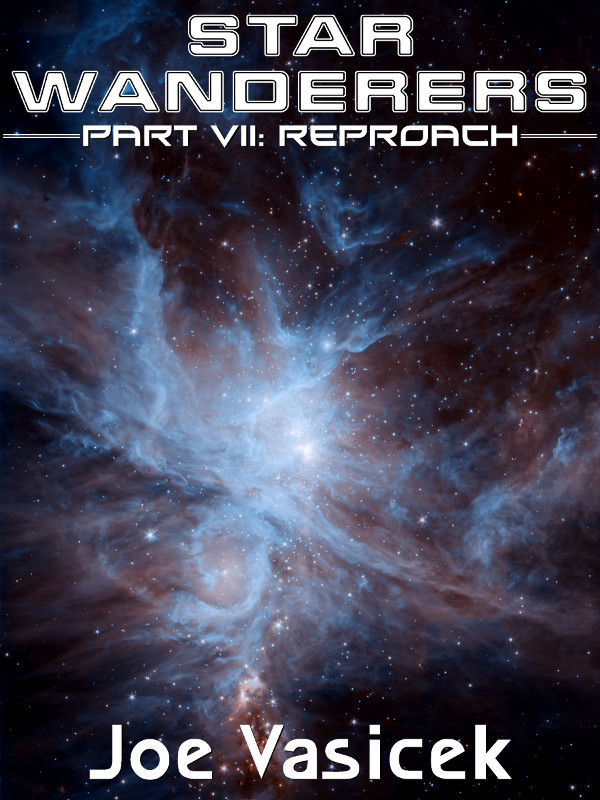
In the meantime, I was playing around with The Gimp today, and I came up with a cover for Star Wanderers: Reproach (Part VII).  Check it out!

SW-VII Reproach (cover) The image is the Orion Nebula, as imaged by the Spitzer Space Telescope.  You can find the original here.
I thought it was fitting, considering how Reproach is a parallel novella to Sacrifice, and Sacrifice also features an image of the Orion Nebula on the cover.  But the important thing is just that it looks cool and is sufficiently eye-catching.

So that’s about it.  I’ve got a lot of heavy revisions to do tomorrow, but even my critical mind agrees that chapters 4 and 5 are actually pretty good.  There’s at least one scene missing and a couple of other things that need to be added, but I’m actually looking forward to writing those.  Also, a couple of characters need some more fleshing out, but that shouldn’t be too difficult.  The Tuesday deadline is quite doable.

Have a good night, and thanks as always for reading!

Update on STAR WANDERERS and a sneak peek at some cover art

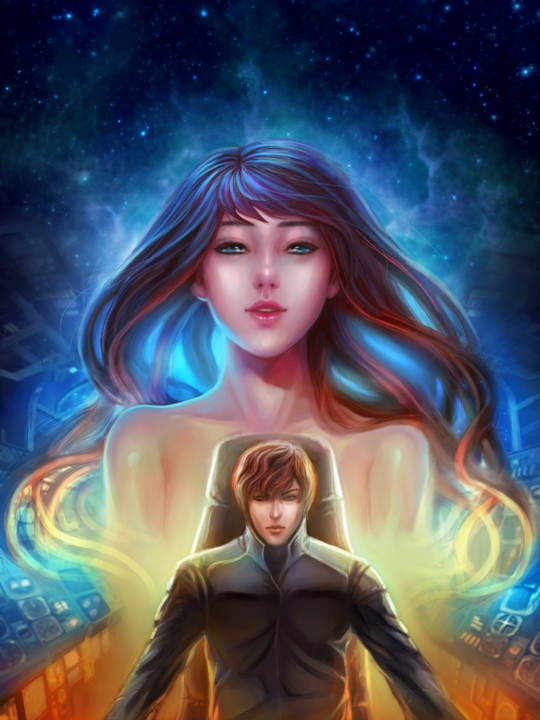
So in case you didn’t know, I’ve been getting an omnibus edition ready for Star Wanderers.  It’s subtitled The Jeremiah Chronicles, and contains parts I-IV (Outworlder, Fidelity, Sacrifice, and Homeworld).  This covers the first major series arc, with all of the stories from Jeremiah’s point of view–hence the title.

I commissioned Ina Wong from Deviant Art for the cover, and this the result:

JV4 COMP

I must say, I’m rather pleased.  It’s got a very different feel from the current space photography covers, but I think this is a lot truer to the actual story.  I can’t commission art like this for the individual installments, of course, but for an omnibus edition, I figure it’s alright to go all out.

The only content in the omnibus that isn’t already in parts I-IV will be the author’s note, which I’ll either post here or include as a PDF to my newsletter subscribers.  In other words, don’t worry about missing out on anything if you’ve already read the individual installments.

I’m getting feedback from my alpha readers for Benefactor, the next part in the series, so I’ll probably release that one in the next six weeks.  In the meantime, I’ve picked up work on Reproach again (Part VII), and hope to finish the first draft before the end of the month.

Just as Dreamweaver is a parallel novella to Outworlder (from Noemi’s POV), Benefactor is a parallel novella to Fidelity (from Jakob’s POV) and Reproach is a parallel novella to Sacrifice (from Noemi and Mariya’s POVs).  After that, I’ll do a parallel novella to Homeworld with Lucca and Mariya as the main POV characters, and then branch out into some other characters and storylines.

The fun part about writing this series is that each new story seeds at least two or three others.  I just wish I could keep up!

I haven’t abandoned Lifewalker, but I did reach a point where I figured it would be good to take a short break just to keep things fresh.  My creative process seems to work that way.  As much as I’d like to train myself to stay on project until it was finished, creativity can’t be trained so much as fostered.  I set myself a deadline to finish something by May 31st, so now it looks like that’s going to be Reproach.

As for The Jeremiah Chronicles, all I have left is to write the author’s note and book description.  It should be out on Amazon, Barnes & Noble, and Smashwords by this time next week.  In the meantime, I’ll keep working on Reproach so you guys can have plenty more stories to read!

Cooking adventures and an awesome webcomic

So I have a bunch of ideas for blog posts I’d like to write, and I’ll probably get around to them eventually, but I thought I’d drop a line now just to let you all know what I’ve been up to.  It’s been a pretty good week, with some decent progress on the current WIP (Lifewalker) and some other random stuff that may be of some interest.

First, Lifewalker.  It’s coming along quite well.  I’m averaging around 2k words a day, so more of a leisurely pace than a white-hot creative heat, but not too bad.  It’s kind of turned into a post-apocalyptic Western, mostly because I can’t write about southern Utah without the landscape taking over.  This video should give you an idea why:

At the same time, the character’s voice really seems to be taking shape in a way that I like.  He’s kind of drifting right now, but the way he writes about it is very much like an old man reminiscing on the course of his life, lingering on the regrets as well as the triumphs, with some rather wistful commentary on each.  This is really a character that I can just pick up and run with–the story is practically writing itself.

It’s not just the voice, either.  Random stuff is just finding it in–powerful stuff that makes the story awesome.  For example, just in the last chapter, the characters were holding a meeting to see what they should do to rescue some of their friends who had been kidnapped.  Out of nowhere, one of them pulls out a skull from a human baby, with beads and feathers dangling from it like some sort of totem.  He brought it out to show that the people who’d attacked them were not just normal bandits, but cannibals from the Nevadan wastelands, which put them in a whole new category of badassery.  Stuff like that comes out of nowhere every time I write, and it’s awesome.

I’ve had a lot of time to write, though I don’t feel I’ve been using it all productively.  Still, I’m on track to finish this thing by the end of the month, which will be extremely gratifying.

In the meantime, I’ve been experimenting a lot with cooking and gardening.  Just planted some tomatoes in 3-gallon ice cream buckets (with dirt instead of ice cream, of course), and those are growing nicely.  It’s fun to have something to water in the morning, and when they start to yield fruit, I’m sure it will be awesome as well.

But I’ve also been experimenting with the old Egyptian kushari recipe I picked up after the 2008 study abroad.  It always seemed to be missing that one thing that would make the other ingredients come together and achieve that delicious synergy.  Well, I think I’ve found it: chickpeas and cumin, with maybe a touch of vinegar.  It might not be 100% authentic, but when I cooked it this time with that stuff, it tasted heavenly.

So this weekend, I’m going to try to perfect the recipe, something I’ve been wanting to do for years.  I’ll try cooking the rice in chicken broth, and adding more onions and garlic with maybe a little tomato.  Also, coriander–I know that coriander and cilantro are basically the same plant, but I think the coriander will go with this better than cilantro.  Also, it helps to fry it with a little oil after taking it out of the refrigerator, rather than sticking it in the microwave.  I haven’t had a microwave for over a year, and I think I actually prefer cooking without it.

Speaking of food, my roommate’s sister’s roommates dropped off a bag full of crap from their kitchen, since they’re moving out for the summer.  We’ve been having an interesting time combing through it–found some pretty good stuff, actually.  One of the more useful things is a bag full of buckwheat, which is AWESOME because kasha was one of my favorite dishes in Georgia.  Kasha and lobio–delicious!

So yeah, I’ve had food on my mind a lot this week.  If things work out, maybe I’ll post a recipe or two.  Kushari is delicious, cheap, filling, and healthy–a winning combination if ever there was one.  Kasha is pretty simple, but that’s what makes it so great–a simple, hearty food that leaves you feeling warm and whole.

Besides cooking exotic foods, I’ve also been reading a lot of Freefall.  I discovered it just last week, and I have to say, it is awesome.  One of the better webcomics I think I’ve ever read.  Like Schlock Mercenary, it’s a space opera comedy romp, but where Schlock kind of turned dark in recent years (which I’m not complaining about, don’t get me wrong), Freefall has still stuck to its happy-go-lucky roots.  And just like Schlock Mercenary, the humor is not only entertaining, but often wonderfully insightful.

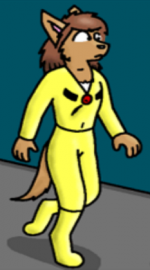
Florence_AmbroseBut by far, the best part of the story is how compelling the characters are.  My favorite is Florence Ambrose, an artificially bred Bowman’s Wolf who is kind of a human-wolf hybrid.  She’s one of only 14 members of her species, and the corporation that created her considers her more as property than an individual. She’s got all these biologically programmed safeguards that force her to obey direct human orders, no matter how ludicrous–but the only way for her species to survive is to convince the corporation that Bowman Wolves are profitable, so that they’ll make more (the whole 50-500 rule and all that).

Somehow, she becomes the engineer of the Savage Chicken, a down-and-out starship captained by the infamous Sam Starfall.  Sam is basically a lazy, larcenous alien squid who wants nothing more than to steal everyone’s wallet and become famous doing it.  At first, it seems like a horrible combination–Florence is basically a good, honest person, who wants to do good work and please everyone.  But as the story goes on, the two develop quite a rapport, and start to rub off on each other.

Florence helps Sam to clean up and get his act together, and Sam helps Florence to learn ways to get around her difficult situation vis-a-vis her safeguards and lack of free will.  More importantly, Sam helps her to stop feeling guilty long enough to recognize that doing the right thing sometimes means breaking (or at least twisting) the law.

As if that weren’t enough, there’s the whole cross-species romance angle between Florence and the biologist who rescues her back in one of the earlier subplots.  As you might expect, it gets really lonely being the only Bowman’s Wolf on the planet–especially when the other 13 are frozen in cryo, on their way to a world several light-years away.  Florence knows that she needs to do what she can to propagate the species, but she’s also got some emotional needs that demand to be satisfied now.  Winston is kind of similar, a lonely parasitic biologist on a frontier terraforming project with only 40,000 humans and a 40-60 male-female ratio.  Except for the whole cross-species issue, they make a really good couple.  I’m riveted to find out what happens next!

So yeah, if I had to sum it up: good, honest, likeable person + insecure future + social limbo + unsatisfied emotional needs = really compelling story.  Plus, she’s half wolf–how cool is that?  What I would give for her incredible sense of smell…

In any case, it’s getting late, and even though tomorrow is Saturday, there’s a bunch of stuff I want to do tomorrow so I’d better cut this short for now.  See you later!

Some new writing resolutions

So I’ve been following Dean Wesley Smith’s blog pretty closely over the last few days, as he posts about his creative process for a novel he’s ghost writing.  It’s more than a little mind-boggling–he started literally with nothing, not even a working title, and yet he’s averaging between 5k-7k per day.  If he hasn’t already, he’ll probably finish it tonight.

I’m learning a lot from these posts, especially about the importance of switching off your internal critic and trusting your creative instincts.  Over the last couple of days, I’ve tried to do just that with the sword & planet novel I mentioned last week, and I can say that it really works!  By doing all I can to put words on the page and ignoring everything else, I’m averaging about a thousand words per day and the story is unfolding wonderfully.  It’s like a trust fall with my muse, where instead of failing miserably I’ve found she’s there to catch me.

All of this has made me think that I need to reorder my writing routine and make some resolutions in order to keep this momentum going.  If I can overcome some of my bad habits and replace them with good ones, I can be a lot more productive, and writing will be that much more fun.

So here’s what I’m going to do this week:

  • Start every day with writing.  Even if it’s only fifteen or twenty minutes, as soon as I get out of bed I’m going to sit down at the writing computer and pound out a few hundred words.
  • Write in lots of little chunks, rather than one or two large chunks.  In other words, don’t put off writing until the chores are done–put off the chores!
  • Shoot for 1000 words per hour or better.  If the pace starts to flag, switch projects if necessary, even if the other project is fanfic.
  • Go for at least one walk at some point in the day.  Walks do more to re-energize my creative energy than just about anything else.

Basically, I’m going to treat my work-in-progress as something fun, rather than work or a chore.  I’ll use a stopwatch to keep track of how many hours I write each day, but I won’t give myself a quota.

My writing process isn’t the same as Dean’s, and I’m not going to try to imitate his process, but I am going to pick out what I like about it and see what works.  Also, I’m going to focus a lot more on quantity than quality, with the understanding that treating everything as practice will likely improve both.

As for the A to Z blogging challenge, I’ve got two posts left, Y and Z.  I haven’t written them yet, but I’ve got a great idea for both of them.  Since writing takes precedence, though, I may not get to them until later in the day.  It also depends on whether the temp agency calls me up in the morning with a job–they’ve been doing that a lot recently.  Last week I was at a factory making toothbrushes for dogs (true story).  This week, I could be doing anything–or nothing, as the case may be.  I’d like a couple of days of nothing, just for a good chance to write.

I have a confession…

…I’ve started writing a Sword & Planet story.

In case you’re wondering what the heck is Sword & Planet, think Conan the Barbarian in space.  With giant lizards and man-eating plants.  And half-naked princesses getting kidnapped by evil technomancers with giant four-armed bodyguards that wield laser-bladed swords.  Basically, science fiction in the style of the classic 20s pulp adventure novels.

In other words, this:

I’ve read a lot more Heroic Fantasy and Sword & Sorcery than straight Sword & Planet, but I figure there’s a good deal of overlap.  I read A Princess of Mars way back in college and really enjoyed it, and of course I’m a huge fan of Star Wars and other series that were heavily influenced by the genre.  Basically, I want to try my hand at a classic science fiction adventure style, without the scientific rigor of Hard SF or the sprawling world building of Space Opera.  It’s all about the adventure, with liberal helpings of awesome sprinkled with omigoshomigoshomigosh.

The tentative title for this book is The Last Warrior Princess, though it’s about a twenty-something college grad working a wilderness job in southern Utah who accidentally finds a portal to another world while wandering around Arches National Monument.  The princess comes later, though not too much later.  I don’t know much about her yet.

In fact, I don’t know much about the story at all.  I’m discovery writing everything, and I do mean everything.  This is a fly-by-your-pants ready-set-go kind of book, with no restrictions and no limits–just me and the muse, not caring what anyone else thinks.  My internal editor is bound and gagged in the cellar with the spiders, and if he breaks out somehow I’ll hamstring him and toss him back down.  This project might never get another mention beyond this post, but I’m okay with that because it’s going to be a whole lot of fun.

For those of you waiting for the next Star Wanderers story, don’t worry, I’m still writing those too.  This is more of a side project at this point, so I won’t put up a progress bar for it until I get fairly close to the end and know it’s something I want to keep.  Which might never happen.

So basically, it’s just a personal pet project for now.  It’s interesting, though, because when you’ve got nothing to fall back on but your own creative impulses, the words start to flow in remarkable ways.  Take this passage, for example:

I drove up just as the sun was setting. The crescent moon hung like a razor in the yellow-orange sky, with Venus a twinkling point on its edge. Blood-red Mars was not far off, while Jupiter loomed ascendant.

I have no idea where that came from, but in the white-hot creative heat of the moment, it just spewed out onto the page that way.  The only word that I changed was “loomed,” which I had originally written as “hung” (maybe I should change it back? Nah, who cares).  In a little over an hour, I committed about 1,500 words, all just like this.

So yeah, if nothing else, this project will help to shake up my creative process and get the juices flowing for other projects.  I could really use that right now, what with a couple of recent life roles (my grandmother passed away last week, which wasn’t unexpected but it did throw a kink in my already rocky routine).  And who knows?  If it turns out well, you might see me put it out as a novel in a few months.  Or maybe the first part of a new series … nah, better not get carried away.  Better just write it first.

Besides the A to Z challenge (which I may also turn into a book at some point) and Star Wanderers: Reproach, that’s what I’ve been up to recently.  I’ve got a Star Wanderers omnibus in the publishing queue, but there’s nothing firm I can say about that yet, other than it will probably be for Parts I-IV and feature a professional cover (though I plan to keep the space images for the individual installments).  I could say more, but I want to go for a walk.  Later.

Random thoughts on creativity and a cover preview

I’ve noticed that I tend to go through at least two revisions on most of my stories.  The first one generally identifies the problems in the rough draft and eliminates them, while the second one adds anything that’s missing and smooths the story over so that it works as a whole.  They both use different parts of my brain: one critical, the other creative.  Since both are important, I can’t easily skip either of them, and combining them into one mega-revision doesn’t really work because it’s hard to switch from one mode to the other.

I’m currently in the second revision for Star Wanderers: Dreamweaver, and it’s coming along really well so far.  Now that I’m in creative mode, it’s a lot easier to add stuff that was missing from the first draft and tidy up some other parts that seem a little disjointed.  With luck, this revision should be finished in a day or two.  It’s really only one chapter that needs the bulk of the work–according to my first readers, everything else is pretty good.  Far be it from me to fix something that isn’t broken.

###

The other day, an old friend of mine emailed me with a question about the world building / plotting process I followed for Star Wanderers.  I wrote a fairly lengthy response, and while most of it was a more detailed explanation of the stuff I’ve already included in the various author’s notes, I came up with some advice that surprised me:

If I had to give any advice, I’d say that the most important thing is to just feed your creativity.  You can’t force your imagination, just like you can’t get any more golden eggs by killing the goose that lays them.  However, you can organize your life and your environment in such a way that bursts of creativity are longer and more frequent.  A huge and important part of it is learning to turn off your internal critic, especially on the rough draft.  Sometimes, if I spend too much time thinking about writing, it paralyzes me so that I can’t actually write–but if I trick myself into opening my WIP without really thinking about it, then ten minutes later I’m plugging away and the ideas are flowing.  And just as bad habits can be very harmful, good habits can be very helpful.

I think a lot of us creative types tend to force ourselves a little too much, especially when we’re first getting started.  We want to be productive, we want to have something that we can show for ourselves in order to feel validated, especially with so many people raising eyebrows at our dreams and creative pursuits.  But productivity goals, while important, are really only a means to an end–and they’re not even the most important means most of the time.

If you want your work to ring with authenticity, or to reflect the truth and beauty you see in the universe, you have to be in touch with that kind of stuff.  And once you get back in touch with the stuff that drove you to create in the first place, there’s nothing that you want to do more.

This morning, I wrote for three hours in one sitting, and I wasn’t tempted by any distractions at all.  I only produced about 1.3k words, but they were good words that added both to the story and my understanding of the story.  I got back in touch with the spark that drove me to write it in the first place, and hopefully that spark will carry through to the readers.  I think that it will.

So yeah–it’s not about productivity goals, or reworking our creative process to be more like someone else’s, or any number of other writerly insecurities.  It’s all about story, and everything that drives us to tell them.

###

All right, if you’re still reading (or even if you cheated and skipped ahead), I have a treat for you.  I just found the AWESOMEST image for the cover of Star Wanderers: Benefactor, which I hope to finish up later this week after finalizing the revisions for Dreamweaver.  Here’s the cover:

SW-VI Benefactor (cover)

Pretty cool, eh? I <3 NASA. 😀

The picture is of Comet C/2001 Q4 (NEAT), taken by the WIYN 0.9-meter telescope at Kitt Peak National Observatory near Tucson, Arizona.  It was taken on 7 May 2004, and covers an area roughly five times the size of the moon.  As with all NASA images, it’s in the public domain.

The inspiration actually came from comet PANSTARRS, which is visible in the sky right now.  I tried to catch a glimpse of it tonight from the Y Mountain trail head, but there were too many clouds on the horizon to see it clearly.  Hopefully, the skies will be clearer tomorrow.

In related news, comet ISON later this year is expected to put on a really incredible show.  Astronomers think that for a brief time, it may even shine brighter than the moon, making it visible even during the day!  If that happens, it’s going to be AWESOME.  Mark it on your calendars for November–it’s going to be great!

That’s just about it for now.  I’d better get back to forming those good habits I mentioned earlier–like actually getting to bed at a reasonable hour. Later!