My New Writing Process (or why I don’t believe in pantsing anymore)

For the longest time, I thought I was a “discovery writer.” That is to say, I believed there were two kinds of writers—pantsers vs. plotters—and that I was very much a pantser. It was what I was comfortable with. It was what I defaulted to when I sat down to write. It was the style of writing that for me, produced the best books.

Or so I thought.

Ten years later, I come to a realization: my writing process needs work. In order to keep writing at a professional level, I need to produce more books, and to do that, I need to write cleaner first drafts. Discovery writing was great for short stories or novellas, but my novels always seemed to hit a block somewhere in the messy middle. If I want to put out a new book each month, that’s not something I can afford.

Around this time, I read The Seven Habits of Highly Effective People. The second habit, “begin with the end in mind,” challenged everything I thought I knew about writing. According to Stephen Covey, everything is created twice: first in the mind, then in reality. To achieve maximum effectiveness in your work, make sure you have a clear plan.

“But wait!” I said. “I’m a pantser—a discovery writer. I don’t do outlines. That’s for plotters.”

And then I thought about it.

What if the whole “pantser vs. plotter” dichotomy is wrong? What if you have to master both skills to really be a masterful writer? Sure, there are plenty of successful writers who never do, but would they be more effective if they did?

What if it’s a bit like talent? People believe that you need talent to be successful, when in reality, talent is just a starting point. A writer who works hard to improve their craft will always overtake a talented writer who doesn’t. And yet, this myth of talent persists, mainly because people can’t see (or don’t want to see) all the hard work that goes alongside it.

This is the conclusion I’ve come to: that when it comes to professional writing, there are no “pantsers” or “plotters.” There are only different forms of outlining. It may be as simple as a one-paragraph sketch, or it may be as complex as a two-hundred page story bible. There are as many outlining methods as there are writers, and many writers tweak their methods with each book in an effort to improve their process.

“Discovery writing” was what came easy to me, but to achieve my full potential, I had to embrace the stuff that was hard. And that meant learning to make an effective outline.

The Old Writing Process

Here’s how I used to write a book:

I’d get a bunch of ideas and do nothing with them. Nothing at all. I told myself I was just letting them stew in the back of my mind, but really it was just an excuse to not do any outlining.

Eventually, the muse would hit me over the head, and an idea would become so compelling that I couldn’t not write about it. At this point, I’d come up with an opening scene and a premise for the rest of the book. I’d also have a vague idea of how the story was going to end, but I wouldn’t pursue it at all, for fear that too much planning would “ruin” it.

All of the other ideas would start to come together, but without an outline to show how they were all connected, I would lose sight of it almost immediately. After writing the first couple of chapters, I soon found myself in the thick of the forest, with only the vaguest idea of where I was going. Soon, I’d lose sight of the forest for the trees. I’d hit a block and try to push my way through, only to find that I was lost.

At this point, I’d set the unfinished WIP aside for a few months, to approach it with “fresh eyes.” It was basically a failed draft. When I felt ready to pick it up again, I would start all over from the beginning, recycling all the stuff that seemed to work and cutting out the stuff that didn’t.

If things went well, I’d push through that block and write the next few chapters… until I came to another block, and had to set it aside again.

If things did not go well, I’d hit the same block only to find that I couldn’t push through it. Something was broken that was fundamental to the story itself. If I was lucky, I’d catch onto that fact soon enough not to lose too much writing time. But more often than not, I’d spent weeks and months agonizing over it, and beating myself up for being a horrible writer.

This would go on for years. My pile of unfinished WIPs grew increasingly larger as I bounced from one failed draft to the next. Usually on the third or fourth attempt, though, I’d push all the way to the ending—not quite the ending I first had in mind, but one that still worked. Kind of sort of.

Then came the revisions.

I’d set the book aside again, usually for a few months. When I was confident I could approach it with “fresh eyes,” I’d pick it up again, only to realize that it suuuuuucked. A little bit angry with myself for writing such a crappy book, I’d go at it with an axe. Characters, subplots, and chapters would all get cut out.

After mauling my WIP to pieces, I’d stitch it back together, usually with the scenes in different order. Then I’d set it aside for a few months again. Rinse and repeat.

Eventually, it would reach a point where it didn’t suck. The ideas would finally come together in some approximation of the way I’d originally envisioned—or would have envisioned, if I’d made the effort beforehand to do so. I’d send it out to my beleagured beta readers (some of whom I’d dragged through multiple drafts), make a few final tweaks, and then start the publication process.

By now, several months would have passed since I’d published anything. If I was lucky, I’d get a couple dozen preorders and sell a few dozen more in the first month. If not, I’d release it to a chorus of crickets.

The New Writing Process

Anything worth creating is worth creating twice.

The first creation starts with a rough outline of the plot. According to Dramatica theory, a complete plot has four throughlines:

  • The Objective Throughline is the basic overview; the general’s view. It’s what you tell people when they ask “what’s your story about?”
  • The Main Character Throughline is the story as experienced by the primary character through whom the readers insert themselves into the story—basically, the character that all the kids fight to be. “I’m Belle!” No, I’m Belle!” “No, you can be Gaston.” “But I don’t want to be Gaston!”
  • The Impact Character Throughline is the story as experienced by the foil or counterpoint to the main character, who creates most of the tension that drives the story forward. “Fine, then, you can be the Beast.” “Okay, but next time, I get to be Belle!”
  • The Relationship Throughline is like the objective throughline, but focused on just the relationship between the main character and the impact character. As both characters change and grow, the best way to show that is often through the changes in their relationship.
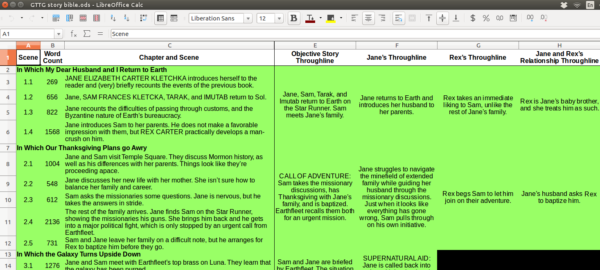
Once I’ve figured out the throughlines, I match them up in a spreadsheet to form chapters. Each chapter breaks down into three or more scenes, which serve to advance the throughlines. The scenes also work together to create a beginning, middle, and end for each chapter.

At this point, with the main plot of the book fully outlined, I start to add subplots. These can be romantic, tragic, or just an opportunity for one of the minor characters to shine. I may also add a background storyline with stuff going on behind the scenes that never makes the page, just to keep track of what’s going on.

Where the plot points for the throughlines correspond to whole chapters, the plot points for the subplots correspond to the scene level. A subplot may start or end in the middle of the book, or lay dormant for several chapters. I try to make each scene do double-duty, but add new ones as necessary.

For each of the major characters, I also write up a character sheet. This lists all of the specific details that tend to get mixed up in a rough draft, like hair color, eye color, height, weight, etc. It also gives me a chance to do a deep dive into who this character is and what makes them tick. Besides things like religion, education, occupation level, etc, I also include things like family relations, backstory, strengths and weaknesses, handicaps, etc.

Beyond that, I may draw up a sheet for conflict alignments, or to list all the story tropes that I want to include in the story. It really depends on the book.
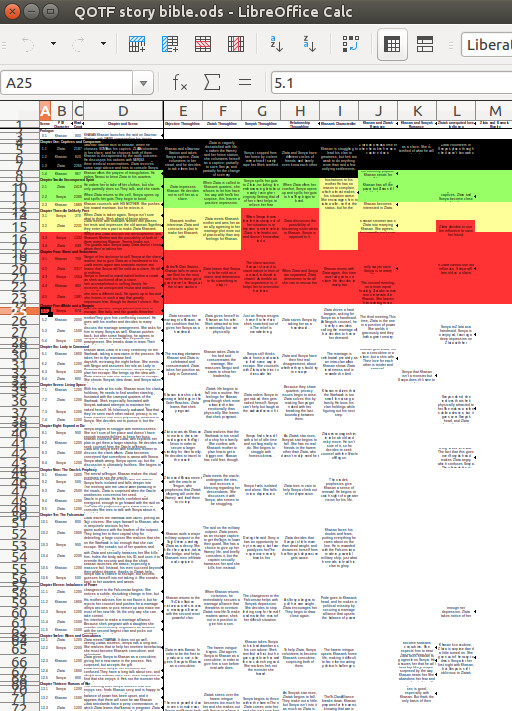
Lately, I’ve been experimenting with a process for revising my WIP as I’m drafting it. I keep a sheet for revision notes and color each scene and plot point for which draft phase it’s currently in: red for first draft, yellow for first revision pass, green for second revision pass, and black for final draft.

After fixing all the major issues, usually on the first or second pass, I set a goal to cut 10% of the words in the scene. Usually I end up cutting closer to 20%. This improves the quality of the writing and helps to make it much tighter.

I’m still experimenting a lot with my outlining techniques, trying out new things and refining the things I’ve previously tried. A year from now, I’m sure it will look much different. But the two major parts that do work quite well are the plot outline and the character sheets. Everything else builds on top of that.

And the really cool part is that it actually works. From June to August, I started a full-time job, moved twice, and experienced a family emergency, and I still managed to finish a novel through all of that, largely thanks to this outline. No writing blocks. No failed drafts. Just 600 words a day, no matter what else was going on, and by the end of it, I had a publishable novel.

I think this book will help me to write longer books, too. That’s what I’m working on next. If all goes according to plan, Queen of the Falconstar will be my longest book yet—not by very much, but still a good 10k words longer than Bringing Stella Home, which is currently my longest book. The things I’m learning now will help me to write more epic fantasy, like the next two books in the Twelfth Sword Trilogy. That’s the goal at least.

If there’s nothing else I’d like you to take from this post, it’s this: don’t be afraid to try new things. Don’t put yourself into a corner by saying things like “I’m a discover writer,” or “I’m not really an outliner.” Try it! You learn a lot more from your failures than you do from you successes.

June Update

Greetings, humans! I am alive. I’m actually doing quite well right now. Lots of stuff going on behind the scenes, and it all seems to be coming together quite nicely.

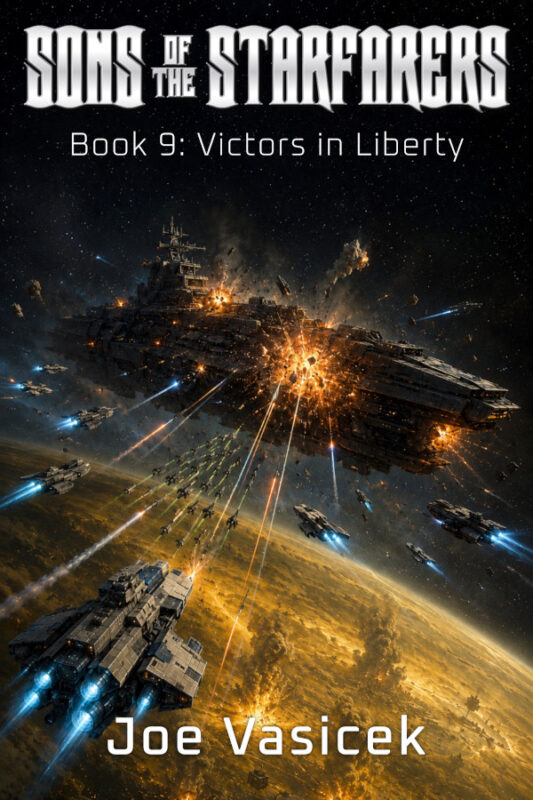
First, Victors in Liberty is now up for preorder, with a release date of July 22nd. This means that the Sons of the Starfarers series is now officially complete! The books have all been written, the plot threads have all been wrapped up (except for one or two, in case I ever decide to write another story), the edits are in, and the final versions have all been uploaded. Four and a half years went into this, and now it’s DONE!

I wrote a lengthy author’s note where I talked about the ups and downs I went through while writing this series. Basically, Sons of the Starfarers was the series that really disciplined me, turning me from a write-when-you-can, publish-when-you-feel-like-it kind of writer to one who makes and keeps deadlines and holds to a consistent release schedule.

Midway through writing this series, I really didn’t know if it was worth it to continue, but I decided to keep with it because I’d made a promise to my readers and I was going to keep it, even if there were only a few dozen of you. As it turns out, there’s quite a few more, for which I am very grateful. If you’ve been waiting since 2014 to read this series, I’m happy to report that your wait will soon be over.

As for my next WIP, I’m about a third of the way through Gunslinger to the Galaxy with a deadline of June 30th. It’s going to be tough to keep that deadline, because I’m moving before the end of the month and don’t yet know where my next place is going to be. Nothing too serious, it’s just that my contract is coming up so it’s time to move on. I’m toying with the idea of buying a National Parks pass and living out of a tent for the next two months, but in all reality I’ll probably just get a summer contract here in the Provo/Orem area. After that, who knows?

My plans are to write Gunslinger to the Galaxy and Gunslinger to Earth over the summer, and publish them both before the end of the year. A couple of years ago, this would have been a tall order, but I’ve reworked my writing process since then to the point where I don’t need multiple drafts to write clean copy. That’s partly the reason why I haven’t been blogging much recently. I’ll do a post on it sometime, if you guys are interested.

Once the Gunslingers trilogy is complete, I plan to finish Edenfall and The Stars of Redemption next. That’s another promise I need to keep to my readers. I don’t feel quite so bad, since Genesis Earth works well as a standalone, but I do need to finish the trilogy and I plan to do that before the end of next year.

On the publishing front, I’m doing a whole bunch of things behind the scenes, but the most visible thing you’ll probably see next is paperback releases for most of my books. It’s been a long time coming, and it will probably be a few months before it happens, but I plan to get those out before the end of the summer.

That’s pretty much it for now. Thanks for reading, and here’s where you can get Victors of Liberty:

Victors in Liberty

Victors in Liberty

$9.99eBook: $2.99Audiobook: $8.99

As Gulchina's forces bombard Edenia II from orbit, Mara Soladze and the Deltana brothers rush to the planet's aid. Trapped on the surface, Reva finds an unlikely ally—one who proves to be a game changer for them all.

More info →

One week left and right on track

An Empire in Disarray
Phase:1.0 Draft
Due:9 years ago
70%

I’ve got exactly one week left on my deadline for An Empire in Disarray (book 8 of Sons of the Starfarers), and surprisingly, I’m actually on track to finish it on time. You have no idea how satisfying it will be if I can actually pull this off.

People tell me that I’m a prolific author, but I never feel like it because I almost never hit my own deadlines. For a long time, I thought that was because of a lack of discipline, but I’m starting to discover it’s more of an issue with my prewriting. As I mentioned in my previous post, I’m retooling my writing process, especially with the prewriting, and it’s making a tremendous difference.

This WIP is a proof of concept. For the last book, Victors in Liberty, I’ll see if I can replicate it. Over the next few WIPs I expect I’ll refine it even further.

Guys—if this actually works, I may be able to triple my creative output. Triple it. Instead of taking years to write novels, it will take months. Instead of agonizing over lengthy revisions and multiple drafts, I’ll be writing clean first drafts that are ready to send to the editor without making a second pass.

All this time, I’ve been using a needle and thread, and now I just got a sewing machine.

So yeah, I’m pretty excited. Also, An Empire in Disarray is on track to be finished by Christmas. I’ll still do a standard revision pass, just to make sure it’s publishable, but still.

Huzzah!

Pantser vs. plotter? There is no such thing

I have come to the conclusion that the “pantsing vs. plotting” way of thinking about writing is as impractical and useless as nature vs. nurture, or talent vs. learned ability.

Are you a pantser who discovery writes from the seat of his pants, or a plotter who has to outline every character, every plot point, and the whole world first? Well, that’s about as useful as asking whether you were born stupid or whether you were taught to be. Probably a combination of both.

The pantsing vs. plotting dichotomy is something I learned early on, when I was just starting out as a writer. At the time, it seemed like a useful distinction to make. Beginning writers tend to make a lot of mistakes, and those range from world-builder’s disease (where you spend all your time outlining instead of actually writing), to rewriting the first chapter into oblivion, to writing yourself into a corner and having all your characters scream at you. It’s amazing how many things you can get wrong. By dividing these things up into pantsing problems vs. plotting problems, it was helpful to figure out how to fix those.

But then you start to identify with one side or the other, and that leads to an entirely new set of problems. Because the truth is that to write well, you need both. A pure pantser often writes himself into problems that he can’t easily get out of, or misses key elements that render the rest of the story moot (like “if only these two people would talk with each other, the obstacles to their romance would all go away” or “if only Hermione would use the time-turner to stop Voldemort from becoming the dark lord, no one else would have to die”). In contrast, a pure plotter often writes stories that are too mechanical and predictable, telegraphing every plot turn and reducing every character into an avatar for some theme or idea.

So, while thinking of it in terms of pantsing vs. plotting may be useful for the beginning writer in diagnosing the areas they need to work on, I’ve found that it’s not particularly useful for the professional writer. In fact, it can be damaging.

For the last several years, I’ve considered myself to be a pantser. Discovery writing is my mojo—give me a few good ideas and the barest outline of a plot, and I’m off to the races. Except… I always tend to stumble and fall in the middle. In fact, I often have to throw out entire chapters or set a story aside for months at a time, to “let the ideas percolate.” For the last several years, that’s been my modus operandi.

Until now.

With Son of the Starfarers, I’m working on a set of very tight deadlines to finish the damn series as quickly as I can. It took way too many months to write book 7, and I can’t afford to take that much time for the last two books because that’s time I’m robbing from other projects (like Edenfall or Gunslinger to the Galaxy or The Sword Bearer). As a pantser, I can write any book if given an infinite amount of time, but that’s not practical. I need to find a new way to write, one that maximizes my efficiency.

And I think I’ve found it. I’m still tweaking it, of course, but it involves <gasp!> outlining. But wait—I’m a pantser, not a plotter! Except, it turns out, that I’m not. Because no one is.

Pantsing vs. plotting does not describe the writer so much as the method of writing. It’s not a question of where you fall on the spectrum, it’s a question of whether this particular project requires more discovery writing or more outlining. And it turns out out that there are ways to outline stories that actually make your discovery writing better. Every battle plan falls apart upon contact with the enemy, but you need the plan to know which direction to march your troops.

In the next few weeks, I’ll go over some of the new outlining methods I’ve been trying out. It took me almost five months to write A Queen in Hiding, struggling over multiple drafts, but it’s been only four weeks since I started An Empire in Disarray and I’m more than 2/3rds of the way through it, with a clean first draft, and I’m on track to have something finished and publishable by the end of next week. There are still a few kinks in the process to work out, but I think I have it down well enough to share.

So if you consider yourself a “pantser” or a “plotter,” and you’re still struggling to write as much or as well as you’d like, I’d urge you to revisit your basic assumptions about your writing process. That’s what I did, and it’s made all the difference.

Mid-August update

It’s already mid-August? Where in the heck did the last eight months go? Feels like the election drama from last year never really died down.

Don’t worry, this post isn’t about politics. Not enough time in the day to follow the latest circus sideshow in the Emerald City of Oz. Time has been on my mind, though: specifically, how to write 10k words a week (minimum) while catching up on the massive list of publishing tasks. I think I’ve found the answer.

I already get up every day around 7am to get ready for my part-time day job. Recently, I started getting up at 6am to put in an hour of writing first thing in the morning. The goal isn’t to pound out words so much as to get the mental gears turning, so that later in the day (such as lunch break) I can pick up very rapidly where I left off.

So far, it seems to be working. Plus, it’s a whole lot easier to sit down and write at the end of the day when you know you’ve already got more than a thousand words under your belt and can hit that daily word count goal with just another few hundred. My writing productivity is improving significantly, and as I continue to work out the kinks, I believe it will continue to improve.

On the writing front, I’ve put A Queen in Hiding on the back burner for the moment, and have instead moved on to Gunslinger to the Galaxy. This one is from Jane’s point of view, and so far, it’s a blast. Should be finished with that WIP by the end of September.

On the publishing side, there’s all sorts of stuff going on. I’ve got a cover artist for The Sword Keeper, and the preliminary sketches look really amazing! Also going through the edits and getting the metadata worked out. I’ll probably write the author’s note over the weekend. By the end of next week, it should be up for preorder with a release date of September 23.

My goal is to get to the point where I’ve always got a novel on preorder. Another goal is to have print books and audiobooks for every title more than 15k words, but that’s going to take some time.

This would all be so much simpler if I didn’t spend 30 hours a week at a day job. Time, money, or youth: you can only pick two of the three, and if you’re under 40 one of them has to be youth.

That’s what I’m up to these days. Expect to see some exciting stuff in the weeks ahead!

So it’s the middle of June, and I really should have finished Patriots in Retreat by now, but it’s been difficult to stick to any kind of writing routine, and the story is at that place where everything seems broken and writing through it is like slogging through a swamp.

Call me crazy, but I’m starting to think that’s not healthy. In Brandon Sanderson’s English 318R class at BYU, he always said the most important thing was to power through and just finish the damn thing–that you can always go back and “fix it in post”–but while that’s good advice for a new writer who hasn’t ever finished anything, I don’t think it works very well for my own writing process.

I think that what I need to do is take every weekend to cycle through the entire story from the beginning, not necessarily to rewrite it all, but to bring it into line with the stuff that unfolds later. Invariably, when I get to the three quarters mark of my WIP, it feels like the whole thing is barely holding together and that I’m writing myself into a train wreck.

For the last several years, I’ve tried to just write through that, only for one of two things to happen: either something else catches my interest and I decide to put the WIP on the back burner for a while, or it actually does turn into a train wreck and I have to set it on the back burner for a while in order to approach it with a new set of eyes.

Needless to say, neither of those outcomes is very productive.

Now, I don’t think Patriots in Retreat is broken. I think there’s actually a really good story in there, but it needs a little more excavation in certain parts before I can pull the whole thing out in one piece. This was my first time in years experimenting with the cycling process, and I don’t think I did it enough. Next WIP will be another experiment.

Long story short, I will probably have to push this one back another two weeks, which is going to push the release schedule for Sons of the Starfarers back another month. I’ve got another short story I can use to fill in the gap, but it is a bit of a personal disappointment.

Why is it so difficult to keep my own self-imposed deadlines? Am I really that flaky and unreliable? Not in other aspects of my life. Maybe my writing process really does need a complete and fundamental overhaul. Should make for some interesting future posts.

In any case, that’s what I’ve been up to. I really really really want to write a couple of short stories in a universe that may turn into a recurring one, but those will have to wait until Patriots is finished (hopefully early next week). On the publishing side of things, I’ve got a new short story and short story bundle out—more on that tomorrow! Lots of other stuff too, but it’s mostly behind the scenes, so not worth talking much about atm.

Patriots in Retreat will be finished soon, it’s just in the “this sucks and I’m a horrible writer!” phase. Which, hopefully, I’ll find a way to remove from my writing process altogether, because it isn’t healthy. When I figure out how to do that, I’ll let you know.

What it’s like to write after a life interruption

Stage 0: Procrastination

I guess I should write… but first, I should check my email. Also, there’s a couple of publishing tasks I need to do. I’m also kind of hungry, come to think of it.

Wow, those publishing tasks took a lot longer than I thought they would. I could start writing now, but I’d only have half an hour, and what can I possibly get done in that time? Maybe I should just relax for a bit and play this addictive online game…

Stage 1: BIC HOC

All right, no more excuses. It’s butt in chair, hands on keyboard time!

What’s wrong with my chair? Did someone put a magnet in it? It seems like my butt gets repulsed every time I try to sit down in it. I can knock off a couple of paragraphs, but then I have to get up and pace for a while. Or do some chores. Or—

No! I’ve got to focus. But man, it feels like I’m pulling teeth. The words just aren’t coming. It’s been more than an hour, and how much have I written? Holy crap, that’s pathetic.

Well, it’s the end of the day, and I only managed a few hundred words, but that’s better than nothing I guess.

Stage 2: Progress

Is something different? It still feels like I’m pulling teeth, but my writing time is only half over and I’ve already passed a thousand words. Also, that last scene was kind of awesome. I could probably improve it in the next pass, but it turned out better than I thought it would.

I’m still way behind from where I need to be, and I have no idea if I’ll ever make my deadline, but I’m slowly making progress. Not bad. Let’s lie down for a while or go for a long walk and think about what happens next. This is actually turning out to be a pretty good story.

Stage 3: Acceleration

It’s getting late and I really should be doing other things, but I’ve got a great idea for this next scene and I just have to write it.

What’s that? My emails are piling up, and my to do list of publishing tasks has been neglected? Yeah, yeah, I’ll get around to that, but first I really have to knock out this scene. And what if I changed this one three chapters ago to foreshadow it? Then I would also have to change how that one character reacted when the big reveal happened on page 128, and…

Wow, that was incredibly invigorating! I feel like I’m reading this story for the first time. The words are really flying, but that actually doesn’t matter because this next chapter is the big one and I’ve got to focus on that. No time to count how many words I’ve written!

Stage 4: Peak Creativity

I can’t wait to wake up in the morning because the next chapter is going to be totally awesome. I spent my whole shift at the day job thinking about it, and it’s really going to tie the plot and thematic elements together.

What is this character thinking right now? What is it like to be in her shoes? Does this other character have any idea what she’s feeling right now? Is he too caught up in his own concerns? Where did those concerns come from? Obviously, they came from the difficulties in his childhood. Let’s take a few moments to work that out. What’s the story behind how this character came to be who he is today, and how does that impact everything else in the book?

All right, time to take a quick break and refill the creative well. What’s this? A mountainous stack of emails and publishing tasks? Let’s chip away at it for a while, and maybe write a blog post while we’re at it.

Enough for now. Back to writing!

Life Interruption

Oh crap. Time to go back to stage 0 again.

So it’s the end of another month, and I’m happy to report that things are going well. Gunslinger to the Stars has had a decent release, and seems to be on its way to grow into its natural readership. I don’t want to push it too hard just yet, better to wait until a few reviews and also boughts come in. But I can push the short story, “Jane Carter of Earth and the Rescue that Never Was.” Will be interesting to see whether that garners interest in the novel.

On the writing front, I’m making good progress on Patriots in Retreat, my current WIP. The plan is to finish the last four Sons of the Starfarers books in quick succession, in order to release them one after another in the beginning of 2018. The covers are all done, and the editing shouldn’t be too expensive, so if I can knock all these books off over the summer, I’ll be in good shape.

The goal is to write each one of them in four weeks, with a week-long buffer between each draft. I’m trying out a new writing method—actually, a method I used to use when I was a kid but laid aside when I wrote my first novel. Instead of writing several distinct drafts, I’m cycling through the previous day’s work in order to produce a more clean first draft.

When I wrote my first novel, the goal was just to finish the thing, so instead of trying to fix all the problems with it as I went along, I prioritized getting to the end. Needless to say, that hot mess of a novel will never see the light of day. But for some reason, I’ve stuck with that method of writing ever since, sometimes to great detriment. Heart of the Nebula took several years to complete because the first two drafts were full of plot holes, worldbuilding inconsistencies, and totally useless characters.

Of course, back then I was a much less experienced writer and needed some emotional distance in order to figure out how to fix my own work. But now, I think I’ve got a pretty good handle of it. So we’ll try out the cycling thing with these books and see how it goes.

I did recently reread the first book, Brothers in Exile. Have to say, it’s not my best work. Not that the story itself is bad, but the writing is pretty poor and needs a good polish. Also, some of the character reactions are off. There’s a bit more melodrama than I’d like, and not enough consistency.

Again, nothing in need of a complete overhaul. Just a touch up. And maybe this is more just a recognition of how much my writing has improved over the last couple of years (at least, I hope that’s what it is). But once the last four books are done, I plan to take a couple of weeks to really touch it up.

In other news, The Sword Keeper, my first fantasy novel, is just about finished and on track for a September release. There’s a couple of issues my first readers have pointed out, but it’s more a question of patching the sails than bringing her into drydock and building a new hull. The next big step after sending it off to the editor is to find a good cover artist. I’ll probably post a classified on Deviantart, see who bites.

I really want an illustrated cover, not one of these photo-realistic things that all tend to blend together (or worse, copy the same stock photos). Those do tend to be a bit more expensive, but for my first fantasy novel, I’m willing to pay a little more.

On the publishing side of things, I’ve got a short story single and a short story bundle lined up for June. It didn’t seem fair to release the one story as a single only to release it a couple months later in a bundle, so I’m doing them both together. The cover is pretty spiffy—I’ll be sure to do a reveal later this week.

And that just about does it. Lots of things to do on the publishing side, lots of stories to write on the writing side, but it’s all coming together and I think you’ll really enjoy how it turns out. Take care!

Another one done!

The Sword Keeper
Phase:3.0 Draft
100%

It’s done! Draft 2.0 of The Sword Keeper is finished. Still need to run it by some test readers, but it’s looking very good for a release this year.

In other news, the power cable for my laptop decided to die. I’ll replace it eventually, but in the meantime, I’m going to try turning my phone into a writing device. Just got a K480 bluetooth keyboard and I’m excited to try it out. My phone is a device I’ve always got with me, so adapting it for writing could be really great.

I’m also going to try a new writing technique that should hopefully lead to cleaner (perhaps even publishable) first drafts. If it works, this could significantly increase my writing output. It involves cycling through yesterday’s words before writing any new ones, getting into the flow and making any changes as necessary. This is actually very close to how I used to write back in high school, before all those college English classes. I also get the sense that this is how Dean Wesley Smith writes.

All sorts of experimental new things going on with my next WIP, which is Edenfall. Yes, it’s time to complete the trilogy. But before I jump into it, I’m going to take some time to do some serious prewriting, in the hopes (again) of writing a clean first draft. Which, if it works, means that the book will be published that much sooner.

In the meantime, Gunslinger to the Stars is almost ready for publication. My editor is working on it now, the cover art is just about finished, and besides that all that’s really left is crafting the book description and metadata. If all goes well, it should be up for pre-order on iBooks, Kobo, Smashwords, and Nook before the end of the month.

Also, new short story!

Nothing Found

Breaking down the elephant

I came to a realization about productivity just recently. It’s one that I’ve known for a while now, but never really applied to my own quirks and strengths.

In order to accomplish a massive, multi-stage task (like writing a novel), you have to break it down into manageable chunks first. Otherwise, you’ll just get overwhelmed. If you try to eat an elephant in one sitting, you won’t be able to do it, but if you process the ground elephant meat into meal-sized tupperware containers, put some recipes together, set a meal schedule, and freeze the meat until you need it, then eating an elephant becomes much more doable.

The question is, what’s the best way to break down the elephant? The answer, of course, is that it depends on the person.

Some writers break their WIPs down into chapters. Others prefer raw word count as a measure of progress. Others use story beats, or a timer, or a hard and fast deadline. A lot of writers don’t use much of a system at all, which is probably why so many of them fall behind.

The hardest part of writing is often just getting yourself to sit down and do it. The blank page really is the most intimidating part of the job. If I had to guess, I’d say that about 50% of writer’s block is not having a good way of breaking down the elephant. And by “good system,” I mean one that is personalized to work for you.

I’ve tried out a lot of systems that didn’t really work—for me, that is. I’m sure they work just fine for other people.

For a long time, I used raw word count, but then I found myself cutting corners by dropping a project and going back to revise a half-finished one, just to get a higher word count boost. After that, I started tracking hours worked per day, but again the quality of my work fell as I started looking for busywork just to feel like I’d accomplished something.

I bounced back and forth between unfinished projects, sometimes starting new ones, sometimes making progress on old ones. Every once and a while, the story would hit me in just the right way to compel me to finish it, which is how I’ve finished probably 80% of the books I’ve written over the past three years. But that’s a very unreliable way to write books.

Then I started using a timer to break my work down into short, measurable writing sessions. The main reason I did this was to work my way up to hitting 10k words in a day (something I’m still working on). The idea was to develop more focus and train myself to write faster. What I didn’t realize until now was that this is a great way to break down the elephant.

Before, I would wake up in the morning and think “how am I going to write X,XXX words before the end of the day?” Understandably, this was a bit intimidating, and over time it tended to grind me down. But now when I wake up, the question is “am I ready for the day’s first writing session? Why not—it’s only 20 minutes.” And then I’m off.

Now, I’m not completely in that mindset yet. I still tend to think in terms of daily word count, which can make me fall back into the old habits of procrstination. And if the day starts off with something non-writing related, it can really throw me off. But using this method, I was able to get through 66% of Gunslinger to the Stars in about six weeks. And if I keep working on it, I’ll bet I can accomplish much more.

I do not consider myself a fast writer. Some of my professional writing friends think that I’m fast, but there are tons of indies out there who write much faster (and better) than me. But a lot of it really just comes down to the psychology of breaking down the elephant. And now that I’ve got a system, I just need to be better about using it.

If you guys are interested in keeping track of my writing progress, I’ll go back to using the WIP progress bars. I took them down in order to keep the sidebar from getting too cluttered, but that is a major reason why readers come to an author blog (to see the ongoing progress on the author’s next book), so I’ll redesign things a bit and figure it out. It would certainly help me to get back on the horse, knowing that people are following this sort of thing.

Right now, I’m about 35k words from finishing The Sword Keeper, a project I’ve been working on and off on for the last four years. It’s a fantastic book, perhaps even the best I’ve ever written, and getting it done is going to be huge.

After that, I’ll probably finish Gunslinger to the Stars. Put it on the back burner after LTUE, but it shouldn’t be too hard to finish it up. It’s a rip-roaring adventure that doesn’t take itself too seriously, and I could frankly use the break.

And then? I think it may be time to finish the Genesis Earth trilogy. Book two, Edenfall, has been on the back burner for a looong time (almost five years), but there seems to be a lot more interest in it now, with sales of Genesis Earth increasing and readers posting reviews that say “can’t wait for the next book!” When you guys speak, I listen.

So that’s the plan for the next couple of months. Beyond that, I have a couple of short stories coming out soon, so be sure to keep an eye out for those.

Thanks for reading!







