Playing with Tropes: Pragmatic Villainy

So as part of my effort to blog more often, I’ve decided to bring back the trope posts. If you’ve been reading this blog for a while, perhaps you remember the Trope Tuesday series that I used to do. Those were mostly just a rehashing of each trope’s tvtropes page, with a bit of commentary at the end. For this new series, though, I’m going to assume you’ve already read the page and are familiar with the trope, and focus on the commentary. I’m calling this series Playing with Tropes, and I’ll do a new post on the first and third Monday of each month.

To start off this new series, I’d like to take a look at Pragmatic Villainy. There’s something especially chilling about a villain who not only possesses power, but knows how to wield it too. In fact, one of the scariest villains is the guy who rises up the ranks through sheer ruthlessness and ambition, starting as an underling and rising to the top. These villains know how to inspire and manipulate their followers, how to use their limited resources efficiently, how to form secret alliances and backstab their enemies, and how to keep a strategic perspective while making brilliant tactical plays. It doesn’t matter whether they command an empire or whether all they’ve got is a cargo-cult following on some far-off backwater. No matter where you put them, these are the guys who are truly dangerous.

It’s worth pointing out that there are a lot of figures from history who fit this trope. A badass colonel when the French Revolution began, he took advantage of the chaos to rise to power, declaring himself emperor and restoring order to his broken country. He then took his armies and conquered nearly the whole of Europe and the Mediterranean, destroying the Holy Roman Empire, invading as far as Egypt and the Nile, and leading his troops through the gates of Moscow before suffering defeat before the Russian Winter. Ever the pragmatist, he developed the modern canning process in order to supply his troops with food. And even after the European powers crushed his armies and exiled him to the island of Elba, he still found a way to escape and very nearly did it all again.

And Napoleon is by no means the most prominent historical example. Hitler was extremely pragmatic, and probably would have won the war if he’d actually listened to his generals and not interfered with their ability to do their jobs. Stalin was also quite pragmatic, identifying and removing his rivals and ruling with an iron fist. Today, Vladimir Putin and Xi Jinping are some of the best examples of this trope.

Sometimes, it’s difficult to tell whether a pragmatic villain is really a villain at all. This is because pragmatic villains often see evil as a means, not an end. You won’t see a lot of gratuitous puppy-kicking with these guys—in fact, you may even see them pet the puppy for the cameras… before quietly taking it out back to skin it.

That’s not to say that pragmatic villains are more redeemable than your average big bad. Far from it, in fact. As Darth Vader put it, “if only you knew the power of the dark side!” In the clash between good and evil, evil often has the upper hand right until the middle of the third act. Even when evil doesn’t have the upper hand, the old poem often applies:

Might and Right are always fighting
In our youth it seems exciting.
Right is always nearly winning.
Might can hardly keep from grinning.

—Clarence Day, “Might and Right”

To really pull off a pragmatic villain, it’s important to make sure that your villain is truly evil. Grand Admiral Thrawn from the old Star Wars Expanded Universe was a great example of this, as was Admiral Ysanne Isard. Even with limited resources, they pulled off some brilliant moves: Thrawn by placing a cloaked warship beneath a planetary shield, to make it appear that he had shield-busting weapons, and Isard by spreading a lethal pandemic that, while curable, was extremely expensive to treat, thus spreading panic and instability as everyone fought over the cure. Yet in spite of their pragmatism, it was clear that neither of them would stop at nothing in their rise to power.

What’s really awesome is when a pragmatic villain manages to pull off a Xanatos Gambit. In fact, pragmatic villains are the only kinds of villains who can pull that kind of gambit, simply because of all the planning and foresight that must necessarily go into it. For the same reason, there tends to be a lot of overlap between this trope and the Chessmaster.

When a villain falls short, it’s often because they were lacking in this trope. A huge example of this for me was The Hunger Games. When the villains in that book backpedaled after Peta and Katniss threatened to kill each other, I pretty much threw the book at the wall. The kind of people who can be manipulated by angsty lovestruck teenagers are not the kind of people who rise to power in a totalitarian dictatorship. And while there’s certainly a place for B movie villains, the Evil Overlord List exists for a reason.
 

Resolution: 10k in 2016

Back in 2012, I set a resolution to write 10k words of fiction in a single day. I had read Rachel Aaron’s semi-famous blog post about it, and decided to give it a shot myself. The most I managed, however, was a handful of 5k writing days—impressive, but still far short.

In the years since, my writing pace has slowed down a lot more than I would like—not because of writing-related reasons, but because of things like procrastination, poor time management, and general disorganization. Well, it’s time for a change, and the new year seems like the best time to shake things up.

Rather than set a goal like “write every day” or “write X,XXX words per week,” I think this goal will do a lot more to put me in the right direction. It’s the difference between setting a goal to go to the moon vs. put something new in orbit every few months. When NASA set the moon as their primary goal, it not only provided them with the single-minded focus that they needed to get stuff done, but it led to a tremendous amount of scientific and engineering breakthroughs in the process. I’m hoping that something similar will happen with me.

So here’s the deal:

I can type at a maximum speed of about 100 WPM. Logistically, that means that the absolute minimum time needed to physically hit 10k words is 100 minutes, or 1:40 hours. That’s typing at top speed with no breaks, no mistakes, and no time to slow down and think.

I’ve measured my writing in the past, and found that my typical fiction writing speed is between 800 and 1,000 words per hour. To hit 10k words at that rate, I would have to work for an excruciating 10 to 12 hours a day—and that’s pure writing time. It doesn’t include things like breaks, water cooler chats, dinking around on social media, or any of the numerous other ways that regular employees waste time while on the clock.

Clearly, if I’m ever going to hit 10k words in a single day, I need to increase the speed at which I write. But how?

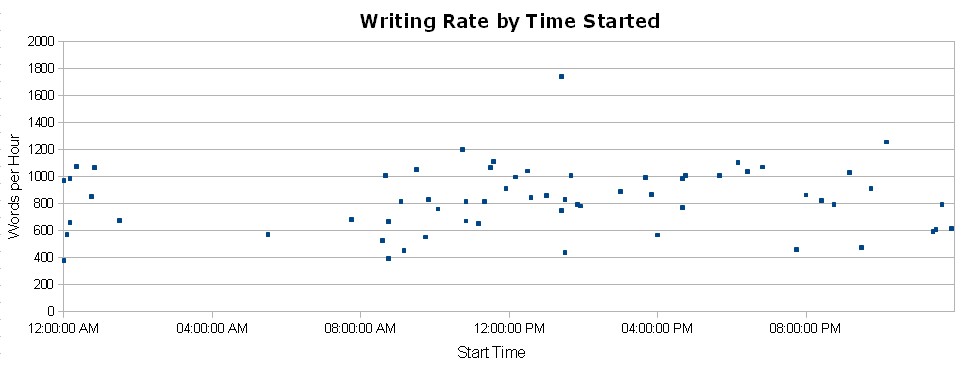
writingrate_by_starttimeWell, I know from my writing log experiment that the time of day doesn’t really affect my writing speed. That means I can start as early as I need to, and the earlier I can start the better. So that pretty much sets up the first step to achieving this 10k goal:

Step 1: Start off each day by writing as soon as possible.

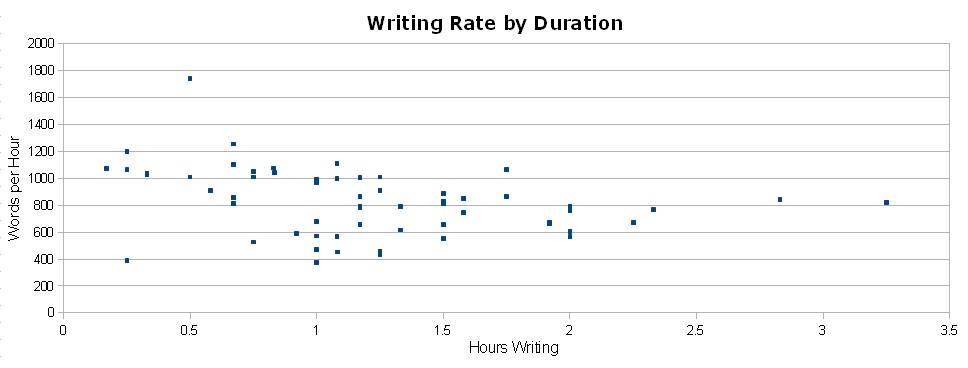
writingrate_by_durationFrom the writing log, it looks like I tend to write fastest in short sprints that are less than one hour. That makes sense: the longer the writing session, the easier it is to get distracted and fall into the procrastination trap.

I have a hunch that the best way to increase my writing speed is to write in short, focused bursts. I’ve never actually tried to limit my writing time before, but it seems that I could really achieve a lot more focus by doing so. It will take some experimentation to figure out the optimal session length, but judging from the data it will probably be less than one hour.

Step 2: Increase speed by writing in short, focused sessions.

Obviously 10 to 12 hours of pure writing time is unreasonable. Even without a day job or other time obligations, burn-out would be a major issue. A much more reasonable amount of time to plan for would be 4-6 hours of pure writing time per day.

At 6 hours, to reach 10k words I would have to write at about 1.6k words per hour, which is reasonable. At 4 hours, I would have to write 2.5k words per hour, which is a lot tougher but still well below the 6k WPH physical limit, especially if I’m writing in short, focused bursts. From this, it’s not difficult to derive the next couple of steps.

Step 3: Increase average writing speed to 2,000 words per hour.

Step 4: Structure each day to achieve 6+ writing sessions.

The real trick to achieving this, as Rachel Aaron and numerous others have pointed out, is to take care of all the non-writing things that make the writing possible. This involves having an outline of some sort, or at least some idea of what is going to go on the page.

I’m a pantser, so I don’t write detailed outlines. However, I’ve found that it can help a lot to sketch out the next few scenes before I write them, and to browse tvtropes like a menu. In addition, long walks really help me to flesh out the story in my head. Without these pre-writing activities, the blank page can be really oppressive.

In more specific terms, I think it’s reasonable to allot 1-2 hours each day to pre-writing activities. Anything more than that would encroach on my actual writing time. Fortunately, I can usually hit two birds with one stone: for example, using my time on tvtropes to find material for blog posts, or outline the next few scenes in my head while hiking or exercising. But it’s important to make time for these things.

Step 5: Spend time each day in pre-writing activities for the next day.

These five steps seem like a good place to start. I’ll post them on my wall and revisit them in a month or so to see how they’re working out.

Ten thousand words in a single day is going to be tough, but if I can hit it at least once this year, I think it will remove a major block in my head and allow the words to really flow. It’s not just about writing faster, it’s about proving to myself that this is something I can do, and to use that as motivation to accomplish much more.

Best of luck with your own resolutions in 2016!

Response to Steve Davidson on Reconciling with the Puppies

So my last blog post about the Sad Puppies has turned into a kerfluffle of its own, which has been very interesting to watch as it unfolds. Mike Glyer of File 770 linked to it, Lou Antonelli’s File 666 picked it up, and Steve Davidson of Amazing Stories wrote a lengthy response to it, which I think is deserving of a response on my part.

Mr. Davidson’s post is interesting, and worth reading. We obviously don’t see eye to eye on a number of things, but it would be rather petty to go through our disagreements line by line. Instead, the part that I want to respond to is his call to action at the end:

Want to reconcile?  Here’s what puppies must do.

1: Stop scamming the system.  If you want to recommend works that you think are worthy of the award, go ahead and do so.  But drop the political agenda (you’re dragons are imaginary) and eliminate the hateful, snarky commentary

If you’re looking for “hateful, snarky commentary,” I’m sure that you’ll be able to find it. On the fringes of both sides, there are a lot of people with blogs and strong opinions. I’d count myself as one of them—while I align with the Sad Puppies, I’m not a leader or organizer by any stretch, just another guy with opinions and a blog. Don’t be so quick to look for ammunition, because there’s a lot of it lying around.

Kate Paulk, one of the Sad Puppy organizers, has pointed out that Sad Puppies 4 is open to nomination suggestions from anyone, which appears to be what you’re calling for. And honestly, I think a lot of us don’t want to see conservative writers edge out everyone else so much as to see them go head to head with more liberal writers on a more equal playing field. It’s not about slaying imaginary dragons so much as breaking down walls.

So on this first point, Mr. Davidson and I tend to be in agreement. This seems like a reasonable step for reconciliation, and it’s one that the Sad Puppies 4 already appear to be taking.

2: Stop attacking the very people who are offering you a bridge

If a bridge is being offered, I’m willing to take it. If people are just trying to get the last word in edgewise, which was the vibe I personally got from Mr. Martin’s original post, then it will probably just lead to more kerfluffles. Then again, if everyone’s fighting to get in the last word, the squabbling will never end, and while that may make for good sport, it makes for poor reconciliation. So again, fair point.

3: Please learn a little bit about the history of Worldcon and the Hugo Awards

I’m not entirely convinced that the Hugo Awards will continue to hold the same influential place in fandom in the next few years. Even with last year’s massive turnout, there were less than 6,000 ballots cast. With those low numbers, it wouldn’t take much for a rival convention to organize their own awards and eclipse the Hugos in short order—especially if a large contingent of fandom becomes disaffected.

This is why I think it’s important to distinguish between the Sad Puppies and the Rabid Puppies. A useful analogy can be drawn from Star Control II: The Ur-Quan Masters:


These are the Ur-Quan Kzer-Za. They want to make the galaxy safe by enslaving all intelligent life, either by encasing their home worlds in impenetrable slave shields, or by enlisting them as Heirarchy battle thralls to conquer and enslave other species.


These are the Ur-Quan Kohr-Ah. They want to make the galaxy safe by “cleansing,” or exterminating, all intelligent life. They are totally without mercy and cannot be pacified.

The Kzer-Za and Kohr-Ah are locked in a civil war over control of the Sa-Matra, an ancient precursor weapon that will enable the victor to conquer the galaxy. If you don’t find a way to stop them in time, then the Kohr-Ah will win the civil war and use the Sa-Matra to exterminate everyone.

The Sad Puppies are like the Kzer-Za, the Rabid Puppies are like the Kohr-Ah, and the Hugo Awards are like the Sa-Matra. The Rabid Puppies want to use the Hugo Awards to burn down the fan community, whereas the Sad Puppies want to reform the Hugo Awards to make Science Fiction less about political correctness and more about telling good stories.

Now, I am not a Sad Puppy spokesperson, so this may not be the most accurate or flattering analogy. Fellow puppies, please correct me if I’m wrong. But it’s worth pointing out that in the Star Control series, the Ur-Quan ultimately become pacified and join the New Alliance of Free Stars. This only happens after the Kohr-Ah have been defeated.

I think that’s what most of the Sad Puppies ultimately want: to have a place with the rest of fandom, where even if we sometimes have heated disagreements (has there ever been a time when all of fandom was in agreement about anything?), we aren’t cast out as “racists,” “Nazis,” or “misogynists,” as happened with Puppygate 2015.

The Rabid Puppies, on the other hand, just want to watch the world burn. And the more vociferous the rhetoric becomes, the more that it plays into their hands. Speaking as a Sad Puppy sympathizer who watched the 2015 Hugos from the sidelines, after all the abuse that I saw my friends receive, it kind of made me want to burn down the Hugos too.

You want to defeat the Rabids? Then reach out to the Sad Puppies, find commonalities with us, and make an alliance. If we can show the world that Science Fiction and Fantasy brings us all together in spite of our ideological differences, then all of fandom will win.

And so regarding Mr. Davidson’s third point, I don’t think it’s about respecting the prestige of the awards so much as listening to and understanding the other side of fandom. And I’ll admit, I can do a better job listening to the side of fandom that sees the puppies (sad or rabid) as the enemy. If they can return the favor, I think that will go a long way.

4: If you want to be counted as Fans, then be Fans.  Fans who care attend Worldcon, nominate their conscience and attend the business meeting to effect change they think is needed.  They work WITH and within fandom – they do not set themselves up as a cabal that engages in fear and hate.

If that’s a challenge to be more involved in the Hugo Awards, then it’s one that I can accept. In 2015, I largely watched from the sidelines, and if I do the same this year then my opinion is pretty empty. I do count myself as a part of fandom, and I can respect the call to put my money where my mouth is.

I’m not entirely convinced that “no one controls [the Hugos].” Overtly, of course not, but there are indirect ways to accomplish the same thing, through whisper campaigns and the manipulation of cliques. But as Mr. Davidson points out, it’s hypocritical to criticize that without also trying to get involved. And if that’s the invitation he’s extending, I am willing to accept—no hate required.

George R.R. Martin and Christmas Puppies

Sad-Puppies-4So it’s not yet 2016, and the first salvos in the Sad Puppies 4 campaign have already been fired, in the form of a kerfluffle over on George R.R. Martin’s blog.

For those of you who haven’t been following Sad Puppies, I can’t say I blame you. It’s basically an ongoing civil war within Science Fiction & Fantasy fandom, between those who believe that the genre should serve the cause of social justice, and those who believe that there should be room for writers on all sides of the political spectrum—that it should just be about telling good stories. Last year, the Sad Puppies (the ones who believe it should only be about the stories) swept the nominations for the Hugo Awards, the (onetime) most prestigious awards in the SF&F genre. The resulting brouhaha was not pretty.

Last year, George R.R. Martin was very aggressive in attacking the puppies. That’s what makes his latest puppy-related blog post so interesting. In it, he basically calls for an end to “puppygate” and for everyone to just get along. In his own words:

The last thing I want… the last thing anyone who truly loves science fiction, fantasy, and fandom would want… would be to have to go through the whole thing again in 2016. Whatever your view of how the Hugo Awards turned out at Sasquan, I think we can all agree that we would like MidAmericon II’s awards to be more joyful, less rancorous, less controversial.

Now, I don’t disagree with Mr. Martin’s sentiment. I too would like to see reconciliation and de-escalation of the ugliness that we saw from both sides in 2015. And to be fair, Mr. Martin does give a positive characterization of what’s going on right now with Sad Puppies 4. That’s a good first step.

The trouble is, you don’t achieve reconciliation by shouting at the other side to lay down their guns first. You achieve it by hearing and acknowledging their grievances. You might not agree that those grievances need to be rectified, which is fine—that’s what negotiations are for—but you do have to make an effort to listen to the other side. And it’s clear enough that Mr. Martin is not listening.

The core of the Sad Puppies movement is a rejection of elitism. In contrast, Mr. Martin’s position is that there are fans and there are Fans. Fans like him, for whom every aspect of their lives revolves around Science Fiction and Fantasy, should have more control, more respect, more ownership—in fine, they should matter more to the genre than the other kind of fans. When pressed, of course, he denies that any part of fandom is any better than the others, but that’s not what comes through in his other positions. “Separate but equal” is the phrase that comes to mind.

The problem here is that Mr. Martin wants to have his cake and eat it too. He wants the Sad Puppies to lay down their guns, but he doesn’t want to lay down his own. If he were genuine about burying the hatchet, he would acknowledge his own elitism, acknowledge that this is a grievance that the Puppies hold against him, and either recant his position or say “we’re going to have to agree to disagree.”

Personally, my position is the opposite of Mr. Martin’s. I think that SF&F should be a big tent that privileges or denies no one—that everyone who calls themselves a fan of the genre should be on equal grounds. After what happened in 2015, I’m as disgusted with the Hugo Awards as Feynman was disgusted with honors and epaulettes:

Am I willing to agree to disagree on that point? Sure, so long as I’m not cut out of the table—so long as I’m not branded a “racist,” or a “misogynist,” or a “neo-nazi” for aligning with the Sad Puppies. But the puppy-kickers and their SJW allies have deliberately mischaracterized us since the beginning, and I have no doubt that they will continue to do so in 2016.

Mr. Martin, if you’re reading this and if you’re genuine in your desire to avoid another “puppygate,” please don’t try to passive-aggressively handwave us away. I applaud your sentiment and believe that your heart is in the right place, but reconciliation requires genuinely listening to the people you disagree with.

State of the Vasicek 2015

I recently read a post over on Brandon Sanderson’s blog where he did an exhaustive recap on his writing and update on all of his WIPs, and called it State of the Sanderson. Since it’s the end of the year and I’m already looking back in order to make some new resolutions for 2016, it seems like a good opportunity to do something similar myself.

In 2015, I managed to publish five books, including two novels, a novelette, and two short stories:

In addition, I wrote a number of short stories that are currently on submission to the major markets, and will probably be published (by myself or in the magazines) sometime in 2016. These include:

  • Killing Mr. Wilson — Time Travel (950 words)
  • My Name Is For My Friends — Sword & Sorcery (2,000 words)
  • Utahraptors at Dawn — Cyberpunk (1,950 words)
  • Welcome to Condescension — Sci-fi Humor (750 words)
  • A Less Than Perfect Game — Sword & Sorcery (1,250 words)
  • Elusive Eden — LDS Science Fiction (2,200 words)
  • The Janus Anomaly — Space Opera (4,400 words)

All of these stories will get out eventually, though it may take a while. I’m putting them on submission to the short story magazines and anthologies that pay at least semi-professional rates, since none of them buy exclusive rights to the stories. Why rush to self-publish if I can get paid twice?

In a lot of ways, it was a pretty decent year. In other ways, I wish it had been more productive. I didn’t publish anything for the first six months, except for A Hill on Which to Die, which I later unpublished in order to take it out of Kindle Unlimited (the first and probably last time I will ever experiment with exclusivity). I made up for it later, but still.

Next year is going to be a lot more productive, I hope. I started a lot more projects this year than I finished, so in 2016 I plan to refocus on the writing and substantially increase my output.

As for writing projects, here is what I’m working on:

Major Projects

Sons of the Starfarers

There are five more books before this series is complete, and while I know more or less how the series is going to end, I’m still in the process of writing it. However, I’m making good enough progress to publish at least two more books in the series this year, possibly three or four.

Captives in Obscurity (Book V) is already written and ready to send off to the editor. Trouble is, cash is kind of tight right now and I probably won’t be able to send it off until after I’ve filed my taxes, which I hope to do early February (I always try to get a jump on tax season each year). For now, that means I’m looking for a launch in May.

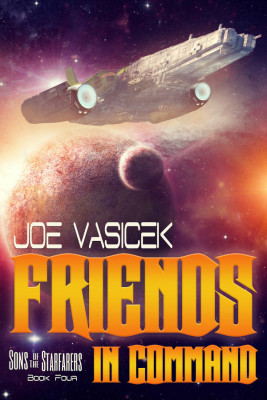
Patriots in Retreat (Book VI) is my current WIP, and I hope to have the first draft finished before the end of January. A lot of stuff happens in this book—it’s kind of like the Empire Strikes Back episode, where crap hits the fan and things get real. Then again, Friends in Command (Book IV) was kind of like that too, and Captives in Obscurity has some really crazy developments… point is, I think you guys are going to like these books.

Haven’t outlined any of the other books in the series yet, but I’m a pantser so that’s normal. I do have a climactic ending that I’m working toward, which will tie in this series with all of my other books in the same universe. It’s going to be great to see it all come together, and I expect it will over the course of the next year!

STATUS: Book VI currently in progress.

Gunslinger to the Stars

I started this book in earnest a few months ago, then hit chapter 2 and realized I had a beginning and an end but no idea what to put in the middle. So I put the project on the back burner, letting the ideas percolate until I’m ready to pick it up again and go full throttle. With luck, that will happen very soon.

This is a really awesome project, and one of the ones I’m most excited about. I’ll post a few excerpts in the next few weeks to give you guys a taste, and I think you’re really going to like it!

STATUS: On the back burner, will resume again soon.

Queen of the Falconstar

A few of the readers who enjoyed my Star Wanderers books have mentioned that they wish Jeremiah, Noemi, and Mariya had ended up in a polygamous relationship. While I don’t think that would have worked for that particular story, in Queen of the Falconstar, it’s a major plot point. In addition, the book is an origin story for the Hameji, which should be a lot of fun for readers of my other books as well.

I’ve been working on this project off and on for the last year or so, and while I have a pretty good handle on the main storyline, I’m still a little iffy about how to proceed. It may have some promise as a hybrid between Space Opera and Sword and Planet (sword and starship? Is that even a thing?). The Princess of Mars books are on my reading list, so I’ll probably revisit this project after reading through some of those.

STATUS: On the back burner.

The Sword Keeper

I really need to finish this book. It’s already more than half written, and has some really fantastic potential. For the last three years, I’ve been working on it off and on, but 2016 will definitely be the year that I finish it (though it might still be a while before it’s published).

STATUS: On the back burner.

Secondary Projects

Starship Lachoneus

In spite of finishing the prologue and publishing it as “Worlds Without Number” under my J.M. Wight pen name, I haven’t yet made a serious attempt to write this book. The main reason is that it’s a passion project that I don’t expect to pay off very well or earn me much prestige. Still, when my career is at a point where I can afford more time for a passion project, I will probably pick it up.

STATUS: On the back burner.

The Genesis Earth Trilogy

Genesis Earth is a standalone book, but I realized soon after finishing it that I could easily turn it into a trilogy. Back in 2011, I even started writing the second book: Edenfall. But one thing led to another, and it got put on hold in favor of Star Wanderers.

The trilogy is still on hold, but if there is enough interest, I could certainly resume work on it. I made Genesis Earth free for the month of December, and it’s had a much stronger free run than I’d anticipated (especially with almost no advertising). Depending on the feedback I get from readers, I’ll finish this project sooner or later.

STATUS: On hold, may resume soon.

Mercenary Savior

This is a prequel to Bringing Stella Home that I’ve had kicking around in my head for the last two years. The interest in Heart of the Nebula has been surprisingly steady, even more than a month after publication. If either of those books starts to break out, then I will definitely pick up this project. Otherwise, I can’t justify making it a priority.

STATUS: On hold.

Empress of the Free Stars

Empress of the Free Stars is a sequel to Stars of Blood and Glory that I started back in 2013 but never got further than the prologue. Again, unless my Gaia Nova books start to break out, I can’t justify prioritizing this over my other WIPs.

STATUS: On hold.

Children of the Starry Sea

This one is a novelized sequel to Star Wanderers, with all of the major characters from that series. I know there’s some interest in this one, but for now I think my time would better be spent launching new series rather than returning to old ones. But in 2016, that may well change.

STATUS: On hold.

Lifewalker

This is a standalone I started back in 2013, and I even got several chapters into it before I put it on the back burner. Haven’t touched it since, so right now it’s really more on hold, but my Dad keeps bugging me to finish it (he read the first chapter and really liked it). So yeah. Someday.

I will say this, though: if the short story that’s derived from this book gets picked up by one of the magazines, I will definitely move it up in the writing queue.

STATUS: On hold.

A Brotherhood of Swords

This book is supposed to be a Sword & Sorcery prequel to The Sword Keeper, but since I already have plans for that book, this one is on hold. I did get a really good short story out of it, though.

STATUS: On hold.

That pretty much does it. This next year is going to be super, super busy, and hopefully productive as well. My goal for 2016 is to get back in the saddle, writing full-time again as soon as I can. There are other resolutions I plan to make as well, but those can wait until Thursday.

First Impressions of Star Wars: The Force Awakens

This post is going to be spoiler-free, but if you haven’t already seen it and you don’t want it spoiled, you had better go on an internet blackout and get thee to a cinema because there is a lot that can be spoiled!

First impressions: I liked it! I really liked it! It felt very true to the originals, much more so than any of the prequels. It had all the same beats and sci-fi elements, the same focus on the characters (as opposed to spectacle), and a lot of the same magic.

At the same time, it wasn’t just a nostalgic rehashing of episodes IV, V, and VI. There was a lot of new stuff mixed in with the old. I know a lot of the true fans are ticked off that Disney nixed the expanded universe, but the new stuff feels like it fits. The new characters have some very big shoes to fill, and it will take more than one movie for them to grow into those shoes, but in this one at least they did pretty well.

Does it fully live up to the originals? I think that’s the wrong question to ask. For those of us who grew up with the original Star Wars, nothing will live up to that experience. The golden age of science fiction is between ages 7 to 14, and in some ways it just isn’t possible to recapture that magic. But for those of us old-timers, I think this new one pays homage to the originals in a way that the prequels never did.

Was it campy? Yep. Was it rife with scientific inaccuracies? Oh heck, yes! Were parts of it over the top? Yeah, probably. But these were all true of the original Star Wars, too. The stuff that really mattered was all there: good writing, solid plot, believable characters, awesome music, and that grand sense of wonder that drew us all into Science Fiction in the first place.

So yeah, I’m satisfied with this new Star Wars movie. And while I’m sure I’ll be spending the next several months nitpicking it to death with other like-minded fans, my first impressions are very positive. I will definitely watch this movie again, and again.

Flashpoints by George Friedman

Some people say that Science Fiction writers are in the business of predicting the future. In fact, that’s only partially true: we don’t predict the future so much as we show people what possibilities the future may hold. But strategic forecasting is a real business, and the foremost personality in that business is George Friedman.

In a world run rampant with hyperbole and sensationalism, Friedman’s analysis consistently stands out for its calm and measured rationality, as well as its ruthless incisiveness. As cordial and softspoken as Friedman can be, he does not mince words or walk on eggshells. He calls it the way he sees it, and he sees some very interesting times coming in the years ahead.

In Flashpoints, Friedman analyzes the current situation in Europe by placing it in the context of history, beginning with the Age of Exploration and culminating in what he calls “the thirty-one years.” From 1914 to 1945, more than 100 million Europeans died of political causes, the most spectacular human catastrophe of the modern era. The question he asks is whether Europe has truly changed, or whether we are on the verge of a return to the savage cruelty that defined the 20th century.

Friedman’s take on the history of the continent is quite fascinating. He points out a number of things that most histories overlook: for example, that European unification was originally an American project, imposed on a recalictrant Europe as a means to counter Soviet expansionism. In any war with the Soviets, West Germany would be the first line of defense, and therefore NATO and the Americans needed a strong West Germany and a united continent. Thus, the European Union started as an essentially American project—something the Europeans often forget.

The thing that really made this book fascinating, though, were the numerous personal insights from Friedman’s own life. As a Hungarian Jew whose mother was a holocaust survivor and whose father was conscripted to fight in Operation Barbarossa, Friedman’s personal story is just as fascinating as the story he tells about Europe. The two weave together in a way that offers a unique and powerful perspective on the challenges currently facing the continent, providing insights that can’t be gleaned in any other way.

Friedman’s writing is remarkably clear. His analysis is eye-opening, and his predictions are compelling. By the end of the book, I not only felt like I had a better understanding of Europe, but a better understanding of humanity as well.

In my opinion, this is Friedman’s best book. The Next Hundred Years was quite excellent, but a project that large in scope couldn’t help but feel a little fantastic. The Next Decade was also good, but it had neither the grand scope of The Next Hundred Years nor the depth of focus of a book dedicated to a single geopolitical question. Flashpoints possesses both that depth of focus and the grand scope of historical context, tracing the rise, fall, and rebirth of what is simultaneously the most savage and civilized continent on this planet. It’s a fantastic book, and I highly recommend it.

Larry Correia on creating “offensive” characters

Larry Correia has a fantastic post up on the pitfalls of political correctness when writing fictional characters. He not only nails it on the head, he takes a nail that’s been twisted in three different directions and rams it into the wood with just a couple of well-placed taps. Seriously, if you’re interested in writing at all, you should check the whole post out.

The main gist of it can be summed up by this quote:

Smart writers are going to focus on entertainment. They’re probably going to offend everybody at some point. But at least they won’t be boring while they do it.

I’ve said this before, and I’ll say it again, the unforgivable sin for writers is being boring. As a writer you can get away with damned near anything as long as you are entertaining a big enough audience.

There is a contingent of readers out there who exist only to nitpick and bitch. There aren’t that many of them, but they make up for it by being loud. Many authors are under the mistaken impression that you can make these readers happy. You can’t. At best you can appease them. Temporarily. But you will cross their invisible line sometime and they will get all sorts of outraged.

The latest person to get outraged was Melissa Harris Perry, who denounced Star Wars because Darth Vader was (and yet at the same time wasn’t) black. Seriously. It’s like she saw this clip and didn’t realize it was satire:

But I digress.

The reason it’s impossible to please politically correct SJW-types is because the way that they signal their virtue to other members of their tribe is by finding something to be outraged about. This is a consequence of their belief that the only way to fix society is through social revolution, a point that Dennis Prager deconstructs quite effectively. It’s all about how loud they can scream.

As Larry points out, trying to placate these perpetually outraged people is a game you can’t win—not unless you’re already a member of their tribe. This ironically makes them far more prejudiced than most of the people they’re so outraged at. When was the last time you heard the word “white” used as an insult? Has the word “cisgender” ever not been used as an epithet? “Privileged” is another one—without knowing anything about you as an individual, they have already passed judgment and despise you.

Again, this is why I support the Sad Puppies: because they have the courage to stand against these perpetually outraged types who would tear down everything in SF&F that they can find offense with. The most imaginative genre in fiction is no place for self-appointed thought police.

There is one important area where I disagree with Larry. He rejects the Bechdel test out of hand, where I think it still has value. As a litmus test, I totally agree with him: I’m against any kind of a litmust test for stories. But from a writing perspective, I think it can still be a very useful tool.

The Bechdel test is something that I usually have in the back of my mind when I write: not out of fear of offending the perpetually outraged, but in order to write more complex and interesting characters who can stand as heroes of their own stories. I don’t think we’re at odds on that point, since Larry himself says the same thing in his discussion of how to write a strong antagonist. To that extent, I personally find the test to be useful.

The point is, if you want to be a successful writer, don’t try to please everyone. As soon as you start to experience success, someone will inevitably take offense with you just to bring you down a notch. Don’t let them get to you. In the words of Brigham Young:

He who takes offense when no offense is intended is a fool, and he who takes offense when offense is intended is a greater fool.

Disagreement is not offensive

Is it just me, or is there an increasing tendency in today’s world to misconstrue anything and everything as “offensive”? This is especially true of the campus protesters, who take offense in everything from Halloween costumes to the name “Lynch.” But the most disturbing trend is when they find someone “offensive” simply because they had the gall to disagree:

When I saw this exchange between a professor at Yale and one of his students, I was frankly shocked at the intellectual laziness and moral dishonesty of the student. “It is not about creating an intellectual space here!” …seriously? You attend one of the most prestigious universities in the Western world and you don’t think it’s supposed to be “an intellectual space”? What did you expect to do here, weave baskets all day?

But notice that the part where she really flies off the hook is when the professor says “I don’t agree with that.” That’s telling. It shows that the student has no interest in engaging with the professor’s point of view, just in shutting him up. It’s as if she knows that her ideas can’t stand on their own, and need to be enforced by bullying.

Well, it appears that the bullying tactics have worked, because the professor’s wife has stepped down from her teaching position at Yale. The thing that started this whole mess was an email she wrote defending students’ rights to wear Halloween costumes that other students found—you guessed it—”offensive.”

Oh, and that racist Halloween party that launched the Yale student protests? It never happened, natch.

I could go into greater detail, but this is just one example of disagreement being conflated for offensiveness. I’m sure that you could cite others. But it’s not the crybully tactics that shock me, or the ideological blindness: it’s the sheer fragility of the intellectual framework on which the “offended” party’s argument is based.

Seriously, almost anytime anyone gets offended because someone else disagrees with them, their position is so flimsy that a high school dropout could poke holes in it. That’s certainly the case with the Yale student shown above. It’s just like the story of the emperor’s new clothes, where everyone can see that the emperor is naked except for the emperor himself.

In fact, that’s a perfect analogy, because all this talk of “safe spaces” and “right to be offended” is nothing less than an attempt to shelter these students from reality—just like the emperor was sheltered from the reality that his new “clothes” were an absolute farce. And seriously, how is it not farcical for a student to shout “it is NOT about creating an intellectual space!” at one of the world’s most prestigious universities?

This is on my mind right now for a couple of reasons: first, because of an online interaction I had recently with one of these overly-sensitive types, and second, because of an interesting post over on Mad Genius Club. This part of the post was particularly relevant:

I’m a very minor pro, and my tips are probably worth precisely what you pay for them. But here is mine: Pro tip for writers. Learn to put yourself in the shoes, thoughts and headspace of people totally unlike you. Learn to write from their perspective. […] If you can’t do this, you may have one or two good books in you – but essentially you’re writing one character, yourself, and those who are very like you. Unless that’s exceptionally appealing… people get a bit sick of it.

Even if you detest those other people who see the world differently, and wish nothing but ill on them, and plan to destroy them… you’ll write it a lot better understanding what they do and feel and why they think or act as they do.

If you take offense whenever people disagree with you, chances are that you’ll never be able to cut it as a writer. In order to write well, you have to be able to see things from inside the heads of people who aren’t like you and probably don’t agree with you.

This is why I support Sad Puppies: because the SJW types in Science Fiction are usually the first to cry offense over anything that doesn’t fit into their narrow worldviews. This naturally makes them as vehemently opposed to intellectual diversity as they (falsely) claim that the Puppies are to racial, sexual, and cultural diversity. When you look at the books and stories that these people uphold as shining examples of the genre, their rigidly ideological worldview is as plain as the emperor’s new clothes.

Disagreement is not “offensive.” In fact, it’s a sign of respect. If your opponent thought that your opinion or argument wasn’t worth engaging with, then they simply would have ignored you. By saying “I don’t agree,” they are acknowledging your position in an intellectually honest way. When you willfully misrepresent your opponent’s views, or bully them into silence, it is a sign of disrespect that warrants taking offense. And who is most guilty of that? I’ll give you two chances, and the first one doesn’t count.