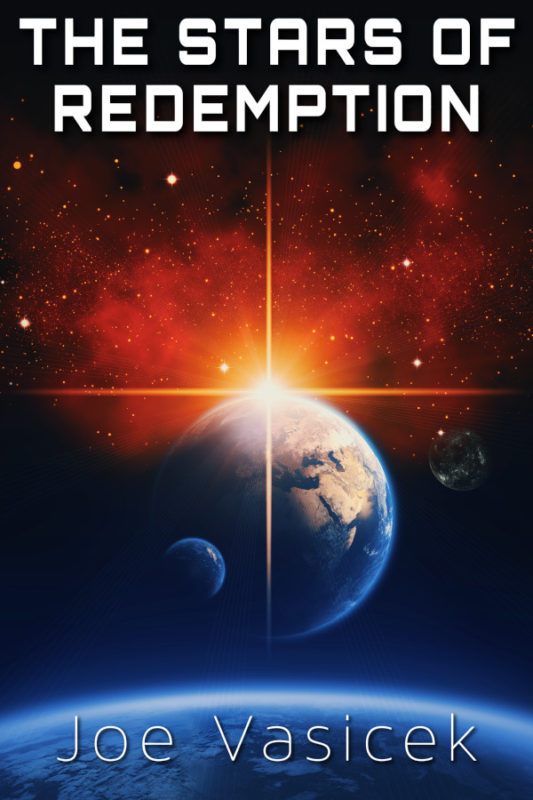
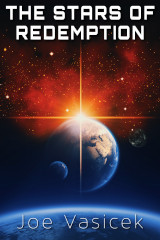
What if the deadliest threat humanity ever faced wasn’t an alien invasion or a rogue AI… but a mistake we keep repeating that always ends with the destruction of Earth? The Stars of Redemption, the last book in my young adult science fiction trilogy, explores this question.
At its core, The Stars of Redemption is about the struggle to break a closed time loop, stop a rogue superintelligence, and rewrite a future that seems unchangeable. This makes The Stars of Redemption a classic time-loop science fiction story, built around temporal paradoxes, fate-versus-free-will dilemmas, and the struggle to break a repeating extinction cycle. It is a story about escaping destructive cycles, choosing hope, and fighting for a future that isn’t predetermined.
Where the Idea Came From
The idea for this theme grew out of my long, tangled journey to finish the trilogy. As I write in the author’s note, the trilogy stalled until I became a husband and father. Holding my newborn daughter for the first time made me realize that the story needed to be about cycles—time loops, family patterns, repeating trauma—and the hope that they can be broken. Only then did I understand how to write about ending the loop and choosing a new future.
How Breaking the Time Paradox Shapes the Story
The entire plot of this sci-fi book revolves around a temporal paradox created by a wormhole, a derelict starship, and a fragmented AI superintelligence. The ghost ship is both the catalyst and the prison of a machine intelligence born from the loop—a being that believes humanity must be wiped out to prevent another cycle of suffering. Every conflict Estee and Khalil face—from warped corridors to shifting timelines—exists because they are trapped inside this repeating extinction loop.
For Estee, breaking the time loop becomes a confrontation with her family’s past and her people’s future. She must decide whether humanity deserves redemption and whether history can be changed. Khalil must confront his own emotional loop: guilt, self-sacrifice, and the belief that his fate is fixed. Together, they face a question at the heart of all time-loop fiction:
Are we doomed to repeat our worst mistakes, or can we rewrite the future?
What the Time Paradox Says About Us
Time loops are powerful metaphors because we all face cycles—personal, cultural, generational—that feel impossible to escape. The paradox in this story mirrors the real world: destructive systems repeat unless someone chooses differently. By facing a machine intelligence convinced that humanity is irredeemable, the characters confront the fear that our past defines us. The book suggests a hopeful alternative: the future changes when we do.
Why This Theme Matters to Me
I didn’t truly understand this story until I became a father. My daughter made the theme real: breaking cycles isn’t abstract—it’s something we do for the next generation. That moment of holding her and realizing this is her story now, not yours helped me finish the book. The Stars of Redemption is my way of saying that even in the darkest timelines—even in repeating loops—hope is possible, and the future can be rewritten.
The Stars of Redemption brings the Genesis Earth Trilogy to its heartwarming conclusion, weaving together cosmic mystery, high-stakes adventure, and the emotional journey of a family caught between past and future. In this character-driven science fiction novel and grand finale of the Genesis Earth Trilogy, the secrets of the ghost ship, the wormhole, and humanity’s long-lost Earth collide, pushing Terra, Michael, Estee, and Khalil toward a destiny that tests their courage, their bonds, and their hope.
What Kind of Reader Will Love This Book?
If you like…
Character-driven science fiction where relationships matter as much as the big ideas
High-stakes adventure rooted in loyalty, courage, and found family
Deep-time, big-concept SF (time paradoxes, shattered superintelligences, dead Earth, existential threats)
Teens thrust into danger who must grow up fast without losing their humanity
Stories where the emotional journey hits as hard as the plot twists
…then The Stars of Redemption is exactly the kind of story you’re looking for.
What You’ll Find Inside
The Stars of Redemption follows Estee and Khalil as they ride a mysterious ancient ghost ship run by a fractured AI. The two young adults now know the truth about the time travel paradox that created it, but they aren’t sure how to stop it from going back and annihilating the human race. But solving the paradox will create an alternate timeline—one where many of their loved ones have lived totally different lives. The result is a tense, emotional, wonder-filled journey that blends survival, mystery, love, grief, and cosmic terror into a finale that feels both epic in scope and heartwarmingly personal.
What Makes It Different
Fans of classic time-paradox stories and authors like Arthur C. Clarke, Becky Chambers, or Michael Crichton will recognize the sense of cosmic mystery, but The Stars of Redemption takes those ideas in a uniquely human direction. Where many time-loop or AI-disaster stories focus on spectacle, this one leans into relationships, trauma, and the fragile bonds that hold people together when everything else collapses. And unlike most YA or near-YA science fiction, it refuses to sacrifice scientific wonder or thematic depth—holding the line on both heart and hard SF ideas.
What You Won’t Find
If you’re looking for grimdark nihilism, sexually explicit romance, or nonstop action with minimal character growth, this isn’t that book. But if you prefer science fiction grounded in hope, heart, survival, and meaning, with characters who feel real enough to bleed, you’ll feel right at home here.
Why I Think You Might Love It
I wrote The Stars of Redemption shortly after becoming a young father, and that life-changing experience deeply informed the conclusion of the Genesis Earth Trilogy. Starting a family of my own made Estee and Khalil’s found family more vivid, as well as Estee’s need to fill the hole left by losing her parents. This became the most mature and thoughtful book in the trilogy—the kind of story I always wanted to write but couldn’t until I’d lived a little more myself.
If you loved the high-concept wonder and emotional heart of Genesis Earth and Edenfall, I think you will find The Stars of Redemption to be a thoroughly satisfying, deeply meaningful conclusion to the trilogy!
As they ate, Terra couldn’t help but reflect on the similarities between their experience cooking pad Thai and how she and Michael had come together. Just as the noodles had taken an hour to soak, she felt like she’d spent the last few years stagnating and going nowhere. But then, when their lives had been aligned in just the right way, everything had come together in a frantic burst of energy, producing something that couldn’t have ever happened in any other way.
I never know which posts of mine China Mike Glyer is going to pick up for his pixel scroll, or whatever he calls the daily bucket of chum that he feeds the folks over at File 770 (the ones who aren’t Chinese bots, anyway). I’ve written at much greater length about my 2022 reading resolution here, and my insights and impressions gained through the experience here and here, but for some reason the post he decided to pick up was the last one. Perhaps he thought that it would be better at ginning up outrage than the other posts? But if that were the case, surely he would have picked up the one before that instead. It was practically written for ginning up outrage among the File 770 crowd (or at least the ones who aren’t Chinese bots).
So when I got the pingback last night, I glanced over the post over at File 770 and saw this comment from Cora Buhlert:
I have to admit that whether or not writers have children is not a characteristic I pay the slightest bit of attention to. Never mind that it is difficult to tell, because even today, not every writer chooses to talk about their family or private life.
But I guess that Joe Vasicek is the sort of person for whom people without children, particularly women without children, are by definition evil.
Cora is an indie writer from Germany that I used to interact with a lot on the KBoards Writer’s Cafe, and some other indie author hangouts. She’s earned the ire of Larry Correia a couple of times, and she has a bad tendency to straw man any opinions or perspectives that challenge her worldview. On one thread, we went back and forth over whether Hitler was a creation of the political right or the political left. I tried to explain that “left” and “right” mean different things in the US than they do in Europe, but it was like trying to have a discussion with a brick wall.
So it doesn’t surprise me in the least that she’s completely mischaracterized me in the comment above. I do not believe that childless women are evil—if I did, I would not have served in the bishopric of a mid-singles ward (a mid-singles ward is a Latter-day Saints congregation of unmarried and divorced people in their 30s and 40s. I was the ward clerk—basically, the guy who handled all the finances and other paperwork for the congregation). My faith teaches me that people are not evil, but are all children of God, no matter who they are born to or what their life choices may be.
In fact, my interest in the parental status of the Hugo and Nebula winning authors has nothing to do with religion or morality, and everything to do with life experience. I didn’t get married until almost a decade after I had started to write professionally, and the experience of becoming a father was so completely lifechanging that it’s transformed my writing as well: what I choose (and don’t choose) to write about, who I choose (and don’t choose) to write for, as well as the themes and ideas that I explore in my books.
You can see this transformation if you read my Genesis Earth Trilogy. Genesis Earth was my first novel, but it wasn’t until almost nine years later—after I’d met my wife and was engaged to be married—that I felt I had the life experience necessary to write the sequel, Edenfall. And the final book, The Stars of Redemption, was not the sort of thing I was capable of writing until after I had become a father and knew what it was like to help bring a child into the world.
When my daughter was born, the very first thought that came into my mind was “this is her story now, not yours.” We all like to say that we’re the hero of our own story, and in a very basic way, that’s true. But when you become a parent (assuming that you’re a responsible parent, and not a scumbag), you’re no longer living just for yourself, but for your children. “He who findeth his life shall lose it: and he that loseth his life for my sake shall find it.”
Having a child changes your perspective on everything. Among other things, you have a much deeper and more personal investment in the future, since you know that your child will inherit that world. Your perspective on your own family history changes too, as you have become a link in the generations, not merely a byproduct of it. Life becomes a lot harder, but it also becomes more meaningful. Things that took up a great deal of your time and attention when you were single suddenly become trivial, and other things that didn’t make much sense to you about people before suddenly click into place.
So that was why, when I decided to read all of the Hugo and Nebula winning novels, I was curious about the parental status of the authors. I wanted to know if the experience of being a parent had affected the quality of their writing, since I know it’s affected mine. And honestly, it’s not that hard to look up: almost all of these authors have Wikipedia pages with a section about their personal lives. Obviously, the details about their children are sparse, but the only thing I cared about was whether or not they had any.
(As a side note, there were other stats that I decided to track, such as the age of the author when they won the award. That hasn’t seemed to have impacted my taste, except that I have not enjoyed a single award-winning novel by an author who was in their 20s at the time that they won. The only exception was Isaac Asimov with the retro-Hugo for The Mule (Foundation and Empire), but that wasn’t awarded until after he was dead. There are also three authors whose age I was unable to determine from a quick internet search: Michael Swanwick, Sarah Pinsker, and Charlie Jane Anders.)
(As another side note, I’ll be the first to admit that I may have made some errors in my research. For example, if a five-minute internet search on an author didn’t tell me anything about their kids, I assumed they didn’t have any. It’s entirely possible that they just prefer to keep that information private. Also, I didn’t bother to look up when they had their children, so it’s possible that they were still childless at the time they won the award.)
Why should I be interested in this sort of thing? Why look at things like an author’s age, gender, or parental status?
Two reasons. The first is that I wanted to do a deep dive on the Hugos and the Nebulas, the two awards which represent themselves as representing the very best of the science fiction genre. Since that is the genre that I write, I want to understand not just the kind of books that win these awards, but the kind of authors who win them. The goal is to have a deeper understanding of the genre, and to look for trends and movements within it.
Second, and more importantly, I want to have a better understanding of my own reading tastes. All of this is subjective, of course, since the act of reading is always a collaboration between the reader and the writer. I’m sure that some of the books I think are terrible are considered by others to be the best in the world, and vice versa. My goal is to look for patterns that will tell me whether I’m likely to enjoy a book (or an author), so that I can find the best books more efficiently. I don’t do this for all of the books that I read, but since the Hugo and Nebula winning books are supposed to be the very best, I figured it was worth it to do a deeper analysis—especially since my goal is to read all of them.
The thing that surprises me is that it isn’t parental status that matters, but gender + parental status. I can think of a couple of reasons why this would be the case. The most obvious is that it’s easier for me to empathize with a childless man, since that was me for such a long time. And I do think that’s a major part of it.
But I also think that there’s something specifically about being a mother—or deliberately choosing not to be one—that’s also a factor. And yes, I’m talking about biological essentialism. I mean, I’m not a biologist, but I know that I will never be able to be a mother—that’s a life experience that I will never be able to have. Conversely, I will never be able to deny my potential motherhood, an equally major life decision. Both of those experiences are bound to have a major impact on an author’s writing, either way.
I also think this factor is what lies at the heart of Roe v. Wade, the worst decided Supreme Court case since Dred Scott v. Sanford. Certainly the cultural impact of that decision has profoundly influenced how our society views children and motherhood. It’s also why I am sooo looking forward to Matt Walsh’s documentary What Is a Woman? coming out in two weeks:
With all of this in mind, I find it fascinating that every Hugo Award for best novel after 2015 (the year that the Sad Puppies had their high water mark) was won, as far as I can tell, by a childless woman. It would be interesting to see if that trend extends to nominees, or to the other categories like best short story, best novelette, and best novella. Maybe I’ll look that up sometime.
And now that I’ve referenced Roe v. Wade, I’m sure that Cora Buhlert (if she’s reading this) is saying to herself: “yup, he just thinks that all childless women are evil.” And to the extent that File 770 is read by humans and not bots, they’re no doubt picking and choosing those parts of this post that confirm their prejudices (if China Mike Glyer even has the balls to cross link to a post that includes that trailer—do it, China Mike! I dare you!)
But I don’t really care either way, because now I have a much better understanding of my own personal reading tastes, and how they contrast with the Hugo/Nebula crowd. For me, the best books are those that are written by authors who have had the life experience of being a mother, and the worst books are by those who have chosen to deny themselves that path. Apparently, the Hugo/Nebula crowd takes the opposite view. Good to know.
I’m currently in the process of writing the second edition of my newsletter exclusive, Science Fiction from A to Z, adding a bunch of new chapters and rewriting all of the old ones. For a blog post this week, I thought I’d share one of the new chapters. Let me know what you think!
I was going to make this section “P is for Pulp,” rounding out “G is for Golden Age,” “N is for New Wave,” “D is for Dark Age,” and “I is for Indie.” But I have to admit, I’m not as familiar with the pulp era of science fiction as I would like to be. I’ve read all of Robert E. Howard’s Conan and Solomon Kane stories, and Edgar Rice Burroughs’s A Princess of Mars (though not the rest of the Barsoom series, unfortunately. It’s on my TBR!) but that’s pretty much it. From what I understand, Jules Verne, H.G. Wells, and (of course) Mary Shelley all preceded this era, and I’m a little more familiar with them, but all I know about the pulp era is what I’ve heard from other sources, and I’d rather not regurgitate that without first exploring it myself.
Instead, I want to write about a major influence on every writer that gets almost no play whatsoever in public treatment of their work, but is arguably the single most important aspect of their lives: parenthood.
Becoming a parent really changes you. When I held my first child in my arms for the first time, a distinct thought came into my mind, almost like a voice: “this is her story now.” They say that we’re all the hero of our own story, and to a certain extent that’s true, but anyone who has brought a child into the world (or adopted a child as their own) has a much more complex and nuanced understanding and perspective. Even a terrible, abusive parent has still experienced what it’s like to become a link between the generations. That experience reshapes everything you do and are in ways that are impossible to appreciate until you’ve had it for yourself.
There is a subtle but distinct difference between books written by authors who have experienced parenthood vs. authors who are childless. I wasn’t as conscious of it until I became a parent myself, but even back in my days as a bachelor, I think I could still sense it, even though I didn’t know what it was. I suspect it’s why I’m a huge fan of David Gemmell, but not of George R.R. Martin, even though on the surface, they write the same kind of book. Both of them write dark and gritty fantasy, both of them are known for killing off major characters and doing horrible things to the ones who survive, and both of them are written quite well—in fact, on an artistic level, Martin is probably superior. But where Martin tends to obsess over themes of victimhood and victimization, Gemmell focuses more on heroism and what makes a hero. Gemmell had two children; Martin (so far as I can tell) has none.
In 2022, I made a new year’s resolution to read or DNF every novel that has won either a Hugo or a Nebula award. To prep for this resolution, I made a spreadsheet of all the novels, along with other pertinent information that interested me, such as each author’s gender, their approximate age when they won the award, and whether or not they have any children. I found some very interesting patterns. There were 110 novels in all, and fifty of them were written by authors who were childless (or at least did not have any mention of children in their author bios and/or Wikipedia entries). After 2015 and 2016 respectively, every Hugo and Nebula award-winning novelist (not counting the Retro-Hugos) has been childless—more specifically, childless women in their 40s and 50s, with one exception who is transgender (Charlie Jane Anders), one exception who is in her thirties (Arkady Martine), and one whose age I cannot determine (Sarah Pinsker). But all three of them are still childless, at least according to the internet.
Now, this is not to say that not having children makes you a terrible writer. In fact, it may actually make you a better writer, since you have more time and energy to devote to learning and improving the craft. But whether for good or ill, I do think that it gives you a handicap in terms of life experience. That handicap is going to influence both the subjects you choose to write about, and how you choose to write about them. I say this not just from my experience as a reader, but as a writer.
My wife and I married a little late, and by the time we had our first child, I’d already been writing professionally for about ten years. Up until that point, the reader I’d had in my mind was basically a younger version of myself. Bringing Stella Home is not a YA book, but a lot of my Amazon reviews assume that it is, probably because I was in college when I wrote it and was writing the sort of book that I wish I’d discovered back when I was in high school and reading things like Ender’s Game and Dune. After I’d experienced the real world and become sufficiently red-pilled, I wrote books like Gunslinger to the Starsfor my naive college self. But since becoming a parent, my perspective has begun to change, and I find myself writing less for myself and more for my daughter—or rather, the kind of person I expect my daughter to grow up to be. I’m a lot more conscious of certain kinds of content, and while that doesn’t mean that I shy away from it, I do find myself asking: “What am I really trying to say here? What purpose does this really serve?”
The Genesis Earth Trilogy is a good example of this evolution in my own work. The first book, Genesis Earth,was my first published novel, and really was written for a young adult version of myself, which is why I chose to categorize it as YA science fiction. The whole story revolves around two young scientists on a mission to an alien planet, and how they come to discover just as much about each other as the planet they’ve been sent to explore. It took me ten years to write the next book, Edenfall, not because I didn’t know what would happen next, but because I didn’t feel like I was ready to write it. Then I got married, and that was the experience I needed to break through the block and finish the book—and it went in a much different direction than it would have, if I had written it while I was still single. But the conclusion to the trilogy, The Stars of Redemption, was the book that I wrote after my daughter was born, and that experience had a very profound impact not just on the story itself, but on the characters, the thematic elements, and the way the last book brought everything together from the first book to a meaningful conclusion. I know for a fact that I would not have been capable of writing such a book without the experience of becoming a father.
I was going to do the same thing with nanowrimo this year that I did last year, and turn out 50k words of short stories, but at the last minute I decided to keep working on the same projects that I’ve been working on, and just write 50k new words in all of those.
The main reason for this is that I changed my own personal writing goals in October, to write 2k new words every day, and I’ve been struggling to hit that consistently. So I think that nanowrimo will serve me better if I use it to get better about hitting that goal (and the daily average for nano comes to about 2k words per day if you take Sundays off), rather than starting a new project.
Besides, I’m still quite excited about my current WIP, so there really is no need to prime or refill the creative well by starting a new project or working on a different project. That was the main reason I did the short story thing again for Camp NaNoWriMo earlier this year, and it worked out very well.
So anyways, today I wrote about 1k words in my current WIP, and another 1k words for the author’s note and acknowledgments of the short story I plan to release in the next week: “Lord of the Slaves.” This is one of the stories that I wrote for NaNoWriMo 2020, and even though it took me a while to fix it, I’m really happy with how it turned out.
I’ll also be releasing book 3 of the Genesis Earth Trilogy, The Stars of Redemption, but I’ve already done all the writing and other production work for that one. In fact, it’s already available for sale on my oneline author bookstore, and I’m currently running a free & $2.99 sale on the first two books in the trilogy: Genesis Earth and Edenfall!
All right, that’s enough self-promotion for now. Point is, I’m running a very agressive publishing schedule right now, which means I have multiple projects to juggle, not just my current novel WIP. That’s another reason I’ve decided not to complicate things by starting any new nanowrimo projects.
First day is off to a good start! Between Children of the Starry Sea and “Lord of the Slaves,” I managed to hit my 2k daily word count goal, which puts me about 300 words ahead of where I need to be. If I can keep this up, nanowrimo should be a cinch—but of course, that’s where things get tricky.
As with the other nanowrimos that I’ve done, I’ll post a daily update at the end of each day (except Sundays). Most of them will probably be shorter than this one. I also have plans to revive this blog and maybe start posting on other social media, but I’ll save that for another post, since this one is long enough.
Evolution isn’t goal-directed. Sometimes …a species (often but not limited to humanity) will sometimes evolve into a more feral, less civilized, sometimes even non-sapient variety, regaining “primitive” characteristics. These “primitive” characteristics can include behaviors and/or physical traits…
Most basic is the scenario common to Post-Apocalyptic settings After the End, where humanity (or another species) is still physiologically more or less the same, but society has collapsed and technological and cultural regression have set in… In more extreme scenarios, the population may have evolved into a new subspecies or another species altogether… Most Scavenger World-type future settings are not far enough removed from the Present Day for natural selection to favor such drastic changes.
May overlap with Was Once a Man. Sometimes, it’s the motivation of an Evilutionary Biologist to try and take control of evolution in order to avert this fate.
This trope has been on my mind as I write Edenfall, the sequel to Genesis Earth. In that book, this trope featured prominently, and drove the main character to question his faith in the progression of the natural world from chaos to order, entropy to complexity, and ignorance and barbarity to knowledge and civilization.
Perhaps the most prominent example of this trope is the Morlocks and Eloi from H.G. Wells’s The Time Machine. In the far future, the children of the rich elites of society have evolved into dainty, helpless, childlike creatures, while the descendants of the lower classes have evolved into dark and predatory monsters. As different as they are, though, they have both lost the drive and ingenuity that makes us human: the Eloi because it was pamperd out of them, and the Morlocks because they were repressed for so long. Both of them have lost their humanity and devolved into little more than animals.
In the Victorian era, people generally had faith in the slow and steady march of progress: that ignorance and superstition inevitably gave way to the light of science and reason, each successive age tended to be more advanced and scientific that the previous ages, and that humanity represented the pinnacle of evolution, the crowning achievement of the natural world. They rejected the notion that catastrophic and violent upheavals had any significant effect on the development of cilivization or humanity, and believed that the world was in a state of constant, unstoppable improvement.
Well, the two worlds wars pretty much shattered that notion forever. And since that time, we’ve discovered all sorts of evidence that in history and evolution, catastrophic change and violent upheaval are the rule, rather than the exception. From the bronze age collapse and the black death to supernovae and the extinction of the dinosaurs, the Victorian concept of the slow, steady, and inevitable march of progress looks very quaint indeed.
That was what I wanted to deconstruct in Genesis Earth. But now that I’m writing the sequels, I plan to subvert this trope. I can’t say how without giving spoilers, but it’s going to be a major plot point, especially in the third book.
What happens when humans meddle in evolution? When we hack into our genetic code and rewrite our place in the natural order? Can time heal the scars of our broken world, or will it take something else to fix us? Something more than human, or something so fundamental to our humanity that it lies in every heart?
Anyways, those are the things on my mind as I finish up Edenfall and get ready to write The Stars of Redemption. With luck, they will both be out by the end of this year!
Guys, I just plotted out the last two books in the Genesis Earth trilogy, and it is going to have the most fantastic ending ever. I can’t tell you anything about it, since that would spoil everything, but it’s going to be amazing.
Perhaps it wasn’t such a bad idea to wait ten years to write the next book after all. I’m still loosely following the original outline I made for Edenfall, but there are some key changes to it, and all the other background stuff I’m sure I would have done differently. Sometimes, it really does help to put some distance between you and the story, and to let it simmer for a long, long time.
In any case, I know what I need to do now to turn Genesis Earth into a proper trilogy. Also, I’ll probably go through the first book at some point to remove all the swearing. It’s far too jarring and doesn’t really add anything to the story. At the time I wrote it, I was itching to write a grittier book, but that’s not Genesis Earth.
Edenfall is going to be good, but The Stars of Redemption is going to be amazing! The secondary plot with the third timeline is going to blow your mind. I can hardly wait to write it!
Greetings, humans! I am alive. I’m actually doing quite well right now. Lots of stuff going on behind the scenes, and it all seems to be coming together quite nicely.
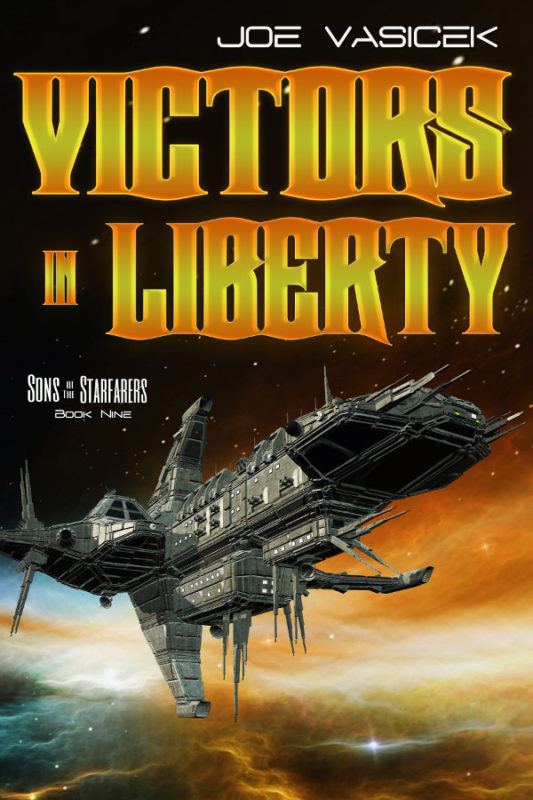
First, Victors in Liberty is now up for preorder, with a release date of July 22nd. This means that the Sons of the Starfarers series is now officially complete! The books have all been written, the plot threads have all been wrapped up (except for one or two, in case I ever decide to write another story), the edits are in, and the final versions have all been uploaded. Four and a half years went into this, and now it’s DONE!
I wrote a lengthy author’s note where I talked about the ups and downs I went through while writing this series. Basically, Sons of the Starfarers was the series that really disciplined me, turning me from a write-when-you-can, publish-when-you-feel-like-it kind of writer to one who makes and keeps deadlines and holds to a consistent release schedule.
Midway through writing this series, I really didn’t know if it was worth it to continue, but I decided to keep with it because I’d made a promise to my readers and I was going to keep it, even if there were only a few dozen of you. As it turns out, there’s quite a few more, for which I am very grateful. If you’ve been waiting since 2014 to read this series, I’m happy to report that your wait will soon be over.
As for my next WIP, I’m about a third of the way through Gunslinger to the Galaxy with a deadline of June 30th. It’s going to be tough to keep that deadline, because I’m moving before the end of the month and don’t yet know where my next place is going to be. Nothing too serious, it’s just that my contract is coming up so it’s time to move on. I’m toying with the idea of buying a National Parks pass and living out of a tent for the next two months, but in all reality I’ll probably just get a summer contract here in the Provo/Orem area. After that, who knows?
My plans are to write Gunslinger to the Galaxy and Gunslinger to Earth over the summer, and publish them both before the end of the year. A couple of years ago, this would have been a tall order, but I’ve reworked my writing process since then to the point where I don’t need multiple drafts to write clean copy. That’s partly the reason why I haven’t been blogging much recently. I’ll do a post on it sometime, if you guys are interested.
Once the Gunslingers trilogy is complete, I plan to finish Edenfall and The Stars of Redemption next. That’s another promise I need to keep to my readers. I don’t feel quite so bad, since Genesis Earth works well as a standalone, but I do need to finish the trilogy and I plan to do that before the end of next year.
On the publishing front, I’m doing a whole bunch of things behind the scenes, but the most visible thing you’ll probably see next is paperback releases for most of my books. It’s been a long time coming, and it will probably be a few months before it happens, but I plan to get those out before the end of the summer.
That’s pretty much it for now. Thanks for reading, and here’s where you can get Victors of Liberty:
As Gulchina's forces bombard Edenia II from orbit, Mara Soladze and the Deltana brothers rush to the planet's aid. Trapped on the surface, Reva finds an unlikely ally—one who proves to be a game changer for them all.
Is it time for another update? Why yes, I suppose it is.
Sons of the Starfarers is coming along quite well. Book 6, Patriots in Retreat, is up for preorder right now with a release date of January 19th. My editor just got back with the edits for book 7, A Queen in Hiding. Haven’t had a chance to look through those yet, but I will in the near future. Come January, that book will be up for preorder as well, with a release date of March 16th.
Right now, I’m writing book 8, An Empire in Disarray, with a hard deadline of 22 December (just before Christmas). Normally, I’d be panicking right now, but I’m trying out a new outlining method that seems to be working quite well. If everything works out the way I hope, I’ll finish up book 9 sometime in February and move on to other projects.
Looking back, it was a mistake to set out to write a nine-book series before knowing how the first one would do. If I could go back to 2009 and do it all over again, I’d stick to trilogies, where the first book stands well enough alone that I can abandon the other two books if it doesn’t gain much traction. That’s going to be my modus operandi from here on out.
So here are the trilogies I need to finish:
Genesis Earth Trilogy
This one has been outstanding for a long time. The first book did much better than I was expecting, and while its popularity has fallen off in recent years, it still gets very good reviews. For a first novel, I’m honestly surprised that this book has done as well as it has.
The second book, Edenfall, is still on the back burner for now. Partially written, partially outlined, it shouldn’t take more than a couple of months to get it done when I finally sit down to finish it.
As for book three, The Stars of Redemption, I have no idea because I haven’t even outlined it yet. Perhaps that’s what I need to get the ball rolling: outline the last book, so I know what has to happen in the second book. In any case.
Gunslingers Trilogy
Gunslinger to the Stars hasn’t done as well as I would have liked, but I enjoy this universe so much that I’m going to finish the trilogy if for no other reason than the fun of it. I’ve already written the first four or five chapters of Gunslinger to the Galaxy, and it’s coming along swimmingly. In fact, I’ll probably go right back to it after finishing up Sons of the Starfarers and call it a vacation. Expect to see more Jane Carter soon!
The Twelfth Sword Trilogy
I am super super excited to finish this trilogy—which is good, because the way the first book ends, it’s definitely not a standalone. Definitely not. Haven’t formally outlined it yet, but there’s a ton of stuff I’m going to throw into the second book, The Sword Bearer. Mercenaries, sorcerors, death mages, winged cataphracts, desert ruins, and mountain strongholds—it’s going to be great fun!
The Outworlds Trilogy
For a while now, I’ve been playing around with the idea of condensing all of Star Wanderers into a novel and then turning it into a trilogy. The first book will basically be made up of bits and pieces from all of the Star Wanderers novellas, spliced together to make a coherent novel. In particular, I’d like to expand on Noemi’s viewpoint and trim out some (or a lot) of the extraneous stuff that made the series drag on. Basically, turn it into less of a sci-fi romance and more of a classic space opera.
I’ve already started the sequel, Children of the Starry Sea, though I haven’t gotten past the first chapter. Where Star Wanderers is a series of novellas, though, Children of the Starry Sea is definitely a proper novel, and it would probably work a lot better to frame it as a trilogy than anything else.
I suppose it’s a bit like how Orson Scott Card turned a bunch of his early short stories into The Worthing Saga, which in my opinion is his very best book. I won’t unpublish any of the old Star Wanderers stuff, but I may just let it fade into obscurity as I push the other stuff.
These are the books that are on my mind. I’ve got to be honest: Sons of the Starfarers feels a bit like a ball and chain, but I’ve committed to finishing it and I’ll do my best to finish it well.
On the publishing front, there’s so much stuff I want to do that I’m having trouble keeping up with it all. My main goal is to get to 10k subscribers on my email list. Currently, I’m just shy of 4k. InstaFreebie has been hugely useful for that, but I’ve got to try other strategies as well. One of those strategies involves a new signup incentive, so if you’re already signed up for my email list, I’ve got a surprise for you soon.
So much stuff going on. I swear, this is the best depiction of what it’s like to be an indie author: