First Contact in Genesis Earth

Genesis Earth by Joe Vasicek is a character-driven first-contact science fiction novel about two young scientists sent through an experimental wormhole to investigate an Earthlike planet and a mysterious artificial signal. Combining deep-space exploration, forced proximity, a reluctant explorer, far-future mystery, ancient artificial intelligence, and a slow-burn romantic relationship, the novel delivers an eerie and contemplative journey filled with scientific wonder, psychological tension, and increasingly personal questions about humanity’s place among the stars.

Tropes at a Glance: First Contact, Deep-Space Exploration, Reluctant Explorer, Forced Proximity, Far-Future Earth, Ancient Artificial Intelligence, Lost Human Civilization, Slow-Burn Romance

Why Genesis Earth Is a First Contact Story

Michael Anderson has spent his life studying alien planets, but he has never wanted to visit one. Born aboard Heinlein Station during humanity’s first attempt to create an artificial wormhole, he grows up haunted by Earth—a homeworld he knows only through photographs, stories, and the memories of his parents.

When the wormhole opens onto an unknown region of space, probes discover an Earthlike planet and detect a powerful signal that cannot be explained by any known natural phenomenon. Michael is the only qualified planetologist young enough to survive the decades-long voyage, so he is sent with astronomer Terra Beck to investigate.

Their mission is supposed to be scientific, but the possibility of first contact hangs over it from the beginning. Michael and Terra do not know who produced the signal, whether its creators are peaceful, or whether they are still present. They have no diplomatic team, military escort, or reliable first-contact protocol. They are two inexperienced scientists traveling alone toward a civilization whose technology may be millions of years beyond their own.

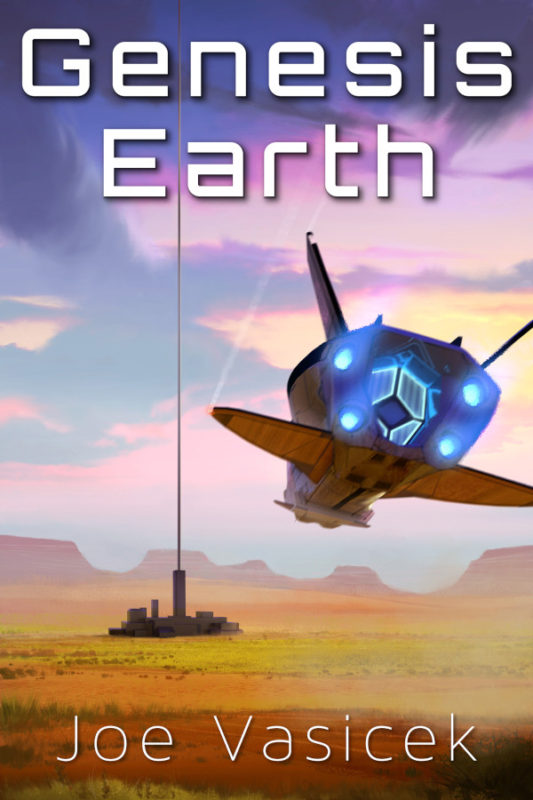
The closer they come to the planet they name Icaria, the stranger the evidence becomes. An enormous spacecraft appears without warning. An ancient space elevator hangs above a world that seems almost untouched by civilization. Primitive settlements exist beneath technological structures their inhabitants could never have built. Every discovery suggests intelligence, yet every attempt to understand that intelligence raises more questions.

How First Contact Drives the Story

First contact is not a single encounter in Genesis Earth. It is the organizing problem behind nearly every major decision Michael makes.

His desire to understand the unexplained signal draws him toward dangers that Terra would rather avoid. When their probes are destroyed, he must decide whether to retreat or risk approaching the mysterious ship directly. When alien technology enters their own vessel, curiosity and fear compete for control. Each new discovery forces Michael to choose between protecting the mission, satisfying his need for answers, and preserving the fragile trust between himself and Terra.

The first-contact mystery also exposes Michael’s deepest weaknesses. He has grown up beneath the expectations of brilliant parents who taught him that his mission could determine humanity’s future. He wants to be a careful scientist, but he also desperately wants to prove himself worthy of their sacrifices. Faced with discoveries larger than anything he imagined, he becomes controlling, obsessive, and increasingly willing to endanger himself in pursuit of answers.

Terra responds differently. Where Michael pushes toward the unknown, she often withdraws from it. Their opposing reactions create mistrust and conflict aboard a ship where neither can escape the other. Yet the danger also forces them to communicate, depend on one another, and reconsider the assumptions they brought from home.

Through these encounters, Michael’s understanding of first contact gradually changes. At first, he sees it as a historic scientific achievement—something that will secure his place in history and fulfill his parents’ ambitions. As the mission develops, contact becomes less about recognition and more about responsibility. The true question is no longer merely whether he can discover intelligent life, but how he should respond when the beings and civilizations he encounters do not fit his expectations.

Supporting Tropes and Genre Conventions

The Reluctant Explorer

Michael is a trained planetologist who would rather study alien worlds through a telescope than walk on one himself. He accepts the mission because of duty, family expectations, and the belief that no one else can perform it. His reluctance makes each step into the unknown feel consequential: exploration is not effortless adventure for him, but a repeated confrontation with fear.

Forced Proximity in Deep Space

Michael and Terra spend decades of objective time traveling aboard the Icarus, with no other human beings within light-years. Inside the ship’s narrow corridors, every disagreement becomes harder to avoid and every failure of trust becomes more dangerous. Their isolation turns the novel’s scientific mission into an intimate psychological story about two people learning whether they can survive one another as well as the unknown.

Slow-Burn Romance

Michael and Terra begin as colleagues who barely know each other and have been primed to distrust one another. Their relationship develops through shared work, arguments, rescues, confessions, and moments of vulnerability. The romance grows gradually out of dependence and hard-won trust rather than immediate attraction, giving the emotional arc a direct connection to the survival story.

Far-Future Earth and Lost Humanity

The wormhole does more than cross an enormous distance. Michael and Terra gradually discover that the silent universe around Icaria contains mysteries connected to Earth and the ultimate fate of human civilization. This far-future setting transforms first contact into an act of cosmic archaeology, as the explorers search through abandoned technology and incomplete evidence for signs of what humanity became.

Ancient Artificial Intelligence and Abandoned Megastructures

A ghost ship, an orbital elevator, autonomous machines, and technology that has continued operating long after its creators disappeared give the novel a strong ancient-technology mystery. These objects are not merely impressive scenery. They become forms of indirect communication, preserving fragments of purpose and history that Michael and Terra must interpret without knowing whether the machinery is helpful, hostile, or simply indifferent.

How Genesis Earth Develops These Tropes

Many first-contact stories focus on communication between two active civilizations. Genesis Earth takes a different approach. Michael and Terra encounter silence, automated systems, ancient infrastructure, and beings whose connection to the technology around them is unclear. First contact becomes a process of interpretation rather than a straightforward diplomatic meeting.

The novel also places unusually vulnerable people at the center of that process. Michael and Terra are young scientists rather than soldiers, politicians, or veteran explorers. They possess specialized knowledge, but they are emotionally unprepared for the isolation and responsibility placed upon them. Their scientific competence does not prevent fear, jealousy, pride, or misunderstanding from distorting their judgment.

That character dynamic gives the familiar first-contact trope a psychological dimension. Michael repeatedly assumes that enough information will make the unknown less frightening, while Terra recognizes that some discoveries cannot be controlled. Neither approach is entirely sufficient. They must learn that successful contact requires more than intelligence. It also demands patience, humility, trust, and a willingness to recognize forms of humanity that do not resemble the civilization they left behind.

The book’s moral perspective ultimately distinguishes technological progress from human flourishing. Vast machines can survive for millions of years, but they cannot by themselves preserve meaning, community, or purpose. Scientific discovery matters, yet the novel repeatedly asks what that discovery is for—and whether making history is worth anything if the pursuit destroys the relationships that give life its value.

The Story’s Tone and Emotional Payoff

Genesis Earth begins with scientific anticipation and gradually develops an eerie, claustrophobic atmosphere. The empty star system, silent spacecraft, narrow corridors of the Icarus, and unexplained movements of ancient machines create a persistent sense that Michael and Terra are being watched by something they cannot understand.

That tension is balanced by moments of cosmic wonder. Icaria’s oceans and continents, the view from the space elevator, and the remains of a civilization spread across the stars give the story a scale far larger than the two people at its center. At the same time, the novel remains emotionally intimate, grounding its largest discoveries in Michael’s longing for Earth and his changing relationship with Terra.

The eventual payoff is hopeful without dismissing the story’s losses. Michael and Terra discover that the future may not resemble the destiny their parents imagined, but that does not mean humanity’s story is over. Their journey transforms first contact from an encounter with something wholly alien into a meditation on inheritance, belonging, love, and the possibility of beginning again.

For readers looking for thoughtful first-contact science fiction with deep-space isolation, ancient technology, far-future mystery, and a slow-building relationship between two young scientists, Genesis Earth offers a distinctly personal journey into the unknown.

Where to Get the Book

Related Posts and Pages

Explore the series index for the Genesis Earth Trilogy.

Return to the book page for Genesis Earth.

Being Equally Yoked in Gunslinger to the Galaxy

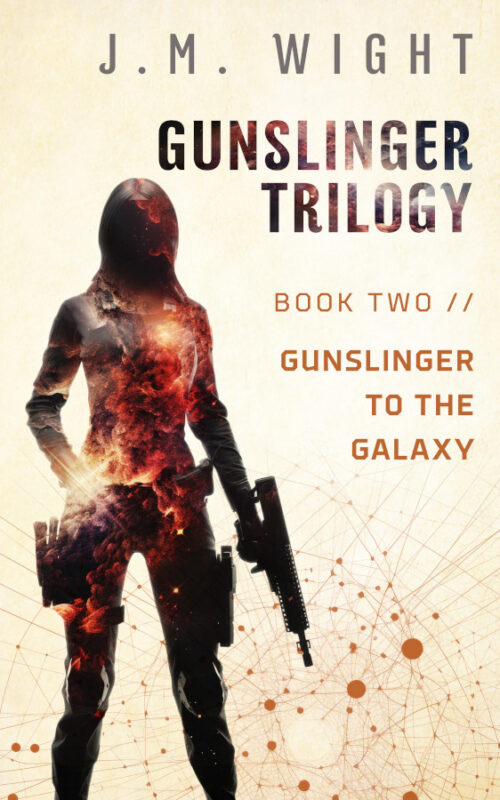
At its core, Gunslinger to the Galaxy is a space-opera story built around a deceptively simple question: what does it mean to be equally yoked when the universe is coming apart at the seams? Jane Kletchka isn’t just trying to save Earth; she’s trying to build a marriage, a family, and a vocation that all matter in an honest, eternal way. The story keeps circling back to this tension: how do you stay true to your gifts, your faith, and your partner when war, politics, and Immortal-sized crises keep demanding more?

Where the Idea Came From

When I wrote Gunslinger to the Galaxy, I was working part-time at a warehouse in Iowa and later grinding through a 40+ hour per week construction job in Utah. I wasn’t married yet, but it was something I definitely wanted in my life, and I poured that into my writing, forcing myself to write a few hundred words a day even when I was exhausted and everything around me felt like a dump.

That experience of trying to build something meaningful in the middle of chaos is baked into Jane and Sam’s story. At its heart, Gunslinger to the Galaxy is about two people trying to be a force for good while the universe keeps trying to knock them flat. I kept that theme close even through the difficult circumstances surrounding its writing—and, fittingly, around the time I finished the book, I also met the woman who would become my wife.

How Being Equally Yoked Shapes the Story

“Equally yoked” isn’t just a passing phrase in this book; it’s the backbone of Jane’s entire arc. From the early garden conversation with her mother—where Mom worries that Jane will end up standing in Sam’s shadow instead of using her own God-given talents as a xenolinguist—the story keeps pressing on a single pressure point: is this marriage helping both partners become what they’re meant to be, or is one being swallowed by the other’s path?

When the jumpgate network collapses and the Immortal civil war throws the galaxy into crisis, Jane has every excuse to curl up and let events happen to her. Instead, the story turns when she realizes she can’t just be “the gunslinger’s wife.” Drawing on Sam’s blunt insight about control and trauma, she chooses to use her training, her languages, and her brain to actually shape events—digging into logs, mapping networks, and turning her grief and fear into concrete action that can save lives and maybe bring Sam home. Being equally yoked here means more than just sharing a last name; it means each partner brings their full self to the fight, and the marriage becomes a shared mission instead of a sacrifice of one person’s calling to the other’s.

By the end, when Jane and Sam are sealed in the temple and begin building a family, the book circles back to that original fear: will motherhood and marriage erase Jane’s larger purpose? The answer is no—but not because the galaxy gets easier. Instead, the story shows her finding ways to balance remote work for the Andromedans and the Intergalactic Council with raising John Moses, weaving vocation, faith, and family into a single, hard-won whole. The adventure isn’t over; it’s just moved into a new phase where “equally yoked” means building a life that can withstand both warp drives and diapers.

What Being Equally Yoked Says About Us

In science fiction, we often see lone-wolf heroes or solitary saviors, but Gunslinger to the Galaxy takes a different path by centering a married-couple partnership in a space-opera setting. Under all the jumpgates and Immortals, this is a story about something very human: the fear that love will cost us our calling—or that our calling will cost us love. Most of us aren’t piloting starships, but we know what it feels like to worry that marriage, family, career, or faith will pull us in different directions until something breaks. Gunslinger to the Galaxy suggests a different model: the people we love most should help us become more ourselves, not less. Being equally yoked doesn’t mean never struggling or never disagreeing; it means pulling the same direction when the load gets heavy, and trusting that God can turn two flawed people into a team that does more good together than either could alone.

Why Being Equally Yoked Matters to Me

I wasn’t married when I wrote Gunslinger to the Galaxy, but it was definitely something I was looking forward to. I wrote it during a season of my life that was chaotic, exhausting, and frankly not very glamorous, but I pushed forward anyway, trusting that the kind of woman I hoped to marry someday would value that dedication. And sure enough, when I finally met her, one of the things that drew her to me was my hard work and dedication to my writing—a dedication that I have also channeled into our marriage and family life.

For me, Gunslinger to the Galaxy is a story about faith, marriage, and the stubborn belief that ordinary people can still choose to do the right thing together, even when it hurts. If this book resonates with you, I hope it’s because you see a bit of your own struggle to be “equally yoked” in a world that always seems on the brink—and you feel a little more hope that it’s worth the fight.

Where to Get the Book

Related Posts and Pages

Explore the series index for the Gunslinger Trilogy.

Return to the book page for Gunslinger to the Galaxy.

Is Gunslinger to the Galaxy for you?

See all of my books in series order.

Is Gunslinger to the Galaxy for You?

Gunslinger to the Galaxy is a character-driven space opera about two gunslingers and the interstellar war that forces them to risk everything for Earth. It’s a fast-paced space-opera adventure told through the sharp, heartfelt, often hilarious voice of Jane Kletchka—a xenolinguist newly married to a mercenary gunslinger whose moral stubbornness keeps getting them both into trouble. This is a story about love, loyalty, danger, and the terrifying size of the galaxy when everything collapses at once. Expect a cinematic blend of military sci-fi, first-contact intrigue, and found-family courage.

What Kind of Reader Will Love This Book?

If you like…

  • Jack Campbell’s Lost Fleet
  • Lois McMaster Bujold’s Vorkosigan Saga
  • Character-driven space opera where the heart of the story is a loyal crew that refuses to quit
  • Western-flavored sci-fi heroes who charge headlong into impossible odds (with big guns and bigger convictions)
  • Xenolinguistics, alien politics, and intergalactic mystery woven into a sweeping adventure
  • Married-couple banter, warm emotional stakes, and a hero/heroine partnership forged in fire
  • High-stakes battles, warp-drive exploration, and cosmic consequences

…then Gunslinger to the Galaxy is absolutely your kind of story.

What You’ll Find Inside

You’ll follow Jane Kletchka, a brilliant xenolinguist, as she returns to Earth with her gunslinger husband Sam—only to be swept into a galactic crisis involving shattered jumpgate networks, Immortal civil wars, refugee swarms, and a catastrophic threat to Sol itself.

The tone blends romantic adventure, military sci-fi tension, and classic space-opera wonder, all grounded by Jane’s warm, honest, often funny narrative voice. Expect tight pacing, big emotional beats, and a story that moves from intimate family moments to galaxy-spanning stakes without missing a beat.

What Makes It Different

Fans of The Expanse, Honor Harrington, or Firefly will recognize the blend of frontier grit, military realism, and cross-species politics—but Gunslinger to the Galaxy takes those ideas in a fresh direction by placing a married couple at the emotional center of the story. Where many space-opera series focus on lone-wolf heroes, this book leans into the dynamics of partnership, trust, and being “equally yoked” in the middle of interstellar chaos. It combines xenolinguistic problem-solving, Immortal cosmic lore, and Western-style gunslinger ethos in a way no other space-opera series does.

What You Won’t Find

This isn’t grimdark, dystopian, or nihilistic sci-fi—there’s hardship and tragedy, but the story is ultimately hopeful, heroic, and rooted in family and faith. There is no gratuitous violence, no graphic romance, and no cynical “everyone is corrupt” worldview. If you’re looking for bleak anti-heroes or hard-SF technobabble at the expense of character, this won’t be the right fit.

Why I Think You Might Love It

At its core, this book is about ordinary people thrown into extraordinary crises who choose—over and over—to do what’s right, even when it costs them everything. Jane and Sam aren’t superheroes; they are a married couple trying to build a life together while the galaxy falls apart around them. Their courage, humor, and stubborn devotion give the story its heartbeat. If you’ve ever wanted a space-opera that delivers big adventure without losing its humanity, Gunslinger to the Galaxy was written for you.

In short, if you’re looking for a hopeful, high-adventure space opera filled with alien civilizations, military sci-fi battles, found-family warmth, and a fiercely devoted married couple, Gunslinger to the Galaxy delivers exactly that.

Where to Get the Book

Related Posts and Pages

Explore the series index for the Gunslinger Trilogy.

Return to the book page for Gunslinger to the Galaxy.

Being Equally Yoked in Gunslinger to the Galaxy

See all of my books in series order.

Breaking the Time Paradox in The Stars of Redemption

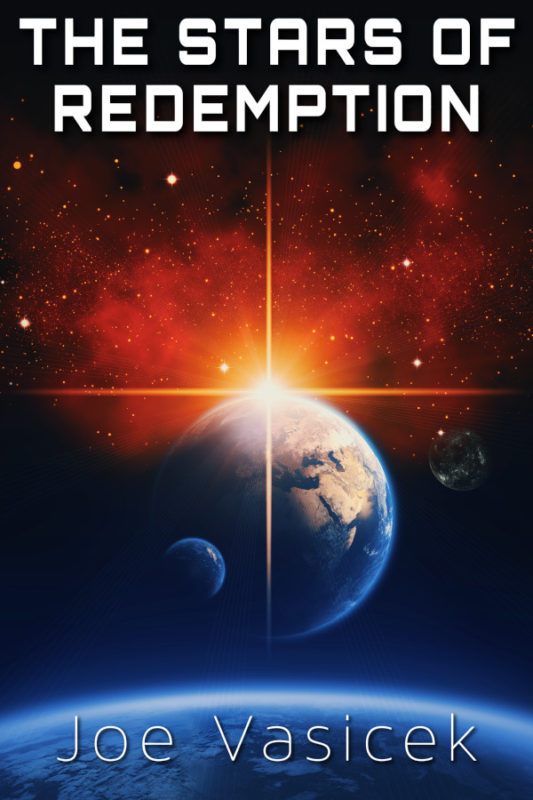
What if the deadliest threat humanity ever faced wasn’t an alien invasion or a rogue AI… but a mistake we keep repeating that always ends with the destruction of Earth? The Stars of Redemption, the last book in my young adult science fiction trilogy, explores this question.

At its core, The Stars of Redemption is about the struggle to break a closed time loop, stop a rogue superintelligence, and rewrite a future that seems unchangeable. This makes The Stars of Redemption a classic time-loop science fiction story, built around temporal paradoxes, fate-versus-free-will dilemmas, and the struggle to break a repeating extinction cycle. It is a story about escaping destructive cycles, choosing hope, and fighting for a future that isn’t predetermined.

Where the Idea Came From

The idea for this theme grew out of my long, tangled journey to finish the trilogy. As I write in the author’s note, the trilogy stalled until I became a husband and father. Holding my newborn daughter for the first time made me realize that the story needed to be about cycles—time loops, family patterns, repeating trauma—and the hope that they can be broken. Only then did I understand how to write about ending the loop and choosing a new future.

How Breaking the Time Paradox Shapes the Story

The entire plot of this sci-fi book revolves around a temporal paradox created by a wormhole, a derelict starship, and a fragmented AI superintelligence. The ghost ship is both the catalyst and the prison of a machine intelligence born from the loop—a being that believes humanity must be wiped out to prevent another cycle of suffering. Every conflict Estee and Khalil face—from warped corridors to shifting timelines—exists because they are trapped inside this repeating extinction loop.

For Estee, breaking the time loop becomes a confrontation with her family’s past and her people’s future. She must decide whether humanity deserves redemption and whether history can be changed. Khalil must confront his own emotional loop: guilt, self-sacrifice, and the belief that his fate is fixed. Together, they face a question at the heart of all time-loop fiction:

Are we doomed to repeat our worst mistakes, or can we rewrite the future?

What the Time Paradox Says About Us

Time loops are powerful metaphors because we all face cycles—personal, cultural, generational—that feel impossible to escape. The paradox in this story mirrors the real world: destructive systems repeat unless someone chooses differently. By facing a machine intelligence convinced that humanity is irredeemable, the characters confront the fear that our past defines us. The book suggests a hopeful alternative: the future changes when we do.

Why This Theme Matters to Me

I didn’t truly understand this story until I became a father. My daughter made the theme real: breaking cycles isn’t abstract—it’s something we do for the next generation. That moment of holding her and realizing this is her story now, not yours helped me finish the book. The Stars of Redemption is my way of saying that even in the darkest timelines—even in repeating loops—hope is possible, and the future can be rewritten.

Where to Get the Book

Related Posts and Pages

Explore the series index for the Genesis Earth Trilogy.

Visit the book page for Genesis Earth for more details.

Find out if The Stars of Redemption is for you.

See all of my books in series order.