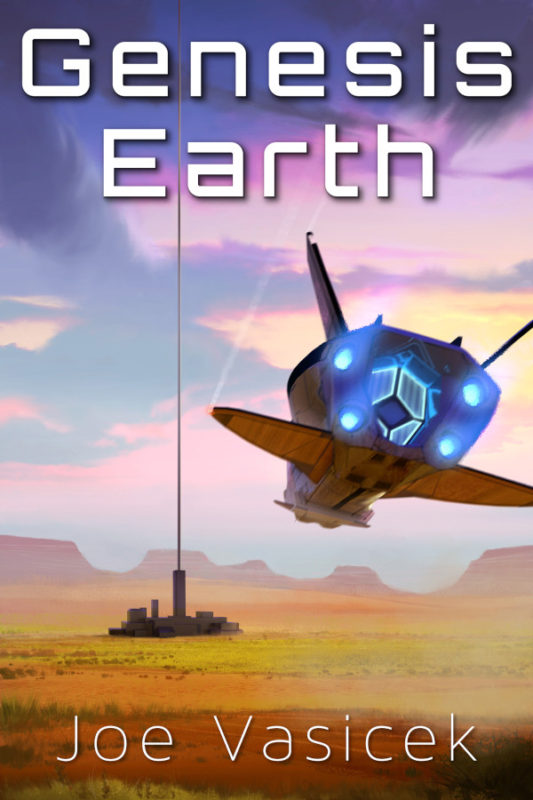
Genesis Earth by Joe Vasicek is a character-driven first-contact science fiction novel about two young scientists sent through an experimental wormhole to investigate an Earthlike planet and a mysterious artificial signal. Combining deep-space exploration, forced proximity, a reluctant explorer, far-future mystery, ancient artificial intelligence, and a slow-burn romantic relationship, the novel delivers an eerie and contemplative journey filled with scientific wonder, psychological tension, and increasingly personal questions about humanity’s place among the stars.
Tropes at a Glance: First Contact, Deep-Space Exploration, Reluctant Explorer, Forced Proximity, Far-Future Earth, Ancient Artificial Intelligence, Lost Human Civilization, Slow-Burn Romance
Why Genesis Earth Is a First Contact Story
Michael Anderson has spent his life studying alien planets, but he has never wanted to visit one. Born aboard Heinlein Station during humanity’s first attempt to create an artificial wormhole, he grows up haunted by Earth—a homeworld he knows only through photographs, stories, and the memories of his parents.
When the wormhole opens onto an unknown region of space, probes discover an Earthlike planet and detect a powerful signal that cannot be explained by any known natural phenomenon. Michael is the only qualified planetologist young enough to survive the decades-long voyage, so he is sent with astronomer Terra Beck to investigate.
Their mission is supposed to be scientific, but the possibility of first contact hangs over it from the beginning. Michael and Terra do not know who produced the signal, whether its creators are peaceful, or whether they are still present. They have no diplomatic team, military escort, or reliable first-contact protocol. They are two inexperienced scientists traveling alone toward a civilization whose technology may be millions of years beyond their own.
The closer they come to the planet they name Icaria, the stranger the evidence becomes. An enormous spacecraft appears without warning. An ancient space elevator hangs above a world that seems almost untouched by civilization. Primitive settlements exist beneath technological structures their inhabitants could never have built. Every discovery suggests intelligence, yet every attempt to understand that intelligence raises more questions.
How First Contact Drives the Story
First contact is not a single encounter in Genesis Earth. It is the organizing problem behind nearly every major decision Michael makes.
His desire to understand the unexplained signal draws him toward dangers that Terra would rather avoid. When their probes are destroyed, he must decide whether to retreat or risk approaching the mysterious ship directly. When alien technology enters their own vessel, curiosity and fear compete for control. Each new discovery forces Michael to choose between protecting the mission, satisfying his need for answers, and preserving the fragile trust between himself and Terra.
The first-contact mystery also exposes Michael’s deepest weaknesses. He has grown up beneath the expectations of brilliant parents who taught him that his mission could determine humanity’s future. He wants to be a careful scientist, but he also desperately wants to prove himself worthy of their sacrifices. Faced with discoveries larger than anything he imagined, he becomes controlling, obsessive, and increasingly willing to endanger himself in pursuit of answers.
Terra responds differently. Where Michael pushes toward the unknown, she often withdraws from it. Their opposing reactions create mistrust and conflict aboard a ship where neither can escape the other. Yet the danger also forces them to communicate, depend on one another, and reconsider the assumptions they brought from home.
Through these encounters, Michael’s understanding of first contact gradually changes. At first, he sees it as a historic scientific achievement—something that will secure his place in history and fulfill his parents’ ambitions. As the mission develops, contact becomes less about recognition and more about responsibility. The true question is no longer merely whether he can discover intelligent life, but how he should respond when the beings and civilizations he encounters do not fit his expectations.
Supporting Tropes and Genre Conventions
The Reluctant Explorer
Michael is a trained planetologist who would rather study alien worlds through a telescope than walk on one himself. He accepts the mission because of duty, family expectations, and the belief that no one else can perform it. His reluctance makes each step into the unknown feel consequential: exploration is not effortless adventure for him, but a repeated confrontation with fear.
Forced Proximity in Deep Space
Michael and Terra spend decades of objective time traveling aboard the Icarus, with no other human beings within light-years. Inside the ship’s narrow corridors, every disagreement becomes harder to avoid and every failure of trust becomes more dangerous. Their isolation turns the novel’s scientific mission into an intimate psychological story about two people learning whether they can survive one another as well as the unknown.
Slow-Burn Romance
Michael and Terra begin as colleagues who barely know each other and have been primed to distrust one another. Their relationship develops through shared work, arguments, rescues, confessions, and moments of vulnerability. The romance grows gradually out of dependence and hard-won trust rather than immediate attraction, giving the emotional arc a direct connection to the survival story.
Far-Future Earth and Lost Humanity
The wormhole does more than cross an enormous distance. Michael and Terra gradually discover that the silent universe around Icaria contains mysteries connected to Earth and the ultimate fate of human civilization. This far-future setting transforms first contact into an act of cosmic archaeology, as the explorers search through abandoned technology and incomplete evidence for signs of what humanity became.
Ancient Artificial Intelligence and Abandoned Megastructures
A ghost ship, an orbital elevator, autonomous machines, and technology that has continued operating long after its creators disappeared give the novel a strong ancient-technology mystery. These objects are not merely impressive scenery. They become forms of indirect communication, preserving fragments of purpose and history that Michael and Terra must interpret without knowing whether the machinery is helpful, hostile, or simply indifferent.
How Genesis Earth Develops These Tropes
Many first-contact stories focus on communication between two active civilizations. Genesis Earth takes a different approach. Michael and Terra encounter silence, automated systems, ancient infrastructure, and beings whose connection to the technology around them is unclear. First contact becomes a process of interpretation rather than a straightforward diplomatic meeting.
The novel also places unusually vulnerable people at the center of that process. Michael and Terra are young scientists rather than soldiers, politicians, or veteran explorers. They possess specialized knowledge, but they are emotionally unprepared for the isolation and responsibility placed upon them. Their scientific competence does not prevent fear, jealousy, pride, or misunderstanding from distorting their judgment.
That character dynamic gives the familiar first-contact trope a psychological dimension. Michael repeatedly assumes that enough information will make the unknown less frightening, while Terra recognizes that some discoveries cannot be controlled. Neither approach is entirely sufficient. They must learn that successful contact requires more than intelligence. It also demands patience, humility, trust, and a willingness to recognize forms of humanity that do not resemble the civilization they left behind.
The book’s moral perspective ultimately distinguishes technological progress from human flourishing. Vast machines can survive for millions of years, but they cannot by themselves preserve meaning, community, or purpose. Scientific discovery matters, yet the novel repeatedly asks what that discovery is for—and whether making history is worth anything if the pursuit destroys the relationships that give life its value.
The Story’s Tone and Emotional Payoff
Genesis Earth begins with scientific anticipation and gradually develops an eerie, claustrophobic atmosphere. The empty star system, silent spacecraft, narrow corridors of the Icarus, and unexplained movements of ancient machines create a persistent sense that Michael and Terra are being watched by something they cannot understand.
That tension is balanced by moments of cosmic wonder. Icaria’s oceans and continents, the view from the space elevator, and the remains of a civilization spread across the stars give the story a scale far larger than the two people at its center. At the same time, the novel remains emotionally intimate, grounding its largest discoveries in Michael’s longing for Earth and his changing relationship with Terra.
The eventual payoff is hopeful without dismissing the story’s losses. Michael and Terra discover that the future may not resemble the destiny their parents imagined, but that does not mean humanity’s story is over. Their journey transforms first contact from an encounter with something wholly alien into a meditation on inheritance, belonging, love, and the possibility of beginning again.
For readers looking for thoughtful first-contact science fiction with deep-space isolation, ancient technology, far-future mystery, and a slow-building relationship between two young scientists, Genesis Earth offers a distinctly personal journey into the unknown.
Where to Get the Book