Lindsey Stirling, Nichieri, Susan Boyle, and thoughts on discoverability and greatness

I saw a couple of things on Youtube that made me think recently about the importance of quality work, especially in the arts.

I’m a casual fan of Lindsey Stirling–I’ve watched most of her videos, put them on in the background from time to time, and get a kick out of following her career. For those of you unfamiliar with her, she’s a Youtube sensation who combines violin music, dance, and dubstep/electronica, often in some interesting and beautiful places. This is her most popular video, and probably her best work so far:

Her career is interesting because it follows a path very similar to a lot of self-published authors. She started by putting out videos on Youtube, built up a huge following that way, turned down a number of deals from traditional record labels and put out her first album herself. Now, she’s touring all over the world, collaborating with a bunch of other Youtube artists, and doing a lot of other amazing stuff completely independently.

The other day, I was really surprised that she was on America’s Got Talent back in 2010. Apparently, this was before she got really big, and the connections she made while on the show helped her find success later on:

Two things stood out to me from that video.  First, the judges were right–even though she was pushing herself, this was not her best work, and it showed in a way that was rather glaring. I hate to say that because I like so much of her stuff, but it’s really true–her performance fell short.

The second thing that stood out to me was her response to the criticism. It must have been incredibly painful to stand up there in front of everybody and get hammered like that, but she still managed to smile, be gracious, thank the judges, and focus on the positive without being confrontational. That takes class.

When I was in Georgia, I watched a lot of TV, especially on the Rustavi 2 channel. One of the most popular shows is Nichieri (ნიჭიერი), a talent competition show set up much like The X Factor or America’s Got Talent. Even though I didn’t really understand anything the people were saying, I could still really tell when a contestant did some truly amazing.

There’s something about greatness that makes you sit up and pay attention–something that makes it stand out on its own. It’s something timeless and stirring, something that drives you to keep coming back to it, or at least to remember it long after it’s passed. With poor quality stuff, like bad writing, clumsy performance, or the like, you tend to forget it (unless of course it’s a spectacular failure, which in a weird way gains a sort of greatness of its own to a certain extent). But good quality stuff sticks with you–indeed, it’s almost like it becomes a part of you. It certainly becomes part of the culture.

When it comes to talent shows like Nichieri, The X Factor, and America’s Got Talent, the greatest moment has to be Susan Boyle. Everything about it is just perfect, from the awkward, homely way she started out to how she blew everyone away with her stellar performance. She didn’t look like she had it, and she certainly didn’t act like she had it, but she did, and she knew it. She didn’t settle for anything less than her best, and she didn’t let anyone else put her down.

In a lot of my discussions with other indie writers, we talk a lot about discoverability. We’re all anxious to be read, to be heard, to be discovered–to get our shining moment. The thing is, though, that moment is not enough if you don’t have quality work. It’s not going to keep you down or “ruin” your career, necessarily–Lindsey Stirling has come a long way since her disappointing performance on America’s Got Talent. But that’s only because she produces quality work.

I think I need to spend a lot less time trying to boost my discoverability and a lot more into producing the best work that I possibly can. The thing to remember, though, is that quality is subjective and you can’t please everyone. As Lindsey later said, “A lot of people have told me along the way that my style and the music I do … is unmarketable. But the only reason I’m successful is because I have stayed true to myself.” You can’t compare yourself against others, either–you can only really compete against yourself.

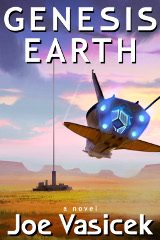
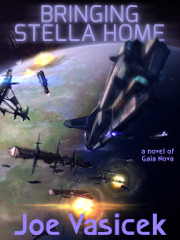
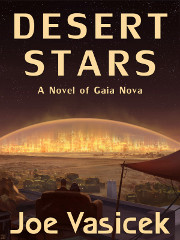
How do you know when you’ve done your best? That can be a little tricky, partly because it’s a moving target. I think Genesis Earth and Bringing Stella Home represent my best work at the time, though when I look back at those books I see things that could be improved. I tend to think that Desert Stars is my best work to date, though I’m not so sure anymore. Do I only think that because I struggled so much and for so long with that book? Just because something is a joy to create doesn’t mean that it’s any less than something you toiled and suffered over.

Star Wanderers was both a gift story and an experiment. The novella format was new to me at the time, so I did a lot of learning on it. Outworlder, Dreamweaver, Homeworld, and Deliverance came to me in a white-hot creative heat, but Sacrifice and Reproach were a real struggle. Is there a discernible difference in quality between them? Not that I can tell. I do think that the later stories hold together better on their own, though. I didn’t really hit my stride with the novella format until I started branching off into other characters’ viewpoints.

This is all on my mind because my next big project, Sons of the Starfarers, is something that I really want to do right. I don’t just want to write it for the sake of putting it out there (though I recognize that writing quickly doesn’t always mean sacrificing quality). I don’t just want to put it out so that I can make my work more “discoverable,” though that’s certainly a motivation. I don’t even just want to do my best. I want to improve my writing and storytelling so much that this becomes the best thing that I’ve ever written.

At LTUE a few years back, Tracy Hickman said that as writers, it is important for us to believe that we have not yet written our best book. That’s so incredibly true. You have to always believe that you can do better, not to make you depressed when you look back, but to make you enthusiastic as you look forward. Imagine what would have happened if Lindsey Stirling thought that her performance on America’s Got Talent was the best that she’d ever do! Her career hadn’t even dawned yet.

I think it’s the same with me. I’ve gained a little exposure, suffered a few setbacks, and experienced a small measure of success, but the big stuff is yet to come. And even though I may not want to be the next Brandon Sanderson or Orson Scott Card in terms of popularity, I do need to shoot high in terms of quality. Before I work on my discoverability, I need to make sure that I’m putting out some truly amazing stuff. I need to shoot for greatness.

So what should I work on next?

Now that Star Wanderers: Deliverance (Part VIII) is published, I’m back in the position of trying to figure out what to write next.  Usually, I just do this on my own, but this time I thought I’d run it by my readers and see what you guys have to say.  Here are the options:

Heart of the Nebula — This is a direct sequel to Bringing Stella Home.  It follows James, Lars, Stella, and several new characters as they struggle to keep the Colony from falling apart following the collapse of the New Gaian Empire.  This one is mostly a space opera story, with lots of action and political intrigue.  It also explores the wolf/sheepdog analogy that Danica brought up in Bringing Stella Home, with Lars’s rebuttal.

Mercenary Savior — Another Gaia Nova novel, this one showing the origins of Danica Nova and her band of Tajji mercenaries.  I’ve got a lot of ideas for this one, though I’ve only written the prologue so far.  This is going to be a military sci-fi story, with lots of action, lots of violence, and (hopefully) a few heart-wrenching moments as well.  Danica, Roman, Mikhail, Artyom, and several of the other mercenaries will appear in this one.

Empress of the Free Stars — Yet another Gaia Nova novel, this one a direct sequel of Stars of Blood and Glory.  It brings back Princess Hikaru, now the Empress of Shinihon, and shows her struggle to ensure the safety and freedom of her people in the face of a Federation that is fast transforming into an autocratic, totalitarian empire.  Colonel Webb is at the heart of the political intrigue in this one, and the stakes are as high as they’ve ever been.

Sons of the Starfarers — This is the spinoff series I’m writing to follow up Star Wanderers.  It takes place in the same universe as the Gaia Nova novels, except a thousand years before, and will eventually show the origins of the Hameji and tie all of these books together.  This is the one I’m most excited to write, as it brings back a bunch of characters from Star Wanderers and puts them into some interesting situations.  Hopefully, it will have the same stuff that made Star Wanderers so great while adding a bit more action/adventure stuff into the mix.

Edenfall — This one is the sequel to Genesis Earth, and the second book in what will eventually become a trilogy.  Basically, about fifteen years after Michael and Terra settle down on Icaria, a military expedition arrives from Earth, shattering the idyllic life they’ve made for themselves.  They try to convince the military people that there is no alien threat, but before they can do that, the ghost ship comes back, throwing everything out of balance.  This story is mostly from the point of view of Estee, Michael and Terra’s daughter, whose whole world is changed when the other humans appear.

Lifewalker — I’ve mentioned this one only a couple of times on my blog, but everyone who’s read the first chapter tells me that they want more.  This one is a completely different project from anything else I’ve done.  It’s a post-apocalyptic tale told from the point of view of a man who lives out his natural life where everyone else is infected with a disease that kills them at age 25.  After the first chapter, the he starts down the ruins of I-15 with a bible, a bicycle, and a copy of Brandon Sanderson’s Mistborn, searching for the mythical city of light known by the forefathers as Lavegas.  Little does he know, that place is now populated by cannibals.

The Sword Bearer — An epic fantasy about an ancient brotherhood of sentient swords who pass down the knowledge and skills of each bearer down through the generations.  The brotherhood has been broken, and the few swords that haven’t been lost have driven their bearers insane to the point where they’re now amassing an army to conquer and enslave the whole world.  The only sword who hasn’t gone down that path is the one prophesied to be wielded in the final battle to defeat this great evil, but it hasn’t taken a bearer for almost a thousand years–that is, until a curious young tavern girl from the mountains accidentally stumbles upon it.

Those are pretty much all the major options.  I have a couple ideas for other books, but nothing that I’ve really started.  Even though I have my preferences, I could go almost any way depending on what you guys want to read.  So if there’s one or two that you really want me to work on next, feel free to let me know!

Trope Tuesday: Forbidden Zone

For the next few Trope Tuesday posts, I’m going to pick apart some of the tropes I’m playing with in my latest WIP, Sons of the Starfarers.  One of the things I love to do when brainstorming a new story is to use tvtropes like a menu, finding the tropes that best fit my story ideas and combining them with other tropes to get even more ideas.

It’s not often hard to spot the forbidden zone in a fantastical world.  Perhaps it has an ominous name (bonus points if it has the word “doom” in it), or perhaps there’s some sort of sign saying “do not enter.” Either way, this is definitely a place where no one goes, and no one is supposed to go.

Of course, you can pretty much guarantee that the main characters are going to go there.  It’s like the forbidden fruit: the very fact that it’s off limits makes it more alluring.  If genre blindness is in effect, someone will probably make the mistake of saying “what could possibly go wrong?

There are many reasons why the zone may be forbidden.  Perhaps it’s a death world, where the characters will soon find themselves running for their lives.  Perhaps it’s not quite so dangerous, but once you go, you can never come back.  Or perhaps all the warnings were lies, and the so-called forbidden zone is actually the place that the characters needed to get to all along.  If that’s the case, then the mentor was probably a broken pedestal or the Svengali.

In any case, the forbidden zone definitely lies in the realm of adventure.  Depending on how soon or how late in the story the characters go there, it may lie just on the other side of the threshold, at the bottom of the belly of the whale, or at the very heart of the character’s nadir.

The Mines of Moria, the Toxic Jungle, Area 51, the Elephant Graveyard, and the Fire Swamp are all classic examples.  In C.S. Lewis’s Space Trilogy, Earth itself is a forbidden zone to all the other inhabitants of the solar system, which is why it’s called the silent planet.

In real life, there are plenty of these as well.  Just look at the DMZ on the Korean Peninsula, or the fallout zone around Chernobyl.  When I was living in Georgia, Abkhazia was off limits to the TLG volunteers, meaning that if you went there (and the Ministry of Education found out about it) it was grounds for immediate firing.  Of course, that only encouraged some of my TLG friends to go there even more–remember the forbidden fruit?  Others waited until their contracts were over and practically made a tour of the many forbidden zones of the Caucasus, including Nagorny Karabakh, which one friend described as safer than Philadelphia.

I’ve toyed with this trope in my own work, but never too explicitly.  The best example is probably the alien ghost ship from Genesis Earth.  It’s not exactly forbidden, since there’s no one around to tell Mike not to go there, but Terra definitely doesn’t want him to go.  Earlier in the same book, she forbids him from entering her workspace in the observatory, which leads to some complications and a major reveal when he inevitably does.  In the Gaia Nova series, the Outer Reaches qualify as a forbidden zone, since the only people who live out there are murderous barbarians like the Hameji.

In my new series, Sons of the Starfarers, the first book starts out with a forbidden zone–a derelict space colony, where everyone has died of an unknown cause.  Since the nearest settlement is light-years away (and because Aaron is perhaps too curious for his own good), that’s where Isaac and Aaron go.  What they find there propels the rest of the book–and quite possibly the rest of the series.

Check back next week for more!

Trope Tuesday: Curiosity is a Crapshoot

curiosity
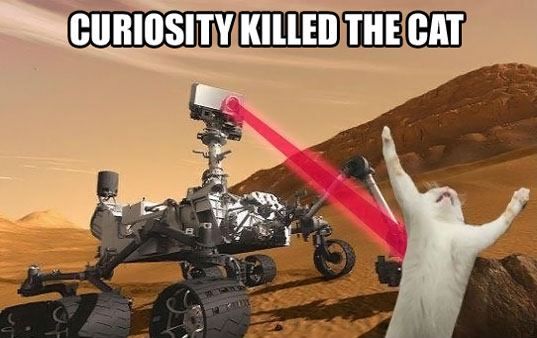
Is there life on Mars? NOT ANYMORE!

Is curiosity a bad thing?  Well, it depends how genre savvy you are.  It seemed to work out pretty well for Alice, but not quite so well for Pandora (or the rest of the ancient Greek world, for that matter).  Curious monkeys seem to come out all right, and their constantly curious counterparts also seem to do okay in the end, but anytime you run into schmuck bait you know that things aren’t going to turn out well.

The truth is, for just about every stock Aesop warning about the perils of being overly nosy, you can find another one exalting it as a virtue.  In fact, you could say that curiosity is a crapshoot.

But what is curiosity exactly?  The Merriam-Webster dictionary defines it as “desire to know,” and “interest leading to inquiry.” As you can imagine, there are situations where this could be good or bad.  Thus, what a story says about curiosity often changes depending on its genre.

For example, in most horror stories, curiosity and nosiness are usually bad, leading the protagonists to go places where they shouldn’t and uncover things that should never have been uncovered.  At the same time, a lack of curiosity can also be fatal … in fact, a lot of things can be fatal in a horror story.

In mythology and folklore, curiosity is often even worse.  From Pandora to Eve, Psyche to the proverbial cat, curiosity leads to Very Bad Things.  Perhaps this is because these kinds of stories are mostly tales of warning, passed on from generation to generation as a way to preserve our collective knowledge about the dangers of the world, rather than inspire us to go out and face them.

(As a side note, there are a few exceptions in the realm of folklore.  In the Bluebeard myth, curiosity killed off all of Bluebeard’s previous wives, but combined with cleverness, faith, and friendship, it saved the last one’s life.)

In fantasy, curiosity is often a mixed box bag.  For example, take the hobbits: most of them are perfectly content to live out their lives in the shire, but the few who are inquisitive enough to venture outside end up saving the world in a way that the elves, dwarves, and humans never could.  At the same time, it puts them through a great deal of pain, even after the world is saved–neither Bilbo nor Frodo are ever able to be content in the shire again.

Curiosity, in other words, is complicated.  It’s not just a quirk or a character flaw–it’s an underlying quality of the hero’s journey.  Without curiosity, either of the world around him or the internal struggles within, the hero would be content to live out an unremarkable life.  Certainly he wouldn’t have the capacity for the cleverness, guile, wisdom, and sensitivity that he needs in order to descend into the darkest dungeon, face his own nadir, and return with the elixir of life.  Curiosity may lead to sorrow, pain, or even death, but it also leads to adventure.

As a subgenre of fantasy, many of these issues carry over into the realm of science fiction.  And yet, as a genre unto itself, science fiction has a distinctly positive view of curiosity compared to other genres.  Science is nothing if not the primary process of human inquiry, where curiosity is not only a virtue but the virtue, one of the most important aspects of humanity.  Consider these words from Adam Steltzner, one of the leading engineers of the NASA Mars Curiosity mission:

Likewise, curiosity is a staple of science fiction.  In Star Trek, it’s the basis of the entire mission: “to explore strange new worlds, to seek out new life and new civilizations, to boldly go where no one has gone before.” In Doctor Who, it’s how the Doctor finds his companions.  In Babylon 5, it’s Delenn’s curiosity about the humans that ultimately saves all the alien races.  And in 2001: A Space Odyssey, it’s the gift from the black monolith that helps monkeys to turn bones into space stations (well, not literally, but you get the idea).

Curiosity isn’t a central theme in most of my books, but it is a major part of Genesis Earth.  If anything, that book is about the importance of balancing curiosity about our universe with curiosity about ourselves and what it means to be human.  In Star Wanderers, Noemi’s curiosity is a huge part of her story, helping her to turn around a horrible (not to mention awkward) situation.  In Desert Stars, curiosity is complicated; it leads Jalil far away from home and puts a schism between him and the girl who loves him, but it also leads him to discover the truth about who he is, giving him the strength to return.

In general, I suppose it all comes down not only to genre, but to the underlying worldview of the author of the story.  Since I have a very positive and enthusiastic view of curiosity, it usually works out for the best in the stories that I write. Then again, perhaps that’s why I’m drawn to science fiction … how about you?

Do you like your chapters named or numbered?

There’s an interesting article linked on The Passive Voice blog about the importance of a table of contents, especially in ebooks.  The article is geared mostly for non-fiction, which is a whole different beast from novels and novellas, but the discussion on TPV got me thinking: for ebooks, is it better to name chapters or to merely number them?

In the comments section on TPV, Jamie makes an interesting point:

With e-books in particular I think there needs to be more care taken with the TOC. I can easily find my place with a print book even without a book mark, but with an e-reader, it’s possible to lose your place very easily, and “loc 4950″ is not going to be committed to my memory banks. I know what happens in the chapter titled “His Grace of Avon Takes Command of the Game,” but I’m not sure if that was chapter 16 or 15 “loc 1730″ or what. I won’t remember the number.

For organizational purposes for my own use I title my chapters, and I believe that readers will appreciate that habit, too, and will be more forgiving if they use the Look Inside feature and see those headers vs. if they just see “1, 2, 3.”

I try to make sure the titles are enticing and pique the curiosity of anyone who would see them in a TOC. They’re not spoilers, because unless you’ve made it to the end of the previous chapter, you’ll likely have no idea what the next chapter’s title is referring to (and if it is obvious, it simply increases the suspense/curiosity). The titles Makes Sense in Context (TM).

When I first learned how to make an ebook, the concept of a table of contents for a novel seemed pretty weird.  I was used to reading print books, which you can flip through much easier and find what you’re looking for just from the feel of the pages.  But with ebooks, obviously that’s much different.  A table of contents is more than just a list of chapters, it’s an important navigational tool that can’t be overlooked.

But if chapter hyperlinks are perhaps the only way to flip through the middle of the book, does that mean that merely numbering the chapters is insufficient?  I have to admit, the concept of naming each chapter seems a bit old-fashioned, but the technology has changed and as writers, we need to change with it.

In the context of a hyperlinked table of contents, numbers are practically meaningless.  They can even be quite ugly, if there’s a huge list of them that sprawls beyond the screen.  Chapter titles can sprawl even more, but they at least provide some idea of what lies on the other side of the link.

I’ve done it both ways.  For example, the table of contents for Genesis Earth looks like this:

Table of Contents

Copyright Page
Table of Contents

The Wormhole | The Mission | Terra | Cryothaw | The Ghost Ship | Trust and Deception | Betrayal and Discovery | Arrival | First Contact | Call and Answer | Earth | Rescue | Emotion and Reason | Planetfall | The Natives | Origin and Destiny | A New Genesis | Epilogue

Author’s Note | Acknowledgments

Most of the chapter titles are pretty mysterious, but I was kind of going for that.  And in any case, is it possible to make them completely unambiguous without spoiling key parts of the story?  It seems like the art of naming chapters is much subtler and more complex than you’d think at a first glance.

In contrast, the table of contents for Desert Stars looks like this:

Table of Contents

Copyright Page
Table of Contents

Prologue
Book I: Dome and Desert
1 | 2 | 3 | 4 | 5 | 6 | 7 | 8 | 9 | 10
Book II: Sand and Stars

11 | 12 | 13 | 14 | 15 | 16 | 17 | 18 | 19 | 20 | 21 | 22

Author’s Note | Acknowledgments

I kept the numbers for the chapters, but divided the novel into two sections or “books” and listed the numbered chapters as minimally as possible, to save space.  I suppose it looks all right, but as a guide to navigating the book, I’m not sure how useful it is–not to mention how hard it can be to click on a hyperlink that’s only one character long, especially on a touchscreen.

For Journey to Jordan, there were so many entries that I didn’t bother listing them all in the table of contents.  Instead, I divided each part into sections based on location, then listed the locations in the table of contents and the posts/chapters at the head of each section, complete with hyperlinks.

As a side note, it’s actually pretty amazing how internal hyperlinks can change the experience of the book.  For one thing, it opens up all sorts of possibilities for alternate endings and “Choose Your Own Adventure” type stories.  Is it possible to list a chapter in the <manifest> without including it in the <spine>?  I don’t think it is (at least, not in a well-formatted ebook), but if you could find a way to do that, you could add all sorts of hidden content and Easter eggs …

In any case, for my shorter Star Wanderers novellas, I think I actually prefer numbered chapters.  The stories are short enough that the numbered subdivisions still have meaning, and the chapter lists aren’t long enough to look too cluttered.  Besides, I’ve already started the series in this particular format so I think it will be better to keep it this way.

But for future books and future series … I don’t know.  What do you think?  Are ebook chapters better off named or numbered?

July Smashwords sale–all books 50% off!

swlogoEvery summer, Smashwords does a sale in which authors can enroll their books.  This year, I’ve enrolled all of mine at 50% off, so all of them are under $2.50.  Check it out!

thumb (Genesis Earth)Genesis Earth
A boy and a girl on a voyage to an alien star.
Price: $4.95 $2.48

thumb 2 (Bringing Stella Home)Bringing Stella Home
He’ll go to the ends of the galaxy to save his brother and sister.
Price: $4.95 $2.48

thumb (Desert Stars)Desert Stars
A tale of adventure and romance from the fringes of an interstellar empire that has forgotten its holiest legend: the story of Earth.
Price: $4.95 $2.48

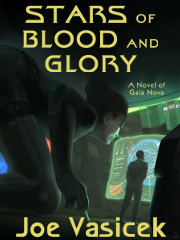
thumb (Stars of Blood and Glory)Stars of Blood and Glory
The only hope for the last free stars now lies on the path of blood and glory.
Price: $4.95 $2.48

SW-TJC (thumb)Star Wanderers: The Jeremiah Chronicles (I-IV)
He wanders the stars in search of a home. Instead, he got a girl without one.
Price: $4.99 $2.49

Star Wanderers II (thumb)Star Wanderers: Fidelity (Part II)
Is fidelity worth the price of freedom? Can love take root beyond the stars?
Price: $.99 free!

Star Wanderers III (thumb)Star Wanderers: Sacrifice (Part III)
She gave up everything to wander the stars with him. Now, he must do the same.
Price: $2.99 $1.49

Star Wanderers IV (thumb)Star Wanderers: Homeworld (Part IV)
They’ve finally found a world to call home. But first, they have to fight for it.
Price: $2.99 $1.49

SW-V Dreamweaver (thumb)Star Wanderers: Dreamweaver (Part V)
He saved her from death, but to save him, she must command the power of dreams.
Price: $2.99 $1.49

thumb (Journey to Jordan)Journey to Jordan
Travels of a young Mormon writer to Jordan, Egypt, and the Holy Land.
Price: $2.99 $1.49

thumb (Decision LZ1527)Decision LZ1527
A boy, a girl, and a whole crew of matchmakers.
Price: $.99 free!

One of the great things about Smashwords is that these prices are the same throughout the world–no extra surcharge for international sales.  So if you live outside the United States and don’t have a US bank account, these are the best prices you’re going to find.

These books will remain 50% off on Smashwords through the month of July.  Just use the coupon code SSW50 to get the discount. Smashwords does accept Paypal, so you don’t have to sign up for an account or share your credit card information to purchase.

If you’ve been meaning to check out some of these books but haven’t gotten around to it, this is a great way to try them out.  And if you want to sample them first, the first 15% to 25% is available on each book’s Smashword’s page.

Enjoy! 😀

Chance to win GENESIS EARTH and SW-II: FIDELITY

In case you didn’t know, my fellow indie author and KBoards member Elle Casey has put together a book giveaway, and she was kind enough to include a couple of my books in it.  If you would like a chance to win a free ebook copy of Genesis Earth or Star Wanderers: Fidelity (Part II), head over to her blog and check it out.  I’m giving away 10 electronic copies of each title, but I’m only one author of many so if you sign up for my books there’s a very good chance you’ll win one.

The giveaway has a lot of different kinds of books, but they trend more toward YA and New Adult (a recently coined categorization that eludes me).  Out of all my books, Genesis Earth and Star Wanderers seemed like the titles that fit best, so those were the ones I chose.  But there are a lot of others to choose from, with no limit on how many you sign up for, so feel free to take your pick!

Tomorrow (Wednesday) is the last day of the promotion, so be sure to act quick!

Y is for Yesteryear

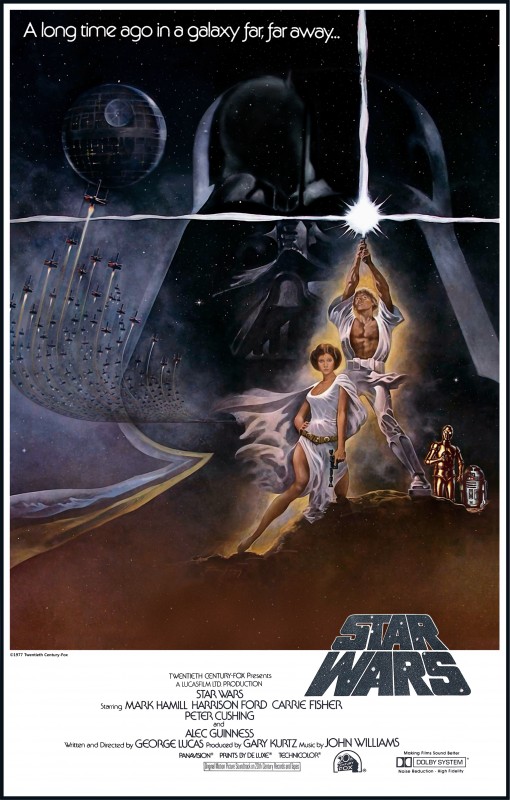
Star_wars_oldThey say that the golden age of science fiction is about twelve years old.  That’s definitely true for me.

My first exposure to the genre was Star Wars: A New Hope.  I saw it when I was seven, right around the height of my dinosaur phase.  Everything about the movie completely blew me away, from the Jawas and Sand People of Tatooine to the stormtrooper gunfights and lightsaber duels.  After watching Luke blow up the Death Star, I spent the next few hours running around the yard pretending to fly my own starfighter.

In a lot of ways, I’ve never really stopped.

My parents made me wait until I was nine to watch The Empire Strikes back, because it was rated PG.  Without any exaggeration, I can say that those were the longest two years of my life.  I was literally counting down days by the end, and to pass the time without going crazy, I read up on all the books about space that I could possibly find.

My father bought the original X-wing flight simulator game somewhere around then, and I soon became totally engrossed in it.  Since the 386 was our only entertainment system (no Super Nintendo–I had to visit a friend’s house for that), X-wing became the defining game of my childhood.  I spent hours and hours on that game, to the point where I knew exactly which simulated missions the characters from the books were flying and how to complete them faster and easier.

I thought The Empire Strikes Back was a little slow the first time I saw it, but it’s since grown on me, to the point where now it’s my favorite film in the whole series.  Thankfully, my parents let me watch Return of the Jedi the next day, and for the next few months my life felt utterly complete.

Around this time I discovered the Star Wars novels and soon immersed myself in them.  The Courtship of Princess Leia by Dave Wolverton soon became one of my favorites, as well as the Heir to the Empire trilogy by Timothy Zahn and the X-wing series by Michael A. Stackpole.

But it was Roger Allen McBride who first introduced me to a different flavor of science fiction with his Corellia trilogy.  As I mentioned in V is for Vast, those books had just enough of a touch of hard science to intrigue me about the other possibilities of the genre.  That was the last Star Wars series that I read before branching out into other works of science fiction.

The Tripod trilogy by John Christopher was my first introduction to the dystopian / post-apocalyptic genre, depicting an enslaved humanity after an alien invasion.  Those books really captured my imagination for a while.  The Giver was also quite interesting and thought provoking, though since it didn’t involve spaceships or aliens it wasn’t nearly as compelling.

I read a lot of fantasy in my early high school years, including Tracy Hickman, Lloyd Alexander, and (of course) J.R.R. Tolkien.  While I enjoyed those books and immersed myself in them for a while, my true love was still science fiction.  For almost a year, I watched Star Trek: Voyager religiously with my dad.  And every now and again, I’d pick out a science fiction book from the local town library and give it a try.  That’s how I discovered Frank Herbert’s Dune.

In eleventh grade, my English teacher had us choose an author and focus our term papers solely on their books for the entire year.  She suggested I choose Orson Scott Card, but I chose Cormac McCarthy instead.  I’m not sure if that was the worst decision of my high school career, or the best decision, since assigned high school reading tends to make any book feel like it sucks.  I discovered Ender’s Game the following summer, and finished it in a delirious rush at 3am the morning after checking it out from the local library.

More than any other book, Ender’s Game cemented my love for the genre, and showed me just how powerful and moving the genre could be.  It opened so many insights into the world and human nature, reading that book made me feel like I’d opened a pair of eyes that I didn’t even know I’d had.  Looking back, that was probably the moment when I knew I would be a science fiction writer.  I’d known I was going to be a writer ever since I read A Wrinkle in Time at age eight, but to be a science fiction writer specifically, that goal was probably cemented by reading Orson Scott Card.

After high school, I served a two year mission for my church, during which I didn’t read any novels or watch any TV or movies.  When I came back, though, Orson Scott Card and Madeline L’Engle helped me to ease through the awkwardness of adjusting back to normal civilian life.  When I left for college, I expanded my horizons even further, starting with Isaac Asimov’s Foundation series and Edgar Rice Burrough’s Princess of Mars.

When I discovered Pioneer Books in downtown Provo, I knew I’d found my favorite bookstore in Utah Valley.  I have so many fond memories sitting cross-legged on the floor in the science fiction section, browsing through the musty used books for hours at a time.  That’s where I discovered C.J. Cherryh, Arthur C. Clarke, Robert A. Heinlein, Ursula K. Le Guin, and numerous other authors who are among my favorites today.

When I discovered Spin, Robert Charles Wilson soon became one of my favorites.  I picked up that novel as a free PDF from Tor, and read it over the summer while studying abroad in Jordan.  Once again, that same hard sf sensibility I’d gotten from Roger Allen McBride touched me in an unforgettable way.  But it was the human element of that book that really moved me–in fact, it’s always been about the human element.  The world building in Downbelow Station was great and all, but the romance of Merchanter’s Luck had a much more lasting impact.  Starship Troopers had some good ideas, but it was Mandella’s personal journey in The Forever War that moved me almost to tears.  The intrigue of the Ender’s Shadow series was quite entertaining, but it was Ender’s Game and Speaker for the Dead that really taught me what it means to be human.

I finished my first novel, Genesis Earth, shortly after returning from that study abroad, and tried to capture the same sensibility from Spin as well as the intimately human element.  Since then, I’ve written several more sci-fi novels, some of them tragic, some triumphant, but in all of them I’ve tried to get as close as I can to the personal lives of the characters.  I don’t know if I’ll ever write a character portrait so intimate as Shevek’s in Ursula K. Le Guin’s The Dispossessed, but I certainly hope to someday.

For me, science fiction started out as a wonderfully exciting entertainment and turned into something much more meaningful.  If there’s anything the genre has taught me, though, it’s that the two aren’t mutually exclusive–that you can have your adventure and learn what it means to be human as well.  Indeed, the more imaginative the adventure, the greater the truths I’ve taken from it.

Because of that, even though I’m almost in my thirties now, I can’t possibly foresee a time when science fiction isn’t a major part of my life.  It’s a love affair that’s grown just as much as I have, and continues to grow with each new author I discover and each new book I write.  When I’m old and grizzled and pushing eighty, I’m sure there will still be a part of that twelve year old boy in me, still running around the yard flying his starship.

V is for Vast

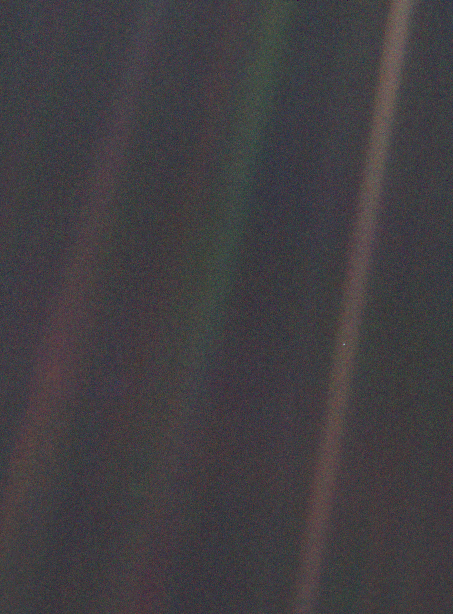
Pale_Blue_Dot

If you don’t know anything else about the universe, you should know this: it’s big.  Really, really, REALLY big.

How big, you ask?  Well, for starters, take a look at Earth in the picture above.  Can you see it?  It’s the pale blue dot in the beam of starlight on the right side of the picture.  As Carl Sagan so famously put it:

From this distant vantage point, the Earth might not seem of any particular interest. But for us, it’s different. Consider again that dot. That’s here. That’s home. That’s us. On it everyone you love, everyone you know, everyone you ever heard of, every human being who ever was, lived out their lives. The aggregate of our joy and suffering, thousands of confident religions, ideologies, and economic doctrines, every hunter and forager, every hero and coward, every creator and destroyer of civilization, every king and peasant, every young couple in love, every mother and father, hopeful child, inventor and explorer, every teacher of morals, every corrupt politician, every “superstar,” every “supreme leader,” every saint and sinner in the history of our species lived there – on a mote of dust suspended in a sunbeam.

The picture was taken by the Voyager 1 spacecraft more than a decade ago.  At the time, the spacecraft was about 6,000,000,000 kilometers from Earth, or 5.56 light-hours.  A light-hour is the distance a particle of light can travel in one hour (assuming it’s traveling through a vacuum).  To give you some sense of scale, in one light-second, a particle of light can travel around the circumference of the Earth seven and a half times.

And lest you think that’s actually a distance of any cosmic significance, consider this: the nearest star, Proxima Centauri, is about 4.24 light-years away.  That’s more than 6,500 times the distance in the photograph above–and that’s just the closest star!

Our galaxy, the Milky Way, is between 100,000 to 120,000 light-years across.  If you were on the other side of the galaxy and had a telescope powerful enough to get a good view of Earth, you would see a gigantic ice sheet over both of the poles with no visible sign of humanity whatosever.  The light from all our cities, from our prehistoric ancestors’ campfires, has not yet traveled more than a fraction of the distance across this galactic island universe we call home.

Seriously, the universe is huge.  If you don’t believe me, download Celestia and take yourself for a spin.  In case you haven’t heard of it, Celestia is basically like Google Earth, except for the universe.  Everything is to scale, and there are all sorts of plugins and mods for exoplanets, nebulae, space probes, and other fascinating celestial objects.

I remember what it was like when I first tried out Celestia back in 2010.  I was at the Barlow Center for the BYU Washington Seminar program, in the little library just below the dorms.  I think it was twilight or something, and I hadn’t yet turned on the lights.  The building had a bit of that Northeast feel to it, like something old and rickety (though not as old as some of the buildings up here in New England).  I turned off the ambient light option to make it look more realistic, and began to zoom out.

Let me tell you, the chills I got as the Milky Way disappeared to blackness were like nothing I’ve felt ever since.  So much space, so much emptiness.  It’s insane.  The vastness between stars is just mind boggling–absolutely mind-boggling.

I got my first introduction to science fiction when I saw Star Wars IV: A New Hope as a seven year old boy.  In the next few years, I think I checked out every single Star Wars novel in our local library’s collection.  It wasn’t enough.  Whenever I was on an errand with my mom, I tried to pick up a new one.  I think they even left some copies of the Young Jedi Knight series under my pillow when I lost my last few baby teeth.

One of those summers, we drove down to Texas for a family vacation.  I picked up the second Star Wars book in the Corellian trilogy, written by Roger Allen McBride.  It was completely unlike any of the other Star Wars books I’d ever read.  In it, Han Solo’s brother leads a terrorist organization in the heart of their home system of Corellia.  They hijack an ancient alien artifact and use it to set up a force field that makes it impossible for anyone to enter hyperspace within a couple of light hours from the system sun.  The part that blew my mind was that without FTL tech, it would take the good guys years to get to the station with the terrorists.

All of a sudden, the Star Wars universe didn’t seem so small anymore.  And it only got crazier.  Roger Allen McBride did an excellent job getting across the true vastness of space.  At one point, Admiral Ackbar mused on just how puny their wars must seem to the stars, which measure their lifespans in the billions of years. For the ten year old me, it was truly mind boggling.

That was my first taste of science fiction that went one step beyond the typical melodrama of most space opera.  And once I had that taste, I couldn’t really stop.  As much as I love a good space adventure, real-life astronomy offers just as much of a sense of wonder.  When a good author combines the classic tropes of science fiction in a space-based setting that captures the true vastness of this universe we live in, it’s as delicious as chocolate cake–more so, even.

I try to capture a bit of that in my own fiction, though I’m not always sure how much I succeed.  In Star Wanderers, the vastness of space is especially significant for the characters because their FTL tech is so rudimentary that it still takes months to travel between stars.  All of that time out in the void can really make you feel lonely–or, if you have someone to share it with, it can bring you closer together than almost anything else.  It’s the same in Genesis Earth, which is also about a boy and a girl who venture into the vastness alone.  The Gaia Nova books lean closer to the action/adventure side of space opera, but the same sensibility is still there.

The best science fiction, in my opinion, both deepens and broadens our relationship with this marvelous place we call the universe.  It’s not just a fantastic setting for the sake of a fantastic setting–it’s the universe that we actually live in, or at least a plausible version of it set in a parallel or future reality.  The universe is an amazing, beautiful place, and my appreciation for it only grows the more science fiction I read.  If I can get that across in my own books, then I know that I’ve done something right.

S is for Space Station

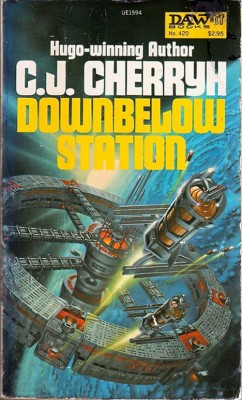
downbelow_stationPlanets are not the only setting for science fiction stories–space stations are common as well.  From the Death Star (“that’s no moon…”) to Downbelow Station, the Venus Equilateral to ISPV 7 to the Battle School in Ender’s Game, space stations are a major staple of any space-centered science fiction.

The reasons for this should be fairly obvious.  Before we can go to the planets and the stars, we need to have a permanent presence outside of this massive gravity well we call Earth.  The easiest and most logical place to expand first is to orbit, where supplies can be ferried up without too much difficulty and astronauts can escape in case of an emergency.  Indeed, with the International Space Station, that’s exactly what we’re doing right now.

In science fiction, of course, space stations go much further than they do in real life.  They’re often giant orbital cities, with thousands of people living and working there permanently.  Often, they feature some sort of rotating toroidal structure in order to simulate gravity.  If there are settlements on the planet below, the station often serves as a major hub for commerce, serving as a waypoint for interstellar merchants and wholesalers who ferry their wares up to orbit.  And if the planet is still being colonized, then the space station often serves as an important umbilical to the outside universe.

They can also have strategic value in the event of a war.  Battleships need to be serviced too, after all, and a station’s position in orbit can provide an excellent platform from which to bombard or lay siege to the planet.  Alternately, outposts at more distant locations like the Lagrange points can serve as a staging ground for future attacks–a sort of astronomical “high ground,” if you will.  If nothing else, abandoned stations may contain supply caches that can aid a fleeing starship, or provide shelter behind enemy lines, as was the case with the first Halo game.

Stations can come in all sorts of different flavors, from the puny to the magnificent.  The most eye-popping station of all is probably the Ringworld from Larry Niven’s series of the same name.  As the name would imply, the station is a giant ring–so huge, its circumference is the orbit of a habitable planet, with the sun at its center!  Gravity is provided by rotation, and night and day by giant orbiting panels that block out the sun at regular intervals.

My favorite stations, though, are the more realistic ones–the ones that I can imagine myself living on someday.  That was one of the things I enjoyed about Downbelow Station by C.J. Cherryh–her depiction of human expansion into space is eminently believable, and her stations are a natural extension of that.  I also really enjoyed her focus on the social dynamics of living on a giant station, and what it would be like to live in such a society.

The Battle School from Ender’s Game is another huge favorite of mine.  One of the advantages of building a structure in space is that gravity becomes malleable, so that some parts of the structure can simulate Earth-surface gravity while others leave people completely weightless.  The Battle School uses that to its advantage, with the main training room a zero-g laser tag battle arena, where the students have to learn how to stop thinking in terms of the planar dimensions, where “up” and “down” have any meaning.  It’s really quite fascinating.

It should come as no surprise that space stations pepper my own works.  They’re especially common in the Star Wanderers series, where few worlds have been terraformed and orbital platforms make up the majority of human living space (at least in the Outworlds).  In Sholpan and Bringing Stella Home, James, Ben, and Stella are all from a space station–a distinction that is especially useful for Stella, since her Hameji captors despise the “planetborn.” Genesis Earth takes that a step further, as spaceborn Michael and Terra have never been to the surface of a planet before until midway through the novel.  Just as going into space is paradigm shifting for us, the experience of walking on a planet proves just as transformative for them.