Thoughts on the danger of falling in love with your characters

As a writer, I spend so much time in the heads of my viewpoint characters that I can’t help but like them. So it sometimes comes as a surprise when readers get frustrated and want to slap my characters around.

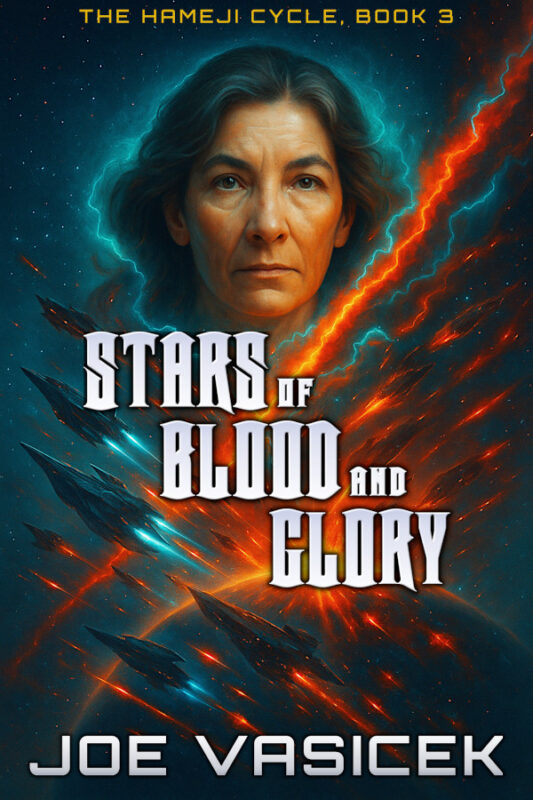
To be fair, sometimes I do that on purpose. For example, in Stars of Blood and Glory, Princess Hikaru does some incredibly stupid and naive things that end up getting everyone else in a lot of trouble. There’s a reason for it, though: she’s been sheltered in the palace all her life and knows nothing of the outside universe. Over the course of the story, she comes to realize just how naive and sheltered she’s been, and has something of a transformation.

Jeremiah from Star Wanderers is another character that readers sometimes get frustrated with. He’s very passive and lacks a strong backbone, at least at the beginning of the series. I did try to make sure that each story in his viewpoint was driven by his choices, rather than the things that happen to him. But he isn’t your typical alpha male starship pilot—far from it.

With Jeremiah, I tried to lean towards writing an “everyman” rather than a “superman.” In a lot of ways, he was also a case study in human nature for me, since I’m not a passive person and in real life tend to get frustrated with passive people. When I dove into Jeremiah’s head, though, I found it almost impossible not to like him, even with all his flaws.
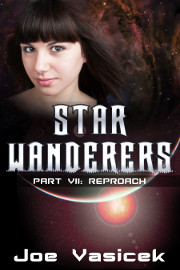
SW-VII (thumb)Another good example from Star Wanderers is Mariya. Some of my readers absolutely hate her. Given her role in the story, it’s not hard to see why: she basically tries to steal away the love interest from the main female protagonist of the series.

In her head, though, she’s not stealing—she’s sharing. Everything she does makes sense for her perspective, and when she realizes how much she’s hurt everyone, she feels genuine remorse and regret. As a character, she fascinated me so much that that was one of the main reasons I decided to write a book solely from her point of view.

To be fair, one of the other reasons readers get frustrated with her is because she’s an angsty teenager. Her life is either amazingly awesome or on the verge of falling apart (the latter being much more common). I can’t fault readers at all for getting frustrated with that—all I can do is hope that the payoff is greater than the pain.

Looking back on all this, I think that one of the potential traps of being a writer is falling in love with your characters more than your readers ever will. That’s not to say that you shouldn’t love your characters, but that you shouldn’t let that love make you blind to how your readers are going to respond to them.

It’s kind of like the central paradox in Orson Scott Card’s Ender’s Game: in order to know an enemy well enough to defeat them, you have to know them well enough to love them as well. But just when you can’t help but love them, you have to destroy them. It can be the same way with your characters: even when you know them well enough to love them in spite of their flaws and weaknesses, you still have to give the readers their moment of schadenfreude.

Of course, a lot of it ultimately comes down to skill. If you truly excel at bringing readers into the character’s head, then perhaps you can get them to love that character as much as you do. But it also depends on the reader. If the reader isn’t particularly interested in falling in love with a character (or in falling in love with that character), then your writing skill probably isn’t going to change that.

It’s interesting to think about, and something I’ll definitely keep in mind as I continue to write. In the meantime, if you have your own thoughts on the subject, please leave a comment—I’d very much like to hear it!

January Goodreads Giveaways!

Hey guys, just thought you might like to know that I’m running a couple of Goodreads giveaways this month! They are for two copies of Bringing Stella Home, and one set of the first four Star Wanderers books. Check it out!

Goodreads Book Giveaway

Bringing Stella Home by Joe Vasicek

Bringing Stella Home

by Joe Vasicek

Giveaway ends January 31, 2015.

See the giveaway details
at Goodreads.

Enter to win


Goodreads Book Giveaway


Star Wanderers by Joe Vasicek


Star Wanderers


by Joe Vasicek


Giveaway ends January 15, 2015.

See the giveaway details at Goodreads.


Enter to win


In addition, I’m currently working on typesetting and formatting the print versions of Star Wanderers: The Jeremiah Chronicles (Omnibus I-IV) and Star Wanderers: Tales of the Far Outworlds (Omnibus V-VIII). If all goes well, those should be up for sale by the end of the month.

That just about does it for now. Thanks for reading!

BRINGING STELLA HOME is free for the month of January!

Hi guys! Just wanted to let you know that Bringing Stella Home is free for the month of January!

This novel is the first book in the Gaia Nova series, and is one of the first books that established the universe in which almost all of my books (including Star Wanderers) take place. For those of you looking for action and adventure, this book definitely has a lot of it. It’s much more of a military SF piece, and has a bit of a dark and gritty edge to it. To this date, I think it’s one of the best books I’ve written.

If you haven’t tried out any of my books yet, this is a great place to start. It’s a full-length novel, and even though it’s the first in the series, it’s complete and stands alone (the other books in the series are indirect sequels that take place loosely in the same universe). So check it out!

==========

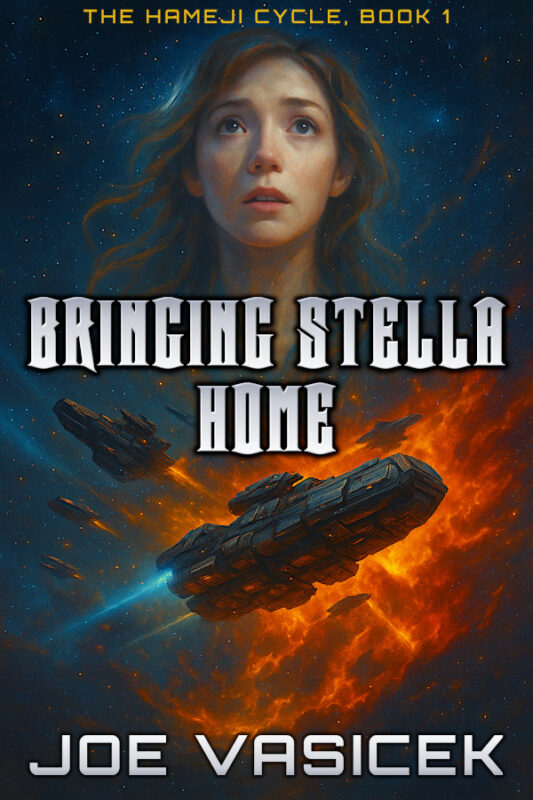
Bringing Stella Home

Bringing Stella Home

In a galaxy ravaged by war, a young man must decide how far he’ll go—and what he’s willing to become—to save his sister.

When a ruthless Hameji battle fleet kidnaps his sister, James McCoy—a young merchant starfarer untested by war—vows to bring her home. But to save her, he must give up everything he has and become something he never thought he could be.

Order Now!
About the Book

In a galaxy ravaged by war, a young man must decide how far he’ll go—and what he’s willing to become—to save his sister.

James never imagined that when his older brother and sister departed on planetside leave, it would be the last he’d ever see them. But as soon as they’re gone, a ruthless Hameji battle fleet invades their peaceful star system, transforming it into a war zone. Fleeing with his father on board the family starship, James can only watch in horror as the verdant planet below is reduced to molten slag.

On the way home, James learns the devastating truth: his sister is alive but enslaved. To rescue her, he must make an impossible choice. He’s no warrior—has never even held a gun, much less fired one. But to save his sister, he’ll become whatever he needs to be—even if it means crossing a line he can never uncross.

Details
Author: Joe Vasicek
Series: Hameji Cycle, Book 1
Genres: Military, Science Fiction, Space Opera
Tag: 2011 Release
Length: novel
List Price: 14.99
eBook Price: $2.99
Joe Vasicek

Joe Vasicek fell in love with science fiction and fantasy when he read The Neverending Story as a child. He is the author of more than twenty books, including Genesis Earth, Gunslinger to the Stars, The Sword Keeper, and the Sons of the Starfarers series. As a young man, he studied Arabic at Brigham Young University and traveled across the Middle East and the Caucasus Mountains. He lives in Utah with his wife and two apple trees.

Some of the links in the page above are "affiliate links." This means if you click on the link and purchase the item, I will receive an affiliate commission. You will not receive any additional charge. As an Amazon Associate I earn from qualifying purchases.

Things I learned in 2014 (Part 1)

Last week, Kris Rusch wrote an interesting blog post reflecting on 2014 and things she observed that indie writers learned, so I thought I’d do something similar and reflect on some of the things that I learned last year about the business and the craft. Here goes!

Readers of SF&F want longer books.

I did a lengthy blog post about this earlier, but the basic gist of it is that readers in my genre want longer, more immersive books. There’s a place for the short stuff, especially for high concept sci-fi, but most readers of speculative fiction want worlds they can get lost in with characters that become their best friends. It’s practically impossible to do that in a story that takes less than an hour to read, so to satisfy those readers, you’ve got to write long.

You can’t have a healthy career with only one income stream.

Between 80% to 90% of my income in 2014 came from Amazon. Times were good in the spring and summer, but then Amazon launched their ebook subscription service (Kindle Unlimited). None of my books were enrolled in KU, but because of the way that Amazon skews the rankings to favor KU books, my Amazon royalties took a huge hit.

I knew back in 2011 when I started that I needed to cultivate multiple income streams if I wanted to have a steady career, but I’d gotten complacent. Since my Amazon earnings were paying all the bills, I figured I was doing all right. But you can’t measure the healthiness of a career in just the revenue it’s bringing in right now; you’ve got to look at contingencies for the future, including the worst case scenario.When most of your revenue comes from a single client, that makes your career far too brittle.

So looking to the future, I can’t say that I have a healthy, steady career until I’m earning at least as much from all my other income streams as I am from Amazon.

I’ve been relying far too much on Amazon’s algorithms.

Related to the last point, I learned that I’ve been relying far too much on Amazon to sell my books. In fact, I can say that the Amazon algorithms were the linchpin of my marketing strategy (inasmuch as I actually had one, heh).

Amazon has the best book recommendation engine in the industry by far. It’s done a lot for my career, connecting my books with many readers who have gone on to become fans. But what the algos give, the algos can take away. To build a career with staying power, you have to constantly work to find new readers in a variety of different ways.

I’ve always believed that cream rises to the top. That said, if you’re starting at the bottom of the ocean, you’ve got a long, long way to rise. Up until now, I’ve been operating under the belief that readers will find me without me making much of an effort to find them. I learned this year that you’ve got to meet in the middle. You don’t have to hand sell every book (thank goodness!), but you do have to make an effort to make your books visible somehow.

A well-articulated negative review does more to sell books than a blasé positive one.

This one surprised me. When I published Brothers in Exile (Sons of the Starfarers: Book I), it garnered a fairly painful two-star review on Amazon about a week or two after launch. The review had some positive things in it, but it also had some negative things that were pretty spot on. Being the angsty writer that I am, I thought my chances had tanked. Instead, sales of the book immediately shot up, and stayed fairly high for about a month.

Readers aren’t stupid. They understand that not everyone has the same tastes in books, and parse their reviews accordingly. A negative review that is articulate and well-reasoned will lend a lot more credibility and cultivate a lot more interest than a string of positive reviews that lack any real substance. It sounds counterproductive, but it’s often the negative reviews that sell the book.

Sometimes you actually can get the best results by doing it yourself.

When I redid the covers for the first three Gaia Nova novels, I decided at first to hire a cover designer. For various reasons, though, that didn’t work out, so I decided to do them myself. I’d done the typography myself on the old ones, and let’s just say they left something to be desired.

The reason I wanted to hire the work out was because I didn’t think I’d get the best work if I did it myself. I figured that if I hired someone who was an expert in it, it would turn out so much better. Instead, when I did it myself, I discovered that my own skills had improved to the point where I could produce really good work myself.

It is possible, especially in self-publishing, to become so skilled at every aspect of the production process that you can do it all yourself and still produce a quality book. The learning curve is so sheer that it’s practically a cliff, but you can do it. And even if the work that you produced at the start of your career wasn’t all that good, you can improve to the point where your work is on par with that of professional designers.

The trouble is, it takes so much time and effort to get to that point that you may be better off hiring the work out. It takes a certain type of personality to DIY everything and produce a quality product without feeling overstretched. I’m pretty sure that’s my personality type, though of course I still have a lot to learn. But just because it’s DIY doesn’t necessarily mean it’s going to be of an inferior quality.

There are other things I learned in 2014 about the craft and business of writing, but this post is starting to get long so I think I’ll table it for the next post. Take care!

Upcoming plans for 2015

I think my favorite time of the year is the week between Christmas and New Year’s. It’s a time for reflection, of looking at what you accomplished in the previous year and setting resolutions for the next one. In that spirit, here are some of the writing and publishing things I’d like to accomplish in 2015:

  • Publish at least six new books
  • Put out print editions of all of my books (except for short stories)
  • Get to the point where at least 50% of my book sales are outside of Amazon

I’ve got a lot of projects on the back burner, and I’m sure that I’ll start lots of new ones in the coming year, but these are the ones I really want to focus on in 2015:

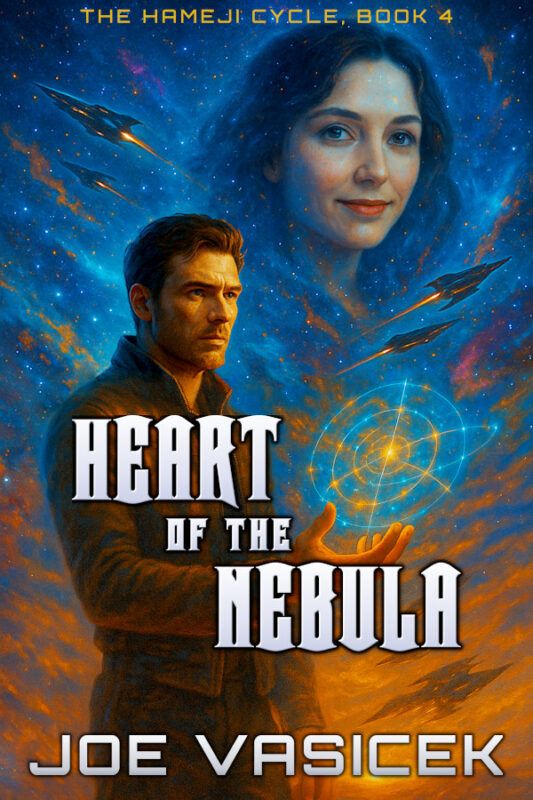
Heart of the Nebula — This is one that I definitely want to release this year. It’s the fourth novel in the Gaia Nova universe, a direct sequel to Bringing Stella Home, and I’m really, really excited about it. For the past month or so, I’ve been in “finish this damn book mode” (which is why I haven’t blogged much), but I’m set to finish it by the end of this week and send it out to my first readers. You can definitely expect to see this one soon.

Sons of the Starfarers — The main reason I haven’t released Friends in Command (Book IV) yet is because my first readers told me it has some serious issues, which need to be fixed by adding another viewpoint character. It shouldn’t be too hard to do that, but before I do a major revision I always try to take a month or two off to work on other things so that I can come at the project with new eyes. I’ll pick up Friends in Command in January, and write the next one, Captives in Obscurity (Book V) immediately after.

Will I finish this series in 2015? I honestly don’t know. The books started as novellas, but each one has been a little longer than the last one, so by the end they’ll all probably end up as full novels. I could probably still do it if this was the only series I worked on all year, but I don’t want to limit myself in that way. Definitely, though, you can expect to see at least the next three books before the end of 2015.

The Sword Keeper — This unfinished fantasy novel has been sitting on my hard drive for about two years, and it’s time that I buckled down and put it out there. I tried to finish it last summer, and the main obstacle was that I had to do some serious world building. For a speculative fiction writer, that should be easy, right? Well … I’m kind of weird in that I tend to do most of my world building from the seat of my pants. But now that I’ve figured out what the holdup was, it shouldn’t be too hard to fix.

These are all books that I want to release before the end of 2015. I’m sure there will be others—perhaps even for story ideas that I haven’t come up with yet. It will be exciting to see how the year turns out!

Trope Tuesday: Colony Ship

It’s been a while since I did the weekly Trope Tuesday posts, but those were a lot of fun and they still get a lot of traffic, so I’m going to bring them back with a couple of changes. Instead of focusing on the trope itself, essentially rewriting the description on the tvtropes page, I’m going to pick apart what I like about it and focus instead on the trope’s appeal. I’m also going to pick tropes that are in my own books, so that I can talk about how I’m using them.To kick things off, this week’s trope is the Colony Ship. A staple of space opera, this trope is exactly what it says on the tin: a giant starship, often a worldship or a starship luxurious, taking a band of colonists to settle the final frontier. Essentially, this trope takes the wagon train to the stars concept to its logical conclusion, since what is a wagon train but a band of hopeful colonists? And since this is space, there’s no limit to where you can take it!

I love this trope because it’s so hopeful. Even in dark post-apocalyptic stories like A Canticle for Leibowitz, the possibility of taking humanity to the stars shines like a beacon of hope, an interstellar ark that can fling a light into the future. No matter how badly we screw up Earth, we can still atone for our sins by starting over with a clean slate out among the stars.

One of the other things that makes this trope appealing is that it’s not that far removed from reality. On that other wiki, there’s an article on Generation Ships with a link to this very interesting academic paper on the feasibility of building giant worldships. Just as Science Fiction conceptualized satellites, robots, and cloning before they were actually built, this may very well be the case with interstellar colony ships as well. I doubt that NASA or SpaceX are currently working on any prototypes, but we’re definitely on a path that will lead us there, if we have the courage and tenacity to follow it through.

If faster-than-light travel is in play, then the people who set off on the colony ship are usually the same people who build the colony. If FTL is not in play, though, things get really interesting. Sanderson’s second law of magic states that the limitations of a magic system are inherently more interesting than the powers, and since sufficiently advanced space travel is itself a kind of magic (see Clarke’s third law), then it makes sense that sublight colony ships are more interesting than FTL ones.

Sublight colony ships come in two basic types: generation ships and sleeper starships. In a generation ship, the colony ship itself becomes something of a miniature world, often like a city in a bottle (with all of the juicy story implications that come with it). In a sleeper starship, the colonists freeze themselves in stasis, opening the possibility for stuff like lightspeed leapfrog.

In my current WIP, Heart of the Nebula, I’ve combined both of these subtropes to create a hybrid generation sleeper ship. The ships are designed for sublight travel through a region of space where FTL is impossible, but there are too many colonists to fit in all the cryotanks. Subsequently, those who don’t go to sleep have to turn their tiny little ship into a self-enclosed home. When the sleepers wake up, they find that they’ve become living relics to the great-great grandchildren of their friends and relatives.

The main character in Heart of the Nebula is James McCoy, who you might remember from Bringing Stella Home. Just before he goes into cryo, he rescues his people from a terrible enemy, so that when he wakes up he’s a living legend. People have been watching movies about his exploits and doing grade school reports on him for generations. But the thing that made him a legend also put a lot of lives at risk, so that he’s also an extremely divisive figure. To make things worse, most of his friends didn’t go into cryo, so they’re all gone by now. But their great-great grandkids are still around …

As you can see, Colony Ships can be a lot of fun to play with. I’m definitely having fun with it now, and I plan to return to this trope often in the future!

DESERT STARS Goodreads giveaway!

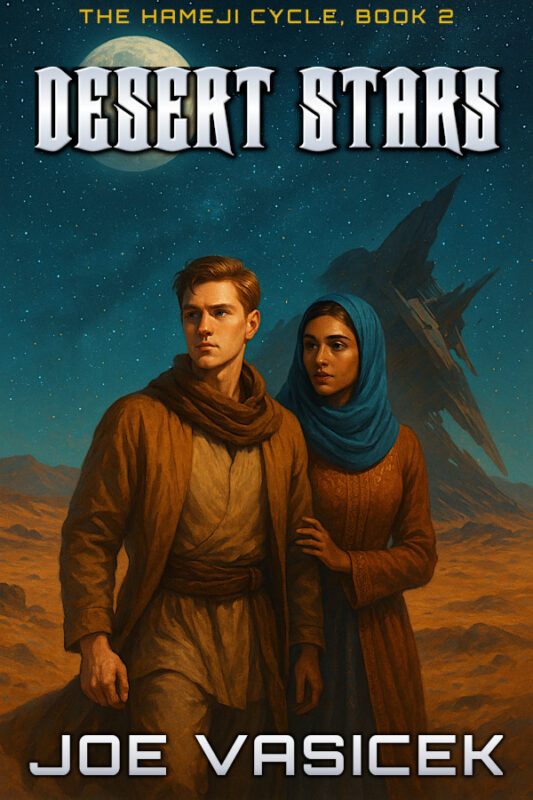
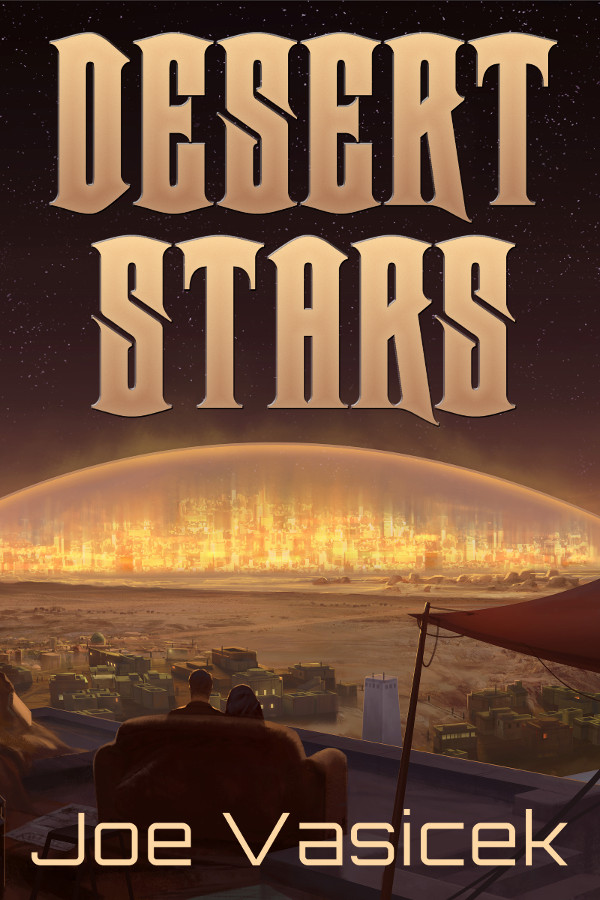
Hey guys, I’m giving away a copy of my book Desert Stars! You can sign up for it in the link below. It’s one copy and I’ll be giving it away on Saturday, so sign up soon if you want it!

This is for the last first edition copy on my bookshelf. I’ve got a new edition with a slightly different cover coming out soon, so I wanted to get rid of the old ones in order to make way for the new.

So sign up!

Goodreads Book Giveaway

Desert Stars by Joe Vasicek

Desert Stars

by Joe Vasicek

Giveaway ends December 13, 2014.

See the giveaway details
at Goodreads.

Enter to win

Back from unannounced hiatus

Wow, it’s been forever since I last blogged. One of my real-life friends even asked me why I never post anything anymore. That’s when you know you’ve fallen off the face of the Earth.

In truth, there’s not a whole lot to report. I’m plugging away on Heart of the Nebula, making good progress. My goal is to finalize this draft before the new year. After that, it’s off to the first readers, who should be pretty happy to see another Gaia Nova novel. It’s been far too long since I’ve written one of those.

As for Friends in Command (Sons of the Starfarers: Book IV), the first draft has some problems that can only be fixed by throwing in another viewpoint character. For that reason, I probably won’t be publishing it until February or March. I could drop everything and try to push it out by the end of January, but I want to make sure that I’m putting out the best possible book that I can. Besides, there are other pots on the back burner that I need to stir.

Speaking of pots and back burners, while I was at my sister’s for Thanksgiving, we got to talking about all the cooking and gardening that I’ve been doing recently, and she suggested in jest that I start a homemaking blog. Well. I have to admit, it sounds like fun. I’m going to write it under a pseudonym, so I don’t want to say too much about it, but it’s going to be about the intersection between homemaking, emergency preparedness, and self-reliance.

Of course, I’ve got a lot of other work to do before I can afford to spend much time on a hobby blog. So at this point, I’m just trying to keep my head above water. With the holidays coming on, there’s a lot of publishing stuff that I need to get done, on top of all the writing. But don’t worry, I’ll still find time to post a thought or two on this blog. And I plan to run a few more Goodreads giveaways in the future, so keep an eye out for that!

Excited for a new old project

So a couple of weeks ago, I picked up the manuscript for a novel I’d written years ago, looking to see how much work it would take to salvage it. It’s a direct sequel to Bringing Stella Home, with James McCoy (again) as the main character. Long-time readers of this blog may remember it as Heart of the Nebula.

I wrote the first draft in 2010-2011 (started it almost exactly four years ago, in fact), and right from the start I could tell there were a lot of problems with it. I tried to throw in a romantic subplot that backfired horribly, and several of the major plot points weren’t thought out very well. I pushed through and finished it, though, and in spite of a few extra arms growing out of weird places, there was a lot of stuff in there that I liked.

(Come to think of it, I think this was my NaNoWriMo attempt back in 2010. That would explain why I pushed myself to finish the thing, even though I knew it had problems. I dropped it before the end of November and didn’t pick it up again until March, but since the only other books I had going on at the time were Desert Stars and Bringing Stella Home, I forced myself to finish it just so I had another one. This was back when I was under the impression that every book needs at least five or six revisions to be any good, and that most of the work in writing is actually revising. I no longer labor under those myths).

Over the next few years, I went back to it from time to time to dust it off and run it through a revision pass. Unlike my other novels, though, this one was so broken to begin with that revising wasn’t enough. I changed a lot in the 2.0 revision, cutting out most of the worst problems but not really replacing them with anything better. In the 3.0 revision, I mixed things around a bit but didn’t substantially change the story. Then I went through a bunch of incomplete revision attempts, tweaking scenes and rewriting sentences, but not really changing the story as a whole.

Then last year, I read through all the sundry drafts that I’d written of this story and put together a massive set of revision notes for the 4.0 draft. This time, I tore into the heart of the story itself, reworking plot points and adding new subplots to replace the ones that didn’t work. I went through the whole thing by chapter and scene, making a list of bullet points for all the changes that needed to be made. I also made notes for scenes that I needed to write entirely from scratch, and other notes for scenes that I needed to recycle from previous versions.

It was a massive undertaking, and I got about halfway through it before putting it on hold for other projects. That was nine months ago. Between then and now, enough time passed for me to more or less forget most of my ideas for it.

So earlier this month, I had an opening in my schedule and decided to take a look at this one again. Instead of picking it up where I’d left of, I decided to start from the beginning. Immediately, I was struck by how much better the story was. This wasn’t the three-armed baby I’d stuffed into the closet back in 2011–this was a really compelling story, with an intriguing hook and great potential to go places. The further I got in it, the better it became.

There were a couple of scenes early on that just didn’t work. I could tell that I’d reworked them to death, so I threw them out and wrote completely new ones. This time, they actually worked! By completely getting rid of the problem scenes, amputating those mutated limbs at the base, I was able to free the story from the mess in which it had spawned. For some of these scenes, revision is not enough–they need to be tossed and rewritten from scratch.

Over the last two weeks, I’ve really gotten excited about this project. Not only do I think it’s salvageable, I think I can make a really awesome story from it. I just got to the middle of it today, past the part where I’d stopped back in February. For the next few chapters, I think I’m going to throw out the revision notes entirely and just see where the story goes. I’ll probably write toward the stuff I know I want to keep, but throw out everything else.

So yeah, you can expect to see Heart of the Nebula come out sometime next year, probably in the spring. I still want to run it past my first readers, but I don’t think it’s going to need any major revisions after this one (at least, not any that should take more than a week). Keep an eye out for it!


The Writer by Dosshaus on deviantART

Two new cover reveals!

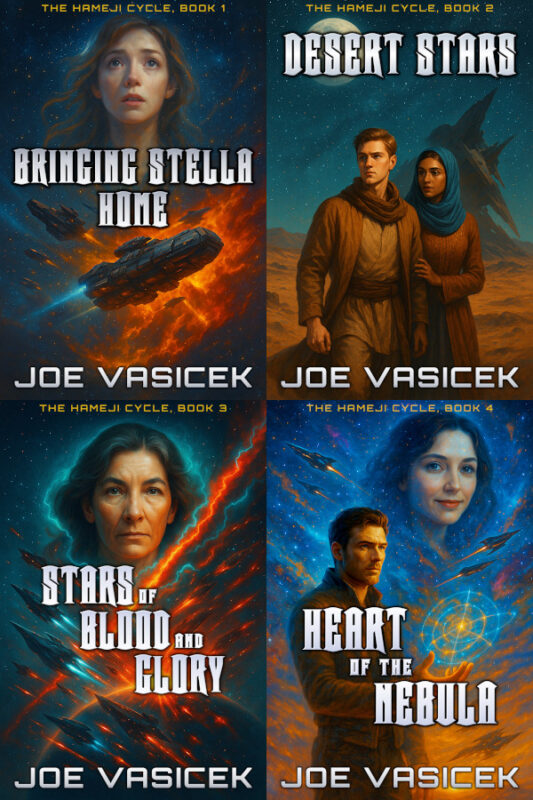
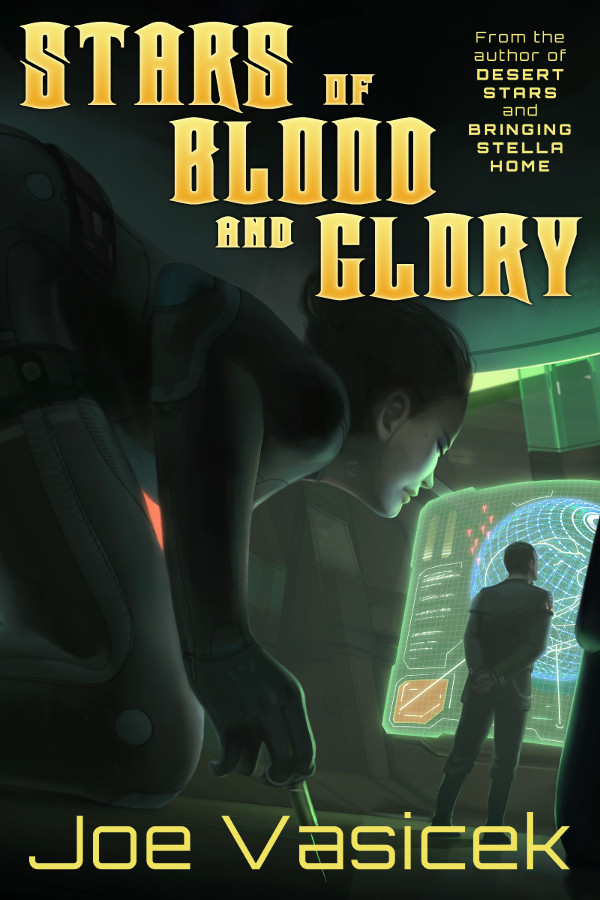
In between writing and revising, I’ve managed to redo the covers for Desert Stars and Stars of Blood and Glory. Check them out!

SBG (cover)DS (cover)I’m really excited to get the new editions out, especially the print editions! Expect to see those soon, like maybe in a week or two.

If you’ve already bought the books, don’t worry; the stories are still exactly the same. The new editions will just have the new covers and some updated metadata. I’m not sure if Amazon automatically updates them if you’ve already bought them, but if it’s an issue, just shoot me an email and we’ll work it out.

Man, designing covers is fun! 😀 I should do it more often!