Pantser vs. plotter? There is no such thing

I have come to the conclusion that the “pantsing vs. plotting” way of thinking about writing is as impractical and useless as nature vs. nurture, or talent vs. learned ability.

Are you a pantser who discovery writes from the seat of his pants, or a plotter who has to outline every character, every plot point, and the whole world first? Well, that’s about as useful as asking whether you were born stupid or whether you were taught to be. Probably a combination of both.

The pantsing vs. plotting dichotomy is something I learned early on, when I was just starting out as a writer. At the time, it seemed like a useful distinction to make. Beginning writers tend to make a lot of mistakes, and those range from world-builder’s disease (where you spend all your time outlining instead of actually writing), to rewriting the first chapter into oblivion, to writing yourself into a corner and having all your characters scream at you. It’s amazing how many things you can get wrong. By dividing these things up into pantsing problems vs. plotting problems, it was helpful to figure out how to fix those.

But then you start to identify with one side or the other, and that leads to an entirely new set of problems. Because the truth is that to write well, you need both. A pure pantser often writes himself into problems that he can’t easily get out of, or misses key elements that render the rest of the story moot (like “if only these two people would talk with each other, the obstacles to their romance would all go away” or “if only Hermione would use the time-turner to stop Voldemort from becoming the dark lord, no one else would have to die”). In contrast, a pure plotter often writes stories that are too mechanical and predictable, telegraphing every plot turn and reducing every character into an avatar for some theme or idea.

So, while thinking of it in terms of pantsing vs. plotting may be useful for the beginning writer in diagnosing the areas they need to work on, I’ve found that it’s not particularly useful for the professional writer. In fact, it can be damaging.

For the last several years, I’ve considered myself to be a pantser. Discovery writing is my mojo—give me a few good ideas and the barest outline of a plot, and I’m off to the races. Except… I always tend to stumble and fall in the middle. In fact, I often have to throw out entire chapters or set a story aside for months at a time, to “let the ideas percolate.” For the last several years, that’s been my modus operandi.

Until now.

With Son of the Starfarers, I’m working on a set of very tight deadlines to finish the damn series as quickly as I can. It took way too many months to write book 7, and I can’t afford to take that much time for the last two books because that’s time I’m robbing from other projects (like Edenfall or Gunslinger to the Galaxy or The Sword Bearer). As a pantser, I can write any book if given an infinite amount of time, but that’s not practical. I need to find a new way to write, one that maximizes my efficiency.

And I think I’ve found it. I’m still tweaking it, of course, but it involves <gasp!> outlining. But wait—I’m a pantser, not a plotter! Except, it turns out, that I’m not. Because no one is.

Pantsing vs. plotting does not describe the writer so much as the method of writing. It’s not a question of where you fall on the spectrum, it’s a question of whether this particular project requires more discovery writing or more outlining. And it turns out out that there are ways to outline stories that actually make your discovery writing better. Every battle plan falls apart upon contact with the enemy, but you need the plan to know which direction to march your troops.

In the next few weeks, I’ll go over some of the new outlining methods I’ve been trying out. It took me almost five months to write A Queen in Hiding, struggling over multiple drafts, but it’s been only four weeks since I started An Empire in Disarray and I’m more than 2/3rds of the way through it, with a clean first draft, and I’m on track to have something finished and publishable by the end of next week. There are still a few kinks in the process to work out, but I think I have it down well enough to share.

So if you consider yourself a “pantser” or a “plotter,” and you’re still struggling to write as much or as well as you’d like, I’d urge you to revisit your basic assumptions about your writing process. That’s what I did, and it’s made all the difference.

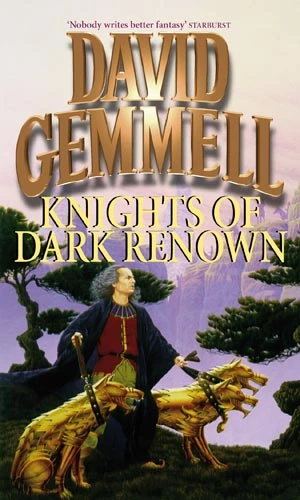
Knights of Dark Renown by David Gemmell

If you’ve been following this blog for any time at all, you know I’m a huge fan of David Gemmell. He’s not only my favorite fantasy writer, he’s my favorite writer, period. His first book, Legend, is still one of my favorite books of all time.

The Knights of Dark Renown is a true standalone, something rare in David Gemmell’s sizeable bibliography. And yet, page for page, it stands up to the best of his work. A brutally violent world populated with unlikely heroes and redeemed villains. An ancient order of magical knights fighting back against an even more ancient evil. Characters who leap right off the page and grab you by the heartstrings, making you weep when they die and stand up and cheer when they triumph—sometimes with the very same breath.

Honestly, if I’d written this review right after I read the book, it would be nothing but “squee!” repeated over and over. It’s been a few months, so my excitement has definitely been tempered with the passage of time, and yet looking back I can definitely say that this was an excellent book.

It’s probably the best vampire novel I’ve ever read, which isn’t what I was expecting. There are a million different kinds of vampires out there, most of which I have no interest in, but these vampires strike much closer to the original: charming, blue-blooded monsters who look perfectly normal on the outside, but beneath the facade are as cruel and terrifying as the most competent and accomplished serial killers—which they very often are. But the really awesome part is how the vampires tempt those they deem worthy to join them, which is how they begin the conquest of the world of men. Without ruining the book, I’ll just say that I was impressed.

Gemmell is often accused of writing the same book over and over again. While that isn’t completely fair, I do see how he gets that reputation. Thing is, that book he supposedly keeps rewriting is a damn good one. He’s a lot like Louis L’Amour in that way.

However, Knights of Dark Renown is something of a departure from that vein. The magic system is different from his other books, as is the lore. The usual character archetypes are there, though he combines them in different ways. The bard, for example, follows a very different path from the Drenai books, and is cut from a different cloth. But none of it is a particularly great departure from Gemmell’s usual fare.

With all that said, I really enjoyed this book. It easily earned the five stars I gave it. Highly recommended.

Trope Tuesday: Chekhov’s Armory

The famous Russian writer Anton Chekhov had a rule:

Remove everything that has no relevance to the story. If you say in the first chapter that there is a rifle hanging on the wall, in the second or third chapter it absolutely must go off. If it’s not going to be fired, it shouldn’t be hanging there.

This is, of course, where we get the trope called Chekhov’s Gun. If a gun shows up at the beginning of a story, you can almost always be sure that it will be fired at some point before the end.

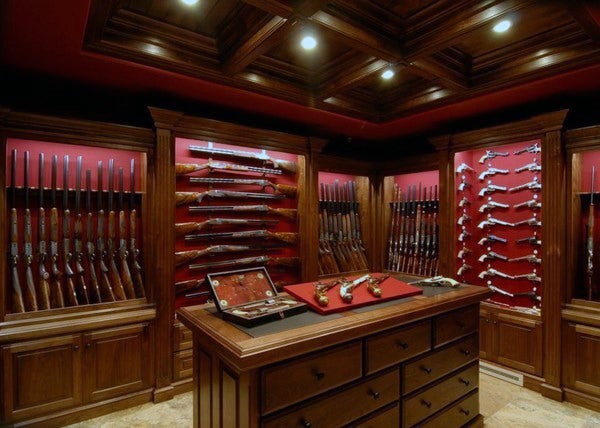
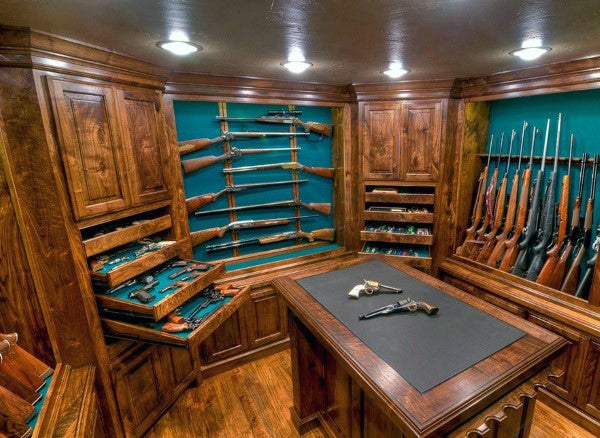
Chekhov’s armory is where the story starts out in a place like this:

Or this:

Or this:

What the hell, I might as well just give you the link to the blog where I got all these photos. There’s plenty more gun porn where that came from.

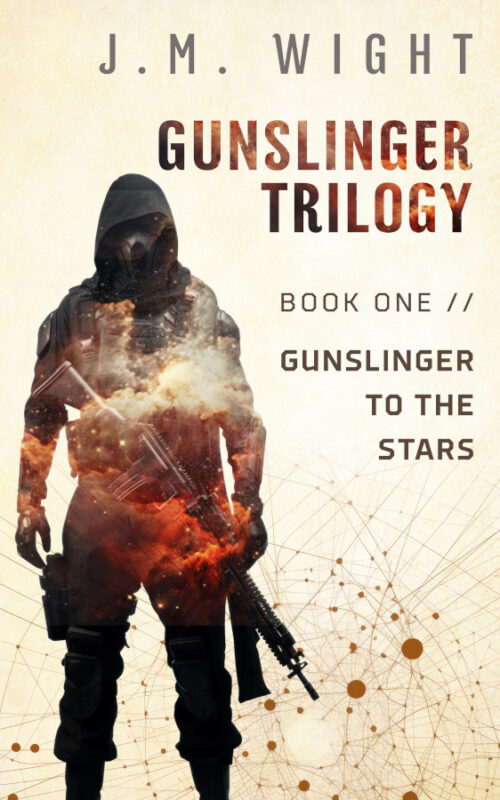
My first time playing with this trope was Gunslinger to the Stars, and I have to say, it made for a really fun story. My outline literally consisted of listing a different gun for every chapter, and figuring out how to work it in. Chapter two was where all most of the guns were listed, but after that, it was pretty much “open fire” and “reload” right up to the grand finale at the end (with a little bit of kissing thrown in for good measure).

Seriously, though, it’s not a bad way to write a book: list all the things that need to go boom and figure out which order to put them in.

The biggest criticism I’ve received for Gunslinger to the Stars is that I should have described the guns in a more personalized detail. To be honest, my life experience is sadly lacking in this regard. I own a couple of guns, most notably an old Mosin 91/30, but most of my shooting experience comes from the Boy Scouts (though to be fair, I did impress the shotgun shooting instructor with a 40+ shot streak). This is a shortcoming that I am eagerly working to rectify.

So yeah, Chekhov’s Armory. It’s a really fun trope to write. When I’m finished with Sons of the Starfarers, I look forward to doing it all again with the next two books in the trilogy: Gunslinger to the Galaxy and Gunslinger to Earth. Expect book two before the end of 2018!

Gunslinger to the Stars

Gunslinger to the Stars

$15.99eBook: free sale!Audiobook: $2.99 sale!

Sam Kletchka here, freelance gunslinger and interstellar privateer. This, my friends, is how I went from being stranded in the armpit of the galaxy to becoming the luckiest human being in the universe.

More info →

Bake the #MAGA cake

The US Supreme Court is hearing a case today that will decide whether or not a gay couple can force a cake artist to decorate a cake for a gay wedding. The issue at stake is not whether a business can refuse service to people based on sexual orientation (the baker was willing to sell the gay couple any out-of-the-box cake on his shelf), but whether the government can force a creative professional to use their talent to advance a message that runs contrary to the individual’s conscience.

Unfortunately, it looks likely that the court will rule against the baker. In other words, we will soon live in a country where artists can legally be forced to create propaganda that runs contrary to their beliefs. And yet, for even questioning this, I’m somehow the fascist??

This isn’t about discrimination. This is about free speech. If I, as an artist, don’t have the freedom to choose what kind of art I create, I no longer have freedom of speech. It really is that simple.

So here’s what I propose. If the Supreme Court rules against the baker, then every bakery in San Francisco, Chicago, and New York City should be forced to make MAGA cakes from now until November 2020. We should fill them up with so many orders that a week won’t go by that they won’t be forced to push the message that put Trump into the White House.

We’ve already seen the power of 4chan and weaponized autism. I have no doubt that this is something that we can do. And maybe, just maybe, it will convince the few reasonable people on the Left to see just how hypocritically batshit insane their side has become. Because if we have to live in a country where conservative bakers are forced to make gay wedding cakes, shouldn’t liberal bakers be forced to make MAGA cakes too?

Please, internet gods. Make it so.

Five awesome history podcasts

At my former day job in Iowa, I had the opportunity to listen to a great deal of audio while I was working. Consequently, I discovered some really fascinating podcasts on a wide variety of subjects.

As a writer, I particularly enjoy history podcasts. Not only do they give me lots of interesting story ideas, but they help to expand my mind and give me some useful perspectives on where we came from and how we arrived at where we are in the modern world today. Before I started listening, there were a lot of dark areas in my understanding of world history. Now, much less so.

I tried out a wide variety of history podcasts, some good, some acceptable, and a few that were less than useful. Of all the podcasts I tried out, here are the five best.

History of Rome by Mike Duncan

Of all the history podcasts out there, Mike Duncan sets the standard with History of Rome. Short and concise, yet full of fascinating insights and connections, this podcast opened my eyes to Roman history and lightened what was previously a very dark section of my understanding of the world.

Where other podcasts lose sight of the forest for the trees, History of Rome never does. And where other podcasts advance a single narrative without exploring alternate explanations of events, History of Rome retains enough curiosity for this never to be a problem. Indeed, for major events like the crisis of the third century or the migration period, Mike Duncan explores multiple causative events, both proximate and ultimate. He’s not just presenting somebody else’s version of history: he examines original sources and comes to his own conclusions.

Histoy of Rome was what got me into history podcasts in the first place. It’s also what opened my eyes to things like monetary systems and the rise of serfdom. There was a hole in my understanding of the world, and History of Rome not only filled it, it gave me a bridge to knowledge I wasn’t aware I didn’t possess. Definitely recommended.

History of Byzantium by Robin Pierson

When the History of Rome ended with the fall of the western Roman Empire, Robin Pierson didn’t want it to end. So he started a podcast of his own, about the eastern Roman Empire from the reign of Zeno in the fifth century to the fall of Constantinople to the Turks in 1453. The result is The History of Byzantium.

This podcast is very much a continuation of the History of Rome. It’s a little more difficult to follow, mostly because Byzantine history is so… well, Byzantine. However, Robin does a good job tying it all together and making it comprehensible. He also interviews a number of historians and other subject experts, which can be very interesting.

I never realized how pivotal and important the eastern Roman Empire was. From Justinian and Theodora to the apocalyptic wars with the Muslims that stopped them from overrunning Europe in the 7th and 8th centuries, the history of Byzantium is absolutely fascinating. Well worth a listen.

Revolutions by Mike Duncan

After finishing the History of Rome, Mike Duncan started a new history podcast called Revolutions. This podcast explores the major political revolutions of the modern era, starting with the English civil war and ultimately leading to… well, we don’t know yet! Once again, this was a relatively dark area in my understanding of the world that Mike Duncan quite effectively illuminated.

It’s been particularly interesting to see how all of these revolutions are connected. The English civil war in many ways laid the groundwork for the political philosophy of classical liberalism, which led to the American Revolution. In turn, the American Revolution inspired the French Revolution, which triggered the Haitian Revolution (the only successful slave revolt in history), which spilled over into South American with Simon Bolivar. The failures of the French Revolution led to Napoleon, the restoration of the Bourbons, and the backlash of Metternich and European conservatism. This led to the tensions which exploded in the revolutions of 1848, whose failures led to the rise of socialism and communism.

Revolutions has shaped up to be just as good as History of Rome, if not better. Definitely worth subscribing.

Western Civ by Adam Walsh

The scope of Western Civ is a lot broader than the other podcasts I’ve listed, and that’s part of what I like about it. Instead of diving into the minutiae, it gives a very good sweeping overview of civilization, starting with the prehistoric fertile crescent and ultimately leading to… well, so far we’re at the high middle ages, but I get the sense that we’re ultimately headed for the modern day.

Adam Walsh also does a lot of readings from stuff like Homer, Cicero, Beowulf, and Norse mythology. It can be really interesting to hear the original documents in translation, especially after getting a context for them. It’s clear from his reading that he’s got a passion for this stuff, which bleeds over into the whole production.

For a broad overview of Western history, both to get a sense where your blind spots are and to put everything else into context, Western Civ is probably the best history podcast I’ve found for that.

History of English by Kevin Stroud

Years ago, in college, I took an ELANG class for my English minor and found it absolutely fascinating. The History of English Podcast combines all the best parts of that linguistics class with the history of the people who spoke it. Starting with the Indo-Europeans and what archaeologists have managed to piece together about them, Kevin traces the origins of just about every aspect of the English language.

In particular, I’ve really enjoyed learning about the Anglo-Saxons and the language they spoke. Kings and Earls, pagans and Christians, far-reaching marriage alliances and invasions from the Vikings and the French. I never considered how the English language itself is a historical artifact, but it really is. As a writer, I find this particularly fascinating.

The History of English Podcast goes really in-depth about things like the Norman conquest and the English monarchy, but it’s never too dry or difficult to follow. Also, each episode is packed with some really fascinating insights into our everyday language. Definitely worth subscribing, especially if you like to write.

WIP excerpt: A Queen in Hiding

The arrival of the starfarer caused stirred a great deal of excitement at Little Gaia. Eve couldn’t remember the last time a man from the stars had visited their humble space station. As one of the few unmarried and eligible girls, she took extra notice of the rumors.

Old bald Thomas, the station’s geneticist, said that the starfarer’s arrival was a miracle. His wife Ethel was the matchmaker, and together they did more to determine the fate of the colonists’ lives than even the station master himself. They were the ones behind every betrothal and wedding. They were the ones with veto power over any proposed marriage. Before she could even walk, the course of Eva’s life had already been set, with her choice of suitable husband reduced to only three. Two of them were already married men more than twelve years her senior, and the last was a childhood friend that she would almost certainly have to share.

So when the mysterious starfarer declared his intention to settle down permanently, it provoked no small stir of commotion.

Almost at once, Eve’s life began to turn upside down. Ethel and old bald Tom immediately selected three young women for the starfarer, but the first of them refused. Predictably, this outraged old bald Tom, causing a small scandal.

“I hope you won’t be so obstinate,” he told Eve privately. “It’s been almost a generation since we had an opportunity like this. Without new blood, our colony is doomed to perish.”

“Don’t worry,” she reassured him. “I’m happy to wed the starfarer.”

“Good. And I hope your union will be blessed with many children. Stars know that’s what we need.”

The second woman was Astrid. She was only two years older than Eve, though growing up, they had never been more than friendly acquaintances. Eve had never expected to share a husband with Astrid, so she had never made a special effort to be close to her. Now, all that had suddenly changed.

Astrid reached out to her first, shortly after the engagements had been arranged. They met privately in Eve’s family apartments, the stars spinning silently through the windows underfoot.

“I sincerely hope you harbor no hard feelings for me,” said Astrid. “Please know that I have none against you.”

Eve smiled and gave her future sister wife a reassuring hug. “Of course I don’t, Astrid. I always expected to share a husband.”

“I wish I could say the same.”

Astrid’s grandfather had been a star wanderer from beyond the Good Hope Nebula, giving her some of the best genetics in the colony. From the way she had kept herself aloof in her earlier years, Eve had always assumed that she held this above everyone else. The desperation in Astrid’s voice surprised her.

“Can I ask you a question?” she asked.

“Certainly, Eve.”

“Why choose to marry the star wanderer? With your gentics, you could have your pick of almost any boy on the station. Why him?”

Astrid swallowed. “If you’re asking why you have to share him with me, I—”

“No, no, not at all,” said Eve, putting her hand on Astrid’s arm. “Please don’t take it that way.”

The moment passed awkwardly. Astrid smiled, but the tension still hung in the air.

“There’s more to matchmaking than genetics,” Astrid said at length. She didn’t offer any more of an explanation, and Eve didn’t push her for one. They spent the next two hours talking to each other, and by the end, they were much closer than before. But still, the unspoken questions hung over them like something rotting in the bulkheads.

Before the marriages could be solemnized, the laws of Little Gaia stated that the betrothed must be given an hour alone together, in total privacy without any outside interference. Afterwards, if either of them desired to cancel their vows for any reason or none at all, it was their legal and moral right to do so. Of course, Astrid and Eve weren’t to go in to the star wanderer together. Each would have their hour alone with him.

Astrid went first. The station master’s office was the designated room, since it was one of the few living areas on the station with soundproof bulkheads. She wore her finest red silk dress, handed down as an heirloom from her grandmother, with a silver girdle inlaid with opals. Eve didn’t have anything nearly so fine.

The hour passed like a neverending eternity. Eve sat outside the office, her emotions vacillating from fear to impatience and back again. She’d heard stories about what couples did in their alloted time alone together, up to and including sex. Things that wouldn’t otherwise be permitted were fair game, since no one would ever have to know.

The hour finally passed. Eve stood breathlessly at the door, waiting for Astrid to emerge. When another full minute passed without any indication from inside, Eve wondered if perhaps she should knock. But before she could, the door slid open and Astrid stepped out.

“Well?” said Eve, her heart pounding nervously.

Astrid stared off as if distracted by something down the hall. Her hair was a little messier than it had been before she’d entered, and her dress was wrinkled ever so slightly. Eve’s gut began to clench.

“Astrid?”

“Oh,” said Astrid, suddenly noticing her. She gave her a smile, which Eve weakly returned.

“Well?”

“Eve, your face is pale. Are you all right?”

I could ask the same of you, Eve thought silently. She shook her head and looked away.

“I’m fine.”

“That’s good.”

An awkward moment of silence passed. There were a thousand questions Eve wanted to ask, but none of them seemed appropriate, and Astrid wasn’t volunteering any answers. In fact, she went right back to staring off at the distance, as if Eve weren’t even there.

“Well,” Eve said at length, “I guess I’d better go.”

“Wait.”

Astrid lay her hands on Eve’s shoulders and looked her in the eye. Her expression was suddenly serious. A chill ran down Eve’s back.

“What is it?”

“Tomas, our future husband, he’s—how do you say?—a telepath.”

She frowned. “A telepath?”

“Yes. Not just him, either. He’s one of many, and now I—I don’t know how to put it. But if you don’t want to go in to him, that’s okay.”

She gently took Astrid’s hands and eased them off of her shoulders.

“Please don’t scare me like this, Astrid.”

“I’m sorry. I’m not trying to—honest.”

“Is he… dangerous?”

“What?” Astrid laughed. “No, of course not. Well, he did used to be a pirate, but those days are behind him now. He just wants to settle down.”

How do you know so much about him?

“Eve,” said Astrid, putting a hand on her arm. “There’s nothing to be afraid of.”

“Then why did you say it was okay if I didn’t want to go in?”

“Forgive me. What I meant is that you don’t have to let him read your mind. If you do, you won’t ever be the same.”

Her words were not reassuring in the least. By now, Eve’s heart was pounding something awful. But she swallowed and nodded, steeling her nerves.

“Thank you, Astrid. I’ll keep that in mind.”

Spontaneously, Astrid gave her a hug. It was one of the most open and honest hugs that Eve had ever received. They held each other for several moments, Eve’s nervous heart still fluttering.

The station master’s office was one of the most richly furnished rooms on the station. An ornate blue and gold rug graced the floor, the geometric design breathtaking in its detail. The table that sat in the center was made from authentic wood, its legs gilded with gold. Hand-woven and highly stylized tapestries depicted the history of the small colony from its founding nearly ten generations ago. Plush, oversized divans ringed the walls, with dozens of tasseled pillows strewn about for additional comfort.

The star wanderer sat on the far side of the room, his arms resting comfortably along the back of the divan. He was healthy and young, with a head of thick brown hair and a trim, attractive figure. The moment his eyes laid hold of her, they never left. Eve stared at the floor demurely, unsure whether to sit across from him or on the same divan.

He gestured for her to join him, which shattered her indecision. Still, her heart pounded as she sat with her knees close together, only an arm’s breadth away. She looked up at him expectantly, but he did nothing to break the silence.

His gaze, for all its intensity, was surprisingly gentle. As she looked into his eyes, she realized there was no need to feel threatened by him at all. His clothes were foreign but simple, a gray uniform shirt that bore no isnignia with a synthleather jacket that had seen considerable wear. They gave him a roguish appearance that only increased his allure.

Should I say something? Eve wondered as the silence rapidly became unbearable. She remembered what Astrid had said about him being a telepath. Was he reading her thoughts even now? If so, what did he think of her.

He leaned forward and put a hand on her knee. A thrill of excitement shot through her body at his touch.

“Hello, Eve,” he said, his eyes never leaving her. “My name is Tomas. Astrid told you about me, didn’t she?”

Eve’s eyes widened. “You—how can you—I thought you couldn’t speak our language.”

“I can, with Astrid’s help. She’s shown me much about your people. I hope that in time, you can show me much about yourself as well.”

He spoke slowly and carefully formed his words, but there was no doubt that he understood them. Eve cleared her throat and sat up straight, her hands in her lap.

“What would you like to know?”

He withdrew his hand from her. “Do you fear me, Eve?”

“No. I’m… just a little nervous, is all.”

“That’s understandable. Things always move quickly when a star wanderer settles down. I take it you didn’t expect to be marrying one?”

“No,” she admitted. “But I’m looking forward to it.”

“As am I.”

He leaned back and crossed his legs. “Astrid told you that I’m a telepath?”

“She mentioned it, yes.”

“Would you like to be one, too?”

Eve paused. “What do you mean?”

He held out his hand toward her. As she watched, a faint blue light traveled up his arm, growing brighter until it reached his palm. She realized that he was offering it to her.

“There is much that I can show you, Eve. But if we are to join minds, it must be your choice, not mine.”

She swallowed, unsure what to do. Astrid’s words came back to her, about how she would never be the same once she let him into her mind. But if they were to be married, wasn’t she supposed to give herself to him anyway? She’d never heard of anything like this, but it didn’t seem too much to ask.

Tentatively, she reached out her hand. As their fingertips touched, the pulse of light ran across her skin, sending chills in its wake. She withdrew and shut her eyes as it passed all the way to her heart.

A sudden wave of dizziness made her head spin. Though her eyes were closed, she could clearly see the station master’s office with all of its furnishings. Except it wasn’t the starfarer she saw seated on the divan. It was her.

She opened her eyes with a start. Now she was looking at Tomas again, but she could still see herself through his eyes. She could also see the hallway outside, where Astrid was waiting for her. That wasn’t all. Other images swam before her, of places she didn’t recognize—places she had never been. There was a dark, bare room with bars around the door like a prison, and a spaceous mausoleum with large, windowed coffins lining all the walls. She saw them as clearly as if with her own eyes.

“Take a deep breath,” Tomas advised her. “Put everything to the back of your mind except what you can see with your own eyes.”

She did as he told her, and the dizziness soon passed. At the same time, she felt a whole host of thoughts and emotions, none of which were hers. The cacophony in her mind was deafening, and she soon felt overwhelmed.

That was when the voice of the mother-queen spoke.

Be at peace, Eve. You are among friends.

The voice instantly brought calm to the chaos. It was quiet and still, yet it had a commanding presence that dispelled her confusion and fear. She saw, as if in a dream, a young woman whose body was covered in tattoos. The woman looked straight at her, and she realized it was no dream.

I am Reva, the mother-queen. I am in you, and you are in me. My voice brings peace to the chaos, and light to the children of the stars.

What is this?

You are one of us now, Eve. Your mind is melded to ours.

She instinctively reached out to Tomas, who put a hand on her shoulder. His touch was another point of familiarity that provided an anchor to her. She looked at him, and realized that he could read all her thoughts.

“What is this?”

“It’s a long story,” he began.

In the blink of an eye, his life’s history flashed before her mind. A modest childhood, on a colony much like her own. His departure on his father’s starship, full of excitement for the future. His first year as a starfarer, struggling to make it on his own. But then things began to change. A war had broken out in the frontier stars, spreading like fire from world to world. His starship lost, he had fallen in with a band of fearsome pirates, who had taken him beyond the most distant colonies to a hidden world where no soul had ever been. And there, something wonderful and terrifying had happened.

Reva closed her eyes and guided Eve through all of their collective memories since Star’s End. She seamlessly wove the disparate pieces into a narrative that encompassed the full breadth of their experience, from the awakening of the collective to Tomas’s departure and arrival at Little Gaia.

Eve gasped for breath. She felt as if she’d lived a dozen lifetimes in the space of a few minutes.

“Less, actually,” said Tomas.

“Beg pardon?”

He gently caressed her shoulders, bringing her back to herself. “It’s been less than a few minutes.” We can read each others’ mind, you know.

Is this what Astrid meant that my life would never be the same?

Yes.

Eve paused, unsure what to think about that. Until just a few moments ago, it would have terrified her. But now that her mind had been expanded, she felt as if a concourse of bright and fantastic worlds had suddenly opened up to her. All her life, she had only known the hundred and twenty two people on board her little station. But now, she saw worlds full of faces, friends, and family she’d never known. She felt the pain of loss and the joy of reunion, the thrill of victory and the despair of defeat. It was as if her whole life up to this moment had been cast in black and white, and only now had begun to take color.

It’s incredible, isn’t it?

The last thought came from Astrid. Eve reached out to her and saw, in an instant, all of her apprehensions about sharing a husband with a sister wife. Most of it was simply due to the uncertainty, and as Eve opened up in kind, her anxieties rapidly dissipated.

You really don’t hold it against me.

No, of course not. Why should I?

My mother was in a polygamous marriage, and it made her miserable.

Immediately, Eve saw everything: the years of toxic jealousy and rivalry, all kept scrupulously hidden from the public eye. Years of speaking as little to each other as possible, with passive-aggressive turf wars over every inconsequential thing. It was enough to drive anyone crazy.

Then why did you choose Tomas, when you could have had your pick of anyone?

Because all my life, the other girls have seen me as a threat. That’s the dark side of having good genetics. I would love to have a husband all to myself, but things can change quickly, and I’d rather marry an unknown than be trapped with a sister wife who hates me.

It all suddenly made sense to her. As she looked into Astrid’s mind, she couldn’t help but feel an overwhelming sense of compassion and empathy. She wasn’t the stuck-up girl everyone thought her to be. In fact, she was more like Eve than either of them had realized.

There’s no need to worry about sharing a husband, Astrid. I’ll be happy to be your sister wife.

Out in the hallway, Astrid quietly wept. Her relief was so strong that Eve herself was nearly brought to tears. If they had been in the same room, she had no doubt but that they’d embrace each other.

Thank you, Eve. That means a lot to me.

It’s the least I can do. We sister wives have to stick together.

We certainly will.

Tomas smiled. “I think this is the start of something wonderful.”

“Yes,” Eve agreed, cuddling up to him. He put his arm around her and kissed her long and slow. No longer were they strangers. As one kiss gave way to another, Eve’s fears and apprehensions melted away, and she felt as if she’d known her husband-to-be for a lifetime.
Late November Update

Is it time for another update? Why yes, I suppose it is.

Sons of the Starfarers is coming along quite well. Book 6, Patriots in Retreat, is up for preorder right now with a release date of January 19th. My editor just got back with the edits for book 7, A Queen in Hiding. Haven’t had a chance to look through those yet, but I will in the near future. Come January, that book will be up for preorder as well, with a release date of March 16th.

Right now, I’m writing book 8, An Empire in Disarray, with a hard deadline of 22 December (just before Christmas). Normally, I’d be panicking right now, but I’m trying out a new outlining method that seems to be working quite well. If everything works out the way I hope, I’ll finish up book 9 sometime in February and move on to other projects.

Looking back, it was a mistake to set out to write a nine-book series before knowing how the first one would do. If I could go back to 2009 and do it all over again, I’d stick to trilogies, where the first book stands well enough alone that I can abandon the other two books if it doesn’t gain much traction. That’s going to be my modus operandi from here on out.

So here are the trilogies I need to finish:

Genesis Earth Trilogy

This one has been outstanding for a long time. The first book did much better than I was expecting, and while its popularity has fallen off in recent years, it still gets very good reviews. For a first novel, I’m honestly surprised that this book has done as well as it has.

The second book, Edenfall, is still on the back burner for now. Partially written, partially outlined, it shouldn’t take more than a couple of months to get it done when I finally sit down to finish it.

As for book three, The Stars of Redemption, I have no idea because I haven’t even outlined it yet. Perhaps that’s what I need to get the ball rolling: outline the last book, so I know what has to happen in the second book. In any case.

Gunslingers Trilogy

Gunslinger to the Stars hasn’t done as well as I would have liked, but I enjoy this universe so much that I’m going to finish the trilogy if for no other reason than the fun of it. I’ve already written the first four or five chapters of Gunslinger to the Galaxy, and it’s coming along swimmingly. In fact, I’ll probably go right back to it after finishing up Sons of the Starfarers and call it a vacation. Expect to see more Jane Carter soon!

The Twelfth Sword Trilogy

I am super super excited to finish this trilogy—which is good, because the way the first book ends, it’s definitely not a standalone. Definitely not. Haven’t formally outlined it yet, but there’s a ton of stuff I’m going to throw into the second book, The Sword Bearer. Mercenaries, sorcerors, death mages, winged cataphracts, desert ruins, and mountain strongholds—it’s going to be great fun!

The Outworlds Trilogy

For a while now, I’ve been playing around with the idea of condensing all of Star Wanderers into a novel and then turning it into a trilogy. The first book will basically be made up of bits and pieces from all of the Star Wanderers novellas, spliced together to make a coherent novel. In particular, I’d like to expand on Noemi’s viewpoint and trim out some (or a lot) of the extraneous stuff that made the series drag on. Basically, turn it into less of a sci-fi romance and more of a classic space opera.

I’ve already started the sequel, Children of the Starry Sea, though I haven’t gotten past the first chapter. Where Star Wanderers is a series of novellas, though, Children of the Starry Sea is definitely a proper novel, and it would probably work a lot better to frame it as a trilogy than anything else.

I suppose it’s a bit like how Orson Scott Card turned a bunch of his early short stories into The Worthing Saga, which in my opinion is his very best book. I won’t unpublish any of the old Star Wanderers stuff, but I may just let it fade into obscurity as I push the other stuff.


These are the books that are on my mind. I’ve got to be honest: Sons of the Starfarers feels a bit like a ball and chain, but I’ve committed to finishing it and I’ll do my best to finish it well.

On the publishing front, there’s so much stuff I want to do that I’m having trouble keeping up with it all. My main goal is to get to 10k subscribers on my email list. Currently, I’m just shy of 4k. InstaFreebie has been hugely useful for that, but I’ve got to try other strategies as well. One of those strategies involves a new signup incentive, so if you’re already signed up for my email list, I’ve got a surprise for you soon.

So much stuff going on. I swear, this is the best depiction of what it’s like to be an indie author:

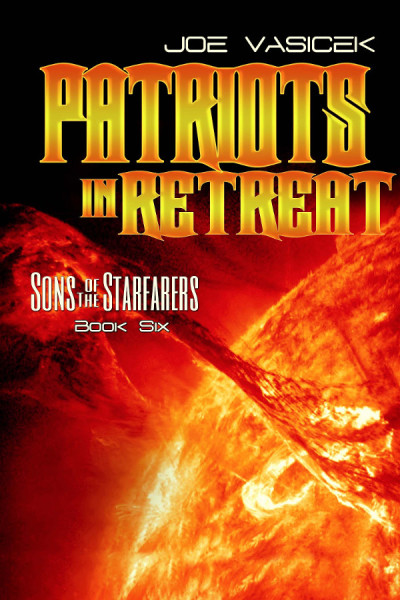
Patriots in Retreat now up for preorder!

For those of you who have been waiting for the next Sons of the Starfarers book, I have good news! Book 6, Patriots in Retreat, is now up for preorder and scheduled to release on January 19th, 2018. Check it out!

Patriots in Retreat

Patriots in Retreat

$9.99eBook: $2.99

Gulchina's betrayal has all but sealed the fate of the Outworld Confederacy. As world after world falls before the Gaian Imperial onslaught and the crew of the Merope-7 take losses of their own, a young Imperial agent must decide what she's truly fighting for.

More info →

Book 7, A Queen in Hiding, is with the editor right now and should be up for preorder soon as well, with a release date in March 2018. If all goes well, book 8, An Empire in Disarray, should be out in May, and book 9, Victors in Liberty—the final book in the series—should be out in July.

Thanks for reading!

Response to Correia’s awesome rant on fans vs. authors

So Larry Correia wrote an awesome rant the other day about fan entitlement and writing professionalism. The thing that set him off was a discussion on his author Facebook page where a bunch of readers were castigating Patrick Rothfuss for taking 6+ years to write his next book. A bunch of them started arguing that authors have a moral obligation to their readers to finish their books, and Larry called bullshit.

Do I have opinions? Why, yes, thank you for asking.

For the most part, I think Larry is spot on, especially about how free market capitalism is the best solution to this problem. Basically, books are just a product—nothing more, nothing less. Readers buy the product, and authors create it. When a reader buys a book, that’s all they’re buying. When an author writes a book, that’s all they’re creating. The free market works things out. The problems only arise when readers think they’re entitled to something more than what they’ve bought, or when authors think they’re entitled to more than what they’ve earned.

As a libertarian sci-fi writer, I could go on and on about the virtues of the free market and how capitalism is the best and most righteous economic system ever invented by man, but for now I’ll save that zeal for my fiction. In particular, there’s a short story recently I wrote for a $12,000 writing contest that is sure to lose because it shows just how evil and destructive a universal basic income would actually be. But I digress.

I know people mean well. I know people think they are helping. I know that you think it is a compliment. Maybe the first couple hundred times, but then after that it becomes a continual droning whine.

If a writer still bothers to post on social media to interact with their fans, and they post about them doing anything, literally anything other than writing, somebody inevitably is going to jump in and say “YOU SHOULD BE WRITING!”

The really sad part you helpful entitled types don’t get is that other stuff non-writing stuff is a vital part of the creative process. Since most of what authors do is in their heads, they never really stop working. So when I’m shooting guns, or painting minis, that is the activity that I do to uncork my brain, so that I can go put in another day of creating imaginary stuff tomorrow.

Authors either have a life outside of writing, or they burn out. Or, alternatively, they just check out and don’t interact with their fans anymore. Because even though there are a hundred cool fans for every entitled whiny douche, the entitled whiny douche is the one that sticks out.

Yes, yes, a thousand times yes. I’m not at a point in my career yet where I have thousands of rabid-at-the-mouth fans screaming at me constantly to get back to work, but I can definitely see how it gets old.

Also, writers genuinely do need to refill the creative well from time to time. To an outside observer, it might look like we’re dicking around, but in reality we’re noodling out our next story, so that when we do sit down to write, the words actually come.

If you think that writing is as easy as sitting down at a keyboard and mashing out words, you might as well kidnap your favorite author, break his legs, and chain him to a typewriter in your basement.

To My Fellow Authors

Get your shit together.

Seriously, act like a professional. In any other job in the world, if you wasted all your time fucking around and didn’t get any work done, you’d get fired. Writer’s Block is a filthy lie. I couldn’t have Accountant’s Block. Oh, woe is me, I can’t make these spreadsheets because I’m just not feeling it today—FIRED.

But if you’re honestly working, and you’re doing the best you can with what you’ve got, you don’t have to take shit off of entitled douches.

The trouble with writing is that it isn’t always clear when the work is done. I’ve had multiple award-winning author friends tell me at conventions that they’re impressed with how prolific I am, and yet I never—NEVER—feel like my work is done.

I totally agree with Larry that if you want to write professionally, you have to treat it like an actual profession. Right now, I’m retooling my writing process so that I can put out two or three times as many books. “Writer’s block” is not an entitlement or a badge of honor. It’s a disease.

This YouTube video is the best take I’ve seen on the subject. I watch it over and over again, sometimes every day. Whenever I don’t think I can meet my next deadline. Whenever I feel like there’s something repelling me from sitting down to write. Rewatching this video gives me a burning desire to finish my WIP, look that resistance in the face, and scream “rest in peace, motherfucker!” I swear, I should get that woodburned on a plaque and hang it over my desk. Best motivation ever.

Screw writer’s block. Screw all that artsy fartsy crap. There’s nothing quite so awesome as looking at your name on a book cover and thinking “yeah, I wrote that.” It never gets old.

I remember a couple years ago when I ran into a really successful author, dude was on top of the world, just got home from a successful book tour, latest book was a huge hit… and he was bummed. I’m talking super depressed. Why? Because Lone Douche in the Wilderness had just ripped him apart on Facebook, and that negativity was enough to screw up all his previous happiness.

Do not give douchebags power over you. Don’t ever let people impose their arbitrary and capricious rules onto you.

To be frankly honest, this is one of the reasons why I don’t do social media anymore. Not because I have a thin skin or can’t take criticism. Not because of a specific instance where someone was a douchebag to me, either. Rather, it was more of a recognition that if I didn’t change course, I would become that douchebag—if indeed I hadn’t already.

There’s something about our current iterations of social media that seems to bring out the worst in people. Twitter in particular is insanely toxic. Future historians (and historical fiction writers) are going to have a heyday writing about all of the online meltdowns of our most prominent cultural and political figures, right up to President Trump himself. It’s a daily occurance at this point, sadly. And yet, the more I look at it, the more it seems that the only winning move in social media is not to play.

Which is not to say that I don’t want to keep in touch with my fans. That’s what this blog and my email list are for. But speaking as a reader for a moment, when I buy a book, I’m not trying to strike up a friendship with the guy who wrote it. I’m just buying a book. Neither am I particularly interested in hearing about whatever social or political cause set them off on a rant today. I just want to read the damn book.

It’s called free market capitalism, and it makes everything so much simpler. If a book looks interesting, I’ll buy it. If I like it, I’ll buy more from the same author. It’s cool and all to feel like we have a connection, but at the end of the day, it’s just books. And readers. And the free market.

Anyways. That’s my take on Larry’s epic rant. Writers and readers, be excellent to each other. That is all.