Interview with Slava Heretz

I met Slava Heretz online shortly after I started publishing my books.  He’s another indie writer who specializes in science fiction and space opera.  I’m reading his short story / novelette series Outer Pendulum right now, and it’s pretty good.  If you like a good space adventure, I think you’ll like his stuff.

Anyhow, we decided it would be fun to interview each other on our blogs, so here he is.

Tell us a little bit about your books.

The Outer Pendulum is a space opera which I am releasing in monthly 10,000 word installments. The story is set in a galaxy where humans are the unwanted newcomers, escaping an oppressive life back in the Milky Way, only to find themselves facing another kind of tyranny: the seemingly endless stream of piracy and corruption in their new land. Our hero is Captain Eli Saffinger, a former New Alliance Navy captain turned mercenary fleet commander. His mission, which he accepts reluctantly, is to escort a freighter carrying extremely valuable mining equipment to the only allies of the weakening colonial state. So his journey begins in Corsair (Outer Pendulum, Book 1), where he must immediately confront the most ruthless and dangerous privateer in the galactic region.

How long have you been a writer, and what got you started?

I started serious work on a near-future technothriller back in late 2007. I think that’s really when I began to consider myself a writer. As opposed to earlier dabbles with fiction back in my youth, I actually spent a very large portion of my days dedicated to this project — and to be perfectly honest, I’m still not exactly sure why. I just suddenly had a story to tell. It came to me one day in the shower and I said to myself, “Hey, Slava, let’s write a novel.” So when the idea for The Outer Pendulum popped into my head this past spring, I had the wisdom and experience from my many many mistakes to give this story more life, energy and passion.

What draws you to space opera and science fiction?

As an only child I had a lot of time to just sit there by myself and dream up wildly imaginative tales of space travel and cool technology. Some of these ideas were good, some not so much. But I always marveled (and still do) at the things which I have no hope of ever accomplishing. Theoretically I could be a rock star. I have no talent for it, but at least the occupation exists. But no matter how hard I work at, there is no way in my lifetime, save a true miracle, that I will ever travel to another solar system. And because of that, the possibilities of the imagination are endless. I love that.

Who are some of your favorite authors?

Dan Simmons for his wonderful characters and settings. Iain M. Banks for that touch of witty humor we all love and need. And M. John Harrison for anytime I want a truly warped, weird, yet poetic reading experience — he’s kind of the Stanley Kubrick of sci-fi noir.

Why did you decide to self publish?

I had submitted several pieces of fiction to traditional publishers in the past. Many of them flat out ignored me. Others, however, sent very positive rejection letters. That’s when a light bulb appeared over my head. I asked myself: why am I waiting for months to have one person tell me I write well, when I could let the world of hungry readers decide for themselves? It wasn’t long before I discovered Amazon Kindle Direct Publishing and Smashwords. I soon realized what a revolutionary idea it was to allow authors to simply create and let the market speak for itself.

What have you learned from your indie publishing experience thus far?

I’ve actually learned quite a bit about readers of indie literature as a whole. I’ve heard the complete spectrum of praise and criticism about my series. Some have absolutely loved the story. Some have vehemently hated it. But if I were to pick out some things that they all had in common they would be a) a seemingly insatiable appetite for reading within the genre b) that MOST of them actually do read samples and/or product descriptions before buying and c) that this growing community of open-minded folks is truly willing to ignore the stigma of indie publishing and seek out works by self-published authors. I can’t say that for them it’s an easy job. But they try, and I thank each and every one that contacts me — because it seems in the end, the reward of finding a few self-published diamonds far outweighs the possible tedium of sifting through the ever-growing rough.

What are your goals and plans for the future?

First and foremost, I have to finish The Outer Pendulum. I envision eight or ten installments culminating into a complete saga by summer of 2012. There is also an audiobook/podcast in the works. There will even be a multiplayer online card game based on the universe within the story. I mean, I have a ton of other ideas kicking around in the ol’ noggin — such as books in other genres. But this will certainly keep me busy for the next several months. It’s really been a lot of fun writing the series.

If all of us have at least one impossible dream, what is yours?

I would love to meet a sentient alien. I can’t say with 100% certainty that they exist, but I really hope so. If I may quote one of my favorite TV shows — “I want to believe”

Slava lives in Brookline, MA with his beautiful wife Alyssa, his neurotic dog Duke and his passive aggressive cat Chester.

“What was your purpose in writing this?”

Yesterday I heard back from one of my first readers for Star Wanderers, and the feedback she gave me was awesome.  You know you’ve got a good first reader when their comments make you go “aha!” and you find yourself with a host of new ideas for the story.

Anyway, at one point, she asked me: “what was your purpose in writing this?” To which I answered “I don’t know; I was supposed to be working on something else, and all of a sudden I found that I’d written this story!”

Her eyes widened a little, and she kind of got this look on her face that said: “how could you possibly write something like this and not put a ton of thought into it?” Which struck me as amusing, because she’s an editor who writes on the side, and I’m a writer who edits on the side.

This is the thing about discovery writing: it’s not about how much sweat and tears you put into your work, but how much energy you get out of it.  If a project just totally drains you, chances are it’s not going to be as good as something so exciting that you can’t not write it.  And once you improve your craft to the point where you’re no longer committing all the stupid new writer mistakes, if you’re having fun, chances are that the readers are going to enjoy it too.

Ah, the joys of spontaneous creativity.  Would that it was always this much fun.

🙂

The interior designer’s approach to story

I recently read a fascinating post on John Brown’s blog with an interesting exercise for analyzing the kinds of stories you most like to read.  By finding out what really turns you on in a story, you can have a much better idea what to write, and how to make your own stories better.

He prefaced the exercise with a story about the interior designer who helped them to decorate their house.  The designer spread out a number of home magazines in front of them, and told them to go through and tear out the pictures that most turned them on.  After doing this, they analyzed the pictures to see what they had in common, and thus discovered how to best decorate their house.

The exercise works much the same way.  First, pick out five books you really like that immediately come to mind.  Mine are:

As many of you know, these are some of my favorite books of all time.  I’ve reread three of them, and I intend to reread the other two at some point.

Next, pick out the elements that these books have in common.  Here’s what I came up with:

1) Set in a different time and place.

Not all these books are science fiction, but the all take place in a world far removed from our own.  Only Spin takes place largely on Earth, but the events of the story transform the world as we know it so much that by the end of the novel, it’s completely different. SPOILER (highlight to see) Besides, at the very end, the two main characters leave Earth by going through the giant portal to another planet, so the novel is arguably about escaping the world as we know it.

2) Stakes that are much more personal than global.

This was interesting, and highlights something I realized when I compared Merchanter’s Luck with Downbelow Station.  In all of these stories, the central driving conflicts are extremely intimate and personal.

To be sure, many of these stories also have an epic backdrop; Mistborn certainly does.  However, I was much more interested in Vin’s growth and development than I was in how the Ska would overthrow the Lord Ruler–in fact, Mistborn is my favorite book in the trilogy for that very reason.

3) Encourages deep introspection.

This shouldn’t come as too much of a surprise if you’ve followed this blog for a while, but I love love LOVE stories that make me see the world in a new way.  Thrillers and adventures are all fun and good, but if it doesn’t make me think, I’m usually like “meh” at the end.

4) Female characters who aren’t weak or passive.

This one might be a bit more controversial, but in all of these stories, I’ve noticed that the female characters are pretty strong, even if they aren’t all kick-butt Katniss wannabes (ugh…I hate Katniss).  Even in Legend, which is largely dominated by men, you still have the earl’s daughter, who is one heck of a spirited woman.

5) Life and death conflicts.

This is interesting: in all of these books, the threat of death is immanently real.  Some of them, such as Legend and On My Way to Paradise, are among the most violent books I’ve ever read.  I’m not sure what it is, but there’s something about life and death struggles that really draws me.

6) Romantic in a broad sense.

I’m using Tracy Hickman’s definition here, in which romance is all about teaching us to feel and bringing us in touch with our deepest feelings.  That’s the central theme of On My Way to Paradise: learning how to be a man of passion after witnessing some of the worst atrocities of war.

All of these books not only make me feel, they are about the feelings that they inspire.  In other words, the emotional elements of the story are both a part of and deeply embedded in the story’s central theme.

The exercises isn’t complete after this, though.  For the last part, take another five books and analyze them to see how they compare.  My second list includes:

So how does the list stack up?  Let’s see…

  1. Definitely true.  NONE of these stories take place in the world as we know it–and that’s awesome.
  2. A Canticle for Leibowitz might seem like an exception, since it follows the broad rise and fall of human civilization after the nuclear apocalypse.  But the things that really drew me to the story were the more personal elements: the novice who makes the illuminated manuscript of the electrical diagram, for example, or the abbot at the very end who SPOILER tries desperately to convince the single mother not to take her baby to the mercy killing station after the bomb fatally irradiates them.  In any case, it’s telling that A Canticle for Leibowitz made this list, whereas none of Arthur. C. Clarke’s books even came to my mind.
  3. Definitely true.  Even Citizen of the Galaxy, which is more adventure fiction than high concept sf, features a fascinating society of interstellar traders that really made me sit back and think about the way we structure our society.  Heinlein has a really awesome way of doing that with everything he writes.
  4. The only possible exception here might again be Heinlein, who had some very extremist views of women (putting it lightly).  However, if I recall, Citizen of the Galaxy has a female character at the end who helps pull out the main character from his indigent circumstances and helps him to come into his own.  Again, they might not all be kick-butt tramp-stamp vampire slayers, but they certainly aren’t weak.
  5. Less true of The Neverending Story and The Dispossessed, but while the central conflicts might not be about life and death, the threat of death (or a total loss of identity) certainly comes into play.
  6. Definitely true.  Few books have taught me to feel more deeply than The Neverending Story.  An absolutely magnificent piece of literature.

So there you have it.  According to this exercise, I should write books set in another time and place, where strong female characters face life and death decisions that personally impact the people in their lives and make the readers think and feel.  Interestingly enough, that is a PERFECT description of Bringing Stella Home, as well as Desert Stars and Into the Nebulous Deep.

Cool stuff.  Makes me want to write.  So on that note, I think I will.

Story Notebook #5 (part 2)

For those of you who don’t know (or can’t remember, since it’s been so long), I’ve been doing this ongoing thing where I go through my old story notebooks.  Last time, we covered my last semester of classes at BYU; this time, we’ll cover my time in Washington DC, when I was trapped in an internship from hell.

Now, you may be wondering: “why is this guy just giving away his ideas for free?” Well, last week at dinner group, the conversation turned to story ideas, so I pulled out my current story notebook and started going down the list.  This quickly turned into a game of “name that tune,” where we managed to show that EVERY SINGLE IDEA had already been done. 

And you know what?  That’s perfectly okay!  There are no original ideas anymore, just new ways of executing them, and maybe a handful of combinations that haven’t yet been tried.  The purpose of keeping a story notebook with you at all times isn’t to come up with something new, it’s to keep track of the stuff that really turns you on.

Enough with that.  On to the notebook.

In a spacefaring culture, the custom will be for the males to leave the station and depart in search of a wife at another port, either to capture or win over in some way.  The women will tend more to running off with the travelers.  This preserves genetic diversity.

This is actually something I want to talk about in a longer post.  The problem of inbreeding in a space-based society is something that many science fiction authors have wrestled with, from Robert Heinlein to C. J. Cherryh.  Their solutions are quite inventive, but while I was in Washington DC working on To Search the Starry Sea (my escapist retreat from a hellish internship), I managed to come up with a few of my own, and used them in Star Wanderers.  More on that later.

What if one of the founders was a time traveler, sent on a mission to ensure that the US constitution made it through?

Hehe…in other words: James Madison, Time Traveler.  It has a certain ring to it, no?

The human mind is like a congress–so many people at extreme odds, arguing constantly but holding together somehow.

Oh boy.  If that were true, the US congress today would be like a paranoid schizophrenic.

A subway haunted by patrons from the past–maybe you will become one when it goes back in time.

Who hasn’t been creeped out by the subway at some point or another?  Except the New York subway system is way creepier than the Washington DC Metro–I swear, some of those rats are man-killers.

A magic system where the cost is your unborn children.  If you don’t have children within a certain period of time, you die.

Sounds like some of the Arab short stories I’ve read.  Families and children are much more important to them than to us in the West.

When the Developed World develops instantaneous transportation devices, it will essentially merge into one super country, while the developing world will be left out.  The only sense of distance will be in the developing world, and terrorism will be an issue.

Kind of like Larry Niven meets dependency theory.

A government where the Supreme Court is a super-intelligent robot.

Hopefully this would rid the country of activist judges…or would it??

A character who believes, at his core, that there is no such thing as a genuine surprise, simply a lack of information–and that if we had perfect information, there would be no surprises.

Sounds a lot like the platonic 19th century ideal of a scientist.  What with quantum physics and such, there aren’t a whole lot of those left.

There are two kinds of shame: shame from loss of honor, and shame from not following the herd.  Don’t mistake the one for the other.

This one isn’t so much a story idea as an observation.  I learned a lot in my hellish Washington DC internship, most of which had very little to do with my area of study and everything to do with the less-than-honorable ways in which the world works.  And on that note:

____ always felt that the world around him was somehow less than real; an illusion.  While staring out the window of the train, he wondered if the window wasn’t just a video screen, like the car windows of old movies–or when looking out at the view of the mountains beyond his house, with the picturesque clouds and too-blue sky, if it wasn’t just an elaborate painting on a wall at the end of the world.  In moments like these, ____ longed to peel back the video screens–to break down the pretty painted wall at the end of the world–and see what lay on the other side of reality.

If my hellish internship on K street taught me anything, it taught me that I would rather be a writer than have all the connections or political influence in the world.  I got out of Washington DC as fast as I could, and haven’t looked back since.

Just following my bliss

They say the way you know you’re a writer is if you can’t not write.  Well, last week I had the gratification of experiencing that again firsthand.

For all of August, I was more or less betwen projects and not writing a lot of new material. I’d just epublished Bringing Stella Home and was busy getting Sholpan ready for epublication.  Then Worldcon happened, and my writing dropped off precipitously.  I tried to get back in a groove, but found it difficult to choose between projects, none of which seemed to fit my writing schedule.

And then the creative half of my brain said “screw it” and ran off on an idea that came from practically out of nowhere.

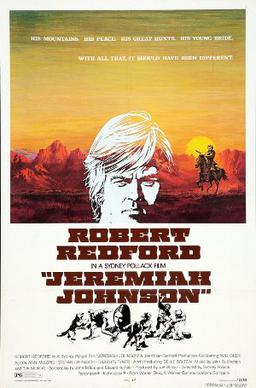
It all started when I was taking a power nap after a long day at work.  For some reason, my mind wandered to Jeremiah Johnson, an old Western with an awesome love story.

In the movie, Robert Redford unkowingly insults an indian chief by giving him several captured scalps.  The chief must return with a gift of equal or greater value, and so gives Redford his daughter, who doesn’t speak a word of English.  At first, things are hilariously awkward, but over time they grow into a beautiful and touching relationship.

Well, as I lay there thinking about the movie, I wondered: what if the same basic storyline were set in space?  Instead of a mountain man, the protagonist would be a space explorer / interstellar merchanter.  Instead of an indian chief’s daughter, the female protagonist would be the daughter of a station master whose colony is facing severe famine and widespread starvation.  When the merchanter boy unwittingly shows up at the doomed colony, the station master coerces him into taking his daughter to save her life.  And so, for the next two months, the boy finds himself crammed into a tiny little ship with a girl who doesn’t speak his language.  Hilarity ensues.

At first, I thought I’d keep it as a short story, but…yeah, that didn’t last long.  The more I run with it, the more ideas keep coming to me–ideas that I haven’t played with in a couple of years.  The story is set in the same universe as Gaia Nova and Bringing Stella Home, but about a thousand years earlier, back when things were, shall we say, more primitive.  I still don’t know where this story is going to take me, but I can tell it’s going to be a lot of fun.

The best part is that even if I expand this into a full length novel, the first part stands on its own so well that I could probably submit it to Writers of the Future.  That never happens!  It’s been years since I submitted to the contest; I always wanted to send something, but all I could ever write was novels with long, complex beginnings that couldn’t be cut off at the 17,000 word mark.

Anyhow, the working title of the novel is Star Wanderer (I can’t believe it’s not already taken), and it’s probably going to end up around 80k words or so.  I only have a vague idea at this point, but it’s much more intimate and personal than epic in scope, so I don’t expect it to go much longer.  I’ll probably finish the first part sometime next week and start looking for some first readers.  I’d like to finish the rough draft before I start the Desert Stars revision in October, but we’ll see whether that works out.

As for Edenfall, don’t worry, I’m still working on that project too.  One of the advantages of writing longhand is that it’s much easier to pick up and just go; instead of having to stop and think about what needs to happen next, the physical act of writing is slow enough that the ideas come much more organically.  I might not finish it before October, but if I can juggle it with Star Wanderer, I can probably juggle it with Desert Stars.  In any case, it’ll be good to work on new material and keep my writing sharp while I’m doing the revision.  We’ll see how it turns out.

So that’s what I’ve been up to in the last week.  I only wish I were doing this full time, so that I could spend all day working on these stories.  Soon, inshallah.

How do you know when you’ve succeeded?

With books and publishing changing so quickly, a lot of writers are wondering how they can tell when they’ve actually “made it.” It’s a valid question, one that I think we all need to answer if we want to write seriously.  For myself in particular, as an indie writer, how will I know when I’ve achieved success?

The question made me think about my experience as a Mormon missionary in California, and the definition of success that my mission president (the ecclesiastical leader and father figure for the missionaries) often quoted:

Success is peace of mind which is a direct result of self-satisfaction in knowing you did your best to become the best you are capable of becoming.

— John Wooden

This definition taught me that success isn’t just about external things that may or may not be in your control (for example, the number of convert baptisms per month), but is more about doing the things that are in your control to stretch yourself and reach your full potential.  To be sure, external factors are important measures of success, but at the end of the day, it’s not just about the numbers.

That said, for a writer like me who hopes to make a living at it, the numbers are pretty dang important.  At my current standard of living, I need to sell between 550 and 750 ebooks per month priced at $2.99 and $3.95 to accomplish that goal.  Right now I’m doing about 30 to 50, so I still have a ways to go.

But is that the best measure of commercial success?  If I have 10 titles selling around 55 to 75 copies each per month, will those books be hitting their full potential?

Probably not.  For that reason, I’ll probably end up signing a deal with a publisher at some point in my career; there’s only so much that I can do by myself.  However, in order for me to do that, the terms have to be right; I’m not going to sell myself short just to see my name in print.

(This is one thing that bugs me whenever I hear writers discuss whether traditional or indie publishing best fits their goals.  If all you want is “to see my name in print,” or “to see my book in a bookstore,” how is that any different from vanity publishing?  If that’s really your goal, fine, but don’t think it somehow puts you above indie writers–many of whom have goals that are much more pragmatic than yours.)

Artistically, I think the best way for me to achieve success is to take on a new challenge with every project and still feel like each book is better than the one before it.  Contests and reviews have their place, but going back to the definition, success is all about self-satisfaction and peace of mind.  I don’t want to tie any of those to someone else’s opinion about my work–that way lies madness.

But really, I think it all comes down to the readers.  Unless you stuff your manuscript in the closet, writing is never a solitary act: it is an act of collaboration with the reader.  If I have any measure of success, it will be because someone took the time to read my words.  To be sure, I can’t please everyone, but that doesn’t matter; it only takes one person to make a story come alive.

When I was a missionary, I constantly asked myself whether I was doing the will of God in the life of every person that I met.  That’s how I knew that I had succeeded: when I felt the peace of mind that came from knowing I’d made that personal difference in someone’s life.

I expect it to be similar with my writing.  Commercial success is great, but numbers aren’t everything.  What really matters is telling a story that connects with people on a deep and personal level, transforming them in some meaningful way.  If I can do that and make a living at it, that’s how I’ll know I’ve succeeded.

Ira Glass on storytelling

I just listened to this awesome presentation by Ira Glass, host of This American Life, on the art of storytelling and narrative, and I wanted to share it because it’s that good. 

If you haven’t ever heard of This American Life before, do yourself a favor and check it out.  You may or may not love it, but it’s one of the best produced radio shows out there, with fascinating stories from all walks of life that will completely blow you away.  My favorite is probably the one about the department of the LAPD that exists entirely to identify the next of kin of people who live and die alone–and how many people in this world have essentially no connections with the people around them.  It was an incredibly sad and incredibly moving story.

Anyhow, Ira makes some very good points about how stories work, and how we as humans are wired to see the world around us in terms of story.  It’s not enough to simply convey facts–you have to hook your audience by making them feel emotionally involved, and creating suspense by giving them the sense that the events in your story are leading up to something.

He finishes the lecture by recounting the basic frame story of the Thousand and One Arabian Nights: how Scheherazade saves the kingdom from the sultan’s madness through the power of story.  It’s a wonderful tale, one that has a lot of bearing on why we write and why fiction matters.

That’s one of the reasons why I decided to name this blog “One Thousand and One Parsecs”; it implies a combination of the magic of the Arabian Nights with the science fiction elements that I love so much. Like Scheherazade, I hope to tell stories that have the power to transform individuals and ultimately change the world for better.

That’s enough from me. Here’s Ira Glass:

Am I a jerk?

Today, a longtime writing friend told me that she wants nothing to do with me, which made me very sad.  I hope she will reconsider, and if she does, I’d gladly welcome her back as my friend.  However, because it’s come to my attention that some of my other friends feel that I come across as a jerk whenever I talk about indie publishing, I feel that I should take the time to clarify a few things.

First, I wish all of my writing friends success, whether they choose to epublish or whether they choose to go the traditional route.  This is not a zero sub game and I have never believed that it is.  Whether or not my own career tanks, if my friends find success in their endeavors, I will gladly tip my hat to them.

Second, I wish no harm on anyone who is involved in any way in the publishing or bookselling industries.  I have less sympathy for multinational corporations and media conglomerates, but I recognize that they employ large numbers of people, and I don’t wish any harm on them either.

Third, I do not believe that writers who choose to forgo indie publishing are somehow inferior to or less intelligent than writers who do.  I do believe that everyone should at least try it out to see if it’s right for them, but I recognize that indie publishing is not right for everyone, and that writers should carefully evaluate their skill levels, personal proclivities, and career goals before making that step.

This is my goal: to make a living telling the stories that I love.  Those stories fall firmly in the realm of science fiction: grand, sprawling space operas, thrilling sf adventures, poignant and moving tales of alien worlds and cultures, etc.

In my research of the publishing industry, I’ve discovered that it’s become extremely difficult over the past couple of decades to build a career writing science fiction.  For whatever reason, publishers aren’t as interested in pushing this genre or serving its readers as they have been in the past.  Contract terms have gotten worse, and it’s become increasingly difficult to break in, much less make a living.

That’s why the changes in publishing and the ebook revolution have made me so excited.  Writers have more options now than ever before, and I believe that I can better achieve my goal through indie publishing than through more traditional paths.

Now, a little bit you should know about myself: I believe in complete and total honesty.  If I see a problem or something that seems to be wrong, I tend to be very upfront and direct about it (and appreciate it when others are the same with me).

This philosophy has its advantages, but one of its disadvantages is that I tend to be a little tactless.  If I come across as arrogant, I want you to know that I’m sorry.  That’s certainly not my intent, and I’ll try to do a better job of making that clear.

At the same time, I’d like to point out that what you perceive as arrogance may just be my own excitement.  All writers are emotionally involved in their work, and because we’re approaching these issues from fundamentally different worldviews, it’s very easy for mutual misunderstandings to arise.

In the future, I’ll try to be more tactful, but I can’t control how others perceive me.  I have no doubt that those who are emotionally invested in resisting change will continue to find fault with those who embraces it.  Ultimately, I can only be answerable to myself, those who depend on me for support, and my readers.

So on that note, I’d like to finish by saying that after reviewing your comments and giving the issue some thought, I’ve decided to go ahead with Edenfall as my next major project.  More on that later, but for now, I’d just like to thank you all for your feedback and support.  I’m excited to get started!

Shoot your fans?

Today’s issue of Dave’s Daily Kick was titled “Hooking Credibility,” and I’m not sure what I think of it.  At the end, Dave’s brother Tailspin Jim had the following to say:

What I’m about to add is so basic that [Dave] would never think to include it, but you may be like the vast majority of Kick readers who just don’t have his depth of background on this subject or who would be benefited from taking a look at it.

Each hook or marketing ploy is like firing a bullet at your reader. You probably won’t kill their resistance with the very first shot. You want to fire bullet after bullet until they collapse and make the decision to buy.

Not only does this statement smack of everything I hate about sales and salespeople, but it seems to fundamentally clash with the new reality of publishing.

With social networking and the internet, writers can now connect directly with their readers.  For those going the indie route, this is absolutely essential.  The key element to success, from what I can see, is developing an ongoing relationship with your fans–one in which they take the role of patron, not merely consumer.

There’s a huge difference between thinking of readers as patrons and thinking of them as consumers.  If they’re just consumers, then the end goal is to get them to buy your product, and there’s nothing wrong with spamming them or shamelessly plugging yourself if that’s what works.

But if they’re patrons, the end goal is to develop that relationship–to connect with your readers on a meaningful level, both before and after they buy your work.  And in this brave new world of publishing, that seems like the best coarse to take.  Consumers have to be sold on each individual book; patrons are sold on you, so they’ll read everything you put out.

And as a reader, that’s how I buy.  Whenever I find an Ende or a Wilson or a Le Guin in the bookstore, I rush to grab it, because those are the writers who speak to me.  I’ve bought just about every Sanderson in hardcover because I love his work and want to support him.

That’s why this comparison of bookselling to “a series of bullets being fired from an automatic rifle at the prospective buyer” rubs me in all the wrong ways.  I’m not just peddling widgets; I’m creating art and sending it out into the world, waiting patiently for it to return back a hundredfold.  And if I work hard to create the best possible art and treat my readers (aka you guys) as my patrons, I sincerely believe that it will.

So to all of you who have read my books, regardless of whether you bought them or downloaded them from Smashwords for free, I just want to say thank you!  The greatest honor any writer can have is to be read, period.

I also want you to know that I’m never going to “shoot” you with a bunch of cheap sales tricks or “hooks” that get in the way of the story.  I’m just going to write damn good books and put them out where you can find them, trusting you to rate, review, like, and share them if you feel they truly deserve it.

I will never, ever, EVER put a gun to your head to get you to buy my work.  I’d much rather you jump at the chance to read a Vasicek, because that’s what speaks to you.

Writing is like tending an orchard

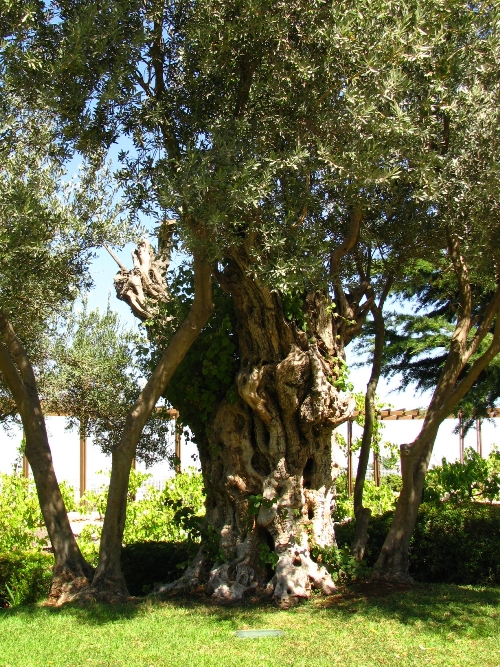
So I was hiking the Y tonight, pondering various things, and the thought occurred to me that writing is a lot like an olive orchard.

First, you’ve got the land, both cultivated and wild.  Cultivated land is like your conscious mind, where everything fits neatly into order and you have control over what you create.  The subconscious is the land beyond the fence, where things grow wild.

Ideas are like seeds; they’re everywhere, but only a few ever take root and sprout.  Those that do need to have new sprouts periodically grafted into the old, in order to preserve the entire tree.  These grafts may come from the cultivated ground of your cultivated mind, but more often than not they come from the wildlands of the subconscious.

Each novel is like an individual olive tree.  It takes a lot of time and work to grow one to maturity, but once you do, it can live for a long, long time.  The fruit itself is like the earnings you get by licensing copyright; if you prune the tree carefully (aka do a good job managing your intellectual property), it just keeps on producing.

Of course, in order to make sure your trees grow properly, you need to be constantly enriching the soil of your mind.  That’s where education and life experience comes in.

Since trees sometimes die, you have to maintain several trees at once in order for your orchard to succeed.  And even though it’s a hell of a lot of work, over the long run the returns are enormous.

For the ancients, olives were a major staple crop. In Greek mythology, Athena was chosen as the patron goddess of the city of Athens because her gift of an olive tree was considered more precious than any other.  And just as good books help us expand our minds, better understand and empathize with others, and generally rise above the boredom and mundane-ness of our daily lives, so also the fruit from this metaphorical orchard is truly of great worth.

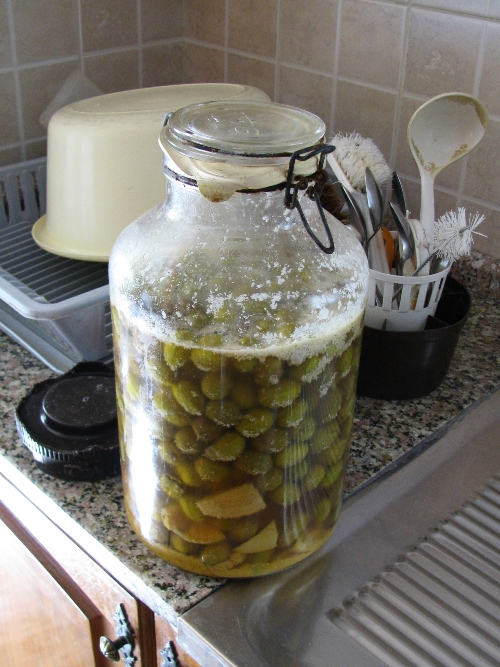
Anyhow, those were some of my random ponderings, climbing down the mountain.  Someday, I want to have an orchard that covers an entire hillside and produces thousands of pounds of olives!  Just thinking of it makes me hungry.  Mmm, olives…