Star Wars is more of a space fantasy than a space western, but the music still fits surprisingly well. I am really looking forward to watching The Good, The Bad, and the Ugly with my kids (and probably Star Wars too).
Tag: westerns
Author’s Note for THE JEREMIAH CHRONICLES
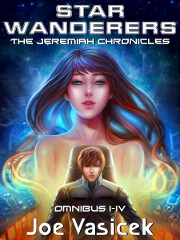 Here’s the author’s note at the end of Star Wanderers: The Jeremiah Chronicles. It’s the only content in the omnibus that isn’t available anywhere else, and I don’t want my readers to feel like they have to buy something they’ve already read in order to get it. And if you do want to buy it, there’s a link in the sidebar over there. ———–>
I put an author’s note at the end of every ebook I publish. It adds a little bit to the progress bar, which can be annoying for readers who expect “the end” to come at 100%, but I think it’s good to briefly tell the story behind the story. It’s certainly something that I would enjoy reading at the end of some of my favorite books (especially the ones by David Gemmell!). Whether you read them or whether you skip over them, it’s a feature I plan to keep in every ebook I release.
So, here it is!
==================================================
One of the questions writers get asked the most is ‘where do you come up with your ideas?’ Honestly, that’s probably the hardest question to answer. Orson Scott Card said that everyone runs across at least a thousand story ideas each day, and a good writer will see maybe three. To that, I would add that it might take years before you realize that you’ve seen them.
The idea that eventually grew into Star Wanderers probably came to me the first time I saw Serenity. At the beginning of the movie, there’s this long continuous shot that shows the space ship from the hangar bay doors to the cockpit. I don’t even remember what the characters were talking about, I was just mesmerized by that shot. For weeks, I dreamed about having my own starship like the Serenity, where I could escape the stresses of college and lead an adventurous life out among the stars. I still daydream about it to this day. Having my own starship and piloting it to places where I can be free and independent is one of my greatest recurring fantasies.
Another major catalyst for the idea that became this story was the Lombardo translation of Homer’s Odyssey. The Odyssey is perhaps the most famous epic work of all time, but the Lombardo translation struck a particular chord with me because of how down-to-earth and accessible it is. Instead of some stodgy 19th century translation that passes for cruel and unusual punishment in some high schools, this one made the story come alive. I was first introduced to it in a Western Civ class in college, but enjoyed it so immensely that I picked up a copy over the summer of 2009 and read the whole thing.
As I read it, I couldn’t help but notice the potential for a science fiction crossover. What if the sailing ships were starships, and the oceans the vastness of space? The islands would be like planets, with their strange and exotic cultures, and travel from world to world would be as arduous and difficult as it was for Odysseus to return to Ithaca. A new form of paganism would emerge, one that worshiped the stars and planets just as the Greeks worshiped the rivers and trees. The starfaring people would be as hardy and self-reliant as the ancient Greeks, and as antagonistic toward the more civilized Coreward peoples as the Aegeans to the Trojans. Most importantly, though, the starfarers would feel a sense of powerlessness as they faced the unforgiving vastness of space, just like Odysseus as he braved the wine-dark sea.
I actually started writing that novel in 2010, and got about a hundred pages into it before moving on to the revisions for Bringing Stella Home. Later, I trunked it, but the basic world-building stayed with me as I continued to expand the Gaia Nova universe with Desert Stars and Heart of the Nebula.
The final catalyst for Star Wanderers was the love story from one of my favorite Westerns, Jeremiah Johnson. My college roommates introduced me to that movie my sophomore year, and just like Serenity, I spent the next several days daydreaming what it would be like to be a mountain man. I went to college in Utah, so the frontier landscape where the film was shot is very familiar to me (in fact, I’m writing this author’s note from Slide Canyon just outside of Provo). But the love story—that was the best part. An accidental marriage from a cultural misunderstanding that blossoms into something touching and wonderful, in spite of the language barrier—by far, that was my favorite part of the whole movie.
All of these ideas were bouncing around somewhere in the back of my mind for years, but it wasn’t until 2011 that they all came together. I had graduated about a year and a half before, and was working a number of low-skilled temp jobs, trying to make ends meet as I grew my writing career. I was between projects, trying to work on Edenfall (sequel to Genesis Earth), but nothing was coming together and I just felt very frustrated.
One day, as I was lying on my bed daydreaming for the umptieth time about escaping this planet on my own starship, the thought “what would Jeremiah Johnson look like if it were set in space?” came to me. It was like a supernova exploding in my mind, illuminating my imagination with the power of an exploding star. For the next half hour, I worked through all the details in my head—the famine backstory of Megiddo Station, the Oddysey-like far-future space setting, the wandering lifestyle of the mountain man turned starship pilot. And then, once I’d replayed it half a dozen times in my head and worked myself up to a fever pitch, I rolled out of bed and wrote the first chapter of Outworlder almost exactly as it now stands. The rest of that novelette came just as readily, and in a couple of weeks I had a finished draft.
As a young single guy in my early twenties, I tend to think about love and relationships a lot. I think it’s a myth that women are somehow more interested in romance than men—we just express that interest in different ways. At Worldcon 2011 in Reno, Louis McMaster Bujold said that women tend to write about love and life, whereas men tend to write about love and death, and I’ve found that to hold very true, at least in my own writing. Perhaps that’s why it was so easy and natural to come up with the backstory that put Noemi on Jeremiah’s starship. The rest, with the pregnancy, the polygamy issues, and the baby at the end, all came naturally as I wrote things out. I was originally going to have Noemi miscarry about halfway through Fidelity, but realized almost immediately that that wasn’t going to fly. Once I realized that the natural ending of the story arc would be the birth of their son, everything else just came together.
My goal from the beginning was to write something that I could submit to the Writers of the Future contest. For that reason, I kept Outworlder fairly short. However, when I got to the end, I realized that there was still a lot of story left unwritten, so I decided to follow it out. I’m more of a novel writer than a short story writer, so it was natural to structure the overall story arc in that way. At the same time, I really enjoyed the intimacy of that first novelette, and the way that the shorter structure allowed me to focus on one or two characters and their relationships with each other. Those were all considerations that pushed me into following the novella format, as well as the chance to experiment with publishing a series of shorter works.
Fidelity and Sacrifice were a lot more challenging to write, in particular Sacrifice. Part of this was because I was still trying to figure out where the overall story arc was going, and part of it was because some of the subject matter (such as polygamy) seemed pretty unconventional for a science fiction story. But after taking a couple of short breaks to work on other projects, I managed to push through it, eventually getting to Homeworld which came much more easily. I’ve always been better at endings than at middles, and I went into Homeworld knowing that it would conclude Jeremiah’s main story arc.
As I was working on the later parts to the Star Wanderers series, I moved to the Republic of Georgia to teach English for a year. That had a tremendous impact on how I wrote the language barrier between Jeremiah and Noemi, mostly because my experience was quite similar. I didn’t accidentally marry a Georgian girl (though there are one or two who I still miss sometimes), but when I showed up in the airport in Tbilisi, I didn’t speak a word of Georgian and knew almost nothing about the people or the country. Needless to say, it was quite an adventure. The stresses of living in a foreign culture did slow down my writing a bit, but I managed to get it back by the end and finished Homeworld before coming back to the States for the summer.
When I first started publishing the Star Wanderers series, I saw it as a sort of side project that I would do before getting back to other projects. However, this series has proven to be more popular than any of my other books, so I’ve decided quite happily to expand it. The Jeremiah Chronicles contains the full story arc for Jeremiah, but there are a lot of other characters who I want to explore, and the novella format is perfect for that. If you have any in particular that you’d like to revisit, feel free to shot me an email at joseph [dot] vasicek [at] gmail [dot] com and let me know. I love getting fan mail and do my best to respond to it, so any comments would definitely be appreciated.
If you’ve just discovered Star Wanderers and would like to keep up with the newest books in the series, you can get them for free by signing up for my mailing list. Whenever I release a new Star Wanderers story, I put out a two-week coupon code to get it for free on Smashwords and send the coupon code out to my subscribers via my email newsletter. That way, you don’t have to feel like you’re spending too much once I have fifteen or twenty ebooks out. I figure that if you enjoy these stories enough to sign up for the mailing list, you’ll probably tell a friend or post a favorable review, so I’m happy to make my new Star Wanderers releases available for free.
I hope you enjoyed this omnibus! If you did, please consider posting a review or sharing it with a friend. Every little bit helps, and the more people discover and read this series, the more stories I’ll be able to write. My goal from the beginning has been to make a living telling stories that I love, and it looks like Star Wanderers might actually make that possible.
In the meantime, don’t be a stranger—you can find me on Twitter (@onelowerlight), Goodreads, or Facebook (Joe Vasicek), but the best way to keep up is to follow my blog, One Thousand and One Parsecs. I’ve been blogging since 2007 and plan to keep it up for the foreseeable future. You can also find links to all my books there, on all the major sites where they’re published. And of course, if you want to sign up for my mailing list, you can find the sign-up form on the sidebar.
That’s just about it. Thanks for reading! It’s readers, not writers, who really make a story come alive, and at the end of the day the greatest honor is simply to be read. So thanks for taking a chance on this one, and until next time, I hope to see you around!
Cooking adventures and an awesome webcomic
So I have a bunch of ideas for blog posts I’d like to write, and I’ll probably get around to them eventually, but I thought I’d drop a line now just to let you all know what I’ve been up to. It’s been a pretty good week, with some decent progress on the current WIP (Lifewalker) and some other random stuff that may be of some interest.
First, Lifewalker. It’s coming along quite well. I’m averaging around 2k words a day, so more of a leisurely pace than a white-hot creative heat, but not too bad. It’s kind of turned into a post-apocalyptic Western, mostly because I can’t write about southern Utah without the landscape taking over. This video should give you an idea why:
At the same time, the character’s voice really seems to be taking shape in a way that I like. He’s kind of drifting right now, but the way he writes about it is very much like an old man reminiscing on the course of his life, lingering on the regrets as well as the triumphs, with some rather wistful commentary on each. This is really a character that I can just pick up and run with–the story is practically writing itself.
It’s not just the voice, either. Random stuff is just finding it in–powerful stuff that makes the story awesome. For example, just in the last chapter, the characters were holding a meeting to see what they should do to rescue some of their friends who had been kidnapped. Out of nowhere, one of them pulls out a skull from a human baby, with beads and feathers dangling from it like some sort of totem. He brought it out to show that the people who’d attacked them were not just normal bandits, but cannibals from the Nevadan wastelands, which put them in a whole new category of badassery. Stuff like that comes out of nowhere every time I write, and it’s awesome.
I’ve had a lot of time to write, though I don’t feel I’ve been using it all productively. Still, I’m on track to finish this thing by the end of the month, which will be extremely gratifying.
In the meantime, I’ve been experimenting a lot with cooking and gardening. Just planted some tomatoes in 3-gallon ice cream buckets (with dirt instead of ice cream, of course), and those are growing nicely. It’s fun to have something to water in the morning, and when they start to yield fruit, I’m sure it will be awesome as well.
But I’ve also been experimenting with the old Egyptian kushari recipe I picked up after the 2008 study abroad. It always seemed to be missing that one thing that would make the other ingredients come together and achieve that delicious synergy. Well, I think I’ve found it: chickpeas and cumin, with maybe a touch of vinegar. It might not be 100% authentic, but when I cooked it this time with that stuff, it tasted heavenly.
So this weekend, I’m going to try to perfect the recipe, something I’ve been wanting to do for years. I’ll try cooking the rice in chicken broth, and adding more onions and garlic with maybe a little tomato. Also, coriander–I know that coriander and cilantro are basically the same plant, but I think the coriander will go with this better than cilantro. Also, it helps to fry it with a little oil after taking it out of the refrigerator, rather than sticking it in the microwave. I haven’t had a microwave for over a year, and I think I actually prefer cooking without it.
Speaking of food, my roommate’s sister’s roommates dropped off a bag full of crap from their kitchen, since they’re moving out for the summer. We’ve been having an interesting time combing through it–found some pretty good stuff, actually. One of the more useful things is a bag full of buckwheat, which is AWESOME because kasha was one of my favorite dishes in Georgia. Kasha and lobio–delicious!
So yeah, I’ve had food on my mind a lot this week. If things work out, maybe I’ll post a recipe or two. Kushari is delicious, cheap, filling, and healthy–a winning combination if ever there was one. Kasha is pretty simple, but that’s what makes it so great–a simple, hearty food that leaves you feeling warm and whole.
Besides cooking exotic foods, I’ve also been reading a lot of Freefall. I discovered it just last week, and I have to say, it is awesome. One of the better webcomics I think I’ve ever read. Like Schlock Mercenary, it’s a space opera comedy romp, but where Schlock kind of turned dark in recent years (which I’m not complaining about, don’t get me wrong), Freefall has still stuck to its happy-go-lucky roots. And just like Schlock Mercenary, the humor is not only entertaining, but often wonderfully insightful.
 But by far, the best part of the story is how compelling the characters are. My favorite is Florence Ambrose, an artificially bred Bowman’s Wolf who is kind of a human-wolf hybrid. She’s one of only 14 members of her species, and the corporation that created her considers her more as property than an individual. She’s got all these biologically programmed safeguards that force her to obey direct human orders, no matter how ludicrous–but the only way for her species to survive is to convince the corporation that Bowman Wolves are profitable, so that they’ll make more (the whole 50-500 rule and all that).
Somehow, she becomes the engineer of the Savage Chicken, a down-and-out starship captained by the infamous Sam Starfall. Sam is basically a lazy, larcenous alien squid who wants nothing more than to steal everyone’s wallet and become famous doing it. At first, it seems like a horrible combination–Florence is basically a good, honest person, who wants to do good work and please everyone. But as the story goes on, the two develop quite a rapport, and start to rub off on each other.
Florence helps Sam to clean up and get his act together, and Sam helps Florence to learn ways to get around her difficult situation vis-a-vis her safeguards and lack of free will. More importantly, Sam helps her to stop feeling guilty long enough to recognize that doing the right thing sometimes means breaking (or at least twisting) the law.
As if that weren’t enough, there’s the whole cross-species romance angle between Florence and the biologist who rescues her back in one of the earlier subplots. As you might expect, it gets really lonely being the only Bowman’s Wolf on the planet–especially when the other 13 are frozen in cryo, on their way to a world several light-years away. Florence knows that she needs to do what she can to propagate the species, but she’s also got some emotional needs that demand to be satisfied now. Winston is kind of similar, a lonely parasitic biologist on a frontier terraforming project with only 40,000 humans and a 40-60 male-female ratio. Except for the whole cross-species issue, they make a really good couple. I’m riveted to find out what happens next!
So yeah, if I had to sum it up: good, honest, likeable person + insecure future + social limbo + unsatisfied emotional needs = really compelling story. Plus, she’s half wolf–how cool is that? What I would give for her incredible sense of smell…
In any case, it’s getting late, and even though tomorrow is Saturday, there’s a bunch of stuff I want to do tomorrow so I’d better cut this short for now. See you later!
W is for Wagon Train to the Stars
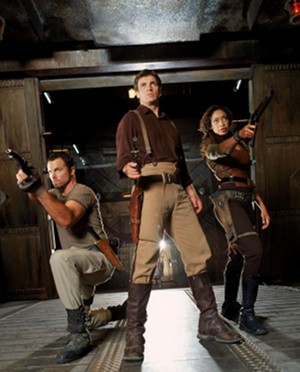 When Gene Roddenberry pitched the original Star Trek series back in the 60s, Westerns were all the rage. Consequently, he pitched his show as a “wagon train to the stars,” where a bunch of quirky characters on an awesome starship travel from adventure town to interstellar adventure town, exploring and pioneering the final frontier.
Sound familiar? Yeah, I thought so. The concept proved so catchy that it’s been redone time and again, from Battlestar Galactica to Firefly to Doctor Who. Even though Westerns aren’t nearly as popular as they used to be, many of its tropes are so well suited to Science Fiction that they drive the genre even today.
For example, adventure planets. In a typical Western, the characters travel from town to town, with a different adventure in each one. Well, in Science Fiction, the characters do the same thing, except that they’re traveling from planet to planet. And really, if you’ve got the ability to travel to other worlds, how can you not have an adventure in each one?
A large reason for the Western / Science Fiction crossover is the whole concept of space as the final frontier, which we explored earlier in this series with I is for Interstellar. There’s a very real sense of manifest destiny in the space exploration community, not because of humano-ethnocentrism (heck, we don’t even know we’re not alone in our local stellar neighborhood), but to ensure humanity’s long-term survival. The parallels between that and the westward movement in 19th century America aren’t perfect, but they do exist.
Similarly, as we explored in R is for Rebel, the notion of space as the final frontier has a special resonance with the American audience. The days of the old frontier may be over, but its spirit lives on in our culture, from guns to road trips to our glorification of the rugged, self-made individual. Today’s Science Fiction, especially the space-focused SF of Space Opera, grew out of the adventure fiction of the pulps, which thrived on that frontier American ethos.
In fiction, the frontier can still be found in two major genres: the Western, which is historical and therefore more backward-looking, and Science fiction, which is futuristic and therefore more forward-looking. Because Science Fiction isn’t burdened with all of the historical baggage of the traditional Western, it’s a much more flexible medium for story, readily adaptable to contemporary issues and concerns.
For example, where Star Trek echoes the large-scale nation to nation conflicts of the Cold War (Federation vs. Klingons and Romulans), the new Battlestar Galactica series echoes the much more asymmetrical conflicts of the post-9/11 world (Cylon agents who are indistinguishable from humans and may not even know that they are cylons). At the same time, the wholesale co-opting of Western tropes enables a latent sense of nostalgia, evident in the look and feel of Firefly, or the famous opening lines from Star Wars: A long time ago in a galaxy far, far away.
My first real experience with a wagon train to the stars type of story was probably Star Trek: Voyager, which I watched religiously with my dad every Wednesday night until maybe 9th or 10th grade. The Western-borrowed tropes are somewhat more muted in that series, but they exist, especially the planetville / adventure towns stuff. However, it wasn’t until Firefly and Serenity that I really experienced the awesomeness of a true Space Western. There were a lot of things in Firefly that I really loved, especially the character interactions, the gun-toting action scenes, and especially the starship Serenity. There were some things I didn’t like so much, like the fact that every planet is basically Wyoming, but overall I really enjoyed the show.
It wasn’t until I started getting more acquainted with straight-up Westerns that I saw the real potential for crossover between the genres. Stories about mountain men like Jeremiah Johnson really captured my imagination–what would this look like if it were set in space? In that sense, I came to the Space Western more from the classic Science Fiction side first, rather than the pulp adventure stuff. But once I discovered the crossover connection, it naturally found a way into my own work.
That’s basically how the story idea for Star Wanderers first came to me. I was lying on my bed, daydreaming about having my own starship like the Serenity, when I wondered what it would be like for a starship pilot to get roped into an accidental marriage like in the movie Jeremiah Johnson? The collision between the two ideas was like a supernova exploding in my brain. I rolled out of bed and started writing, coming up with chapter one of Outworlder almost exactly like it’s written today. And the more invested I became in those characters and that world, the more the story grew. I’m writing Part VII right now (Reproach, from Noemi and Mariya’s POV), and so long as people read them I’ll keep writing more.
Genre mash-ups and crossovers are a great way to keep things fresh and come up with some really interesting stories. Some genres aren’t very well suited for each other (Erotica and Middle Grade, for example), but others come together so well that they seem almost complementary. That certainly seems to be the case with Westerns and Science Fiction, at least here in the United States where the spirit of the frontier still echoes through the popular culture.
Trope Tuesday: Space Cossacks
 I’m going to take a break from the hero’s journey trope posts for a while, until I have the time to do them justice. In the meantime, let’s have a little fun.
Some of my favorite science fiction stories are the ones about a culture of nomadic starfaring people wandering the universe in search of a new homeworld. Earth is usually a half-forgotten legend, and their starships have probably seen better days. On tvtropes, the page for these stories is Space Cossacks, named after a real world culture in historic Russia that basically experienced the same thing, albeit on a terrestrial scale.
The description of this trope on the tvtropes page is so good, I’m just going to repost it here. Seriously, every one of those cross links is worthy of your click.
There is no hope and You Can’t Go Home Again. The Empire is spreading out. Even The Federation has too many Obstructive Bureaucrats. There is no way for free men to get out of the reaches of The Government and even mounting La Résistance will be of no avail.
So what do you do? You become Space Cossacks.
You flee to the border and live in a tough area where you all have to be sharp. You set up as Space Pirates or as Hired Guns or as Intrepid Merchants. Or all of these at once.
With you are various dissidents like people who feared being Made a Slave. There might be a Noble Fugitive or two, perhaps even a Defector from Decadence. You and your brave band of Fire-Forged Friends will struggle on to survive and maintain your freedom and heed no laws but your own.
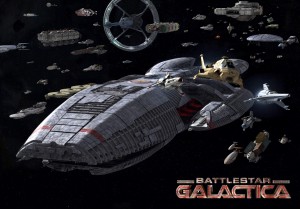
One of the things that I think should qualify a story for this trope is that the society of space cossacks is just that: a community of people who share at least a few cultural bonds. Battlestar Galactica definitely qualifies, but I’m a little on the fence as to Firefly, since that story is more or less about a ragtag band of failed revolutionaries. Are the Browncoats all from the same culture, like the Kurds or the Circassians or the Ossetians, or are they just a pologlot group of frontiersmen from all over the settled worlds? Does it even matter?
In the end, I suppose it doesn’t. The spirit of this trope is a lot like that of Fighting for a Homeland: a bunch of displaced underdogs on the fringes of civilization trying to make their way in the universe. The nature of the conflict is such that by the end, they can’t help but form their own distinct subculture.
I don’t know why I love this trope so much. Maybe it has to do with the way it blends elements from the Western genre in a classic Science Fictional setting. Maybe it’s because I was born in the wrong century and naturally dream of settling the frontier. Maybe it’s because this is one of the best ways to get awesome space battles.
Whatever the reason, I can’t get enough of it, as you can probably guess from reading my books. In Bringing Stella Home, Danica and her band of Tajji mercenaries fit this trope to a T. Stars of Blood and Glory delves quite a bit deeper into their background, with Roman as a major viewpoint character. In Heart of the Nebula, the people of the Colony basically become Space Cossacks over the course of the novel. Both of those novels are currently unpublished, but I hope to put them up in the next year.
On the subject of roving bands of displaced Eastern Europeans, I listened to this Circassian folk song maybe a dozen times while writing this post:
Awesome stuff–I’m totally putting it in the soundtrack for my next Gaia Nova novel. Also, I’ll have to name a moon or a planet in the Tajjur system after Mount Elrus or something. Space Cossacks indeed!
Trope Tuesday: The Cavalry
Things look bleak: the Big Bad is on the verge of conquering the world, and the heroes have gathered for one last stand. Just when it looks like all hope is lost, a horn sounds in the distance, and the cavalry arrive to save the day. Whether a ragtag bunch of minor characters, an army of unlikely heroes, or the ultra-heroic Eagle Squadron, the timely reinforcements use their overwhelming force to crush the villains and save the day.
When done right, this trope can be one of the defining moments of greatness of the entire work. When done wrong, however, it becomes little more than a Deus Ex Machina of the most unsatisfying kind. How, then, can this moment be done right?
As with any Deus Ex, one of the keys is to adequately foreshadow the end. This often takes the form of Gondor Calls For Aid, when the heroes petition the cavalry for assistance before going into battle. To make things interesting, the relationship between the two parties is often complicated and ambiguous, making it doubtable that the cavalry will actually show up.
However, I think it goes deeper than this. In order for the arrival of the cavalry to be satisfying, it needs to not invalidate everything that the heroes have already gone through. If the cavalry shows up after the heroes have defeated the Big Bad, and essentially rescue them from a heroic sacrifice, that’s satisfying. If the heroes are still fighting the Big Bad and the cavalry comes out of nowhere to hand them an unearned victory, that’s cheap.
In English 318R, Brandon Sanderson often used the film versions of the Lord of the Rings Trilogy to illustrate this. The Battle of Helm’s Deep was satisfying, because the entire premise was to hold out until the third day. When Eomer arrived with the Rohirrim on the morning of the third day and swept away the Uruk-Hai, that didn’t invalidate King Theoden’s efforts because all he was trying to do was survive.
In the Battle of Minas Tirith, however, Aragorn’s arrival with the unbeatable army of the dead was kind of cheap, because the premise was to defeat the orcs, not to hold out for reinforcements. Gondor could have just stood down and let the orc army capture the city, and they still would have won in the end.
The two genres where you’re most likely to see this trope are westerns (trope namer) and heroic fantasy. Just about every David Gemmell novel involves a cavalry moment of some kind, and I looove it. It’s also quite common in military science fiction, too–basically, any story where war is a major part of the narrative.
The variations on this trope are also quite fascinating. For example:
- Cavalry Betrayal: When the cavalry switch sides in the final battle, utterly crushing all hope of victory.
- The Cavalry Arrives Late: When the heroes defeat the bad guys on their own, and the cavalry cleans up the mess.
- Come with Me If You Want to Live: When the cavalry rescue the heroes from danger midway through the story.
- Cavalry Refusal: When the only ones who could save the heroes refuse to do so.
- Redshirt Army: When the cavalry is utterly useless.
- Bolivian Army Ending: When everything goes terribly, horribly wrong.
Trope Tuesday: Chaotic Neutral
If you’ve ever read a space adventure with smugglers and pirates, or a sword & sorcery with rogue thieves and master-less swordsmen, or a western with gritty outlaws and mountain men, you know this character alignment. If you’re a fan of any of these genres, chances are you love him, too.
The Chaotic Neutral‘s one consistent rule is to always look out for #1. Beyond that, he’s a free spirit who believes in individuality and resists anyone or anything that tries to control him. Rebellious spirits and lovable rogues tend to fall into this alignment, but so do tricksters and wild cards. Their resistance to any form of personal restriction makes them unreliable allies, despite what Jack Sparrow says.
From the easydamus alignment page:
A chaotic neutral character follows his whims. He is an individualist first and last. He values his own liberty but doesn’t strive to protect others’ freedom. He avoids authority, resents restrictions, and challenges traditions.
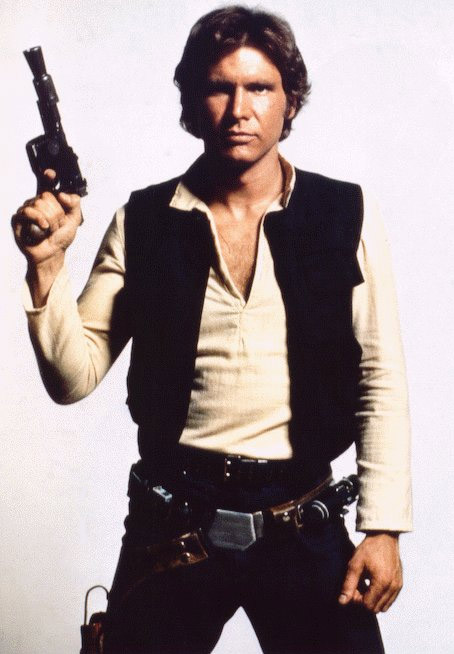
A lot of characters start out as this but tend to shift as the story progresses. Han Solo, for example, shifts from Chaotic Neutral to Chaotic Good as he becomes more and more involved with the Rebellion. The Jägers from Girl Genius are Chaotic Neutral until they have a Heterodyne to lead them. But in other stories, such as Pirates of the Caribbean and Schlock Mercenary, the Chaotic Neutral serves as an anchor.
My favorite Chaotic Neutral is probably Waylander from David Gemmell’s Drenai series. The Jerusalem Man is another good one–in fact, just about every one of his books has a Chaotic Neutral that I love. Haruhi Suzumiya is an excellent example of a female Chaotic Neutral–in fact, she’s probably the queen of this particular character alignment.
In my own work, the best example of a Chaotic Neutral would probably be Tamu from Bringing Stella Home / Sholpan. Even though she’s technically a slave, she doesn’t really mind it because she has everything she wants and doesn’t have to be beholden to anybody (not even Qasar, really, since she’s his favorite). Amina from Desert Stars is also Chaotic Neutral, in contrast with Surayya, who is more of a Lawful Neutral, though sometimes it’s hard to tell. And in Genesis Earth, Terra is definitely a Chaotic Neutral at the beginning, though she shifts a little somewhere around the middle.
I’m hesitant to admit this, but when I took the character alignment test for myself, I tested out as a Chaotic Neutral. As to what that means, exactly…I’m not going to say. o.0
The Jerusalem Man by David Gemmell
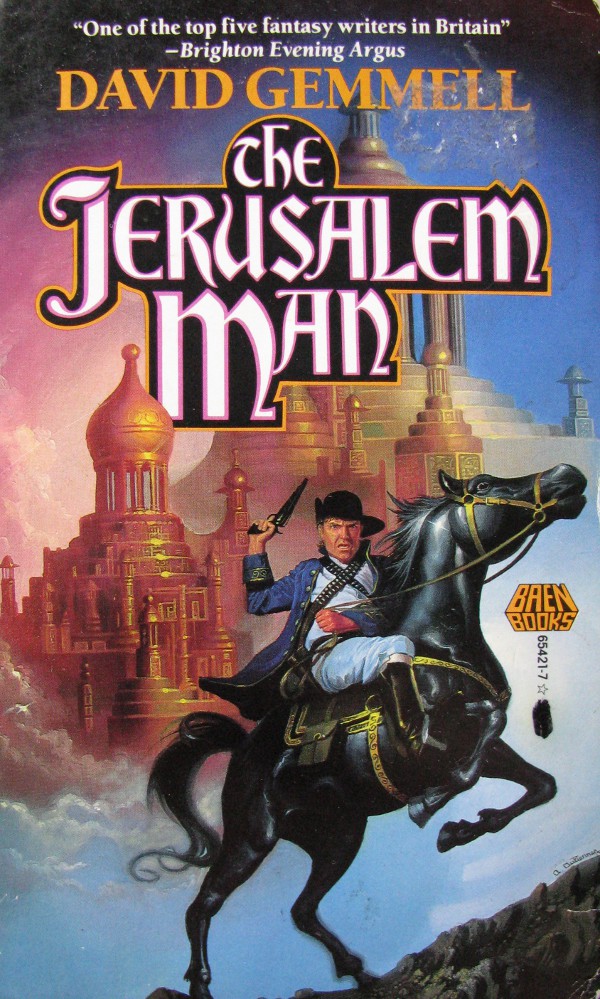 The old world is dead, destroyed by nuclear fire. The old ways are long forgotten–except by one man in search of the Holy City. He wanders the Earth with two guns and a Bible, leaving a trail of death and ancient prophecy in his wake. Brigands fear him, honest men pity him, and the Hellborn hunt him. He is John Shannow–the Jerusalem man.
This is some vintage David Gemmell. In fact, I think this particular edition has been reprinted as Wolf in Shadow, and can no longer be found except in used bookstores and book trading sites. Regardless, the book is awesome, right on par with Gemmell’s other work.
David Gemmell has the uncanny ability to suck you in almost as soon as you open the book, making you emotionally invested in the characters and conflicts to the point where you can’t stop thinking about it. My favorite part of this book was in the first few chapters, when John Shannow found a frontier woman and briefly settled down. It only lasted a handful of pages, but it was so powerful and moving that I felt compelled to read almost nonstop until I’d finished the book.
The later half gets a little outlandish, with magic stones, the lost city of Atlantis, and a Satanic cult bent on world domination. It was a fun adventure, but not as compelling for me as the personal story of John Shannow. In fact, it seems as if Gemmell unconsciously fell back on all the old tropes of the Drenai series, turning his post-apocalyptic western into a sword and sorcery romp, like Waylander with guns. It wasn’t bad, but at times it did feel a little over the top.
This might have to do with my own personal tastes, however. I tend to enjoy stories that have more to do with the personal lives and intimate struggles of the characters than grand quests to save the world. I don’t know if it’s always been like that, or if it’s just something that’s changed as I’ve gotten older.
Regardless, The Jerusalem Man was a great book, and I thoroughly enjoyed it. If you’re a fan of fantasy-western mashups, or post-apocalyptic fantasy in general, then this is a must-read. And even if that’s not your usual fare, if you’re drawn to loner heroes who don’t pull any punches, you’ll almost certainly love this book.
Trope Tuesday: Walking the Earth
Oh there’s sober men in plenty
And drunkards barely twenty
There are men of over ninety
That have never yet kissed a girl.
But give me a wandering rover
From Orkney down to Dover
We will roam the country over
And together we’ll face the world.
When a character decides to walk the Earth, they leave behind friends, family, and earthly possessions to wander from town to town in search of adventure. In real life, we think of these people as bums, but in fiction these characters are often the protagonists–or if not, then some sort of wise figure or noble adversary.
There are two character archetypes that tend to fill this trope: the drifter (or “the stranger” as Joseph Campbell called him) and the knight errant. For the knight errant, walking the Earth is simply part of the job description: always in search of evil to slay and damsels to rescue, he cannot stay in one place for long. It’s the same with the drifter, though he might not have the same skill set or code of honor.
As you can imagine, this trope tends to be most prevalent in Westerns, with the knight errant transformed into a gunslinger and the drifter wandering the wide frontier. American culture has definitely embraced this trope; what else did you expect from the nation that invented cars, highways, and the road trip? However, it’s also quite prevalent in East Asia as well, with the ronin and other wuxia archetypes.
Of course, this trope is only possible in a society that has a long tradition of sacred hospitality; otherwise, the wandering hero will almost certainly starve. That’s one way to spot stories where this trope is done poorly: if the wanderer has no visible means of support, yet appears clean and well-fed, the author hasn’t connected the dots. Also, characters who walk the earth are almost always male, since women who travel alone are more likely to get raped or assaulted.
One of my favorite examples of this is Van Hoenheim from Full Metal Alchemist. <SPOILER: highlight to read>After he unwittingly helps the first humunculous to sacrifice the population of Xerxes to make two giant philosopher’s stones, Hoenheim sets off to wallk the Earth as an immortal being, his sorrow too great to allow him to settle down. However, while the humunculous uses his stone to acquire even greater power, Hoenheim becomes familiar with every damned soul trapped in his and enlists their help. In the final battle, we learn that Hoenheim has used his centuries of walking the Earth to bury the damned souls in such a way to counter the humunculous’s transmutation circle, thus saving the people of Amnestria.</SPOILER>
There’s a dark side to this trope, however: the flying dutchman, cursed to wander the earth forever. By definition, every adventure must come to an end; when it doesn’t, it becomes instead a sentence of exile. Perhaps this is why characters who walk the Earth in a post-apocalyptic setting (like the wandering Jew in A Canticle for Leibowitz) tend to lean more towards this: after the world ends, there is no going home.
Which makes me wonder: in order for this trope to be positive, is it necessary for the main character to have the option of settling down whenever he wants to? Certainly there are those who choose a life of eternal adventure, but that implies that they have a choice. Even if they would have chosen not to settle, when that option is taken from them does that always make the story darker and less hopeful?
Either way, this trope intrigues me. Expect to see it in my own work soon.
Lyrics from “The Ramblin Rover” by Silly Wizard.
Trope Tuesday: Recycled IN SPACE!
Or, as my friends at Leading Edge would say, IN SPAAACE!!!
The basic idea behind this trope is that setting a story in space makes it cool and different. The tvtropes article focuses mainly on how this trope is used in children’s cartoons, but it actually goes much wider. In fact, most space stories are actually based on stories from other genres, or even from history.
For example, Asimov’s Federation series is based on Edward Gibbon’s Decline and Fall of the Roman Empire, David Drake’s Lieutenant Leary series is based on Patrick Obrian’s Master and Commander series, and Frank Herbert’s Dune is based on the rise of Islam. Westerns are especially prone to get the space treatment (Firefly, anyone?), which is where we get “wagon train to the stars.”
At its worst, this trope is nothing more than a pointless gimmick. At its best, however, it can produce some extremely good work. The key, as always, is to work within the limitations of the setting.
One of the best examples of this is Dune. Frank Herbert didn’t merely lift 7th century Arabia into space and call it Arrakis; he created a distinctly alien world with its own history, culture, biology, and role within the galactic empire. For example, Herbert solved the FTL problem by linking interstellar travel to the spice, tying his space-Arabs to the politics and economics of the rest of the galaxy.
Interestingly, your space physics don’t have to be perfect for this trope to work; they just have to be believable. For things like artificial gravity and faster than light travel, most people will accept a little hand-waving, provided that you do it well. The important thing, as always, is the story.