Why I won’t be signing up for KDP Select

In the last couple of weeks, there’s been a lot of discussion about Amazon’s new Lending Library program.  Just a few days ago, Amazon opened it up to indie writers with the KDP Select program.  By signing up, writers gain access to Amazon Prime members (US only), where readers can borrow the book for free and Amazon still reimburses the writer.

The catch?  Two, actually: writers agree to make their books exclusive to Amazon for 90 days, and payment for all KDP Select authors comes out of a monthly “fixed pot” of $500,000, where every writer gets a cut according to what percentage of the Lending Library downloads were for their books.

Reactions from the indie community have been mixed.  Within only a few hours, several thousand enthusiastic writers had signed up (the current number of participants is ~50k), but many others remain cautious and aloof.

The full range of reactions can be seen in the Kindle Boards thread.  Guido Henkel does a good job pointing out how the numbers don’t add up, while David Gaughran offers a compelling analysis that likewise dampers enthusiasm for the program.  On the Smashwords blog, Mark Coker pleads with writers to keep their options open, while at Writer Beware, A.C. Crispin points out some disturbing language in the terms & conditions that essentially amounts to a non-compete clause.

I’m sure that many others will weigh in on KDP Select in the coming days, and I look forward to reading their analysis, but I’ve already decided that I won’t be signing up with the program.  Even if no one else signs up, with 50k writer splitting a $50,000 pot, the average monthly paymentis only going to be $10.  Unless you’re one of the lucky bestsellers, you’ll probably make even less than that.

But the real reason I’m not signing up is because I don’t feel that it serves my readers.  If I put any of my titles through KDP Select, I’d be giving Amazon a 90 day exclusive, which means that my readers would be forced to either buy through Amazon or wait three months to buy my books.  I don’t feel that that’s fair to my readers, especially in territories where Amazon levies a $2 surcharge.

At this point in my career, my goal is to build up a dedicated fan base that looks forward to each new release.  To do that, I want to make my books available in as many places as possible.  Even if I’m not selling all that well right now at Barnes & Noble or the smaller retailers, it’s not worth it to cut those readers off and tell them to go to Amazon or wait.

However, the KDP Select program does foreshadow the next big phase of the ebook revolution, and that is the move to subscription services.  I expect that in the mid- to near-future, we’re going to see a lot of ebook lending models arise, kind of like Netflix for books.  The big question in my mind is how the writers are going to be compensated.

Like David, I have a lot of concerns with KDP Select’s “fixed pot” model.  Besides the lack of any guaranteed or minimum rate of compensation and the general opaqueness of the system, it fundamentally pits writers against each other in a zero-sum game, where one writer’s gain is another one’s loss.  To me, this represents a giant step backward.

When a reader finds something they like, they’re more likely to try out another book just like it.  This is how readers have historically found new writers, and it fosters a sense of community, where writers work together to reach out to new readers and expand the scope of the genre.  The “fixed pot” model disincentives all this and replaces it with a Machiavellian system that, at its worst, works against the natural advantages of the medium and undermines the genre community.

For all these reasons, I won’t be signing up for Amazon’s KDP Select.  The exclusivity hurts writers and readers, the numbers just don’t add up, and the “fixed pot” model represents a fundamental shift in bookselling that I cannot support.

Thoughts on kickstarter

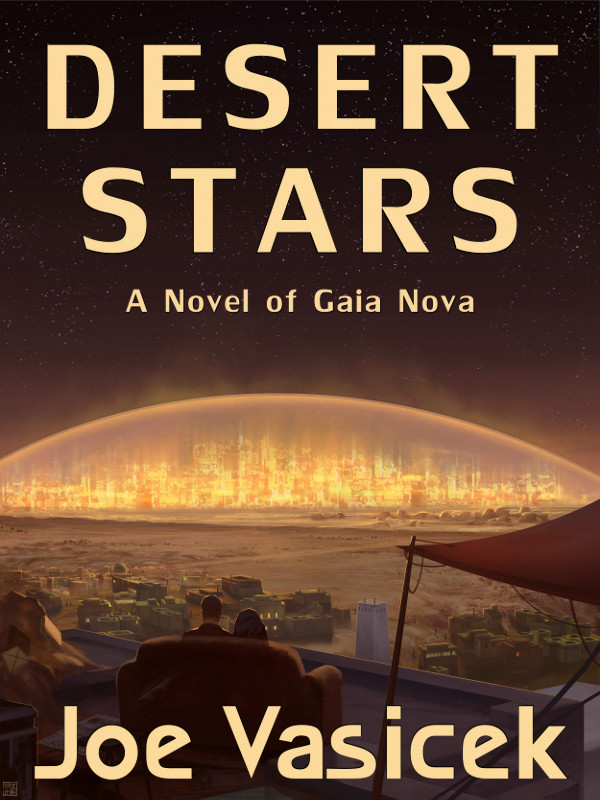
So as many of you know, I ran a kickstarter campaign as an experiment to see if I could raise enough money to fund my next release, Desert Stars.  Over the course of the month, about a dozen people pledged over $300, but ultimately it wasn’t enough to meet the goal.

First of all, I want to thank everyone who made a pledge or spread the word.  I appreciate all of your support, no matter at what level.  My biggest obstacle at this point is obscurity; without you, I’d never be able to overcome it.  So thanks!

While the campaign was a bit of a disappointment, I learned a lot from the experience.  My strategy going in was to set a modest goal and give a variety of high-value rewards at various pledge levels.  However, I didn’t do much to publicize the project, mostly because self-promotion makes me so uncomfortable.  That was probably the biggest single reason why the support never reached a critical mass.

If I were to do it again, I would work out a plan for the marketing and publicity before launching the campaign.  I would also run the campaign for a longer period of time and talk about it more, just to make sure people are aware of it.  Also, I would try to get an endorsement from someone with an established audience that overlaps with my own.  It’s hard to tell people you’re awesome, but if someone else who is awesome tells them, they’re much more likely to believe it.

Will I ever do a kickstarter campaign in the future?  Probably, but only after I’ve built my fanbase a little more.  Kickstarter isn’t a good way to launch if you don’t already have a devoted following.  Like everything at this point, it’s a catch-22.  In order to be successful, you have to be noticed.  In order to be noticed, you have to be successful.  Obscurity is the biggest obstacle, and there’s no sure way to overcome it besides trying and failing until something finally works.

Fortunately, while the kickstarter campaign was a bit of a setback, it’s not going to prevent me from releasing the book.  I’ve secured an alternate source of funding, and should be able to have it out by January if not before.  As a gesture of gratitude to everyone who made a pledge, I’ll send you a free copy once it’s out.

Thanks so much!

Picking up the pace

I’m writing this post from somewhere in Iowa, riding the California Zephyr from Chicago to Salt Lake City. Since I hate sleeping on the train, I figured now is as good a time as any to write a blog post.

One of the good things about traveling by train is that you have lots of time to just sit and think. Yesterday I took a long, hard look at my writing over the course of the last year, and was surprised at what I found. Long story short, I think it’s time for a major recalibration.

As you know, my main writing goal is to produce a minimum of two novels per year, fully polished and of publishable quality. Desert Stars will be my third this year, if I can get it up before January. But after that, I don’t have a whole lot lined up in the queue. Heart of the Nebula is a finished rough draft, but it’s the only one; everything else is either incomplete or just an idea floating around in my head.

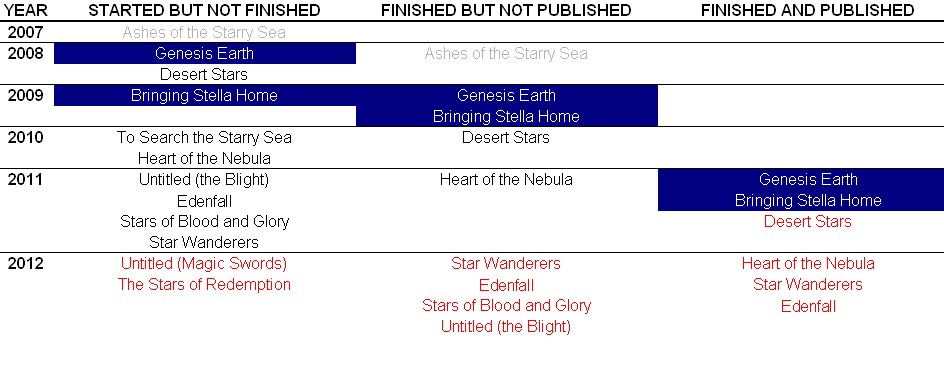
Perhaps the best way to see it is to look at this chart. It lists all of the novels that I started, finished, and published by year. The titles highlighted in blue are novels that I’ve epublished. Ashes of the Starry Sea was a practice novel, so I’ve grayed it out, but everything else is a project I intend to carry to completion.

While 2011 was a great year for me in terms of starting new works, it was a downright horrible year in terms of actually finishing anything new. I’m worried that unless I can force myself to buckle down and produce new material at a much faster rate, this handicap is going to bite me in the butt next year.

Here’s another way to think about it: if I want to write two novels per year, and I can only focus on one novel at a time, I should be able to complete any project in no more than 26 weeks. And yet, when I look at my word count spreadsheet (which only goes back to May 2009), here’s what I see:

  • Genesis Earth: 22 to 26 weeks
  • Bringing Stella Home: 50 to 54 weeks
  • Desert Stars: 52 to 56 weeks
  • Heart of the Nebula: 18 weeks (unfinished)
  • Edenfall: 2 weeks (unfinished)
  • Star Wanderers: 9 weeks (unfinished)

What this tells me is that my current writing method is unsustainable. Either I need to learn how to juggle two projects at once, or I need to learn how to produce quality material in half the time–and in all reality, I should probably learn how to do both.

For those of you who might be worried that I’ll sacrifice quality for speed, let me assure you that I don’t intend for that to be the case. Dean Wesley Smith makes a very compelling argument on this subject, how speed and quality are not mutually exclusive. The more I write, the more practice I’ll get, which will hopefully improve the quality of my writing.

One thing I really ought to do is write something new every day. For most of 2011, I was revising something I’d originally written in 2008 or 2009, maybe throwing out a couple of scenes to start from scratch, but overall simply revising an older work. It’s made me a little rusty, and I can feel it. I can say right now, that needs to change.

My biggest concern is that once I’m overseas, it will be much harder to balance these writing goals with everything else going on. However, this isn’t 2008; I don’t have all the obligations of a student. As for whether the obligations of a teacher are any worse, we’ll have to see.

What I really want to do is write a novel in a week–preferably, in three days. Even if the first draft isn’t very good, just the act of doing it will break down some major barriers, I feel. If I finish Star Wanderers by mid-January, I’ll turn it around and write a novel with the same events from Noemi’s point of view, all in a weekend if possible.

In short, this is what I want to do:

  • Produce a minimum of 2 publishable novels per year.
  • Reduce the time for each draft to 6 weeks average.
  • Write a minimum of 500 new words each day.
  • Learn to juggle two projects when revising.

This isn’t going to be easy; I have the feeling that it’s going to involve a fundamental shift in the way I approach writing. However, if I can pull through it, I think this might just transform my career in the way that I need in order to take things to the next level.

In the meantime, I’d better get some sleep. I’ve got a long day of travel ahead tomorrow, and I’ll need all the energy I can get if I want to get some serious writing done.

Struggling not to settle

I’m in the middle of my first revision pass through Heart of the Nebula, direct sequel to Bringing Stella Home, and…I don’t know exactly how to put this, but the story seems to be simultaneously smoother and more shallow.  Plot-wise, everything works great; character-wise, there just doesn’t seem to be as much depth as my other work.

I remember finishing the first draft in May, and being surprised at how well structured it was.  Each of the three major plot points happened after exactly five chapters, and each of the chapters was almost perfectly balanced–a far cry from my previous work.  I had a few stops and starts in the first part, but everything after the first hundred pages was smooth as gravy.  What’s more, I’m finding in this revision that not a whole lot needs to change; it works pretty well as-is.

And yet…I can help but feel as if something is missing.  The characters just aren’t coming alive the way they did in my previous works.  The story isn’t quite as engaging, the climaxes quite as gut-wrenching as I would like.  It feels like a good story, but not a great story.

Here’s the thing: my previous stories were all broken in this phase.  Desert Stars was so broken I had to write another novel to figure out how to finish it–and even then, the second half of the book went entirely in the wrong direction and had to be thrown out.  Bringing Stella Home had a solid storyline, but Stella’s character was completely broken and had to be rebuilt from the bottom up.  And Genesis Earth had half a dozen false starts, and at least as many chapters that had to be thrown out because they did nothing to advance the plot.

But Heart of the Nebula isn’t exactly broken, it’s just…not at the level I would like.  And I worry that because it isn’t broken, I won’t feel as compelled to make it better.  I worked hard on the others, and learned a lot of lessons which helped me to write this book, but even if I’ve hit my stride and this is the result, it feels too much like settling.  I can do better.

None of this probably makes any sense if you haven’t read the manuscript, but I hope it doesn’t sound too much like whining.  Even if these are problems, these are good problems and I’m happy to have them.  When I share this with my first readers, they will probably have all sorts of insights that will make me smack my forehead and make everything awesome again.

I guess my point is that I don’t want to settle, even though this draft will probably not be as good as I’d like it to be.  I’ll fix all the known problems, then send it out to my first readers and trust them to help me find the unknown problems.

In the meantime, I should probably start something new.  I have a ton of great ideas for the fantasy novel, and bouncing them off of friends has really helped me to figure out what else the story needs.  After I finish reading American Gods, I’ll stock up on some fantasy to get into the right mindset, starting with David Gemmell (incidently, at dinner group tonight, I literally squeed while talking about David Gemmell.  It was simultaneously embarrassing and really awesome).

Enough of this.  Time for sleep.

Why I’m not a fan of writing groups

I was listening to a recent episode of I Should Be Writing today, and it got me thinking about writing groups and how my philosophy on them has changed.  Long story short, I used to love them, but now I’m not such a huge fan.

I should probably start out by mentioning that I lead a college writing group for two years, and I don’t regret the experience at all.  The Quark writing group was extremely helpful, both in terms of my own growth as a writer, and the connections it gave me with other writerly people.  I still keep in touch with many of them.

But now…I just don’t think writing groups are all that great.  In fact, I think that they often do more harm than good, not just for experienced writers, but for the beginner who lacks the confidence to strike out on their own.  Here’s why:

The group dynamic gives inexperienced critiquers a false sense of authority.

Most writing groups consist of writers who are at roughly the same level of expertise.  For beginners, this means that the people critiquing your story might not know any better than you whether the story is broken.  However, because of the dynamics of the whole thing (captive audience, desire to impress peers, etc), these people are likely to act as if they have more authority than they really do.

To be fair, I’ve had plenty of critique partners who have managed to be modest and down-to-Earth when offering their critiques.  However, I’ve also seen plenty of others get puffed up and offer some really dumb advice.

Beginning writers often naively look for someone to show them the answers–some mentor or authority figure whose every word is true, who will light the path and show them the way.  Put a bunch of them into a writing group together, and more often than not you’ll end up with the blind leading the blind.

The weekly submission process does not simulate the reading experience.

Logistically, most writing groups have to set a limit on the size and number of submissions.  For the Quark writing group, our limit was three submissions of four thousand words each.  It worked out fine for short stories, but most of us were writing novels, which meant that we had to workshop our books in little four thousand word chunks.

The problem is that nobody reads novels at that rate.  Either they get hooked and finish the thing, or they get bored and stop reading.  Therefore, while the feedback you receive might be good for helping out with craft issues, by the time the next week rolls around either everyone has forgotten what happened already, or they remember it wrong, or they were expecting something different and are ticked off because they have to wait another week.

After I revised Bringing Stella Home a couple of times (after–see below!), I workshopped it through a writing group I’d put together after leaving the Quark writing group.  I can’t tell you how many times I heard “why are we in James’s point of view this week?  I hate James!  I want to get back to Stella!” I got this comment so often, for a while I thought the book was really flawed.  However, when I got the feedback from my first readers, no one had this problem at all.

The reason?  They read the book the way it was actually meant to be read.

Workshopping a work in progress is the surest way to kill a book.

Committees might be good at doing some things, but they’re absolutely horrible at producing anything innovative or original.  Make no mistake: if you’re workshopping something you haven’t already finished and you follow most or all of the feedback you receive, you’re writing your book by committee.

Most writers agree that when you write your first draft, you should not revise anything until it’s done.  This is because the act of revision makes you so critical of your own work that it’s very easy to get discouraged or “fix” something that was actually a good idea.

Workshopping a work in progress does exactly the same thing: it puts you in a critical frame of mind that will literally kill your book.  Even if you manage to finish it, it won’t be nearly as good as it could have been because you’ve probably nipped all your best ideas in the bud, before they had time to grow and develop.

A truly great book does not appeal to everyone.

There’s a word for something that appeals to everyone equally, that runs about middle of the road and doesn’t upset anyone.  That word is “average.”

No truly great work is loved by everyone.  This isn’t just true of controversial stuff–it’s true of everything.  For every one of your favorite books, there’s a one-star review of it on the internet somewhere.  So if everyone tells you your book is good, that might not actually be the case.  In fact, it’s a much better sign when some people hate it and others can’t stop raving about it.

The trouble with writing groups is that the group dynamic can lead to a herd mentality, where everyone goes along with the first opinion that gets expressed.  Ever played Werewolf?  The same thing happens there.  One person throws out an accusation, the vote gets called, everyone starts looking around to see who is raising their hand and before you know it, all the hands are in the air.

So unless one of the seven or eight people in your writing group loves your work enough to stand up and defend it, chances are the feedback will err on the side of being too negative.  This makes it very difficult to tell whether your story actually sucks, or whether it’s just above average.

Writing groups teach you to write to rules, not for readers.

One of the dynamics of writing groups is that they encourage people to find and latch on to certain writing rules, where people can say “this story is broken because of x” or “this writing is flawed because of y.” Over time, this becomes so ingrained that people stop reading to see whether the story actually works and instead read to see whether the story follows the rules.

The truth, however, is that there are no hard and fast rules when it comes to writing.  For example, you’ve heard of “show, don’t tell”?  Yeah, go and read Ender’s Game.  The entire book is one giant tell–and it’s brilliant.  It was the first sf novel to win both the Hugo and the Nebula awards in the same year, and has remained a perennial bestseller ever since.

Nothing hit this home for me more when the cryo scene excerpt from Genesis Earth won first place in the 2009 Mayhew contest at BYU.  Parts of the scene lapse from first person past tense to second person present tense, and the members of my writing group pointed that out as a major no-no.  However, even though it broke the rules, it worked well enough to win an award.

To be fair, there are some things that writing groups are very good for.  They can be a good way to learn the basics of craft (ie “the rules”), and they do give you a sense of community that can be very encouraging when you’re just starting out.  However, the drawbacks are so great that I don’t think I’ll ever go back.

Personally, I’ve moved from writing groups to a core group of first readers whose feedback I value and whose opinions I trust.  I finish my project, send them the entire manuscript with a deadline in which to read it, and thank them graciously for whatever feedback I receive.  Most of them aren’t even writers, in fact–but all of them are readers.  Most of them don’t know who the others are, and none of them ever see any of the feedback from the others.

Criticism is good; if you want to grow as a writer, you should welcome criticism and constantly solicit it.  But I do believe it’s possible to grow out of a writing group–or to succeed without ever being a part of one at all.

Random late night thoughts

I’ve been going on a lot of late night walks lately, just wandering restlessly around Provo.  Tonight I had some interesting thoughts about how much I’ve changed in the last year.  Surprisingly, I’ve grown a lot.

Last  year at this time, I was all geared up for World Fantasy Convention.  I had just finished Bringing Stella Home, and I my thoughts went something like this: “if I’m lucky, maybe I’ll find an agent, and they’ll like my pitch enough to see it, and after they read it they’ll want to represent me, and then they’ll sell my book somewhere, so that maybe, just maybe, I can make a living as a writer in ten years.”

Now, I don’t want to get into the whole indie vs. traditional debate, because I think it’s ultimately a false dichotomy.  However, now that I’ve gone ahead and published my own work independently, I feel like I’ve taken charge of my career in a way that I hadn’t before.  I’m no longer waiting on someone else to make my hopes and dreams come true, I’m going out and pursuing them myself.

That’s the big thing that I think has changed in the past year: I’ve gained a lot more confidence.  A year ago today, I was working a temp job in a costume company warehouse, fretting and worrying over how to make ends meet and where to find a stable job.  I had considered freelancing as a translator and teaching English in another country, but hadn’t actively pursued those options because frankly they terrified me.  And as for writing, that was the impossible dream that might come true someday, but not today.

Now, writing is still the impossible dream, but at least I’m on a path that doesn’t involve lottery thinking like the old one.  None of my books have really taken off yet, but at least I have them published and available for readers to discover, so when I do start to get some traction I’ll be in a much better position to succeed.  And either way, I’ve taken charge of my own career.

So yeah, I can say I’ve grown a lot in the past year–which is surprising, considering all I did was stay in my old college town and work odd jobs.  At least I didn’t move back in with my parents–which makes me part of an elite 15%.  But now, I think I’ve just about reached the limit of how much I can grow here in Provo.  If something doesn’t change, I worry that I’m going to start stagnating.

So in a year, where will I be?  Who knows, but if I’ve grown as much as I have since October 2010, I’ll count that as a success.

Trope Tuesday: The Call Knows Where You Live

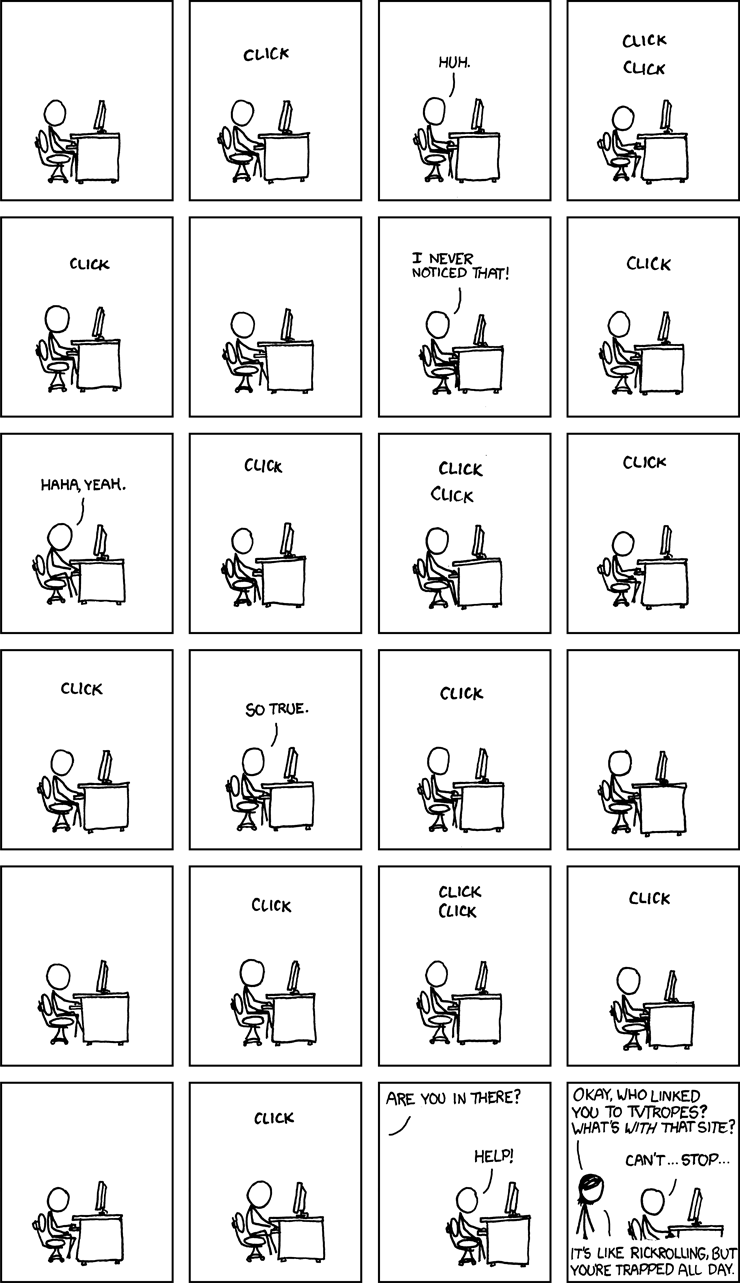
Yeah, it's kind of like that.

I have a confession to make: I’m a tvtropes addict.  Fortunately, it’s only about as bad as vicodin, which means that doses which would knock other people out do nothing to me–but still, I’ve wasted many, many hours on that site.

So anyhow, I thought it would be fun to do a weekly series where I pick out a trope and discuss it.  After a lot of deliberation (and much clicking), I decided to start with:

The Call Knows Where You Live

This trope stems from one of the stages of the archetypal Hero’s Journey.  The hero usually starts out in some sort of familiar setting, so that the reader gets a sense of who he is and where he’s coming from.  To get the story started, someone or something from the realm of the unfamiliar calls him to leave on an adventure.

Most of the time (but not always), the hero turns down the call at first, not wanting to leave his comfort zone.  This is called the Refusal of the Call, and it happens a lot.  In The Matrix, Neo refuses to climb outside the window to escape the agents.  In Ender’s Game, Ender Wiggin doesn’t actually want to go to Battle School, he just wants to be a normal kid and stay with his sister Valentine.  In Star Wars IV, Luke tells Obi-Wan that he can’t go to Alderaan because he’s needed on the farm.

Unfortunately, the Call is not so easily evaded.

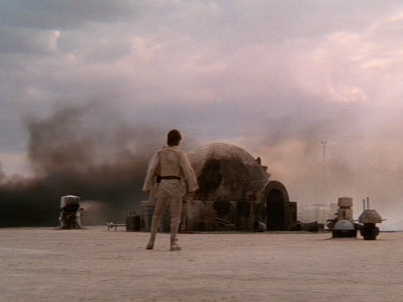
Uncle Owen? Aunt Beru?

Sometimes, the best way to send a character off on an adventure is to have him lose everything right at the very beginning.  With nothing to hold him back, the hero is free to go off and do something truly reckless.

I still remember how I felt when I first saw the burning homestead scene in Star Wars IV.  The sinking feeling when I saw the smoke billowing from Luke’s house, the wide-eyed gasp at the mangled bodies of Luke’s aunt and uncle (I was so young, I had to close my eyes for that part).  All of a sudden, the conflict felt a lot more real–and a lot more inevitable.

Of course, this trope only works for a certain kind of story. If the hero’s family is dead before he even leaves his home, there had better be some serious action later on. Also, the villain had better be the real thing–if nothing else in the story lives up to the depravity at the very beginning, a major promise has been left unfulfilled.

Alternately, I suppose you could have the hero’s family killed off by a natural event, or an unintentional accident–something where he has no one to blame and no face to put to the tragedy.  I can’t think of any examples of this off the top of my head, but it seems a plausible motivation for, say, a scientist who wants to find a cure for some disease, or the source of some magnificent and dangerous anomaly.

Now, if I were an overlord, I would avoid this trope altogether by cozying up to the hero’s parents, perhaps even sending them Christmas cards.  I might consider imprisoning them alive as collateral, but that would give the hero too much of an incentive to storm my castle.  And of course, when slaughtering villages, I would make absolutely certain that everyone in the village is dead.

So what do you guys think of this trope?  Any other cool examples you can think of, or interesting ways to subvert it?  Let me know!

The interior designer’s approach to story

I recently read a fascinating post on John Brown’s blog with an interesting exercise for analyzing the kinds of stories you most like to read.  By finding out what really turns you on in a story, you can have a much better idea what to write, and how to make your own stories better.

He prefaced the exercise with a story about the interior designer who helped them to decorate their house.  The designer spread out a number of home magazines in front of them, and told them to go through and tear out the pictures that most turned them on.  After doing this, they analyzed the pictures to see what they had in common, and thus discovered how to best decorate their house.

The exercise works much the same way.  First, pick out five books you really like that immediately come to mind.  Mine are:

As many of you know, these are some of my favorite books of all time.  I’ve reread three of them, and I intend to reread the other two at some point.

Next, pick out the elements that these books have in common.  Here’s what I came up with:

1) Set in a different time and place.

Not all these books are science fiction, but the all take place in a world far removed from our own.  Only Spin takes place largely on Earth, but the events of the story transform the world as we know it so much that by the end of the novel, it’s completely different. SPOILER (highlight to see) Besides, at the very end, the two main characters leave Earth by going through the giant portal to another planet, so the novel is arguably about escaping the world as we know it.

2) Stakes that are much more personal than global.

This was interesting, and highlights something I realized when I compared Merchanter’s Luck with Downbelow Station.  In all of these stories, the central driving conflicts are extremely intimate and personal.

To be sure, many of these stories also have an epic backdrop; Mistborn certainly does.  However, I was much more interested in Vin’s growth and development than I was in how the Ska would overthrow the Lord Ruler–in fact, Mistborn is my favorite book in the trilogy for that very reason.

3) Encourages deep introspection.

This shouldn’t come as too much of a surprise if you’ve followed this blog for a while, but I love love LOVE stories that make me see the world in a new way.  Thrillers and adventures are all fun and good, but if it doesn’t make me think, I’m usually like “meh” at the end.

4) Female characters who aren’t weak or passive.

This one might be a bit more controversial, but in all of these stories, I’ve noticed that the female characters are pretty strong, even if they aren’t all kick-butt Katniss wannabes (ugh…I hate Katniss).  Even in Legend, which is largely dominated by men, you still have the earl’s daughter, who is one heck of a spirited woman.

5) Life and death conflicts.

This is interesting: in all of these books, the threat of death is immanently real.  Some of them, such as Legend and On My Way to Paradise, are among the most violent books I’ve ever read.  I’m not sure what it is, but there’s something about life and death struggles that really draws me.

6) Romantic in a broad sense.

I’m using Tracy Hickman’s definition here, in which romance is all about teaching us to feel and bringing us in touch with our deepest feelings.  That’s the central theme of On My Way to Paradise: learning how to be a man of passion after witnessing some of the worst atrocities of war.

All of these books not only make me feel, they are about the feelings that they inspire.  In other words, the emotional elements of the story are both a part of and deeply embedded in the story’s central theme.

The exercises isn’t complete after this, though.  For the last part, take another five books and analyze them to see how they compare.  My second list includes:

So how does the list stack up?  Let’s see…

  1. Definitely true.  NONE of these stories take place in the world as we know it–and that’s awesome.
  2. A Canticle for Leibowitz might seem like an exception, since it follows the broad rise and fall of human civilization after the nuclear apocalypse.  But the things that really drew me to the story were the more personal elements: the novice who makes the illuminated manuscript of the electrical diagram, for example, or the abbot at the very end who SPOILER tries desperately to convince the single mother not to take her baby to the mercy killing station after the bomb fatally irradiates them.  In any case, it’s telling that A Canticle for Leibowitz made this list, whereas none of Arthur. C. Clarke’s books even came to my mind.
  3. Definitely true.  Even Citizen of the Galaxy, which is more adventure fiction than high concept sf, features a fascinating society of interstellar traders that really made me sit back and think about the way we structure our society.  Heinlein has a really awesome way of doing that with everything he writes.
  4. The only possible exception here might again be Heinlein, who had some very extremist views of women (putting it lightly).  However, if I recall, Citizen of the Galaxy has a female character at the end who helps pull out the main character from his indigent circumstances and helps him to come into his own.  Again, they might not all be kick-butt tramp-stamp vampire slayers, but they certainly aren’t weak.
  5. Less true of The Neverending Story and The Dispossessed, but while the central conflicts might not be about life and death, the threat of death (or a total loss of identity) certainly comes into play.
  6. Definitely true.  Few books have taught me to feel more deeply than The Neverending Story.  An absolutely magnificent piece of literature.

So there you have it.  According to this exercise, I should write books set in another time and place, where strong female characters face life and death decisions that personally impact the people in their lives and make the readers think and feel.  Interestingly enough, that is a PERFECT description of Bringing Stella Home, as well as Desert Stars and Into the Nebulous Deep.

Cool stuff.  Makes me want to write.  So on that note, I think I will.

9.11.11

I realize that by the time you read this it will probably be September 12th, and most of you will be breathing a collective sigh of relief that the 10th anniversary of 9/11 is over and done with.  I apologize for bringing up the subject again; I’ve been putting off writing this post because I feel exactly the same way.  And yet it doesn’t feel right to say nothing, so I figure I’ll just get this off my chest and return to my normal blogging routine tomorrow.

To be honest, there’s very little I can say about 9/11 itself that I haven’t said already.  Last year’s post pretty much summed up everything I could say about my experience that day, and I won’t try to do a better job here.

There’s a reason I chose to spill everything last year as opposed to now, however, and that’s because last year was the final year in a decade that I think it’s safe to say all of us would rather forget.  It started with the 9/11 terror attacks and ended with a global financial meltdown and massive recession, with two ultimately fruitless wars and millions of shattered lives in between.

I almost want to call it the “Decade of Lost Dreams,” which is sad because many of those years were the prime of my life.  It’s true, though; the world has gotten a lot darker and grittier, at least for us Americans, and there are very few places we can look to for hope.  President Monson wrote an excellent op-ed in the Washington Post on that subject, coming at it from a more spiritual perspective.

I wish I could be more positive, but I don’t expect things to get better anytime soon.  These are dark times, and even if the specter of terrorism isn’t as bad as it used to be (thanks to the brave men and women in counter-terrorism and the military, to whom I give my utmost respect), the economy is a hundred times worse.  With the crisis in Europe, I wouldn’t be surprised if we fall into a second recession; it may be that the 00’s were merely the “Decade of Disillusionment,” whereas the 10’s will truly be the “Decade of Lost Dreams.”

I actually want to do a series of posts on this later, because even though things are grim, I still think there’s a lot of options open to us–possibly more than at any other time in history.  But that’s a subject for another time.

Basically, I just wanted to say that I feel like after 9/11, the country took a nosedive off a cliff, and that’s something I would rather put behind me than commemorate.  Fortunately, we don’t need to let that define us–I know I certainly don’t.  And as for those who have been working hard to make this world a better place since then, I tip my hat to you.  We need a lot more people like that right now.

NPR’s Top 100 Science Fiction & Fantasy

In case you didn’t know, NPR just put together a list of the Top 100 Science Fiction and Fantasy novels of all time.  The list had a panel of judges who vetted nominations, but the voting was public and turnout–over 60,000–was pretty high.

I usually don’t like top 100 lists, but this one did a pretty good job representing the genre.  I recognized about 2/3rds of the titles, and most of my own personal favorites were included.

There were a few notable exceptions, however.  David Gemmell wasn’t represented at all–a travesty of the highest proportions.  Neither was C.J. Cherryh, which I find very surprising.  Robert Charles Wilson has certainly written some books worthy of the list, and Dave Wolverton’s On My Way to Paradise–which, I would argue, is one of the best science fiction novels ever written–was notably absent.

Also, a few of the titles were further down on the list than I would have put them.  The Dispossessed by Ursula K. Le Guin came in at #78, while I would have put it at least in the top 20.  A Canticle for Leibowitz did better at #35, but was it really an inferior book to The Handmaid’s Tale?  Come on, people.

One thing I don’t think this list represents well (or top 100 lists in general) is the way in which sf&f fandom has split into dozens of communities and tribes, almost like Darwin’s finches on the Galapagos Islands.  Before science fiction went mainstream, it was possible to follow all the various titles and developments.  Now, however, there’s so much out there that it’s impossible to be fully cognizant of everything.

I think fandom has split into some very distinct communities clustered around the popular authors and sub-genres, and there’s not a whole lot of overlap between them.  None of them are large enough to spawn an entirely new genre (with the possible exception of paranormal romance), but lumping them all into science fiction & fantasy can be a bit problematic.

That said, I think this is a pretty good list.  What do you think?