Sholpan, or The Great Novella Experiment

So now that I’m finished with Desert Stars, the next project I’m working on is a companion novella to Bringing Stella Home titled Sholpan.  While Bringing Stella Home is about James and his quest to rescue his brother and sister, Sholpan is entirely from Stella’s point of view and traces her rise in Hameji society, from prisoner and slave to…well, I won’t ruin it for you.

I started writing it on Monday, and so far it’s been a lot of fun.  In some ways, it’s kind of a break for me, since I already know the story (most of the material is lifted straight from Bringing Stella Home, with a few extra changes to make the viewpoint tighter and build more character development).

At the same time, though, it’s a challenge because I’ve never written in the novella format before.  The definition as given by SFWA, has mostly to do with length:

For the purposes of the Nebula Awards, the categories are defined as follows:

  • Novel — 40,000 words or more
  • Novella — 17,500–39,999 words
  • Novelette — 7,500–17,499 words
  • Short Story — 7,499 words or fewer

However, I can’t help but feel that there are many other artistic elements to consider.  For example, the Oxford Dictionary of Literary Terms gives this definition:

novella [nŏ‐vel‐ă], a fictional tale in prose, intermediate in length and complexity between a short story and a novel, and usually concentrating on a single event or chain of events, with a surprising turning point.

Other sites I’ve browsed (including this post from The Galaxy Express, this review from 2009 of several small press novellas, and another interesting post on short stories vs. novellas vs. novels) leave me with the impression that novellas typically

  • can be read in one long sitting, such as a train ride,
  • center around one major conflict, idea, or issue,
  • have more room for rich settings and lavish descriptions,
  • tend to focus more intimately on character,
  • are compact enough to take risks with voice and theme, and
  • can end without a definitive conclusion to the central idea or conflict.

I must confess, I’m not an avid reader of novellas.  I’ve read some of the classics, of course: Dr. Jekyll & Mr. HydeThe Time Machine, Animal Farm, etc, but in terms of modern sf novellas, all I’ve really read is I Am Legend (and a few golden/silver age “novels,” if you count them).  Point is, I’m not an expert on novellas by any means.

However, the novella seems like a very promising format for epublishing, especially in conjunction with a novel.  Readers can pick up the novella for $.99 and get both a sample of the writer’s longer novel-length stuff, as well as a complete story in itself.

That’s what I want to do with Sholpan.  I want to write a less-expensive derivative work that’s artistically sound in its own right, while also driving interest in the full length novel.  Besides, it’s just fun to experiment with new styles and formats.

If this is successful, I can see myself writing a companion novella to most, if not all of my novels.  And who knows?  Maybe I’ll be able to sell some of those to more traditional print and electronic markets.  It’s worth a shot, and no matter what happens, I’m bound to learn something new.

So yeah, that’s my current writing project.  If all goes well, expect to see it out sometime this fall.  And if you have any comments or suggestions regarding novellas, please share!  I’m very interested to learn anything I can.

Blurb for Bringing Stella Home and thoughts on Borders

One of the essential elements for a successful in epublishing is a killer book description, and I think I’ve got a pretty decent one for Bringing Stella Home.  However, I could use some feedback, so if you could read it and tell me what you think, that would be great. Here it is:

It is a dark time for the galactic empire. Rebellions at Tajjur and the New Pleiades sap the empire’s strength from within, while hordes of spacefaring Hamiji warriors from the outer reaches sweep ever closer to the Imperial capitol, slagging entire worlds in their wake.

When the Hameji forces conquer his homeworld, young James McCoy runs away to rescue his older brother and sister, Ben and Stella, from their grasp. Though he faces an enemy undefeated in battle and feared throughout all of inhabited space, James will stop at nothing–not even death–to get his brother and sister back.

Things start to look up when he meets Danica Nova, a Tajji mercenary captain who takes him in and becomes his mentor. James reminds Danica of her own brother, whom she failed to protect when the empire slaughtered her family years ago. Now, she hopes to find some redemption from her demons by saving James from his own.

Unfortunately, neither of them realizes that Stella has become a concubine to the main Hameji overlord–and that Ben has been brainwashed and made into an elite shock trooper in the empath squadron sent to hunt them down.

So what do you think?  Too long, too confusing, too cliche, or too boring?  The genre (if you can’t tell) is space opera / space adventure, so I’m hoping it will appeal to fans of Orson Scott Card, C. J. Cherryh, Lois McMaster Bujold, Star Wars & Star Trek, etc.  It’s also got a slight military science fiction bent to it, though I wouldn’t presume to be qualified to write true military sf.

In unrelated news, I recently did an interview with Charlie of Playground51, which appears to be down for some reason (the link is on my Blog Tour page above).  Topics discussed include how I got the idea for Genesis Earth, which parts were inspired by real life, and thoughts on book promotion.  Hopefully the site will be up again soon!

Also, I’m thinking it’s time to do a major overhaul of my blog template.  As much as I love the current one with the purple stars and nebulae, I need something with two sidebars so that my books don’t push everything else to the bottom.  If you have some ideas for a good WordPress template that still keeps the sci-fi feel of this one, please let me know!  I’m very much open to suggestions.

Finally, since the Borders liquidation is all over the news, I thought I’d share my $.02.  It’s sad, certainly, but I don’t think that the fallout will be nearly as gloomy as Joshua Bilmes claims.

Corporate-run big box stores are certainly on the way out, but there will always be a market for good stories, and in many ways the new ebook technology is causing that market to expand at a wonderful rate.  So while the predictions of the print death spiral appear to be coming true (David Gaughran did a great post recently on that), new models will emerge–indeed, are already emerging–which will fill the vacuum.

The thing that gives me great reason to hope is that these new business models give so much power back to writers.  Instead of relying on the mercies of large media corporations to build a viable career, we can now make a living by publishing independently or going with any number of small independent presses.  Readers have more choices and writers have more options.  It’s glorious.

If anything, the Borders bankruptcy has confirmed to me that I’ve made the right choice to go indie, rather than wait for New York to anoint me before launching my career.  Will I ever go with a traditional publisher?  I’d like to someday, but I no longer feel dependent on the old system to accomplish my dreams.  Instead, it’s my readers who will decide my fate, and that’s exactly as it should be.

So thanks for reading!

Shoot your fans?

Today’s issue of Dave’s Daily Kick was titled “Hooking Credibility,” and I’m not sure what I think of it.  At the end, Dave’s brother Tailspin Jim had the following to say:

What I’m about to add is so basic that [Dave] would never think to include it, but you may be like the vast majority of Kick readers who just don’t have his depth of background on this subject or who would be benefited from taking a look at it.

Each hook or marketing ploy is like firing a bullet at your reader. You probably won’t kill their resistance with the very first shot. You want to fire bullet after bullet until they collapse and make the decision to buy.

Not only does this statement smack of everything I hate about sales and salespeople, but it seems to fundamentally clash with the new reality of publishing.

With social networking and the internet, writers can now connect directly with their readers.  For those going the indie route, this is absolutely essential.  The key element to success, from what I can see, is developing an ongoing relationship with your fans–one in which they take the role of patron, not merely consumer.

There’s a huge difference between thinking of readers as patrons and thinking of them as consumers.  If they’re just consumers, then the end goal is to get them to buy your product, and there’s nothing wrong with spamming them or shamelessly plugging yourself if that’s what works.

But if they’re patrons, the end goal is to develop that relationship–to connect with your readers on a meaningful level, both before and after they buy your work.  And in this brave new world of publishing, that seems like the best coarse to take.  Consumers have to be sold on each individual book; patrons are sold on you, so they’ll read everything you put out.

And as a reader, that’s how I buy.  Whenever I find an Ende or a Wilson or a Le Guin in the bookstore, I rush to grab it, because those are the writers who speak to me.  I’ve bought just about every Sanderson in hardcover because I love his work and want to support him.

That’s why this comparison of bookselling to “a series of bullets being fired from an automatic rifle at the prospective buyer” rubs me in all the wrong ways.  I’m not just peddling widgets; I’m creating art and sending it out into the world, waiting patiently for it to return back a hundredfold.  And if I work hard to create the best possible art and treat my readers (aka you guys) as my patrons, I sincerely believe that it will.

So to all of you who have read my books, regardless of whether you bought them or downloaded them from Smashwords for free, I just want to say thank you!  The greatest honor any writer can have is to be read, period.

I also want you to know that I’m never going to “shoot” you with a bunch of cheap sales tricks or “hooks” that get in the way of the story.  I’m just going to write damn good books and put them out where you can find them, trusting you to rate, review, like, and share them if you feel they truly deserve it.

I will never, ever, EVER put a gun to your head to get you to buy my work.  I’d much rather you jump at the chance to read a Vasicek, because that’s what speaks to you.

Why I am not afraid of the Noise part II

A recent op-ed in the Wall Street Journal titled “Cherish the Book Publishers–You’ll Miss Them When They’re Gone” has ignited a firestorm across the indie publishing community.  The post’s basic argument is that the ease of self publishing and the end of New York as the gatekeepers of quality will make it harder for readers to find the truly worthwhile literature amid the flood of crap that will inevitably overwhelm us all.

Joe Konrath fired the opening salvo; in characteristic fashion, he decried the op-ed as hogwash and blamed jealousy among traditionally published writers for the perpetuation of this myth.  He concluded that while the “tsunami of crap” is real, it is ultimately irrelevant.

His advice? “Don’t write crap.”

Michael A. Stackpole responded by examining the much more dangerous fear of authors worried about the coming flood; the fear that their own work is crap, and not worth putting out.  After examining what we mean when we call something “crap,” he concludes that the really bad stuff will sink to the bottom…

…not because of a rising tide of crap, but because they deliberately swim toward the bottom, open their mouths, and willfully suck.

And the rest of us will happily swim past the effervescent markings of their demise, moving on into the golden age.

Kris Rusch’s take on the issue was perhaps the most instructive of all.  First, she used her own experience as editor of The Magazine of Fantasy & Science Fiction to completely blow out of the water the idea that editors are arbiters of good taste.  Editors buy what they like; when they try to predict what the public will like, more often than not they fail–and when they try push their own reading tastes onto the public, they make themselves irrelevant.

She concluded that the only truly relevant “gatekeepers” are other readers–that word of mouth is still king, and because the traditional publishing system treats books “like produce, taking them off the shelf as if the book will rot after a month,” indie publishing is much better suited to help the good stuff rise to the top.

David Gaughran responded next by pointing out all the ways that indie publishing and the ebook revolution are enriching the literary world.  He concluded that the only people hurt by these changes are the middlemen–that both writers and readers only stand to benefit.

Well.  Like I said, it’s quite a firestorm.

So what’s my take? I already posted my thoughts on why the original argument is invalid–that fear of the Noise, aka the “tsunami of crap,” is a specious reason not to epublish.  However, I think that the real issue goes much deeper than that.

The most fundamental divide between those who embrace the ebook revolution and those who fight it is whether or not they trust readers to find the truly great works of literature on their own.

The obvious question, of course, is what exactly constitutes “great literature.” As a lover of genre fiction, I measure the quality of literature by the impact it has on readers; that when readers can’t stop talking about how awesome a book is, it’s a good book.  For that reason, I’ve never put much credence by Twilight bashers; paranormal romance might not be my thing, but Stephanie Meyer struck a chord in a lot of people, and that certainly counts for something.  In other words, story is King.

Putting it that way makes the argument somewhat circular.  Can we trust readers to find the good stuff on their own?  Yes, because readers read what they love.  But what about that literary piece about a depressed writer who has a sexual affair that completely changes his life?  Well, I guess it just wasn’t that good.  But they would have loved it, if not for all that genre crap flooding the system!

As for readers getting swamped, I think the system itself prevents that.

First, readers browse by means of tags, search terms, categories, top seller lists, “also bought” lists, etc.  They follow book bloggers and take recommendations from friends.  When they find a book with an attractive cover, they click on it, give the book description a cursory glance, and perhaps check a few reader reviews.  If their curiosity is still piqued, they download the free sample to their ereader.

Up to this point, no money has been spent.  Readers can download as many free samples as they want, of anything that catches their fancy.  When they finally get around to reading the sample, they can decide whether they want to buy the book.  If they do, all they need is to click a button on their ereader, and the book is theirs.

Once they finish the book, the ereader prompts them to leave a review (at least the Kindle does this–not sure about the others).  If they enjoyed it, they can give a favorable rating which helps other readers find the book.  If they don’t, they can give an unfavorable rating which warns others to stay away.

What is happening is nothing less than the democratization of literature.  Therefore, it should come as no surprise that those who trust readers will embrace the new system, while those who still cling to editors-as-gatekeepers will reject it at all costs.

But can we really trust readers?  Yes, if we believe that story is King.  If readers and writers are collaborators in the literary experience, and the truly great literature is that which has the greatest impact on its readers’ lives, then it stands to reason that readers must be the ultimate judges of quality.

Therefore, if we truly believe in the power of story, we cannot help but put our trust in the readers.  And if that’s true, why shouldn’t we rejoice in the revolution?

I sincerely believe that we are witnessing the dawn of a great golden age of literature.  The invention of the ebook is at least as revolutionary as the Gutenburg press, perhaps a great deal more.

The only ones who have anything to fear from the revolution are those who have built their livelihoods by pushing their own arbitrary tastes on others.  Frankly, that’s nothing less than cultural tyranny–and with the democratization of literature, we no longer have to put up with it.

Viva la Revalucion!

Arrrgh Smashwords!

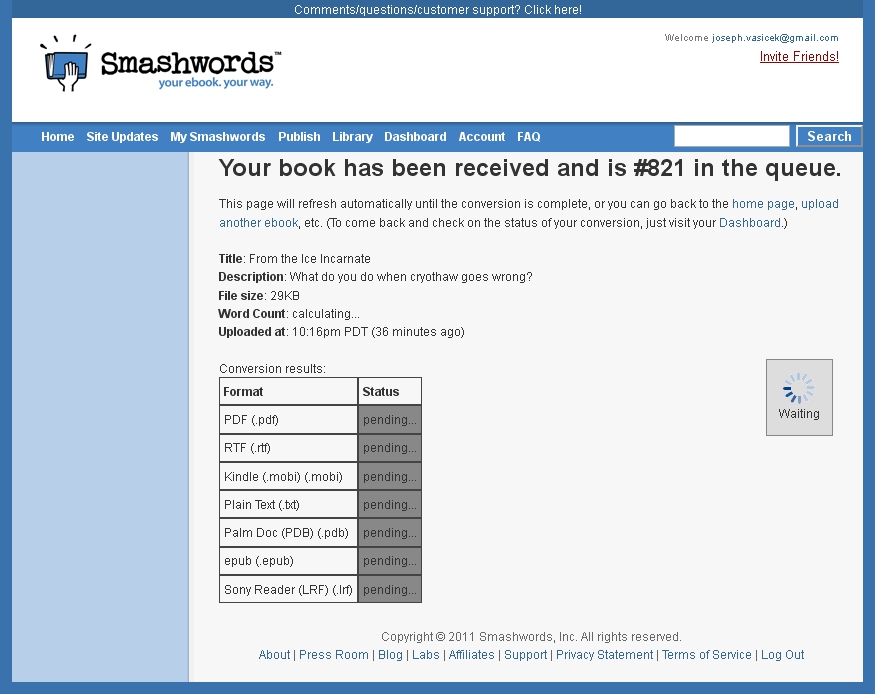
So I go to upload “From the Ice Incarnate” to Smashwords as a free give away, and this is what I see. Arrgh!  Why do I have to wait??  Why can’t my book be up nowww…?

Okay, seriously, it’s not that big of a deal.  I’ll just have to wait until tomorrow to start spamming everyone sharing it.  And unlike last week, I’m going to be more open about the fact that I’m giving this story away for free.

I decided last week to put up “Decision LZ1527” and “Memoirs of a Snowflake” for free on Smashwords, mostly to see if I could get Amazon to price match.  So far it hasn’t worked, but it has given me some very interesting insight into the minds of ebook buyers.

The results aren’t scientific, of course, but so far it’s confirmed what I’ve heard elsewhere: that there’s a HUGE difference between people willing to pay more than $1 for an ebook, and people who will grab anything because it’s free.  So far, 62 people have downloaded “Decision LZ1527,” 33 people have downloaded “Memoirs of a Snowflake,” but only 2 people this week downloaded the free sample of Genesis Earth–and no one has bought a copy.

Of course, this is only after one week.  Perhaps the people who downloaded the free stories are just taking a long time to read them.  Perhaps they just can’t afford to buy many ebooks right now, but because they read and enjoyed my stories, they’ll check it out when they have more time/money.  Maybe some of them will run across my ebooks years later and remember “oh hey, that’s the guy with that crazy sci fi dating story” and check me out then.  Or maybe they’re all cheapskates who only read stuff they can get for free.  I don’t know.

But I don’t think it’s the last one.  A friend from my apartment complex walked up to me today and told me he’d read and enjoyed my story.  It was pretty cool.  That’s what I’m really after at this point: exposure and readers.  So I think it’s a good idea to give at least some stuff away for free, even if it doesn’t push people to buy your other books in the short term.

Speaking of which, I’ve tried out something else new: raising the price of Genesis Earth from $2.99 to $3.85.  Why in the heck would I do that?  Mostly because of value perception; I want people to know that I have confidence that my book is worth at least #3.85, that I believe they’ll feel it was worth what they paid for.  The kind of books I want to write are the kind that people will want to read twice, and I want to see if changing the price to reflect that will build the kind of readership that is looking for that sort of thing.

I might be totally wrong, of course, but hey it’s worth a shot.  I’ve sold two copies so far this month, so at least it hasn’t totally killed sales.  I’ll probably keep it at that price for at least a couple of weeks, just to see what happens.

But I can tell you one thing I don’t think I’ll ever do: price a novel higher than $5.  I’ve always thought that $6.99 and $7.99 for a paperback is a little steep, even if the book completely changes my life.  That’s not something you can put a dollar value on, and even if you could, why would you want to charge that much?  If your book was so deep and meaningful, wouldn’t you want to give it away for free?

So yeah, I’m trying to suck my readers dry, only to find a business model that works.  And if you think $3.85 is too steep, please let me know.  I’d like to give my books away for free, but at the same time, I want to eat without spending my life as a wage slave.

In the meantime, if you haven’t already, check out my free stories!

Craving another retreat

Last night, I got together with an old friend from last year and went camping down in Sanpete county, in the Manti-Lasal National Forest.  Even though I didn’t get a whole lot of writing done, it was a much needed change of scenery.

Man, southern Utah is so different from the Salt Lake and Utah valleys.  More rural, more laid back, more of a back-country attitude but not in a California kind of way…I don’t know if that makes any sense, but I like it out there.  It feels like the kind of place you’d pass through on a road trip, that mystic old-time Americana that always feels like it’s just out of reach.  Part of me wants to settle down in a place like that someday, while the other part doesn’t want to settle down ever.

Spending time away like that gives you a renewed perspective.  I wouldn’t say that I feel more “centered” now, but getting out in the wilderness certainly made me see the daily grind here in Provo a little differently.  It’s so easy to get caught up in a routine, where the weeks and months go by until suddenly it’s summer again and you don’t know where the last year went.  Unless you take the time to step back, you can never get perspective.

Unfortunately, in order to save up for Worldcon this August, I’m going to need to work 40 hours per week almost right up to the convention weekend itself.  I’m not complaining; I feel blessed to have a steady source of income right now, especially in this economy.  But as a writer, it’s hard when your job takes so much time and energy away from your writing time.

Lately, I’ve only been spending two or three hours a day writing, and a lot of that time is filled with interruptions.  Part of it is just procrastination, but another part is that my day is so split up that the only periods of unbroken free time are from 9 pm to 8 am. That’s tough, because I need a big chunk of writing time to do my best work.

Even though I’ve been making decent progress on Desert Stars, I feel like I could be doing so much more.  If I could take a week off for a retreat where I did nothing but focused on my writing, I could probably finish this draft in a matter of days, with time to start a bunch of new projects.  In fact, I already have about a half dozen stories in embryo, with scenes and characters just begging to be written.  Once this latest project is finished, I don’t quite know what I’ll be starting next.

Since I should be writing right now instead of posting to this blog, I’ll wrap up by saying that I really wish I could take some time off for another retreat, this time to focus solely on my writing.  But since I can’t, I’ll do my best to carve away large periods of unbroken time for writing, and unplugging myself from distractions both online and off in order to make the most of it.

It’s a difficult balance, one that’s a constant struggle to maintain.  Right now, I feel like I’m on the losing side of the battle, which means it’s time for a change of routine.  Thankfully, taking some time off in the wilderness has helped me to better see what I need to do.  I only hope I can maintain that perspective in order to break out of this stifling routine.

<sigh> One of these days, when writing is my primary source of income, this will not be nearly so difficult of a problem.  You have no idea how much I want to make that happen.  In the meantime, back to work.

Writing is like tending an orchard

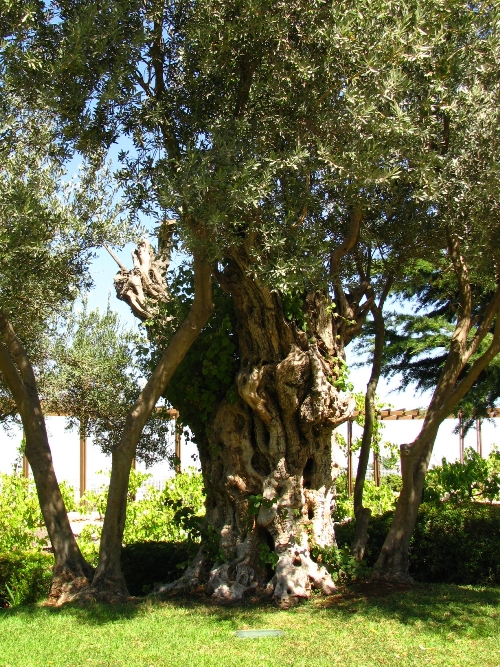
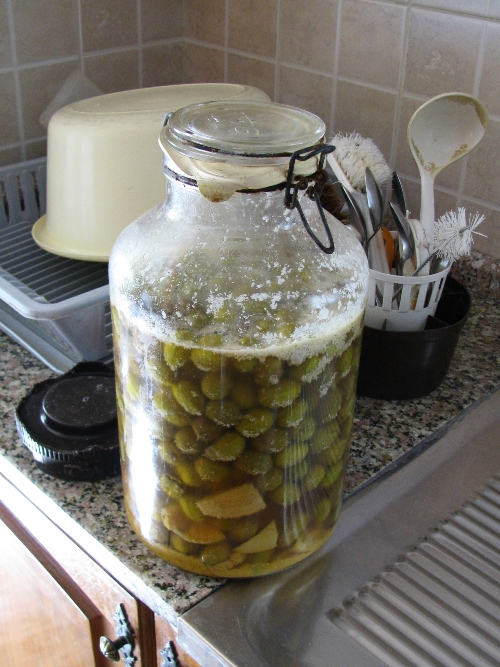
So I was hiking the Y tonight, pondering various things, and the thought occurred to me that writing is a lot like an olive orchard.

First, you’ve got the land, both cultivated and wild.  Cultivated land is like your conscious mind, where everything fits neatly into order and you have control over what you create.  The subconscious is the land beyond the fence, where things grow wild.

Ideas are like seeds; they’re everywhere, but only a few ever take root and sprout.  Those that do need to have new sprouts periodically grafted into the old, in order to preserve the entire tree.  These grafts may come from the cultivated ground of your cultivated mind, but more often than not they come from the wildlands of the subconscious.

Each novel is like an individual olive tree.  It takes a lot of time and work to grow one to maturity, but once you do, it can live for a long, long time.  The fruit itself is like the earnings you get by licensing copyright; if you prune the tree carefully (aka do a good job managing your intellectual property), it just keeps on producing.

Of course, in order to make sure your trees grow properly, you need to be constantly enriching the soil of your mind.  That’s where education and life experience comes in.

Since trees sometimes die, you have to maintain several trees at once in order for your orchard to succeed.  And even though it’s a hell of a lot of work, over the long run the returns are enormous.

For the ancients, olives were a major staple crop. In Greek mythology, Athena was chosen as the patron goddess of the city of Athens because her gift of an olive tree was considered more precious than any other.  And just as good books help us expand our minds, better understand and empathize with others, and generally rise above the boredom and mundane-ness of our daily lives, so also the fruit from this metaphorical orchard is truly of great worth.

Anyhow, those were some of my random ponderings, climbing down the mountain.  Someday, I want to have an orchard that covers an entire hillside and produces thousands of pounds of olives!  Just thinking of it makes me hungry.  Mmm, olives…

I need a productivity boost

Yeah…today wasn’t that great.  I revised through about 2k words in Desert Stars, but none of it was new material, and I only worked on it for maybe 3 cumulative hours.  I’m working full time now, but even so, I can do better than this.

My self-imposed deadline for Desert Stars is July 9th.  That needs I need to do three chapters per week, and last week, I only did two.  Some of the later chapters are going to require tossing out everything and starting from scratch, but for the next four or five, I probably just need to shuffle scenes around without changing too much.  Hopefully, I can get through three this week, perhaps even four.

Genesis Earth continues to do well, though.  I checked it at work, and saw that 69% of the people who view the Amazon page end up buying the book.  That’s huge.  Some glitches over the weekend have made sales updates sporadic, but it’s still selling a good 1.5 copies per day.  So to all of you who have bought a copy: thanks so much!

There’s still a lot I need to do for Genesis Earth on the epublishing front, however.  Here’s my to do list for this week:

  • Send GE to +5 review sites.
  • Publish GE to the nook.
  • Get GE listed on Goodreads.
  • Do 3 guest posts / interviews for the blog tour.
  • Create an index for the blog tour.

Should be pretty straightforward…if I can balance writing time with non-writing publishing/promotion time (along with full time job time).  It’s going to be tricky, but I think I can do it.

Here’s my plan: I’ll get up at 6:30 each morning and write for at least half an hour, exercise, get ready for work, etc.  When I get  home at 5:30, I’ll eat a quick dinner and then devote myself to writing until about 7:30 (I have events going on every weekday evening that start at 7:30).  In the late night, I’ll maybe write a little, but that won’t be my primary writing time (since I never get much done when it is).

So anyways, that’s my tentative plan for this week.  Hopefully, that productivity boost will kick in soon, and I’ll be writing 3.5k words a day again.

In unrelated news, Adventures in Sci Fi Publishing posted an awesome interview of Kristine Katherine Rusch up on their podcast yesterday.  To all my writing friends: you really should check it out and listen to it.  Kris is an amazing veteran professional in the sf&f field, and has loads of good advice.  I read her blog religiously and recommend that all other aspiring writers do the same.

Which reminds me: Robin Sullivan was interviewed last week on another podcast, and this one is also very much worth checking out.  Robin runs a small press called Ridan, which is embracing unorthodox business practices and doing surprisingly well in today’s publishing climate.  I’ve said that I’m on hiatus from seeking a publishing house for the next three years…but if I could get into Ridan, I would in a heartbeat.

Finally, let me end this post with a cool trance song I discovered the other day.  Way mellow, with sweet vocals that fit surprisingly well with my current WIP.

Ebook update

As many of you know, I epublished my first novel two weeks ago, and three short stories a few months before that.  How has it been going?

First, let me point out that I have another guest post out as part of the Genesis Earth blog tour, this one on my friend Gamila’s blog.  Gamila reviews YA and LDS fiction, and is a big proponent of clean reads.  For my post, I wrote about the place of LDS writers in science fiction and fantasy and the unique things we have to offer these genres.  Fun stuff; you should check it out.

So now that that’s out of the way, how do the numbers look for my epublishing venture?  Not bad, actually.  In two weeks, I’ve sold twenty copies of Genesis Earth and gotten two five star reviews on Amazon, only one of which was from someone I know.  Not bad–I’m looking to get at least $50 from Amazon come September, which should be very nice.

The short stories have not sold nearly as well, however.  Part of it probably has to do with the fact that I’m not a super stellar short story writer, but another part probably has to do with the lack of promotion.  The review of “From the Ice Incarnate” by Red Adept Reviews did lead to a few extra sales for all my stories, but only about half a dozen or so.  Nothing spectacular.

Part of it also has to do with the sampling system, I think.  With ebooks, you can download a free sample (usually the first 10% of the text) and decide whether you want to buy it or not.  For Genesis Earth, that amounts to the first three chapters and then some; for the short stories, maybe a couple of paragraphs and that’s it.

So what’s the takeaway?  I think that novels work out much better as ebooks than short stories.  For one, you can justify charging more for them (I haven’t seen anyone selling short stories for more than $.99), and thus get the higher royalty rate. For another, they work much better with the sampling system; readers are much more likely to get hooked on the first 10% of a novel than the first 10% of a short story.  And lastly, I’d say that you need to figure out some kind of way to promote yourself and get your work out there.  Still working on that.

All in all, not too bad.  But here’s the really cool part (and I mean really cool): at my current cost of living, I estimate that I need to sell only 15 ebooks per day to break even financially.  At a consistent average of 25 books per day, I could justify quitting my “day job” (150% of all monthly expenses).

How is that exciting?  Well, get this: starting out the gate with very little platform or exposure, I’m averaging a little over 1 ebook sale per day.  If I could boost that up to 3 sales per day for 5 books, I’d be breaking even.  At 5 sales per day for 5 $2.99 books (~800 total ebook sales per month), I’ll be making a living.

See why I’m excited?

My goal now is to get up to 5 full length novels / novellas out before the end of the year.  Believe it or not, that’s very achievable.

First, I’ll be epublishing Bringing Stella Home sometime this summer, hopefully in time for worldcon.  Shortly thereafter, I hope to publish Sholplan as a $.99 novella.

My current WIP is the third draft of Desert Stars, and I bet I can have that ready before Christmas.  While I’ll put the whole thing out as its own novel, I like Emma’s idea of splitting it into two books as well.  I’ll probably title them Dome and Desert and Sand and Stars, and make the first one available for free just to get more exposure.

And at some point in between all that, I’ll finish compiling all my travel journals from the 2008 BYU Jordan study abroad and put that out as its own work.  That one should be fun, and a good way to experiment with in-text photos and illustrations.

That’s my plan.  The more I put my work out there, the better my chances at making it big.  And even if I don’t, if I have enough titles out and they all sell more or less consistently, I can still leverage that to make a full-time living.  And that’s my dream.

So yeah, I’m extremely excited.

Are ebooks there yet? My response to Wired

I just read an interesting article on Wired putting forth five reasons why ebooks aren’t yet better than print books.  I find it mildly interesting that Publisher’s Weekly linked the article on Twitter; the more things change, the more that people in traditional publishing seem to plug their ears and pretend like it isn’t happening.  However, I disagree with the article’s reasons, and here’s why:

1) “An unfinished e-book isn’t a constant reminder to finish reading it.”

The solution?  Writers need to write better books–and because of the pressure that this problem exerts, I believe they will.  If print publishing resists the ebook revolution long enough, well-established indie authors might well develop a reputation for better written, more engaging page turners than traditionally published authors.

2) “You can’t keep your books all in one place.”

I’m not plugged into the tech world, but I imagine that this problem will be solved rather quickly once readers start complaining.  This is a tech problem, and the tech industry is far better at change and innovation than traditional publishing.

3) “Notes in the margins help you think.”

I don’t mean to put down any of my friends who do this, but…seriously?  How many of you write in the margins as you read?  It’s probably more of an issue with literary fiction, but with science fiction and fantasy, most of us read for story, and the best books are the ones we finish at a breathless sprint at 4:00 am the next morning.  When it comes to the genres I write in, I think this is a non-issue.

4) “E-books are positioned as disposable, but aren’t priced that way.

This one is my favorite.  Sure, traditional publishers are overpricing their ebooks, but that just opens the door for hordes of indie authors (like me) to undercut them and earn more on their own than they would if they took a traditional publishing deal. In addition, all the longtime professional authors I know are doing everything they can to jump ship, which is only going to bring about the crash of the traditional publishing model all the sooner.

In all honesty, I hope that traditional publishers continue to overprice their ebooks as long as they can.  The more they tick off readers with bloated prices, the greater an advantage my books will have over theirs.  And the more readers buy indie, the more money goes to supporting authors, as opposed to overpaid corporate officers and ridiculously expensive New York rents.

5) “E-books can’t be used for interior design.

Two responses: 1) how many people do you see these days with CD racks in their living rooms, and 2) why do you think people still buy vinyl?

When the iPod came around, people didn’t let this argument stop them from switching their collections to mp3 and boxing up all their CDs.  When a new technology arrives that is demonstrably superior to the old, culture adapts to fit around it.

At the same time, I have no doubt that print books will continue to exist.  People still ride the California Zephyr even though we have airlines, and they still buy vinyl even though we have mp3s.  It may well be that the half-dozen collectible leather-bound hardcovers you own in the age of ebooks will say more about you than the hundred or so secondhand paperbacks you have on your shelf now.