Disagreement is not offensive

Is it just me, or is there an increasing tendency in today’s world to misconstrue anything and everything as “offensive”? This is especially true of the campus protesters, who take offense in everything from Halloween costumes to the name “Lynch.” But the most disturbing trend is when they find someone “offensive” simply because they had the gall to disagree:

When I saw this exchange between a professor at Yale and one of his students, I was frankly shocked at the intellectual laziness and moral dishonesty of the student. “It is not about creating an intellectual space here!” …seriously? You attend one of the most prestigious universities in the Western world and you don’t think it’s supposed to be “an intellectual space”? What did you expect to do here, weave baskets all day?

But notice that the part where she really flies off the hook is when the professor says “I don’t agree with that.” That’s telling. It shows that the student has no interest in engaging with the professor’s point of view, just in shutting him up. It’s as if she knows that her ideas can’t stand on their own, and need to be enforced by bullying.

Well, it appears that the bullying tactics have worked, because the professor’s wife has stepped down from her teaching position at Yale. The thing that started this whole mess was an email she wrote defending students’ rights to wear Halloween costumes that other students found—you guessed it—”offensive.”

Oh, and that racist Halloween party that launched the Yale student protests? It never happened, natch.

I could go into greater detail, but this is just one example of disagreement being conflated for offensiveness. I’m sure that you could cite others. But it’s not the crybully tactics that shock me, or the ideological blindness: it’s the sheer fragility of the intellectual framework on which the “offended” party’s argument is based.

Seriously, almost anytime anyone gets offended because someone else disagrees with them, their position is so flimsy that a high school dropout could poke holes in it. That’s certainly the case with the Yale student shown above. It’s just like the story of the emperor’s new clothes, where everyone can see that the emperor is naked except for the emperor himself.

In fact, that’s a perfect analogy, because all this talk of “safe spaces” and “right to be offended” is nothing less than an attempt to shelter these students from reality—just like the emperor was sheltered from the reality that his new “clothes” were an absolute farce. And seriously, how is it not farcical for a student to shout “it is NOT about creating an intellectual space!” at one of the world’s most prestigious universities?

This is on my mind right now for a couple of reasons: first, because of an online interaction I had recently with one of these overly-sensitive types, and second, because of an interesting post over on Mad Genius Club. This part of the post was particularly relevant:

I’m a very minor pro, and my tips are probably worth precisely what you pay for them. But here is mine: Pro tip for writers. Learn to put yourself in the shoes, thoughts and headspace of people totally unlike you. Learn to write from their perspective. […] If you can’t do this, you may have one or two good books in you – but essentially you’re writing one character, yourself, and those who are very like you. Unless that’s exceptionally appealing… people get a bit sick of it.

Even if you detest those other people who see the world differently, and wish nothing but ill on them, and plan to destroy them… you’ll write it a lot better understanding what they do and feel and why they think or act as they do.

If you take offense whenever people disagree with you, chances are that you’ll never be able to cut it as a writer. In order to write well, you have to be able to see things from inside the heads of people who aren’t like you and probably don’t agree with you.

This is why I support Sad Puppies: because the SJW types in Science Fiction are usually the first to cry offense over anything that doesn’t fit into their narrow worldviews. This naturally makes them as vehemently opposed to intellectual diversity as they (falsely) claim that the Puppies are to racial, sexual, and cultural diversity. When you look at the books and stories that these people uphold as shining examples of the genre, their rigidly ideological worldview is as plain as the emperor’s new clothes.

Disagreement is not “offensive.” In fact, it’s a sign of respect. If your opponent thought that your opinion or argument wasn’t worth engaging with, then they simply would have ignored you. By saying “I don’t agree,” they are acknowledging your position in an intellectually honest way. When you willfully misrepresent your opponent’s views, or bully them into silence, it is a sign of disrespect that warrants taking offense. And who is most guilty of that? I’ll give you two chances, and the first one doesn’t count.

Giving Thanks

If there is any national holiday that is routinely overlooked, it is Thanksgiving. In our intensely consumer-driven society, Christmas looms ever greater, bringing with it the pseudo-holidays like Black Friday and Cyber Monday. Each year, the jingles of commercialism threaten to drown out the message of gratitude which Thanksgiving celebrates.

So with that in mind, I intend to keep a proper Thanksgiving this year, and every year. It is a time for food, a time for family, and above all else a time to ponder on all the good things in our lives, and to give thanks for them.

According to tradition, the first Thanksgiving feast was made by the pilgrims in 1621, after their first good harvest in the New World. They had come to America seeking religious freedom, which had been denied them in Europe. Instead, they found a foreboding wilderness whose native inhabitants had been all but wiped out by the plague. There were no hospitals, no grocery stores, no internet—no one except an English-speaking indian named Squanto to help them, and no way to send for help across the wide, dark Atlantic.

It was a struggle just to survive. Many of them died. Those who lived saw the hand of Providence in their survival, and after a bounteous harvest ensured that they would have food for the winter, they dedicated a feast to acknowledging that Providence that had saved them.

In a lot of ways, the pilgrims are to America what the pioneers are to the Mormons. And interestingly enough, I have direct ancestors among the pilgrims as well as the Mormon pioneers. So for me, it’s more than just a nice story: it’s a part of my family history that makes me who I am. And I suspect the same is true for many other readers of this blog.

So in the spirit of that first Thanksgiving feast, here are the things that I am especially thankful for this year:

  • I am thankful for my near and extended family. Tolstoy was wrong when he said that all happy families are alike: every family has their own quirks, even the ones that hold together. I wouldn’t give up my family’s quirks for anything.
  • I am thankful to live in a free country, where my rights to life, liberty, and property are respected and honored. I am also thankful for the brave men and women of our armed forces who sacrifice so much to keep it free.
  • I am thankful for the opportunity to pursue a career as an author, and for the flexibility and control that indie publishing provides. I have no one but myself to blame for my failures, but my successes are all my own. Even after four years, it’s still exhilarating.
  • I am thankful for my readers, who have made and continue to make this publishing journey possible. I am thankful for all that they do that supports me, from buying and reading my books to sharing with friends, posting reviews, sending me fan mail, and connecting in a hundred other little ways that together make this whole thing worthwhile. Seriously, you guys are awesome. The only thing I could ask is to have more of you!


A blast from the past: predictions from 2011 on how the ebook revolution would turn out

While cleaning up some of the unpublished drafts on this blog, I came across this interesting post which I wrote in August 2011 but never published.

At the time, I had just published my second novel, Bringing Stella Home, and was very much committed to the indie career path. Self-publishing was still a very new thing, however, and most of my writer friends thought that I was crazy. Sometimes, I couldn’t tell if I was crazy or if everyone else was, and I was the only sane one. Because self-publishing had such a stigma, I actually lost a couple of friendships over this. That’s probably what prompted this post.

Looking back, this was the reason why online self-publishing communities like KBoards were so important. The ebook revolution was in full swing, and self-publishing still required a massive leap of faith. No one really knew how things would turn out. Writers who had chosen to stay the traditional route of querying agents saw us indies as subversives and heretics, and every week saw a new article go viral bashing either indies, or Amazon, or ebooks in general. It was pretty wild.

Those days are over now. We won. Self-publishing no longer has its stigma, at least in the mainstream, and it’s considered perfectly normal to forego submitting to agents and editors altogether. According to some reports, indies control more than 30% of the ebook market.

But back then, everything was still very much in the air. It was in that vein that I wrote this post.

================================

1) Ebooks will radically change the way we read, write, and think of books.

Nothing has demonstrated this more to me than owning a Kindle.  It is truly a revolutionary device.  Not only do I have instant access to practically any book I want to read, I can hold my entire library in the palm of my hand and take it with me wherever I go.  I can see what others are saying about any given title, and interact with them as well.  It’s incredible.

For writers, the changes are even more profound.  Printing, shipping, and warehousing costs are nonexistent in the digital realm, and with increasingly ubiquitous internet access, distribution is no longer a problem.  Put simply, ebooks are game changing–this is nothing less than a technological revolution.

Where are we going?  No one really knows, but I find that exciting.

2) Not all major publishers will survive the change.

For numerous reasons, the old publishing system is being rendered obsolete, and I’m not convinced that all the major publishing houses are adapting rapidly enough to weather the changes.

How many will go under, and which ones?  I have no idea, but since I don’t want my book rights to get tied up in a bankruptcy case, I’m forgoing traditional publishing for a year or so until I have a clearer picture.

However, please note: this is a business decision, not an emotional one.  I have nothing against any of these houses; in fact, I’m quite grateful to them for providing me with so many good books over the years.  I hope they make the necessary changes to succeed, but until they do, I’d rather go it alone.

3) To succeed, it is critical that we acknowledge and embrace these changes.

This is why I focus so much on issues that can be so controversial.  Change can be frightening, but I think that it’s important that we engage in an open, honest, and critical discussion about what’s going on.  Doing this will help us to adapt to the new world and take advantage of its many opportunities.

4) Writers and readers are more empowered than ever before.

This excites me more than just about anything else.  If I want to read a quirky science fiction story that most people would find strange and bizarre, I can find it.  I don’t have to rely on tastemakers to tell me what is literature and what is crap; I can decide for myself.  And frankly, for someone who loves science fiction as much as I do, that’s quite liberating.

Perhaps this is why I come across as antagonistic of traditional publishing sometimes: I tend to believe that they’re under-serving the science fiction readership.  But if I am upset, it’s more with the top-down corporate system than any house in particular.  I love what Tor, Baen, Pyr, and Night Shade Books are doing, and will keep reading their titles as long as they’re still around.  I just wish they’d put out more of them, and at lower prices.

5) The future is bright.

There’s a lot of opportunity for creative types right now–not just writers, but illustrators, game designers, programmers, and a host of others.  That’s why I don’t buy into the doom and gloom arguments, and perhaps I can be a bit overzealous about it at times.  However, if I had to err, I would rather be an overzealous optimist than an overzealous pessimist.

Well, this post is getting a little long, so I’d better end it soon and get back to writing.  I just want to say that if I come across as a jerk sometimes, it’s not because I’m trying to tear anyone down–quite the opposite.  My message to my fellow writers is to not be afraid, but to recognize some of the really cool ways in which things are changing, and what that means for you and your careers.

Goodbye KBoards, or how I was banned for the sake of social justice.

In 2011, I joined an online message board forum called Kindle Boards (later KBoards) where other self-publishers had joined to give each other support, share what works, and otherwise band together as a community. Back then, self-publishing was considered the kiss of death, and many of my former writer “friends” shunned me for starting down that dark path. Having a community where people could assure you that you weren’t crazy was really a big help.

Yesterday, I was permanently banned from KBoards. But from the way it went down, I doubt that I’m going to miss the place, because it is a very different community now from the one that I joined in 2011.

The brewhaha started when a new member posted a thread to announce a book promotion site that she had just started. These types of sites offer advertising opportunities to authors and curated book recommendations to readers. There are dozens of these sites across the internet, and they are an important part of the indie book world.

On the thread, someone noted that the OP’s promo site did not accept erotica or LGBT books, according to the submission guidelines. Immediately, people began to pile up on the OP, demanding an explanation and accusing her of being unfair. The pile-up had all the signs of a social justice mob:

  • Unsubstantiated accusations that get taken at face value and added to a laundry list of perceived wrongs.
  • The formation of a narrative that ties in with a much wider set of perceived injustices, making the accused guilty by association.
  • Calls for “justice” that make a peaceful and mutually amicable reconciliation impossible.

I’ve seen it happen many times, as I’m sure you have too. If the accused tries to make amends, it only makes the social justice warriors howl even louder. The only thing that can satisfy them is the complete ruination of their enemy—and sometimes, even that is not enough.

As a side note, I would like to point out that I have nothing wrong with people who write LGBT books. Should these books be allowed to be published? Absolutely! The book world is a richer place because of them. I have nothing against people writing them, reading them, publishing them, or promoting them. People should be free to write whatever they want, so long as it does not cause criminal harm (such as doxxing or child porn).

But that’s not what this social justice mob was about. They had taken one line from the submission guidelines (which has since been removed) about not accepting LGBT books, and twisted it in every possible way to skewer the OP. For example, people took it to mean that books of any genre with LGBT characters would not be accepted, when original intent was pretty clear that genre LGBT would not be accepted. There is a difference. They then went on to say that LGBT is “not a category” (though according to Amazon, it most certainly is), and to accuse the OP of all sorts of other things.

When I saw this social justice mob forming, I decided to step in and stop it by deflecting some of the attention onto myself. The idea was to tank their attacks, rile them up just enough for the moderators to take notice, and leave it to them to stop the bullying.

Until this point, my opinion of the moderators at KBoards was pretty good. Even though I’d been on the receiving end of the “cattle prod” a couple of times, I’d always felt that they were more or less fair—or at least that they gave fair reasons for everything that they did. On the KBoards forums, the mods are generally praised as one of the main reasons why the place is so friendly and welcoming.

Part one of my plan worked out perfectly. I poked the SJWs just enough for them to show their true colors, and the thread was predictably locked. The OP and some other KBoards members sent me private messages thanking me for standing up to the bullies. When the mods re-opened the thread, however, all of my posts were gone, but the pile-up that had started the mob from forming was still in place. And predictably, the bullying began again in earnest.

I was disappointed in the mod’s decision, and stated as much, but tried to exercise restraint since there wasn’t much else I could do. Then someone openly accused the OP of being “discriminatory” because their site didn’t promote LGBT books. In response, I started a new thread:

Can we please stop calling promo sites “discriminatory”?

On another thread announcing a new promo site, a bunch of writers are piling up on the OP for stating in their guidelines that they do not promote LGBT books. Rather than derail that thread even further, I figured it would be better to start a new thread to say my piece about it.

It really galls me when anyone accuses a promo group of being “discriminatory” because it doesn’t promote their particular kind of book. By turning their rejection into a social justice issue, it flies in the face of the obvious: that readers aren’t morally obligated to like every kind of book equally, and that promo sites have to pick and choose which books they promote according to (among other things) the tastes of their readers.

Look, I have no problems with people writing, reading, publishing, or promoting LGBT books. If you’re an LGBT author who writes LGBT books, rock on and more power to you. But as a reader, I probably wouldn’t subscribe to a newsletter that promoted them—not because I hate gays, but because it’s just not the sort of thing that I read. Does that make me evil and discriminatory? Am I having “wrongfun”? Should I be forced to read a book that I don’t want to read? No? Then why say all that of promo sites that don’t carry those kinds of books?

My BS test for this sort of thing is to replace the allegedly oppressed minority group with Mormon Texas Czech (I defy you to find a smaller minority group!). If a promo site rejected, say, religious historical fiction, would I get all huffy and accuse them of discriminating against my Moravian Mormon heritage because they rejected my novel about a 1920s Czech immigrant who ran away to Utah and started a kolache shop? No—I’d shrug and figure my book probably wouldn’t do all that well at that site anyway, since their readership obviously isn’t into that sort of thing, and look for a promosite that would be willing to carry my book. And if that site doesn’t exist, I would create it!

Behind these knee-jerk accusations of discriminatory behavior is an implicit call for a new regime of gatekeepers to ensure that the “right” books—the ones that promote the accuser’s particular brand of social justice—are entitled to premium placement. But the fact is that no one is entitled to anything in this business, nor should they be. Besides, we tore down the gates years ago.

I knew that the thread would ruffle some feathers, but I did not predict the response—though in retrospect, it wasn’t surprising at all. Instead of trying to engage with my ideas, the SJWs reported the thread to the mods, who promptly locked it. Only two responses got through, both of which came within spitting distance of Godwin’s Law (“What if a promo site refused to accept books with Jews in them? Huh? HUH?”).

A lot of people were upset that the thread got locked. It accumulated more than 400 views before it dropped off the front page, and I got several PMs saying “I totally agree, these people have gone too far,” and “I was in the middle of my response when the mods locked this thread,” etc.

When I got back to my computer, I posted on the first thread, where I basically said “I find it telling that instead of engaging with me, you got the mods to lock my thread. Since when did disagreement become tantamount to hate speech?” In response, I got the following PM from the moderators:

Joe,

even before the blow up in the My Book Cave thread, you had been pushing the boundaries in your posts here and many had to be edited or removed.

In the My Book Cave thread, it was the tone of your posts that was the problem.  I advised you via PM that people who appreciated the restrictions posed by My Book Cave were welcome to post their support in a civil manner.  You have refused to do that, instead choosing to make more than one inflammatory post or thread.  I refer you again to  my most recent PM.

Accordingly, you are placed on post moderation.  I note that this at least your third significant moderation action.  As you indicate in your most recent post, now deleted, perhaps you need to think about whether KBoards is the place for you.  Hopefully this period of post approval will give you that opportunity to think about it.

Betsy
KB Moderator

In response, I wrote the following:

The question is not whether Kboards is the place for me, but whether KBoards has become the sort of place where people can be bullied in the name of social justice. In the last couple of days, I have received multiple PMs thanking me for taking a stand against these bullies, which tells me that this problem is much larger than just me. The fact that your response is to put me on post moderation tells me everything that I need to know: that disagreement truly is seen as hate speech in this community. I won’t be the only one who leaves KBoards because of this.

The final message that I received from the moderators was this:

Joe,

Please tell me where I equated disagreement with hate speech?  In the My Book Cave thread, to the best of our ability, we have removed and continue to remove posts on both sides that attacked other members or the OP in the thread and left those that stated their reason for not using the service or asked more questions about it.

I refer you again to my prior PM.  You, and others, are more than welcome to state your support for My Book Cave in a civil manner.  Instead, you have attacked your fellow members for stating their reasons for not wanting to use the service and for asking questions to clarify the restrictions.  There were also questions about the erotica restriction and the restrictions on language.  These are reasonable questions.  It would also be reasonable for a member to state (as you did, in one bit of your locked thread), that you would appreciate a site that had restrictions.  Posts that stated a different point of view in a civil manner without attacking your fellow members would have remained and have been protected.

You chose not to do that, but to instead start yet another thread that attacked your fellow members.  While we were discussing that thread (which had not been permanently locked at that time–we were still in discussion), you chose to make yet another post continuing the same discussion in the original MBC thread.

Refusal to accept moderation is a bannable offense.  You have been previously banned and placed on post moderation and tonight have refused to accept post moderation.  Immediately after posting this, I will ban your account.  KBoards is clearly not the right forum for you.

I wish you the best in your future endeavors.

Betsy
KB Moderator

There are a number of things that I found disingenuous about this exchange.

First, I never attacked anybody. I never singled anyone out. I never engaged in personal insults, though personal insults (now deleted) were directed at me. And while I was aggressive in the way that I engaged, I also endeavored to be as intellectually honest as possible. I cannot say the same of those I disagreed with.

Second, it’s pretty clear that the mods were not treating me with the same benefit of the doubt as the bullies. SJWs have a way of rewriting history, and that’s exactly what they were doing by claiming to ask “questions to clarify the restrictions.” There were no attempts to clarify the promo site’s submission guidelines: as soon as one person suggested that any book with an LGBT character would be rejected, everyone assumed that it was true.

Third, it seems quite clear that the mods were waiting for an excuse to ban me. They locked down my thread within minutes of posting it, based solely on reports from people who disagreed with it. With the phrase “perhaps you need to think about whether KBoards is the place for you,” they issued a veiled threat which they followed through on within minutes. Their claim that they hoped “this period of post approval” would help me turn around was duplicitous on its face. So was the question “Please tell me where I equated disagreement with hate speech?” because my account was locked and my IP was banned, making it impossible for me to respond.

Looking back on what I could have done differently, I suppose I could have toned down my rhetoric a bit, or refrained from engaging. But at what point does silence become complicity? If I had let the social justice mob run its course, and the OP had been attacked outside of the boards, would I have done the right thing? When it became clear that the mods were going to let the bullying continue, what was I supposed to do?

Honestly, I feel like I came out of that exchange with my integrity intact. If that means I got banned, so be it.

And to be frankly honest, if KBoards is the kind of place where social justice warriors can dominate the discussion and drive out anyone who disagrees with them, then I really don’t feel bad about getting banned. There is a war going on in our culture today, and I would rather pick a side than be complicit through my silence.
A glorious fisking and what it means to be a real man

Oh my heck, I just read the most glorious fisking of my life over on Larry Correia’s blog. The subject is a New York Times article titled “27 Ways to be a Modern Man” (is it just me or is the NY Times taking its cues from Buzzfeed?), and Larry pulls no punches. Glorious. Absolutely glorious.

It got me thinking, though, about what it means to be a real man. Jokes about meat and action movies aside, there seems to be a lot of confusion about the subject these days. It’s actually getting to be a serious problem with our society, as evidenced by the fact that a list as pathetic as Brian Lombardi’s can be taken seriously enough to be published in a major national newspaper.

So without further ado, here’s my list:

1) A real man provides for the needs of his family.

The traditional role of fathers is to provide, or to supply what is wanted or needed. There are many good reasons for this. Families have needs, some of which women are uniquely suited to fulfill, others of which men are uniquely suited to fulfill. Individual circumstances necessitate adaptations, but a real man knows that his duty is to his family.

A real man provides his family with shelter and security, with material support and protection. He makes his family feel safe, both from evil and from want. He provides them with love, with advice, with a positive example and role model for them to emulate. He provides his children with everything they need to grow up healthy and have families of their own.

A real man is not an absent father—unless, of course, the State steals his children from him and makes that impossible. Misandry is a far greater problem in our society than misogyny, especially within family law, but that’s a subject for another time.

2) A real man respects women and girls.

To respect someone is to regard them as being worthy of admiration because of good qualities, and to treat them in a proper way. A real man respects and values women, and treats them accordingly.

He does not see them as objects for his lusts, but as human beings. He recognizes the importance of their contributions to society, especially as wives and mothers, and helps them to feel wanted and appreciated.

A real man never lashes out at or physically abuses a woman. If a woman abuses him, he does not abuse her back.

3) A real man is someone that others can depend on.

A real man is dependable. He keeps his promises. He does what he says he will do. He understands that people are depending on him: his spouse, his children, his family, his parents, brothers, sisters, and friends. Inasmuch as it is within his power, he does not disappoint them.

4) A real man takes care of himself.

A real man understands that he cannot help others unless he first helps himself. For that reason, he strives for independence and self-reliance, so that he can better serve those who depend on him.

A real man does not need to be mothered, especially not by his wife or girlfriend. He cleans up after himself. He showers and keeps himself clean. He knows how to do his own laundry. He knows how to clean his own dishes. He knows how to eat healthy and how to exercise. He knows how to manage his time.

In short, a real man has his shit together. He may be a child at heart, but he is also a responsible adult.

5) A real man knows how and when to lead.

A real man does not wait for his parents or his wife to tell him what to do. He does not leave the decision-making to other people when it’s his responsibility to step up and lead. He knows how to take charge when people are looking up to him, and how to inspire confidence in those who look to him for direction.

Because he knows how to lead, he also knows how to follow. He does not his drag his feet or grumble about the tasks he’s assigned to do, but fulfills them to the best of his ability. He knows when to take charge, but he also knows when to step down. He also knows when to get out of the way.

6) A real man knows the difference between taste, quality, and value.

This was the biggest issue that I had with the NY Times article: 80% of the stuff on Lombardi’s list were merely matters of personal taste. A real man understands that different people have tastes that are different from his, and is perfectly willing to accept that. He does not condemn others for having “wrongfun.”

That said, he can also recognize quality and value. He understands that a $10 knockoff tool may, in the long-run, be more expensive than a well-made $50 tool. He knows how to use the right tool for the job, and how be efficient and do quality work.

7) A real man strives constantly to learn, grow, and improve.

At the same time, a real man recognizes that he is not an expert in all fields. When out of his area of expertise, he is able to admit what he does not know and to accept counsel from those who know more than him.

Life is a process of constant growth. Just like a muscle will atrophy if it is not exercised, so too will our minds and spirits deteriorate if we do not constantly strive for self-improvement. A real man recognizes this and does all he can to be a better man.

8) A real man faces his fears with courage.

Courage is not the absence of fear: it is the strength to overcome fear. The difference between heroes and cowards is often no more than the decision to stand up and do. A real man understands this, and overcomes his fears to do what is necessary. From the outside, he may appear fearless, but the truth is that he simply knows how to face his fears.

9) A real man helps others to achieve greatness.

A real man is not interested in petty infighting or drama. He does not keep score or hold grudges. He does not feel that he is diminished in any way by the achievements of others. Instead, he inspires and lifts those around him, often without even realizing it. People naturally look up to him, because he brings out the best in them.

10) A real man’s greatness is measured by the way he treats those he loves.

A real man is not overly concerned with titles or awards. He knows that greatness is not bestowed upon him by those in positions of authority, but is attributed to him according to how he treats those whom he loves. Because of this, he has developed a tremendous capacity to serve his fellow men, and exercises that capacity daily.

“Greater love hath no man than this: that a man lay down his life for his friends.” That is the true measure of a man: how much he gives of himself. Some men literally give everything, dying to serve and protect their loved ones. Others give their lives by living, giving freely of their time, talents, and love.

Regardless, a real man does not live for himself alone. He always lives for others.

Of pioneers and politics

Today is Pioneer Day here in Utah, where we celebrate the achievements and heritage of the Mormon Pioneers. One hundred and sixty-eight years ago today, Brigham Young looked over the Salt Lake Valley (a barely hospitable desert at the time) and declared “this is the place.”

I feel a great deal of pride for my pioneer heritage. My ancestors walked across the plains in the Willie Handcart Company, they organized one of the most successful cooperatives of the United Order, they fought in the Utah Wars, and they built numerous cities across the Intermountain West. Before the pioneer exodus, they built and later abandoned the Nauvoo Temple, endured the horrible conditions at Winter Quarters, and left trails of bloody footprints as they fled their homes and lands during the Missouri persecutions.

One of my direct-line ancestors was Lyman Wight, leader of the Mormon Militia. When the Missouri mobs captured the Mormon leadership and a kangaroo court sentenced them all to death, Lyman Wight’s reputation was so fierce that the mob hesitated to execute him. They offered to let him free if he would renounce Joseph Smith.
Lyman Wight looked the Missourians in the eye and said “Joseph Smith is the best friend you ever had.”

The leaders of the mob asked him why he said that.

He told them: “if it weren’t for Joseph Smith, I would have slit all your throats years ago.”

The mob then threatened to execute him. Lyman Wight answered without hesitation:

“Shoot, and be damned.”

None of the members of the mob dared to execute him, fearing that his ghost would haunt them to the end of their days.

There are tons and tons of stories like that in my family, and even more that belong to my friends. History is alive here in Utah, where monuments to our pioneer heritage are scattered throughout the state.

The Mormon corridor has a very unique subculture compared to the rest of the United States. It’s a unique and sometimes paradoxical blend of individualism and collectivism, of self-reliance and communal spirit, of libertarian ideals and obedience to moral authority. To an outsider, I’m sure it must be extremely perplexing, but there’s nowhere else in the United States where I feel so totally at home. These are my people. This is my home.

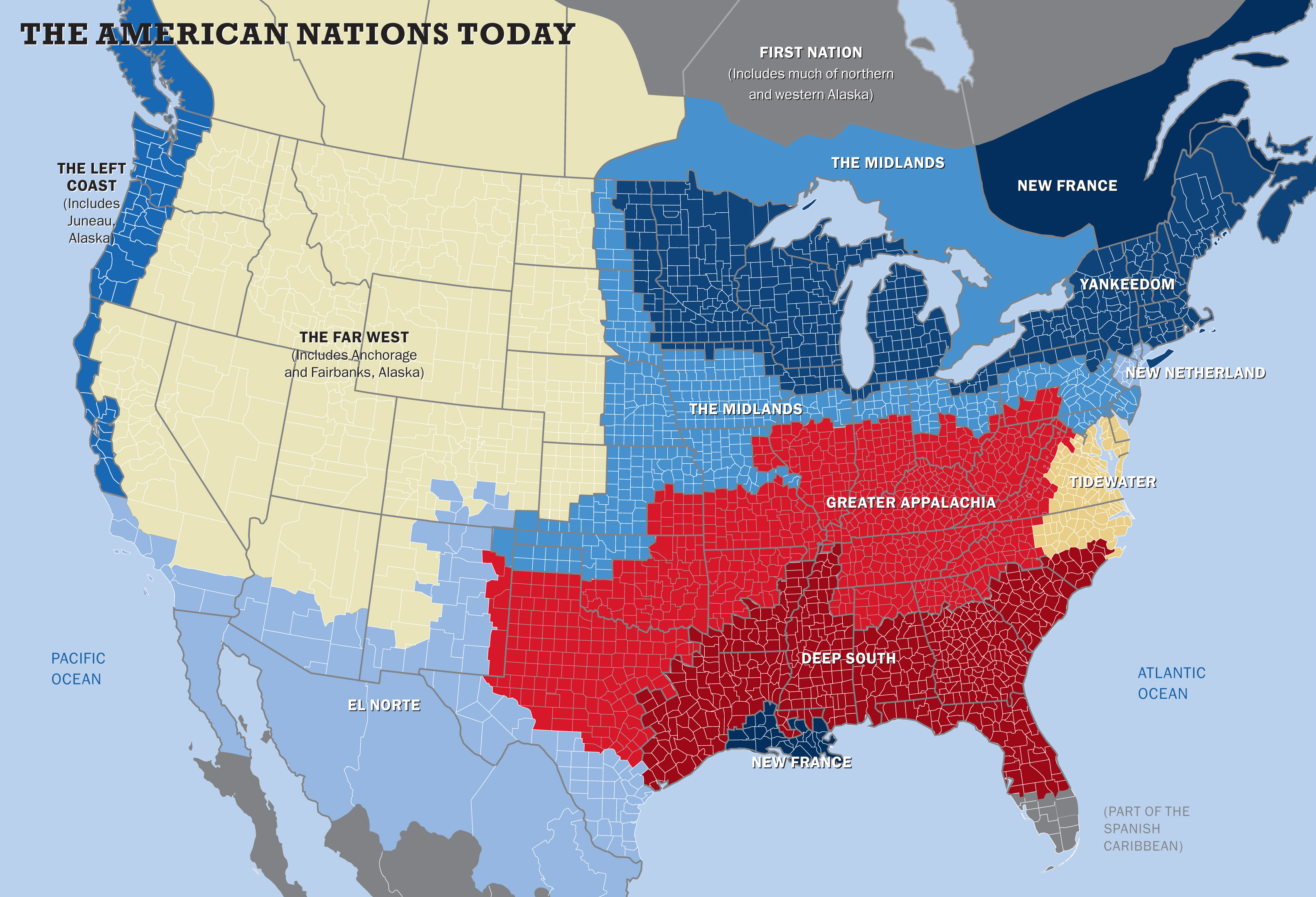
upinarms-map-largeThat’s why I found this map of the “eleven American nations” so fascinating. According to the corresponding Washington Post article, almost all of the battles in the culture wars can be explained by the lines on this map. Furthermore, the mobility of American society is causing these regional differences to grow sharper as Americans pick up and move to the places where the dominant culture best suits them.

A further explanation can be found here, where the author of the map (and the book American Nations) states:

The borders of my eleven American nations are reflected in many different types of maps—including maps showing the distribution of linguistic dialects, the spread of cultural artifacts, the prevalence of different religious denominations, and the county-by-county breakdown of voting in virtually every hotly contested presidential race in our history. Our continent’s famed mobility has been reinforcing, not dissolving, regional differences, as people increasingly sort themselves into like-minded communities, a phenomenon analyzed by Bill Bishop and Robert Cushing in The Big Sort (2008). Even waves of immigrants did not fundamentally alter these nations, because the children and grandchildren of immigrants assimilated into whichever culture surrounded them.

The thing that I find most fascinating about this map is how closely the borders of the Far West “nation” parallel the State of Deseret, first proposed by Brigham Young and the Mormon pioneers. The Mormons didn’t get along very well with Congress, and the territory was eventually pared down to the current boundaries of the state of Utah (the name “Deseret” was also replaced). But cultural boundaries cannot be declared by presidents or kings.

According to the author, the development of this region “was largely directed by corporations headquartered in distant New York, Boston, Chicago, or San Francisco, or by the federal government, which controlled much of the land.” I’m not so sure that’s the case, however. Corporations certainly became important players after the railroads crossed the country, but culturally, I would argue the pioneers had a much deeper and more lasting impact.

The Intermountain West is remarkably conservative, with Utah ranking as one of the reddest states in the nation. With the government expansion under President Obama and the Tea Party revolt in the Republican party, the politics in this part of the country have taken a decidedly libertarian turn. As issues like healthcare, gun control, gay marriage, and late-term abortion have each swept the nation in turn, my positions have changed to reflect the libertarian attitudes of the culture in which I live.

In 2008, I considered myself “agnostic” as far as politics were concerned. Perhaps there was a greater truth out there as far as politics were concerned, but I wanted nothing to do with it. Now, however, I believe very strongly that individuals and families should be free to live their lives as they see fit, without being subject to Leftist schemes to redistribute their wealth or bloated, self-serving government that overreaches its constitutional bounds.

I think this view would resonate very deeply with the pioneers. They came to the West to practice their religion freely, and emphasized self-reliance and thrift. Their industriousness was a means of guarding their independence from the governments that had oppressed them in the east, and continued to oppress them as they sought to build their Zion. Though they could be quite collectivist at times, it was local and voluntary, a far cry from State-enforced socialism. And while they cared for the poor and needy, they did all they could to keep them from becoming dependent on welfare.

These are interesting times we live in, and interesting cultures we hail from as well. As I look back on my own pioneer heritage, I can’t help but look forward as well. The “shoot and be damned” independent streak of my ancestors is still with me today, and I have no doubt that pioneer spirit will continue to guide me in the future.

Streamlining

About a month ago, I decided to make some changes to my writing process. I’d noticed that a lot of time was passing between book releases, and that even though I was writing almost every day, there wasn’t much to show for it.

My old process tended to go in one of two ways:

ONE

“I have the coolest idea for a story! Ima drop everything and write it now!”

Writes the first chapter.

“Okay, it’s not quite as cool as I’d imagined, but I can work with this.”

Writes another chapter or two.

“Hmm, this story is starting to have issues. Maybe it’s not as cool as I thought it was.”

Gets writer’s block for a couple of days. Struggles to do anything productive.

“Dammit, why isn’t this story coming together? I should be doing 2k words a day, but I can barely manage 500. If this story is really that bad, then maybe it’s not the project I should be focusing on right now. Maybe I shouldn’t even be writing it at all.”

Gets discouraged and takes off a couple of days.

“I have the coolest idea for a totally different story! Ima drop everything and write it now!”

TWO

“It’s been forever since I actually finished anything, so I am going to stick with this project until it is DONE.”

Writes productively for a week or two.

“Yes! The story is coming together just like I knew it would!”

Reaches a difficult scene.

“Why am I not as productive as I was last week? I can do better than this! Words, dammit! Words!”

Struggles to finish the difficult scene. Loses all momentum and enthusiasm.

“Okay, that was pretty tough, but at least it’s finished. I am really, really, really excited about this random shiny story idea that came to me yesterday, but I have to stick with my current work in progress until it is DONE.”

Procrastinates for hours every day. Watches in dismay as productivity falls.

“WHAT THE HELL IS WRONG WITH ME??”

Tries for weeks to regain enthusiasm for the project. Invariably fails.

“Maybe I should work on something else.”

It went on like this for the better part of a year, which is why I haven’t published anything for the last six months (until Friends in Command, that is). And honestly, it’s not a lot of fun. When you feel like you should be more productive but don’t seem to really be getting anywhere, it’s very easy to lose touch with the passion that made you want to be a writer in the first place.

So back in May, while hiking in the mountains, I thought about it for a while and asked myself: what is the 20% of what I do that produces 80% of the results?

The answer, interestingly enough, wasn’t “butt in chair, hands on keyboard.” I’d been doing that for months, and all I had was a dozen unfinished projects to show for it. For me at least, merely showing up to work is not enough to produce results.

In 2014, one of my resolutions was to publish a new release every six weeks. I didn’t keep that resolution perfectly, but I did keep a regular release schedule right up to the holiday season. At that point, I ran into some troubles with Friends in Command and pushed the publication date back (which in retrospect was definitely the right thing to do). I abandoned my release schedule (which was not the right thing to do) and fell into the traps I mentioned above.

When I write without a goal beyond a daily word count, I tend to spin my wheels. In contrast, when I write with a set of goals for a project timeline, such as deadlines for finishing the first draft, sending it out to first readers, making revisions, and preparing the finished project for publication, I tend to get stuff done.

So I streamlined my writing process by giving myself more structure: a WIP log with writing deadlines and publishing schedules. And this is how it works now:

ONE

“I’m really excited about my next project! I’ve been thinking about it for weeks, ever since I put it on the schedule, and now I can finally work on it! Yay!”

Writes for a week. Gets the coolest idea for a totally different story.

“I have the coolest idea for a totally different story! Ima put it in the WIP log and schedule it for… let’s see… two months from now. That should give me something to write while I’m getting project X ready for publication.”

Continues to work on current WIP.

TWO

“It’s time to finally finish this thing so that I can publish it six months from now.”

Writes productively for a week or two. Reaches a difficult scene.

“This story is not coming together, and my deadline is coming up. I don’t know if I’ll reach my deadline. I’d better swap places with this and project Y in the publishing schedule to make sure I have something to publish.”

Keeps writing anyway. Begins to lose momentum and enthusiasm.

“Well, I’m not going to finish this project by my deadline. However, I have enough time that I can take another shot at it six weeks from now, after finishing project Z. I’ll write what I can by the deadline, then box it up so that I can approach it with fresh eyes when the time comes.

Writes until the deadline and sets unfinished project aside. Starts next project with renewed enthusiasm.

In June, I spent most of my time working on Captives in Obscurity (Sons of the Starfarers: Book V). I hoped to finish the project by the first week in July, but I hit a really difficult scene about midway through. Instead of forcing myself to stick with it, though, I pushed on until the deadline and left it unfinished so that I could pick up the next WIP on the schedule.

I think that was the right thing to do, because changing it up has helped to keep things fresh, both for Captives in Obscurity and my current WIP, Heart of the Nebula. Instead of bringing heaps of baggage to the next project, I’m starting clean, and things are going quite well. With luck, Heart of the Nebula should be up for pre-order in September and published over Thanksgiving week. As for Captives, I’ll come back to it in September with fresh eyes, which will not only help me to fix what was broken, but finish the first draft in a few weeks, rather than taking months to agonize over it.

So that’s what I’ve been up to. Hopefully it will lead to lots and lots of books in the coming months and years!

My take on the Sad Puppies

There’s been a lot of mud-slinging in the past few months regarding the Sad Puppies, and it’s increasingly difficult to navigate the SF&F side of the internet without getting caught up in it. I’ve been reluctant to weigh in publicly on Sad Puppies 3, simply because I’ve been dissapointed to find that authors whom I otherwise love and respect saying things that I find reprehensible. As Mark Twain so famously said, better to keep your mouth shut and appear stupid than to open it and remove all doubt.

That said, I think we’re fast approaching the point (if we haven’t passed it already) where neutrality and silence are just as contemptible as outright partisanship. Lines are being crossed, and people are being bullied and defamed. In such an environment, I would rather have people know where I stand than to try to pretend that nothing is happening.

For the purpose of this post, I’m going to assume that you already know the basics about what’s going on. If you don’t, I would recommend you start by reading these two posts by Brad Torgerson announcing Sad Puppies 3 and explaining why it’s necessary, Larry Correia’s explanation for why he started the whole thing, and Eric Flint’s rebuttal to them both.

The Sad Puppies controversy is a bit complicated, and my position doesn’t fall neatly into any one camp. There are people like Brad Torgersen and Eric Flint that I respect on both sides of the controversy. That said, the people that I find toxic all fall squarely into the anti-puppy camp. They are the ones who define fandom the most narrowly, and in my experience they are the ones with the most intolerant views.

My own experience with Worldcon and the Hugos is rather limited. I attended Renovation 69 in 2011 and was actually rather struck with how small and insular the convention seemed to be. Until then, I had revered the Hugo Award as the most prestigious award in the SF&F field, and when I realized that the vast majority of readers were not represented at the con, that prestige was tarnished. But my response at the time was to shrug and say “oh well.”

I don’t say this to disparage Worldcon at all, because I enjoyed myself there and would genuinely like to attend as often as I could. But the Hugos themselves lost quite a bit of their allure, and I no longer felt it so important to participate in the voting or involve myself in them.

When Sad Puppies 1 happened, I therefore stayed mostly on the sidelines. I sympathized with Larry Correia, both because I’ve met him in person and found him to be an affable fellow, and also because we share similar political and religious views. However, I didn’t really get involved.

For Sad Puppies 2, I also mostly stayed out of it. There were quite a bit more rumblings the second year, and when the anti-puppies rubbed their victory into everyone’s faces following the 2014 Hugo, I was seriously unimpressed with their behavior (especially Scalzi’s).

So when the Sad Puppies swept the Hugo nominations in 2015, I have to admit that it felt pretty gratifying. I already knew that the Hugos didn’t really represent my side of fandom, and I’d had enough experience with the anti-puppies to see through their hypocrisy and intolerance. Then the SF&F corner of the internet exploded, and things became truly popcorn-worthy.

Which brings us to where we are today. In some ways, I still feel like I don’t have a dog in this fight. I don’t have a membership to Worldcon 2015, I have no particular interest in either killing or saving the Hugo Awards, and don’t really have any aspirations to win a Hugo or any other major awards for that matter. As a self-published indie author, my readers are my greatest reward.

But in another sense, I cannot avoid having a dog in this fight. Science Fiction and Fantasy is my livelihood, and the Sad Puppies controversy affects the very core of my field. Authors whom I look up to and respect have become targets of some of the worst smear tactics, and if no one stands up against these bullies, things are only going to get worse. The lines have been drawn, the wagons have been circled, and my voice, however small, is needed in this hour.

With that out of the way, here is where I stand:

I believe that everyone who loves science fiction and fantasy has and should have a place in this genre, no matter how reprehensible I find them or how vehemently I disagree with their views.

I believe that SF&F authors flourish best when there is no single dogma, political or otherwise, that dominates the field. Those who enforce their brand of social justice through bullying and smear campaigns are anathema to everything that makes science fiction and fantasy great.

I believe that TRUE DIVERSITY in the SF&F field is good and worth working toward. TRUE DIVERSITY includes women, people of color, other ethnic minorities, and people of every gender and sexual orientation. It also includes Republicans, Conservatives, Libertarians, residents of the “flyover states,” and devout practitioners of every faith, be they Christians, Mormons, Muslims, Jews, Buddhists, Sikhs, or supplicants at the temple of Athe.

I believe that sexism that is directed against men is still sexism.

I believe that racism that is directed against whites is still racism.

I believe that it is impossible to defeat racism and sexism through racist and sexist means. Those who attempt to do so are bigots and hypocrites of the worst possible stripe.

I believe that no one is entitled to any award. True recognition is earned, not bestowed.

I believe that books should be judged solely on the merits of the story itself, and not on the merits of the author.

I believe that readers should be free to read whatever they want, and not have to answer to anyone or feel guilty for their reading choices.

I believe that the Sad Puppies have legitimate grievances, and that they have done nothing wrong or dishonorable by pushing their Hugo slate. I’m not sure if I can say the same of the Rabid Puppies, but to the extent that they’ve played by the Hugo voting rules, I can’t say that I hold that against them.

I believe that people should be judged by their own words and actions, not by what others say about them.

I do not believe in guilt by association.

I do not believe in unsubstantiated accusations of racism, sexism, homophobia, or affiliation with the National Socialist German Worker’s Party or any of its ideological offshoots. In today’s climate, those are all four-letter words as far as I’m concerned.

I do not believe that gatekeepers add anything of value by excluding people from the field.

I do not believe that fandom is an exclusive club.

I do not believe that the Hugos are representative of the entire field, nor that any single award is or should be.

I do not believe that the Sad Puppies are out destroy all that is good in science fiction and fantasy (or the Rabid Puppies, for that matter). I doubt that any single faction could accomplish that even if they wanted to.

Above all else, I respect my readers. I am grateful for them. I would not be able to do what I do without them.

I understand that many of my readers may not share my personal views. I also understand that it is possible to respect someone and still disagree with them. I hope to always be worthy of respect. But whether others choose to respect me or not, I must live in such a way that I can always respect myself.

Thoughts on Clean Reader

cleanreaderIn case you haven’t heard, there’s a new app in the book world that is stirring up quite a bit of controversy. It’s called Clean Reader and it basically goes through an ebook and filters out the profanity, with settings for “clean,” “cleaner,” and “squeaky clean.” It was designed by the parents of a teenager who expressed dismay at finding profanity in an otherwise clean book.

The response from authors has been vociferous. Chuck Wendig (WARNING: Chuck uses so much profanity, he probably deserves a Clean Reader filter setting of his own) predictably came down hard against it, as well as Joanne Harris, the author of Chocolat. Over on KBoards, there’s an ongoing thread of indie authors slamming it as a denial of artistic expression, as a copyright violation, as malicious censorship—basically, the whole gamut. Interestingly, though, Cory Doctorow came out in defense of it.

Personally, this app reminds me a lot of CleanFlicks, a movie rental place here in Utah that edited out objectionable content such as sex, violence, and profanity. I watched the edited version of Zombieland while I was in college, and while I enjoyed it, it was… short. CleanFlicks did a lot of business, right up until the US Supreme Court shut it down.

While I can see why some writers would hate this app, I actually sympathize more with the readers. Living in Utah, I know a lot of people (some of them in my own family—hi Kate!) who are exactly the kind of people for whom Clean Reader was made. And much like Cory Doctorow, I think that their right to control their own reading experience trumps the writer’s right to freedom of expression.

The act of reading is fundamentally a collaborative experience. Until someone opens a book and reads it, that book is just symbols on a page, or bytes of data on a storage device. Meaning is only generated through the act of reading—in a very real sense, the story is created by the reader just as much as by the writer. As much as we writers like to think of ourselves as free to write whatever we want, without readers, that freedom counts for very little. And that’s exactly the way it should be.

A lot of writers are making fun of Clean Reader on the basis that the very premise is flawed—that filtering out profanity won’t do anything to clean a fundamentally dirty story. But while that’s true of some books, I do think there’s a middle ground where the app can give some value.

For example, my first novel Genesis Earth is a mostly clean science fiction adventure romance with a few tense moments where the characters use a mild level of profanity. As a writer, it didn’t feel right to have my characters say “darn” instead of “damn,” or “crap” instead of “shit.” Sanitizing the book on that level would have kicked most readers right out of the story. But if a reader who is sensitive to that use of language wants to read a filtered version of Genesis Earth, the story is not going to be fundamentally changed by filtering out those words.

Probably the biggest objection to Clean Reader is that it enforces or promotes a censorship regime that many writers find objectionable. Of course, most of the people who make that argument probably have no idea what “censorship” really entails, just like the people who throw out accusations like “socialist,” “sexist,” “racist,” etc. But putting that can of worms aside, is it right for people to use apps like this—say, parents of young children—to control what other people read?

I am a diehard libertarian, but I actually think that beneath a certain age, parents do have a right to censorship. As legal guardians of their children, parents have a right and a responsibility to raise them as they see fit. If you don’t allow parents to censor what their children are exposed to, then you’re basically saying that society as a whole should raise them, or (God forbid!) the government. I think that’s a horrible idea. Children should be raised by the people who are closest to them, and responsible parents/guardians should be free to raise their children as they (and only they) see fit.

So I’m actually rather supportive of the Clean Reader app. I personally wouldn’t use it, either for myself or for my children, but if other readers do then I have no objection to that. Writers should be free to write whatever they want, and readers should be free to read whatever they want, however they want to read it.

Blogging vs. journal writing

So as you may have noticed, I generally blog a lot less nowadays than I did just a couple of years ago. That doesn’t mean I don’t blog at all, or that I don’t value keeping a blog, but it’s just not something I do as frequently as I used to. I’ve been wondering why that is—about what changed to make me blog less frequently. And I think I’ve found the answer.

Last year, one of my new year’s resolutions was to keep a detailed weekly personal journal. All of my other 2014 resolutions eventually fell by the wayside, but that was the one that I actually accomplished. In fact, towards the end of the year, I switched from keeping a weekly journal to keeping an almost daily journal. By December, I had written 169,000 words—more than four hundred pages—about the personal events in my life for the year 2014 alone.

I’ve been a journal writer ever since elementary school, but when I started this blog back in 2007, I kind of took a break from that. My reasoning at the time was that my blog was my journal, and while I recognized that there were some parts of my life that I wanted to keep private, I figured that those just weren’t worth writing about.

After living and studying in Jordan for a summer, I realized that there was value in keeping a private journal in addition to my blog, and I started up another one. But I kept it fairly infrequently, sometimes with months going by between journal entries. In 2012 when I went to Georgia, I had a lot more things happening in my life to write about (and a lot less access to the internet), so I kept it much more regularly. But then I came back to the States, and life fell back into a monotonous routine.

The thing that changed in 2014 was the realization that I wasn’t just keeping a journal for myself, but that I was keeping it for my children, grandchildren, and others who would come after. When I was a teenager, journal writing was an act of self-discovery, and for that reason it was much more private. As an adult, though, I already have a pretty firm sense of who I am, so the self-discovery is much less important. Keeping a personal historical record, though, both for myself and for my family, is much more important to me.

Even though I’m not just keeping a journal for myself anymore, there is still a lot of sensitive information in there that really shouldn’t be available for public consumption at the present time. That’s especially true now that my blog is less of a personal project than it was when I started it. Now that I’m a professional writer, I’m a lot more careful about what I post here. I still try to be honest and genuine, but I’m probably not going to blog about, say, my romantic relationships or personal spiritual experiences.

It’s weird, though, because the roles are now reversed. Back in 2007, I felt free to blog about anything but didn’t know what to write about in my journal. Now, I know exactly what sorts of things to write about in my journal (I’ve already up to 42,000 words for this year) but have no idea what to write for my blog. And that’s the main reason why I haven’t been posting quite as much.

So for those of you who do keep up with this blog, what sorts of things do you want to hear about? I’m happy to post weekly updates on my writing, though I’m worried it might get tedious after a while (contrary to popular belief, writing is one of the most boring professions on the planet). Do you want to hear more of my thoughts on current and political events? More reflections on life as an indie author? More insights about the worlds and characters in my books? More tvtropes?

This blog is not going anywhere, so don’t worry about that. But it’s going to change as I figure out exactly what I want to use it for.