More thoughts on indie publishing

Since my last post on indie publishing, I’ve been thinking a lot about this subject.  I haven’t decided to take the plunge into self published ebooks yet, but I have decided to make some changes in my writing and my career strategy, in order to position myself more favorably if/when I choose to do so.

Basically, my new strategy is something like Japan or Saudi Arabia’s approach to nuclear weapons: they don’t have an explicit nuclear program (since that would violate the nuclear non-proliferation treaty), but they have gathered the equipment, resources, and expertise together so that if they decided to go nuclear, they could do it in a year or less.

First, though, I attended Brandon Sanderson’s class lecture this Thursday, in which he had some very interesting things to say about ebooks and the publishing industry.  This was part I of his “how to get published” lecture, and here are some of the more interesting points he made:

  • Almost all the indie writers who are making it big have at least one loss leader ($.99 or less) on their list.
  • No one really knows whether indie publishing will be viable for large numbers of writers, or whether authors like Amanda Hocking and Joe Konrath are outliers.
  • Successful indie published books are typically:
    1) short (70k to 80k words)
    2) written in a pulp genre (thriller, romance, paranormal, sword & sorcery, etc)
    3) promoted very well through social networking
  • We have not yet seen any indie successes in epic fantasy, young adult / middle grade, historical fiction, or non-fiction.
  • The produce model vs. unlimited shelf space argument for going indie doesn’t apply as much to science fiction & fantasy as other genres, because:
    1) sf&f stays on the shelves in bookstores longer than other genres
    2) sf&f series grow better with a big push on the first book
    3) sf&f makes a lot of money on hardcover, unlike other genres

A lot of these points tend to mesh with what I’m hearing from my other sources–and Brandon really represents the last of the successful writers to make it big on the old model, before the ebook revolution began to take off.  He doesn’t make as big a deal on the current 25/75 split on net ebook sales as I would make, but then again, he’s making most of his money through print.

So anyways, here is what I plan to change about what I’m doing in order to better position myself to best take the ebook plunge, if/when I decide to do so:

1) Write at least 2 polished novels per year

Kris Rusch and Dean Wesley Smith make very good arguments about how being able to write well quickly is a huge asset for a writer these days.

There are many good reasons for this:

1) Writing faster gives you more practice with craft, which tends to improve quality.
2) The best way to promote  your books is to constantly write new books.
3) The limited shelf space argument against writing quickly is now moot with ebooks.

In particular, I want to increase my writing speed in order that I can have a larger list to put out if/when I decide to go with indie publishing.  It’s much harder to be successful if you’ve only got one book available for sale; if/when I decide to take the plunge, I want to have at least three.

So far this year, I’ve finished one (Bringing Stella Home), but that’s because it was already sitting in the queue and only needed a quick touch up.  I would like to get Worlds Away from Home polished before the end of the year, and possibly one other project, such as Edenfall.

2) Reduce production time to as close to one year as possible

Right now, it takes me on average about two years to write a polished, salable novel.  That’s not a problem, because I have a lot of projects in the queue, but it’s not as fast as I would like.  I wrote Genesis Earth and Bringing Stella Home while I was still a journeyman writer, figuring out my craft.  I should be able to produce a lot faster.

Towards that end, I’m going to try to get Edenfall finished and polished within a year.  Since it’s already March, that might mean getting it polished by February of next year, but I still want to try.

My biggest weakness is first drafts; I always tend to get stuck midway and drop the project for a while before I feel ready to finish it.  That’s something I would like to change.  Then again, that might just be part of my writing process, and shouldn’t be forced.  However, I certainly could go through my revisions much faster.

3) Write out the direct sequels while the first book is still unpublished

Previously, I thought it was a bad idea to write out all the books in a series or trilogy before the first one is ever picked up.  After all, a rejection from a publisher on the first book is a rejection on all the other books in the series as well.  Using this reasoning, it was much better to write the first book of another trilogy, in order to maximize how much I could submit at any given time.

With indie publishing, however, it’s much better to release the whole trilogy all at once, so that readers who finish the first book can immediately pick up the others.  Again, the paradigm here is that the best way to sell books is with other books; if they loved the one, they’ll buy the others, especially to find out what happens next.

Of course, the best model is probably to have an open series with several indirect sequels with recurring characters in the same world.  With the Gaia Nova books, that’s exactly what I plan to do: Worlds Away from Home is set in the same universe as Bringing Stella Home, but with different characters and different story arcs.

However, Genesis Earth has serious trilogy potential, and with Edenfall I’ve decided to actually write the other books.  If/when I decide to take the plunge, I want to be able to release at least the first two books in that trilogy at the same time.  In fact, Genesis Earth is perhaps the biggest reason why I’m thinking so seriously about going indie, but that’s a subject for a whole other post.

4) Experiment with pulp genres such as space adventure stories

When Brandon said that the pulp genres tend to do better, I wasn’t sure whether that includes what I write.  I write primarily science fiction, but not the kind of stories you’d read only for entertainment and promptly forget once you’re finished.  If anything, I want to write more like Ursula K. Le Guin, whose stories are so meaningful they stick with you long after you’ve finished them.

Then again, there tends to be a lot of overlap in science fiction between the thoughtful, meaningful stuff and the pulps.  Ender’s Game and Starship Troopers immediately come to mind as awesome, entertaining stories that also have a lot of depth.  In his lecture, Brandon made it clear that “pulp” does not necessarily conflict with high art–just that the primary purpose of the story is to entertain.

I can live with that–and I actually have several story ideas that would translate well with the pulp mentality.  I’d like to do a novel (or a series of novels) with Danica from BSH and her mercenary team, perhaps as a sort of origin story for Roman, Anya, Artyom, and the others.  I’d like to revisit the Hameji as well, with a sort of “Ain Jalut in space” involving Sholpan’s son (BSH was basically the Mongol conquest of Baghdad in space).  I’ve already started an “Odyssey in space,” as told from a female Telemachus character–that’s To Search the Starry Sea.  All of these are, at their core, space adventure stories, and might translate well as pulps.

5) Commit to releasing one book every 6 months if/when I take the plunge

This is related to the first strategy on the list, but it’s more of a business plan than a personal writing goal.  Basically, if/when I take the plunge, I want to:

1) have at least 3 finished, polished books to put out at first,
2) know that I can put out one book every six months at least.

This not only means developing a backlist, it means doing some soul searching as a writer to find out how difficult it is to keep up with this pace–and adjusting my writing habits accordingly.  I’m optimistic that I can, but it’s something of a paradigm shift, and I want to make sure I’ve made that shift before I take the leap.

Anyhow, these are my thoughts on how to alter my current writing strategy.  I haven’t yet decided to go indie, but when the time comes, I think that these things will help me to maximize my potential if/when I decide to do so.

Of course, what do any of us really know?
Thoughts on traditional vs. indie publishing

In case you didn’t know, the publishing industry is in the throes of a major revolution.  With the growing popularity of e-books and the collapse of distribution channels and chain bookstores such as Borders, traditional business models are proving simply untenable.

I’ve been perusing several internet sources to make sense of all the craziness, among them Joe Konrath’s blog (a midlister who is now making six figures via ebooks), Writer Beware (which still emphasizes caution with self-publishing), the Adventures in Sci Fi Publishing podcast (which has recently started interviewing several successful indie authors), Dean Wesley Smith’s blog, and his wife Kristine Rusch’s series on the changing business of publishing (which I highly recommend–seriously, if you read nothing else, read this).

Some of these people predict the imminent collapse of the big publishers, and have selected (ironically enough) 2012 as the predicted date of the collapse.  Others agree that many traditional publishers will collapse, but believe that most will survive and evolve into something different (the “dinosaurs evolved into birds” theory vs. the giant meteor).  All of them agree, however, that whatever new form the publishing industry takes, ebooks will dominate.

For someone in my position–a budding author looking to break in in the next few years–all of this is simultaneously thrilling and unnerving.  Should I venture into indie publishing and risk having my work lost in the flood?  Or should I spend the next five years toiling endlessly to break into traditional publishing, only to see my rights get tied up in a bankruptcy?

Thus far, my strategy has been to a reputable agent, or a new agent at a reputable agency.  I’ve been holding back from submitting directly to publishers, out of fear that getting rejected from publishers would make it difficult for an agent to do her job.

That was the orthodox model under the traditional system, when the big six (HBGUSA, HarperCollins, McMillan, Penguin, Random House, and Simon & Schuster) dominated the industry.  For the time being, they still dominate, but I’m wondering whether it’s such a good idea to go with them.

The big six have been swallowing up independent presses and imprints for years, and as a result, they’re now major corporations.  As such, they aren’t looking for moderate midlisters who sell consistently–those kinds of writers would drive them bankrupt.  No, in order to support their corporate expenses (like multimillion dollar office space and executive bonuses), they need bestsellers like Stephen King or J.K. Rowling.

Trouble is, they often lose when they gamble on new writers, which means that the next bestseller needs to be even more spectacular than the first.  And with the ebook revolution underway, they’re getting desperate.

Agent Kristin Nelson recently lambasted McMillan for claiming rights to all “derivative works” in their new boilerplate (a bad faith move comparable, IMO, with the worst scams on Writer Beware), while Kristine Rusch recently noted how the big publishers are becoming increasing hostile to new writers.  Advances as low as $1,500, or single book only contracts, or nebulous clauses that ensure publishers keep ebook rights for decades, even with the author barely making $20 per year on royalties?

How am I ever going to make it full time in a business like this?

Well, according to Joe Konrath, every day my books aren’t up as indie published ebooks, I’m losing big money.  His views are pretty extreme, but he makes a very compelling argument, especially for someone in my position.  Yes, there will be a flood of crap, but good stuff inevitably rises to the top.  Yes, sales start out slow, but that’s simply part of the new model–and they build over time.  For a minimal investment of time and money, I could launch my books and start earning an income from them now.

But money (such as I may or may not make as an indie) isn’t everything in this business.  At this point in my career, gaining prestige and making a name for myself is just as much if not more important than income.  Granted, I can build some prestige through indie publishing if my books sell enough, but I don’t want to have to depend on that, especially if it takes years for sales to build.

For the science fiction and fantasy genres, the professional standard is set by SFWA, or the Science Fiction & Fantasy Writers of America.  In order to become a member, you have to have your work published in one of their approved markets.

Last night, I did some research on those publishers.  Of those that specialize specifically in science fiction and fantasy, seven of them are affiliated with the big six (Tor, Ace, Baen, Bantam Spectra, Roc, Del Ray, and Orbit).  Thirteen others are independent presses that might conceivably be interested in my work.

Now, just because a science fiction and fantasy imprint is affiliated with the big six doesn’t mean it’s a bad idea to submit to them.  Tor, after all, is the undisputed king of the genre–the company has won the Hugo for “best publisher” every year since 1988.  I also tend to think (though I have no data to support it) that the bad contracts are more common with mainstream fiction.  Science fiction, after all, has always been small potatoes to the rest of the publishing world.

But precisely because science fiction is so small, I’m starting to wonder if it’s a bad idea to submit to agents first.  Agents go where the money is–in LDS publishing, virtually every author is unagented.  While there’s still a national market for science fiction, it’s definitely a small one, and all the agents I’ve found always tend to list it as an afterthought, focusing instead on YA/MG, thrillers, romance, or the ubiquitous “commercial fiction.”

In other words, I think that part of the reason agents have been so reluctant to pick me up, even after showing some interest, is that they just don’t see enough money to justify taking a risk on me.  Granted, it may also be the quality of my work, but the bulk of the rejections I’ve accrued seem to point more to subjective factors, like the agent’s personal tastes (the ubiquitous “I don’t feel I’m the right agent for this work”).

Which is not to say that I don’t think it’s a good idea to get agent–not at all.  Even Amanda Hocking, who has turned down several big publishing deals, has an agent.

No, what I’m saying is that in today’s market, it might be easier for a science fiction writer to attract an agent by getting picked up by a publisher, rather than attract a publisher by getting picked up by an agent.

And, of course, the only big reason to do any of this is to make a name for myself.  At some point, I will go indie, even if only with a few of my works.  The revolution has arrived, and I’d be a fool not to capitalize on it–the only question is when, and how.

(images from Postsecret)

The technological singularity: a thing of the past?

One of the latest trends in science fiction is the concept of the technological singularity — the point in history at which technological advances occur so rapidly that we can no longer learn the new stuff fast enough to keep up with it.
I hear a lot of people talk about this at cons, and I’ve read/listened to quite a few stories about this concept.  Basically, these stories posit a world where science has become a new magic, and our world has been transformed beyond all intelligible recognition.

However, a recent post on the excellent Rocketpunk Manifesto blog made me wonder if we’ve already passed the point of singularity in our own society.  The post basically asserted that the period 1880 to 1930 saw so many sweeping technological advances that the world in 1930 would have been unrecognizable to a person from 1880, whereas our current society would still be intelligible to a person from 1930.

This made me wonder: how far into the singularity have we already come?  How much of our technological infrastructure has become so advanced that the common man lacks the capacity to comprehend it?

Think about it.  Fish around in your pockets and pull out your phone.  Do you understand how it works well enough to take it apart and put it together again?  To rebuild the device from parts?  Do you own the tools and machinery to construct the parts from which it is made?

How about the building in which you currently find yourself?  Do you possess the knowledge to build a comparable structure that performs the same functions?  That keeps you sheltered and provides the same light, heat, electricity, and internet connection that you now enjoy?

There was a time, not too long ago, when people would move out to the wilderness and homestead land by building their own homes from available natural resources.  If you needed to build your own house, as so many people used to do, could you do it?

How about your means of transportation?  If necessary, could you take apart your car and rebuild it again from the ground up?  Could you perform basic maintenance on it if you needed to?  How many of us can change our own oil–and how many of us are dependent on others for such a simple service?

Or what about the things we take most for granted–our understanding of the way the universe works.  Do you really understand the principles of physics?  Do you comprehend how electricity or magnetism really works, or are you still thinking in overly-simplified terms like electrons flowing through a circuit like water?  Even the most intelligent physicists can’t reconcile electromagnetism with Newtonian physics, so what makes you think you know so much?

How much of what we think we know is really just an illusion, meant to keep us pacified and docile?  To give us a false sense of security–that someone is in control, so we can rest easy?  Does anyone REALLY understand 100% how the economy works?  Do any of us know who or what is really in charge anymore?  Have we unwittingly handed over the reigns of control to some digital algorithm so basic to our newly networked way of life to be practically invisible?

Looking at how few of us are truly self-sufficient, and how much power we’ve ceded to forces beyond our control, our modern society seems so delicate and fragile.  Can anyone REALLY say that our society is not in danger of falling apart?  That our way of life is not an unnatural and unsustainable aberration?

Anyhow, those were some of my initial thoughts.  The more I compare the science fiction of the past with the reality of the present, the more predictions I see coming true in the most unexpected of ways.  The singularity may have less to do with uplinked consciousnesses and more to do with Google’s SEO algorithms than we are comfortable admitting.  And realistically, the light bulb may prove to be more revolutionary than anything Apple has ever or will ever produce.

World Fantasy 2010: Day 2

Wow, what a tiring day.  I feel drained, mentally and physically, and I didn’t even spend all that much time at the parties tonight.

I got started a bit early, prowling around the book-swap table, where I was rewarded with some books that look really good.  If you know what you’re doing, you can totally get the price of your admission ticket in free books (and then some).  I packed super light for that exact reason.

The convention started out with an awesome panel titled “Fantasy Gun Control,” where the panelists discussed why fantasy tends to favor swords over guns, even though guns have existed since the 1300s.  Funniest quote from the panel: Walter Jon Williams asked what if Samuel L. Jackson was one of the Defense Against the Dark Arts teachers from Harry Potter, and Charles Gannon quipped “do I have to get magical on your ass?”

The other panel I attended was “The Tension Between Art & Commerce,” an excellent panel which very quickly evolved into a cage fight between Nancy Kress and her publisher, Tom Doherty.  It basically went something like this:

Tom: I don’t think there is any tension; the best art always sells the best.

Nancy: No way!  Just look at Danielle Steele: her writing is CRAP, yet she sells like crazy–and that’s the norm!

Tom: But true art endures beyond its time and sells much better over the long run.  After all, just look at Homer and the Iliad.

Nancy: Homer? Are you serious? He’s been dead, what–2,000 years?

Tom: Yeah…but my point is, if you’re a writer, you need to write what’s in your heart and not chase the market.  If you do try to chase the market, your writing will be crap, AND it won’t sell.

Nancy: True, but what about my apocalyptic novel about a plague that turns domestic dogs feral?  I got four rejections that all said: “this book is great, but it would offend dog lovers so much that we can’t publish it.”

Tom: Well, those were just stupid editors.

Nancy: Uh, Tom…one of those was from your publishing house!

Of course, those aren’t exact quotes, and Nancy was very quick to make it known that she loves Tom and appreciates him for publishing so much of her work, but that was more or less how it went.  It was hilarious.

At the  same time, the panel was quite useful as well.  Everyone mentioned how a writer’s willingness and ability to learn the craft and accept criticism is key–especially after getting an editor.  Without this capacity to learn, aspiring writers will almost never succeed, whereas those who have it have a chance.

The rest of the time I spent hanging out and shmoozing with various people.  I interviewed both Dan Wells and Peter Ahlstrom for the Mormon Artist article on BYU’s “class that wouldn’t die,” and those interviews went very well.  Those two guys are seriously awesome–way down to earth and easy to talk with.

I also pitched to a couple agents, and I think it went very well.  For one of them, I thought I saw her eyes light up as I described the characters in my novel from last year, Genesis Earth.  It might just be wishful thinking, but her response was enough to convince me that I need to give that story a thorough revision and send it out to her before the end of next month.

I worry, though, that there’s not as much demand for the kind of fiction I write.  My writing falls very solidly into science fiction (space opera, to be more specific), but everything I see here at the con is fantasy–epic fantasy, urban fantasy, paranormal, steampunk.  No science fiction, except from a couple small presses.  Just fantasy.

In the art vs. commerce panel, Ginger Buchanan claimed that science fiction was never a popular genre–that the popularity was all due to a handful of specific writers and a handful of specific works.  I’m not sure I agree with that, but it is a bit discouraging.  Speculative fiction is a fairly niche corner of the publishing world to begin it, and to see and hear people within that niche treating science fiction as ANOTHER niche…it doesn’t bode well for someone who wants to make a full time living writing it.

But then again, maybe my stuff is good enough that it’ll find a home anyways–and not just a home in a small press, but with a big enough publisher that I can actually be a full time writer.  I don’t hold any illusions about my books making me fabulously rich and famous or somehow spawning a new sub-genre unto itself, but I do think my writing is good enough that I can shoot big and hope to get somewhere–perhaps even expect it.  I don’t know, but I feel that the hope is justified, at least.

Anyhow, that’s probably more angst than you cared to read.  World Fantasy is going great, and I’m exhausted, so I’m going to hit the sack.  Good night.

What have you learned from reading science fiction?

While trolling around the new Facebook questions app, I came across this interesting question.  Unable to resist, I spent the next hour crafting my answer.

This is what I wrote:

Gosh, what HAVEN’T I learned from science fiction?

Because of science fiction, I do not fear the alien. I do not feel threatened by people of different places or cultures, but take great interest in learning from them. I look at them and love them, because I can see myself in them.

Because of science fiction, I can look out at the vast expanse of the universe and not despair because of my insignificance. I know my place within it, and can appreciate the wonders and endless possibilities all around me.

Because of science fiction, I can look at the world and know which questions to ask. I can see through the lies that society constantly feeds me, and know how to fight against them.

Because of science fiction, I can look to the future with hope. Having seen the best and the worst of all possible worlds, I know which paths to avoid and which paths to follow. With this knowledge I can inspire my fellow men, because I know that nothing is inevitable.

Because of science fiction, I have a deep and endearing love for the world in which I live. I know better what it means to be human, and knowing this helps me to take no human life for granted. I have a greater capacity to love those around me, and that is the most important thing of all.

Science fiction has enriched my life beyond measure. By constantly stretching the bounds of my imagination, science fiction has led me to more truth than any other literary genre–and not only led me to that truth, but helped me to incorporate it into all that I do. So long as I live, I will always be a reader and a writer of science fiction.

Answering this question reminded me of my interview with Shayne Bell a couple weeks ago.  In it, he talked about how rich and vibrant science fiction is as a literary genre, and how it deeply impacted his own life.  Listening to him speak, I couldn’t help but feel that I was in the presence of a great man.

I don’t think he’d be comfortable with me posting the full audio of that interview, but many of his comments will appear in the article I’m putting together for the December issue of Mormon Artist.  Between working full time and trying to finish the fourth draft of Mercenary Savior in time for World Fantasy, I haven’t had much time to work on it, but it’s going to be awesome.

What have YOU learned from science fiction?  How has it enriched your life?

Confessions of a delinquent blogger

Man, so much has been happening, but now that I’m working an eight to five job, I never have the time to blog about it.  It’s 2am and I’m running on only four hours of sleep from the previous night.  Oh well, it’s a weekend.  Here goes.

I passed the 50k mark for the rewrite of Mercenary Savior. I’m surprised how much I’m changing the draft.  I’m especially finding a lot of slow chapter beginnings and thinly veiled expository lumps–not of scene descriptions so  much as  worldbuilding.  Gotta remember the iceberg concept (to only include about ten percent or less of your worldbuilding in your story’s narrative).

I interviewed a few more people for the article on the “class that wouldn’t die.” Good stuff, all around.  I met with Cara O’Sullivan today, and she had a very interesting comment about why there are so many LDS writers of science fiction and fantasy.

In her opinion, Mormon literary culture tends to push the more talented writers into sf&f because of the extreme lack of freedom in other genres of LDS writing.  In mainstream and literary LDS fiction, there are so many expectations for the writers: for example, that the story will have a clear message, or that it will contain a certain brand of Mormon sentimentalism, etc.  In science fiction and fantasy, OTOH, there’s much more freedom; therefore, LDS writers tend to gravitate that way.

I also had a phone interview for the wilderness job last Thursday.  I think it went well, but we’ll find out at the end of the month, I suppose.  Questions that caught me off guard include: “how do you define success?” and “how would you respond to something you heard secondhand about an employee from another shift?”

Finally, I recently got hooked on an old abandonware DOS game called Princess Maker 2. It is so freaking awesome. Basically, you are the father of this ten year old girl, and you have to raise her from childhood to adulthood.

There are so many possible ways to do this: build her fighting skills and send her on adventures, build her artistic skills and have her win dancing/painting contests, build her refinement and send her to court to build her social reputation, etc etc.  There are over 70 different possible endings, including some really weird and crazy ones!

And yes, I know, it seems strange that I’d go for a game this girly–but dude, you have no idea until you try it out.  It’s like being a father, but with magic and knights and dragons and stuff!  So totally awesome!

The flipside is that I spent almost the entire day playing this game.  Yeah…still got in 2.5k words, but I was hoping to put in somewhere around 6k or 7k.  Man, I haven’t been this addicted since Alpha Centauri. Will it last?  I don’t think it will, but then again, I don’t know.  The bigger question is whether this is a game I can play in moderation (like Star Control II).  I certainly hope it is, but I don’t know.

In the meantime, I’ve got five weeks to write 70k words.  Lets go!

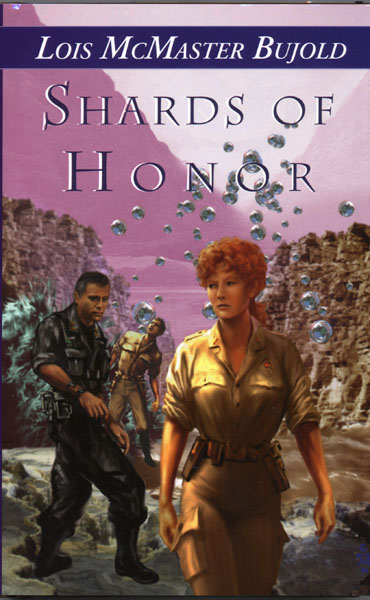
Shards of Honor by Lois McMaster Bujold

Cordelia Naismith never thought she would find the love of her life on a scientific survey to an unexplored border world, let alone that he would be a Barrayan, one of the enemy.  But Aral Vorkosigan is not just any other officer in the Barrayan Military.  He is courteous, fair-minded, thoughtful–and above all else, driven by an innate sense of honor.  To her surprise, Cordelia soon finds that she has more in common with the man than she thought possible.

But the rumors of war between Escobar, Beta Colony, and Barrayar soon conspire to drive them apart.  Though Cordelia sees Vorkosigan for the good man he is, the rest of the galaxy only knows him as the “Butcher of Komarr”–an unfortunate title which Vorkosigan does not entirely deserve.

As Barrayar goes to war and Cordelia finds herself rising through the ranks of the Betan Military, she is forced to choose between loyalty to her country and loyalty to the man she loves.  When the two are mutually exclusive, how does one preserve one’s honor while securing a degree of happiness?

I loved this book.  Unlike some romances, where the male protagonist is a complete douchbag, Aral Vorkosigan is the kind of guy I’d like to be like.  Bujold strikes an excellent balance between strong and sensitive that enhances, rather than taints, his manliness.  Besides that, Vorkosigan is extremely fascinating, with a complicated backstory and motivations that are both believable and interesting.

Though it’s technically a romance, the book reads very much like military science fiction, with deliciously tongue-in-cheek phrases like “the cadet was too young to believe in death after life” and rigorous attention to the details of military life, such as rank and chain of command.  The book definitely has enough explosions, space battles, and political intrigue to appeal to boys as well as the romance audience, but Bujold melds the space adventure elements seamlessly with the romantic elements, so that readers of either genre don’t feel left out or patronized.

There was only one thing that bothered me, and since it contains spoilers I’ll put it in black so that you don’t inadvertently see it.  To read it, highlight the text:

After Cordelia ran away from home and married Vorkosigan, why did she never think about her homeland again? You would think that as a career military officer who had dedicated her life to her country, she would at least have some lingering doubts that she’d done the right thing by running away–especially when her husband became the new Lord Regent of Barrayar! To me, this seems in-congruent with her character.

All things considered, though, this was an excellent, well-written science fiction adventure/romance. I thoroughly enjoyed it and will definitely be reading more of Lois McMaster Bujold’s work again.

Wolverton interview and more

The interview with Dave Wolverton was a resounding success!  We had a fascinating conversation about science fiction and the gospel, his latest book In The Company of Angels, self-publishing, the English 318 class at BYU and the profound impact it’s had on the LDS writing community, and much, much more.
On that, I suppose I should disclose my full reasons for going down to St George and meeting with Dave.  I’m putting together an article for the December 2010 issue of Mormon Artist, where I hope to give a brief history of BYU’s “class that wouldn’t die” and explore the impact that it’s had on both the LDS writing community and on mainstream sf&f.

The “class that wouldn’t die” was the group of students who signed up for the first English 318R science fiction creative writing class at BYU, back in ’78 (I think it was ’78…gotta check that).  After the semester was over, the students banded together through forming a writing group, which they called “Xenobia.”

They didn’t stop there, however.  As Xenobia grew and matured, the students decided to form other organizations designed to help new writers (especially sf&f writers) improve their craft and build their writing careers.  Specifically, they founded Quark, BYU’s science fiction and fantasy club; Leading Edge, a student-run magazine that gives written feedback to every story submitted; and LTUE, an annual science fiction and fantasy symposium (like a convention, only no costumes).

These organizations, as well as the 318 class, led directly to the explosion of LDS writers in science fiction and fantasy.  Several bestselling LDS authors, including Stephanie Meyers, Brandon Sanderson, and Dan Wells (among many others) can trace the launch of their careers back to this class.  In turn, these authors are having a tremendous impact on mainstream sf&f literature.

The article is slated to come out in next December’s issue of Mormon Artist Magazine, just in time for LTUE 2011 (which I hope to attend).  Right now, I’m in the research phase, meeting with some really amazing people and gathering some fascinating stories.  This article is going to be awesome.

In parting, let me share one of the more interesting things Dave said in the interview.  As we talked about all these amazing resources available for sf&f writers in Utah valley, I asked him why this happened in this community and not elsewhere.

His answer was extremely insightful: for many writers, the mentality is that once you break in, you have to close the gate behind you.  It’s something of a zero-sub game, where people horde their ideas, compete with each other to break in, etc.

Not so in the LDS community.  As Latter-day Saints, we have a deep-set mentality of helping each other and building each other up.  That’s exactly what happened with the “class that wouldn’t die”–they did everything they could to foster other writers.  The proliferation of Latter-day Saints in mainstream sf&f is a direct result of this.

That’s Dave’s take on it, anyway.  It will be interesting to hear what others think.

Oh, and FYI, Mormon Artist is 100% volunteer run and free, so when the article and interview come out, you won’t have to pay anything to read them.  I’ll certainly provide links on this blog–stay tuned!

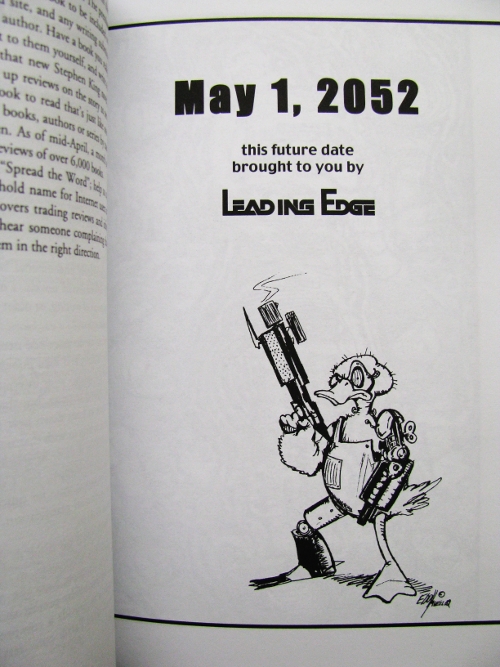
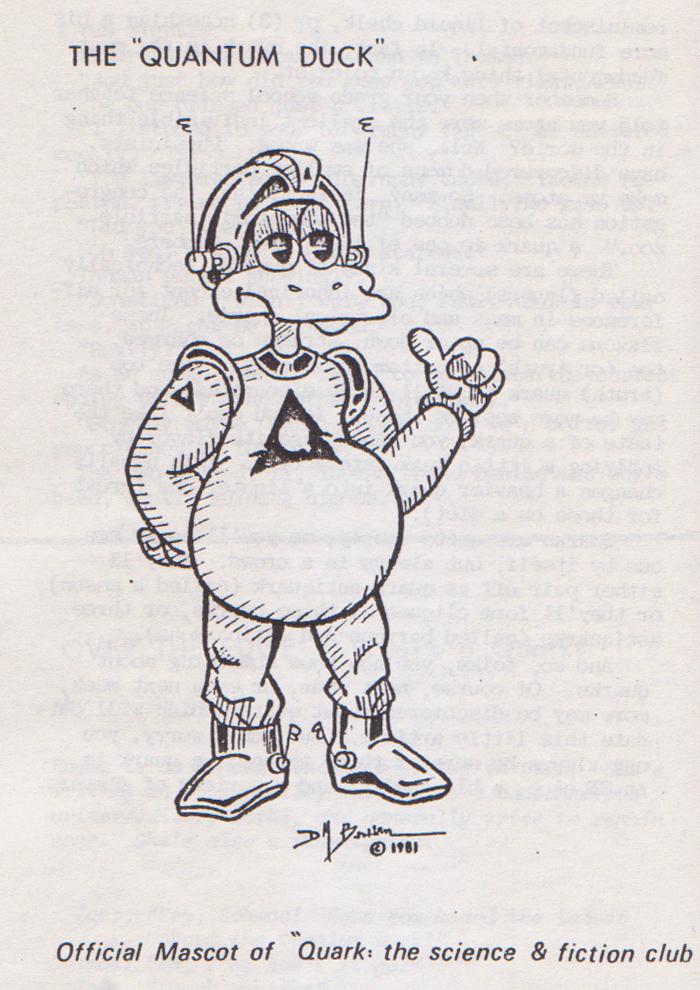
And as one final note, check out this piece of Xenobia history: the original Quantum Duck, as featured in the first issue of The Leading Edge.  Why a quantum duck, you ask?  Because that’s where the club’s name came from: a bumper sticker that said: BEWARE THE QUANTUM DUCK THAT GOES ‘QUARK,’ ‘QUARK’!

Story notebook #2

A while ago I rediscovered my first story notebook and wrote a few posts on it.  I promised I’d do the same for my other story notebooks, so here’s the next one.

For those of you who may be surprised that I’m sharing all my story ideas, let me explain why I’m doing this.  First, ideas are cheap, especially in genres as imaginative and inventive as science fiction and fantasy.  What really matters is the execution, and any two people’s take on the same idea is going to be different. For that reason, I’m not too worried about anyone “stealing” my ideas.

Second, and more importantly, I believe that the only way for ideas to grow in value is for them to be shared.  Ideas that get horded only worsen with age, because they’re not being explored. Only by exploring ideas can they come into their full potential, and the best way to explore ideas is to share them.  When we fail to share our ideas, we inevitably fail to explore them from all angles, because working alone in a vacuum, we’re so much more likely to miss something crucial.

Enough of that.  Here are the story ideas from my second notebook, roughly covering the fall of ’08, right after I finished my first novel and got back from Jordan.

How will myths arise in the space exploration age? Previously, myths formed perhaps because people had very limited means of communication and limited means of world awareness. Now, technology allows much better spread of information and science, but in isolated spacecraft, will [the conditions of isolation that lead to myth formation] return?

An interesting and somewhat complicated thought. How do myths form, anyway? I suppose that at the very least, the extreme isolation of space will lead to a proliferation of wildly different cultures and worldviews.

Just as the Catholic monks set up a monastery in Iceland, so people will go beyond the explored universe in the age of space travel and set up a religious order there.

Fascinating–and I think it runs somewhat counter to the grain, too. Most people tend to see space explorers as either adventurers or absolute believers in pure science–but what about the devoutly religious? If the Catholic monks set up a monastery in Iceland, is it possible that the monks of some other religious order may set one up on Mars, or Alpha Centauri, or Gliese?

And…that’s all I’ve got in this notebook. Sorry–there’s lots of scribbling and calculating for Genesis Earth, as well as library call numbers for books about Saladin and the Crusades, but not too much else in the way of story ideas. For more, you’ll have to wait until story notebook #3.

Thoughts on the convolutions of discovery writing

It’s been forever since I posted, so I figured I’d put something up and let you guys know what I’ve been up to.

I’m happy to say that Worlds Away From Home is going well; I wrote just under 20k this week, which is more than I’ve written in a long time.  I hope to keep a steady 15k to 20k for the next three weeks as I finish this draft.

I think I’m through the roughest parts (famous last words, right?), and I’ve got a fairly clear idea where I want to take this.  That is, I have a target ending that’s both specific enough to give me direction and vague enough to give me some flexibility.  If I’m doing things right, I expect these characters will surprise me before the end.

When I first started this novel almost two years ago, I hit a bad rough patch right around my current spot and had to put it on hold for a while.  At the time, I thought it was because of a particularly difficult scene (which I just rewrote), but now I see that the problem was much bigger.

I thought that I was telling a story about a guy who nearly falls for the wrong girl and ends up with the right one in the end, when really the first girl was the right one.  Once again, I found myself telling a very different story than the one I set out to tell.

Interestingly, in order to see what I needed to do to fix the problem, I had to write a completely unrelated novel in the same world about the same overarching world events.  My problem, I think, was that I spent so much time world building that I stopped paying attention to what the characters were doing.

With the current draft, I’ve discovered that this story is very solidly a science fiction romance.  There’s plenty of sf action, but it’s the romance that drives the plot.

While this discovery comes as a pleasant surprise, it also worries me because the potential audience may be very small.  Traditionally, science fiction has been anathema to romance, and while that may be changing (as evidenced by this interesting post at tor.com), I wonder how well this book will sell, especially because it’s not your typical romance.  In some ways, it’s actually a critique of our typical ideas of romance.

Oh well.  I suppose there isn’t anything I can do about it except finish the damn thing and worry about selling it later.  These types of thoughts tend to be counterproductive to the creative process, especially when you’re more thank 50k into the draft.

Overall, though, I’m optimistic.  I like this story that I’m telling, and while I may cringe at the mistakes I make as I go along, I know that I need to resist the urge to fix them until the rough draft is complete.

Writing for me is like wandering around blindfolded with a Polaroid camera and taking a picture of something that sounds cool.  When I take off the blindfold and check the picture, it takes a while before I can see the coherent whole.  Usually, though I have some idea what to expect, the end result surprises me.

I love it, though.  That element of surprise and spontaneity is well worth the lack of control, because usually (if I handle things right) it helps to give the story depth, meaning, and honesty that my conscious mind simply could not give it.

I’m very optimistic about this novel.  Now that the world is solidly built, I can focus everything on the characters, and that’s where the true story lies.  I’m currently having a lot of fun torturing them, but I know where their headed with their growth arcs and how all of this ties together (well, most of it, anyway).  If I can pull it off, it should be quite satisfying.  In the meantime, I’m excited to seeing where it takes me.