The gulf between the generations

I just watched a fascinating interview with a 1960s White House intern who claimed to have an eighteen month affair with President John F. Kennedy.  But the most interesting thing wasn’t the affair itself, but the way the President’s staff, the “fourth branch” of government (AKA the media), and the entire general public of 1960s America seemed more intent on keeping the secret than on facing the truth about JFK’s many affairs.

It seems that my parents’ generation had so much trust in their government that nobody would even raise the question–that to raise doubts about the integrity of the man who held the highest office in this country would itself be unconscionable.  Rather than face the facts, the American public seemed unwilling to do anything that would shatter the gilded image of the man who led the free world.  And that, quite frankly, is a mindset that I simply cannot understand.

In contrast, my own generation has very little trust in our government.  We’ve been raised in an age of ambiguity, where the enemy doesn’t wear a uniform or pledge allegiance to a flag, but live quietly among us, until they strap a bomb to their bodies or turn a commercial airplane into a weapon of terror.  Or at least, that’s the excuse our government gives us for an increasingly invasive security regime that infringes on our basic liberties, enables the military to hold us in detention indefinitely, and sends our soldiers overseas to fight increasingly senseless wars to “liberate” the people of oil-rich nations who don’t even want us there.  As if that weren’t enough, the economic crash has taught us that all that stuff our parents taught us about equality and opportunity is really just a pack of lies–that the rich get bailouts while the rest of us foot the bill, and all that stuff about changing the world and being whatever you want to be…yeah.  Lies, all of it.

My Dad had an interesting rebuttal to all this, though.  He said that it wasn’t his generation that put the president on a pedestal–it was his generation that tore the pedestal down.  During the 60s and 70s, the Vietnam era and the rise of the hippy movement, his generation fought back and made it acceptable for us to question the president, or to criticize the government, or to do all the things that we take for granted today.  In fact, he said that we’re the ones who are backsliding into complacency, with our deafening echo chambers, our social media inanities, our reactive attachment to corporate brands and advertising, and our almost religious sense of  entitlement.

I’m not totally convinced he’s right, but I do think there’s a fundamental gulf between these three generations.  Our grandparents’ was the silent generation, where people were expected to keep to their own business and not rock the boat.  Our parents’ generation was one of top-down media, where ABC, NBC, and CBS ruled the airwaves and told us all what to think, buy, and believe.

Ours is a much more peer-to-peer generation, but I worry that we’re turning into a collection of mindless herds who are turning the culture wars into a messy riot where we abandon civil dialog and rational thinking for a much more destructive mob mentality that isn’t really building anything, but tearing it all down.

Sometimes, it gets so frustrating that it makes me yearn for the days of the frontier, when anyone could leave it all behind and reinvent themselves somewhere out in the west.  That’s probably why I’m so drawn to science fiction, where space is the final frontier.  There really are times when I wish I could go to the stars and escape to it all, and I think that shows in my writing.

Maybe that’s why I feel so compelled to write Star Wanderers.  It’s basically 80% wish fulfillment, about a guy who goes from planet to planet on the kind of spaceship I wish I had.  It’s not all rosy, of course–space can be a cold, dark, and lonely place–but so can this world, when you’re lost and you don’t really know what you’re doing with your life.

Anyhow, those are just some of my random late-night thoughts about the situation in this country and how much things have changed over the decades.  If I had a time machine and got a chance to go back to the 60s (after seeing The Empire Strikes Back on opening night, of course), I don’t know I’d be able to recognize this as my own country.  But really, I don’t think I recognize anything as my own country anymore.  Like Van Gogh, all I can say is the sight of the stars makes me dream.

Trope Tuesday: Space pirates with Kindal Debenham

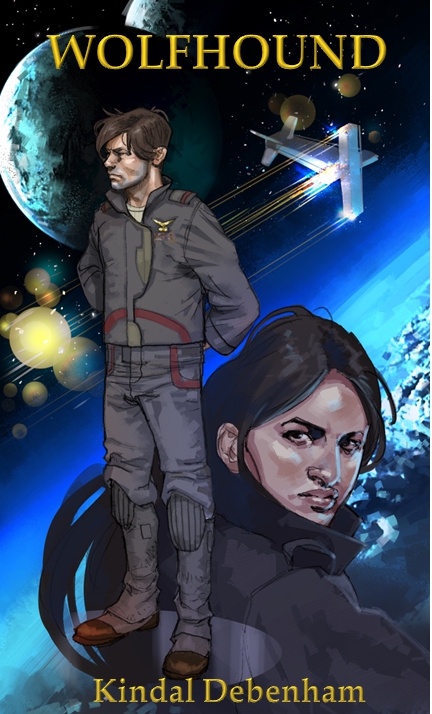
For today’s Trope Tuesday post, I thought it would be fun to bring on my friend Kindal Debenham to speak about one of the tropes in his new book, Wolfhound.

Kindal and I were in the same writing group in college, and attended Brandon Sanderson’s English 318 class together.  I just picked up a copy of his book, and it’s pretty good–definitely the kind of science fiction that I love.  You can currently find Wolfhound on Amazon, as well as Kindal’s self-publishing site.

So anyhow, here’s Kindal’s discussion of space pirates in Wolfhound.

==============================

Space pirates are kind of a staple in science fiction. We’ve seen them in all sorts of different forms since the genre came into being. As the trope states, though, there are basically two main classes. The first class is basically a bunch of violent criminals on a spaceship, kind of mirroring the behavior of modern day pirates in Somalia or Southeast Asia. The second are a corny recycled in space variant of the eighteenth century Caribbean pirate with robotic peg legs and a space parrot. Obviously one is a bit more realistic than the other. 🙂

The version I went for leans a lot more heavily on the first class of space pirates rather than the second. I wanted a smaller scale conflict in order to introduce my main character, and pirates seemed to be a good opponent to use for that purpose. Since the ship that Jacob Hull is on was partially based on the USS Constitution, I decided that I could use some of the pirates that ship fought during its history: the Barbary pirates.

These pirates weren’t your clichéd corsairs with parrots and a desire for plunder. The Barbary pirates were a collection of raiders that operated out of northern Africa. Their motivation was to support their nations by taking ships and capturing crews, which they then added to their fleet and put to work as slaves. In addition to raiding ships, the Barbary pirates also went on slave raids throughout southern Europe. They would accept tribute to ignore the ships of certain countries (think ‘protection money’ for a mob equivalent). The US had to pay about a fifth of the early national budget in tribute to these pirates until the politicians decided that guns were cheaper to buy—which led directly to the creation of the USS Constitution.

Building off of those ideas, I created the Telosian pirates. Vicious, more interested in valuable ransom for prisoners and well armed ships than simple cargo, and willing to do just about anything to satisfy their greed. With an utter ruthlessness only matched by their subtle plots, they made quite a good enemy for Jacob Hull and the rest of Wolfhound’s crew, and they were a much more interesting enemy to fight than a stereotypical Pirate-with-an-Eyepatch would have been. In my opinion at least, though I’m a little biased.

So those are the bad guys of Wolfhound—at least, they’re the majority of the bad guys—and believe me, they live up to their reputation as nasty pieces of work. Hope you guys enojoyed the background, and I hope I didn’t get too history nerd on you guys. See you around!

Why I’m not submitting to the 2012 Amazon Breakthrough Novel Award contest

Last year, I submitted Genesis Earth to the Amazon Breakthrough Novel Award contest and made it to the quarter-finals.  I’m pretty sure I could do at least that well this year, but after reading the contest rules, I’ve decided not to participate.

Why? Because of this:

5. GRANT OF RIGHTS. By submitting an Entry and if you are selected as a Quarter-Finalist or Semi-Finalist, you grant Penguin the exclusive first publication rights to your Entry. If you are selected as a Quarter Finalist, Penguin’s exclusive first publication rights to your Entry terminate when you are eliminated from the Contest (unless you are selected as a Semi-Finalist); and if you are selected as a Semi-Finalist, Penguin’s exclusive first publishing Rights to your Entry terminate after June 30, 2012.

But mostly because of this:

A. Grand Prize. If you are selected as the Winner in a category, you will receive one of two Grand Prizes each consisting of a full publishing contract with Penguin to market and distribute your Manuscript as a published book…you may not negotiate the publishing contract with Penguin, and you must sign it “as is” upon receipt of the executable contract.

The language is a little unclear as to whether the grand prize winner can elect to turn down the publishing contract, but considering how merely submitting to the contest constitutes a grant of publication rights, I’m guessing no.

So why is this a big deal?  Because it gives the writer no room to negotiate.  Suppose the boilerplate contract is unfavorable when it comes to rights reversion, non-compete clauses, or derivative works.  Penguin could conceivably retain the rights to my book indefinitely, even if I’m earning less than $10 a year on it.  With a non-compete clause, they could forbid me from writing or publishing any other books.  Even worse, they could conceivably buy up rights to the world or the characters, making it impossible for me to write any other books in my own series without their approval.

But even if none of those unfavorable terms are in the contract, the standard royalty for erights is 25% of net, not gross.  For those of you who know the difference between net and gross, that’s a red flag in itself, but even supposing Penguin does pay me the full 25% of the 70% it receives from Amazon, that comes to only 17.5% of the cover price.  Right now I’m getting 70%.  Is it really worth it?

I checked the sales rankings for the last three years of ABNA winners, and they aren’t all that great.  The ebook versions for the 2010 winners have a slightly better ranking than mine, but they can’t be selling more than a couple of books a day.  At the prohibitively high price of $9.99, that’s $.30 less per unit than what I’m earning for Genesis Earth at $2.99.  And the 2009 winners?  Their sales rankings are abysmal.  Whatever Penguin did to market those books, it either didn’t work or they’ve given up and moved on to other things.

Now, I don’t expect to win the grand prize even if I submit to this contest.  Most of the previous winning novels are either literary, mystery, or mainstream YA–no science fiction.  Even so, by submitting to this contest, I would not be able to negotiate a publication contract with any other publisher until my book is eliminated.  That’s a headache I could do without.  And as for the consolation prizes, if this year’s Publisher’s Weekly reviewer is anything like last year’s, I already know what she’ll say: “science fiction is garbage.”

So yeah, I won’t be submitting to this year’s ABNA contest.  If I win, I’m forced to sign a contract that I haven’t seen and have no power to change, and if I lose, I get an unnecessary hassle for all my time and effort.  Thanks but no thanks.

The interior designer’s approach to story

I recently read a fascinating post on John Brown’s blog with an interesting exercise for analyzing the kinds of stories you most like to read.  By finding out what really turns you on in a story, you can have a much better idea what to write, and how to make your own stories better.

He prefaced the exercise with a story about the interior designer who helped them to decorate their house.  The designer spread out a number of home magazines in front of them, and told them to go through and tear out the pictures that most turned them on.  After doing this, they analyzed the pictures to see what they had in common, and thus discovered how to best decorate their house.

The exercise works much the same way.  First, pick out five books you really like that immediately come to mind.  Mine are:

As many of you know, these are some of my favorite books of all time.  I’ve reread three of them, and I intend to reread the other two at some point.

Next, pick out the elements that these books have in common.  Here’s what I came up with:

1) Set in a different time and place.

Not all these books are science fiction, but the all take place in a world far removed from our own.  Only Spin takes place largely on Earth, but the events of the story transform the world as we know it so much that by the end of the novel, it’s completely different. SPOILER (highlight to see) Besides, at the very end, the two main characters leave Earth by going through the giant portal to another planet, so the novel is arguably about escaping the world as we know it.

2) Stakes that are much more personal than global.

This was interesting, and highlights something I realized when I compared Merchanter’s Luck with Downbelow Station.  In all of these stories, the central driving conflicts are extremely intimate and personal.

To be sure, many of these stories also have an epic backdrop; Mistborn certainly does.  However, I was much more interested in Vin’s growth and development than I was in how the Ska would overthrow the Lord Ruler–in fact, Mistborn is my favorite book in the trilogy for that very reason.

3) Encourages deep introspection.

This shouldn’t come as too much of a surprise if you’ve followed this blog for a while, but I love love LOVE stories that make me see the world in a new way.  Thrillers and adventures are all fun and good, but if it doesn’t make me think, I’m usually like “meh” at the end.

4) Female characters who aren’t weak or passive.

This one might be a bit more controversial, but in all of these stories, I’ve noticed that the female characters are pretty strong, even if they aren’t all kick-butt Katniss wannabes (ugh…I hate Katniss).  Even in Legend, which is largely dominated by men, you still have the earl’s daughter, who is one heck of a spirited woman.

5) Life and death conflicts.

This is interesting: in all of these books, the threat of death is immanently real.  Some of them, such as Legend and On My Way to Paradise, are among the most violent books I’ve ever read.  I’m not sure what it is, but there’s something about life and death struggles that really draws me.

6) Romantic in a broad sense.

I’m using Tracy Hickman’s definition here, in which romance is all about teaching us to feel and bringing us in touch with our deepest feelings.  That’s the central theme of On My Way to Paradise: learning how to be a man of passion after witnessing some of the worst atrocities of war.

All of these books not only make me feel, they are about the feelings that they inspire.  In other words, the emotional elements of the story are both a part of and deeply embedded in the story’s central theme.

The exercises isn’t complete after this, though.  For the last part, take another five books and analyze them to see how they compare.  My second list includes:

So how does the list stack up?  Let’s see…

  1. Definitely true.  NONE of these stories take place in the world as we know it–and that’s awesome.
  2. A Canticle for Leibowitz might seem like an exception, since it follows the broad rise and fall of human civilization after the nuclear apocalypse.  But the things that really drew me to the story were the more personal elements: the novice who makes the illuminated manuscript of the electrical diagram, for example, or the abbot at the very end who SPOILER tries desperately to convince the single mother not to take her baby to the mercy killing station after the bomb fatally irradiates them.  In any case, it’s telling that A Canticle for Leibowitz made this list, whereas none of Arthur. C. Clarke’s books even came to my mind.
  3. Definitely true.  Even Citizen of the Galaxy, which is more adventure fiction than high concept sf, features a fascinating society of interstellar traders that really made me sit back and think about the way we structure our society.  Heinlein has a really awesome way of doing that with everything he writes.
  4. The only possible exception here might again be Heinlein, who had some very extremist views of women (putting it lightly).  However, if I recall, Citizen of the Galaxy has a female character at the end who helps pull out the main character from his indigent circumstances and helps him to come into his own.  Again, they might not all be kick-butt tramp-stamp vampire slayers, but they certainly aren’t weak.
  5. Less true of The Neverending Story and The Dispossessed, but while the central conflicts might not be about life and death, the threat of death (or a total loss of identity) certainly comes into play.
  6. Definitely true.  Few books have taught me to feel more deeply than The Neverending Story.  An absolutely magnificent piece of literature.

So there you have it.  According to this exercise, I should write books set in another time and place, where strong female characters face life and death decisions that personally impact the people in their lives and make the readers think and feel.  Interestingly enough, that is a PERFECT description of Bringing Stella Home, as well as Desert Stars and Into the Nebulous Deep.

Cool stuff.  Makes me want to write.  So on that note, I think I will.
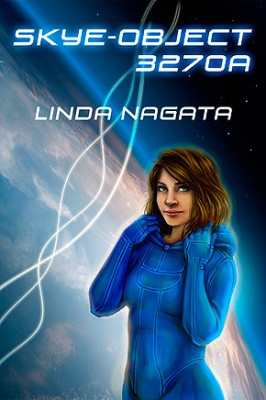
Skye Object 3270a by Linda Nagata

It’s not easy being a teenager in the orbital colony of Silk–especially when all the adults are functionally immortal and anyone under one hundred is considered an adolescent.  To make matters worse, Skye fell to the city in an escape pod when she was just a baby, with no idea who she is, where she’s from, or how long she was drifting in space.

Fortunately, she’s a tough girl with several close friends and a determined spirit.  One way or another, she’ll find out where she’s from–and whether there are any of her people still out there.  

I thoroughly enjoyed this book.  It combined the best of both science fiction and young adult: likeable teenage characters struggling to find their place in a high-tech alien world.  In particular, I found it fascinating how the widespread nanotech shaped both the society and the universe.

But the story isn’t about the technology, it’s about the characters, their adventures, and the friendships that form between them.  This was what really made the story come alive for me.  There’s a small amount of wish fulfillment, which may or may not be your thing, but overall I found the characters to be both believable and likeable.  It was a lot of fun to watch them grow and learn together.

At times, though, it felt as if the characters weren’t challenged enough.  The friendship and relationship issues were well done, but it wasn’t until the end that they started to have any significant try-fail (or try-almost fail) cycles in their adventures.  Also, while the ending was quite satisfying, it was also a little abrupt.

Those didn’t detract much from the rest of the story, though.  Overall, I thought it was a very satisfying read–the sort of book I wish I’d found when I was twelve or thirteen.  If I wasn’t already hooked on science fiction by that age, I have the feeling that this book would have turned me into a lifelong fan.

As a footnote, I’d like to add that this is EXACTLY the kind of book that indie publishing was made for.  It’s a great story, but the science-fictional setting is so unconventional that most publishers wouldn’t take a chance on it.  Even houses like Tor and Baen are focusing more on sub-genres like urban fantasy and military sf, which both have large, proven readerships.  For something that’s a little more niche or experimental, it’s good to see that there’s still a way to get it out to readers who would love it.

So yeah–if you like young adult books and you’re not turned off by space elevators, nanobots, or alien planets, you should totally try out this book.  I think it will surprise you just how much you enjoy it.

Am I a jerk?

Today, a longtime writing friend told me that she wants nothing to do with me, which made me very sad.  I hope she will reconsider, and if she does, I’d gladly welcome her back as my friend.  However, because it’s come to my attention that some of my other friends feel that I come across as a jerk whenever I talk about indie publishing, I feel that I should take the time to clarify a few things.

First, I wish all of my writing friends success, whether they choose to epublish or whether they choose to go the traditional route.  This is not a zero sub game and I have never believed that it is.  Whether or not my own career tanks, if my friends find success in their endeavors, I will gladly tip my hat to them.

Second, I wish no harm on anyone who is involved in any way in the publishing or bookselling industries.  I have less sympathy for multinational corporations and media conglomerates, but I recognize that they employ large numbers of people, and I don’t wish any harm on them either.

Third, I do not believe that writers who choose to forgo indie publishing are somehow inferior to or less intelligent than writers who do.  I do believe that everyone should at least try it out to see if it’s right for them, but I recognize that indie publishing is not right for everyone, and that writers should carefully evaluate their skill levels, personal proclivities, and career goals before making that step.

This is my goal: to make a living telling the stories that I love.  Those stories fall firmly in the realm of science fiction: grand, sprawling space operas, thrilling sf adventures, poignant and moving tales of alien worlds and cultures, etc.

In my research of the publishing industry, I’ve discovered that it’s become extremely difficult over the past couple of decades to build a career writing science fiction.  For whatever reason, publishers aren’t as interested in pushing this genre or serving its readers as they have been in the past.  Contract terms have gotten worse, and it’s become increasingly difficult to break in, much less make a living.

That’s why the changes in publishing and the ebook revolution have made me so excited.  Writers have more options now than ever before, and I believe that I can better achieve my goal through indie publishing than through more traditional paths.

Now, a little bit you should know about myself: I believe in complete and total honesty.  If I see a problem or something that seems to be wrong, I tend to be very upfront and direct about it (and appreciate it when others are the same with me).

This philosophy has its advantages, but one of its disadvantages is that I tend to be a little tactless.  If I come across as arrogant, I want you to know that I’m sorry.  That’s certainly not my intent, and I’ll try to do a better job of making that clear.

At the same time, I’d like to point out that what you perceive as arrogance may just be my own excitement.  All writers are emotionally involved in their work, and because we’re approaching these issues from fundamentally different worldviews, it’s very easy for mutual misunderstandings to arise.

In the future, I’ll try to be more tactful, but I can’t control how others perceive me.  I have no doubt that those who are emotionally invested in resisting change will continue to find fault with those who embraces it.  Ultimately, I can only be answerable to myself, those who depend on me for support, and my readers.

So on that note, I’d like to finish by saying that after reviewing your comments and giving the issue some thought, I’ve decided to go ahead with Edenfall as my next major project.  More on that later, but for now, I’d just like to thank you all for your feedback and support.  I’m excited to get started!

NPR’s Top 100 Science Fiction & Fantasy

In case you didn’t know, NPR just put together a list of the Top 100 Science Fiction and Fantasy novels of all time.  The list had a panel of judges who vetted nominations, but the voting was public and turnout–over 60,000–was pretty high.

I usually don’t like top 100 lists, but this one did a pretty good job representing the genre.  I recognized about 2/3rds of the titles, and most of my own personal favorites were included.

There were a few notable exceptions, however.  David Gemmell wasn’t represented at all–a travesty of the highest proportions.  Neither was C.J. Cherryh, which I find very surprising.  Robert Charles Wilson has certainly written some books worthy of the list, and Dave Wolverton’s On My Way to Paradise–which, I would argue, is one of the best science fiction novels ever written–was notably absent.

Also, a few of the titles were further down on the list than I would have put them.  The Dispossessed by Ursula K. Le Guin came in at #78, while I would have put it at least in the top 20.  A Canticle for Leibowitz did better at #35, but was it really an inferior book to The Handmaid’s Tale?  Come on, people.

One thing I don’t think this list represents well (or top 100 lists in general) is the way in which sf&f fandom has split into dozens of communities and tribes, almost like Darwin’s finches on the Galapagos Islands.  Before science fiction went mainstream, it was possible to follow all the various titles and developments.  Now, however, there’s so much out there that it’s impossible to be fully cognizant of everything.

I think fandom has split into some very distinct communities clustered around the popular authors and sub-genres, and there’s not a whole lot of overlap between them.  None of them are large enough to spawn an entirely new genre (with the possible exception of paranormal romance), but lumping them all into science fiction & fantasy can be a bit problematic.

That said, I think this is a pretty good list.  What do you think?

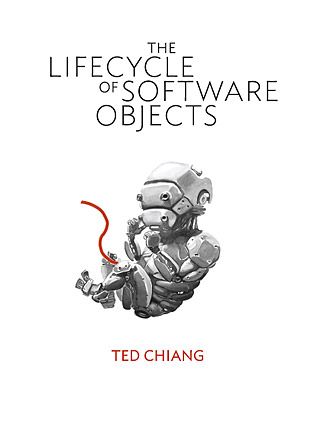
The Lifecycle of Software Objects by Ted Chiang

Ana was a washed-up zoologist turned programmer looking for work; Derek was an avatar designer for the Data Earth virtual reality platform.  The thing that brought them together: Blue Gamma Inc., manufacturer of autonomous self-aware AI pets known as digients.
Like any pet, each digient requires constant attention as they learn and grow.  Soon, Ana and Derek become as attached to their own digients as parents to their children.  But when Blue Gamma goes out of business and the Data Earth platform becomes obsolete, the future for the digients looks grim–until they enter the next phase of their natural evolution.

I really, really liked this story.  It’s got just about everything that makes science fiction so great: futuristic setting, well-rounded characters with believable motivations, one Big Lie with everything else held more or less at the level of our current understanding, and tons of parallels between the fantastic world and our own that makes you step back and really think about things.

The interesting thing about this story was how it played with all the old robot/AI tropes.  Usually, stories of this kind will have the robots rise to transcendence, either becoming the benevolent (or largely absent) rulers of the world, or taking over and enslaving humanity in some fashion. Not so with this story; the scope was much more intimate and personal, driven by characters rather than the Fate of Mankind, and that ultimately made the story much more believable.

If I had any problem with this story at all, it was the ending.  After so much build-up and development, I felt as if it cut off rather abruptly, just as things were getting more and more interesting.  I suppose the author was going for something of a “Flowers for Algernon” feel, but that wasn’t what I took from it.  Or perhaps he ran up against the novella word limit and decided to cut it off; I don’t know.

Regardless, I thoroughly enjoyed this story.  It’s certainly worthy of the Hugo for which it’s been nominated.  Highly recommended.

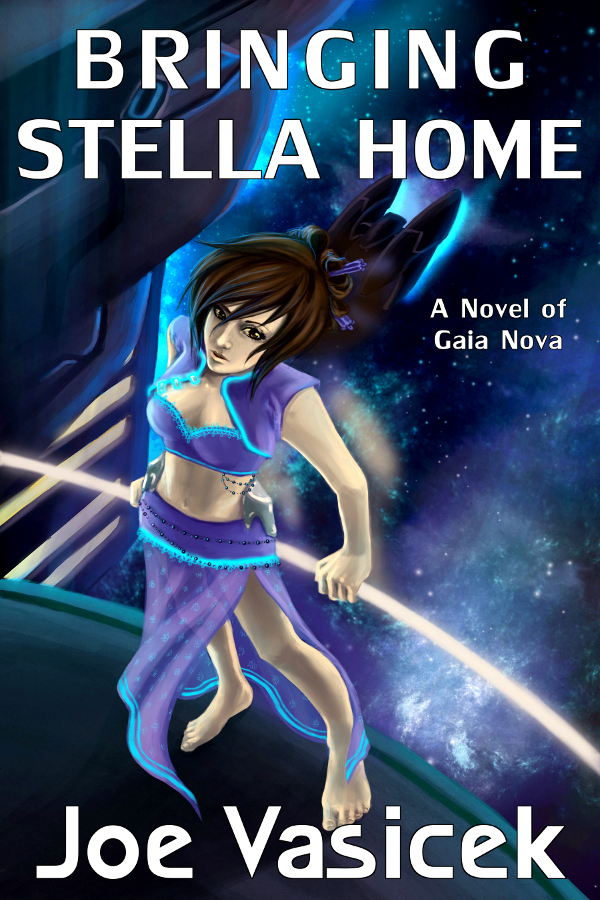
Bringing Stella Home is now up on Amazon!

That’s right–after a whole lot of work, my novel is now up on Amazon for $3.95.  Check it out!

This novel is the first of a much larger series that I have planned.  It’s not a series like Ender’s Game or Song of Ice and Fire, though; all of the novels are supposed to stand alone, though they share the same setting and feature recurring characters.  In that sense, it’s more like Gemmell’s Drenai series.

Even though the series is space opera, I tried to keep the science plausible at least on a high school level.  So while there’s “magic” like FTL and artificial gravity, I’ve tried to bend rather than break the laws of physics.

At its core, the story is more about the characters than the setting or even the plot.  It follows a young boy who is determined, at all costs, to save his brother and sister, even as his world quite literally falls to pieces all around him.  Along the way, he meets up with a mercenary captain who is running from some demons of her own.  The way they help each other overcome their personal challenges is a major driving force throughout the book.

Anyhow, I suppose that’s enough.  I could ramble on forever, but I don’t want to get in the way too much.  Thanks so much, and I hope you enjoy it!

T minus 24 hours and counting…

That’s right!  After much wrangling, I formatted it this morning and published it to Amazon this afternoon.  In less than 24h hours, it should be up for sale!

In many ways, Bringing Stella Home is a lot different from Genesis Earth.  For one, the scope is much larger, with the rise and fall of galactic empires and a war leaving billions dead in its wake.

At the same time, however, the stakes are very personal.  It’s not about turning the tide of human history or saving millions of lives; it’s about one boy who doesn’t want his world to fall apart, and will do anything to save the people he loves.

I put a content warning in the description because there’s a lot of darkness in this book.  It’s not for everyone; I know that some of my friends would find it shocking and offensive.  However, it isn’t my intention to glorify evil or celebrate immorality; rather, by portraying it honestly, I hope to make the struggle against it that much more meaningful.  There is, after all, an opposition in all things.

Writing this book was a watershed moment for me.  Not only is it the first book in a series which I hope to continue across many books, but it marked a shift in my writing.  Before the rise of indie publishing, I thought this would be the one that finally broke through the iron gates of the publishing industry and made my debut.  Perhaps that was why I was so reluctant to send it out; I didn’t want to experience the crushing blow of rejections from agents who didn’t think they could sell it, or editors who think that science fiction is dead.

But now, I don’t have to break through those iron gates; now, I can send this story out into the world and let the readers decide whether it’s any good.  And that’s exactly what I intend to do.

For all those of you who have helped bring this project up to this point, I want to sincerely thank you by giving you a free copy of this ebook.  I’ll be sending it out tomorrow, most likely; if for some reason I miss you, please email me and I’ll correct the mistake.  They say that writing is a solitary art, but this day and age, that’s no longer true.  So once again, thank you.

It’s been an exciting journey thus far, and something tells me that it’s only getting started.  I can hardly wait to see what the future will bring!