 The interview with Dave Wolverton was a resounding success! We had a fascinating conversation about science fiction and the gospel, his latest book In The Company of Angels, self-publishing, the English 318 class at BYU and the profound impact it’s had on the LDS writing community, and much, much more.
On that, I suppose I should disclose my full reasons for going down to St George and meeting with Dave. I’m putting together an article for the December 2010 issue of Mormon Artist, where I hope to give a brief history of BYU’s “class that wouldn’t die” and explore the impact that it’s had on both the LDS writing community and on mainstream sf&f.
The “class that wouldn’t die” was the group of students who signed up for the first English 318R science fiction creative writing class at BYU, back in ’78 (I think it was ’78…gotta check that). After the semester was over, the students banded together through forming a writing group, which they called “Xenobia.”
They didn’t stop there, however. As Xenobia grew and matured, the students decided to form other organizations designed to help new writers (especially sf&f writers) improve their craft and build their writing careers. Specifically, they founded Quark, BYU’s science fiction and fantasy club; Leading Edge, a student-run magazine that gives written feedback to every story submitted; and LTUE, an annual science fiction and fantasy symposium (like a convention, only no costumes).
These organizations, as well as the 318 class, led directly to the explosion of LDS writers in science fiction and fantasy. Several bestselling LDS authors, including Stephanie Meyers, Brandon Sanderson, and Dan Wells (among many others) can trace the launch of their careers back to this class. In turn, these authors are having a tremendous impact on mainstream sf&f literature.
The article is slated to come out in next December’s issue of Mormon Artist Magazine, just in time for LTUE 2011 (which I hope to attend). Right now, I’m in the research phase, meeting with some really amazing people and gathering some fascinating stories. This article is going to be awesome.
In parting, let me share one of the more interesting things Dave said in the interview. As we talked about all these amazing resources available for sf&f writers in Utah valley, I asked him why this happened in this community and not elsewhere.
His answer was extremely insightful: for many writers, the mentality is that once you break in, you have to close the gate behind you. It’s something of a zero-sub game, where people horde their ideas, compete with each other to break in, etc.
Not so in the LDS community. As Latter-day Saints, we have a deep-set mentality of helping each other and building each other up. That’s exactly what happened with the “class that wouldn’t die”–they did everything they could to foster other writers. The proliferation of Latter-day Saints in mainstream sf&f is a direct result of this.
That’s Dave’s take on it, anyway. It will be interesting to hear what others think.
Oh, and FYI, Mormon Artist is 100% volunteer run and free, so when the article and interview come out, you won’t have to pay anything to read them. I’ll certainly provide links on this blog–stay tuned!
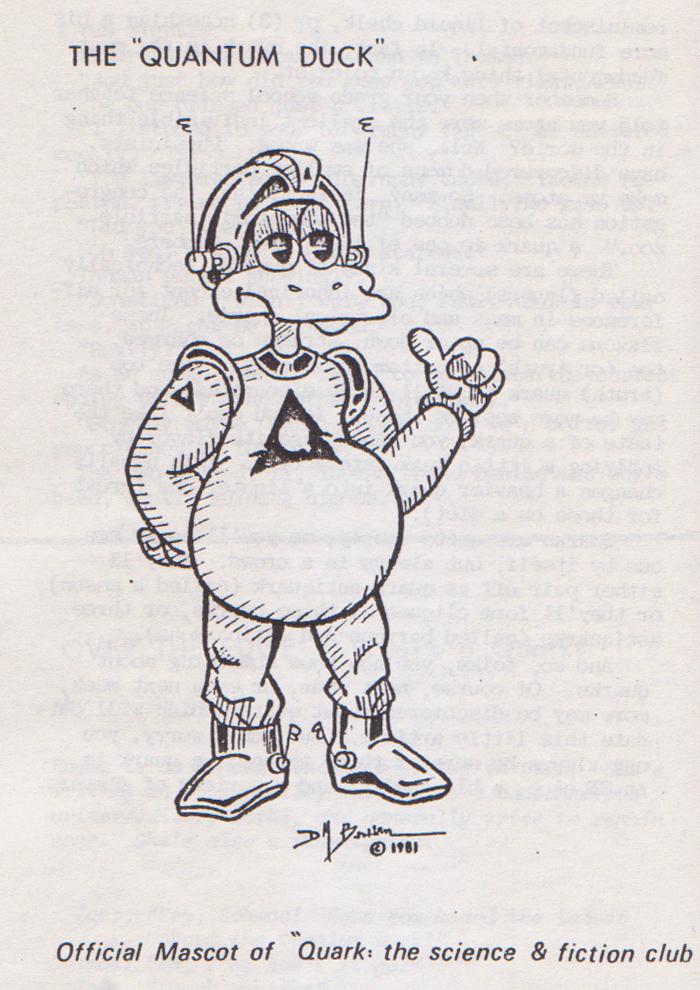
And as one final note, check out this piece of Xenobia history: the original Quantum Duck, as featured in the first issue of The Leading Edge. Why a quantum duck, you ask? Because that’s where the club’s name came from: a bumper sticker that said: BEWARE THE QUANTUM DUCK THAT GOES ‘QUARK,’ ‘QUARK’!
 In the 21st century, Earth was conquered by an alien collective consciousness known as the Tyr. Now, five hundred years later, humankind has been scattered across the Tyr-occupied worlds as slaves. It is a dark and uncertain existence, under the rule of masters who do not care whether their charges live or die.
 Worlorn is a planet without a sun, wandering on the fringes of the galaxy where the skies are starless. Though it came to life briefly as it passed the red giant Fat Satan, those days are over, and the world is slowly dying.
 Before I came out to Washington DC, I saw Avatar in the theaters. AWESOME movie. Loved the concept, loved the characters, LOVED the science fiction elements and how well they were woven into the story.
 Urras and Annares, a world and its moon, separated by the gulf of space and two hundred years of mutual contempt. On Urras, capitalist and socialist nations vie for dominance over the world’s rich and abundant resources. On Annares, the anarchist exiles scrounge for a meager living, but live in peace–and in hope.
 It was said that God, in order to test mankind which had become swelled with pride as in the time of Noah, had commanded the wise men of that age, among them the Blessed Leibowitz, to devise great engines of war such as had never before been upon the Earth, weapons of such might that they contained the very fires of Hell, and that God had suffered these Magi to place the weapons in the hands of princes, and to say to each prince: ‘Only because thine enemies have such a thing have we devised this for thee, in order that they may know that thou hast it also, and fear to strike.’