2020-01-16 Newsletter Author’s Note

This author’s note originally appeared in the January 16th edition of my email newsletter. To sign up for my newsletter, click here.

For my birthday last year, Mrs. Vasicek got me the first three books in the Dune series by Frank Herbert. I looove the new cover art, which is mostly why I wanted them, but I’ve only ever read the first book. Since the other books are on our shelves now, I pretty much have to read them, but it’s been years since the last time I read it.

So that’s why I’m reading Dune for the third time, and wow, it is so much better than I remembered. Part of that is because there is so much going on that you have to reread it two or three times just to get it all. The first time I read Dune, I thought it was okay but not all that great—certainly not on par with Lord of the Rings, which everyone compares it to. In reality, though, most of the story went right over my head. I read it again a couple of years later, after catching up on some of the lore, and that time I was much better able to appreciate it.

My own book Desert Stars takes place on a desert planet in a far distant future, but that’s basically where the similarities end. The politics of empire, with the emperor, the great houses, and the spacing guild; the Mentat human supercomputers and secretive Bene Gesserit with their megalomanaical breeding program; the Fremen, the spice, and above all else the transcendant leap in evolution, perfected in Paul Atreides, that allows certain people to see past this dimension into the future. Dune may just be the most perfect science fiction novel ever written.

Having said that, I should point out that Mrs. Vasicek doesn’t really like it. She feels that the characters fall flat, that their near-superhuman abilities strain credulity and make them much less interesting, and that the omniscient point of view makes the book too dense. In the seven months that we’ve been married, I’ve learned that I shouldn’t dismiss her judgment too quickly. Not only does it go a long way toward promoting marital tranquility, but more often than not, she’s actually right.

Then again, she’s only read Dune once. When I read it for the first time, I had many of the same criticisms. And while new things did stand out on my first rereading of it, including things about the characters, it wasn’t like they leaped off the page or the prose itself became any less dense. Mostly, it was all the other things that really stood out: the world building, the politics, and the statement the book makes about mankind’s ultimate destiny.

My new year’s resolution for 2020 is to read 100 books. When I told my sister that, she said “you should read at least 100 of them before the baby is born.” Dune is such a massive brick of a book that I’m already a couple of weeks behind, but I don’t care. It’s really, really good. I’m looking forward to the other ones!

A Much Deserved Fisking

In the November issue of Locus magazine, Cory Doctorow wrote an op-ed piece defending Jeannette Ng and the decision to strip Campbell’s name from the Campbell Award. At least, that’s how it started out, but it quickly devolved into a hatchet piece against everyone in science fiction whose politics lie somewhere to the right of Stalin.

Ever since Sad Puppies III, I’ve more or less gotten used to the gaslighting, hypocrisy, and projection that has become de rigeur in the traditional publishing side of the field. But somehow, Doctorow’s hit piece manages to hit a new high water mark for leftist insanity.

Since my own politics lie somewhere between Boadicea and Genghis Khan, I thought it would be fun to give the piece a good old-fashioned fisking. I can’t pretend to be as good at it as Larry Correia (and I sincerely hope he fisks it himself), but damn, if anything ever was written to be fisked, it was this ridiculous piece.

Doctorow writes:

At the Hugo Awards ceremony at this summer’s Dublin Worldcon, Jeannette Ng was presented with the John W. Campbell Award for Best New Writer. Ng gave an outstanding and brave acceptance speech

Translation: Ng reinforced the dominant far-left narrative in the science fiction field, telling the gatekeepers exactly what they wanted to hear and earning widespread praise for it.

True bravery is Jordan Peterson deleting his $35,000/month Patreon in protest of their hate speech policies, or Kanye West coming out as a devout Christian, producing a worship album, and announcing that he will no longer perform any of his old songs.

in which she called Campbell – the award’s namesake and one of the field’s most influential editors – a “fascist” and expressed solidarity with the Hong Kong pro-democracy protesters.

You know who else shows solidarity with the Hong Kong protests? That’s right—everyone’s favorite deplorable frog!

Now that’s a dank meme.

I’m curious: does this make Ng a white supremacist for showing solidarity with people who use such a rascist hate symbol? Does it make Cory Doctorow a dog whistler to the far right for appealing to these obviously racist deplorables?

Of course not, but that’s the level of insanity we’ve fallen to.

I am a past recipient of the John W. Campbell Award for Best New Writer (2000) as well as a recipient of the John W. Campbell Memorial Award (2009). I believe I’m the only person to have won both of the Campbells,

All red flags to deplorable readers like me,

which, I think, gives me unique license to comment on Ng’s remarks, which have been met with a mixed reception from the field.

I think she was right – and seemly – to make her re­marks. There’s plenty of evidence that Campbell’s views were odious and deplorable.

There’s that word: “deplorable.” Whenever someone uses it unironically, it’s a sure sign that they hate you. It’s also a sign that they don’t actually have a good argument.

It wasn’t just the story he had Heinlein expand into his terrible, racist, authoritarian, eugenics-inflected yellow peril novel Sixth Column.

I haven’t heard of that one. Thanks for the recommendation, Cory! I’ve already ordered it.

Nor was it Campbell’s decision to lean hard on Tom Godwin to kill the girl in “Cold Equations” in order to turn his story into a parable about the foolishness of women and the role of men in guiding them to accept the cold, hard facts of life.

Okay, I call bullshit. “Cold Equations” wasn’t about the “foolishness of women,” it was about how when our inner humanity comes into conflict with the hard realities of the universe, the hard realities always win.

Switch the genders—a female pilot and a teenage boy stowaway—and the story still works. Switch the endings—have the pilot decide to keep the stowaway, dooming himself and the sick colonists—and it does not.

In fact, it makes the girl even more of a hapless, weak feminine stereotype. Stepping into the airlock voluntarily is an act of bravery. In some ways, she’s stronger than the pilot—and that’s kind of the point.

The thing that makes “Cold Equations” such a great story is that it functions as something of a mirror. It’s the same thing with Heinlein: those who see him as a fascist are more likely to be authoritarians, while those who see him as a libertarian are more likely to be libertarians themselves. After all, fascism is “citizenship guarantees service,” not “service guarantees citizenship.”

It’s also that Campbell used his op-ed space in Astound­ing to cheer the murders of the Kent State 4. He attributed the Watts uprising to Black people’s latent desire to return to slavery.

Was John Campbell a saint? No, and I don’t think anyone’s claiming that. In the words of Ben Shapiro, two things can be true at once: John Campbell had some racist, sexist views, and stripping his name from the award is wrong. (Also, that Doctorow is full of shit.)

The Campbell award isn’t/wasn’t named after him because he was a perfect, flawless human being. It was named after him because of his contributions to the field. If we’re going to purge his name from the award, are we also going to purge all of the classic golden-age books and stories that he edited, too? Are we going to have the digital equivalent of a book burning? Because that strikes me as a rather fascist thing to do.

These were not artefacts of a less-englightened [sic] era. By the standards of his day, Campbell was a font of terrible ideas, from his early support of fringe religion and psychic phenomena to his views on women and racialized people.

What are the standards of our own day? In what ways are we less-enlightened? Are future generations likely to accuse Doctorow of being a “font of terrible ideas,” just like he accuses Campbell here?

Do unborn black lives matter? If Trump is truly a fascist, why does the left want him to take all our guns? Is it okay to be white? Is Islam right about women? Is transgender therapy for prepubescent children just another form of conversion therapy? Are traps gay?

When you free your mind to explore new ideas, a lot of them are bound to be terrible. It’s simply Sturgeon’s law. So is Doctorow criticizing Campbell for having an open mind, or for not conforming to Doctorow’s values and beliefs?

Who’s supposed to be the fascist again?

So when Ng held Campbell “responsible for setting a tone of science fiction that still haunts the genre to this day.

I’m pretty sure that taking hormone blockers and getting your balls cut off makes you a hell of a lot more sterile than anything else. Lesbians, gays, transgenders, queers—all of these tend to be sterile as a general rule. Most babies are still made the old-fashioned way.

Male.

Isn’t her word choice kind of sexist here? I mean, she could have used the word “patriarchal,” but she didn’t. She. Deliberately. Used. The. Word. “Male.”

White.

Is she saying that it isn’t okay to be white?

Exalting in the ambitions of imperialists and colonisers,

Come on, Ng. Let’s not be racist. There were plenty of imperialists and colonizers who weren’t white Europeans. After all, how can we forget Imperial Japan and the Rape of Nanking? Now that was an ambitious massacre. The Turks also ran a pretty brutal empire, as did the Zulus and the Aztecs. You can’t tell me that cutting out the beating hearts of more than 80,000 prisoners to rededicate your temple isn’t ambitious.

settlers and industrialists,”

Find me one place that was not built by “settlers.” Find me one human being on this planet who has not benefitted from “industrialists.” Who do you think makes the vaccines and antibiotics? Who do you think makes machines that harvest your food?

Just for a single day, I would like to see all of these anti-capitalist types live without any of the benefits that capitalism and modern industry provide.

she was factually correct.

And yet, so completely full of shit.

In the words of Andrew Klavan, you can’t be this stupid without a college education.

Not just factually correct: she was also correct to be saying this now.

Because it’s [current year]!

Science fiction (like many other institutions) is having a reckoning with its past and its present. We’re trying to figure out what to do about the long reach that the terrible ideas of flawed people (mostly men) had on our fields.

The best way to fight a terrible idea is to allow it out in the open while fostering freedom of speech. In the words of Andrew Breitbart, sunlight is the best disinfectant.

The reckoning that Doctorow is calling for is something that’s already built into the field. Science fiction is constantly evolving and revisiting its past. Good science fiction not only builds on the stuff that came before, it critiques it while taking the ideas in a new direction.

We don’t need to tear down the legacy of the giants in the field who came before us; we simply need to build up our own legacies for the generations that come after us. But that’s not what Ng and the social justice warriors want to do.

It isn’t a coincidence that the traditionally published side of the field is rapidly losing market share as the SF establishment seeks to purge everything that could possibly offend their progressive sensibilities. The people doing the purging can’t compete on the open market because their toxic ideologies don’t resonate with the buying public, so they’re forced to resort to the digital equivalent of burning books and tearing down statues. Meanwhile, indie publishing is eating their lunch.

Get woke, go broke.

We’re trying to reconcile the legacies of flawed people whose good deeds and good art live alongside their cruel, damaging treatment of women. These men were not aberrations: they were following an example set from the very top and running through the industry and through fandom,

Future generations will struggle to reconcile our good deeds and our good art with our cruel and inhuman treatment of the unborn.

None of this is new. All of us are flawed; every generation is tainted with blood and sins that are reprehensible to those that follow. Realizing all this, you would think a little introspection is in order. But the people today who are so eager to throw stones are completely lacking in self-introspection that they can’t—or rather, won’t—see their own blood and sins.

to the great detriment of many of the people who came to science fiction for safety and sanctuary and community.

Is science fiction a “safe space,” or is it the genre of ideas? It can’t be both at the same time. Ideas are inherently dangerous.

It’s not a coincidence that one of the first organized manifestations of white nationalism as a cultural phenomenon within fandom was in the form of a hijacking of the Hugo nominations process.

Bullshit. If you think that the Sad Puppies were white nationalists, you’re either stupid or willfully ignorant (a distinction without a difference).

Larry Corriea’s flagship fantasy series, the Saga of the Forgotten Warrior, is set in an Indian-inspired fantasy world populated entirely by brown people. Brad Torgerson has been happily married to a woman of color for decades. Sarah Hoyt is both latina and an immigrant.

If this article was written three years ago, you would have just called them all racists, but you can’t do that now because “racist” has lost its edge. You’ve cried wolf far too many times, and no one pays attention to those accusations anymore. That’s why you use words like “fascist,” “white nationalist,” and “white supremacist” to describe your enemies—not because you actually believe it, but because those accusations haven’t yet lost their edge.

While fandom came together to firmly repudiate its white nationalist wing, those people weren’t (all) entry­ists who showed up to stir up trouble in someone else’s community. The call (to hijack the Hugo Award) was coming from inside the house: these guys had been around forever, and we’d let them get away with it, in the name of “tolerance” even as these guys were chasing women, queer people, and racialized people out of the field.

Translation: we’re done with paying lip service to “tolerance” and “open-mindedness.” From now on, if you don’t look like us, act like us, or think like us, we’re going to do everything we can to destroy you.

I’m telling you, these people hate us. That’s why they call us “deplorables.” That’s why they paint us as racists and fascists, even when we’re nothing of the sort. They don’t want to listen to us. They don’t want to give us a fair hearing. They want to destroy us.

Stripping Campbell’s name from the Campbell Award is just another example of this toxic cancel culture. It isn’t about reckoning or reconciliation. It’s a naked power grab.

Those same Nazis went on to join Gamergate, then became prominent voices on Reddit’s /r/The_Donald, which was the vanguard of white national­ist, authoritarian support for the Trump campaign.

See, this is why I can’t trust you, Cory. Gamergate had legitimate grievances with Anita Sarkeesian, Zoe Quinn, and Gawker. Trump supporters had legitimate reasons to want to stop Hillary Clinton from becoming president. Yet you casually dismiss all these people as deplorables, racists, and fascists without even listening to them.

That’s intelluctually dishonest, Cory. It’s also a form of gaslighting.

The connections between the tales we tell about ourselves and our past and futures have a real, direct outcome on the future we arrive at. White supremacist folklore, including the ecofascist doctrine that says we can only avert climate change by murdering all the brown people, comes straight out of SF folklore, where it’s completely standard for every disaster to be swiftly followed by an underclass mob descending on their social betters to eat and/or rape them (never mind the actual way that disasters go down).

I don’t think Cory Doctorow has any idea what actually happens when society collapses. When the thin veneer of civilization gets stripped away, people will eat each other. We’ve seen this just recently in Venezuela, Syria, and Mexico. Here in the US, we can see the seeds of our own collapse in Chicago, Portland, San Francisco, Baltimore, and Detroit (all very blue and progressive cities, by the way).

Also, I don’t think Cory Doctorow has any idea what he’s talking about when he says “white supremacist folklore.” What is that even supposed to mean? Just a couple of paragraphs ago, he called all the Sad Puppies “white nationalists,” and that obviously isn’t true. By “white supremacist folklore,” does he mean all the science fiction that doesn’t fit his radical progressive political ideology? Once again, he’s painting with an overly broad brush.

Also, notice how he uses “white supremacist” instead of “racist.” He can’t use “racist” because that word has been overused. Give it a couple of years, and “white supremacist” will lose its edge as well.

When Ng picked up the mic and told the truth about Campbell’s legacy, she wasn’t downplaying his importance: she was acknowledging it. Campbell’s odious ideas matter because he was important, a giant in the field who left an enduring mark on it. No one questions that. What we want to talk about today is what Campbell’s contribution was, and what it means.

Whenever the people on the progressive left claim that they want to have a “conversation” about something, what they really mean is “shut up and let me tell you how I’m right and you’re wrong.” There is no way to have an honest dialogue with these people, because they will not listen to us “deplorables.” Cory Doctorow has already demonstrated this with his blanket accusations against all the supporters of Gamergate, the Sad Puppies, and President Trump.

These people don’t want to talk about “what Campbell’s contribution was, and what it means.” They want to purge him from the field. Metaphorically, they want to burn his books and tear down his statues.

Look, I’m not trying to defend all of Campbell’s views here. I’m all for having an honest discussion about his bad ideas and how they’ve influenced the field. But I don’t believe I can have that discussion with people who clearly hate me, and will do whatever it takes to cancel and destroy me.

After Ng’s speech, John Scalzi published a post where he pointed out that many of the people who were angry at Ng “knew Campbell personally,” or “idolize and respect the writers Campbell took under his wing… Many if not most of these folks know about his flaws, but even so it’s hard to see someone with no allegiance to him, either personally or professionally, point them out both forcefully and unapologetically. They see Campbell and his legacy ab­stractly, and also as an obstacle to be overcome. That’s deeply uncomfortable.”

Scalzi’s right, too: the people who counted Campbell as a friend are au­thentically sad to confront the full meaning of his legacy. I feel for them.

Do you really, though?

It’s hard to reconcile the mensch who was there for you and treated his dog with kindness and doted on his kids with the guy who alienated and hurt people with his cruel dogma.

Did you catch the sneaky rhetorical trick that Doctorow uses here? He assumes that we’ve already accepted his argument that Campbell’s views were odious enough to have his name stripped from the award. Now he’s using an appeal to emotion to smooth it over.

Gaslighting of the highest order.

Here’s the thing: neither one of those facets of Campbell cancels the other one out. Just as it’s not true that any amount of good deeds done for some people can repair the harms he visited on others, it’s also true that none of those harms can­cel out the kindnesses he did for the people he was kind to.

Or cancel all of his contributions to the field?

If Doctorow actually believes all this, why does he support Ng, who argues that everything Campbell did should be cancelled out by his most odious views? If anything, this is an argument against stripping Campbell’s name from the award.

Life is not a ledger. Your sins can’t be paid off through good deeds. Your good deeds are not cancelled by your sins. Your sins and your good deeds live alongside one another. They coexist in superposition.

Yes, and you should never underestimate the capacity of the human mind to believe two mutually exclusive ideas at the same time, especially when his name is Cory Doctorow.

You (and I) can (and should) atone for our misdeeds.

Not in today’s cancel culture, where everything you’ve accomplished can be erased by the one bad thing you tweeted or posted to Facebook ten years ago. There’s also no forgiveness or repentance, when you will be forever remembered for the worst thing you said or did.

We can (and should) apologize for them to the people we’ve wronged.

No. Giving a public apology is the absolute worst thing you can do in today’s cancel culture, because your enemies will smell blood in the water and come in for the kill.

Never apologize to a mob.

We should do those things, not because they will erase our misdeeds, but because the only thing worse than being really wrong is not learning to be better.

Oh, this is rich.

You first, Cory. Have you taken a good, hard look in the mirror? Have you really, truly asked yourself “what if I’m wrong?”

I don’t see eye to eye with Vox Day about everything, but he was right about this: you social justice types always lie, you always double down, and you always project your own worst faults onto your enemies. That’s why you’re so blind to your own hypocrisy, even when it’s staring you in the face.

I completely and totally agree that we should all strive to admit when we’re wrong and learn to be better for it, but you’re not in a position to tell me that, Cory. Not after painting all us “deplorables” with such a broad brush.

People are flawed vessels. The circumstances around us – our social norms and institutions – can be structured to bring out our worst natures or our best. We can invite Isaac Asimov to our cons to deliver a lecture on “The Power of Posterior Pinching” in which he would literally advise men on how to grope the women in attendance, or we can create and enforce a Code of Conduct that would bounce anyone, up to and including the con chair and the guest of honor, who tried a stunt like that.

Honest question: was the sexual revolution a mistake?

Asimov, Heinlein, Farmer, and all the other science fiction writers who explored questions of sexuality back the 60s and 70s were speaking to a culture that had abandoned traditional morality for a new, “free love” ethic. In other words, having thrown out all the rules, they now felt free to explore their newly “liberated” sexuality.

Was Asimov wrong in his attempt to rewrite our sexual norms? Personally, I believe it was, but I come from a religious tradition that still practices total abstinence before marriage and total fidelity within. Even then, it still depends on context. Groping a random stranger at a science fiction convention is obviously wrong, but playfully pinching my wife when the two of us are alone? Not so much.

I find it really fascinating that the woke-scolds of the left have become far more puritanical and prudish than the religious right ever was. Within the bonds of marriage, most of us religious types are actually very sex positive—after all, where do you think all those babies come from?

And Ng calls us “sterile.” Heh.

We, collectively, through our norms and institutions, create the circum­stances that favor sociopathy or generosity. Sweeping bad conduct under the rug isn’t just cruel to the people who were victimized by that conduct: it’s also a disservice to the flawed vessels who are struggling with their own contradictions and base urges.

Fair enough, but there’s nothing generous about today’s cancel culture, which is frankly pathological in the way it defines everyone by their worst flaws and basest urges.

Creating an environment where it’s normal to do things that – in 10 or 20 years – will result in your expulsion from your community is not a kindness to anyone.

But how can we know what will and will not be acceptable in 10 to 20 years?

Twenty years ago, it wasn’t considered hate speech to say that there are only two genders. Ten years ago, “micro-aggressions,” “safe spaces,” and “white privilege” were not a thing. In fact, we’d just elected our first black president, bringing an end to our racially divisive past. /sarc

In the next 10 to 20 years, will we adopt all the theories and ideologies of the radical left? Or will the pendulum swing back in favor of more conservative morals and standards? We don’t know yet, because the future has not been written, and frankly, it’s not our place to write it. Every generation reinvents the world.

There are terrible men out there today whose path to being terrible got started when they watched Isaac Asimov grope women without their consent and figured that the chuckling approval of all their peers meant that whatever doubts they might have had were probably misplaced. Those men don’t get a pass because they learned from a bad example set by their community and its leaders – but they might have been diverted from their path to terribleness if they’d had better examples.

Certainly. I’m just not convinced that these virtue signalling, social justice warrior types are the examples that we should hold up.

They might not have scarred and hurt countless women on their way from the larval stage of shittiness to full-blown shitlord, and they themselves might have been spared their eventual fate, of being disliked and excluded from a community they joined in search of comradeship and mutual aid. The friends of those shitty dudes might not have to wrestle with their role in enabling the harm those shitty dudes wrought.

I’m confused. Does Doctorow believe that women are strong and independant, or does he believe that they’re tender, fragile creatures that need to be protected from socially inept, “larval” shitlords? I mean, I can see how they need to be protected from predators, since all of us—women and men—are vulnerable to various degrees… but you’d think that a strong, independent woman would be able to hold her own against a socially incompetent geek who is simply a “flawed vessel.”

Since her acceptance speech, Ng has been subjected to a triple-ration of abuse and vitriol,

Join the club.

much of it with sexist and racist overtones.

You keep using those words. I do not think they mean what you think they mean.

But Ng’s bravery hasn’t just sparked a conversation, it’s also made a change. In the weeks after Ng’s speech, both Dell Magazines (sponsors of the Campbell Award) and the James Gunn Center at the University of Kansas at Lawrence (who award the other Campbell Award at an event called “The Campbell Conference”) have dropped John W. Campbell from the names of their awards and events. They did so for the very best of reasons.

No, they did it because they were bullied into it by the woke-scolds.

As a winner of both Campbell Awards, I’m delighted by these changes. Campbell’s impact on our field will never be truly extinguished (alas),

Yes, because what you really want is to tear down all the statues and burn all the books. Who’s the fascist again?

but we don’t need to celebrate it.

Back when the misogynist/white supremacist wing of SF started to publicly organize to purge the field of the wrong kind of fan and the wrong kind of writer, they were talking about people like Ng.

Bullshit.

The entire point of the Sad Puppies (which Doctorow intentionally and dishonestly mischaracterizes as “the misogynist/white supremacist wing of SF”) was to bring more attention to a diversity of conservative and libertarian writers, many of whom are also women and people of color. We were the ones who were excluded, not the ones doing the excluding. In fact, we invented the words “wrongfan” and “wrongfun” to describe the unfair way that we were treated by the mainstream establishment.

Please stop trying to gaslight us, Mr. Doctorow. Please stop projecting your own faults onto us, and recognize your own hypocrisy which is laced throughout this article. I don’t expect a public apology, since I wouldn’t offer one myself, but do wish for once that you would just listen to the people on the other side of these issues. Just. Listen.

I think that this is ample evidence that she is in exactly the right place, at the right time, saying the right thing.

Meanwhile, traditional publishing and the SF establishment will continue to implode, and indies will continue to eat your lunch.

If all you want is to be king of the ashes, you can have it. The rest of us are off to build the new world.

Trope Tuesday: Future Primitive

From tvtropes:

Evolution isn’t goal-directed. Sometimes …a species (often but not limited to humanity) will sometimes evolve into a more feral, less civilized, sometimes even non-sapient variety, regaining “primitive” characteristics. These “primitive” characteristics can include behaviors and/or physical traits…

Most basic is the scenario common to Post-Apocalyptic settings After the End, where humanity (or another species) is still physiologically more or less the same, but society has collapsed and technological and cultural regression have set in… In more extreme scenarios, the population may have evolved into a new subspecies or another species altogether… Most Scavenger World-type future settings are not far enough removed from the Present Day for natural selection to favor such drastic changes.

May overlap with Was Once a Man. Sometimes, it’s the motivation of an Evilutionary Biologist to try and take control of evolution in order to avert this fate.

Common to After the End settings. Likely to exist in Humanity’s Wake. Contrast Evolutionary Levels, Ultimate Lifeform and The Singularity (all of which tend to assume evolution’s a linear, goal driven process). Has nothing to do with the effects of a Devolution Device.

This trope has been on my mind as I write Edenfall, the sequel to Genesis Earth. In that book, this trope featured prominently, and drove the main character to question his faith in the progression of the natural world from chaos to order, entropy to complexity, and ignorance and barbarity to knowledge and civilization.

Perhaps the most prominent example of this trope is the Morlocks and Eloi from H.G. Wells’s The Time Machine. In the far future, the children of the rich elites of society have evolved into dainty, helpless, childlike creatures, while the descendants of the lower classes have evolved into dark and predatory monsters. As different as they are, though, they have both lost the drive and ingenuity that makes us human: the Eloi because it was pamperd out of them, and the Morlocks because they were repressed for so long. Both of them have lost their humanity and devolved into little more than animals.

In the Victorian era, people generally had faith in the slow and steady march of progress: that ignorance and superstition inevitably gave way to the light of science and reason, each successive age tended to be more advanced and scientific that the previous ages, and that humanity represented the pinnacle of evolution, the crowning achievement of the natural world. They rejected the notion that catastrophic and violent upheavals had any significant effect on the development of cilivization or humanity, and believed that the world was in a state of constant, unstoppable improvement.

Well, the two worlds wars pretty much shattered that notion forever. And since that time, we’ve discovered all sorts of evidence that in history and evolution, catastrophic change and violent upheaval are the rule, rather than the exception. From the bronze age collapse and the black death to supernovae and the extinction of the dinosaurs, the Victorian concept of the slow, steady, and inevitable march of progress looks very quaint indeed.

That was what I wanted to deconstruct in Genesis Earth. But now that I’m writing the sequels, I plan to subvert this trope. I can’t say how without giving spoilers, but it’s going to be a major plot point, especially in the third book.

What happens when humans meddle in evolution? When we hack into our genetic code and rewrite our place in the natural order? Can time heal the scars of our broken world, or will it take something else to fix us? Something more than human, or something so fundamental to our humanity that it lies in every heart?

Anyways, those are the things on my mind as I finish up Edenfall and get ready to write The Stars of Redemption. With luck, they will both be out by the end of this year!

The most unmarketable story every conceived

I have an awesome idea for a story that absolutely, completely, 100% unmarketable. It blends two completely unrelated genres in such a way that it will almost certainly offend large numbers of readers in both. The best way to blend genres is usually to label it clearly as one and don’t let the others know that they’re invited. Well, with this particular story, that’s impossible.

The story blends Mormon religious fiction with Space Opera. It takes place in the Millennium, hundreds of years after Jesus Christ’s second coming to the Earth. The lamb has laid down with the wolf, and the lion eats straw like the ox. There are no more wars or armed conflicts: the swords of the Earth have been turned into plowshares, and the spears into pruning hooks. Satan has been bound, that he has no power over man, and Christ reigns in power and glory upon the Earth. People live to the age of a tree, and when their time comes, they are changed from mortality to immortality in the twinkling of an eye without tasting death. Resurrected beings regularly come down to visit the Earth.

All is not well, however. The events that launched the Millennium set off a thousand-year chain reaction that will turn the Earth to a sea of glass. At that time, it will become a great Urim and Thummim and be rendered uninhabitable for mortal beings. For that reason, Christ descended in power and glory to unite the nations of the Earth so that they could pool their resources and build a generation ship that will take the last remnants of humanity to the stars. This Millennial ark, the Starship Lachoneus, now represents the last hope for the continuation of humanity.

By now, you can probably see why this story is completely unmarketable. Science Fiction fans will be turned off by all the overtly religious stuff (I plan to make Jesus Christ an actual character), and Mormons will be turned off by all the Science Fiction mixed with their religion. There’s no doubt that I’ll offend large numbers of people in both genres if/when I ever write it.

At the same time, though, the concept really fascinates me. The Mormon version of Christ’s Millennial reign is completely different from most other Christian flavors, in ways that make for some very interesting story possibilities. For example, we believe that there will still be unbelievers in the Millennium–that people will still be free to reject Christ and deny the existence of God, even though He lives and walks among them. What kinds of life experience would lead a person to do that? And how would they react if Christ Himself took the time to have a personal chat with them?

Then there’s the question about which audience the book should be written for. Clearly, it’s meant for people who have at least a passing familiarity with Mormonism. It would be far too tedious for both myself and the readers if I had to stop and explain every religious reference. At the same time, though, I don’t feel that it’s right to limit the audience exclusively to Mormons. The Left Behind series was written almost exclusively for Evangelical Christians, and if you try to read those books, it readily becomes apparent that there’s a wide gulf between the gentile unbelievers and the faithful–not only in the books themselves, but in the eyes of the authors as well (full disclosure: I have only read parts of the first book). I don’t want this book to be that hostile or alien to anyone, whether they’re part of the intended audience or not.

By far, though, the most difficult issue is going to be the world building. What the heck is the Millennium supposed to be like? The last time any Mormon General Authority spoke in-depth about it was sometime in the 70s–not because we’re any less fervent in our Millennialist beliefs, but because whenever a church leader talks about it over the pulpit, people tend to freak out and think that the world is about to end (literally!). And aside from the issue of research, there’s the practical difficulties of fitting it all together in a way that doesn’t strain incredulity. If the lions, wolves, and other carnivorous animals no longer hunt or kill for their food, how can the Earth have a functioning ecosystem? If resurrected beings regularly visit the Earth, what’s to stop them from doing all our work for us?

In spite of all these challenges, though (or indeed, perhaps because of them), I really, really want to write this book. In some ways, I even feel like it’s something I’m supposed to write. I already have the title picked out: Starship Lachoneus, based off of a story from the Book of Mormon about a prophet who saved his people by gathering them all together for a lengthy siege that starved out their enemies and brought his people closer to God. I also have the first chapter planned out in my head, though as for the rest of the story, I have no idea.

For now, it’s probably just going to be another side project of mine. It might take years to get it done in a way that I find satisfactory. But it’s definitely something I plan to write, starting now.

Why boycotting Ender’s Game is stupid

First of all, let me just say that I don’t think there’s anything wrong with making a personal decision not to read a book or see a movie because you disagree with the views of the author.  We all should be free to consume (or not consume) the media we choose, and if a certain author offends for any reason, I think it’s perfectly fine to cut that author’s work out of your life–as a personal decision.
But with Orson Scott Card and Ender’s Game, there’s a group of people who are taking it a step further and organizing an all-out boycott.  They want the movie to fail, because Orson Scott Card holds some views about morality and homosexuality that they find offensive–views that have nothing to do with the movie at all.  The idea is that Orson Scott Card is a homophobe, and as such everything he creates should automatically be rejected out of hand.

There are a number of reasons why this idea is stupid, many of which have been discussed elsewhere.  There are those who agree with Card’s views and make their arguments on that basis.  I don’t care to go there, because he has been a controversial and divisive figure, and I do think there are legitimate reasons for disagreeing with his views.  There are views he holds that I disagree with very strongly.  However, I do think there is something to be said about the way his opponents have twisted his words.

Laying ideology aside, there are those who say the boycott is stupid because it will send the wrong message.  If the boycott is successful (which I doubt it will be), then all that filmmakers are going to take from it is that the public doesn’t want to see sci-fi movies of this type.  There’s nothing whatsoever in Ender’s Game that has anything to do with Card’s views on homosexuality, so boycotting it isn’t a very effective way to protest his views.

Those are all valid reasons, but none of them are the main reason why I think the idea of this boycott is flawed.  I’m not concerned with the impact this boycott will have on Orson Scott Card, but the impact it will have on the writers who follow after him.

Frankly, Ender’s Game is such a phenomenon, I doubt that this boycott is going to do any real harm, no matter how loudly some corners of the internet rage against him.  If anything, it’s just more publicity, and perhaps an opportunity for him to get back into the public arena to bring attention to some of his views. As of now, it seems he’s content to ignore the boycotters, which he can easily afford to do since he’s successful and well-established.

But the message it sends to budding writers is a lot more powerful, and much more dangerous.  For science fiction writers who are in the early stages of their careers, this boycott sends the message that there is an ideological orthodoxy in the science fiction community that will do everything it can to destroy you if you challenge the beliefs that they hold sacrosanct.  It sends the message that some beliefs should never be challenged, not even in a genre that is famous for challenging beliefs and ideas.  And finally, it sends the message that if you challenge the new orthodoxy, they will not engage your ideas in an intellectually honest debate, but do everything they can to marginalize and dismiss you.

I could understand this boycott if Orson Scott Card had actually done something illegal like committing hate speech–something that clearly crosses a line that we as a society have collectively agreed upon.  But he hasn’t.  He just holds some views that a lot of people, perhaps even a majority, find hateful and offensive.  But if that’s just a way of saying that he opposes the new status quo, how is it not regressive and reactionary to attack him for that?

If you disagree with Card’s views, engage him.  Make him eat his words.  Use the movie as an opportunity to bring up these old debates and point out just how wrong and offensive he was.  Don’t use something he said fifteen years ago to sabotage what is arguably the best sci-fi movie of the year, if not the decade.  And for the sake of all the books that are yet unwritten, don’t threaten the writers who dare to challenge the beliefs you hold sacrosanct.  Don’t replace one rigid orthodoxy with another.

There was a time when science fiction was known as the genre of ideas, where writers were free to question anything, even our most basic assumptions about humanity.  Let’s do what we can to bring those days back, not shut them off forever.

The Dying Earth by Jack Vance

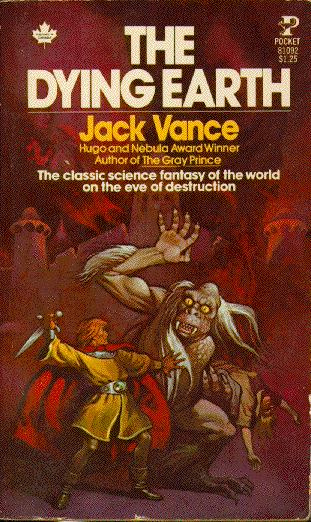
the_dying_earthDo you remember those creepy-weird montages from those old 60s and 70s era Disney movies?  The ones like Dumbo, or The Three Caballeros–or heck, the entire thing of Fantasia–where all these weird kaleidoscopic shapes and psychedelic colors just move in and out of each other in twisted, convulsing ways?  Well, guess what?  Jack Vance’s The Dying Earth is like one of those montages in written form, and I loved it.
I picked up this book in order to familiarize myself a little better with the Sword & Planet subgenre, which I’d like to write in (as you may remember … my WIP is currently on hold, but I’d like to pick it up again soon).  This one is a lot different from the Princess of Mars series, with an eerie apocalyptic feel, arcane magic and forbidden knowledge, weird, monstrous creatures, and above all else, a decidedly un-Disney fairy-tale feel that pervades the book with doom and danger.

If you’re looking for straight-up Science Fiction, you’re better off looking elsewhere.  This book is even more fantastic than Ray Bradbury’s stuff, and while there’s a little bit of a sci-fi dressing thrown in, there really is no scientific justification for anything.  The basic premise is that the Earth is dying, meaning that the sun is growing dimmer and dimmer and will soon go completely out.  The last few people eking out an existence on this planet are mostly wizards and witches, each one intent on building their own little empire and cheating or stealing from everyone else.  There are a few pure-hearted souls, but the world is completely lawless, and the only way to survive is through magic or brute force.

The chapters are really more like interconnected short stories, where each one stands on its own, and yet may feature a recurring character, or be set in the same place as another.  There were only six chapters in the version I read (the 1977 Pocket Book edition), which makes me wonder if I missed any.  If I did, I would definitely like to read them, because the stories were absolutely mesmerizing!

Because I read this book to get a feel for the sub-genre, I’m going to list some of the things I really enjoyed about it.  Here they are:

  • The fairy-tale story structure.  None of the chapters started out with “there once was a …” but it certainly felt like they did.  Each character started off with a quest or dilemma, and then went on a journey of some sort where they faced trials, made friends, and defeated enemies in order to attain some sort of boon at the end.
  • Lots and lots of world-breaking magic.  Seriously.  One of the guys sets out on his journey with a spell that basically keeps him from any danger whatsoever, so long as he stays on “the path.” Since he really has no idea where he’s going, “the path” is basically any path he chooses to travel.  Since all the rest of the magic is just as world-breaking, you have no idea what could happen next.  There’s always a sense that anything could happen.
  • An elevated sense of diction.  The characters don’t speak like we do, they speak like people from the 18th or 19th centuries, with words like “thus,” “whence,” “wherefore,” and grammatical structures like “I know not,” and “half yet remains.” It’s not just the characters, either–the whole book is like that.  It really adds to the fantastic, otherworldly feel.
  • Lots of contrasting extremes.  The demons are truly perverse and sadistic, with death and brutality on every other page.  At the same time, though, the moments of beauty and love are just as great.  My favorite line from the whole book, which practically made me cry, is “My brain is whole! I see–I see the world!” If I explained it any more, it would be a spoiler.
  • High adventure.  LOTS and LOTS of high adventure.  There isn’t a viewpoint character in the book who doesn’t leave home to go on some sort of quest through all sorts of wild and creepy dangers.  Every character is seeking something, and not in a “meh” kind of way–they are so wholly focused on what they’re seeking that they put their very lives in peril just to obtain it.  Almost all the romance is rescue-romance, of the pulpiest possible kind.  It’s awesome.

There are more, but those are the big things.  Overall, I’d say that this book is about 50% Fantasy, 30% Horror, and 20% Science Fiction, with none of the more modern conventions of any of those genres.  It was first published in 1950, but it feels a lot closer to Robert E. Howard and Jules Verne than J.R.R. Tolkien and Arthur C. Clarke.  If you’re looking for a good spec-fic throwback with lots of magic and adventure, this is a great one to check out.

Trope Tuesday: Curiosity is a Crapshoot

curiosity
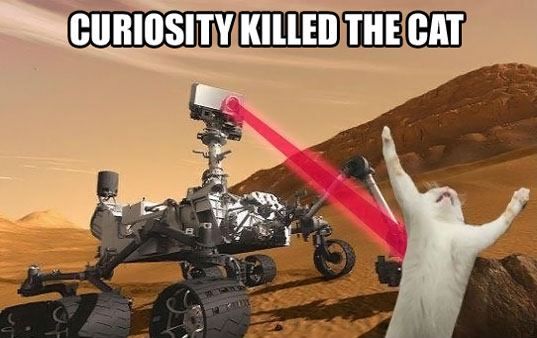
Is there life on Mars? NOT ANYMORE!

Is curiosity a bad thing?  Well, it depends how genre savvy you are.  It seemed to work out pretty well for Alice, but not quite so well for Pandora (or the rest of the ancient Greek world, for that matter).  Curious monkeys seem to come out all right, and their constantly curious counterparts also seem to do okay in the end, but anytime you run into schmuck bait you know that things aren’t going to turn out well.

The truth is, for just about every stock Aesop warning about the perils of being overly nosy, you can find another one exalting it as a virtue.  In fact, you could say that curiosity is a crapshoot.

But what is curiosity exactly?  The Merriam-Webster dictionary defines it as “desire to know,” and “interest leading to inquiry.” As you can imagine, there are situations where this could be good or bad.  Thus, what a story says about curiosity often changes depending on its genre.

For example, in most horror stories, curiosity and nosiness are usually bad, leading the protagonists to go places where they shouldn’t and uncover things that should never have been uncovered.  At the same time, a lack of curiosity can also be fatal … in fact, a lot of things can be fatal in a horror story.

In mythology and folklore, curiosity is often even worse.  From Pandora to Eve, Psyche to the proverbial cat, curiosity leads to Very Bad Things.  Perhaps this is because these kinds of stories are mostly tales of warning, passed on from generation to generation as a way to preserve our collective knowledge about the dangers of the world, rather than inspire us to go out and face them.

(As a side note, there are a few exceptions in the realm of folklore.  In the Bluebeard myth, curiosity killed off all of Bluebeard’s previous wives, but combined with cleverness, faith, and friendship, it saved the last one’s life.)

In fantasy, curiosity is often a mixed box bag.  For example, take the hobbits: most of them are perfectly content to live out their lives in the shire, but the few who are inquisitive enough to venture outside end up saving the world in a way that the elves, dwarves, and humans never could.  At the same time, it puts them through a great deal of pain, even after the world is saved–neither Bilbo nor Frodo are ever able to be content in the shire again.

Curiosity, in other words, is complicated.  It’s not just a quirk or a character flaw–it’s an underlying quality of the hero’s journey.  Without curiosity, either of the world around him or the internal struggles within, the hero would be content to live out an unremarkable life.  Certainly he wouldn’t have the capacity for the cleverness, guile, wisdom, and sensitivity that he needs in order to descend into the darkest dungeon, face his own nadir, and return with the elixir of life.  Curiosity may lead to sorrow, pain, or even death, but it also leads to adventure.

As a subgenre of fantasy, many of these issues carry over into the realm of science fiction.  And yet, as a genre unto itself, science fiction has a distinctly positive view of curiosity compared to other genres.  Science is nothing if not the primary process of human inquiry, where curiosity is not only a virtue but the virtue, one of the most important aspects of humanity.  Consider these words from Adam Steltzner, one of the leading engineers of the NASA Mars Curiosity mission:

Likewise, curiosity is a staple of science fiction.  In Star Trek, it’s the basis of the entire mission: “to explore strange new worlds, to seek out new life and new civilizations, to boldly go where no one has gone before.” In Doctor Who, it’s how the Doctor finds his companions.  In Babylon 5, it’s Delenn’s curiosity about the humans that ultimately saves all the alien races.  And in 2001: A Space Odyssey, it’s the gift from the black monolith that helps monkeys to turn bones into space stations (well, not literally, but you get the idea).

Curiosity isn’t a central theme in most of my books, but it is a major part of Genesis Earth.  If anything, that book is about the importance of balancing curiosity about our universe with curiosity about ourselves and what it means to be human.  In Star Wanderers, Noemi’s curiosity is a huge part of her story, helping her to turn around a horrible (not to mention awkward) situation.  In Desert Stars, curiosity is complicated; it leads Jalil far away from home and puts a schism between him and the girl who loves him, but it also leads him to discover the truth about who he is, giving him the strength to return.

In general, I suppose it all comes down not only to genre, but to the underlying worldview of the author of the story.  Since I have a very positive and enthusiastic view of curiosity, it usually works out for the best in the stories that I write. Then again, perhaps that’s why I’m drawn to science fiction … how about you?

Z is for Zenith

pioneer_book_scifiHas space opera passed its zenith?

Sometimes, it certainly looks that way.  All the major stuff seems to be reprints of past series and reboots of decades-old franchises.  Star Trek, Star Wars, Stargate, Battlestar Galactica, Ender’s Game, Dune, Babylon 5–all the big names seem to have had their start at least a generation ago.  At any science fiction convention, you’re likely to see more gray-haired men than kids in their teens and twenties.  And if you go to a publishing conference, new adult, urban fantasy, and paranormal romance are ascendant.

I’ve noticed that people are using the term “science fiction” increasingly to describe stories that don’t have anything to do with space.  Dystopian, post-apocalyptic, steampunk, even time travel–all of these subgenres are certainly part of the fold, but they’re very different from the stories about starships and alien worlds.  And then you have all the markets for short fiction that have been forced out of business–and even a few larger publishers, like Night Shade Books which is now selling off all its assets (read: authors) to avoid bankruptcy.

I remember going to World Fantasy 2010 in Columbus, Ohio, and feeling dismayed at the complete lack of science fiction.  World Fantasy is (or was, at least) the premier professional conference for speculative fiction literature, but all of the attention was going to urban fantasy and steampunk.  On the freebie table where publishers often dumped ARCs and review copies of their books, the only space opera stuff I really saw were a couple of titles by Glen Cook and one other guy–and I watched that table hawkishly for the full three days of the conference.

Sometimes, it seems as if it would be so much better if I had grown up in the 80s.  That’s when science fiction really had its heyday.  But all through the 90s, the genre seems to have been on the decline, much like NASA and the US space program.

So is space-centered science fiction on the way out?  Have we passed the glory days, and it’s now just a long decline until it becomes an obscure niche, beloved by some, but enigmatic to others?

In spite of everything I said above, I actually don’t think so.  In fact, I think we’re on the cusp of a science fiction renaissance, and that sci-fi geeks like myself will look back twenty years from now and wish that they were born in our era.  Here’s why:

1) Scientific discoveries are transforming the way we see the universe.

The day I posted P is for Planets, NASA’s Kepler mission announced the discovery of three Earth-like worlds orbiting in the habitable zones of their stars.  The existence of alien Earths is not conjecture–it’s a confirmed fact.  As our ability to study these worlds improves, it’s only a matter of time, IMO, before we find a world that has life.

We’ve discovered the Higgs-Boson.  We’re unraveling the fundamental building blocks of the universe.  We’ve built telescopes to look back to the dawn of time itself, and we’re learning more about the cosmology of the universe every year.  Perhaps even more remarkably, we understand now how little it is that we actually know–that the entirety of the observable universe is only about 5% of it, and even that’s optimistic.

All of this will take time to trickle down to the popular consciousness, but with all the new discoveries that are happening, I think that’s already in the process of happening.  In particular, I think the recent discoveries in the realm of exoplanets and astrobiology are going to shake things up in a major way in the next five or ten years.

2) The privatization of space travel is paving the way for a rapid expansion into space.

The US space program has been plagued with funding problems since at least the end of the Cold War space race.  Since the space shuttle program was retired just last year, the only way for our astronauts to get into space is through the Russian Soyuz spacecraft at Baikonur.  If NASA had to put a man on the moon, they do not currently have the knowledge or technology necessary to do it.

In the private sector, though, it’s been a very different story.  SpaceX has had a number of successful launches recently, most notably sending the first unmanned resupply capsule up to the International Space Station.  And just a couple days ago, Virgin Galactic had the first successful test flight of its rocket-powered spacecraft.

It’s sad to see the space shuttle go, but there are a lot of reasons why the program was flawed and inefficient to begin with.  By handing things off to the private sector and turning space exploration into a viable business venture, we can hopefully overcome those inefficiencies and eventually make space accessible to the general public.

And then you have the organizations like Mars One that are looking even further ahead to the colonization of Mars.  There’s a groundswell of excitement for Martian colonization that is starting to get some real money behind it.  Will it go anywhere?  It’s hard to say right now, but even if it suffers another decade or two of setbacks, it’s getting public attention, especially from the younger generation.

3) Video games are bringing a fresh new look and feel to the genre.

Not all of the big sci-fi series hail from 70s and 80s.  Halo started up as recently as 2001, and it’s a multi-billion dollar franchise with games, books–even Legos.  In fact, there are lots of sci-fi video game franchises right now, many of them right on par with other classic space opera.  Just look at Starcraft, for example, or Mass Effect, or Eve Online and Sins of a Solar Empire.  The number of sci-fi games has been exploding.

In fact, this explosion has been happening for some time.  While literary science fiction may have suffered something of a decline back in the 90s, that was the heyday of games like Master of Orion and Sid Meier’s Alpha Centauri.  Flight simulators like Flight Commander and X-wing proliferated like crazy, while even some of the classic RPGs like Final Fantasy borrowed heavily from science fiction tropes.  And those are just a few of the games that I can list off the top of my head!

Whether or not literary sf is on the decline, a whole new generation has been introduced to the genre through the medium of video gaming.  This is not just a small niche audience playing this stuff, either–in the US at least, Halo is as mainstream as Monopoly or Settlers of Catan.  In fact, you could say that science fiction is more mainstream now than it ever has been, and a lot of that is due to sci-fi video games.

4) The e-publishing golden age is giving us thousands of new voices.

But what about the world of literary sf?  Are we in a decline?  Do people just not read science fiction anymore?  How bright is the future for science fiction literature?

Actually, this is the area where I’m the most optimistic of all.

The publishing industry is changing at the speed of light, much in the same way that the music industry changed about a decade ago.  Just as the MP3 revolution allowed all sorts of eclectic yet entrepreneurial artists to thrive without the oversight of record labels, the epublishing revolution is opening all sorts of doors for the enterprising author.  And while the changes are driving publishers (such as NSB) out of business, they are enabling authors who only sell in the mid-list range to make a respectable living.

At Worldcon 2011, Ginger Buchanan (senior editor at Tor) asserted that there has never been a runaway science fiction bestseller.  In the eyes of New York publishing, that may be true–but New York has a notorious record for missing the catch in pursuit of one big fish.  Because of epublishing, whole new genres like New Adult that publishers thought would never sell are now going mainstream.

And even the niches that stay niches are becoming quite lucrative for the authors who can build a decent following.  When author cuts out the middlemen and develops a direct relationship with the readership, it only takes a thousand true fans or so become a financial success.  As Kris Rusch pointed out so aptly, those numbers may bring only scorn from New York, but for the writers who actually produce the content, that’s a vein of pure gold.

I can’t tell you how many success stories I’ve heard from fellow sci-fi writers over on the Kindle Boards, who started just for the grocery money and ended up quitting their day jobs.  But as Hugh Howey pointed out, the runaway bestsellers are not the true story of the epublishing revolution–it’s the little guys who only sell a few hundred copies a month but are earning enough to support themselves writing what they love.

Indeed, we’re already starting to see an explosion of new science fiction, thanks largely to the ease of electronic self-publishing.  I’ve only read a few of them so far, but Nathan Lowell stands out among them, as well as my good friend Kindal Debenham.  These guys and so many others are bringing a fresh new voice to space opera, revitalizing the genre in ways that simply weren’t economical back in the days of Big Publishing.

So even if space opera as a literary genre isn’t quite large enough to go mainstream, it is large enough to support a wide range of new voices under the emerging business models.  And as the epublishing revolution continues to mature, I think we’re going to see a new golden age comparable to the era of the pulp adventure stories.

I’ve been publishing my own work since 2011, and I can attest that there’s never been a better time to be a writer.  I’m not quite making enough to go full-time yet, but at the rate things are going, it will only be a  year or two before I realize my dream of making a living telling stories that I love.  And if they’re the kind of stories that you love too, then that’s great news for all of us!

So has science fiction reached its zenith?  I don’t think so.  It went mainstream about a generation ago, which was definitely a huge moment, but for the last few decades it’s been in the process of branching out and rediscovering itself.  Right now, I think we’re on the verge of a wonderful new renaissance that is going to blow us all away.  As a lifelong reader and writer of science fiction, I certainly hope that’s the case.  And because of the reasons listed above, I sincerely believe that it is.

Y is for Yesteryear

Star_wars_oldThey say that the golden age of science fiction is about twelve years old.  That’s definitely true for me.

My first exposure to the genre was Star Wars: A New Hope.  I saw it when I was seven, right around the height of my dinosaur phase.  Everything about the movie completely blew me away, from the Jawas and Sand People of Tatooine to the stormtrooper gunfights and lightsaber duels.  After watching Luke blow up the Death Star, I spent the next few hours running around the yard pretending to fly my own starfighter.

In a lot of ways, I’ve never really stopped.

My parents made me wait until I was nine to watch The Empire Strikes back, because it was rated PG.  Without any exaggeration, I can say that those were the longest two years of my life.  I was literally counting down days by the end, and to pass the time without going crazy, I read up on all the books about space that I could possibly find.

My father bought the original X-wing flight simulator game somewhere around then, and I soon became totally engrossed in it.  Since the 386 was our only entertainment system (no Super Nintendo–I had to visit a friend’s house for that), X-wing became the defining game of my childhood.  I spent hours and hours on that game, to the point where I knew exactly which simulated missions the characters from the books were flying and how to complete them faster and easier.

I thought The Empire Strikes Back was a little slow the first time I saw it, but it’s since grown on me, to the point where now it’s my favorite film in the whole series.  Thankfully, my parents let me watch Return of the Jedi the next day, and for the next few months my life felt utterly complete.

Around this time I discovered the Star Wars novels and soon immersed myself in them.  The Courtship of Princess Leia by Dave Wolverton soon became one of my favorites, as well as the Heir to the Empire trilogy by Timothy Zahn and the X-wing series by Michael A. Stackpole.

But it was Roger Allen McBride who first introduced me to a different flavor of science fiction with his Corellia trilogy.  As I mentioned in V is for Vast, those books had just enough of a touch of hard science to intrigue me about the other possibilities of the genre.  That was the last Star Wars series that I read before branching out into other works of science fiction.

The Tripod trilogy by John Christopher was my first introduction to the dystopian / post-apocalyptic genre, depicting an enslaved humanity after an alien invasion.  Those books really captured my imagination for a while.  The Giver was also quite interesting and thought provoking, though since it didn’t involve spaceships or aliens it wasn’t nearly as compelling.

I read a lot of fantasy in my early high school years, including Tracy Hickman, Lloyd Alexander, and (of course) J.R.R. Tolkien.  While I enjoyed those books and immersed myself in them for a while, my true love was still science fiction.  For almost a year, I watched Star Trek: Voyager religiously with my dad.  And every now and again, I’d pick out a science fiction book from the local town library and give it a try.  That’s how I discovered Frank Herbert’s Dune.

In eleventh grade, my English teacher had us choose an author and focus our term papers solely on their books for the entire year.  She suggested I choose Orson Scott Card, but I chose Cormac McCarthy instead.  I’m not sure if that was the worst decision of my high school career, or the best decision, since assigned high school reading tends to make any book feel like it sucks.  I discovered Ender’s Game the following summer, and finished it in a delirious rush at 3am the morning after checking it out from the local library.

More than any other book, Ender’s Game cemented my love for the genre, and showed me just how powerful and moving the genre could be.  It opened so many insights into the world and human nature, reading that book made me feel like I’d opened a pair of eyes that I didn’t even know I’d had.  Looking back, that was probably the moment when I knew I would be a science fiction writer.  I’d known I was going to be a writer ever since I read A Wrinkle in Time at age eight, but to be a science fiction writer specifically, that goal was probably cemented by reading Orson Scott Card.

After high school, I served a two year mission for my church, during which I didn’t read any novels or watch any TV or movies.  When I came back, though, Orson Scott Card and Madeline L’Engle helped me to ease through the awkwardness of adjusting back to normal civilian life.  When I left for college, I expanded my horizons even further, starting with Isaac Asimov’s Foundation series and Edgar Rice Burrough’s Princess of Mars.

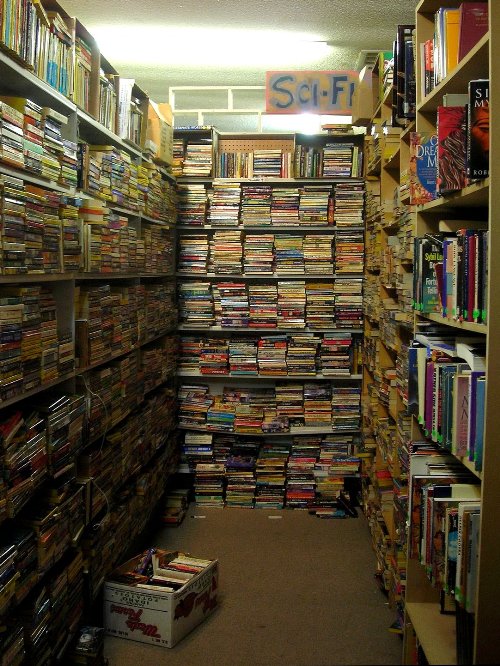
When I discovered Pioneer Books in downtown Provo, I knew I’d found my favorite bookstore in Utah Valley.  I have so many fond memories sitting cross-legged on the floor in the science fiction section, browsing through the musty used books for hours at a time.  That’s where I discovered C.J. Cherryh, Arthur C. Clarke, Robert A. Heinlein, Ursula K. Le Guin, and numerous other authors who are among my favorites today.

When I discovered Spin, Robert Charles Wilson soon became one of my favorites.  I picked up that novel as a free PDF from Tor, and read it over the summer while studying abroad in Jordan.  Once again, that same hard sf sensibility I’d gotten from Roger Allen McBride touched me in an unforgettable way.  But it was the human element of that book that really moved me–in fact, it’s always been about the human element.  The world building in Downbelow Station was great and all, but the romance of Merchanter’s Luck had a much more lasting impact.  Starship Troopers had some good ideas, but it was Mandella’s personal journey in The Forever War that moved me almost to tears.  The intrigue of the Ender’s Shadow series was quite entertaining, but it was Ender’s Game and Speaker for the Dead that really taught me what it means to be human.

I finished my first novel, Genesis Earth, shortly after returning from that study abroad, and tried to capture the same sensibility from Spin as well as the intimately human element.  Since then, I’ve written several more sci-fi novels, some of them tragic, some triumphant, but in all of them I’ve tried to get as close as I can to the personal lives of the characters.  I don’t know if I’ll ever write a character portrait so intimate as Shevek’s in Ursula K. Le Guin’s The Dispossessed, but I certainly hope to someday.

For me, science fiction started out as a wonderfully exciting entertainment and turned into something much more meaningful.  If there’s anything the genre has taught me, though, it’s that the two aren’t mutually exclusive–that you can have your adventure and learn what it means to be human as well.  Indeed, the more imaginative the adventure, the greater the truths I’ve taken from it.

Because of that, even though I’m almost in my thirties now, I can’t possibly foresee a time when science fiction isn’t a major part of my life.  It’s a love affair that’s grown just as much as I have, and continues to grow with each new author I discover and each new book I write.  When I’m old and grizzled and pushing eighty, I’m sure there will still be a part of that twelve year old boy in me, still running around the yard flying his starship.

X is for Xenocide

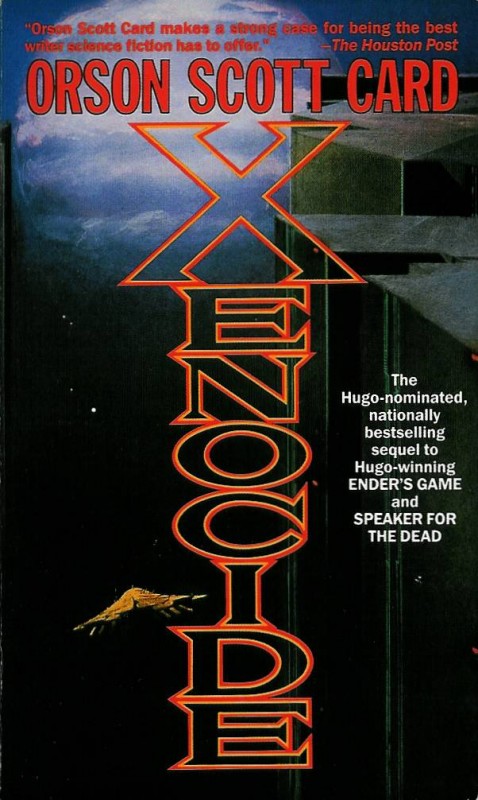
xenocideThis post isn’t just about the third book in the Ender’s Game series–it’s about the genocide of an entire alien race, which is actually a fairly important trope in science fiction.

Of all the evils of our modern era, perhaps the most heinous is the systematic extermination of an entire race or ethnicity.  These acts of genocide not only cross the moral event horizon, they create specters and villains that live on from generation to generation.  Just look at how the Nazis are portrayed in popular culture–even today, they are practically mascots of the ultimate evil.

And for good reason.  There really is something evil about the total annihilation of a foreign culture.  It’s one of the reasons why terms like “genocide” and “ethnic cleansing” are so controversial, especially in conflicts that are still ongoing–and there are so many unresolved conflicts where the systematic and purposeful annihilation of a race or culture is still happening.

Is wholesale genocide a phenomenon unique to our modern age?  Probably not, but modern science has enabled it on a scale that was previously impossible.  This became all too clear to us after World War II.  Only a generation before, great numbers of people believed that we were on a path of progress that would eventually culminate in world peace.  If there was any of that sentiment left, it was shattered with the liberation of Auschwitz and the bombings of Hiroshima and Nagasaki.  Suddenly, we realized that systematic mass destruction and genocide were not only possible, they were a modern reality.

It should come as no surprise, then, that science fiction immediately began to explore this issue.  From Frankenstein to 1984, science fiction has been full of cautionary tales of science gone wrong, issuing a critical voice of warning.  But after 1945, it went much further, exploring the issue in ways that can only be done in a science fictional setting.

Is genocide ever morally justifiable?  In our current world, probably not, but what if an alien race was bent on our destruction?  If their primary objective was the utter annihilation the human race, and negotiation was impossible?  Wouldn’t it be justifiable–perhaps imperative even–to stop such a race by annihilating them first?

This is what is meant by the term “xenocide.” A portmanteau of “xenos,” the Greek word for stranger, and “genocide,” it denotes the complete extermination of an alien race.

Xenocide forms the core conflict of Orson Scott Card’s Ender’s Game series (hence the title of the third book) and features in The Forever War by Joe Haldeman.  Battlestar Galactica presents an interesting twist, where the cylons debate the ethical questions surrounding the complete annihilation of the humans.  And then, of course, there’s all the time travel stories involving Hitler–let’s not even go there.

The interesting thing about xenocide stories is that even though they describe a dilemma that does not currently exist in our modern world, they inevitably come down to issues of Otherness that lie at the very core of the evils of genocide.  In order for xenocide to be morally justifiable, you have to know your enemy well enough to know that there’s no possibility of forging any sort of peace with them.  And to know them that well, they cease to be quite so alien.  It’s one of the major themes in Orson Scott Card’s work–that to defeat an enemy, you have to know them so well that you can’t help but love them.

In our modern world, genocide is only possible when an ethnic group is relegated to the position of Other–when they are made out to be so different and unlike us that we can never possibly relate to or mix with them.  They become “sticks” (Germany), “cockroaches” (Rwanda), “animals” and “barbarians” (Israel).  That is precisely why it makes us uncomfortable in stories about xenocide–because it turns the well-intentioned saviors of humanity into knights templar, or possibly the very monsters they are trying to destroy.

By positing a situation in which genocide might actually be justifiable, science fiction helps us to understand exactly why it is so reprehensible–and that’s only one of the ways in which the genre can uniquely explore these issues.  That’s one of the things I love so much about science fiction: its ability to take things to their extreme logical conclusions, and thus help us to see our own real-world issues in ways that would otherwise be impossible.

Since most of my characters are human, xenocide as such isn’t a major theme in my books, but genocide certainly is.  In the Gaia Nova series, the starfaring Hameji look down on the Planetborn as inferior beings and think nothing of enslaving them and slagging entire worlds.  That’s how Prince Abaqa from Stars of Blood and Glory sees the universe at first, but by the end of the novel he’s not quite so sure.  Stella from Sholpan and Bringing Stella Home also deals with these issues as she comes to realize how it’s possible for the Hameji to hold to such a belief system.

If genocide is one of the ugly skeletons in the closet of this screwed up modern world, then xenocide is science fiction’s way of taking those skeletons out and dignifying them with a proper burial.  By wrestling with these issues in stories set on other worlds, we are better able to humanize the Other and prevent these horrors from happening again on our own.  In this way and so many others, science fiction helps us to build a better world.