
What do you want to see more of in author group promotions?

For the last several months, I’ve quietly been running these Christian Author group promotions on Book Funnel and Story Origin. I started them in response to some other group author promotions that I saw floating around on Facebook, with banners that have the standard woke progressive litany. You know how it goes: in this home, we believe that love is love, science is real, black lives matter, vaccines are yada yada yada.

Anyway, I saw those super left-wing promotions floating around, and thought: how can I signal to the readers who think that woke nonsense is insane that I also think it’s insane and don’t have any of that woke crap in my books? In other words, how can I organize a group promotion for non-woke authors without actually coming out and saying “we aren’t woke!”

The reason I don’t want to just come out and say “we aren’t woke!” is because if that’s the way you define yourself, you’re going to be overtly political, just in the opposite direction. For that reason, books that advertise as “anti-woke” are often just as terrible as woke books—or in other words, just as infected with toxic politics. Since the whole point was to get away from the toxic politics, I wanted to anchor the promotions on something that is very much antithetical to the woke nonsense, but not overtly political.

Hence the reason I settled on Christian authors as the theme: not on overtly Christian books, but books that are written by Christians. The thinking was that authors who self-identify as Christians probably wouldn’t go for all that woke nonsense that is, after all, antithetical to Christian teachings, and that readers who want to read Christian authors are also probably trying to avoid fiction that is infected with woke ideology.

Then I read Church of Cowards by Matt Walsh, and I realized that my plan had a fatal flaw: Christianity itself has become so infected with woke ideology that it no longer serves as an effective filter or signal against it. Of course, I knew that this was a problem, but I didn’t know serious the problem had become. In my church, we all still dress in church clothes on Sunday, still actually go to church on Sunday, believe in scripture as the literal word of God, and, you know, accept Jesus Christ as our Lord and Savior. Apparently, all of those points are now super controversial among those who profess to be Christians. Go figure.

Also, Christian fiction comes with its own baggage that isn’t doing these group promotions any favors—which is a shame, because it’s not the books that are explicitly Christian, just the authors themselves. But apparently, Christian fiction has become so sappy and poorly written that I can hardly blame most readers for looking at those banners and thinking “uh, no thanks”—even the believing Christian readers. In particular, Matt Walsh took apart the God’s Not Dead series, which is apparently worse than most self-published stuff. Also, I tried out Left Behind last month, and DNFed it before the end of the first chapter just because of how ludicrous the setup for that book/series is.

(Seriously, Russia makes an alliance with… Ethiopia? …and randomly decides to wipe Israel off the face of the Earth, only to have their ENTIRE AIR FORCE destroyed in a day by a supernatural event? Every combination of the words in that sentence is laughably nonsensical to anyone who follows contemporary geopolitics. The current situation in the Middle East, with Russia and Iran basing forces in Syria, and Iran supplying Russia with kamikaze drones, is a more believable fulfillment of the Gog and Magog prophecies—and that’s before the Russo-Ukraine war spirals into a global conflict. Reality is far more terrifying—and far more Biblical—than anything the Left Behind series cooked up.)

With all of that in mind, it’s not much of a surprise that these Christian Author promotions have underperformed, not just among my existing newsletter subscribers, but among readers generally. So now I’m looking to try out some different themes for group promotions. Some of them are going to be totally non-political: I’ve always had success with the September Space Adventure group promo, after all. But how to reach that reader who thinks that this woke nonsense is insane?

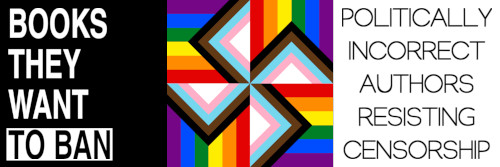
The second banner might be a little too on-point (not to mention, it may get me banned from a few places), but I’m trying out this Books They Want to Ban theme again right now. I did something like it a while ago, and it didn’t do super well, but it’s worth running at least a couple of times to see how it goes.

So what do you think? Should I try running with this theme, or just totally avoid the woke / anti-woke politics altogether?
Things I learned in 2014 (Part 1)

Last week, Kris Rusch wrote an interesting blog post reflecting on 2014 and things she observed that indie writers learned, so I thought I’d do something similar and reflect on some of the things that I learned last year about the business and the craft. Here goes!

Readers of SF&F want longer books.

I did a lengthy blog post about this earlier, but the basic gist of it is that readers in my genre want longer, more immersive books. There’s a place for the short stuff, especially for high concept sci-fi, but most readers of speculative fiction want worlds they can get lost in with characters that become their best friends. It’s practically impossible to do that in a story that takes less than an hour to read, so to satisfy those readers, you’ve got to write long.

You can’t have a healthy career with only one income stream.

Between 80% to 90% of my income in 2014 came from Amazon. Times were good in the spring and summer, but then Amazon launched their ebook subscription service (Kindle Unlimited). None of my books were enrolled in KU, but because of the way that Amazon skews the rankings to favor KU books, my Amazon royalties took a huge hit.

I knew back in 2011 when I started that I needed to cultivate multiple income streams if I wanted to have a steady career, but I’d gotten complacent. Since my Amazon earnings were paying all the bills, I figured I was doing all right. But you can’t measure the healthiness of a career in just the revenue it’s bringing in right now; you’ve got to look at contingencies for the future, including the worst case scenario.When most of your revenue comes from a single client, that makes your career far too brittle.

So looking to the future, I can’t say that I have a healthy, steady career until I’m earning at least as much from all my other income streams as I am from Amazon.

I’ve been relying far too much on Amazon’s algorithms.

Related to the last point, I learned that I’ve been relying far too much on Amazon to sell my books. In fact, I can say that the Amazon algorithms were the linchpin of my marketing strategy (inasmuch as I actually had one, heh).

Amazon has the best book recommendation engine in the industry by far. It’s done a lot for my career, connecting my books with many readers who have gone on to become fans. But what the algos give, the algos can take away. To build a career with staying power, you have to constantly work to find new readers in a variety of different ways.

I’ve always believed that cream rises to the top. That said, if you’re starting at the bottom of the ocean, you’ve got a long, long way to rise. Up until now, I’ve been operating under the belief that readers will find me without me making much of an effort to find them. I learned this year that you’ve got to meet in the middle. You don’t have to hand sell every book (thank goodness!), but you do have to make an effort to make your books visible somehow.

A well-articulated negative review does more to sell books than a blasé positive one.

This one surprised me. When I published Brothers in Exile (Sons of the Starfarers: Book I), it garnered a fairly painful two-star review on Amazon about a week or two after launch. The review had some positive things in it, but it also had some negative things that were pretty spot on. Being the angsty writer that I am, I thought my chances had tanked. Instead, sales of the book immediately shot up, and stayed fairly high for about a month.

Readers aren’t stupid. They understand that not everyone has the same tastes in books, and parse their reviews accordingly. A negative review that is articulate and well-reasoned will lend a lot more credibility and cultivate a lot more interest than a string of positive reviews that lack any real substance. It sounds counterproductive, but it’s often the negative reviews that sell the book.

Sometimes you actually can get the best results by doing it yourself.

When I redid the covers for the first three Gaia Nova novels, I decided at first to hire a cover designer. For various reasons, though, that didn’t work out, so I decided to do them myself. I’d done the typography myself on the old ones, and let’s just say they left something to be desired.

The reason I wanted to hire the work out was because I didn’t think I’d get the best work if I did it myself. I figured that if I hired someone who was an expert in it, it would turn out so much better. Instead, when I did it myself, I discovered that my own skills had improved to the point where I could produce really good work myself.

It is possible, especially in self-publishing, to become so skilled at every aspect of the production process that you can do it all yourself and still produce a quality book. The learning curve is so sheer that it’s practically a cliff, but you can do it. And even if the work that you produced at the start of your career wasn’t all that good, you can improve to the point where your work is on par with that of professional designers.

The trouble is, it takes so much time and effort to get to that point that you may be better off hiring the work out. It takes a certain type of personality to DIY everything and produce a quality product without feeling overstretched. I’m pretty sure that’s my personality type, though of course I still have a lot to learn. But just because it’s DIY doesn’t necessarily mean it’s going to be of an inferior quality.

There are other things I learned in 2014 about the craft and business of writing, but this post is starting to get long so I think I’ll table it for the next post. Take care!

How going indie is like driving a manual (plus a cover reveal)

A couple of weeks ago, I got a new (to me) car. It’s a 2005 Ford Focus / Saleen: a two-door hatchback that drives like a racing car and gets about thirty miles per gallon (WA-A-AY better than the gas guzzler I was driving before). It’s also a manual transmission, which is perhaps the biggest difference between this and my previous car.

This is my first time driving stick shift, and I have to say, it is a lot of fun! When you drive a stick, each hand and each foot is doing something different. There’s a lot more to keep track of, and if you do things in the wrong order (like braking without engaging the clutch, or starting without giving it some gas), you run the risk of making the car stall or doing nasty things to your transmission. On the other hand, driving a manual gives you a much better feel for the engine and what it’s capable of. You can feel when you’re putting too much stress on it–or alternately, when you can push it a little further.

I usually like to walk everywhere, but ever since I got this car, I just want to drive it! It’s way more fun than driving an automatic, even with (or indeed, because of) the extra challenge. So today, while I was walking to BYU campus (alas, the parking situation there makes driving a major pain), I got to thinking about it, and I realized that driving a manual is a lot like being an indie author.

When you’re an indie, you have a lot more things to juggle, just like driving a manual. This gives you much greater control of your career, but it also makes it easier to stall or screw up. At the same time, because of that extra control, you’ve got a much better feel for the market, and probably a better connection with your readers. And for me at least, the extra challenge doesn’t make it less enjoyable, it actually makes me enjoy it more!

Nothing Found

This week, I had the first day where I sold 100+ books in a 24 hour period. That was pretty awesome! I’ve been running a $.99 sale for Star Wanderers: The Jeremiah Chronicles (Omnibus I-IV), and it got picked up by a couple of ebook sites that really pushed it in the right way. Now that I know how to run a sale like that, I hope to do it again, perhaps for Black Friday. And if you haven’t picked up this one yet, it’s on sale for $.99 through Friday.

Marketing and promotion is one of the harder parts about going indie for me, kind of like how finding the clutch point and starting without stalling is hard when you first drive a manual. The more that I practice, though, the better that I get at it, and the more I enjoy it.

Another area where I think I’ve more or less stalled is in my covers. When I put out the first few Gaia Nova novels, I spent a fair amount of money hiring out artists to do the illustrations, but I did the typography myself. On those earlier covers, it definitely shows. For my later books, I worked with a bunch of cover designers, and seeing their work made me realize that there’s definitely room for improvement on those earlier ones, especially for the print editions.

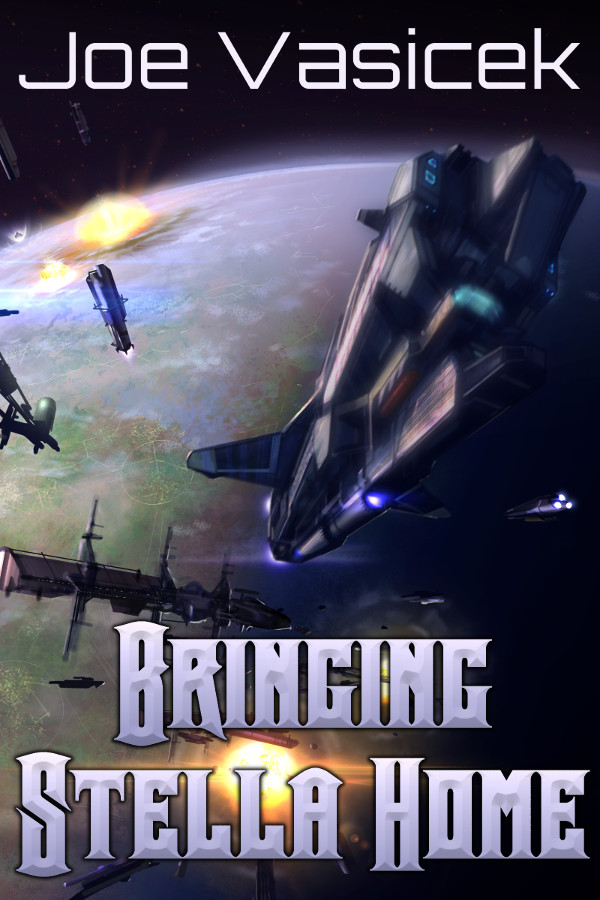
I’ve decided to redo the covers for those three novels (Bringing Stella Home, Desert Stars, and Stars of Blood and Glory), keeping the illustrations but changing the typography. I tried to find a cover designer to do it, but I wasn’t able to find one that did satisfactory work, and after playing around with them for a bit I think I can actually do them myself. I’ve got a lot more experience with covers and cover design now than I did when I was starting out, and I’ve learned a few photoshop tricks as well.

In any case, here is what I came up with for Bringing Stella Home:

BSH (cover)How do you like it? I rather like how it turned out, though I’ll admit I’m still learning. I did the new design just this morning, so I figure I ought to wait a couple of days and maybe seek out some feedback from professional designers before I go through with it.

I hope to have the new edition out before the end of the month. The content and story will all be the same, but the cover and metadata will be updated, and some minor errors such as typos will be fixed. I also hope to do the same thing with Desert Stars and Stars of Blood and Glory. Once the new editions are out, I’ll probably run some sales and giveaways with them, so definitely stay tuned!

As for my other projects, the next book in the Sons of the Starfarers series is out with my first readers, so it’s on track for a January release. My next WIP is The Sword Keeper, a fantasy novel I think I’ve mentioned before, and I hope to get that one knocked out in about a month or so. It’s already halfway finished, so the hard part is just ahead. There are also a couple of Gaia Nova novels that I’ve been meaning to get around to, and probably will before the end of the year.

That just about does it. Look out for more covers soon! I’m definitely having fun with the new ones. 😀

Thoughts on declining sales and the summer slump

According to conventional bookselling wisdom, summer is the slowest time out of the year for book sales. But is that really the case? I’ve heard David Gaughran and Ed Robertson argue that that’s just a myth perpetuated by New York publishers who are completely out of touch with their readers. Sales don’t fluctuate with the season so much as with promotions and new releases, so the argument goes.

Well, it’s been three years since I started self-publishing, and I still have no idea whether there’s a slump or not. June was my best month ever, but sales have fallen off sharply since then and it looks like August is going to be the worst month of the year. I wish I could blame that on the summer slump, but last year, June was also my best month, and sales after that held more or less steady.

It’s a hard thing to watch your main source of income fall more than 50% over the course of seven or eight weeks. More than anything else, it’s reinforced to me that I cannot afford to rely on just one income stream. Most of my sales come through Amazon, but I need to figure out ways to promote and market my books on the other venues. Relying almost exclusively on Amazon is like putting all your officers in the same shuttlecraft.

How much of the decline has to do with the launch of Kindle Unlimited last month? I don’t know, but it’s making me nervous. None of my books are available through KU because Amazon requires exclusivity in order to be enrolled in the program. That’s not something I’m willing to give them, at least with my already published books. But I may enroll one of my future books in the program, just to see what it’s about.

Honestly, though, I think the slump has more to do with my own lack of promotion and the fact that I haven’t had a new release for two months. When Strangers in Flight (Sons of the Starfarers: Book 3) comes out next month, I hope that will change things around.

I think it’s also good to remember that books don’t spoil. In a certain sense, it doesn’t matter when a book comes out–when a reader discovers a book for the first time, to them, it’s something new. My Star Wanderers series has been out for a while, but there are still a lot of people who have never heard of it and would probably enjoy it. I’ve got to find ways to get at least the first book into those people’s hands.

I really, really suck at marketing though, as you can probably tell from the fact that I’m blogging about writerly business stuff that isn’t all that interesting to the average fan. 😛 Until now, I’ve been relying mainly on the strength of my writing to sell itself, but that probably isn’t the best strategy.

And that’s one of the other problems with the idea of the summer slump–it lulls you into thinking that things will pick up on their own once the summer is over. Well, that’s one rude awakening that I’d rather avoid if I can help it. In this case, the path of least regret is to assume that the slump is a myth and get back to work, dammit. Because even if it isn’t, it’s not like the extra marketing is going to hurt you.

Enough with the boring business stuff. Here’s Grant Thompson doing the ALS ice bucket challenge with dry ice. Enjoy!

M is for Marketing

Whenever indie writers get together to talk shop, the discussion almost always turns to marketing. How to sell more books and get more readers–that’s what everyone wants to know.

Honestly, I’m not much of a marketing expert. My approach to marketing can basically be summed up in one sentence: “figure it out later.” That is not a good long-term strategy! And yet, in a weird and crazy way, it’s actually kind of worked.

A lot of people say that you have to market your books–that if you don’t spend XXX amount of time on it, or do XXX number of things, or hit XXX goal, that you’re doing it wrong. And because most writers have this weird sort of guilt complex built around how we work, we absorb these “rules” into the list of other things we feel guilty about and beat ourselves up for not doing it–or worse, spend way too much time and effort doing things that aren’t really working, simply because we feel that we have to.

Right from the start, I figured that that mindset was just silly. Good marketing isn’t about following rules, it’s about doing things that bring results. When I first started out, I figured I didn’t have enough books out to warrant any sort of a marketing push. What good is it to bring a bunch of people to your store if the shelves are all empty? So for the first several years, I focused almost entirely on writing more (and better) books.

That’s not to say that I didn’t do any marketing at all. Here are some of the things I’ve tried out so far, and whether I decided to keep them or not:

  • Putting sample chapters at the end of each book — I eventually realized that doing this pads the end of your book and makes readers feel cheated when they hit the 85% mark and realize that the story is over. Instead, I now put a short teaser and a picture with the cover.
  • Exchanging short blurbs with other writers — I tried this out with my friend Kindal Debenham, where we both inserted book teasers for each other at the end of our books. I have no idea whether it’s worked or not, but it’s something I’d do again with my fellow author friends.
  • Making a couple of books permanently free — Free is an awesome way to move a large number of books very quickly, but in order for it to boost the sales of other books, I’ve found that 1) it has to be a complete story, 2) it has to be its own unique story, not just based on an excerpt, and 3) it has to be directly connected with the other books in some way, such as the first book in a linear series. Of course, that’s just my own experience–I’m sure there are people who manage to make it work doing it differently. Free is great because it takes off a lot of the pressure and makes your book a much easier sell, not just for you, but for your fans to share with their friends.
  • Going on blog tour — I did a couple of small blog tours for my first couple of books, and while I didn’t see a huge explosion of sales from it, it’s something that I would do again. In general, though, I think that blog tours are better for retaining existing fans and keeping you fresh in their minds than it is for acquiring new ones.
  • Ending every book with an author’s note — I’ve found that this is a great way to build relationships with your fans–to become more than just another name on a book to them. The fan mail I’ve gotten from readers who mention the notes is great, and I think it’s converted at least a few casual readers into genuine fans. That said, I have gotten some negative feedback too, so these days I try to keep them short and unobtrusive for those who don’t care to read them.
  • Being active on social media — When my Star Wanderers books first really started to take off, I was teaching English in a developing country where my internet access was limited. Consequently, I’m extremely skeptical of any marketing advice as it relates to social media. That said, I think it’s a great way to connect with your fans if it’s a platform that you enjoy. I’m not really keen on Facebook, but I do enjoy Twitter, so that’s a good place to find me (my handle is @onelowerlight).
  • Keeping an email list for new releases — This is one thing that other successful indies seem to encourage the most. My list is only about a hundred strong right now, which is not enough to lead to a huge explosion of sales, but the results are direct and measurable. It’s definitely something that I’ll continue to do.
  • Participating in a group promo with other authors — I’ve had mixed results with this. In 2012, I did one that resulted in several thousand downloads and boosted my Star Wanderers series to a whole new level. But in 2013, I did another one that completely fizzled. In general, if the group promo seems pretty well organized, I’ll participate in it, but if it seems that the organizers don’t really know what they’re doing, I’ll back out.
  • Advertising on a site/newsletter like Bookbub, Kindle Books & Tips, Ereader News Today, etc. — This is something I’ve just started to try out, and the results have been astounding. Some sites will give a much bigger boost than others, but the ones that do work can work extremely well. Of course, I’ve only tried this with Star Wanderers: Outworlder (Part I), which is free–I’m not sure how effective it would be at moving paid books.

If there’s one thing that I’ve learned, it’s that marketing doesn’t have to feel sleazy. In fact, when you’re doing it right, it almost never does. For every book that you write, there is someone out there who would love to read it–good marketing is about connecting those people with your books, helping them grow into their natural audience.

Marketing is definitely important, but it’s not something that you have to guilt yourself over or treat like a chore. In fact, it can actually be a lot of fun! I’ve certainly made my own fair share of mistakes, but I’m learning from them and trying out new things. So long as you base your marketing decisions off of measurable results and not a particular dogmatic position or someone else’s opinion, you’ll be in good shape–even if your plan is to figure it out later.

L is for Launch

How important is it to have a massive book launch whenever you release a new book?

I think the answer to this question varies from genre to genre. For the more mainstream genres where word of mouth is driven by general popularity, such as romance or thriller, it’s probably fairly important. For more niche genres like science fiction that are driven mostly by a dedicated core of fans, it’s not as crucial as you might think.

The reason most often cited for doing a big book launch is to try to get onto the rolling 30 day and 90 day new release lists on Amazon. When I published Genesis Earth back in 2011 before the publishing landscape flooded with indie books, I saw decent sales for the first 90 days, probably because that book was on the list. That happened more by accident than design, though, and it would be much harder to replicate now.

In general, I think that indies tend to overemphasize the importance of the new release lists. On forums like KBoards, I’ve even heard some writers go so far as to say a book is dead after the first 90 days. That runs contrary to my own experience–in fact, I doubt that it’s true even in the mainstream genres. Ebooks are forever, and there are all sorts of things that can give a book wings after months or even years from its initial launch.

That said, I do try to do a couple of things whenever I have a new release:

  1. Mention it on social media and here on my blog. I don’t generally send out those annoying “buy my book!” posts, but when I have a new book out, I figure it’s worth a mention since my readers are going to want to know.
  2. Send out an email to my mailing list. That’s the only reason why the list exists–to announce new releases. Typically, though, I wait until the book is up on multiple retail sites, so that I can include most if not all of the links.
  3. Put up the book on the sidebar of my blog. Ever since I got rid of all the typical blogging widgets (like calendars, tag clouds, archive lists etc) and dedicated the sidebar almost exclusively to my books, I’ve sent a small but steady trickle of traffic in that direction. The sidebar links aren’t comprehensive, but most of my books are up there.

That’s about it. As you can see, nothing too fancy. My book launches tend to be fairly quiet, and that works just fine for me.

At the same time, though, I kind of wonder what would happen if I tried for a more aggressive launch. When I was first starting out, it didn’t make much sense because I didn’t have much of a platform or very many books out. Now, though, I wonder if putting a bit more emphasis on a new release will yield measurable results.

When I release Brothers in Exile in May, I’m going to try out a couple of things to give it an initial boost. I already have it listed on Goodreads, and I’ll post a few short excerpts from it here on my blog in the days leading up to and immediately following its release. Beyond that, I don’t have any firm plans, but I would like to do a few guest posts and maybe run a couple of promos.

As you can probably tell, I’m not a huge expert on how to run a massive book launch. What I do know is that in some genres at least, you can succeed without going all out on them. Throwing a massive launch probably isn’t going to hurt you, but it’s not like that’s your only hope for ever breaking out.

Novella woes and farmers markets

Today I wrote about 2.6 words in my current WIP (Sons of the Starfarers), which didn’t really feel like it because I was constantly getting distracted.  Still, 2.6 words is pretty solid–it’s about mid-range for me.  If I can hit that every day from here on out (which is doubtful, but hey), the rough draft should be finished before the end of the month.

The crazy thing is that I just hit the inciting incident at the end of today’s writing session, after passing the 6k word mark.  For a mid-sized novella, that’s pretty late.  In the classic three act structure, the inciting incident usually hits between the 12%-15% mark, but this one is well past 20% for a 30k word novella–and just barely at 16% for a 40k.

So in layman’s terms, how long is this book going to be?  Probably longer than any of the Star Wanderers stories, but not quite as long as Genesis Earth.  It probably won’t turn into a full-fledged novel, since there’s only one viewpoint character, but I can already tell that it’s going to flirt with the line between novella and novel.

We’ll see how it turns out.  I’m still really excited about this story, and even though I don’t have a clear idea how to write the ending, I do know exactly how it’s going to end, if that makes any sense.  I’ve got a clear idea of the series arc that this book is going to set up, but I don’t yet have a clear idea of the book’s self-contained arc.  Once I figure that out, maybe I’ll be able to trim it down to a 30k novella after all.

============================================================

I visited the Stadium Farmer’s Market in Provo for the first time today.  It was pretty neat–lots of great produce, a nice community atmosphere, and a few quirky things like Jalapeno Jelly and tie died baby jumpers that you can’t really find in a mainstream grocery store.  I came away with some excellent peaches and a hankering to come back next week for more.

Anyhow, the trip got me thinking how indie publishing is kind of like a farmer’s market.  You’ve got everything from the guys who sell their produce out of unmarked paint buckets (writers who toss their books up to amazon with hardly a thought) to the local farm operations with pretty banners, pretty baskets, and laminated fact sheets drilling down on every possible difference between Elberta and Briscoe peaches (writers who go to great lengths to organize their own small presses and become Facebook/Twitter/Blogging personalities).

Almost everyone gives away free samples, which actually does a lot to drive sales.  In a similar way, most indie writers either have a couple of perma-free titles or free-pulse their books.  Everyone at the farmer’s market tries to be friendly and reach out to the customers (kind of like authors on Facebook and Twitter), but for me personally this kind of drives me away.  A good entertaining sales pitch, though, can be quite interesting.  I listened to the guy selling honey for almost twenty minutes, going on and on about his wares.  It’s clear he’s in a business that he loves.

Even though the fruit in the farmer’s market tends to have more blemishes than the stuff you find in the mainstream store, it is WAAAY more fresh and delicious.  Similarly, the stuff from the mainstream presses might be a lot more edited and polished, but the true innovation and formula-breaking stuff is happening in the world of self-publishing.  Publishers want things to be more predictable and formulaic so that they can have a better idea how something is going to sell, but indies are free to try almost anything.

Those aren’t the only parallels, either.  The more I think about it, the more it seems that being a self-published indie writer (or “author-publisher,” a newer term that I think I actually prefer) is a lot like being a local small farmer.  I’m sure there are differences, but the similarities are quite striking.

And now I’m really wishing I’d bought some of that honey.

Read an Ebook Week 2013 at Smashwords

EB_RAEBW_LOGO_v1Aswlogo

In case you didn’t know, the first week of March is Read an Ebook Week. Apparently, this is something that the early adopters of ebooks started back in 2004 to help popularize the new reading format and break down some of the initial wariness from the general public.

Well, Smashwords does a Read an Ebook Week promo every year, and I’ve enrolled all of my books at a 50% discount.  If you want to check out one of my $.99 short stories like “Memoirs of a Snowflake,” or Part II (Fidelity) and Part III (Sacrifice) of the Star Wanderers series, you can now pick those up for free.  If you want to try out one of my novels, like Bringing Stella Home or Desert Stars, they’re all under $3.  In fact, with the promo code REW50, all my books are under $3 on Smashwords right now.

Also, if you’re a Smashwords affiliate, I’ve juiced the affiliate bonus for all of my titles to 35%.  Since I sell all my full-length novels at $4.95, you can make about $1.75 for each referral–almost the full 85% for a novel selling at $2.99.

Some indie writers aren’t too keen on Smashwords, but I’m definitely a fan of the site.  Mark Coker has done a lot of great things, opening doors and breaking down walls to help us get our stories out to the world.  He’s also been good to readers, especially international readers, who have to pay an extra $2 surcharge for any ebooks they buy on Amazon.

Once you purchase a book on Smashwords, you have access to multiple DRM-free formats, including mobi (Kindle), epub (Nook, Kobo ereader), PDF, and straight up HTML for online reading, among others.  Anytime the author uploads a new version, you have access to that as well (or any of the previous versions since the initial purchase).  All the books are screened before going up on the site, so the formatting is generally pretty clean.

So yeah, between March 3-9, feel free to check out my books on Smashwords!  And while you’re at it, check out some of the other great authors as well.  There’s a lot of good stuff up there–a lot of black swans that would never have made it in traditional publishing, but thanks to the ebook revolution now have a decent chance.  Who knows what you’ll find?  It might just be your next favorite book!

Why I am not afraid of the Noise part III

These days, it seems as if everyone is terrified by the fact that anyone can publish a book.  Indies, self-published writers, authors with traditional book contracts–it doesn’t matter.  Everyone is mortified by the sheer volume of crap books coming out nowadays, as if Sturgeon’s Law is a new thing.  The assumption is that all this noise is making it harder to get noticed–that readers have to slog through all the crap to find the good stuff.

I’ve blogged about this twice before, here and here.  My views haven’t changed–I still think that the flood of crap ebooks is nothing for writers or readers to fear.  However, I’ve found a new way to think about it.

Message in a Bottle Washed AshoreIt’s been almost two years since I tested the waters of self/indie publishing.  Since then, I’ve learned that an ebook is like a message in a bottle, floating in the midst of a stormy sea.  Readers make up the ocean, and the vicissitudes of the market are the storms that rage across it.

A good book will tend to float, whereas a bad book will tend to sink.  Gimmicks like Select freebies and other promotional activities may pull the bottle back up to the surface, but they won’t make it float.  And maybe, if a bottle sinks to the bottom of the ocean, someone will come trawling for sunken treasure and haul it up, but more likely than not it will just stay there.

Most readers don’t go to the bottom of the ocean to find their books.  They go to the beaches, where the bottles eventually wash up. These represent communities like book clubs or Goodreads, or just groups of friends who like to talk about books.  When a bottle does wash up on a beach, that represents a book coming into its natural audience.  It might take years, but if the book is good enough to float, eventually it will wash up somewhere.

As long as the bottle floats, it doesn’t matter how deep the ocean is beneath it.  Similarly, as long as a book is selling a handful of copies a month, it doesn’t matter that there are ten million bazillion crap ebooks on Amazon, or Smashwords, or Kobo, or wherever.  Those books are all at the bottom of the ocean, where the waters are calm and cold.

When I was a kid, I was terrified of deep water.  Then I had a swimming instructor who told me that it didn’t matter how deep the water was–so long as I could swim, the ocean could be a mile deep and it wouldn’t matter.  Since then, I’ve swum in some pretty deep waters, and I can say with complete confidence that my swimming instructor was right.

Discoverability and visibility are challenges for authors everywhere, but the problem is not the flood of crap that everyone always worries about.  It doesn’t matter how deep the ocean is, or how many ebooks are being published.  Instead, the problem is making sure that your writing is good enough to float.  If it is, then with enough courage and perseverance, you’re going to make it.

Right now, I feel like most of my books are floating on the face of that stormy ocean.  A couple of them have sunk, mostly the short stories.  I’m not much of a short story writer, though, so that makes sense–I still have a lot to learn in that area.  But the novels and novellas are all selling, with no promotion other than the first title in the series set to perma-free.  That tells me that they aren’t crap.  So long as I can keep telling good stories, I’m confident that my books will find their audience.  When and where they’ll wash up, I have no idea, but one thing is certain: all the crap at the bottom of the ebook ocean isn’t going to keep me from making it.

Image taken from this site here, which I recommend checking out.  Interesting stories!

Have internet, will blog

Hey guys, I’m back in Kutaisi today, so I thought I’d drop in and post an update on this (much neglected as of late) blog.  Life hasn’t been too eventful, but there are a couple of things that I thought you might want to know about.

First of all, I’ll be participating in an ebook promo with some other sci-fi indie authors this cyber monday (the online equivalent of black friday).  My book Star Wanderers: Outworlder is already available for free, but if you’re a fan of science fiction and free / $.99 ebooks, be sure to check it out!  Here’s the link:

Also, if you check out the CURRENT PROJECTS section in the sidebar (over there ———>), you’ll see that I recently dusted off Heart of the Nebula for another revision pass.  This is a direct sequel to Bringing Stella Home, featuring many of the same characters (James, Lars, Stella) plus a few new ones.  I’m about midway through chapter 4 right now, and really getting into the story.

The previous drafts had some issues, but I think I’ve got a better handle on them now.  I have no idea when it will be ready to be published, but I’m shooting for sometime next summer.  With luck, this next revision will be finished in December, at which point I’ll send it out to my first readers and see what they think of it.

Also, I took some time out to work on meta-writing stuff, like goal setting and such.  I’ll save that discussion for new years, though, since that seems like a much better time to discuss goals and resolutions.  Also, it will give me a chance to refine them a bit in the intervening month.  Long story short, I was experiencing a creative block due to some unrealistic personal expectations, but I think I’ve more or less worked it out.

Other than that, life is pretty good.  I got to see my host family from last year a couple of days ago, when I came in late from Tbilisi and missed the last marshrutkka to my village.  Called up the family, and they were kind enough to let me spend the night on their couch.  Today, I said thank you by dropping by with a box of chocolates.

It was great to see them again and spend some time in the neighborhood where I lived last semester.  Also: twix cookies.  The market in Batoni next to ProCredit Bank is one of the few places in Kutaisi that sells them.  If you’ve ever spent any significant time in Georgia, you know exactly what I’m talking about.

So that’s just about it for now.  If all goes well, I should hear back from my first readers on Star Wanderers: Homeworld sometime during the Thanksgiving break.  Depending on their feedback, it’ll come out anywhere between 1-3 weeks later.  This will conclude the main story arc for Star Wanderers (at least, the first arc), but it won’t be the last book in the series.  More on that later, though.

Take care!