An open letter to my 2008 self

Dear Joe,

This is yourself from the future. I know, that sounds kind of cheesy, but it’s true. Pay attention, because there are things I need to tell you. This is not to replace the life lessons that you’ll soon be learning, but to help you learn them faster so you can move on to the important stuff.

Right now, your college career is in full swing. You’re writing a lot of books on the side, and that’s great—keep it up. You will find a lot of success in your goal to be a professional writer. You’re also studying Arabic and Political Science with vague ideas of having some sort of an impact on the world. That’s fine, but unless you make those goals more specific and focused, you’re not going to accomplish anything by them. And before you try to change the world, you first need to take the time to understand it.

At this very moment, the world is transforming right before your eyes in ways that will cause you to look back and wonder. The financial collapse and housing bubble have thrown the global economy into chaos, and the resulting fallout will have a greater impact on your life than 9/11 or any other event. Up until now, you’ve focused on the Middle East, but the place you should be looking to is Europe. Why? Let’s just say there is a reason why every world war has had its origins in the European penninsula. Study the continent. Spend some time there. Learn a couple of languages, and pay attention to current events. Always be aware that you live in interesting times.

Your political affiliation on Facebook is “agnostic,” which you think is really funny. Frankly, that’s bullshit. Good and evil have political dimensions, and you aren’t doing anyone any favors by sitting on the fence. Pick a side, and choose it well. But always have the strength and integrity to admit it when you were wrong.

You’re proud of the fact that you never voted for George W. Bush. In the future, though, you’re going to regret your vote for Obama more than you ever would have regretted a vote for Bush. Obama will break every campaign promise he ever made, except to get us out of Iraq, and that will be the biggest mistake of his presidency (yes, the Iraq War was a mistake, but trust me, Obama will make it unimaginably worse). However, you will never regret your vote for Romney in 2001.

One of the most important lessons you will ever learn is that there are two kinds of people in this world: makers and takers. The makers believe in expanding the pie by creating wealth and value for everyone. In contrast, the takers believe that everyone should get “their fair share.” Somehow, this always ends up with the takers being the ones to cut the pie, with them getting the biggest slice. Don’t be a taker. Be a maker.

Enough about politics. Let’s move on to personal advice.

Don’t be afraid to change your major. Don’t put off doing an internship. Those will be the biggest regrets of your college career. Even so, there is nothing you do in college that you will deeply regret, so don’t worry about it too much. Continue to take full advantage of your time there.

At the same time, don’t worry too much about grad school. Your real education won’t begin until after you leave academia. Book learning is good, but it’s no substitute for real-world experience. Learn how to master your own personal finances. Never be ashamed to work an honest job, no matter what that job may be.

Contrary to what you currently believe, marketing and sales are not evil (though human resources certainly is). The only reason you think they’re evil is because they rule the world, and from your sheltered academic perspective you can’t see the good that capitalism creates. Embrace marketing. Learn how to properly sell yourself. You don’t have to be dishonest to be a good salesman.

People who self-publish are not as crazy as you think they are. The publishing industry is about to be turned on its head, and that is going to create a lot of opportunities for you. Keep your eyes open, but be aware that the best and worst publishing advice you will ever hear will come from the same source. Also, Miss Snark is full of shit.

Finally, don’t worry too much about dating or getting married. Definitely put yourself out there, but spend less time obsessing about it and more time having fun. Contrary to what you may think, there are actually attractive women out there who will be attracted to you. Keep an open mind, grow out your beard, and you’ll find them (if they don’t find you first!).

That pretty much sums it up. Always be happy, but never be content.

Your 2015 self.

P.S: If you want to lose weight, lift weights. Running and hiking just don’t cut it for your body type.

The Decline and Fall of Fandom and the Hugo Awards

Lately, I’ve taken a serious interest in family history. A huge amount of records have gone online in the past decade, making it far easier to trace your ancestors. Before that, my father was able to trace the Vasicek line to the Czech lands (places with cool names like Frenštát, Vratimov, Trojanovice, Staříč, etc), but that was as far as he could go. Just a couple of years ago, however, my sister found the parish records for that region. They’re mostly all scanned and online, and they go back as far as the late 15th century to the start of the Hapsburgs. The pieces are all there—all we have to do is put them together.

Needless to say, this has got me really excited. It also made me wonder: how far back is it possible go? According to my sister, who is also a certified genealogist, the European records start to get really sketchy around the 7th or 8th century. Only the royal lines go back that far, and since they were all trying to connect themselves to mythical figures and Biblical characters, the records are not very reliable.

So I went to Wikipedia to look up the period of Late Antiquity leading up to the 7th century, and soon became completely absorbed in it. This is the period when the Roman Empire collapsed, leaving Europe in a hot mess. The Vandals, Franks, Goths, Visigoths, Ostrogoths, Huns, and Saxons were running around all over the place, sometimes fighting for the Romans, sometimes fighting against them, constantly fighting each other, and migrating clear across the continent in their search for new homelands.

As clear as I can make it out, this is how it basically went down:

There once was a tribe on the Italian penninsula that built a city called Rome. Through innovations in engineering, warfare, governance, and philosophy, they conquered virtually all of the known world and built a mighty empire. Rome became legendary as the center of it all.

Over time, however, the Romans became decadent and corrupt. The empire slowly began to disintegrate and fall apart, though great pains were taken to preserve the appearance that all was well. By the end of the third century, it had effectively split into two halves: the eastern empire and the western empire. This division fell roughly along cultural lines: the Greco-Roman culture in the east, and the Latin-Roman culture in the west.

Around this time, a barbarian tribe (or alliance of tribes) appeared on the northeastern frontiers of the empire. Known as the Huns, these barbarians launched an invasion of Europe that completely shuffled the deck. They only briefly threatened the Romans, but had a much larger impact on the barbarian tribes of Europe, displacing them from their homelands and forcing them to seek a new home. This launched what is known as the migration period.

There were a lot of barbarian tribes seeking a new homeland: the Franks, the Saxons, the Goths, Visigoths, Ostrogoths, and the Vandals. With the Huns at their backs, they invaded the Roman Empire, which was the weaker of the two.

…except “invade” isn’t quite the right word. Many of these tribes became allies or foederati of the Romans (often after defeating them). Even some Hunnic tribes were absorbed into the empire in this way, and were often employed as mercenaries to fight against the Frankish, Gothic, and Vandal tribes that hadn’t allied with Rome. The salient point is that Rome had become weak, and thus had to make concessions to these barbarians who were starting to flood the empire.

At the end of the fourth century, a tribe of Visigoths that had settled in the eastern empire became upset with the way that the Romans were treating them. After being starved, taxed, and treated as sub-human, they took up arms under a leader named Alaric the First. They were unable to make much headway against the eastern empire, so instead they went west and invaded the Italian penninsula.

Over the course of the next two decades, the western empire vacillated between accomodating them, backstabbing them, and declaring outright war. This was mostly due to internal power struggles that had little to do with the Visigoths. Even though Alaric threatened the heart of the western empire and laid seige to Rome three times, they treated him with outright contempt, blatantly violating previous agreements and going so far as to ambush him under a flag of truce.

In 408, the internal power struggle eliminated the faction that was willing to accomodate the Visigoths. Shortly thereafter, Alaric decided that he’d had enough and marched on Rome. In 410, he sacked the city, shocking the civilized world.

Up until that point, Rome was considered sacrosanct. Sure, the barbarians were overrunning the frontiers and threatening vast swaths of the empire, but Rome was the cultural and spiritual center of the world. How could it possibly fall? But it did, and following the sack in 455 at the hands of the Vandals, the Roman Empire never regained its former glory.

Reading up on this history at the same time as the 2015 Hugo Awards played out has made me notice a bunch of similarities between the two events. Obviously, the decline and fall of Rome is not a perfect analogy for the decline and fall of the Hugo Awards, but there are some very interesting parallels.

The Hugo Awards were founded in the 1950s, back when SF&F fandom was a tiny community of geeks on the fringes of society, and not taken seriously by anyone in the cultural mainstream. Over the next several decades, the geeks took over the world, dominating the popular culture with things like Star Wars, Star Trek, Lord of the Rings, Harry Potter, Game of Thrones, etc.

But somewhere along the way, this happened:

Fandom (with a capital F) became decadent and corrupt as the Truefen jealously guarded their turf, creating all sorts of weird Hugo categories (“related work”? “short-form” editor vs. “long-form” editor?) and pushing back against the mainstreaming of the SF&F field. As a result, Worldcon went from the premier SF&F convention to a second-tier convention that falls well short of Dragoncon, Gencon, San Diego Comic Con, Salt Lake Comic Con and Fan Ex, etc, all of which are 1-2 orders of magnitude larger than Worldcon now. The once-prestigious Hugos were now decided by mere hundreds of votes.

Around this time, a tribe (or alliance of tribes) of cultural Marxists began to invade the cultural space. Also known as Social Justice Warriors (SJWs), they began to dominate multiple forms of media, pushing out many of the more conservative readers and viewers who resisted. Fandom (with a capital F) gradually embraced them, using them as mercenaries in their internal power struggles.

By this time, Fandom had split into two broad divisions: Baen and Tor. Baen books were more about action & adventure, while Tor books were more about social issues (though of course there was some overlap). These two houses dominated the field, but it was the Tor side of Fandom that had more ownership in the Hugos than the Baen side.

The SF&F fans who had been displaced by the SJW invasion formed the Sad Puppies and Rabid Puppies. To Fandom, however, they were all just “wrongfans”—essentially, barbarians. And it wouldn’t exactly be right to say that the puppies “invaded” Fandom, because many of them were already there or were willing to coexist and make alliances. Others, of course, were not.

Vox Day entered the scene as one of the disgruntled puppies who had had enough of Fandom. The Tor side was far more susceptible to his machinations, responding to him in knee-jerk fashion at every turn, so he went after them. In 2015, he sacked the Hugos, causing “no award” to sweep five categories (and place in eight more).

To an impartial observer, Vox Day was the only clear victor of the 2015 Hugo Awards. How else can you explain all the “no awards”? His stated goal was never to win the Hugos, it was to destroy them, and he accomplished that spectacularly. When an esteemed professional such as Toni Weisskopf loses to “no award” purely out of guilt by association (on a ballot decided by less than 6,000 total votes, no less), how can anyone possibly take the Hugos seriously anymore? What was once considered the most prestigious award in the SF&F field has now proven to be a narrow, exlusivist club of politically like-minded elitists.

Fandom (capital F) accomplished many wonderful things back in the days before SF&F entered the mainstream. In a very real sense, they conquered the world. But by doggedly trying to hold on to their turf and refusing to let others play with their toys, especially those who see the world differently than them, they are declining. Like the sack of Rome in 410, the sack of the Hugo Awards in 2015 was a watershed moment that demonstrated just how much the old order had decayed.

Can the Hugo Awards be saved? I seriously doubt it. The “truefans” will jealously clutch it to their chests until they die, and with the graying of fandom, that will probably be accomplished fairly soon. But just as the Renaissance rose from the long-cold ashes of the Roman Empire, so too I hope that something good will eventually come out of all of this. Because really, there is a place in fandom (lower-case f) for everyone, and that has never changed.

Of pioneers and politics

Today is Pioneer Day here in Utah, where we celebrate the achievements and heritage of the Mormon Pioneers. One hundred and sixty-eight years ago today, Brigham Young looked over the Salt Lake Valley (a barely hospitable desert at the time) and declared “this is the place.”

I feel a great deal of pride for my pioneer heritage. My ancestors walked across the plains in the Willie Handcart Company, they organized one of the most successful cooperatives of the United Order, they fought in the Utah Wars, and they built numerous cities across the Intermountain West. Before the pioneer exodus, they built and later abandoned the Nauvoo Temple, endured the horrible conditions at Winter Quarters, and left trails of bloody footprints as they fled their homes and lands during the Missouri persecutions.

One of my direct-line ancestors was Lyman Wight, leader of the Mormon Militia. When the Missouri mobs captured the Mormon leadership and a kangaroo court sentenced them all to death, Lyman Wight’s reputation was so fierce that the mob hesitated to execute him. They offered to let him free if he would renounce Joseph Smith.
Lyman Wight looked the Missourians in the eye and said “Joseph Smith is the best friend you ever had.”

The leaders of the mob asked him why he said that.

He told them: “if it weren’t for Joseph Smith, I would have slit all your throats years ago.”

The mob then threatened to execute him. Lyman Wight answered without hesitation:

“Shoot, and be damned.”

None of the members of the mob dared to execute him, fearing that his ghost would haunt them to the end of their days.

There are tons and tons of stories like that in my family, and even more that belong to my friends. History is alive here in Utah, where monuments to our pioneer heritage are scattered throughout the state.

The Mormon corridor has a very unique subculture compared to the rest of the United States. It’s a unique and sometimes paradoxical blend of individualism and collectivism, of self-reliance and communal spirit, of libertarian ideals and obedience to moral authority. To an outsider, I’m sure it must be extremely perplexing, but there’s nowhere else in the United States where I feel so totally at home. These are my people. This is my home.

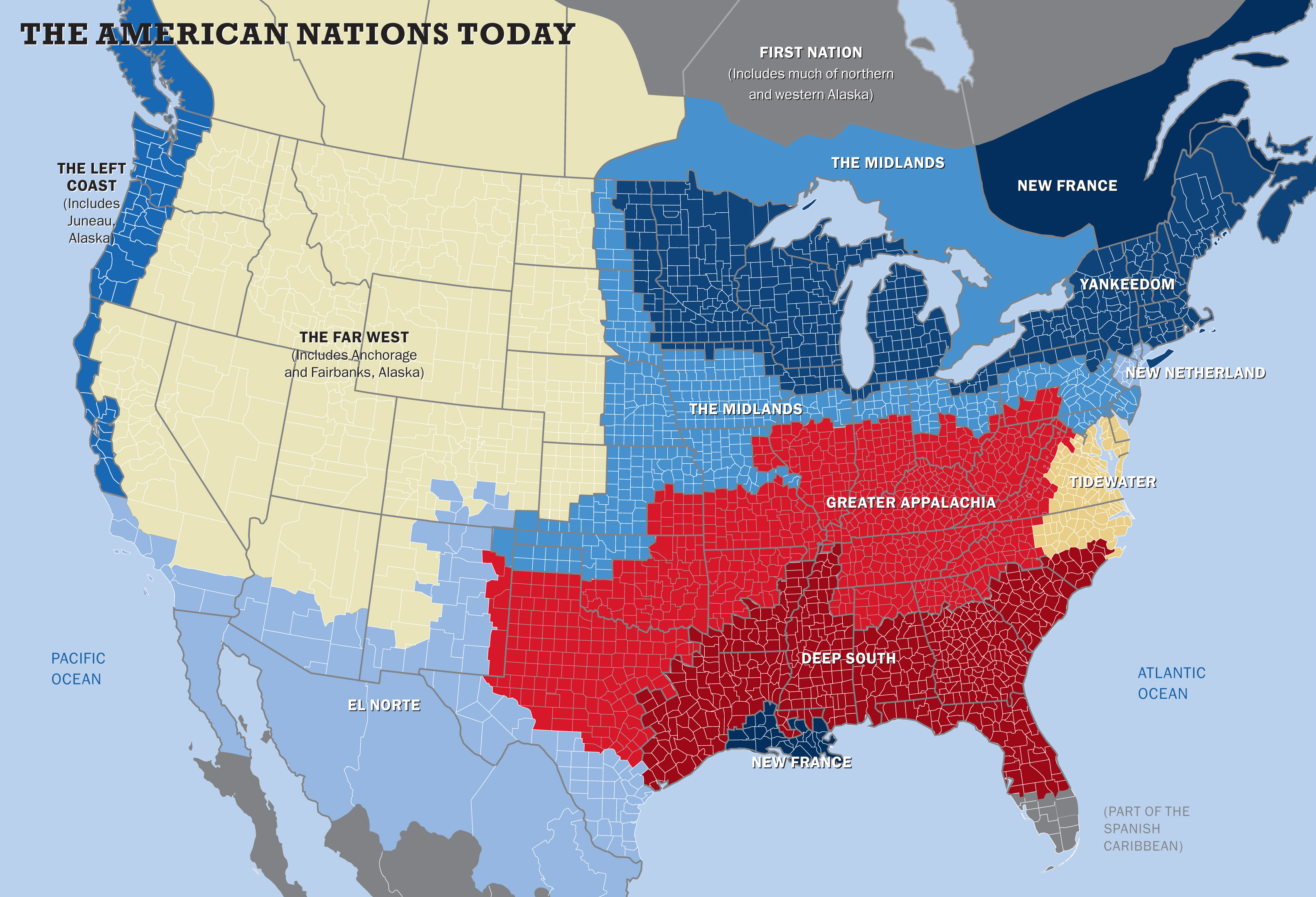
upinarms-map-largeThat’s why I found this map of the “eleven American nations” so fascinating. According to the corresponding Washington Post article, almost all of the battles in the culture wars can be explained by the lines on this map. Furthermore, the mobility of American society is causing these regional differences to grow sharper as Americans pick up and move to the places where the dominant culture best suits them.

A further explanation can be found here, where the author of the map (and the book American Nations) states:

The borders of my eleven American nations are reflected in many different types of maps—including maps showing the distribution of linguistic dialects, the spread of cultural artifacts, the prevalence of different religious denominations, and the county-by-county breakdown of voting in virtually every hotly contested presidential race in our history. Our continent’s famed mobility has been reinforcing, not dissolving, regional differences, as people increasingly sort themselves into like-minded communities, a phenomenon analyzed by Bill Bishop and Robert Cushing in The Big Sort (2008). Even waves of immigrants did not fundamentally alter these nations, because the children and grandchildren of immigrants assimilated into whichever culture surrounded them.

The thing that I find most fascinating about this map is how closely the borders of the Far West “nation” parallel the State of Deseret, first proposed by Brigham Young and the Mormon pioneers. The Mormons didn’t get along very well with Congress, and the territory was eventually pared down to the current boundaries of the state of Utah (the name “Deseret” was also replaced). But cultural boundaries cannot be declared by presidents or kings.

According to the author, the development of this region “was largely directed by corporations headquartered in distant New York, Boston, Chicago, or San Francisco, or by the federal government, which controlled much of the land.” I’m not so sure that’s the case, however. Corporations certainly became important players after the railroads crossed the country, but culturally, I would argue the pioneers had a much deeper and more lasting impact.

The Intermountain West is remarkably conservative, with Utah ranking as one of the reddest states in the nation. With the government expansion under President Obama and the Tea Party revolt in the Republican party, the politics in this part of the country have taken a decidedly libertarian turn. As issues like healthcare, gun control, gay marriage, and late-term abortion have each swept the nation in turn, my positions have changed to reflect the libertarian attitudes of the culture in which I live.

In 2008, I considered myself “agnostic” as far as politics were concerned. Perhaps there was a greater truth out there as far as politics were concerned, but I wanted nothing to do with it. Now, however, I believe very strongly that individuals and families should be free to live their lives as they see fit, without being subject to Leftist schemes to redistribute their wealth or bloated, self-serving government that overreaches its constitutional bounds.

I think this view would resonate very deeply with the pioneers. They came to the West to practice their religion freely, and emphasized self-reliance and thrift. Their industriousness was a means of guarding their independence from the governments that had oppressed them in the east, and continued to oppress them as they sought to build their Zion. Though they could be quite collectivist at times, it was local and voluntary, a far cry from State-enforced socialism. And while they cared for the poor and needy, they did all they could to keep them from becoming dependent on welfare.

These are interesting times we live in, and interesting cultures we hail from as well. As I look back on my own pioneer heritage, I can’t help but look forward as well. The “shoot and be damned” independent streak of my ancestors is still with me today, and I have no doubt that pioneer spirit will continue to guide me in the future.

Thoughts on American Sniper

Yesterday, I saw American Sniper. In a word, it was fantastic. Super intense—so much that the friend I went to see it with had to walk out in the middle—but well, well worth it.

The movie is about Chris Kyle, a US sniper in Iraq who had an incredible number of kills. He’s credited with being the most lethal sniper in US history. And yet, at the end of the movie, he states quite openly that he can answer a clear conscience for every shot he took—including the one in the trailer, which was his first combat kill.

Pause for a minute to think about that. What must it be like to have your first ever kill be a child? There you are with your finger on the trigger, wondering if you have it in you to take another human life, and instead of an obvious combatant, you’re presented with a grenade-carrying child. On top of that, add on the fact that you’re a family man. Could you do it?

And that was just the first combat encounter of the film. Things got progressively more intense with each combat tour, with some truly evil people and some truly hard decisions.

At the same time, though, the film didn’t try to dehumanize the enemy. Again and again, Chris goes head-to-head with an enemy sniper named Mustafa who is just as good as he is. Just as we see Chris with his wife and child, we see that Mustafa has a family as well. But there are evil people in the movie—truly evil people, such as the Butcher, whose preferred instrument of death is a power drill—and we see them too. Because guess what? Those people were real, and the atrocities they committed were real as well.

I can’t imagine what it must be like to kill one person, let alone more than two hundred. And yet at the end of the film, I sincerely believe Chris Kyle when he says that he can answer a clear conscience for every shot that he took. That is what made the movie so fascinating. The man was a true hero—I don’t see how you can possibly come to any other conclusion than that.

Still, I couldn’t help but think about the wider context of the war in which Chris Kyle was fighting. Men like the Butcher exist in every society, including our own. If a foreign government had set up a brutal dictator over our country, plunged us into a ten year proxy war in which millions of our people were killed, imposed a punishing sanctions regime on us for another ten years, and finished it off by invading us, would the United States be any different? Because that’s exactly what happened in Iraq. Every enemy that we have in the Middle East is an enemy of our own creation, and the harder we try to fight them, the more enemies we create.

I don’t say this to diminish Chris Kyle at all. I admire the man tremendously, and I can only hope that I would rise to the level of his stature if given the same responsibility to protect American lives. And to be fair, American Sniper didn’t try to defend the Iraq War at all. In fact, it wasn’t even about the Iraq War—it was about a soldier who struggled to do the right thing in combat and not be consumed by the war itself. In that aspect, I think that this film was outstanding. It’s probably the most empathetic war movie that I’ve ever seen, and I would gladly watch it again.

I have tremendous respect for the men and women of the US military, and this movie reminded me why. At the same time, I have very little respect for the politicians who sacrifice the lives of these brave men and women for their political ambitions. My personal views on the subject are best reflected in this 2012 campaign ad for Ron Paul which sums up the history quite succinctly. I don’t agree with Ron Paul on every issue, but on this one, I think he’s spot on:

But yeah, American Sniper was an amazing movie—well worth seeing. It’s rated R mostly for language, so even if you don’t usually see R rated movies, don’t let the rating alone scare you away.

O is for Online Presence

When you’re an indie author, your business exists almost exclusively on the internet. Chances are that ebook sales make up the bulk of your revenue, and those are entirely online. And without the backing of a major publisher, you probably aren’t going to get many books into bookstores (although it is possible). Most of your print sales are going to be online as well.

So if the bulk of your business is online, it only makes sense that you should maintain an online presence or persona of some kind. But what sort of presence should this be? Do you need to be on social media, even if you don’t really enjoy it? What about blogging? What are the dos and don’ts of maintaining an online presence?

Honestly, I don’t think it really matters which platforms you use to build your online presence, so long as you’re accessible in some way. Marketing gurus say that you have to be on social media, but my Star Wanderers books took off when I was living in a developing country with very limited internet access, and hardly ever posted to Facebook or Twitter at all. Even now, my Facebook author page is kind of a ghost town–I post links to each blog post, and I respond whenever a fan drops in with a comment, but that’s about it.

In my opinion, the most important thing to keep in mind when building an internet presence is to do the things that feel the most genuine and authentic. Facebook has never felt very authentic to me, except when I’m interacting with people I know in real life. Twitter, though, had an in-the-moment format that I really enjoy. Even then, I don’t feel nearly as authentic on Twitter as I do on my own blog, where I can post my thoughts and observations without restriction. For that reason, the core of my online presence is my blog, and I use my social media accounts to funnel people here rather than using social media as an end destination.

Besides being authentic, I think it’s important to be gracious to your fans and to not insult or repel them. A handful of authors (such as John Scalzi and Larry Correia) have developed personas that are highly opinionated, controversial, and crude, but they do it in such a way that it draws a following and keeps them. You don’t have to be liked by everyone–indeed, if you’re being authentic you certainly won’t–but you need to be careful to show respect and basic decency toward your fans. They are your bread and butter, and if they find your online behavior repulsive, you’re going to have a very hard time making and keeping them.

When it comes to politics and religion, I try not to be too divisive. Those are certainly important parts of my life, so it wouldn’t be very authentic of me to ignore them completely, but I don’t want my political opinions or religious beliefs to get in the way of my fans enjoying my stories. I don’t write stories just for Mormons, or just for libertarians, or just for white men–I write stories for people who look up at the stars and wish that they could go there. For that reason, I try to be mindful that the people who enjoy my stories might not (indeed, certainly do not) all look or act or believe like I do. I may disagree with them on some issues that I personally find important, but I don’t have to let that come between them and my stories.

The author-reader relationship is a fascinating thing that I have much still to learn about. Right now, my approach is basically to keep from getting in the way as much as possible. Occasionally I’ll get a piece of fan mail that will gush about something they loved about a story but criticize something they didn’t. I never argue back against it, since arguing isn’t going to change the experience they had when they read the story. Instead, I thank them as graciously as I can for reading.

My goal as an author is to stay out of the way of my readers enjoying my stories. For those who do enjoy the stories and want to connect with me, I write author’s notes at the back of all my books and keep an online presence on my blog where they can reach me. But if they don’t want to do that, that’s fine too. I try to be as authentic as I can without alienating anyone who enjoys my stories, and the key to that is to always be grateful for my readers. Writers may create stories, but readers bring them to life, since without anyone to read them, stories are basically dead.

Trope Tuesday: Sinister Surveillance

secure
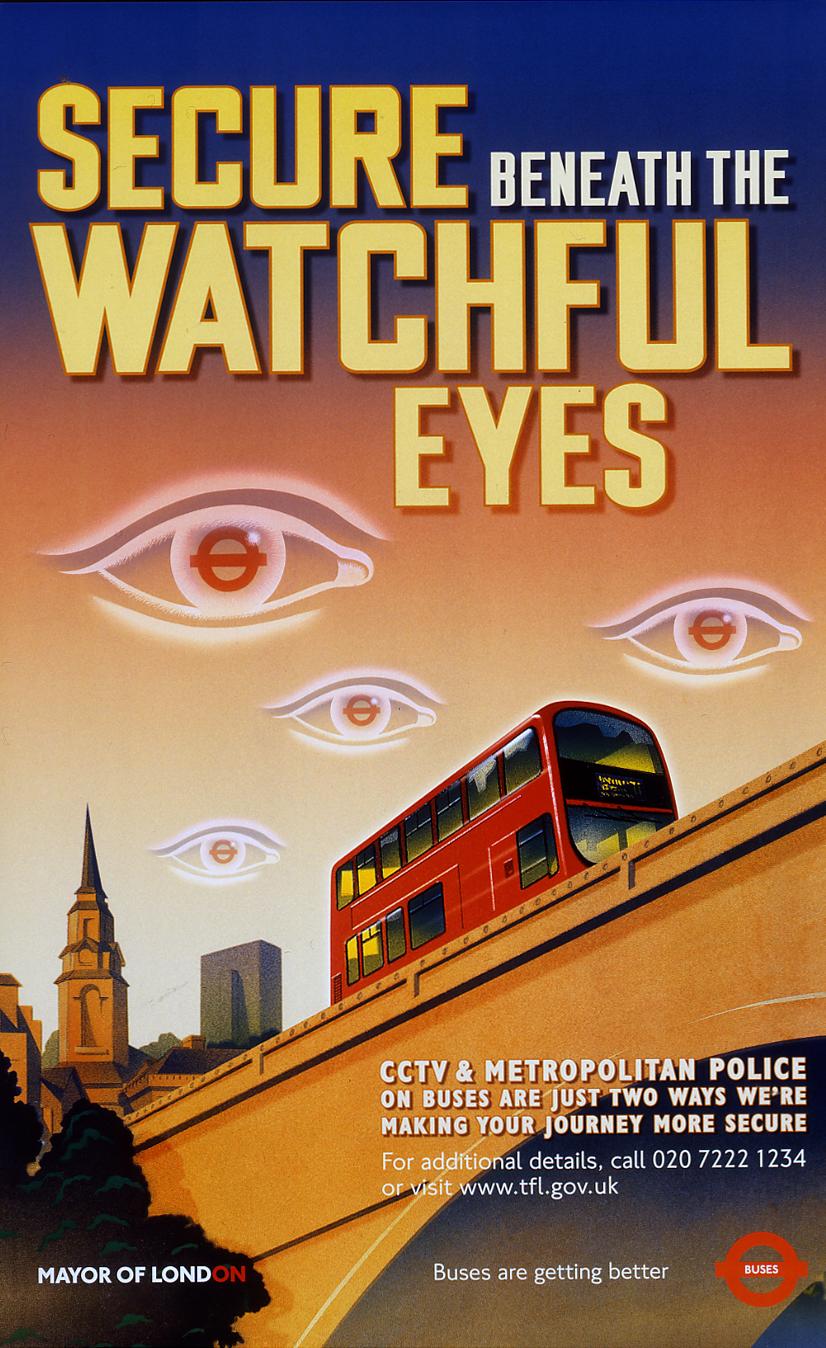
This was actually a real poster.

Someone is watching you.  Their eyes are everywhereEverything you do, everything you say … it’s all being recorded in a giant database.  But don’t worry–you can trust the ones watching youThey have your best interests at heartThey’re only after the bad guys.  You won’t even know that they’re there.

Sinister Surveillance is a hallmark of Dystopia, as essential to the genre as the Crapsack World and the Police Brutality tropes.  Often, you’ll find all three in the same story together.  It’s closely related to Big Brother is Watching, where the government is so powerful, and reaches into so many aspects of everyday life, that they see and record everything you do.  Where Big Brother shapes every aspect of the society, however, down to the language of the citizens and the basic truths accepted as facts, Sinister Surveillance is more about the surveillance itself, and the ulterior motives behind it.

It’s not enough for the government to simply watch you, though.  Even more important in some ways is the idea that you don’t know what they can and can’t see.  The reason for this is the same reason why, in horror stories, we almost never see the monster until the very end–because our imagination makes things a lot scarier than they really are.  If we the bad guys know the limitations of our government surveillance, we they can safeguard our privacy and basic rights game the system.  We’re all afraid of the dark, not because of what’s actually there, but what could be.

The concept behind all this goes back to the Panopticon, a hypothetical prison where the prisoners know that the guards are constantly watching them, but can’t actually see any of the guards themselves.  Proposed by the British philosopher Jeremy Bentham in the 1700s, the idea is to disempower the prisoners and empower the guards simply through the act of surveillance.  If everything you do can be seen, and you don’t know exactly who’s watching, that puts a tremendous amount of social pressure on you to conform.  As Michel Foucault put it:

The Panopticon creates a consciousness of permanent visibility as a form of power, where no bars, chains, and heavy locks are necessary for domination any more.

But if the prisoners are the citizens, and the guards are the government, how can such a system ever be democratic?  How can the citizens of such a society ever give their informed consent?  Well, that’s kind of the point.  The government in dystopian stories is rarely democratic–it’s usually a dictatorship of some kind, or a system that turns well-meaning people into Knights Templar, showing how even the best of us die like animals when the game is rigged.

As benevolent the intentions of the government may initially be, it is nonetheless true that power corrupts, and absolute power corrupts absolutely.  Just as the Panopticon takes power from the prisoners and concentrates it with the guards, so does universal surveillance grant dangerous amounts of power to the government–not because the act of surveillance is dangerous in itself, but because it brings out the worst in the people doing the surveillance.

In The Road to Serfdom, Freidrich Von Hayek pointed out that self-serving, ambitious, power-hungry people tend to rise in government a lot faster than people who have others’ best interests at heart, especially when so much power is concentrated in the government.  That’s one of the biggest dangers of surveillance–and in stories where Sinister Surveillance is in play, the government has already passed that point.

I wish I could say that this trope is limited mostly to the realm of fiction, but unfortunately, that does not appear to be the case.  These days, it’s impossible to talk about surveillance without getting political, even on a blog dedicated to books and writing.  Because everything these days is online, it’s easier now than ever before for our governments to watch us.  And if Edward Snowden’s claims are even partially correct, that’s exactly what they’re trying to do.  Even more worrying are the indicators that they’re trying to do it in secret, such as this recent letter from Senators Wyden and Udall.  The United States government has lied to us in the past about the extent of the PRISM surveillance program, and it would appear that they’re continuing to do just that.

Wherever you fall politically on PRISM or the Edward Snowden case, I think that Sinister Surveillance is a trope that we should all find profoundly disturbing.  When George Orwell took this trope to its extreme logical conclusions in 1984, he did so to prevent that horrific social order from ever coming to pass.  I wonder: only two or three generations after that book came out, have we forgotten its lessons already?  Or do we need a new retelling to remind us?  I fear that that retelling is taking place, not in the pages of a novel, but in real time on the major blogs and news sites.

E is for Empire

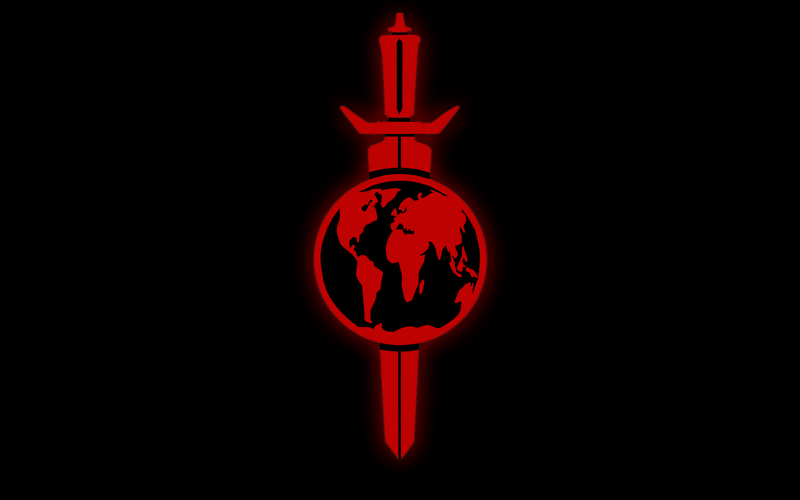
terran_empireAlmost every far future science fiction story has a galactic empire of some kind.  From Dune to Foundation, from Star Wars to Firefly, there’s always someone trying to rule the galaxy, often in a way that makes life difficult for the protagonists.

Why?  Rule of drama, of course, but also because it gives the story a truly epic scope.  Just as the classics such as Homer’s Iliad and Tolstoy’s War and Peace are as much about entire civilizations as they are about the people characters within them, so it is with science fiction, especially space opera.  Combine that with science fiction’s forward-thinking nature, and you have the potential for some truly amazing stories about humanity’s destiny among the stars.

But why empire?  Because even if we make it out to the stars, we’ll probably still take with us all of the baggage that makes us human.  Science fiction may be forward looking, but history repeats itself, and you can’t have a clear view of the future without understanding and acknowledging the past.

Not all galactic empires are evil, but most of them are.  We shouldn’t have to look further than the real-world history of Imperialism to see why.  Oppression, exploitation, slavery, genocide–all of these have been done in the name of Empire, and many more evils besides.  Even benevolent hegemonic powers (such as, I would argue, the United States of America) often end up doing great harm, either through action or inaction.

Of course, all of this makes for some really great stories.  When Asimov wrote his Foundation series, he quite literally based it on The History of the Decline and Fall of the Roman Empire by Edward Gibbon.  When Frank Herbert wrote Dune, he drew extensively from his background as an orientalist and based the overworld story on the Muslim conquests of the 7th and 8th centuries.  Star Wars is based loosely on the collapse of the Roman Republic, and Firefly echoes many of the old Western tales of former Confederate soldiers heading west after the US Civil War.

It’s worth pointing out that the Galactic Empire is by no means the only form of political organization in space opera.  There are actually several, including:

  • The FederationA loose organization of stars and planets that usually exists to foster cooperation and mutual peace between galactic civilizations.  Rarely evil, but can be crippled by red tape.
  • The RepublicA more centralized version of the Federation, typically.  Exercises more control over its citizens, but not in an oppressive way.  Usually features some form of representative government.
  • The AllianceA team of political underdogs united to overthrow the Empire and establish a more just form of government in its place.  If they win, they usually become the Republic or the Federation.
  • The KingdomA smaller government within the larger political system, often struggling for survival against more powerful forces. Not always democratic, but is often good, at least to its own citizens.
  • The Hegemonic EmpireLike the Empire, but rules primarily through soft power, ie co-opting their enemies rather than crushing them.  May overlap with the Republic or the Federation.
  • The People’s Republic of TyrannyThe Empire pretending to be the Federation.
  • The Vestigial EmpireWhat the Empire becomes when it’s been defeated but not yet destroyed.  Still oppressive and evil, but rules a smaller territory and struggles for relevance and survival.
  • The RemnantAn element from the Alliance that’s gone rogue.  The war may be over, but these guys are still fighting it, even if they’ve lost sight of what they’re fighting for.
  • The HordeA highly aggressive and expansionist warlord state.  By far the most violent and brutal of any political organization, it seeks to conquer and subjugate the entire galaxy.

As a political science major, all these forms of government really fascinate me.  I’ve played with quite a few of them, especially the Horde (Bringing Stella Home), the Empire (Desert Stars), the Hegemonic Empire (Star Wanderers), the Kingdom (Stars of Blood and Glory), and the Remnant (also Stars of Blood and Glory).  You can definitely expect to see me play with them again in the future.

Trope Tuesday: Mexican Standoff

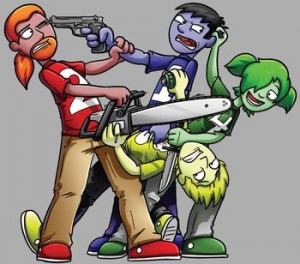
rsz_standoff_9776In a typical standoff, such as a hostage situation, two characters face off without immediately shooting at each other.  One or both of them may be using a human shield, or be reluctant to shoot first for fear that the other will take them with him.  A Mexican standoff, however, takes that up to a whole new level.

Perhaps the best explanation is the one from Wikipedia:

A Mexican standoff is most precisely a confrontation among three opponents. The tactics for such a confrontation are substantially different than for a duel, where the first to shoot has the advantage. In a confrontation among three mutually hostile participants, the first to shoot is at a tactical disadvantage. If opponent A shoots opponent B, then while so occupied, opponent C can shoot A, thus winning the conflict. Since it is the second opponent to shoot that has the advantage, no one wants to go first.

Basically, it’s Mutually Assured Destruction (MAD) on the level of individuals rather than nations.  The classic example is the finale from The Good, the Bad, and the Ugly.  Clint Eastwood’s character rigged it, though, so the outcome was never really in dispute.  Elsewhere, things rarely end so cleanly.

If the Cavalry doesn’t show up to save the day, these situations tend to lead to a messy free for all.  Heck, that may happen even if someone from the outside comes to save the hero.

If the resulting fight has a little more thought and strategy to it, though, you’ll get a Mêlée à Trois.  This happens in The Hobbit with the Battle of Five Armies, and in Downbelow Station with the stationers, merchanters, and Captain Mallory.  It also tends to happen a lot in A Song of Ice and Fire, with the various factions in that world.  Heck, it happened in real life during the Lebanese civil war, and is probably happening right now between the Christians, Sunnis, Shia, and Alawites of Syria.

When the fight has room for a little more scheming, you’ll often see things like a gambit pileup or a kingmaker scenario.  This is where things get really tricky, and the intrigue becomes positively delicious.  It isn’t enough just to have two parties duking it out–you’ve got to have lots of characters and factions, each with their own agenda.  That way, even the weakest party can win if they can convince everyone else to fight each other.

All of that happens after the Mexican standoff, though.  The standoff itself is the moment of tension and uncertainty before the crap hits the fan.  When done well, it’s an awesome moment of tension that can really boost the suspense.  When done poorly (or just for laughs), it’s over-the-top crazy, like Duke Nukem meets Scooby Doo.

I haven’t played around with this trope too much yet.  Stars of Blood and Glory has a little more intrigue than some of my other works, but I can’t think of a specific Mexican standoff moment in the book.  The situation near the end of Desert Stars is kind of like this, but with relationships and marriage alliances rather than guns.  I’m sure that’s a different trope, but I’m not sure which one.

Yet another reason to keep trawling tvtropes…

Dila Mshvidobisa Sakartvelos

That’s Georgian for “good morning, Georgia.” It’s 7:20 am in Tbilisi right now, and I figure it’s time for an update before starting another day of TLG orientation.

So Georgia is a pretty interesting place so far.  We haven’t seen too much of it, because we’ve been in the hotel most of the time doing various cultural and language training sessions, but last night we got out and hiked to the top of the fortress in Tbilisi which was very fun (unfortunately, I didn’t bring a camera–next time!).  I’ve just about mastered the alphabet, though I can’t really read it well yet, and I know a few basic phrases that together with gestures and pantomimes will help me to get around.  Very few people speak English; that’s what we’re here as part of the TLG program to change.

There are 33 other teachers in my group, and they’re all pretty awesome.  Most are from the US, though there are a handful from Australia and New Zealand, which is fun.  Most of us are the same age and in the same life position: young, single, fresh out of college, fairly well educated, free of major life responsibilities and looking for an adventure.  For that reason, I think we’ve been able to bond fairly quickly, which is encouraging.  I don’t know how often I’ll see most of these people once I’ve been placed, but I’ve been making friends and getting along fairly well.

So far, the people running the TLG program seem really on the ball.  This is only the program’s second year, but it’s a major initiative from the government and has really started to have an impact.  It’s humbling, actually, to see how much the Georgians are investing in us; the program might not pay as well as JET or EPIK (TEFL programs in Japan and Korea), but for a developing country like Georgia, it’s quite a lot.  The country has been through a lot of tremendous difficulties, but they are pushing forward for a brighter and more prosperous future and I hope that I can make a difference and be a part of that.

In case you’re wondering whether I feel safe, don’t worry; everything in Tbilisi is fine.  Yes, there has been a lot of saber-rattling with Iran, but that hasn’t directly affected Georgia other than the attempted attack on the Israeli diplomats (which could have happened anywhere).  If the Western powers do undertake a major military operation in the area, Russia could become antagonistic, but I think Obama has made it clear that the US is going to stick with sanctions, at least for the foreseeable future.  Personally, I think a military strike is unlikely.  Slightly more disconcerting are the Russian anti-terrorist operations in Chechnya/Dagestan, but that seems to be an internal Russian affair, so don’t worry: I’m safe.

As far as the local culture goes, I think there will be some challenges but I should be able to get along quite well.  It seems that the people have a strong sense of community, emphasize people and relationships over rules and regulations, are honest and outgoing, very passionate, and very friendly toward Americans.

The biggest challenge will probably be the alcohol; Georgians are very proud of their wine, and men are expected to be heavy drinkers (REALLY heavy drinkers–like, even the Australians are nervous about it).  Hopefully, I’ll be able to communicate that I don’t drink because it’s forbidden in my religion, and they’ll respect that.

In general, the orientation has been preparing us for the worst (Turkish toilets, difficulties with co-teachers, host parents trying to marry us off), so a lot of us are nervous, but we’re also very excited. This is definitely an adventure!  And three or four months from now, I think most of us will look back and laugh at how nervous and scared we were.

Honestly, I’m not scared at all.  If not for the study abroad trip to Jordan, I probably would be, but so far the experience has been quite similar (though I’m sure it will be quite different).  I’ll just keep my eyes open, be a gracious guest, work hard, and experience as much as I can of this beautiful and wonderful country.

Trope Tuesday: Lawful Evil

If the term “villain” applies to anyone, it applies to the Lawful Evil.  Whether the evil overlord, his trusted right-hand man, or one of his devoted minions, these characters are dedicated wholeheartedly to their cause, whether they believe it will lead to a better world or not.  Taking over the world is often a major obsession, because hey, someone’s got to do it.  A staple of the evil empire, these guys often turn their country into an industrialized wasteland, though they often have propaganda machines to take care of any bad press.  Bonus points if they can transform into a freakish monster in battle.

From the easydamus character alignment page:

A lawful evil villain methodically takes what he wants within the limits of his code of conduct without regard for whom it hurts. He cares about tradition, loyalty, and order but not about freedom, dignity, or life. He plays by the rules but without mercy or compassion. He is comfortable in a hierarchy and would like to rule, but is willing to serve. He condemns others not according to their actions but according to race, religion, homeland, or social rank. He is loath to break laws or promises.

While Lawful Evils believe in following rules and keeping their word, they’re not above emotional manipulation, negotiating unfavorable contracts, or following the law in letter only.  Even so, they tend to suffer from genre blindness and bureaucratic stupidity (as well as megalomania–but hey, that’s part of the job description).

According to tvtropes, Lawful Evils come in four types:

  1. The supreme ruler, dedicated to establishing and maintaining a civic order that is itself evil.  A good example of this would be Sauron from The Lord of the Rings.
  2. A zealot or übermensch whose moral code falls outside of established social norms.  Khan from The Wrath of Khan is a pretty good example of this, as is Tyler Durden from Fight Club (though your mileage may vary).
  3. The Dragon or other minion who may have their own goals, but answers to the big bad.  Darth Vader is probably the most well-known example.
  4. A complete monster who is dedicated to the destruction of free will and liberty.  The Mormon conception of Satan fits this perfectly.

The scary thing about this trope is that it actually exists in real life.  In fact, outside of our sheltered middle-class, liberal democratic existence (a relatively recent and unusual development in the eyes of history), this type of overlord tends to be the rule and not the exception.  You don’t have to look any further than North Korea, Burma, or Syria for examples of this–which is to say nothing of the Soviet Union, the Third Reich, or the British Empire.

My favorite example of this trope is probably Darth Vader, not just because of how badass he is, but because of his heel face turn at the end of Return of the Jedi.  Ignoring how bad episodes I, II, and III were, his character arc really is the thing that makes that story.  And while we’re on the subject of history, let’s not forget this epic showdown between Stalin and Hitler.  Seriously, click that link.

In my own work, the best example of a Lawful Evil would probably be Qasar from Bringing Stella Home / Sholpan.  He’s more of the affable type than a true evil overlord, though; that would be Tagatai, who doesn’t really come to power until Stars of Blood and Glory. A much more sinister example would be Emile from Heart of the Nebula, or the villain I have planned for Edenfall–I’d better finish those!  And of course, there’s Sheikh Sathi from Desert Stars, though he’s mostly a type 3 Lawful Evil under the thumb of his Neutral Evil wife.

Perhaps one of the reasons I haven’t done a truly despicable Lawful Evil yet is because I’ve been kind of sheltered here in the states.  It will be interesting to see how my writing changes after spending some time in Eastern Europe; Georgia, after all, is the homeland of Stalin.

Darth Vader helmet taken from this site.