update post

This is my current writing setup. The top of the filing cabinet already needs to be decluttered, but the rest is actually working out pretty well. The nice thing is that the computer can be raised into a standing desk, which works out really great for writing, since I tend to write better when I’m standing or pacing.
I am almost finished with the AI draft of The Soulbond and the Sling. It looks like it’s going to be about 140k words total, which is on the short end for an epic fantasy novel, but longer than anything else I’ve written (except for the first novel I ever finished, which shall never see the light of day).

The human draft will likely be longer than that, though. I’m going to add more details as I humanize it, which is easier to do just by writing it yourself than it is to get an AI to write it. Though parts of it will likely be shorter, since I’m sure there are places where I let the AI overwrite. Most of the skill in AI-assisted writing consists of knowing what to cut out, since generating words is the easy part.

I have also finished the outline for The Soulbond and the Lady, the second book in the Soulbound King series. It should clock in at about 20 chapters, 100 scenes, and 165k words. The next step is to fill out all the prompts and generate a rough AI draft, but because of how Sudowrite works, I don’t want to do that until the AI draft of The Soulbond and the Sling is complete (since it would require tweaking a bunch of the worldbuilding and character prompts). So that will probably wait until the end of the month.

In general, I have found that I tend to work best when I have two current WIPs: one human and one AI. This is because the two different kinds of writing exercise different parts of my brain, and I can rest the one part while I’m using the other. However, it only really works if both WIPs are in the same series. If I have to mentally switch from one universe to another, that adds friction that makes things difficult.

So the key is to pair up different WIPs together, such that I’ve always got both a human WIP and an AI WIP in the same series. With The Soulbound King, that’s not so difficult, because the AI draft of The Soulbond and the Sling is complete enough for me to start the human draft. And once the AI draft is complete, I can move on to the AI draft of book 2 while I finish up the human draft of book 1. It might become a problem if I finish one of the drafts well before the other, but that won’t be a problem for a while.

With the Falconstar Trilogy, that’s also not a huge problem. I will probably human-write a reader magnet while I work on the AI draft of Captive of the Falconstar, then humanize Captive while I work on the AI draft of Lord of the Falconstar.

With Return of the Starborn Son, the last science fiction novel I plan to write for a while, it’s going to be more tricky because that is the last book in the trilogy, and I still haven’t generated the AI draft. What I’ll probably do is start work on the human draft after I’m about 15% done with the AI draft, and see if I can’t work on both simultaneously. That hasn’t worked as well for me in the past, since I actually prefer to write the human draft out of order, but if it starts to break down I’ll just hold off on the human draft until the AI draft is more complete.

With the Sea Mage Cycle, I’ve currently just got one WIP in that series (The Unknown Sea), and it’s in the AI drafting stage. But it’s short enough that I can probably finish it in just a couple of weeks. At that point, I’ll take my wife out to dinner and have her pick out the next one I’ll write, then work on the AI draft for that one while I’m humanizing The Unknown Sea.

Which brings me to my J.M. Wight pen name. After a lot of thought and some careful deliberation, I’ve decided to put The Road to New Jerusalem on the back burner for now. I was going to try to finish that one in time for the Ark Press contest in October, but I don’t think this is the right time to work on that particular WIP. In the first place, it probably won’t win, and even if it did, that might actually be more of a liability, since it’s a near-future post-apocalyptice novel, and I’m currently trying to establish myself as a writer of epic fantasy.

From now until 2030, I plan to write epic fantasy almost exclusively. The only exceptions for that are the two sci-fi series (The Falconstar Trilogy and the Outworld Trilogy) that I haven’t yet finished. Also, I will probably write some zany space adventure-type stuff under my J.M. Wight pen name, more in the vein of my Gunslinger books (which I have republished under J.M. Wight). But aside from that, I plan to focus on writing fantasy—specifically, epic fantasy.

In my blog series Fantasy from A to Z, I wrote about how epic fantasy has fallen into decline in recent years, due to reader fatigue with big name authors like George R.R. Martin and Patrick Rothfuss failing to finish their series, and how this has put newer authors in a conundrum, because epic fantasy novels are way too big to rapid release, but most readers aren’t willing to start a new series until after it’s already been finished. I hope that my new AI-assisted writing method will help me to crack that particular nut, writing and releasing epic fantasy books fast enough to satisfy readers. Because even though there haven’t been a ton of new epic fantasy authors in recent years, I don’t think the reader demand for epic fantasy has gone down at all. There may still be an opportunity there for writers who can deliver.

That’s what I’m hoping, at least. So I’ll keep plugging away at The Soulbound King, and hopefully release the first all three books of the first trilogy around this time next year.
Fantasy from A to Z: X is for eXpectations

What sort of books are fantasy readers looking for today? What are the expectations that readers have for the genre?

Overall, the fantasy genre is growing. Sales are up, both in traditional and indie publishing, and the big names in the field (like Brandon Sanderson) are doing quite well. It’s clear that the fantasy genre as a whole is robust and healthy.

When you break it down by publishers and subgenres, however, things start to look a little different. Romantasy is dominating the traditional publishing world, but most of it is little more than pornography for women, dressed up with fantasy trappings. And because of how traditional publishing now relies on a few big blockbusters to make most of their earnings, romantasy is sucking all of the oxygen out of the room, making it much more difficult for debut and midlist authors in the other fantasy subgenres.

In the world of indie publishing, litRPG has begun to demonstrate some staying power. It was the new hot thing back in the early 2020s, but it’s attracted enough attention and developed enough of a following that it has become a major subgenre that is likely to endure for some time. I could be wrong about that, but from what I see, that’s where most of the innovative authors and whale readers (ie >1 book per week) are focusing their attention these days.

But because of the way that the algorithms tend to govern the indie publishing cycle (and the way that indie publishing has unfortunately turned into a zero-sum, pay-to-play game with online advertising), the rise of litRPG in the indie publishing world may very well be sucking all of the oxygen out of the room in the same way that romantasy is sucking it out of the traditional publishing world. 

Both subgenres are also very gender-biased, with women gravitating toward romantasy and men gravitating toward litRPG. This reflects the broader social and political trend of men and women going separate ways, across a whole host of different metrics. So as the gender divide continues to widen in society generally, that will probably reinforce the divide between romantasy and litRPG, creating a positive feedback loop (or death spiral, depending on how you look at it).

Sword and sorcery continues to do okay, and has probably been given a boost by the recent release of Conan the Barbarian into the public domain. But most of sword and sorcery got siphoned off into grimdark back in the 00s—in fact, you could say that sword and sorcery reinvented itself as grimdark. And while grimdark has resisted the feminization of literature, standing as one of the few remaining bastions where male readers continue to feel at home, I think grimdark has already passed its peak. In a post-pandemic, post-Trump world, I think most readers are hungry for books that are less nihilistic and more uplifting.

Which brings us to epic fantasy. While Brandon Sanderson continues to dominate this subgenre, with his massive kickstarters and huge book releases, it’s debatable whether his readers are hungry for more epic fantasy, or just for more Brandon Sanderson. He’s kind of a subgenre all to himself. Recent streaming adaptations like Wheel of Time and Rings of Power have failed miserably, and Game of Thrones has fallen almost totally out of cultural significance, with George R.R. Martin’s failure to finish the last book (and Patrick Rothfuss’s failure to finish his own series) becoming something of a meme.

In fact, the failure of these two big-name authors to finish writing their books may have struck epic fantasy a mortal wound. Because of how they have been burned, a large number of epic fantasy readers are now unwilling to commit to a series until after it is complete. But very few authors can afford to write a truly epic series and release the whole thing at once. It takes several years to write a series like that—and what are authors supposed to do if the first one flops? 

In other words, debut epic fantasy authors are damned if they do, and damned if they don’t. If they release the first book by itself, it will probably sink into obscurity before they can write and release the next book. And if by some measure of hard work and tenacity they manage to write a whole series and hold back from publishing until they’re ready to release it all at once, if the first book still fails to sell, they’re SOL and all that hard work was for nothing. 

This is also why traditional publishers are so unwilling to publish a new epic fantasy series from a debut or a midlist author. A bestseller like Larry Correia might be able to dip his feet in that pond (and do quite well—I highly recommend his Sons of the Black Sword series), they won’t do that for anyone else. Which is fine, except that indie publishing epic fantasy is just as hard—arguably more so.

For these reasons, I don’t think it’s an exaggeration to say that Patrick Rothfuss and George R.R. Martin have done more to kill epic fantasy than they have to grow it.

But this may actually have created an opportunity for those authors who are willing to drive into the smoke. After all, there’s much less competition if you can manage to break in and build a decent following. But how much hunger is there for epic fantasy, compared to other fantasy subgenres? And how can a newer/midlist author reach them, without a big push from a publisher or the algorithms?

Fantasy from A to Z: E is for Epic

What is the ideal length of a fantasy novel? Of a fantasy series?

Fantasy, as a genre, is known for being big. Big stakes, big emotions, big battles—and big books. It isn’t unusual for a single fantasy novel to run well over 200,000 words. Authors like Brandon Sanderson regularly turn in doorstoppers, with Words of Radiance clocking in at over 400,000 words, longer than the entire Lord of the Rings trilogy combined. And of course, there’s J.R.R. Tolkien himself, whose influence looms large over the genre. The Lord of the Rings helped establish the idea that a fantasy story needs room to breathe—and to expand.

Series length is no different. Some of the most beloved and influential fantasy series are also some of the longest. Steven Erikson’s Malazan Book of the Fallen spans ten main volumes and several more side novels. Robert Jordan’s Wheel of Time ran for fourteen massive books (fifteen, if you count the prequel). These stories require commitment, but for many readers, that’s part of the appeal. Once they find a world they love, they want to spend as much time there as possible.

But not all fantasy needs to be long.

Robert E. Howard, one of the foundational voices in the genre, wrote mostly short stories. His Conan tales, often published in pulp magazines like Weird Tales, rarely ran longer than a few thousand words. Yet they endure. David G. Hartwell, in “The Making of the American Fantasy Genre,” points out that Howard and Tolkien were arguably the two most successful fantasy authors of the twentieth century. Before The Lord of the Rings took off in the 1970s, most fantasy readers thought of the short story as the natural format for the genre. That pulp tradition carried strong into the mid-century, where fantasy shared shelf space with science fiction in magazines and anthologies.

That clearly isn’t the case anymore. In today’s market, a 90,000-word fantasy novel is often considered short. Readers are more than happy to put up with a bit of filler or extra padding if it means they get to linger in the world a little longer. And to be fair, there is something immersive about a book that takes its time. When done well, it can feel less like reading a story and more like living inside another world.

That said, I still believe in the value of economy of words. Economy of words doesn’t mean writing short—it means writing lean. It means using only as many words as the story needs. Louis L’Amour is a great example of this. His prose is tight, clear, and evocative. Most of his novels are quick reads, but they pack a punch. He could sketch a character in half a page and make you care about them. That’s not to say all of his books were short—The Walking Drum is a long and sprawling novel—but even there, his style is efficient. Every scene does something. Every word earns its place.

So why does epic fantasy run so long? Does it always have to be padded with extra filler? Not when it’s done well. One of the defining features of epic fantasy is that the world itself becomes a character. Tolkien mastered this. Middle-earth isn’t just a setting; it has a history, a culture, and an arc. The long travelogues, the deep lore, the songs and genealogies—they help build a sense of depth that makes the final conflict in The Return of the King resonate on a mythic level. You’re not just watching Frodo destroy a ring; you’re watching the curtain fall on an entire age.

And when the world has that kind of weight—when it grows, transforms, and carries the burden of history—it’s no surprise that a single book often isn’t enough. That’s one of the reasons epic fantasy so often stretches into multi-volume series. If the world is a character, it needs space for its own arc to unfold. A hero might only need three acts to complete their journey, but a world? That can take a bit longer.

Still, there’s more than one way to structure a series. Take Louis L’Amour again. He wrote mostly short standalone novels, but many of them followed the same families—like the Sacketts or the Chantrys—so that readers who wanted more could get it. You didn’t have to read them in order. You could pick up whichever one you found first and still get a complete story. That’s a far cry from most modern fantasy series, where the series itself is a single, complete work that must be read in order. After all, try starting The Wheel of Time at book five or A Song of Ice and Fire at book three, and you’ll be utterly lost.

My copy of The Lord of the Rings is a single-volume edition, the way Tolkien originally intended it. The main reason it was split into multiple books was to save on printing costs (Tolkien himself split the book into six parts, but the publisher turned it into a trilogy). Frankly, I think it works better that way. When a series beings to sprawl, the middle books often sag, and readers can definitely feel that. Just look at Crossroads of Twilight (Book 10 of The Wheel of Time) and how much the fans hate that book. I also remember when A Dance with Dragons first came out, with a 2.9-star average on Amazon that held for several years. (That rating has since improved, but I suspect that a large part of it is due to review farming by the publisher.)

Another risk inherent in writing a long, sprawling series is that the author will never finish it. George R.R. Martin is the most infamous example here—fans have been waiting for The Winds of Winter for over a decade, with no firm release date in sight. Patrick Rothfuss has faced similar criticism, with readers growing increasingly frustrated over the long delay between The Wise Man’s Fear and the long-promised third book in the Kingkiller Chronicle. And Orson Scott Card has yet to finish his Alvin Maker series. Seventh Son was published when I was just four years old, and though I enjoyed the first two books in that series, I refuse to read the rest of it until Card finishes the damned series.

I’m not alone. Many readers, burned one too many times, now refuse to even begin a new fantasy series until it’s complete. I can’t blame readers for feeling this way, but it does create a real challenge for new and midlist authors trying to break into the genre. Without the benefit of an established readership, it’s hard to convince readers to invest in book one of a planned trilogy or longer series. And if readers don’t start the first book, the rest may never see publication.

Right now, I’m writing an epic fantasy series based loosely on the life of King David. According to my outline, it’s a seven book series, but I’ve decided instead to split it into two trilogies (each with a complete arc) and a bridge novel (kind of like what Frank Herbert intended for the Dune books, though he died before he could finish the final book of the second trilogy). My plan is to wait until the first trilogy is totally written, publish the first three books within a month of each other, and promote that trilogy while I write the bridge novel and sequel trilogy.

In the meantime, I’ve been having a blast writing short fantasy novels in the Sea Mage Cycle, in-between drafts of my larger books. With The Sea Mage Cycle, I’m following a series structure that’s much closer to what Louis L’Amour did with his Chantry and Sackett books. Each book is a standalone, and the books can be read in any order, but they all tie together with recurring characters/families. As with all epic fantasy, the world itself is something of a character, but each book is more like a single thread in the tapestry of that wider story.

Not every epic needs to be long. Not every story benefits from being part of a massive, sprawling series. But when done well—when every word pulls its weight, when the world itself becomes a living character, when the structure supports the arc instead of smothering it—epic fantasy becomes something truly special.

It becomes epic, in every sense of the word.

Should I split my epic fantasy series into two trilogies?

So I’m working on the first book in a new epic fantasy series, called the Soulbound King. It’s basically a fantasy retelling of the life of King David, loosely adapted from the biblical stories about his life. I’ve already outlined the first book and generated a rough AI draft, which came in at 153k words. The final draft will likely be longer than that, but I think it’s very likely that I will be ready to publish it before the end of the year.

The question I’m currently grappling with is whether to keep it as a seven book series, or to release it as two trilogies with a bridge novel in the middle. Frank Herbert did a similar thing with his Dune books: the first three books (Dune, Dune Messiah, and Children of Dune) were a trilogy, and the next book, God Emperor of Dune, was supposed to be a bridge novel setting up the second trilogy—except he died before finishing the last book, so his son Brian Herbert got together with Kevin J. Anderson to write it, and then they blew it up into a franchise… point being, stuff like this has been done before.

Now, I’m reasonably confident that I’m not going to die before finishing the last book. In fact, I’ve already made a 7-point outline for all seven books, so I know exactly where they start and end, with the inciting incident, midpoint, climax, etc. I’m also writing these books with AI assistance, which is making it possible for me to write these books much faster than I otherwise would have been able to write them. For the first book, The Soulbond and the Sling, I anticipate that it will only take between six to nine months of total work to go from story idea to finished draft.

But the trouble with writing a seven book epic fantasy series is that a lot of readers aren’t going to bother picking it up until all seven books are out. This is because so many readers have been burned by authors like George R.R. Martin and Patrick Rothfuss, who have not and likely will never finish their bestselling series. I can’t really blame the readers for that (though I can and do blame the authors), but it creates a market reality that I need to anticipate and plan for.

So here’s what I’m thinking: instead of making it a seven book series, I’ll make it two trilogies with a bridge novel in-between. The first three books will complete one arc, and the last three books will complete another arc. I’ll wait to release the first book until after I’ve completed the AI draft of the third book, so that way I can release all of the books in the first trilogy within 1-3 months of each other. And after the first trilogy is complete, I’ll market it as a trilogy while working on the last four books, probably releasing each of those a year apart, as I finish them.

The reason I’m thinking about this now is because a strategy like this is going to influence how I write all of these books. If I’m going to split the series into two trilogies, the last thing I want to do is end the first trilogy on a cliffhangar. It has to hold together as a complete story, with only one or two loose threads. But since I’m still in the early writing stages of the first book, I still have enough room creatively to make that kind of adjustment. I just have to decide if that’s truly the plan.

By the way, the first trilogy ends with the fantasy equivalent of the Battle of Mount Gilboa, where the Saul and Jonathan characters die in an epic battle and the David character becomes king (I know that in the Bible, there was a gap of several years between those two events, but I’m combining them for purposes of this book). So it is a rather natural stopping place, even if it does end on a massive downer, followed by a false victory (the second trilogy begins with David and Bathsheba).

Anyways, what do you think of this plan? Does it sound like a good idea, or is there a compelling reason I haven’t thought of yet for why I shouldn’t do it?

Writing and Publishing Plans moving forward

Over the past few months, I’ve been spending a lot of time experimenting with AI writing and finding ways to incorporate it into my writing process. The goal so far has been twofold:

  1. Develop the ability to write one novel per month.
  2. Get to a level where I can write 10k words per day.

I’ve accomplished both of those things, but I can’t hit them consistently without burning out. Writing with AI has proven key to both of them, but I feel like I need a lot more practice with AI-assisted writing before I’ve achieved any level of mastery. Once I have mastered AI-assisted writing, however, I should not only be able to achieve both goals consistently, producing a much higher quantity of work, but should also be able to maintain or exceed the current quality of my writing as well.

However, I was thinking about it from a reader’s perspective on my morning walk last week, wondering what I would think if, say, David Gemmell was still alive and writing Drenai books, or Roger Zelazny was still alive and writing Amber books. What would I think if either of them announced that they had found a way to incorporate AI into their writing process, so that they could produce a new Drenai/Amber book once every month, instead of once every year? Better yet, what if Andrew Klavan—who is both still alive and still writing Cameron Winter books—announced that he would start publishing new books monthly. As a fan of all these writers, what would I think of that?

Assuming that there was no drop-off in the quality of these new, AI-assisted books, I would find this really exciting, and would probably become a much bigger fan, simply from the fact that I’m reading so much new stuff. However, after a while this might become too costly to me to keep up, leading me to fall away and not be quite so current on what they’re producing. I would still love them as authors, but if they published too quickly, I might have to take a break after a while—and if they continued to publish at that rate, I might never catch up. After all, there are lots and lots of authors that I love, and I can’t dedicate more than a fraction of my reading time to any particular one of them.

So there’s probably a sweet spot, between publishing too much and publishing too little. Most authors are probably on the Patrick Rothfuss / George R.R. Martin side of that line, where fans wish they would write more and write more quickly. But at a certain point, it is possible to overwhelm most readers by writing too much. Of course, there will always be a core group of fans who will read everything much faster than you could ever possibly write, even with AI assistance, but if that’s the only group you’re catering to, then you probably won’t ever have more than a cult following, because you won’t be able to convert casual readers into superfans.

With all of that said, I feel like I’ve gotten to a good place right now, where I’m publishing a free short story every month. I think that’s actually been a really effective way to turn casual readers into fans, and to keep my name fresh in the minds of my readers. And if Gemmell, or Zelazny, or Klavan were producing a free short story every month, I would definitely subscribe to their newsletters and drop everything to read it.

So keeping up the free short story per month is probably a good idea. But for novels, it might be better to release a new one every two or three months instead. Free short stories are much less of a time and money burden on the readers, and thus are effective at turning fans into superfans. But with the novels, which do take more time and money to read, it’s probably better to throttle that back a little bit.

The interesting thing to me is what that means for my creativing process, especially once I’ve reached the point where it takes less than a month for me to produce a novel. If I’m only publishing a novel every 2-3 months, that means that I can—and probably should—take a break between each novel WIP. Which means that the thing I should be shooting for isn’t to maintain a writing speed of one novel per month, month after month after month, but to hit that speed in creative bursts, taking some down-time to replenish the creative well and prepare for the next project.

It’s a very different writing paradigm from the one I’ve been following for the past decade. Until now, I’ve basically always had a novel WIP that I’ve actively been working on, and whenever I feel like I need a break, I usually move on to a different novel WIP. From time to time, I’ll “take a month off” to work on short stories, but the goal there has always been to write X number of stories in no more than a month or two, once again making writing the focus instead of recharging the creative well.

How would things be different if instead, I told myself “I’m taking a break in order to prepare myself to write my next novel,” with a plan for books and other media to consume in order to get things ready for it? And then, instead of taking several months or even years to write the project, to produce it in just a few weeks of white-hot creative heat, afterwards necessitating a break for a while just to cool down? Until now, I’ve never tried anything like that, because I haven’t thought myself capable of producing work that quickly. Indeed, the very thought of taking an extended break from having an active writing WIP has struck me as being lazy. But now that I know I can produce that quickly, perhaps this is a new paradigm that I ought to at least explore.

For my current WIP, Captive of the Falconstar, I’m not stressing out about finishing it in less than a month. But I am following all the benchmarks that I developed, and watching closely to see what takes more time to write than I thought, and what takes less. And it may very well turn out that the best way to improve quality is to get into that white-hot creative heat that comes from producing quickly, so that’s something that I’m watching closely as well.

Short-form vs. long-form fantasy

For the last month, I’ve been doing a lot of research into the fantasy genre, rereading all of the original Conan the Barbarian stories by Robert E. Howard and a bunch of the other ones too, by authors like L. Sprague De Camp, Lin Carter, Bjorn Nyberg, Robert Jordan, etc. I’ve also been reading a lot of epic fantasy, like the Wheel of Time series by Robert Jordan and the Stormlight Archive by Brandon Sanderson. And I’ve also read some essays on the genre, most notably “The Critics, the Monsters, and the Fantasists” by Ursula K. Le Guin, and “The Making of the American Fantasy Genre” by David Hartwell. Oh, and opening a bunch of chats with ChatGPT, though those are of limited usefulness (for some reason, ChatGPT hallucinates like crazy when you ask it to recommend any noblebright fantasy that isn’t more than two or three decades old).

From what I’ve gathered, there are basically two camps or schools within secondary-world fantasy: the heroic / sword & sorcery camp, based off of Howard’s Conan the Barbarian, and the epic fantasy camp, based off of Tolkien’s Lord of the Rings. According to David Hartwell, those are the only two franchises to achieve breakout success: everything else has either achieved only moderate commercial success in its time before petering out, or gained only a niche audience. Apart from Conan, the fantasy genre as a whole didn’t really take off until Terry Brooks immitated Tolkien with his Shannara series, thus launching a wave of Tolkienesque epic fantasy in the 70s and 80s that morphed into Grimdark in the 90s, 00s, and 10s.

So for a while, I was looking into all the various tropes and archetypes that make Conan and LOTR tick, and trying to use those to differentiate the two. But lately, I’ve been wondering if maybe I’ve been overthinking all of this, and the real difference between the two is that Tolkien mastered long-form fantasy, and Howard mastered short-form fantasy. In other words, what if the defining difference between the two camps doesn’t have to do with tropes so much as with the length of the actual story?

I suspect that short-form fantasy is poised to make a resurgence, especially with all of the challenges associated with writing and selling long-form fantasy in the 2020s. Larry Correia is right: Rothfuss and Martin have ruined the epic fantasy field for new authors by failing to finish their series in a reasonable timeframe. Unless you are independently wealthy or already have a large and loyal following of readers, it just doesn’t make commercial sense to write a lengthy series of +200k-word fantasy epics. Better to write shortier, punchier 40k-word novels instead, especially if you can churn them out every other month or so. That seems to be the model that works best for indies, at least in adjacent genres like urban fantasy and paranormal.

Anyway, that’s my current thinking on the subject. What’s your take on it?

The Generational Cycles of Grimdark vs. Noblebright

A couple of months ago, I was discussing genre trends with my indie publishing mastermind group where we drew some fascinating connections between grimdark fantasy, noblebright fantasy, and Strauss-Howe generational theory. In that discussion, we came up with a theory that predicts when each type of fantasy (grimdark, nobledark, noblebright, and grimbright) will be ascendant, and explains exactly why. According to this theory, grimdark is currently in the beginning phase of a multi-generational decline, and will be replaced by noblebright as the ascendant form of fantasy by about the mid-2030s.

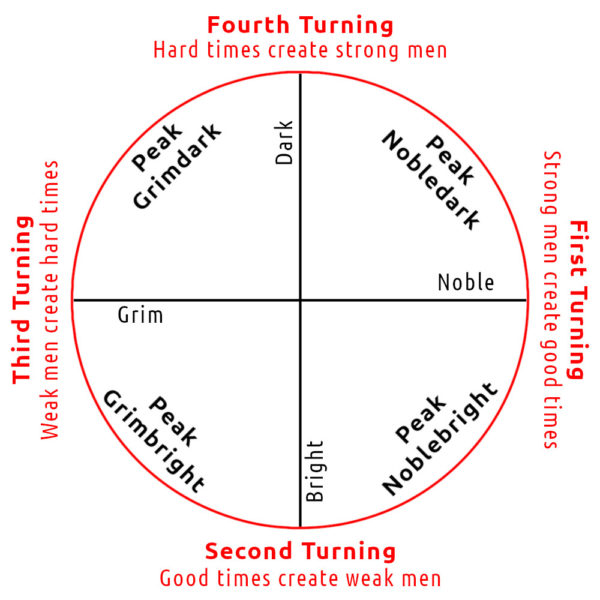
To start, we need to understand the difference between grimdark and noblebright. Both forms of fantasy exist on a field with two axes: noble vs. grim and bright vs. dark.

The bright vs. dark axis describes whether the fantasy takes place in a world where good usually triumphs over evil (bright), or a world where evil usually triumphs over good (dark).

The noble vs. grim axis describes whether the characters have the power to change the world (noble), or whether they do not (grim).

Thus, with these two axes, we get the following combinations:

  • Noblebright: A fantasy world where good usually triumphs over evil and the characters have the power to save it.
  • Grimbright: A fantasy world where good usually triumphs over evil, but the characters aren’t on a quest to save it and are usually preoccupied with smaller concerns.
  • Grimdark: A fantasy world full of moral shades of gray, where evil usually triumphs over good and the characters are either anti-heroes or otherwise fail to save the world.
  • Nobledark: A fantasy world where evil usually triumphs over good, but the characters are empowered to change it.

These categories are subjective to some degree, and fans will often disagree about which category to put each book/series. However, I think that most fans will agree on the following examples:

  • Noblebright: The Chronicles of Narnia by C.S. Lewis
  • Grimbright: The Princess Bride by William Goldman
  • Grimdark: A Song of Ice and Fire by George R.R. Martin
  • Nobledark: Lord of the Rings by J.R.R. Tolkien

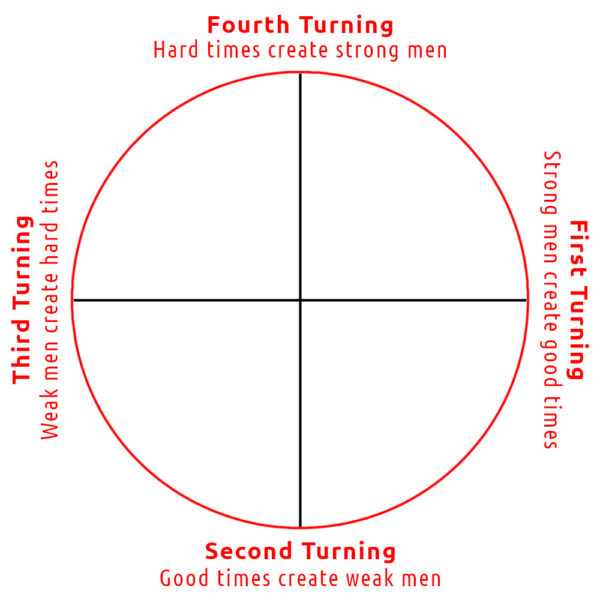
Next, let’s review in the broadest possible terms William Strauss and Neil Howe’s generational theory. To really understand their work, I highly recommend that you read The Fourth Turning. I have some criticisms of the finer nuances of that book, but their ideas are really excellent, and their predictions hold up surprisingly well three decades later.

If I had to boil their theory down to one simple, easy-to-understand statement, it would be this:

Strong men create good times.

Good times create weak men.

Weak men create hard times.

Hard times create strong men.

Thus, our society and culture passes through a secular cycle that takes about 80-100 years to complete (or in other words, the length of a long human life). The cycle has four seasons, or turnings, each one corresponding to a generational archetype (since it takes about 20-25 years for people born in the one turning to start having children of their own, thus moving us into the next generational turning).

The first turning happens when the society comes together after resolving a major crisis (eg the Revolutionary War, the Civil War, World War 2) and builds a new, stable order. The second turning happens when their kids rebel against that order, seeking freedom (eg the First and Second Great Awakenings, and the various counterculture movements of the 60s). The third turning happens when the order breaks down completely and everyone goes their own way (eg World War I, the Roaring Twenties, and the culture wars of the 90s). Finally, the fourth turning happens when the society faces a major existential crisis that totally reshapes it.

According to the theory, each axis of the grimdark/noblebright field corresponds to a different generational turning. Thus, stories that are noble have the most resonance in a first turning, stories that are bright have the most resonance in a second turning, grim stories resonate most in a third turning, and dark stories resonate most in a fourth turning.

In other words, the generation that comes of age during a major existential crisis will tend to gravitate more toward fantasy where evil typically triumphs over good, whereas the generation that comes of age during a period of rebuilding will tend to gravitate more toward fantasy where the characters have the power to change the world. And so on for bright and grim stories: the generation that comes of age during a spiritual awakening will gravitate more toward stories that take place in a world where good usually triumphs over evil, and the generation that comes of age in a declining and/or decadent society will gravitate more toward fantasy where the characters are relatively powerless.

Another way of thinking about it is to consider what each generation is not going to be drawn to, or which stories are not going to resonate well. An American who came of age in the 40s and 50s, when US power was on the rise and the Pax Americana was reshaping the world, isn’t going to resonate well with grim stories about powerless characters. Likewise, a boomer who came of age during the counterculture movements of the 60s and 70s isn’t going to resonate well with a dark fantasy world where evil usually triumphs, because (as much as they hate to admit it) they grew up in a very sheltered world that generally made sense—so much so, in fact, that they couldn’t help but rebel against it.

According to this theory, the next generational turning begins when one of the four forms of fantasy (noblebright, grimbright, grimdark, or nobledark) is at a peak. Over the course of the turning, that fantasy form declines until the next form in the cycle becomes ascendant, at which point the next generational turning begins.

Thus, at the start of a first turning, nobledark stories are typically ascendant, where the fantasy worlds are dark and morally gray, but the characters are empowered to save the world. As that generation successfully establishes a new order, the culture’s taste in fantasy shifts away from dark stories and toward noblebright stories, where the characters are still empowered but the world is more ordered and stable.

At the start of the spiritual awakening that characterizes a second turning, noblebright fantasy is ascendant: stories with an optimistic outlook on the world where the characters are larger than life. But as the awakening progresses, people in the society care more about freedom and individuality and less about the group, so stories about characters who sacrifice everything to save their world resonate less with them. Thus, by the end of the second turning, the ascendant form of fantasy is grimbright, which is really more of a slice-of-life fantasy about beloved characters having fun (but not world-altering) adventures.

At the start of a third turning, where the social order has started to break down and corruption begins to permeate all levels of the society, these grimbright stories start to take a darker tone. Readers find it too “unrealistic” to believe that good always triumphs over evil, and they certainly do not believe that good people have the power to change the world—at least, not the “smells like teen spirit” world that they inhabit. Their tastes shift away from the fun, adventurous slice-of-life of grimbright, and toward the dark and gritty anti-heroes of grimdark.

Finally, at the start of the fourth turning, grimdark is ascendant, but readers are starting to lose patience with it. As each new crisis in the real world compounds with all the others, they find it unbearable to read about characters that don’t have the power to change the fantasy worlds they inhabit. At the height of the fourth turning, society reaches an existential breaking point where, in the words of Strauss and Howe, “all of [our] lesser problems will combine into one giant problem, [and] the very survival of the society will feel at stake.” (The Fourth Turning, p277) At this point, readers are ravenous for books about characters who are empowered to fight back against the tides of evil and darkness. Grimdark fantasy declines and nobledark fantasy ascends.

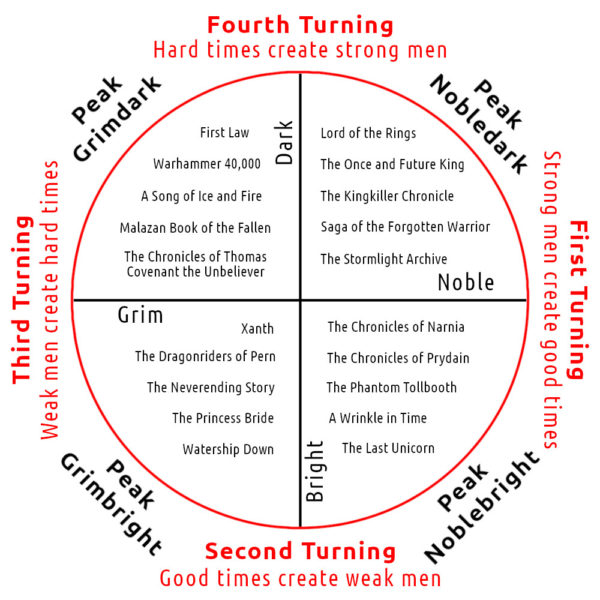
I haven’t read all of the series in the diagram above, but I do have a pretty good sense of most of them, and I put the diagram together with the help of my mastermind group. The key thing about it is that each fantasy series came out in roughly the generational turning that corresponds with each quadrant.

Now, it’s worth pointing out that these trends aren’t absolute. In each of the secular seasons, you can find examples of contemporary fantasy that runs counter to trend. For example, David Gemmell’s Drenai Saga came out in the 80s, at the start of the last third turning when grimbright should have been ascendant, and yet the Drenai Saga is solidly nobledark. Terry Pratchett’s Discworld books had their heyday in the 90s, 00s, and arguably 10s, but they probably fall into grimbright (though you could make the argument that, as absurdist fantasy, they are more similar to grimdark: stories where good and evil really doesn’t matter, and the characters are just doing their best to go along).

But the theory doesn’t state that each fantasy form’s antithesis dies completely when that form is ascendant: only that it reaches a nadir of decline in its resonance with the culture. But without sufficient contrast, the ascendant form cannot stand out. Thus, there still has to be some noblebright Paolini to provide sufficient contrast with the grimdark of Abercrombie and Martin, some low fantasy slice-of-life Legends and Lattes grimbright to make the epic nobledark high fantasy of Sanderson stand out stronger.

According to this theory, as we continue to muddle our way through this present fourth turning, the decline of grimdark fantasy will accelerate, and the bestselling fantasy books of the 2020s will mostly be nobledark. And indeed, we can already see that happening with the meteoric rise of Brandon Sanderson (especially his Stormlight Archive series), the popular enthusiasm surrounding Larry Correia (whose Saga of the Forgotten Warrior falls squarely into nobledark), and the enduring anticipation of Patrick Rothfuss’s fans for the conclusion to the Kingkiller Chronicle. Meanwhile, enthusiasm for George R.R. Martin has waned significantly with the train wreck of Game of Thrones, and Abercrombie, though still quite popular, seems to be testing the nobledark waters with his YA books.

It would really be interesting to do a deep dive on the generational archetypes and make a study of how that affects the fantasy forms that run counter to the cycle. But that’s beyond the scope of this blog post, and frankly I need to get back to writing my own books. But what do you think of this theory? Does it resonate with you, or is there something that we missed?

Response to Correia’s awesome rant on fans vs. authors

So Larry Correia wrote an awesome rant the other day about fan entitlement and writing professionalism. The thing that set him off was a discussion on his author Facebook page where a bunch of readers were castigating Patrick Rothfuss for taking 6+ years to write his next book. A bunch of them started arguing that authors have a moral obligation to their readers to finish their books, and Larry called bullshit.

Do I have opinions? Why, yes, thank you for asking.

For the most part, I think Larry is spot on, especially about how free market capitalism is the best solution to this problem. Basically, books are just a product—nothing more, nothing less. Readers buy the product, and authors create it. When a reader buys a book, that’s all they’re buying. When an author writes a book, that’s all they’re creating. The free market works things out. The problems only arise when readers think they’re entitled to something more than what they’ve bought, or when authors think they’re entitled to more than what they’ve earned.

As a libertarian sci-fi writer, I could go on and on about the virtues of the free market and how capitalism is the best and most righteous economic system ever invented by man, but for now I’ll save that zeal for my fiction. In particular, there’s a short story recently I wrote for a $12,000 writing contest that is sure to lose because it shows just how evil and destructive a universal basic income would actually be. But I digress.

I know people mean well. I know people think they are helping. I know that you think it is a compliment. Maybe the first couple hundred times, but then after that it becomes a continual droning whine.

If a writer still bothers to post on social media to interact with their fans, and they post about them doing anything, literally anything other than writing, somebody inevitably is going to jump in and say “YOU SHOULD BE WRITING!”

The really sad part you helpful entitled types don’t get is that other stuff non-writing stuff is a vital part of the creative process. Since most of what authors do is in their heads, they never really stop working. So when I’m shooting guns, or painting minis, that is the activity that I do to uncork my brain, so that I can go put in another day of creating imaginary stuff tomorrow.

Authors either have a life outside of writing, or they burn out. Or, alternatively, they just check out and don’t interact with their fans anymore. Because even though there are a hundred cool fans for every entitled whiny douche, the entitled whiny douche is the one that sticks out.

Yes, yes, a thousand times yes. I’m not at a point in my career yet where I have thousands of rabid-at-the-mouth fans screaming at me constantly to get back to work, but I can definitely see how it gets old.

Also, writers genuinely do need to refill the creative well from time to time. To an outside observer, it might look like we’re dicking around, but in reality we’re noodling out our next story, so that when we do sit down to write, the words actually come.

If you think that writing is as easy as sitting down at a keyboard and mashing out words, you might as well kidnap your favorite author, break his legs, and chain him to a typewriter in your basement.

To My Fellow Authors

Get your shit together.

Seriously, act like a professional. In any other job in the world, if you wasted all your time fucking around and didn’t get any work done, you’d get fired. Writer’s Block is a filthy lie. I couldn’t have Accountant’s Block. Oh, woe is me, I can’t make these spreadsheets because I’m just not feeling it today—FIRED.

But if you’re honestly working, and you’re doing the best you can with what you’ve got, you don’t have to take shit off of entitled douches.

The trouble with writing is that it isn’t always clear when the work is done. I’ve had multiple award-winning author friends tell me at conventions that they’re impressed with how prolific I am, and yet I never—NEVER—feel like my work is done.

I totally agree with Larry that if you want to write professionally, you have to treat it like an actual profession. Right now, I’m retooling my writing process so that I can put out two or three times as many books. “Writer’s block” is not an entitlement or a badge of honor. It’s a disease.

This YouTube video is the best take I’ve seen on the subject. I watch it over and over again, sometimes every day. Whenever I don’t think I can meet my next deadline. Whenever I feel like there’s something repelling me from sitting down to write. Rewatching this video gives me a burning desire to finish my WIP, look that resistance in the face, and scream “rest in peace, motherfucker!” I swear, I should get that woodburned on a plaque and hang it over my desk. Best motivation ever.

Screw writer’s block. Screw all that artsy fartsy crap. There’s nothing quite so awesome as looking at your name on a book cover and thinking “yeah, I wrote that.” It never gets old.

I remember a couple years ago when I ran into a really successful author, dude was on top of the world, just got home from a successful book tour, latest book was a huge hit… and he was bummed. I’m talking super depressed. Why? Because Lone Douche in the Wilderness had just ripped him apart on Facebook, and that negativity was enough to screw up all his previous happiness.

Do not give douchebags power over you. Don’t ever let people impose their arbitrary and capricious rules onto you.

To be frankly honest, this is one of the reasons why I don’t do social media anymore. Not because I have a thin skin or can’t take criticism. Not because of a specific instance where someone was a douchebag to me, either. Rather, it was more of a recognition that if I didn’t change course, I would become that douchebag—if indeed I hadn’t already.

There’s something about our current iterations of social media that seems to bring out the worst in people. Twitter in particular is insanely toxic. Future historians (and historical fiction writers) are going to have a heyday writing about all of the online meltdowns of our most prominent cultural and political figures, right up to President Trump himself. It’s a daily occurance at this point, sadly. And yet, the more I look at it, the more it seems that the only winning move in social media is not to play.

Which is not to say that I don’t want to keep in touch with my fans. That’s what this blog and my email list are for. But speaking as a reader for a moment, when I buy a book, I’m not trying to strike up a friendship with the guy who wrote it. I’m just buying a book. Neither am I particularly interested in hearing about whatever social or political cause set them off on a rant today. I just want to read the damn book.

It’s called free market capitalism, and it makes everything so much simpler. If a book looks interesting, I’ll buy it. If I like it, I’ll buy more from the same author. It’s cool and all to feel like we have a connection, but at the end of the day, it’s just books. And readers. And the free market.

Anyways. That’s my take on Larry’s epic rant. Writers and readers, be excellent to each other. That is all.