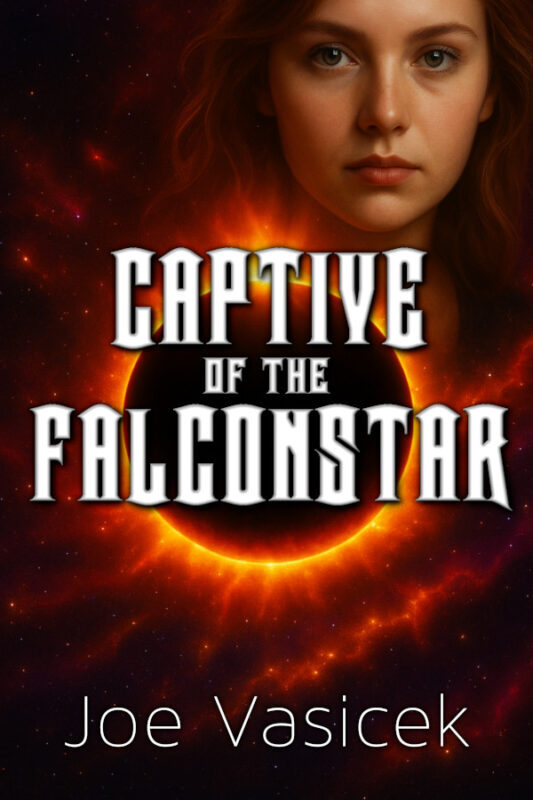
Author’s Note: Captive of the Falconstar

This is the author’s note I wrote for Captive of the Falconstar. To preorder the novel, click here.

As a young reader, I noticed an interesting pattern in the science fiction books I used to read. Whenever there were three books in a trilogy, the first one was usually a standalone of sorts, with a straightforward plot arc and a satisfying conclusion. But the second book in the trilogy either ended in a major cliffhanger, or else followed a tragic arc with a very unsatisfying conclusion that set things up for the third and final book in the trilogy, which wraps things up in a much more satisfying way. Over time, I internalized this basic rhythm, and still keep it in mind whenever I outline a new series arc.

With the Falconstar Trilogy, I had the idea for the first book long before I knew where the series itself was going. But I found it very difficult to write Queen of the Falconstar until I knew how the rest of the trilogy would end. For that reason, Queen of the Falconstar remained an unfinished draft on my hard drive for the better part of a decade, until I dusted it off in 2020 and tried to rewrite it as a novella. After running it through my writing group, I had a long conversation with my wife, in which I shared some of my story ideas for books 2 and 3. Her response was the catalyst that became Captive of the Falconstar: she basically said “Sonya is too much of a passive character. You should make her the villain/anti-hero of book 2, and give her a revenge plot.”

Suddenly, everything came together, and I knew exactly what I needed to do. I scrapped the novella version of Queen of the Falconstar and turned it into a novel, publishing it in 2021. I then set the Falconstar Trilogy aside to finish The Stars of Redemption (the third book in the Genesis Earth Trilogy) and Children of the Starry Sea. Basically, I had a lot of irons in the fire and wanted to finish those other WIPs before finishing what I’d started with Falconstar. Also, I wanted to see how Queen of the Falconstar did as a standalone, to judge whether or not to prioritize the next two books.

Then, in 2022, OpenAI released ChatGPT and everything began to change. Suddenly, generative AI was turning the writing world upside down. Two camps began to emerge: the first and most vocal was vehemently opposed to all things AI, but especially with using AI as a writing tool. From what I can tell, between a third to a half of all writers fall into that camp. The other half, however, quietly began to implement AI in their writing process in varying degrees. Some writers were lazy about it, leading to some hilarious mishaps when they copy-pasted the full AI response in their books without reading it first, including phrases like “here is the passage you requested, in the style of such-and-such author.” But others were more thoughtful about it, striving to find a balance between using AI as a tool and preserving their own authorial voice and vision.

It was a fascinating time to be a writer, especially one with several novels under my belt. Since I’d already written at least a million words without any AI, and had already developed my own personal voice, I didn’t see much harm in experimenting with these new AI writing tools to see what they could do. I very quickly found that the lazy approach was not the best way to “write,” as AI has, at best, a very bland voice and very little logical consistency over the course of a 300 page book. To really make it work, I found that I had to bring my own vision in the form of a solid outline, and to rewrite everything in my own words to make sure that my voice made it to the final version. But for all the work in-between, I found that AI was a very powerful tool.

There are basically three parts to writing a book: coming up with the story, translating that story idea into words on the page, and turning those words into good words. The part that I struggle the most with is putting the actual words on the page, because a story often changes in the course of writing it down, and when my focus is on putting words on the page, it’s very difficult for me to keep a broad view of the story. Suddenly, the words stop coming to me, because my subconscious mind recognizes that something in the story is broken, but because I’ve lost sight of the forest for the trees, I don’t know how to fix it. So I spend the next month (or two, or three) trying to write my way through the block, only to find that the whole book is hopelessly broken, at which point I decide to set the book aside and come back to it later, once I can approach it with fresh eyes. When I come back to it, the problem is often obvious enough that a quick rewrite can fix it, but by that point I’m several months (or even years) into the project, with very little to show for it. And that is when things work out well—I’ve got plenty of other books that I couldn’t fix, and ended up trunking.

But with AI, I can now translate my outline into a passable rough draft without losing sight of the overall story. By doing this, I can immediately identify all of the major issues with the story, and fix them before they turn into months and months of writer’s block. Of course, the AI draft is too terrible to publish on its own, but that’s no different than any other crappy first draft. So after tweaking the prompts, generating a few different versions of the book, and combining the best parts of each version into a version that’s as good as I can make it with the AI tools alone, I find that I’m ready to rewrite the whole thing in my own words. At that point, it doesn’t matter if I lose sight of the overall story, because all of the major story issues are fixed, and I can focus on the page without having to worry about falling into writer’s block.

In general, I think there are two approaches to using AI. The first is to use AI to do all the work, so that you can reap all of the reward. This isn’t always the wrong approach, but it does always produce “slop.” The other approach is to use AI to do the work that you really struggle with, so that you can refocus your energy on the work that you’re actually good at. Usually, this is the 20% of what you do that produces 80% of the results. Using this approach to AI, you can 5x your productivity without sacrificing quality or producing AI slop.

Imagine a world where instead of waiting a year or more to read the next book from your favorite author, you could get a new book every few months. A world in which your favorite author writes more than a hundred really good books over the course of his lifetime, rather than only one or two dozen. With the way AI is changing things, I’m very optimistic that we are entering this kind of a world. Yes, there will be a lot of slop too, but most of that is going to sink while the cream will rise to the top. And as for the fear that AI will completely replace human authors, I’m not too worried about that, because voice and vision are the two distinctly human elements that make the best books stand out from all the rest. We may get to the point where AI can write a good, generic fantasy novel, but it will never be able to write a Joe Vasicek novel. So if I can learn to use these AI writing tools without losing my voice or my vision for my books, the result is a world where I can write not just more books, but better books—enough to build an audience that will sustain a lifelong career.

So from 2023 through 2025, I focused all of my writing efforts on experimenting with these new AI writing tools, figuring out what worked and what didn’t work, and incorporated all of that into my new creative process. I wrote a lot of practice novels in that time, most of them in the Sea Mage Cycle, but I did experiment a lot with Captive of the Falconstar too. In 2024, I wrote out a detailed outline for the book, but my first attempt was not satisfactory, and I ended up trunking that AI draft and reworking the project from scratch. All through this time, the AI models themselves were rapidly changing, (as well as Sudowrite, the platform I use for most of my AI drafts,) so when I did pick up this WIP again, it made more sense to rewrite the prompts and generate a whole new version anyway.

In January 2026, I decided to buckle down and finish Captive of the Falconstar, even if it took the better part of the year. Thankfully, I managed to finish it in only four months, even though I was watching three small kids for most of that time while my wife was working full-time. (That’s another great thing about writing with these new AI tools: they can really help you to write through difficult life circumstances that would otherwise force you to put your writing on the back-burner for months, or even years.) Once it was done, I sent it off to my editor and put it up for preorder.

The content issues of Captive of the Falconstar did give me pause, since this is much more of an R-rated book than I usually write. In particular, I spent a lot of time agonizing over whether to fade to black instead of including the explicit sex scene where [SPOILER REDACTED]. But her realization of [SPOILER REDACTED] was important enough to her character development that I decided to keep it in. And whenever I paused for a gut check, I always got the impression that this was the book I was supposed to write, even with the explicit sexual content.

Zenoba’s bisexuality was also difficult to write, because of the danger that it would upset everybody and satisfy nobody: that LGBTQ readers would be outraged by the lack of positive affirmation, and that conservative readers would be disgusted by the inclusion of any LGBTQ content at all. But [SPOILER REDACTED] is so key to Zenoba’s character, and to [SPOILER REDACTED], that I couldn’t write her character honestly without including it. And again, whenever I paused for a gut check, I always felt impressed to go on. For all that, I can only suppose that there is a reader out there whom this story was meant to touch. Perhaps that reader is you.

When it comes to mature subjects like [SPOILER REDACTED], there’s a fine line between depicting the subject honestly and depicting it gratuitously. If you err too far on one side, you end up with a weak or an incomplete story, but if you err too far on the other, you veer into writing porn. I’ve done my best to thread that line, and to write my characters as true and as honestly as possible. Perhaps I could have done better, but I do believe that I’ve done the best that I can with my current level of skill.

My plan as of now is to finish another Sea Mage Cycle book and write the third and final book in the Falconstar Trilogy in time for a May 2027 release. I’m still not at a point where I can write a new book in less than 3-4 months, but I do think I can write them fast enough to publish 2-3 novels per year. So that’s the goal. Maybe when the kids are a little older, and I’m a little more practiced with these AI writing tools, I’ll be able to to do more than that. But either way, you won’t have to wait another five years before getting the conclusion to the Falconstar Trilogy. That much I can definitely promise you!

If you enjoyed this book, I would greatly appreciate it if you would post a rating or a review. It really does help to train the recommendation algorithms, so that other people with similar tastes can find these books. Or you can tell a friend about them—even in today’s interconnected world, there’s no substitute for an authentic human connection. If you want to follow my books and my writing, the best way to do that is to sign up for my email newsletter, which I send out about 1-2 times per month. Or you can follow my blog at One Thousand and One Parsecs, or email me at jvasicek.author@gmail.com if you want to get in touch.

That’s all for this one. Until next time, thanks for reading!

Joe

June 2026

HTTL

What if it’s all hallucination?

I’ve been thinking a lot recently about something my wife said about AI. She’s finishing up her PhD in computer science, and knows more about generative AI and computational linguistics than just about everyone I know IRL (and most people I follow on the internet, too). So when she speaks on the subject, I do my best to listen.

Ever since OpenAI and ChatGPT took the world by storm, she’s been telling me that she doesn’t think the hallucination problem (where LLMs make stuff up) will ever be solved. Indeed, she doesn’t think it’s a “problem” in a technical sense at all, because every response from a generative AI is a hallucination—and that’s kind of a point. These aren’t really thinking machines, they’re hallucinating machines, replicating patterns in human language and thought. What difference does it make if the answer is false or true?

We call it “artificial intelligence,” but that’s really a misnomer, because these machines have no “intelligence” at all—at least, not in the human sense. Instead, they are like mirrors of our own intelligence, parroting back things that sound like they involve real thought, when really it’s all just pattern replication. They aren’t trained to recognize truth, they’re trained to recognize patterns. So, in reality, everything an AI generates is a “hallucination.”

This is why she thinks that we will never fully solve the hallucination “problem.” Indeed, the whole effort is a bit like trying to turn a lion into a vegan. And until we can train an AI on absolute truth—a thing that humanity has never been able to agree upon, much less reduce to zeroes and ones—then all we will really be able to do is create better and better plumage for our stochastic parrots.

What are the implications of this? First of all, we can safely ignore the worst of the AI doom porn, because a machine that cannot fundamentally recognize truth from falsehood is probably not capable of taking over the world and exterminating or enslaving humanity, even if it does qualify as a “general” intelligence.

We can also lay aside the fear (or the pipe-dream) that AI will 100% replace humans in all or most or really any fields. Even if they can do 90% of the work, recognizing truth is still an essential part of just about everything we as humans do. We can give it jobs and tasks—perhaps even some genuinely complex tasks—but so long as these machines cannot fundamentally distinguish between truth and falsehood, we will still need a human to oversee them.

That doesn’t mean that most humans are safe from being replaced by AI, though. If an AI-augmented person can accomplish the work of 10x or 100x the number of other human workers, we’re still going to face a massive disruption in the labor market and society as a whole. The question, then, is one of ownership and distribution. Who owns the AI? How do we distribute the productivity gains from AI? These are some of the difficult problems we need to solve in the next few years.

But the real problem—and the scariest implication of all of this—is the question of truth itself. After all, if AI is fundamentally incapable of recognizing truth, and all AI output is hallucination on some level, then who determines what is true and what is not? Sam Altman? OpenAI? Congress? Some three-letter government agency?

I think this is going to be the defining question of the rising generation, which is growing up in an AI-native world. What is truth? How can we recognize it? How do we distinguish between what is true and what is false? Increasingly, we are going to find that these are questions that AI cannot answer. And in a world saturated by deep fakes, bots, and sock puppets, where the internet is dead and all the most powerful players are constantly fighting a 5th gen war with each other, truth will be the thing we are all starving for.

The tragedy of the millennial generation is that everything in our world conspired to starve us of the three things we needed most. More than anything else, we hungered for meaning, authenticity, and redemption—and for the most part, we never got it. You can blame social media, the boomers, capitalism, student loan debt, the Republicans, the Democrats—it really makes no difference. All of those things and more came together to hobble our generation and make it almost impossible for us to launch.

Will the same thing happen with the zoomers and gen-alpha over the question of truth? It appears that things are moving in that direction. In a world saturated with AI, truth becomes a scarce and valuable commodity.

So what do we do? First, I think it’s important to recognize that AI cannot and never will be an authority on truth. At best, it only mirrors our own thoughts and ideas back to us—and at worst, it feeds us the thoughts and ideas of those who seek to control us. But AI itself is neutral, just like a gun or a knife lying on a table is neutral. What matters is how it is used.

Beyond that, I don’t really know what to say. Only that this is something I need to think about a lot more. What are your thoughts?

Will super-intelligent AI take over the world?

I’ve been reading a lot of non-fiction books about AI recently. Basically, whenever a nonfiction audiobook that has anything to do with AI comes into my audiobook library app, I jump on the waiting list and listen to it right away. I’ve also been following AI news podcasts and watching lots of YouTube channels that discuss the recent developments… and boy, is there a lot of doom porn out there.

People who are closely watching this stuff believe that AGI (Artificial General Intelligence) is imminent, ie within the next 6 to 72 months, and that when AGI gets mainstreamed, it will either usher in a golden age of post-scarcity, or the ultimate extinction of all mankind (or both, weirdly). The main crux of their thesis is that once we achieve an AGI that can rewrite its own code, it will quickly turn into a superintelligence, and then it will either work to serve humanity or else work to eliminate humanity as a threat, either by outright exterminating us, or putting us into some kind of zoo.

This is all very science fictional stuff—but now more than ever, we are living in a science fictional world. So what is actually going to happen? Do I believe we going to enter the singularity, and give birth to a new species of superintelligent AI that will ultimately replace us? Or, in the lingo of Silicon Valley, what is my P(doom)?

TL;DR: I have two P(doom) values, one of which is 0%, the other of which is 90%. My P(doom) for basically all of the scenarios that involve a runaway superintelligence is 0%, but my P(doom) for massive catastrophic social upheaval due to the disruptive nature of AI technology is 90%.

For the last century or so (basically ever since Turing’s work during WWII), the field of artificial intelligence has followed a cyclical pattern. First, researchers make some sort of breakthrough, which leads to rapid technological advancements and a brief AI boom. During this boom, futurists and technologists rave about how this technology will keep scaling up forever until it ushers in a sci-fi utopia/dystopia and utterly changes what it means to be human. Then, the technological development stalls as researchers run up against a hard barrier that makes further scaling impossible, at which point most of the investors sours on the technology and we fall into an “AI winter” for a decade or two.

The problem with the futurists and technologists who promote AI technology is that the vast majority of them are transhumanists who believe that intelligence is purely an emergent phenomenon that is 100% materialistic in nature. In other words, they believe that the human mind is little more than an organic machine created through the process of evolution, and that 100% of our intelligence, emotions, spirituality, and experience can be explained and understood through purely material processes. Therefore, if they can build a machine that replicates the same biological processes as the human brain, and subject it to similar conditions that evolution subjected us to, intelligence will naturally emerge from such processes and conditions.

But what if they’re wrong? What if there are more things in heaven and in earth than are dreamed up in our modern philosophies? I’m not saying that evolution didn’t play a role in the creation/emergence of intelligence—only that it’s insufficient. And why wouldn’t it be? Science, by definition, can only explain what it can measure. And what about the questions that we can’t ask? The things about this universe that are as foreign to our own understanding as quantum physics is to a German Shepherd?

For these reasons, I do not think that these generative AI models are going to keep scaling upward until we achieve a general superintelligence. At some point in the next 0-18 months, I think that the researchers and developers are going to start hitting hard limits that we don’t understand, because of the limitations of our understanding of the human brain and how our own intelligence emerged or was created.

I am extremely skeptical of all of the doom porn floating around out there, that we are months away from achieving AGI, and that a superintelligence will shortly thereafter replace us as the dominant species on this planet. For one thing, the goalposts for AGI are constantly moving—by the standards two or three decades ago, we have already achieved it—and for another, the transhumanists have turned this concept of AGI into a sort of Messianic savior / world-ending destroyer. And I just don’t buy into that religion.

So if I’m right, all of this doom porn about a world-ending superintelligence is utterly misguided. Which, on a certain level, is somewhat comforting. But on the other hand, that also means that we shouldn’t expect AI to save us—and that anyone who tries to tell us otherwise is ultimately trying to sell us something.

The big AI developers like OpenAI, Anthropic, etc. have every incentive to hype up the doom porn. It makes them look powerful, which in turn attracts investment capital. At the same time, they also have every incentive to promote this idea that a superintelligent AI can be our savior, since if AGI is inevitable, shouldn’t we put everything we have into making sure that our AI overlords are benevolent and have humanity’s interest at heart? But again, if we take that view, we also end up pumping lots of investment capital into these AI companies, turning them into massive cultural behemoths without really questioning their ultimate aims.

What if instead of building a superintelligent AI savior, we ultimately end up with a new form of techno-feudalism, powered by AI? What if a true superintelligence never emerges, and all of the energy and resources we’re pumping into AI is really just going to create a new class of elites, with the rest of us dependent on some sort of universal basic income and totally at the mercy of the owners, controllers, and operators of AI?

To me, this seems like a much more likely scenario—and from what I can tell, we are already in the opening phases of it. Generative AI has already become so powerful that it will likely replace a large number of jobs or render them obsolete—which may or may not be a problem in the medium- to long-term, but will certainly be a problem in the short-term. As increasing numbers of people find themselves unemployed, it will put a tremendous strain on our welfare safety nets, and drive calls for increased government spending on social problems. But our governments are already so deep in debt that these pressures can only lead to some combination of (hyper)inflation, soveriegn debt crisis, and austerity-driven political instability.

Some people think that the solution to all of this is a universal basic income (UBI). But every time a UBI has been introduced, it has always led to negative outcomes, including wealth outcomes. Unfortunately, if AI is truly going to be a huge driver of unemployment (which doesn’t require AGI or a superintelligence—our current models are already powerful enough to drive massive disruption in the labor market), then I don’t see how we can avoid a massive push toward UBI. Certainly not with how our current investments in AI are so centralized—but again, all of the AGI doom-porn is driving us to centralize things even more. So while all of the benefits of this new technology accrue to Sam Altman, Elon Musk, Dario Amodei, etc, and they keep holding out the promise of a messianic superintelligent AI that never truly emerges, the rest of us end up in a world where we have very little agency or control over our lives, with or without a UBI.

It doesn’t have to be this way. But if we all keep buying into the doom porn without looking critically at these AI companies and their transhumanist messianic promises, I think that this is the future we’re most likely going to get.