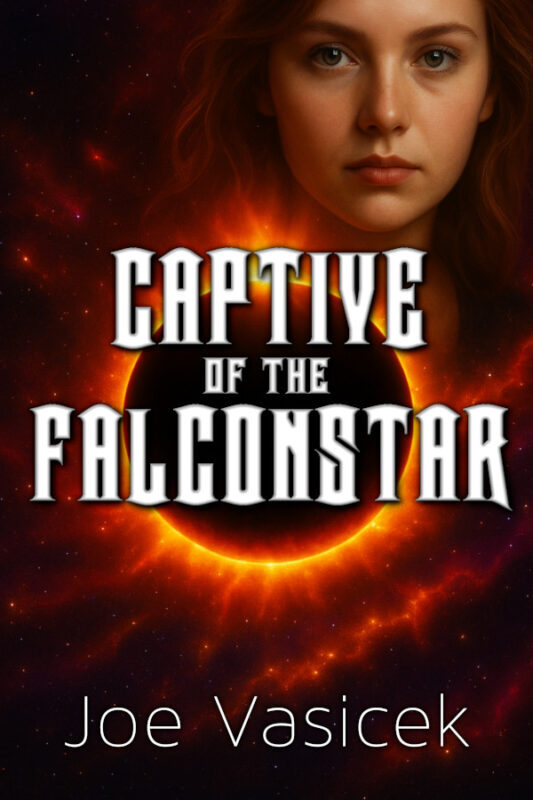
This is the author’s note I wrote for Captive of the Falconstar. To preorder the novel, click here.
As a young reader, I noticed an interesting pattern in the science fiction books I used to read. Whenever there were three books in a trilogy, the first one was usually a standalone of sorts, with a straightforward plot arc and a satisfying conclusion. But the second book in the trilogy either ended in a major cliffhanger, or else followed a tragic arc with a very unsatisfying conclusion that set things up for the third and final book in the trilogy, which wraps things up in a much more satisfying way. Over time, I internalized this basic rhythm, and still keep it in mind whenever I outline a new series arc.
With the Falconstar Trilogy, I had the idea for the first book long before I knew where the series itself was going. But I found it very difficult to write Queen of the Falconstar until I knew how the rest of the trilogy would end. For that reason, Queen of the Falconstar remained an unfinished draft on my hard drive for the better part of a decade, until I dusted it off in 2020 and tried to rewrite it as a novella. After running it through my writing group, I had a long conversation with my wife, in which I shared some of my story ideas for books 2 and 3. Her response was the catalyst that became Captive of the Falconstar: she basically said “Sonya is too much of a passive character. You should make her the villain/anti-hero of book 2, and give her a revenge plot.”
Suddenly, everything came together, and I knew exactly what I needed to do. I scrapped the novella version of Queen of the Falconstar and turned it into a novel, publishing it in 2021. I then set the Falconstar Trilogy aside to finish The Stars of Redemption (the third book in the Genesis Earth Trilogy) and Children of the Starry Sea. Basically, I had a lot of irons in the fire and wanted to finish those other WIPs before finishing what I’d started with Falconstar. Also, I wanted to see how Queen of the Falconstar did as a standalone, to judge whether or not to prioritize the next two books.
Then, in 2022, OpenAI released ChatGPT and everything began to change. Suddenly, generative AI was turning the writing world upside down. Two camps began to emerge: the first and most vocal was vehemently opposed to all things AI, but especially with using AI as a writing tool. From what I can tell, between a third to a half of all writers fall into that camp. The other half, however, quietly began to implement AI in their writing process in varying degrees. Some writers were lazy about it, leading to some hilarious mishaps when they copy-pasted the full AI response in their books without reading it first, including phrases like “here is the passage you requested, in the style of such-and-such author.” But others were more thoughtful about it, striving to find a balance between using AI as a tool and preserving their own authorial voice and vision.
It was a fascinating time to be a writer, especially one with several novels under my belt. Since I’d already written at least a million words without any AI, and had already developed my own personal voice, I didn’t see much harm in experimenting with these new AI writing tools to see what they could do. I very quickly found that the lazy approach was not the best way to “write,” as AI has, at best, a very bland voice and very little logical consistency over the course of a 300 page book. To really make it work, I found that I had to bring my own vision in the form of a solid outline, and to rewrite everything in my own words to make sure that my voice made it to the final version. But for all the work in-between, I found that AI was a very powerful tool.
There are basically three parts to writing a book: coming up with the story, translating that story idea into words on the page, and turning those words into good words. The part that I struggle the most with is putting the actual words on the page, because a story often changes in the course of writing it down, and when my focus is on putting words on the page, it’s very difficult for me to keep a broad view of the story. Suddenly, the words stop coming to me, because my subconscious mind recognizes that something in the story is broken, but because I’ve lost sight of the forest for the trees, I don’t know how to fix it. So I spend the next month (or two, or three) trying to write my way through the block, only to find that the whole book is hopelessly broken, at which point I decide to set the book aside and come back to it later, once I can approach it with fresh eyes. When I come back to it, the problem is often obvious enough that a quick rewrite can fix it, but by that point I’m several months (or even years) into the project, with very little to show for it. And that is when things work out well—I’ve got plenty of other books that I couldn’t fix, and ended up trunking.
But with AI, I can now translate my outline into a passable rough draft without losing sight of the overall story. By doing this, I can immediately identify all of the major issues with the story, and fix them before they turn into months and months of writer’s block. Of course, the AI draft is too terrible to publish on its own, but that’s no different than any other crappy first draft. So after tweaking the prompts, generating a few different versions of the book, and combining the best parts of each version into a version that’s as good as I can make it with the AI tools alone, I find that I’m ready to rewrite the whole thing in my own words. At that point, it doesn’t matter if I lose sight of the overall story, because all of the major story issues are fixed, and I can focus on the page without having to worry about falling into writer’s block.
In general, I think there are two approaches to using AI. The first is to use AI to do all the work, so that you can reap all of the reward. This isn’t always the wrong approach, but it does always produce “slop.” The other approach is to use AI to do the work that you really struggle with, so that you can refocus your energy on the work that you’re actually good at. Usually, this is the 20% of what you do that produces 80% of the results. Using this approach to AI, you can 5x your productivity without sacrificing quality or producing AI slop.
Imagine a world where instead of waiting a year or more to read the next book from your favorite author, you could get a new book every few months. A world in which your favorite author writes more than a hundred really good books over the course of his lifetime, rather than only one or two dozen. With the way AI is changing things, I’m very optimistic that we are entering this kind of a world. Yes, there will be a lot of slop too, but most of that is going to sink while the cream will rise to the top. And as for the fear that AI will completely replace human authors, I’m not too worried about that, because voice and vision are the two distinctly human elements that make the best books stand out from all the rest. We may get to the point where AI can write a good, generic fantasy novel, but it will never be able to write a Joe Vasicek novel. So if I can learn to use these AI writing tools without losing my voice or my vision for my books, the result is a world where I can write not just more books, but better books—enough to build an audience that will sustain a lifelong career.
So from 2023 through 2025, I focused all of my writing efforts on experimenting with these new AI writing tools, figuring out what worked and what didn’t work, and incorporated all of that into my new creative process. I wrote a lot of practice novels in that time, most of them in the Sea Mage Cycle, but I did experiment a lot with Captive of the Falconstar too. In 2024, I wrote out a detailed outline for the book, but my first attempt was not satisfactory, and I ended up trunking that AI draft and reworking the project from scratch. All through this time, the AI models themselves were rapidly changing, (as well as Sudowrite, the platform I use for most of my AI drafts,) so when I did pick up this WIP again, it made more sense to rewrite the prompts and generate a whole new version anyway.
In January 2026, I decided to buckle down and finish Captive of the Falconstar, even if it took the better part of the year. Thankfully, I managed to finish it in only four months, even though I was watching three small kids for most of that time while my wife was working full-time. (That’s another great thing about writing with these new AI tools: they can really help you to write through difficult life circumstances that would otherwise force you to put your writing on the back-burner for months, or even years.) Once it was done, I sent it off to my editor and put it up for preorder.
The content issues of Captive of the Falconstar did give me pause, since this is much more of an R-rated book than I usually write. In particular, I spent a lot of time agonizing over whether to fade to black instead of including the explicit sex scene where [SPOILER REDACTED]. But her realization of [SPOILER REDACTED] was important enough to her character development that I decided to keep it in. And whenever I paused for a gut check, I always got the impression that this was the book I was supposed to write, even with the explicit sexual content.
Zenoba’s bisexuality was also difficult to write, because of the danger that it would upset everybody and satisfy nobody: that LGBTQ readers would be outraged by the lack of positive affirmation, and that conservative readers would be disgusted by the inclusion of any LGBTQ content at all. But [SPOILER REDACTED] is so key to Zenoba’s character, and to [SPOILER REDACTED], that I couldn’t write her character honestly without including it. And again, whenever I paused for a gut check, I always felt impressed to go on. For all that, I can only suppose that there is a reader out there whom this story was meant to touch. Perhaps that reader is you.
When it comes to mature subjects like [SPOILER REDACTED], there’s a fine line between depicting the subject honestly and depicting it gratuitously. If you err too far on one side, you end up with a weak or an incomplete story, but if you err too far on the other, you veer into writing porn. I’ve done my best to thread that line, and to write my characters as true and as honestly as possible. Perhaps I could have done better, but I do believe that I’ve done the best that I can with my current level of skill.
My plan as of now is to finish another Sea Mage Cycle book and write the third and final book in the Falconstar Trilogy in time for a May 2027 release. I’m still not at a point where I can write a new book in less than 3-4 months, but I do think I can write them fast enough to publish 2-3 novels per year. So that’s the goal. Maybe when the kids are a little older, and I’m a little more practiced with these AI writing tools, I’ll be able to to do more than that. But either way, you won’t have to wait another five years before getting the conclusion to the Falconstar Trilogy. That much I can definitely promise you!
If you enjoyed this book, I would greatly appreciate it if you would post a rating or a review. It really does help to train the recommendation algorithms, so that other people with similar tastes can find these books. Or you can tell a friend about them—even in today’s interconnected world, there’s no substitute for an authentic human connection. If you want to follow my books and my writing, the best way to do that is to sign up for my email newsletter, which I send out about 1-2 times per month. Or you can follow my blog at One Thousand and One Parsecs, or email me at jvasicek.author@gmail.com if you want to get in touch.
That’s all for this one. Until next time, thanks for reading!
Joe
June 2026
HTTL
