Reading Resolution Update: March

My 2022 reading resolution: Read or DNF every novel that has won a Hugo or a Nebula award, and acquire all the good ones.

So March is usually the time where people get tired of their new year’s resolutions and either give them up entirely or put them on the back burner for a while. But at this point, I’m a little more than halfway through achieving this one, so I will definitely keep pressing on since I don’t think it will take the whole year to accomplish it. In fact, I may actually expand it to include all of the short stories, novellas, and novelettes. I’ve already filled out the spreadsheet (with a huge thanks to the Internet Speculative Fiction Database, which also lists all of the collections and anthologies where each story can be found).

With that said, my enthusiasm for reading all of these books is starting to flag, and I’m not pushing on as vigorously as I did back in January. There have been a lot of DNFs… a lot of DNFs. But now, I’m starting to get to the books that aren’t obvious DNFs, which is frustrating, because when you get more than halfway through a 600 page book before you realize it isn’t worth finishing, that really does take the fun out of reading, at least in the short term.

But it has been very eye-opening to see what kinds of books tend to win Hugos and Nebulas. I’ve noticed some interesting patterns that have given me real insight into the people who vote in these awards, which consists of the old guard in fandom for the Hugos, and members of SFWA (mostly professional authors) for the Nebulas.

One book in particular I found really eye-opening in this regard, and that was They’d Rather Be Right by Mark Clifton and Frank Riley. Mark Clifton was a science fiction short story writer who was fairly prolific, but died tragically about ten years after They’d Rather Be Right came out in 1955. Frank Riley was a newspaper man who dabbled a little bit in mystery short stories but only ever co-wrote this one novel.

They’d Rather Be Right is a notoriously difficult book to get your hands on. An abridged version with the title The Forever Machine is on sale on Amazon somewhere north of $100, and neither version was available at either my local library or the Harold B. Lee Library at BYU, and that’s unusual because the HBLL’s science fiction and fantasy collection is one of the best in the country. I eventually bought a used version of They’d Rather Be Right on Amazon from a third-party seller for $10: it was an old library copy from a small town in Arizona, and I think the seller was the actual library.

In reading about this book, I discovered that it’s been widely panned as the “worst book to win a Hugo.” However, after reading it, I can definitely say it is not the worst book. It’s not the best book either, but it is far from the worst, and I enjoyed it enough to put it on the “books worth keeping” list. So why is it considered the worst Hugo-winning book, and why has it been forgotten so thoroughly?

My working theory is that They’d Rather Be Right isn’t actually bad, it’s just heretical. Science fiction has always skewed toward the political left, and this book thoroughly ridicules some deeply held left-wing beliefs of its day. For example, it goes out of its way to ridicule scientists as a class, and makes it seem ludicrous that they have any business deciding on how the rest of society should be governed. It also pokes fun at some of Sigmund Freud’s ideas, which is notable because so many of the Hugo and Nebula winning novels of the 60s and 70s are so thoroughly Freudian.

So what happened, I believe, is that after the Hugos became a regular feature of Worldcon (They’d Rather Be Right was only the 2nd novel to ever win a Hugo), the influencers and kingmakers within fandom decided that this one won on a fluke, and did everything they could to suppress it. And perhaps it really was a fluke, since the Hugo Awards weren’t yet established, and Worldcon itself was only a little more than a decade old.

Because here’s the thing: the Hugos and the Nebulas have always been radically left-wing. Science fiction in general has always leaned hard to the left, and those of us who consider ourselves right-wingers have always been a despised minority to most of the rest of fandom. That didn’t start in the 50s either: if anything, it started with the Futurians, as Donald Wollheim himself (founder of DAW Books) said that science fiction “should actively work for the realization of the scientific world-state as the only genuine justification for their activities and existence.” The Futurians were the ones who founded both Worldcon and SFWA, as well as several other establishment institutions in the SF&F field.

But I think it started before the Futurians, because it makes a lot of sense that science fiction would attract left-wingers more than it would right-wingers. Left-wingers are the kind of people who think that traditions should be thrown out and new ideas should be implemented, whereas right-wingers are the kind of people who think that new ideas should be treated cautiously, and traditions should be upheld.

There’s a cycle that happens about every 50 to 100 years, and it goes like this: someone comes up with a Beautiful Idea that almost everyone on the left becomes enamored of. They pore over this idea, ponder it, debate it amongst themselves, and spill copious amounts of ink over it, mostly in the form of academic discourses and thesis papers.

Gradually, this idea matures into a General Theory, and the left constructs a whole worldview around it. But at this point, it starts to come into conflict with reality—not in a catastrophic way at first, but definitely in a way that causes some uncomfortable cognitive dissonance. But because the Beautiful Idea was so beautiful, none of the theory’s proponents really want to give it up, so they start to build a bulwark of apologia to explain the theory’s inconsistencies and contradictions.

After a while, though, that isn’t enough, and reality begins to intrude in ways that simply cannot be ignored. At this point, the General Theory morphs into an Ugly Ideology, possessing all of its followers and driving them into incredible pathologies. Groupthink and doublespeak become de rigueur, and hypocrisy infects everyone. Values like diversity, curiosity, open inquiry, freedom of speech, and intellectual honesty are all thrown out, as nothing is more important than promoting the ideology. Right and wrong cease to matter as well: the only thing that matters is power.

Eventually, reality intrudes in such a way that the entire edifice comes crumbling down, completely discrediting the Beautiful Idea and everyone who ever believed in it. But if the Ugly Ideology persists for too long, it culminates in a reign of terror, with guillotines, gas chambers, firing squads, holocausts, and genocides.

Fortunately, there are people who drop out at every stage of this cycle: “That’s a Beautiful Idea, but it’s still flawed.” “I like the General Theory, but I don’t think it explains everything.” “I am a true believer in this Ugly Ideology, but I’m not going to pull the trigger on those people.” And if enough people drop out, the pendulum swings back, the left goes into retreat, and culture and politics swing back to the right again… until someone discovers (or rediscovers) a Beautiful Idea.

In the 60s and 70s, the left was in the early stages of the Ugly Ideology phase of this cycle. Not surprisingly, the science fiction of that time was pretty terrible. Then the Reagan era happened, the Soviet Union collapsed, the Cold War ended, and left was thrown on the back foot for a generation. During this time (the 80s and 90s), the award-winning science fiction was actually pretty good.

But that was also the time when the ideas that underpin critical race theory began to take root—the “Beatiful Ideas” that gave us, among other things, Defund the Police, the George Floyd riots, the epidemic of smash-and-grab robberies, and the ongoing collapse of leftist-run cities like Chicago and San Francisco. In science fiction, this culminated in the sad and rabid puppies, at which point the Hugos and Nebulas became total garbage again, because the left-leaning fandom had become so ideologically possessed.

So anyways, that’s my take on it. I really did enjoy They’d Rather Be Right, and not just for the insights into fandom. In any case, here are all of the other Hugo and Nebula winning books I read or DNFed in March:

Books that I read and plan to or have already acquired:

  • They’d Rather Be Right by Mark Clifton and Frank Riley (1955 Hugo)

Books that I read and don’t plan to acquire:

  • The City & The City by China Mieville (2010 Hugo)

Books that I did not finish:

  • Stranger in a Strange Land by Robert A. Heinlein (1962 Hugo)
  • To Your Scattered Bodies Go by Philip Jose Farmer (1972 Hugo)
  • Where Late the Sweet Birds Sang by Kate Wilhelm (1977 Hugo)
  • The Snow Queen by Joan D. Vinge (1981 Hugo)
  • The Yiddish Policeman’s Union by Michael Chabon (2008 Hugo and Nebula)

Reading Resolution Update: February

My 2022 reading resolution: Read or DNF every novel that has won a Hugo or a Nebula award, and acquire all the good ones.

I didn’t read nearly as many books in February as I did in January. Part of that might have been enthusiasm for the resolution waning a bit, but a good chunk of it was due to the fact that my grandmother passed away, and we took off a week for the funeral. Also, potty training completely upended our daily routine. I also went ahead and finished Jeff VanderMeer’s Southern Reach Trilogy, after reading Annihilation, so that took off a lot of reading time that otherwise would have gone toward this goal.

But I’m not too worried about it, since I’m already well past the halfway point and should be able to finish before the end of the year. In fact, I went ahead and made a similar spreadsheet of all the short stories, novelettes, and novellas that won a Hugo/Nebula, and may move on to those after I finish the novels. It’s going to be a lot more challenging to hunt down all of those titles, though, so I might just move on to the Dragon Awards instead.

In any case, here are all the Hugo/Nebula award-winning novels that I read or DNFed in February:

Books that I read and plan to / have already acquired:

  • The Three Body Problem by Cixin Liu and Ken Liu, trans. (2015 Hugo)

Books that I read and don’t plan to acquire:

  • Conjure Wife by Fritz Leiber (1944 Retro Hugo, awarded in 2019)

Books that I did not finish:

  • This Immortal by Roger Zelazny (1966 Hugo)
  • Babel-17 by Samuel R. Delany (1967 Nebula)
  • The Healer’s War by Elizabeth Ann Scarborough (1990 Nebula)
  • Stations of the Tide by Michael Swanwick (1992 Nebula)
  • Slan by A.E. Van Vogt (1941 Retro Hugo, awarded in 2016)

Thoughts after reading the Southern Reach Trilogy by Jeff VanderMeer

So I recently finished reading the Southern Reach Trilogy by Jeff VanderMeer, and I have a lot of thoughts on it. I’ll do my best to avoid major spoilers, but I’ll probably end up spoiling some of it, so I’ll mark those parts as best as I can.

Overall, I can say that it started out strong, but ended rather mixed. I really enjoyed the first book, with its creeping sense of escalating paranoia that kept me glued to the page right to the end. This book won the Nebula Award in 2014, which was how I discovered it, and I was pleasantly surprised to find a Hugo/Nebula award-winning book from the past decade that I actually enjoyed.

The second book had some good moments, but overall I felt that it suffered from second-book slump. Which is understandable. It did a decent job of setting things up for the third book, but it lacked that sense of creeping, paranoid danger that really drew me into the first book—or rather, the danger was dialed down to the point where it just felt creepy instead of gripping or suspenseful.

Also, even though it explained a lot more than the first book, I don’t feel like it explained enough. This is probably because the book is clearly written to be deconstructed using the kind of literary theories that English majors spend most of their time in college learning about. There’s a lot of vague symbolism and recurring motifs, which makes for some very obtuse reading. The quality of the writing somewhat makes up for that, but if the first book hadn’t captured my imagination so much, it definitely would have felt like a slog.

And then, the third book. In some ways, I really enjoyed it. In other ways, I feel like it suffered from all the same problems as the second book, with a frustrating number of loose ends. But if any more loose ends had been tied up, it probably would have felt a bit like the ending to Lost. Which makes me wonder if behind all the pretty writing and other literary tricks, there isn’t a whole lot of substance behind any of the books in this trilogy.

But the thing that really got to me was the trope where a character is LGBTQ for no other discernible reason than to make him sympathetic—as if all LGBTQ people are sympathetic or virtuous by default. [Minor Spoiler] This particular character is also the only Christian in the trilogy, which makes me wonder if VanderMeer believes that being a Christian automatically makes you villanous by default—especially given the eerie strangling fruit sermon in the first book. [/Minor Spoiler] I see this trope fairly often, especially in modern science fiction and fantasy, and it’s super frustrating because of how it ties in with all of the other grooming and gaslighting that comes along with the religion of woke. At least if it was preachy, there would be some sort of message to ponder and digest, hamfisted as it might be.

But the saddest thing is that I can’t tell if VanderMeer fell back on this trope because he actually believes it, or because he knows that his audience (which seems to be rich, woke English majors drowning in student debt) requires it. In other words, is he merely responding to his audience, or is he leading them? Probably some of both, with a little bit of “I’m a straight, white male, so I have to prove that I’m not a white supremacist” thrown in.

Don’t get me wrong. There was a lot about this trilogy that I liked, and literary deconstruction aside, it’s clear that VanderMeer can write. But after finishing the trilogy, I don’t think I’ll be picking this one up. Unfortunately.

Reading Resolution Update: January

My 2022 reading resolution: Read or DNF every novel that has won a Hugo or a Nebula award, and acquire all the good ones.

I had expected to DNF a lot of these books, but I was a little dismayed at how terrible they are. Or rather, how some of them can be so well-written and yet so idelogically possessed.

For a while, I worried that I was pre-judging some of these books too harshly, based on my opinions of the author. After all, shouldn’t art be treated separately from the artist? But then I decided that it would be better to lean into that bias, and trust my intuition. After all, it’s impossible to approach reading without a personal bias—and even if it were possible, it wouldn’t be advisable.

One of the key things I’m hoping to take away from reading these books is a better understanding of my own personal tastes. Toward that end, it’s much better to DNF early and often, since that tells me something valuable about my own tastes. I’ll get much more out of this exercise if I pay attention to that than whether or not I’m being “fair” to a particular book or author.

As for how my bias against an author might prejudice me against a book, I don’t think that’s too much of a problem so long as I’m aware of those biases. Yes, it makes it more likely that I’ll read a book with a critical eye, and not in the way that I typically read for enjoyment, but that goes both ways, since if I do enjoy a book, that’s going to improve my opinion of the author (or at least make me reconsider my opinion). So long as I’m aware of my biases and make sure that they aren’t set in stone, I think it should be fine

Besides, it’s not like I have anything to prove. Sure, China Mike Glyer might pull out an excerpt from this post to use as content (hi China Mike!), but I couldn’t care less what that particular corner of fandom thinks about my public ruminations. I will know if I’m being too “unfair” to a book or an author, and the only criterion that really matters is whether I have a clear reason for DNFing the book, separate from my biases about the author.

And honestly, what I’ve found so far is that my biases are pretty spot on. Authors who behave insufferably in public or on the internet tend to write some pretty insufferable books, especially if they’re woke.

Fortunately, I have found a few new-to-me books and authors who are really fantastic. And my decision to DNF early and often is helping to keep it from becoming too much of a slog, which is good. It also means that I may complete this resolution a lot sooner than I’d expected, at which point I’ll probably move on to the Dragons or the Prometheus awards.

In any case, here are all the Hugo and Nebula awared-winning novels that I read or DNFed in January 2022:

Books that I read and plan to / have already acquired:

  • Way Station by Clifford D. Simak (1964 Hugo)
  • Foundation’s Edge by Isaac Asimov (1983 Hugo)
  • The Vor Game by Lois McMaster Bujold (1991 Hugo)
  • Annihilation by Jeff VanderMeer (2015 Nebula)

Books that I read and don’t plan to acquire:

  • None

Books that I did not finish:

  • The Big Time by Fritz Leiber (1958 Hugo)
  • A Case of Conscience by James Blish (1959 Hugo)
  • The Wanderer by Fritz Leiber (1965 Hugo)
  • The Einstein Intersection by Samuel R. Delany (1968 Nebula)
  • Stand on Zanzibar by John Brunner (1969 Hugo)
  • Rite of Passage by Alexei Panshin (1969 Nebula)
  • Man Plus by Frederik Pohl (1977 Nebula)
  • Dreamsnake by Vonda N. McIntyre (1979 Hugo and Nebula)
  • A Deepness in the Sky by Vernor Vinge (20000 Hugo) (My wife recommended this one, and I will probably try it again, since I took a break midway through and forgot who all of the characters were. But for now, I’m counting it as a soft DNF.)
  • Camouflage by Joe Haldeman (2006 Nebula)
  • The Windup Girl by Paolo Bacigalupi (2010 Hugo and Nebula)
  • Redshirts by John Scalzi (2013 Hugo)
  • Ancillary Justice by Ann Leckie (2014 Hugo and Nebula)
  • All the Birds in the Sky by Charlie Jane Anders (2017 Nebula)
  • The Calculating Stars by Mary Robinette Kowal (2019 Hugo and Nebula)
  • A Memory Called Empire by Arkady Martine (2020 Hugo)
  • A Song for a New Day by Sarah Pinsker (2021 Nebula)

Reading Resolution Update: Before 2022

My 2022 Reading Resolution: Read or DNF every novel that has won a Hugo or a Nebula award, and acquire all the good ones.

I was going to keep track of my reading resolution this year by mentioning each book and what I liked or didn’t like about it, why I DNFed it if I did, etc… and then I thought about it a little more and realized that that’s a terrible idea. Perhaps if I weren’t an author myself, I could risk bringing down the wrath of the internet by broadcasting everything that I really think about these books, but that’s still a really stupid thing to do—not to mention, a great way to burn a bunch of bridges that, as a writer, I really shouldn’t burn.

Instead, I’m going to post a monthly update where I list all of the books that I read and want to acquire, all the books that I read and probably won’t acquire, and all of the books that I DNFed, without any book-specific commentary. I do think that having some public accountability will help me to keep this resolution, and I do intend to keep it. But because I anticipate DNFing a lot of books that have very, um, merciless fans, this seems like a better way to do it.

So here is how things stood on the morning of January 1st, 2022:

Books that I read and want to / have already acquired:

  • Double Star by Robert A. Heinlein (1956 Hugo)
  • Starship Troopers by Robert A. Heinlein (1960 Hugo)
  • A Canticle for Leibowitz by Walter M. Miller Jr. (1961 Hugo)
  • The Man in the High Castle by Phillip K. Dick (1963 Hugo)
  • Dune by Frank Herbert (1966 Hugo and Nebula)
  • The Left Hand of Darkness by Ursula K. Le Guin (1970 Hugo and Nebula)
  • The Dispossessed by Ursula K. Le Guin (1975 Hugo and Nebula)
  • Downbelow Station by C.J. Cherryh (1982 Hugo)
  • Neuromancer by William Gibson (1985 Hugo and Nebula)
  • Ender’s Game by Orson Scott Card (1986 Hugo and Nebula)
  • Speaker for the Dead by Orson Scott Card (1987 Hugo and Nebula)
  • Barrayar by Lois McMaster Bujold (1992 Hugo)
  • Mirror Dance by Lois McMaster Bujold (1995 Hugo)
  • The Mule (included in Foundation and Empire) by Isaac Asimov (1946 Retro Hugo, awarded in 1996)
  • Harry Potter and the Goblet of Fire by J.K. Rowling (2001 Hugo)
  • Farmer in the Sky by Robert A. Heinlein (1951 Retro Hugo, awarded in 2001)
  • Fahrenheit 451 by Ray Bradbury (1954 Retro Hugo, awarded in 2004)
  • Spin by Robert Charles Wilson (2006 Hugo)
  • The Sword in the Stone by T.H. White (1939 Retro Hugo, awarded in 2014)
  • Network Effect by Martha Wells (2021 Hugo and Nebula)

Books that I read and don’t plan to acquire:

  • The Demolished Man by Alfred Bester (1952 Hugo)
  • The Forever War by Joe Haldeman (1975 Hugo and Nebula)
  • Gateway by Frederik Pohl (1977 Hugo and Nebula)
  • Red Mars by Kim Stanley Robinson (1993 Nebula)
  • American Gods by Neil Gaiman (2001 Hugo)

Books that I did not finish:

  • The Moon is a Harsh Mistress by Robert A. Heinlein (1966 Hugo)
  • Flowers for Algernon by Daniel Keyes (1966 Nebula)
  • Lord of Light by Roger Zelazny (1967 Hugo)
  • Ringworld by Larry Niven (1970 Hugo and Nebula)
  • Rendezvous with Rama by Arthur C. Clarke (1973 Hugo and Nebula)
  • Green Mars by Kim Stanley Robinson (1993 Hugo)
  • Blue Mars by Kim Stanley Robinson (1996 Hugo)
  • Forever Peace by Joe Haldeman (1997 Hugo, 1998 Nebula)
  • The Fifth Season by N.K. Jemisin (2015 Hugo)
  • The Obelisk Gate by N.K. Jemisin (2016 Hugo)
  • The Stone Sky by N.K. Jemisin (2017 Hugo and Nebula)

P is for Parenthood

I’m currently in the process of writing the second edition of my newsletter exclusive, Science Fiction from A to Z, adding a bunch of new chapters and rewriting all of the old ones. For a blog post this week, I thought I’d share one of the new chapters. Let me know what you think!


I was going to make this section “P is for Pulp,” rounding out “G is for Golden Age,” “N is for New Wave,” “D is for Dark Age,” and “I is for Indie.” But I have to admit, I’m not as familiar with the pulp era of science fiction as I would like to be. I’ve read all of Robert E. Howard’s Conan and Solomon Kane stories, and Edgar Rice Burroughs’s A Princess of Mars (though not the rest of the Barsoom series, unfortunately. It’s on my TBR!) but that’s pretty much it. From what I understand, Jules Verne, H.G. Wells, and (of course) Mary Shelley all preceded this era, and I’m a little more familiar with them, but all I know about the pulp era is what I’ve heard from other sources, and I’d rather not regurgitate that without first exploring it myself.

Instead, I want to write about a major influence on every writer that gets almost no play whatsoever in public treatment of their work, but is arguably the single most important aspect of their lives: parenthood.

Becoming a parent really changes you. When I held my first child in my arms for the first time, a distinct thought came into my mind, almost like a voice: “this is her story now.” They say that we’re all the hero of our own story, and to a certain extent that’s true, but anyone who has brought a child into the world (or adopted a child as their own) has a much more complex and nuanced understanding and perspective. Even a terrible, abusive parent has still experienced what it’s like to become a link between the generations. That experience reshapes everything you do and are in ways that are impossible to appreciate until you’ve had it for yourself.

There is a subtle but distinct difference between books written by authors who have experienced parenthood vs. authors who are childless. I wasn’t as conscious of it until I became a parent myself, but even back in my days as a bachelor, I think I could still sense it, even though I didn’t know what it was. I suspect it’s why I’m a huge fan of David Gemmell, but not of George R.R. Martin, even though on the surface, they write the same kind of book. Both of them write dark and gritty fantasy, both of them are known for killing off major characters and doing horrible things to the ones who survive, and both of them are written quite well—in fact, on an artistic level, Martin is probably superior. But where Martin tends to obsess over themes of victimhood and victimization, Gemmell focuses more on heroism and what makes a hero. Gemmell had two children; Martin (so far as I can tell) has none.

In 2022, I made a new year’s resolution to read or DNF every novel that has won either a Hugo or a Nebula award. To prep for this resolution, I made a spreadsheet of all the novels, along with other pertinent information that interested me, such as each author’s gender, their approximate age when they won the award, and whether or not they have any children. I found some very interesting patterns. There were 110 novels in all, and fifty of them were written by authors who were childless (or at least did not have any mention of children in their author bios and/or Wikipedia entries). After 2015 and 2016 respectively, every Hugo and Nebula award-winning novelist (not counting the Retro-Hugos) has been childless—more specifically, childless women in their 40s and 50s, with one exception who is transgender (Charlie Jane Anders), one exception who is in her thirties (Arkady Martine), and one whose age I cannot determine (Sarah Pinsker). But all three of them are still childless, at least according to the internet.

Now, this is not to say that not having children makes you a terrible writer. In fact, it may actually make you a better writer, since you have more time and energy to devote to learning and improving the craft. But whether for good or ill, I do think that it gives you a handicap in terms of life experience. That handicap is going to influence both the subjects you choose to write about, and how you choose to write about them. I say this not just from my experience as a reader, but as a writer.

My wife and I married a little late, and by the time we had our first child, I’d already been writing professionally for about ten years. Up until that point, the reader I’d had in my mind was basically a younger version of myself. Bringing Stella Home is not a YA book, but a lot of my Amazon reviews assume that it is, probably because I was in college when I wrote it and was writing the sort of book that I wish I’d discovered back when I was in high school and reading things like Ender’s Game and Dune. After I’d experienced the real world and become sufficiently red-pilled, I wrote books like Gunslinger to the Stars for my naive college self. But since becoming a parent, my perspective has begun to change, and I find myself writing less for myself and more for my daughter—or rather, the kind of person I expect my daughter to grow up to be. I’m a lot more conscious of certain kinds of content, and while that doesn’t mean that I shy away from it, I do find myself asking: “What am I really trying to say here? What purpose does this really serve?”

The Genesis Earth Trilogy is a good example of this evolution in my own work. The first book, Genesis Earth, was my first published novel, and really was written for a young adult version of myself, which is why I chose to categorize it as YA science fiction. The whole story revolves around two young scientists on a mission to an alien planet, and how they come to discover just as much about each other as the planet they’ve been sent to explore. It took me ten years to write the next book, Edenfall, not because I didn’t know what would happen next, but because I didn’t feel like I was ready to write it. Then I got married, and that was the experience I needed to break through the block and finish the book—and it went in a much different direction than it would have, if I had written it while I was still single. But the conclusion to the trilogy, The Stars of Redemption, was the book that I wrote after my daughter was born, and that experience had a very profound impact not just on the story itself, but on the characters, the thematic elements, and the way the last book brought everything together from the first book to a meaningful conclusion. I know for a fact that I would not have been capable of writing such a book without the experience of becoming a father.

Reading Resolution

My resolution last year was to read or DNF 100 books. I was doing pretty well on it through the summer, but then I stopped using Goodreads and lost count. (No particular reason, other than that I just fell out of using the site. It’s clunky and difficult to navigate, and after I started using my wife’s spreadsheet system for tracking my reading, I just didn’t feel like posting updates.) Counting children’s books, I definitely hit 100—probably more like 120—but without counting children’s books, it was probably closer to 80.

I do really want to keep up on my long-term goal to become a better reader—or to be more well-read, which amounts to the same thing. This last week, I’ve been giving that goal some serious thought, and I’ve decided on the following new year’s resolution for 2022:

Read or DNF every novel that has won a Hugo or a Nebula award, and acquire all of the good ones.

Ever since 2015, I’ve been pretty jaded about the Hugos (and the Nebulas, to a lesser extent). However, for a long time they were the most important and authoritative awards in science fiction, and by using it as a reading list, I hope to get a better sense of how the genre has evolved over the years, including how in recent years it has fallen to the woke insanity of our time.

There are 110 novels that have won either a Hugo or a Nebula award (or both). Of those, I’ve already read or DNFed 33 as of today, January 1st. I anticipate that I will DNF many of the rest, but I’ll give them all an honest try, and differentiate between hard DNFs (where I know I’ll never get back to reading it) and soft DNFs (where I intend to come back to it later). For purposes of this resolution, though, I’ll count both, since as a reader I believe in DNFing early and often.

As for acquiring them, that shouldn’t be too hard, and will help to build our family library, which is one of my long-term goals. Paperback Swap is great for acquiring used books, especially mass market paperbacks, which is actually my preferred format for most books (great for stuffing in a back pocket or tossing in a backpack, and you don’t mind it as much if someone borrows and never returns it). The added benefit of using Paperback Swap is that it will help me to get rid of some of the books I’ve acquired over the years that I’ll probably never read.

That’s actually a huge problem for me, and I was thinking about making another resolution to have read at least half of the fiction books that we own before the end of the year, but I think this reading resolution will help with that enough that I don’t need to make it more complicated. I’ve found that it’s generally better to set one resolution and focus on that, rather than setting so many that I’ll probably forget all of them by mid-March. Besides, having a bunch of unread books isn’t actually much of a problem, unless you don’t have a place to store them. We do.

While putting together the spreadsheet of all the Hugo and Nebula winning books, I discovered some very interesting things. One of them had to do with the age of each winner at the time they won the award. The average age was about 46, with Samuel Delany coming in as the youngest for Babel-17 in 1967 at age 25, and Ursula K. Le Guin as the oldest for Powers in 2009, at age 80. (Her first novel to win either award was The Left Hand of Darkness, in 1970 when she was 41.) The average age skewed younger in earlier decades; now, it’s closer to 50.

Another very interesting thing to look at is which authors have had children and which ones haven’t. Of the Hugo and Nebula award-winning novels that I’ve DNFed, almost all of them are from authors who are childless. That’s not too surprising when you consider how much it changes your perspective on the world to have or adopt a child. What’s really surprising to me is how many of these authors are childless, and how many of the childless authors are writing books for children. Since 2015 and 2016 respectively, none of the living authors who have won a Hugo or a Nebula award for best novel have had any children of their own—or if they have, it’s not public knowledge and the internet doesn’t know.

So anyways, that’s basically the long and short of it. I’ll keep track of this goal through the detailed spreadsheet I’ve set up for it, and post updates throughout the year. And when I’m done with the Hugos and Nebulas, I’ll probably move on to the Dragon Awards, which may actually be harder since 1) there are more than half a dozen sub-categories, 2) many of the winning novels are the umpteenth book in a long-running series, and 3) I probably won’t DNF as many of them.

What are your reading resolutions?

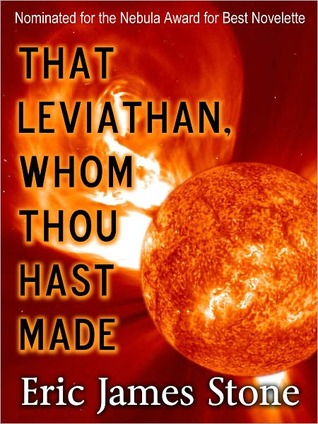
That Leviathan, Whom Thou Hast Made by Eric James Stone

When Harry Malan’s work transferred him to Sol Station deep inside the sun’s core, he didn’t expect to become a Mormon branch president over more than a hundred alien converts to the faith.  The Swales, ancient sun-dwelling beings with their own history and culture, travel the universe by naturally teleporting between stars.

When Harry learns that one of the members of his congregation has been raped, he determines to take it up with the chief Swale.  But at several thousand meters long and more than a hundred millenia old, the chief is revered by the Swales as a god incarnate.  To make matters worse, the only other eligible female on the station is an atheist xenoanthropologist determined to stop Harry from “polluting” the Swale culture.

In an alien society millions of years older than humanity, where gods were dwelling among mortals long before the birth of Jesus Christ, is there a place for those who convert to any of the human faiths?

This story was awesome, and I’m not just saying that because I’m a practicing Mormon.  The story concept was brilliant, the alien world was fascinating, and the issues raised were dealt with in a very balanced way.  This is a must read for any Latter-day Saint science fiction writer–or for aspiring writers of any religious faith, for that matter.  In fact, Eric James Stone has it available right now on his website for free–so check it out!

My only issue was that the story didn’t feel fleshed out enough.  The Swales were so fascinating, I wanted to spend more time with them–I wanted to explore their culture, learn more about their history and evolution, etc.  I also wished there were more detailed descriptions to make me feel like I was there.

I think that has more to do with the shortcomings of the medium than anything else, though.  The piece is an 8,000 word short story / novelette, so there isn’t a whole lot of room to flesh things out.  Still, the world is so fascinating, can you blame me for wanting more?

All things considered, “That Leviathan, Whom Thou has Made” definitely deserves the Nebula Award which it won earlier this year, and I wouldn’t be surprised if it wins a Hugo as well.  It represents a significant milestone in LDS literature, and is an excellent mainstream piece as well.  Whether you’re Mormon, Christian, Muslim, or whatever, if you’re a religiously devout writer of science fiction, this is a must-read.  And even if you’re not, it’s still a great story.  Highly recommended.