How I would vote now: 1958 Hugo Award (Best Novel)

The Nominees

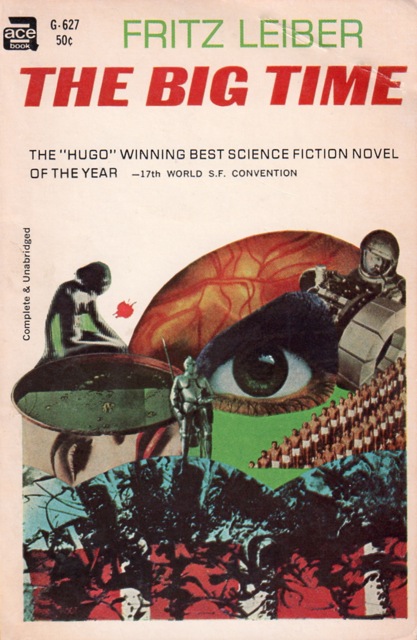
The Big Time by Fritz Leiber.

The Actual Results

  1. The Big Time by Fritz Leiber.

How I Would Have Voted

  1. (Abstain)

Explanation

The Big Time has a lot of things in it that I normally would like. It’s a time travel story that bucks the popular convention of the butterfly effect—the idea that small changes in the past lead to big changes in the future. Instead, Leiber’s view of time travel is much closer to Connie Willis’s, in that the continuum itself tends to seek a stable equilibrium, negating the effect of small changes. But unlike Willis’s books, the time travelers aren’t just a bunch of cloistered academics looking to be passive observers of history. Instead, there’s a full-on time war between two monolithic factions, each of which has screwed so much with the timeline that they hardly know who they are anymore.

So what’s so bad about it that I feel it didn’t earn my vote? I’ve tried twice to read this book, and I’ve DNFed it both times because I just can’t get over the fact that it’s about a bunch of comfort women—with everything that term implies—servicing the time warriors of their particular faction. In WWII, “comfort women” was a euphemistic term for civilian sex slaves taken captive by the Japanese Imperial Army. That’s basically what’s happening here, except it’s played straight, with no ick factor, or even really an acknowledgment that an ick factor might exist. And that’s what turns me off—not just the ick factor itself, but the way that the author treats it as something normal and blase—progressive, even. After all, every good time soldier needs a “sex therapist.” </sarc>

Usually when older science fiction turns me off, it has something to do with the sexual content. So many scifi writers in the 50s, 60s, and 70s had these almost utopian visions of a free love future, or at least a very optimistic view of the sexual revolution. They never imagined that we might become even more prudish than the Victorians, or that incels would be a thing, or that we’d be facing a loneliness epidemic, a population collapse, and both a war on men and a war on women because, in large part, of how the Boomers tore down all the boundaries around sex and sexuality—which is to say nothing of how so many people can’t even define what a woman is these days.

These scifi writers were supposed to be our visionaries, but they were so totally blinded by their own carnal lusts that they failed to predict the second- and third-order effects of the kind of free love future they were writing about. That’s not exactly the case with The Big Time, but it falls into that same trap, along with most of Fritz Leiber’s work that I’ve read. However, it wasn’t so bad that I’d vote No Award over this book. Rather, it was more of a background element that rubbed me the wrong way, to the point where I just couldn’t finish the book.

Reading Resolution Update: February

My 2022 reading resolution: Read or DNF every novel that has won a Hugo or a Nebula award, and acquire all the good ones.

I didn’t read nearly as many books in February as I did in January. Part of that might have been enthusiasm for the resolution waning a bit, but a good chunk of it was due to the fact that my grandmother passed away, and we took off a week for the funeral. Also, potty training completely upended our daily routine. I also went ahead and finished Jeff VanderMeer’s Southern Reach Trilogy, after reading Annihilation, so that took off a lot of reading time that otherwise would have gone toward this goal.

But I’m not too worried about it, since I’m already well past the halfway point and should be able to finish before the end of the year. In fact, I went ahead and made a similar spreadsheet of all the short stories, novelettes, and novellas that won a Hugo/Nebula, and may move on to those after I finish the novels. It’s going to be a lot more challenging to hunt down all of those titles, though, so I might just move on to the Dragon Awards instead.

In any case, here are all the Hugo/Nebula award-winning novels that I read or DNFed in February:

Books that I read and plan to / have already acquired:

  • The Three Body Problem by Cixin Liu and Ken Liu, trans. (2015 Hugo)

Books that I read and don’t plan to acquire:

  • Conjure Wife by Fritz Leiber (1944 Retro Hugo, awarded in 2019)

Books that I did not finish:

  • This Immortal by Roger Zelazny (1966 Hugo)
  • Babel-17 by Samuel R. Delany (1967 Nebula)
  • The Healer’s War by Elizabeth Ann Scarborough (1990 Nebula)
  • Stations of the Tide by Michael Swanwick (1992 Nebula)
  • Slan by A.E. Van Vogt (1941 Retro Hugo, awarded in 2016)

Reading Resolution Update: January

My 2022 reading resolution: Read or DNF every novel that has won a Hugo or a Nebula award, and acquire all the good ones.

I had expected to DNF a lot of these books, but I was a little dismayed at how terrible they are. Or rather, how some of them can be so well-written and yet so idelogically possessed.

For a while, I worried that I was pre-judging some of these books too harshly, based on my opinions of the author. After all, shouldn’t art be treated separately from the artist? But then I decided that it would be better to lean into that bias, and trust my intuition. After all, it’s impossible to approach reading without a personal bias—and even if it were possible, it wouldn’t be advisable.

One of the key things I’m hoping to take away from reading these books is a better understanding of my own personal tastes. Toward that end, it’s much better to DNF early and often, since that tells me something valuable about my own tastes. I’ll get much more out of this exercise if I pay attention to that than whether or not I’m being “fair” to a particular book or author.

As for how my bias against an author might prejudice me against a book, I don’t think that’s too much of a problem so long as I’m aware of those biases. Yes, it makes it more likely that I’ll read a book with a critical eye, and not in the way that I typically read for enjoyment, but that goes both ways, since if I do enjoy a book, that’s going to improve my opinion of the author (or at least make me reconsider my opinion). So long as I’m aware of my biases and make sure that they aren’t set in stone, I think it should be fine

Besides, it’s not like I have anything to prove. Sure, China Mike Glyer might pull out an excerpt from this post to use as content (hi China Mike!), but I couldn’t care less what that particular corner of fandom thinks about my public ruminations. I will know if I’m being too “unfair” to a book or an author, and the only criterion that really matters is whether I have a clear reason for DNFing the book, separate from my biases about the author.

And honestly, what I’ve found so far is that my biases are pretty spot on. Authors who behave insufferably in public or on the internet tend to write some pretty insufferable books, especially if they’re woke.

Fortunately, I have found a few new-to-me books and authors who are really fantastic. And my decision to DNF early and often is helping to keep it from becoming too much of a slog, which is good. It also means that I may complete this resolution a lot sooner than I’d expected, at which point I’ll probably move on to the Dragons or the Prometheus awards.

In any case, here are all the Hugo and Nebula awared-winning novels that I read or DNFed in January 2022:

Books that I read and plan to / have already acquired:

  • Way Station by Clifford D. Simak (1964 Hugo)
  • Foundation’s Edge by Isaac Asimov (1983 Hugo)
  • The Vor Game by Lois McMaster Bujold (1991 Hugo)
  • Annihilation by Jeff VanderMeer (2015 Nebula)

Books that I read and don’t plan to acquire:

  • None

Books that I did not finish:

  • The Big Time by Fritz Leiber (1958 Hugo)
  • A Case of Conscience by James Blish (1959 Hugo)
  • The Wanderer by Fritz Leiber (1965 Hugo)
  • The Einstein Intersection by Samuel R. Delany (1968 Nebula)
  • Stand on Zanzibar by John Brunner (1969 Hugo)
  • Rite of Passage by Alexei Panshin (1969 Nebula)
  • Man Plus by Frederik Pohl (1977 Nebula)
  • Dreamsnake by Vonda N. McIntyre (1979 Hugo and Nebula)
  • A Deepness in the Sky by Vernor Vinge (20000 Hugo) (My wife recommended this one, and I will probably try it again, since I took a break midway through and forgot who all of the characters were. But for now, I’m counting it as a soft DNF.)
  • Camouflage by Joe Haldeman (2006 Nebula)
  • The Windup Girl by Paolo Bacigalupi (2010 Hugo and Nebula)
  • Redshirts by John Scalzi (2013 Hugo)
  • Ancillary Justice by Ann Leckie (2014 Hugo and Nebula)
  • All the Birds in the Sky by Charlie Jane Anders (2017 Nebula)
  • The Calculating Stars by Mary Robinette Kowal (2019 Hugo and Nebula)
  • A Memory Called Empire by Arkady Martine (2020 Hugo)
  • A Song for a New Day by Sarah Pinsker (2021 Nebula)