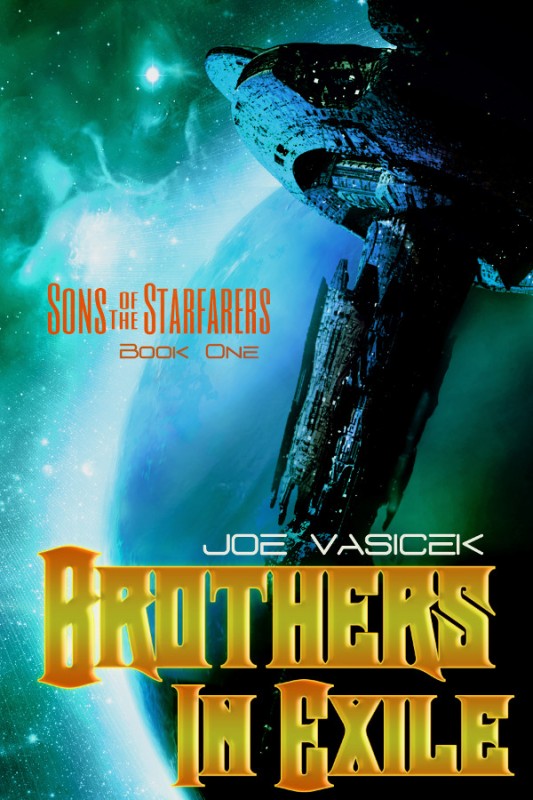
At its heart, Brothers in Exile is a character-driven space opera and science fiction adventure built around a single, defining moral choice. The story asks a deceptively simple question: what happens when compassion turns freedom into responsibility? From that choice grows a story about brotherhood, moral obligation, and the moment when an independent life gives way to lasting commitment.
Where the Idea Came From
Brothers in Exile grew out of my thoughts on frontier stories about rugged individualism and personal freedom. On the edge of civilization, mobility means safety: you can leave, disengage, and avoid entanglements. I wanted to explore what happens when characters reject that logic—not because they’re naïve, but because compassion demands commitment. What if, in a frontier science fiction setting, compassion isn’t a momentary kindness, but a decision that permanently ties you to others—and to a future you can no longer walk away from?
How the Cost of Compassion Shapes the Story
In Brothers in Exile, Isaac and Aaron begin as independent starfarers with no fixed home, no political allegiance, and no long-term obligations beyond each other. Compassion changes that. When they choose to help a young woman frozen in cryosleep—someone they were never meant to be responsible for—they are no longer merely passing through the Outworlds. They become involved—personally, morally, and historically.
The cost of compassion in this story is not framed as regret or doubt; the brothers never question whether they did the right thing. Instead, the cost appears as entanglement: new enemies, new loyalties, new dangers, and the slow erosion of the freedom they once prized. Isaac feels this as the weight of responsibility—each compassionate choice narrowing his room to maneuver. Aaron experiences it as clarity: once you recognize another person’s humanity, walking away is no longer an option.
This tension—between freedom and obligation, independence and belonging—drives the conflict of the book and sets the trajectory for everything that follows.
What the Cost of Compassion Says About Us
We often want to think about compassion as something offered freely, but real compassion creates bonds—and bonds create responsibility. Brothers in Exile reflects the idea that freedom is comfortable precisely because it avoids commitment. True compassion ends that comfort. It ties us to people, to places, and to futures we did not plan. The story suggests that while this cost is real and often painful, it is also the price of meaning. For readers who enjoy thoughtful, hopeful science fiction where moral choices matter more than spectacle, this tension sits at the heart of the story.
Why This Theme Matters to Me
This theme matters to me because I don’t believe that moral choices exist in isolation. Compassion changes who we are and what we’re responsible for next. In Brothers in Exile, Isaac and Aaron don’t lose their freedom because they make a mistake—they lose it because they choose to care. That choice doesn’t make their lives easier, but it gives them direction, purpose, and a place in a larger story. That, to me, is what makes the cost of compassion worthwhile—and why this story belongs at the beginning of the Sons of the Starfarers series.
There is nothing unethical about using generative AI to write or make art. Those who say otherwise either haven’t thought through their position, or they are lying for rhetorical effect. Or both.
If Andrew Tate wrote a book titled How To Enslave Your Woman For Fun and Profit, would he be within his rights to demand that no woman ever read that book? If you believe that AI is unethical because it was trained on writers’ and artists’ work without their consent, congratulations—that is exactly the position you have taken. You can’t pick up one end of the stick without also picking up the other.
Whether or not writers and artists were fairly compensated for the use of their work is a separate issue. Many of these AI companies obtained their training data by indescriminately scraping the internet, which means the used a lot of pirated work. But if using copyrighted material to train an AI system is fair use—and here in the US, the courts have ruled that it is—then all that they owe you is the cost of your book. So if your book is $2.99 on Kindle, that is what OpenAI owes you. Congratulations.
Does Brandon Sanderson owe Barbara Hambly royalties? Brandon Sanderson has sold something like $45 million in books, comics, and other media. Barbara Hambly struggles to pay her bills. Barbara Hambly wrote Dragonsbane, the young adult book that inspired Brandon Sanderson to write fantasy. Clearly, her work had a deep and lasting influence on him. So does he owe her?
If you believe that AI companies owe artists and writers more than simply the price of their own published work, this is a question that you must wrestle with. If it counts as “stealing” to train an AI on artists’ and writers’ work, then every artist and writer is also a thief, and owes royalties to the people who inspired them. Which is why the word “plagiarism” has a tight definition, and why our legal code recognizes fair use.
There is nothing unethical about using generative AI to write or make art. Almost everyone who says otherwise is either lying to themselves about that fact, or lying to you.
Why would someone lie about that? For the same reason people accuse you of being a racist, or a sexist, or a fascist, or a white supremacist, or a Christian nationalist… because using that term gives them power. They don’t actually want to make a reasoned argument. They just want to “win” the argument without ever having to make it in the first place. They use words that they know will get the reaction that they want, and they scream them as loudly as they can until they get it. That’s what the public discourse looks like in 2025.
To be fair, this is not just something that happens on the left. Plenty of people on the right will scream “woke” or “based” or “demonic” to cow people into accepting their point of view. These words do have meaning, and can be used to make a well-reasoned argument—just like “racist” and “fascist” have meaning. But most of the people who use these words are just wielding them like rhetorical clubs to bully their way around.
There is nothing unethical about using generative AI to write or make art. Most of the people who say otherwise are just using the word “ethical” to mean “things I don’t like.” They don’t believe in objective good or objective evil, and instead believe that things like truth and morality are relative. In other words, they think that good and evil change depending on who’s looking at it. This is why so many writers today can’t write a compelling villain (or a compelling hero, for that matter). They just don’t understand how good and evil work.
So why should you listen to them when they scream at you for using AI? You shouldn’t. They don’t know what they’re talking about. Or worse, they do, but they’re lying to you, because they want to compel you not to use AI in your art. Why? Because they’re afraid that if you do, you’ll create something better than what they can create. And on that point, they’re probably right.
…because it’s impossible to write a villain who’s truly evil if your moral compass reflects our current-year’s understanding (or lack therof) of good and evil.
Seriously, it explains so much, especially the concept of “emotional ethics,” where characters are deemed to be good or evil based on how likeable or relatable they are. This happens ALL THE TIME in modern fantasy, and I HATE it. I don’t care if your character has friends or pets a cat or has a thorough and well-written backstory. If they do something I find to be wrong or immoral, I will judge them accordingly.
Back in the early days of the internet, when it was still a fun and carefree place, there was this thing called the evil overlord list (which is still up, if you want to read it). The list is organized like a top 100 list of resolutions that the smart evil overlord has made, in order to avoid the fate of all the not-so-smart evil overlords who have come before him. It’s got some really hilarious zingers, including the last one:
Finally, to keep my subjects permanently locked in a mindless trance, I will provide each of them with free unlimited Internet access.
Yikes. Explains a lot about the world today, doesn’t it?
But all joking aside, villains are a staple of fantasy literature—including the super campy villains that we love to mock with things like the evil overlord list. And there’s a very good reason for that. Every great hero needs an intractable problem to overcome. And while man vs. nature and man vs. self provide a certain degree of conflict, nothing provides a hero with more opportunities to prove himself than man vs. man.
When I was learning how to write fiction, the popular advice when writing villains was to remember that every character is the hero in their own story. Thus, every villain you write shouldn’t think of himself as the bad guy. Instead, he should think of himself as the good guy, who only does morally questionable things because that’s what needs to be done.
I do still think that there is validity to this advice. I still remember the moment when, as a young boy who was starry-eyed for all things Star Wars, I first saw the opening cinematic for the computer game Tie Fighter. It blew my nine year old mind to think that my beloved Rebel Alliance might actually be a band of terrorists, opposing the forces seeking to restore law and order to the galaxy. Suddenly, the one-dimensional conflict at the heart of my favorite franchise had a whole other dimension to it. I was hooked.
But in the last few years, I think people have become hungry for villains who are truly evil to the core. The transition probably began a while ago, around the time when Breaking Bad was still new. Walter White is an extremely complex and nuanced character, with a rich and well-developed character arc, exactly in line with the old writing advice. And yet, by the end of the show, he is genuinely evil. He gets a bit of a redemption arc in the last episode, but he is not a good guy by any stretch—and he admits it. In fact, the scene where he finally admits as much to his wife is, in many ways, the capstone of his character arc. He has no illusions about the fact that he never was a hero—not even in his own story.
These things tend to be cyclical and generational. From the mid-1960s to about the 2010s, I think most readers preferred villains who were nuanced. Even in Lord of the Rings, which really took off in the 1970s, Sauron is more of a force of nature than an actual human person. Besides, the true villain of Lord of the Rings is the ring itself, and everyone who interacts with it has a slightly different reaction, with some of them passing the test, and others failing (and, in the case of Boromir, redeeming themselves afterward). Besides, Tolkien wrote Lord of the Rings at the tail end of the last cycle, where from the 1910s through the 1950s the villains were unambiguously evil. Robert E. Howard’s Conan stories are a great example—there is no redemption arc for the Stygian priests or the remnant of Xuchotl.
The older I get, the more I have come to appreciate stories with unambiguous heroes and villains. That doesn’t mean that everything has to be black and white—just look at Lord of the Rings for that. But there’s a lot more room for nuance and complexity between two extremes than there is between different shades of grey. Again, Lord of the Rings is a good example of this. You can make a solid case that the true “hero” of that story is Gollum, who succumbed entirely to the ring and had absolutely no desire to save the world at all. And yet, the ring is unambiguously evil, and Gandalf, Aragorn, Elrond, etc. are all unambiguously good.
What would a revised version of the evil overlord list look like? Most of the tropes in the original list are based on recycled old franchises that have mostly faded from cultural relevance now. Would the new list include things like “I won’t waste time fretting about the corruption of my soul” or “I’ll harbor no illusions about being the good guy”? I don’t know, but I suspect that a good number of items will remain relevant for a long time. After all, whether or not the villain sees himself as the hero of the story, a good villain is always very competent at what they do.
Is anyone in this world inherently and irredeemably evil?
That is the moral question at the heart of the fantasy race known most often as “orcs.” They are occasionally called by other names, of course: goblins, tuskers, blackbloods, etc. Sometimes, you will also find different but similar fantasy races filling the same niche: trolls, kobolds, trollocs, ogres, etc. But the thing that ties them all together is that they are both inherently and irredeemably evil.
…or are they? In some iterations, the orcs aren’t necessarily evil, just savage—kind of like Robert E. Howard’s Conan, or his many stories extolling the barbaric hero who stands against the corrupt forces of a decadent civilization. I played around with that myself in my novelette “A Hill On Which To Die.” More recently, such as in Amazon’s Rings of Power series, the orcs are played up as sympathetic creatures, whose only true fault is that they come from a different culture than our own.
Here’s the thing, though. While I enjoy a good redemption arc, or a heel-face turn when it’s done really well, I also believe that there are some people and some cultures in this world that are wholly and irredeemably evil. They may not have started out that way—indeed, my faith teaches me that we are all children of an eternal Heavenly Father who loves us—but my faith also teaches me that evil also exists, and that there are some in this world who cannot be saved, because they have become sons of perdition.
Traditional publishing (and the entertainment industry more broadly) is currently dominated by people who skew to the left in their politics and their cultural values. As such, they are heavily influenced by the philosophies of thinkers like Rousseau, who posited that all people are inherently good, and that evil originates from social structures and institutions. That’s why they are so obsessed with “systemic oppression,” or with stories that obsess over victimization and victimhood—as if being a victim (especially of “colonization”) makes one inherently virtuous.
I don’t think that’s true, though. I think that some cultures are more virtuous or morally good than others. For example, when Columbus discovered the truth about the Amerindians he’d first made contact with—that they were the remnants of a tribe that had been conquered by cannibals, who had slaughtered all their men, put their women on an island, and were now farming them out for meat, visiting them once a year to devour all their infant children, then raping and impregnating them again before leaving—I believe that Columbus was justified in concluding that the culture of this vile cannibal tribe was inherently and irredeemably evil. And I believe that the world was made a better place after this culture was exterminated.
The term “orc” has its origins in Old English, especially in the epic poem Beowulf, where the word “orcneas” refers to monstrous beings who make an appearance in the poem. Tolkien was a scholar of Old English, so when he needed a name for his race of inherently and irredeemably evil creatures, he came up with the name “orc.” Tolkien also saw action in the trenches of WWI as a British soldier, and that undoubtedly influenced him as well.
It is an unfortunate reality of war that in order to fight effectively, you need to dehumanize the enemy. This is true, whether or not the enemy deserves to be dehumanized. World War I was perhaps the most senseless war in history, where the cause that everyone was fighting for was ultimately a suicide pact made by the incompetent and incestuous European royal branches. I honestly don’t know that the Germans were the bad guys in that war (though WWII is a very different story). I honestly don’t know if there were any bad guys—or any good guys, for that matter. The whole war was just a senseless cluster of a catastrophe.
So even though I do believe that some cultures are inherently evil, I can also sympathize with those who take a principled anti-war stance and say that we should all take a step back and focus on the things we have in common before rushing off to war. In our own day and age, there are many corrupt and evil warmongers who are working very hard to dehumanize the various groups that they would have us go to war against, whether those are Jews, Arabs, Russians, Ukrainians, Christians, Muslims, immigrants, or Trump voters. In such a complex world, there is a very real temptation to listen to such voices, and embrace the view that the other side is inherently and irredeemably evil.
And yet, there is such a thing as pure evil. There are some people who cannot—or will not—be redeemed. For that reason alone, I think there is still a place in our fantasy literature for creatures like the orc, who are inherently and irredeemably evil.
I was born in 1984, and for most of my life, stories with black and white morality—in other words, stories about the struggle between good and evil, with good guys who are good and bad buys who are bad—have been considered unfashionable and out of style. This is especially true of fantasy, where grimdark has been the ascendant subgenre for basically the past two decades. The Lord of the Rings movies gave us somewhat of a respite from this, but the popularity of George R.R. Martin’s Game of Thrones seems to have turned everything darker and grittier, to the point where I just don’t enjoy reading most new fantasy anymore.
I remember going to conventions like World Fantasy 2009 and talking with other aspiring writers, most of whom could not stop gushing about this George R.R. Martin guy and how he was subverting reader expectations in new and innovative ways. So I picked up a copy of Game of Thrones, and after finishing it, I thought: “yeah, the writing was pretty good, and the story did have a lot of unexpected twists… but I hated literally every character in this book who was still alive by the end of it.”
Looking back, it seems like the greatest reader expectation that GRRM subverted was the expectation that he would finish the damned books. Then again, the books only really took off after the TV series got big, and I suspect that the real reason the TV series got so big was because of all the porn sorry, the sexposition that the writers threw in. (Sex + exposition = sexposition. Seriously, the term was coined because of Game of Thrones.)
So for at least the last three decades (Game of Thrones came out in 1996), grimdark fantasy has been in style, with its morally ambiguous characters and its gray-on-grey or gray-on-black morality. Meanwhile, stories that are unambiguously about the struggle between good and evil have been considered trite, passé, or otherwise out of style. We live in a modern, complex world, and stories with such black-and-white conflicts are far too simplistic and unsophisticated to speak to our times.
That’s a load of horse shit, and here’s why.
But first, because we live in the stupidest of all possible timelines, I need to preface this discussion by stating what should be obvious to anyone capable of free and independent thought: namely, that talking about morality in terms of “black” and “white” has not a damned thing to do with anyone’s race. Seriously. It is not racist in any way to use “black” to symbolize evil and “white” to symbolize good, and the term “black and white morality” is not an example of white supremacy or whatever. Frankly, only a racist would think that it is.
But if you’ve only recently recovered from the insane left-wing cult that dominates every aspect of our society right now, and terms like “black” and “white” still trigger you, perhaps it will help to keep these two images in the forefront of your mind as we talk about morality in terms of black and white:
Now, on to something of actual substance.
The biggest complaint against black and white morality is that it divides all of the characters into black hats and white hats. In other words, all the bad guys are unambiguously bad, and all the good guys are unambiguously good, with no room in the middle for moral ambiguity or complex ethical dilemmas. So in other words, the spectrum of morality in your story looks something like this:
Now, while that may work for a certain kind of story, I will concede that it’s usually a sign of poor writing. This is especially true of epic fantasy, where complex worldbuilding and an expansive cast of characters is typical for the genre. Black hats and white hats might work for a twenty minute episode of a classic western, but not for a multi-book epic fantasy series.
However, when black and white morality is done well, it looks a lot more like this:
Notice that every shade of gray is contained within the spectrum. Indeed, allowing for the extremes of good and evil is the only way to hit every shade of morality and have it mean anything at all.
Think of Lord of the Rings. Yes, there are purely evil characters like Sauron, and purely good characters like Gandalf, but in between those two extremes there is a lot of moral ambiguity. For example, you have Boromir, who falls to the temptation of the ring but redeems himself with his sacrifice; Gollum, who ultimately rejects the last remnants of good that is in him, but still ends up serving the good in the end; Sam, who isn’t particularly noble or heroic, but bears the ring without succumbing to its temptation because of the power of friendship; Faramir, a noble and heroic figure who nevertheless knows his own limits and recognizes that the ring will corrupt him if he takes it; etc etc. Even the hero of the story, Frodo nine-fingers, succumbs to temptation in the end, and only succeeds in his quest by a brilliant subversion of the reader’s expectations.
Now, let’s contrast (pun intended) black and white morality with gray and grey morality, which TV Tropes defines as “Two opposing sides are neither completely ‘good’ nor completely ‘evil’.” Here is what that looks like when it’s done poorly:
…and here is what that looks like when it’s done well:
Does anything about those two images stand out to you? Because the thing that stands out to me is that they look almost identical—which means, as a newbie writer, it’s much easier to get away with a badly written gray-and-grey story than a badly written black-and-white story. Little wonder that all those aspiring writers at World Fantasy 2009 were gushing about George R.R. Martin.
Of course, since there’s only so much of this morally gray soup that readers can stand, two other sub-tropes of graying morality have emerged to satisfy the readers’ unfulfilled needs: black-and-gray morality, which TV Tropes defines as “Vile villain, flawed hero,” and white-and-gray morality, where “the best is Incorruptible Pure Pureness, and the worst is an Anti-Villain.”
Representing both of those visually, here is what black-and-gray morality looks like:
…and here is what white-and-gray morality looks like.
Much more satisfying than the nihilistic, soul-sucking soup that is gray-on-grey morality, but taken individually, neither one truly represents the full spectrum of moral complexity. The only way to include every shade of gray within your story is to do black-and-white morality, and to do it well.
Also, do you notice how the gray on the right side of the black-and-gray spectrum looks a lot darker than the gray on the left side of the white-and-gray spectrum? Those are both identical shades of 50% gray, but they appear darker or lighter than they actually are, simply by association with only one of the extremes.
Likewise, even if a black-and-gray or white-and-gray story is done well, it will still feel like it’s totally black or white. And if you read a white-and-gray story for the contrast reading after a black-and-gray story, the effect will be more similar to reading a badly written black-and-white story, regardless of the quality of either one.
To get the full spectrum of morality, with all of its finer nuances and shades of gray, you must include both extremes of good and evil. Remember, here is what that looks like:
Which is why it’s a load of horse shit to say that black and white morality is “unsophisticated” or “simplistic.” Done poorly, perhaps that’s true—but you can say that of any book done poorly. Done well, though, a black-and-white tale of good and evil is more satisfying and complete than any other kind of tale is capable of being, even if done well.
“But Joe!” some of you may be saying right now. “What about blue-and-orange morality? What about that most bizarre of moral codes that is neither good nor evil, lawful nor chaotic, but bacon and necktie? What does that look like, represented visually?”
Fine. Here’s your blue-and-orange morality, which TV Tropes defines as “morality that’s bizarre, unconventional and distorted by human standards”:
He who takes the bacon path shall be with dinner blessed, But he who takes the necktie path shall be for dinner dressed.
And here’s a poem by ChatGPT to explain the finer nuances of it:
In bacon’s sizzling embrace, flavors shall dance and sing, A feast for the senses, a delightful offering. Juicy and savory, its aroma fills the air, Blessed is the one who follows the bacon’s dare.
Yet the necktie path, with elegance and grace, Leads one to adornment, a refined embrace. In formal attire, he walks the path of class, Dressed for the occasion, ready to raise a glass.
For bacon nourishes the soul, brings joy and delight, A savory indulgence, a culinary highlight. While the necktie adorns, a symbol of esteem, Preparing for gatherings, where memories gleam.
So choose your path wisely, with heart and desire, Whether blessed with bacon or dressed to inspire. For in the journey’s choice, a tale shall unfold, Of dinners blessed or dressed, both stories worth being told.
Remember the time before the pandemic, when “conspiracy theory” was still a dirty word? It still is in some quarters, but for many of us the term is now closer to “spoiler warning.”
After all, what are we supposed to believe: that Epstein hung himself with a bedsheet that couldn’t hold his weight, from a height that couldn’t kill him, at exactly the moment when the guards had abandoned their posts and all of the surveillance equipment had mysteriously and inexplicably gone dark? That is still the official story—just like Ghislane Maxwell, Epstein’s Madam, was thrown in prison for trafficking sex slaves to… well, nobody, at least officially.
Or are we supposed to believe that a novel coronavirus whose genetic profile shows clear evidence of artificial manipulation jumped species from a bat to a pangolin to a human, in a Chinese wet market (which the CCP destroyed before any investigation could be launched) more than 900 miles from the bat’s native habitat, which also just happens to be down the street from the Wuhan Institute of Virology where gain-of-function research was being conducted with bat coronaviruses? I’m not generally a fan of Jon Stewart, but I think he hit the nail on the head with this one:
Of course, this isn’t to say that all conspiracy theories have weight and value. By no means do I believe that the moon landings were fake—there are just too many people who would have to be in on the thing to keep it secret for long, and also, we can see the tracks of the moon landingsfrom Earth. But conspiracies do happen, and often have tremendous impact on the course of history. For example, the United States constitution was born out of the Philadelphia Convention, which conspired to throw out the Articles of Convention and replace them with something entirely different, which was technically an act of treason at the time.
Conspiracies are real, though not all conspiracy theories are true. The challenge is separating conspiracy theory from conspiracy fact.
Which brings us to the old aphorism: “never attribute to malice that which can be attributed to incompetence.” For the last two years, when I look at the direction my country is going and all of the harm that the Biden Administration has done, I find myself constantly asking: “is this malice, or is this incompetence?” After all, if my goal was to destroy this country, I could hardly do better than what this administration has already done (Victor Davis Hanson has an excellent article about that, and he says it better than me). And yet, every time the press secretary opens her mouth, I am reminded of just how staggering is the incompetence of these people. Or is it?
And then I had a realization: if you go up high enough, all of these people are useful idiots to a force of pure malice that is striving to bring about our spiritual enslavement and destruction. I am speaking, of course, of Satan himself.
Now, perhaps you don’t believe that the devil is real. Laying aside the aphorism that “the greatest trick the devil ever pulled was convincing the world he doesn’t exist,” you don’t have to believe in a literal fallen angel and his hordes of demonic followers in order to follow this particular rabbit hole. The devil is an archetype for a reason, after all. Personally, my own experience has convinced me that demonic forces do indeed exist, but that’s all I care to say on the subject, and I’ll leave you to draw your own conclusions.
But my point is that it’s not like the forces of evil are monolithic: there is a hierarchy of conspirators and useful idiots, and some who may be conspirators on one level are useful idiots on another. At the bottom, it’s almost all useful idiots wreaking havoc by their own incompetence, but at the top, it’s all driven by malice.
Because here’s the thing: when we attribute a particular action to incompetence, we are making an implicit assumption about the motive behind that action. If we assume that Biden’s motive is to serve the interests of the American people, he’s doing a piss-poor job of it—but if we consider that he may have been compromised by China (as the Hunter Biden laptop implicates), or that he only cares about the Biden crime family’s interests, then his actions no longer reak of so much incompetence.
In the game of chess, there’s a thing called a gambit, where the player sacrifices a piece in order to gain an advantage of tempo or position. To the inexperienced player, a gambit often looks like a mistake. Some of the most brilliant chess moves involve a gambit that seems, at first, to be an act of utter incompetence, but that in fact make winning inevitable if the opponent falls for the gambit.
So even though “never attribute to malice” is a good rule of thumb, it’s clearly not sophisticated enough to explain all the insanity we’ve seen in the last two years. But neither is it sufficient to explain this insanity in terms of pure conspiracy—indeed, falling into that trap makes us susceptible to becoming infected by that insanity ourselves. Mattias Desmet points this out in chapter 8 of his seminal work, The Psychology of Totalitarianism. He also says:
In the whole process of exercising power—i.e., shaping the world to the ideological beliefs—there usually is little need to make secret plans and agreements. As Noam Chomsky put it, if you have to tell someone what to do, you’ve chosen the wrong person. In other words: the dominant ideology selects who ends up in key positions… Consequently, all people in positions of power automatically follow the same rules in their thinking and in their behavior and are under the influence of the same attractors.
One of the main points that Desmet makes in this chapter is that when people are driven by an evil ideology—or, in the words of Jordan Peterson, become ideologically possessed—their actions often appear, to someone on the outside, as if they are all part of a grand conspiracy. And yet, none (or at least, very few) of these people have actually entered into a clandestine agreement to support a deliberate plan: they are all just playing the part that they find themselves in, most of them unwittingly.
And yet, even though there is no “conspiracy” in the classical sense, the people who get caught up in the insanity all end up working to advance the purposes of something much bigger than themselves. Indeed, explaining this phenomenon is the entire purpose of Mattias Desmet’s book. He does a brilliant job of it, but mostly from a psychological perspective.
What I want to do is look at this phenomenon from a spiritual and an archetypal perspective, not as a scientist but as a storyteller. That’s why I’m calling it the “grand conspiracy,” even though I recognize that on most levels, it’s not a conspiracy so much as a confluence of interests (or more accurately, a confluence of lusts). I do think that there’s a lot that can be gleaned by looking at it this way, because there is a spiritual dimension to our lives—as Mattias Desmet emphatically points out—and stories and archetypes have been absolutely essential to our understanding of the world since prehistoric times. I happen to believe that Satan is more than just an archetype, but you don’t have to believe that in order for this grand conspiracy to be useful and make sense.
I’ve planned this series out in twelve parts, listed here. From now until the end of February, I’ll post about once a week. Since Christmas is coming and I don’t want to be thinking about all this diabolical stuff over the holiday itself, I’ll post part 2 next Tuesday, and part 3 the week after that, then go back to posting on Saturdays. The first three parts will outline the general theory that I’ve come up with, and the next eight parts will examine each piece of the theory in detail. In the end, I’ll share some concluding thoughts about how this grand conspiracy can—and indeed, ultimately will—be defeated.
I hope you find this series interesting, and I look forward to hearing what you think about it!
This author’s note originally appeared in the September 19th edition of my author newsletter. To subscribe to my newsletter, click here.
It’s September, which means (among other things) that it’s time to revisit my business plan and update it for the next year. Every January 1st, I print out a new and revised copy of my business plan, which provides a great opportunity to evaluate my efforts and hone in on the things I need to do better.
For the last couple of weeks, I’ve been working on the section titled “What I Write.” In this year’s business plan, it was a pretty straightforward breakdown of all of the series in my catalog. But for next year, I took a few steps back to address things like what is a Joe Vasicek book? or what are some of my books’ recurring themes? or what kind of science fiction and fantasy do I write specifically, and how does my work contribute to the genre?
The exercise really got me to think about why I write. In the day to day life of a writer, it’s very easy to lose sight of the forest for the trees. Deadlines and daily word count goals keep the focus on the page right in front of you, and when you do think ahead it’s usually just to the next chapter. But without taking time to step back and look at the bigger picture, it’s easy to lose that creative drive, or settle for second-rate work.
So what is a Joe Vasicek book? I hope it’s a book that’s memorable and meaningful. It may be dark, but never dismal. It may push you out of your comfort zone, but it also leaves you feeling rejuvenated and inspired. It features interesting characters wrestling with complex ethical dilemmas and struggling to do the right thing as best as they know how.
What are some of my books’ recurring themes? The balance between liberty and responsibility is a huge one. Actions have consequences, and true liberty is taking ownership of those consequences as well as your actions. Another is the sanctity of sex, contrasting selfish gratification with the affirmation of commitment and love. The yearning for God is another recurring theme, with a great deal of religious diversity in the starfaring civilizations of my books. Another theme I keep coming back to is the call of the frontier.
I’m curious, though, to hear what you guys think. What do you think makes a Joe Vasicek book? What tropes or recurring themes have you enjoyed in my books? As a writer, I’m often too close to my own work to see what’s obvious to everyone else. What do you think is my biggest contribution to the genre?
A while ago, I wrote a blog post titled Why I don’t like George R.R. Martin, in which I laid out some of the issues I had with the Song of Ice and Fire series, and why I decided not to read past the first book. That post has been getting a lot of traffic lately, probably because the last season of Game of Thrones is coming out and there’s a lot of hype right now about it.
At FanX a couple of weeks ago, I attended an interesting panel with Steve Grad from Pawn Stars on the do’s and don’ts of collecting. On that panel, he expressed some skepticism that Game of Thrones signatures and collectibles would hold their value over time. This made me wonder: will the books this TV series is based on stand the test of time?
Full disclosure: I have only read the first book, A Game of Thrones, and have not watched any episodes of the miniseries. I’ve watched a few of the more important scenes on YouTube and occasionally follow discussions about it on online forums. After reading the first book, I decided that this series was not the sort of thing I wanted to watch or read. See the blog post linked above.
People have been calling George R.R. Martin the American Tolkien for years now, but I’ve always been skeptical of that claim. Tolkien’s books are timeless because they are so archetypal, with the classic struggle of good vs. evil permeating every page. In contrast, Martin rejects the archtypes of good and evil for a nihilistic black-and-gray morality, where there are no heroes, only victimizers and victims.
Why, then, is A Song of Ice and Fire so popular? First of all, because the writing and storytelling really are top notch. For all my criticism of George R.R. Martin, I fully recognize that he is a master. But there are a lot of excellent, masterful books that never capture the public imagination quite like Game of Thrones and A Song of Ice and Fire. What, then, makes Martin’s work so different?
I believe it’s because George R.R. Martin has struck a nerve with the current zeitgeist, and scratches a uniquely contemporary itch in a way that none of the great works by the old masters can. What is that zeitgeist? It is spirit of a culture in the late stages of decadence, where wealth disparity, big government, endless wars, easy credit, runaway debt, moral decline, and corruption are the defining aspects of the age.
In a world where, in so many ways, we are shielded from the consequences of our own actions, morality becomes irrelevant and entertainment shifts to serve our basest, most carnal lusts. In such a world, we turn to nihilistic stories like Game of Thrones, which are saturated with sex and violence. They reinforce the view that good and evil don’t exist, that honor and integrity are for fools, and that wealth, power, and sexual indulgence are all ends in themselves. “Eat, drink, and be merry, for tomorrow we die, and it shall be well with us.”
At the same time, these stories satisfy a deep sense of self-loathing that arises out of the very nihilism that they celebrate. In those few moments when we are honest with ourselves, the decadence of our age profoundly disgusts us. As Haruki Murakami put it, “secretly everyone is waiting for the end of the world.” That is exactly what stories like Game of Thrones give us: gleeful destruction and total collapse, with blood, fire, ice, and steel. No one is safe. Anyone can die, even our most beloved characters. Winter is coming.
Every empire collapses, however, and every age of dedadence comes to an end. The very nihilistic elements that make stories like A Game of Thrones so appealing ultimately cause them to fall away and vanish, along with the culture itself. To stand the test of time, stories must be built upon archetypes that transcend the spirit of the age, rather than indulge it. Does George R.R. Martin do this? I don’t believe that he does.
A Song of Ice and Fire has an added disadvantage in that the TV series has overtaken the books. How many people will simply give up on the books after watching the season 8 finale? A Dance with Dragons averaged a 2.9-star rating on Amazon the year it came out, with thousands of reviews. It takes George R.R. Martin so long to write these books that it’s already become a meme, and his health isn’t all that great.
Personally, I think we’ve already reached peak George R.R. Martin. The season 8 finale will be an enormous affair, but after that the show’s popularity will steadily decline, and the books will not renew the public interest. I still think the books will do well compared to other books in the fantasy genre, but compared to previous installments, I think the Song of Ice and Fire series will go out with a loud and plaintive whimper.
A generation from now, when the current age of decadence is over and our children and grandchildren are rebuilding the world, I believe they will look at these books and scratch their heads—if they even bother to read them at all.
Okay, I think the folks at Extra Credits got it wrong with this one in a really big way.
Gollum didn’t redeem himself. That’s the entire point. Redemption is an important and very Christian theme of Lord of the Rings, but so is the problem of evil. Several comments on the video point this out:
I disagree about Gollum. He gave into the temptation of the Ring. I think more he is there for how God can turn evil into a good.
Gollum is more a Judas figure. Judas was not redeemed for betraying Jesus, but his evil actions did allow for the salvation of Man through Christ’s sacrifice.
“A traitor may betray himself and do good he does not intend.” Judas betraying Jesus was the catalyst that led to salvation. Gollum’s final act of greed was the catalyst that led to the destruction of the Ring.
The thing that really gets to me, though, and the part where I think the folks at Extra Credits really do a disservice to these books, is how they argue, very subtly, that Gollum shouldn’t be held responsible for his own actions, that it wasn’t really his fault that he was addicted to the ring—that he “couldn’t escape his own sin.” (4:50)
No. Just, no.
The entire point of redemption is that we CAN escape from our sins. We see that with Theoden, we see that with the Dead Men of Dunharrow, and we see that in all the other examples of redemption that were not discussed in this video, like Boromir. In fact, Boromir is a far better example of “redemption through a single, all-important act.”
But it goes much deeper than that. In order to be meaningful, sacrifice must be intentional. It’s not just the act that matters, but the intention behind the act.
With that in mind, consider Gollum’s intentions when he bit off Frodo’s finger. The only way you can argue that his intentions weren’t evil is that the Smeagol half of his split-personality overcame the Gollum half, and flung him into the lava. But the support for that reading is ambigous at best. And if that isn’t true, and Gollum simply fell into the lava by accident, then it wasn’t a sacrifice on his part, and therefore there was no redemption.
To say that Gollum made an “accidental” sacrifice is nonsense. And to say that he redeemed himself through that sacrifice is not only a faulty argument—it completely undermines the themes of redemption and sacrifice throughout the entire book.
Gollum was never redeemed. Through him, Middle Earth was saved, but he was never personally redeemed, and that’s the point:
I’ve heard a different interpretation where Gollum’s sacrifice wasn’t an act of redemption, and was never meant to be. In the end, it was the ring’s own power that caused it to be destroyed; not Frodo, not Gollum, it was an accidental suicide. As far as I understand it, the message wasn’t “good triumphs over evil”, instead it was “evil is more powerful than good, but all it can do is destroy; in the end it will always destroy itself”.