1. Hit 10k words in a single day at least once this year. #amwriting #ResolutionsFor2016
— Joe Vasicek (@onelowerlight) January 1, 2016
Back in 2012, I set a resolution to write 10k words of fiction in a single day. I had read Rachel Aaron’s semi-famous blog post about it, and decided to give it a shot myself. The most I managed, however, was a handful of 5k writing days—impressive, but still far short.
In the years since, my writing pace has slowed down a lot more than I would like—not because of writing-related reasons, but because of things like procrastination, poor time management, and general disorganization. Well, it’s time for a change, and the new year seems like the best time to shake things up.
Rather than set a goal like “write every day” or “write X,XXX words per week,” I think this goal will do a lot more to put me in the right direction. It’s the difference between setting a goal to go to the moon vs. put something new in orbit every few months. When NASA set the moon as their primary goal, it not only provided them with the single-minded focus that they needed to get stuff done, but it led to a tremendous amount of scientific and engineering breakthroughs in the process. I’m hoping that something similar will happen with me.
So here’s the deal:
I can type at a maximum speed of about 100 WPM. Logistically, that means that the absolute minimum time needed to physically hit 10k words is 100 minutes, or 1:40 hours. That’s typing at top speed with no breaks, no mistakes, and no time to slow down and think.
I’ve measured my writing in the past, and found that my typical fiction writing speed is between 800 and 1,000 words per hour. To hit 10k words at that rate, I would have to work for an excruciating 10 to 12 hours a day—and that’s pure writing time. It doesn’t include things like breaks, water cooler chats, dinking around on social media, or any of the numerous other ways that regular employees waste time while on the clock.
Clearly, if I’m ever going to hit 10k words in a single day, I need to increase the speed at which I write. But how?
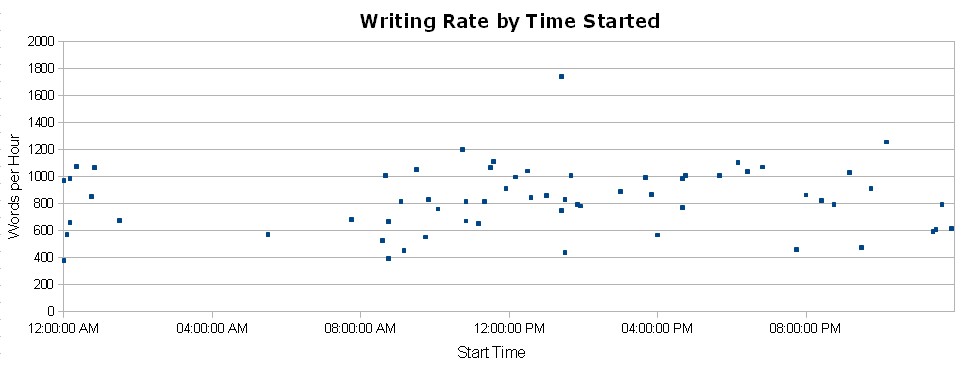 Well, I know from my writing log experiment that the time of day doesn’t really affect my writing speed. That means I can start as early as I need to, and the earlier I can start the better. So that pretty much sets up the first step to achieving this 10k goal:
Step 1: Start off each day by writing as soon as possible.
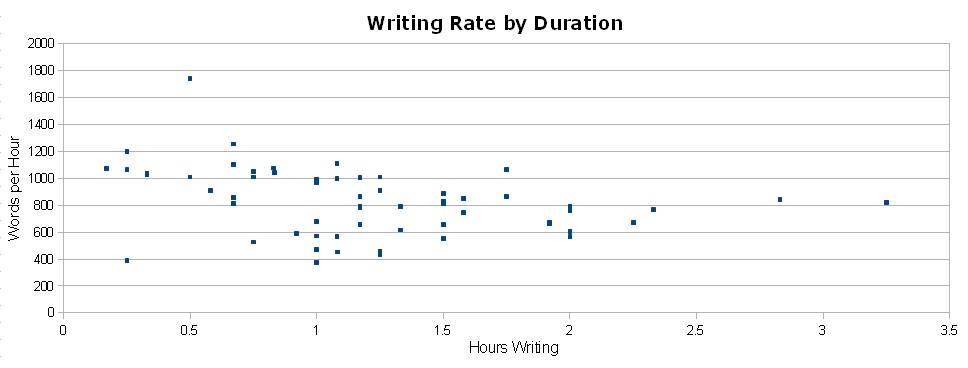 From the writing log, it looks like I tend to write fastest in short sprints that are less than one hour. That makes sense: the longer the writing session, the easier it is to get distracted and fall into the procrastination trap.
I have a hunch that the best way to increase my writing speed is to write in short, focused bursts. I’ve never actually tried to limit my writing time before, but it seems that I could really achieve a lot more focus by doing so. It will take some experimentation to figure out the optimal session length, but judging from the data it will probably be less than one hour.
Step 2: Increase speed by writing in short, focused sessions.
Obviously 10 to 12 hours of pure writing time is unreasonable. Even without a day job or other time obligations, burn-out would be a major issue. A much more reasonable amount of time to plan for would be 4-6 hours of pure writing time per day.
At 6 hours, to reach 10k words I would have to write at about 1.6k words per hour, which is reasonable. At 4 hours, I would have to write 2.5k words per hour, which is a lot tougher but still well below the 6k WPH physical limit, especially if I’m writing in short, focused bursts. From this, it’s not difficult to derive the next couple of steps.
Step 3: Increase average writing speed to 2,000 words per hour.
Step 4: Structure each day to achieve 6+ writing sessions.
The real trick to achieving this, as Rachel Aaron and numerous others have pointed out, is to take care of all the non-writing things that make the writing possible. This involves having an outline of some sort, or at least some idea of what is going to go on the page.
I’m a pantser, so I don’t write detailed outlines. However, I’ve found that it can help a lot to sketch out the next few scenes before I write them, and to browse tvtropes like a menu. In addition, long walks really help me to flesh out the story in my head. Without these pre-writing activities, the blank page can be really oppressive.
In more specific terms, I think it’s reasonable to allot 1-2 hours each day to pre-writing activities. Anything more than that would encroach on my actual writing time. Fortunately, I can usually hit two birds with one stone: for example, using my time on tvtropes to find material for blog posts, or outline the next few scenes in my head while hiking or exercising. But it’s important to make time for these things.
Step 5: Spend time each day in pre-writing activities for the next day.
These five steps seem like a good place to start. I’ll post them on my wall and revisit them in a month or so to see how they’re working out.
Ten thousand words in a single day is going to be tough, but if I can hit it at least once this year, I think it will remove a major block in my head and allow the words to really flow. It’s not just about writing faster, it’s about proving to myself that this is something I can do, and to use that as motivation to accomplish much more.
Best of luck with your own resolutions in 2016!












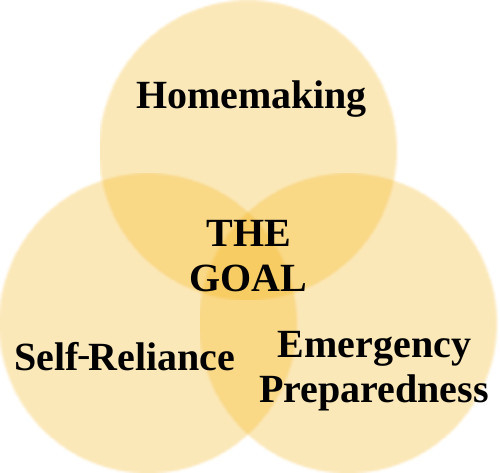 So that is the kind of self-sufficient lifestyle that I personally want to live. As you can probably tell, family is one of the main themes running through everything. I’m single right now, but I do want to have a family of my own and that’s what I’m working towards.
 So, I have great news! Sons of the Starfarers, Book III: Strangers in Flight will be coming out in just a couple of days. Everything is squared away for the release–all I need to do is finish approving the edits, write a teaser for the next book, and put the ebook together!