Ebook update

As many of you know, I epublished my first novel two weeks ago, and three short stories a few months before that.  How has it been going?

First, let me point out that I have another guest post out as part of the Genesis Earth blog tour, this one on my friend Gamila’s blog.  Gamila reviews YA and LDS fiction, and is a big proponent of clean reads.  For my post, I wrote about the place of LDS writers in science fiction and fantasy and the unique things we have to offer these genres.  Fun stuff; you should check it out.

So now that that’s out of the way, how do the numbers look for my epublishing venture?  Not bad, actually.  In two weeks, I’ve sold twenty copies of Genesis Earth and gotten two five star reviews on Amazon, only one of which was from someone I know.  Not bad–I’m looking to get at least $50 from Amazon come September, which should be very nice.

The short stories have not sold nearly as well, however.  Part of it probably has to do with the fact that I’m not a super stellar short story writer, but another part probably has to do with the lack of promotion.  The review of “From the Ice Incarnate” by Red Adept Reviews did lead to a few extra sales for all my stories, but only about half a dozen or so.  Nothing spectacular.

Part of it also has to do with the sampling system, I think.  With ebooks, you can download a free sample (usually the first 10% of the text) and decide whether you want to buy it or not.  For Genesis Earth, that amounts to the first three chapters and then some; for the short stories, maybe a couple of paragraphs and that’s it.

So what’s the takeaway?  I think that novels work out much better as ebooks than short stories.  For one, you can justify charging more for them (I haven’t seen anyone selling short stories for more than $.99), and thus get the higher royalty rate. For another, they work much better with the sampling system; readers are much more likely to get hooked on the first 10% of a novel than the first 10% of a short story.  And lastly, I’d say that you need to figure out some kind of way to promote yourself and get your work out there.  Still working on that.

All in all, not too bad.  But here’s the really cool part (and I mean really cool): at my current cost of living, I estimate that I need to sell only 15 ebooks per day to break even financially.  At a consistent average of 25 books per day, I could justify quitting my “day job” (150% of all monthly expenses).

How is that exciting?  Well, get this: starting out the gate with very little platform or exposure, I’m averaging a little over 1 ebook sale per day.  If I could boost that up to 3 sales per day for 5 books, I’d be breaking even.  At 5 sales per day for 5 $2.99 books (~800 total ebook sales per month), I’ll be making a living.

See why I’m excited?

My goal now is to get up to 5 full length novels / novellas out before the end of the year.  Believe it or not, that’s very achievable.

First, I’ll be epublishing Bringing Stella Home sometime this summer, hopefully in time for worldcon.  Shortly thereafter, I hope to publish Sholplan as a $.99 novella.

My current WIP is the third draft of Desert Stars, and I bet I can have that ready before Christmas.  While I’ll put the whole thing out as its own novel, I like Emma’s idea of splitting it into two books as well.  I’ll probably title them Dome and Desert and Sand and Stars, and make the first one available for free just to get more exposure.

And at some point in between all that, I’ll finish compiling all my travel journals from the 2008 BYU Jordan study abroad and put that out as its own work.  That one should be fun, and a good way to experiment with in-text photos and illustrations.

That’s my plan.  The more I put my work out there, the better my chances at making it big.  And even if I don’t, if I have enough titles out and they all sell more or less consistently, I can still leverage that to make a full-time living.  And that’s my dream.

So yeah, I’m extremely excited.

Goals for May

The last two weeks have pretty much decimated my writing routine.  Between family stuff and a 40 hour per week temp job, I’ve pretty much fallen behind on everything.

However, the good news is that with the money from the temp job, I can afford to take a month off to work exclusively on writing projects.  Here’s what I plan to accomplish, in order of importance:

  • Finish Into the Nebulous Deep 1.1.
  • Finish the online TEFL class.
  • Publish Journey to Jordan on the Kindle.
  • Finish >50% of Worlds Away from Home 3.0.
  • Prepare Genesis Earth for publication.
  • Release the short stories on Nook, Smashwords.
  • Switch to Linux.

A hefty bill, especially considering that my youngest sister’s wedding is next weekend.  However, I think I can definitely do it.  I’ve got about 18k words left in ITND, and with the feedback from my first readers, I’ve got tons of ideas for WAFH.  That project is going to be fun.

Journey to Jordan shouldn’t be too hard, either.  I found a good WYSIWYG html editor and played around with some test files today until I figured out how to make it work.  Now, I just need to play around with an actual Kindle to see how small I need to make the interior illustrations/photos to make sure they look good.  After that, it’s just copy and paste from old blogs, with a little spot editing and some time to write a foreword.

Journey to Jordan is going to be a lot of fun.  It’s a travel journal, not a science fiction novel, but my experiences in the Middle East definitely shaped my writing style, and it might be fun for readers of my novels/stories to see where the influences came from.  If all goes well, I can have it up by the 14th.

But above all else, my priority is going to be writing. I want to get back into a steady routine, plugging out a good +2.5k words each day until ITND is finished.  The deadline for that is the 14th, but I want to have it finished sooner if possible.  It’s going to be hard with my sister’s wedding, but I’ll do the best I can.

Of course, this is all assuming that I can take the whole month of May off.  However, Pioneer Book called me up on Saturday to set up an interview–they’ve got a position open, and I’m pretty optimistic that they’ll want to hire me.

If that happens, great!  I’ll just push some of this stuff back into June and juggle part time work with these writing projects.  Full time work is much harder to juggle, but if things don’t work with Pioneer Book, the guys at the temp job want me to come back in June.  So either way, I won’t be broke (inshallah).

The ultimate goal, of course, is to make the writing pay the bills.  That seems more possible to me now than ever before, but it’s still a ways out there.  2015, though–that’s the goal.  I want to me making a full time living as a writer by 2015.

But for now, I’d better get some sleep.  After all, I want to write +4k words tomorrow.  Wish me luck!

A year later

So a year ago, I came back to Utah after a terrible internship experience, with no idea where I was going to live, how I was going to support myself, or what I was going to do with my life.  I was leaving the cloistered halls of academia and venturing for the first time out into the “real world.”

Now, a year later, I can honestly say that even though there have been ups and downs, overall it’s been a great experience.  I’ve learned a ton, both about myself and this “real world” business, and I’ve changed in some surprising ways.

How, you may ask?  Well, let’s see…

1) I never want to be salaried.

This was probably the most surprising thing I learned.  Even if my writing career never takes off, I would rather work for myself and own the value I create than work for someone else and have them own me. Even if it means not knowing where my next paycheck is coming from, I’d rather have the control, the independence, and the satisfaction of working for myself doing what I love.

Sometimes I wonder if we’ve unwittingly become a nation of wage slaves.  So many people work at jobs they hate, only to have the illusion of financial security.  Well, that’s not me, and it’s never going to be me.  I’d rather work for myself and love it than spend the rest of my life counting down the days to my next vacation, or the years to my retirement.  I’m a smart, resourceful guy; I’m sure I can figure things out.

Which brings me to the next point…

2) The idea of being an entrepreneur excites me.

Writing is not just an art, it’s a business, and the more I research the business aspect of it–or indeed, business in general–the more excited I’ve become.  Leaving academia has helped me get in touch with my entrepreneurial side, and surprisingly it’s a lot stronger than I’d thought it would be.

As a writer, I see myself as a self-employed small business owner who creates intellectual properties and licenses the rights to publishers, film makers, game designers, etc.  With ebooks, now I can sell my work directly to readers, and you have no idea how excited that makes me.  It’s not just because of all the hype surrounding Amanda Hocking or Joe Konrath–it goes much deeper into who I am.  All things being equal, I’d rather be an indie author because I see myself as an entrepreneur.

Those are probably the two biggest things I’ve learned.  I can probably summarize the others with a simple list:

  • It’s not possible to work two careers and focus all your effort on only one.  If you really want to be a writer, get a job, but focus on the writing.
  • Temp and part time jobs are much better for balancing creative pursuits, even though they offer less security (which may be an illusion anyway).
  • It takes a long time to naturally grow a blog readership, but once you hit a certain point, it grows very fast.  I assume it’s the same with books and stories.
  • Social media, when used correctly, can work magic.
  • Cheap/free headphones can sometimes work remarkably well.
  • Budgeting is not hard.  Neither are taxes (if you’re poor).
  • Never turn down a job because you think you might get a different one.
  • A creative career won’t give you security, but you can still make it work.

So, looking back, would I change anything?  Not really.  I kind of wish I’d applied earlier to teach English in Korea, but if I had, I’d have started in February, and I wouldn’t have been in a good position to take advantage of the ongoing ebook revolution.  In fact, I might not have even noticed it until I got back to the states.

My plans for now are to focus on my writing over the summer, leave in August to teach English abroad (probably in Korea, though I’m toying around with other places), spend a year or two traveling and earning money to live off of until the writing takes off.

And marriage and family…who knows?  That’s an adventure that still lies beyond my ability to foresee.  One thing is for sure, though; I’d better avoid getting trapped in any comfort zones if I want to make progress on that front.  In terms of work and career, the past year has definitely not been a comfort zone, but it’s also helped me to see what I want to do with my life–more than college, even.

The future is uncertain, but that’s what makes it so awesome.  Even if my writing career never gives me a “secure” source of income, I’m more confident now than ever that I can make it work.  Until then, I’ll be writing.

Good things are coming

…I can feel it.

I got my tax return today, and it was significantly more than I was expecting.  Between that and the money I’m getting from my current temp job, I may have enough to last through this month and the next.  The last time I took a month off to focus exclusively on the writing, I accomplished quite a lot; I’m hoping I can do that again.

My current job is a 40 hr/week data entry position at a local alarm company.  The work is kind of tedious, but I can read blogs and listen to my mp3 player while I do it, so it’s actually kind of nice.

The workplace is pretty laid back, the people are way cool, and the work looks to be steady at least for the next few weeks.  A 20 hour or 30 hour job would probably be more conducive to writing, but for a short term gig this is pretty good.

Also, I’m seriously considering releasing Genesis Earth as an indie ebook if it doesn’t make the next cut in the ABNA contest.  Recent developments in the publishing industry make me think that this might be a better path to go with my career.

In February of 2011, ebooks surpassed all other trade categories (hardback, mass market, etc), taking ~30% of the market.  Just a couple of months before that, ebooks were around 8%.  At the same time, Kris Rusch has evidence that traditional publishers may be under-reporting ebook revenues (and underpaying authors) by as much as 90%.  I can’t go the traditional route without giving up my ebook rights, and with the current climate and royalty rates (14.9% of cover price for the (indefinite?) life of the ebook), that’s looking like a worse business decision every day.

So here is what I’m thinking of releasing, in the order (more or less) of when I plan to release them:

Journey to Jordan: Basically, a combination of blog posts and private journal entries from my experiences in Jordan.  It’s non-fiction, not a novel, but I think it’s the best project to practice on (probably because it will require the most formatting work).  Besides, I put a lot of myself into it, and it deserve to find an audience.

Genesis Earth: This is a full length novel, and has received a lot of positive feedback from friends, reviewers, and people who’ve picked up the free excerpt from the ABNA contest.  If it doesn’t make the semi finals, or (better) if it makes the semi finals but doesn’t win the grand prize, I’m seriously considering releasing it as an ebook.  It would certainly be a leap, but honestly, what have I got to lose?

Sholpan: This is a novella based on Stella’s story from my novel, Bringing Stella Home.  I haven’t shopped BSH around the traditional markets much yet, and I think it could find a home there, which would certainly give my career a terrific launch.  At this point, I’m looking to build my career more than earn a living, so I probably won’t release BSH until after I’ve shopped it around…but Sholpan, I think, would be a good way to test the waters and build things on the indie front.

Bringing Stella Home: At the same time, if Sholpan does well, and things start to take off in a surprising way, I’d seriously consider releasing Bringing Stella Home as an ebook.  I don’t anticipate releasing it any earlier than August or September, but you never know.  Also, this one has an advantage in that it’s part of a series; Genesis Earth is just book one of an unfinished trilogy.

So far, my short stories aren’t doing spectacularly well, but that’s okay–my goal with them was mainly to get some practice, not to make a ton of sales.  And even so, they are selling at a modest rate, though it’s too early to notice any definite patterns.

I’m curious, though, because it seems that readers are drawn more to novels and full-length books than short stories.  Will things be different when I release a few novels?  There’s only one way to find out.

Overall, though, this is very exciting.  As Kris Rusch says, I’ve got nothing to lose, and everything to gain.  I definitely feel that good things are coming my way.

Q1 report, 2011

So in terms of writing, this was a pretty decent quarter.  Nothing too prolific, but definitely making progress on my writing goals for 2011, which include:

1) finish at least two polished novels,
2) finish at least three new rough drafts,
3) start at least four major new projects.

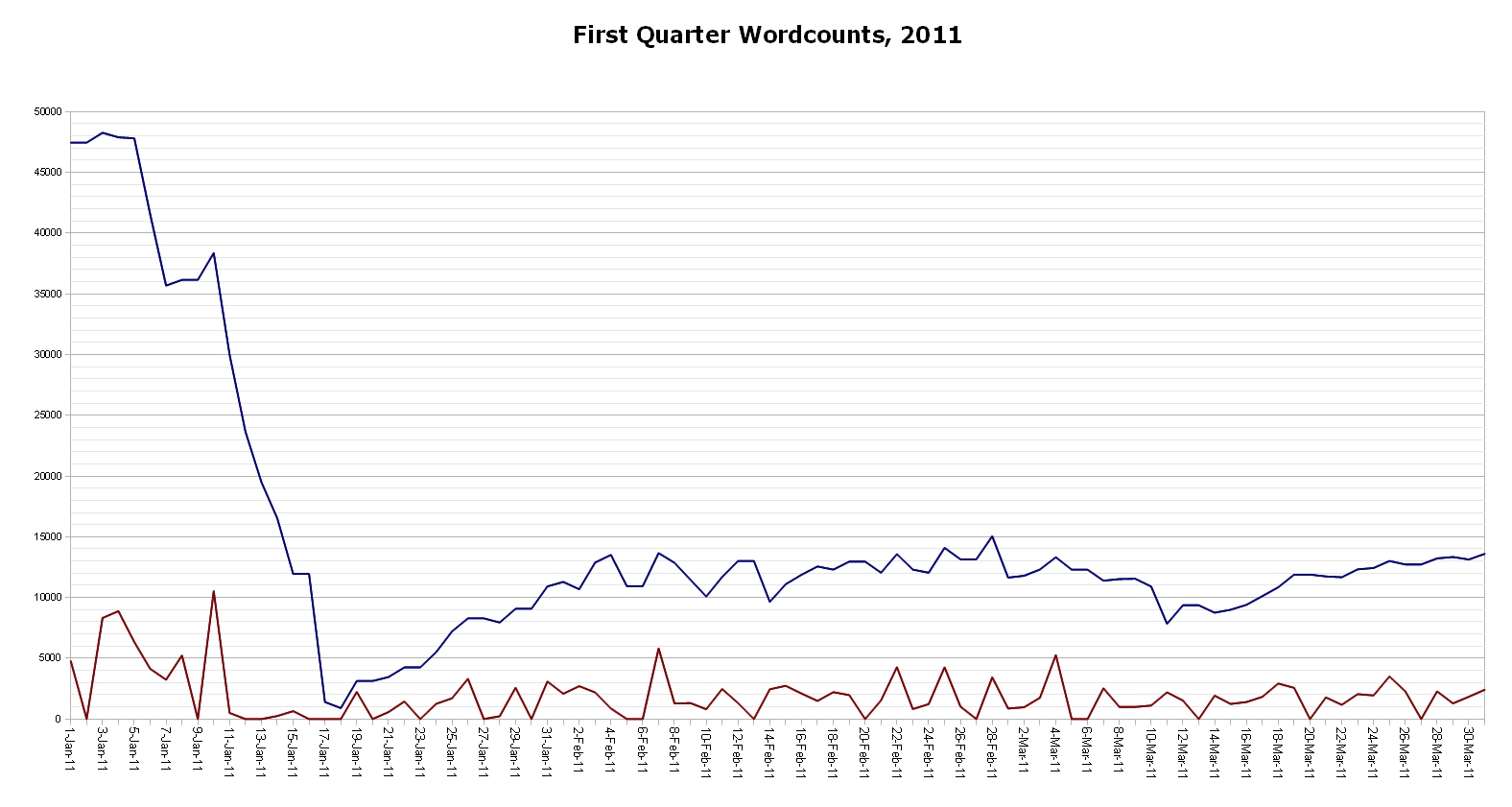
The spike in the graph from the beginning of the month is from the final revision of Bringing Stella Home, which was pretty much just a final polish.  After that was finished, I had a little difficulty picking up the next project, but once I did, I was able to be pretty consistent.

In mid-January, I picked up Worlds Away from Home and worked on that until the beginning of March.  This was a pretty huge overhaul, especially for the end, but it still needs a lot of work.  Basically, this draft was just to get it to the point where I could send it out to my first readers without being eternally ashamed.

After finishing WAFH 2.1 in the beginning of March, I launched right back into the sequel for BSH, Into the Nebulous Deep.  I figured it would be good to have the sequel in hand, in case I decided to go indie with BSH, as well as to practice writing sequels.

All throughout March, the writing was surprisingly steady, but recently things have kind of gone off kilter.  Maybe it’s all the increased distractions (job interviews, EPIK application, the TEFL course, other random crap), or maybe it’s just that I’ve become less disciplined, but I don’t feel like I’ve been writing very consistently in the last little while.  And the graph doesn’t really show that, because I recently started a few other projects which have sort of taken the place of ITND.

The first of these is currently untitled, but it takes place in a post-apocalyptic version of our world which I’ve code named “The Blight.” I don’t want to say much about it, but it’s REALLY REALLY REALLY cool…trust me.  Think lone man, wandering the ruins of civilization two hundred years after its fall, trying to make a life for himself when everyone else around him dies at a ridiculously early age because of this blight that has swept across all of humanity.

I’m having a TON of fun building this world, and the story is practically writing itself.  In the interest of finishing what I start, though, I’m going to sideline it until ITND is completely finished (which should be by the end of April, inshallah…).

The other project is a novella version of BSH, basically taking just Stella’s viewpoints and telling the story of her capture and eventual ascension to the Hameji throne.  This project shouldn’t be too hard–basically, I’m just frankensteining it from BSH, with a few tweaks.  My main reason for writing it is to have a novella-length work that I can release as an ebook, possibly to generate interest in Bringing Stella Home.

Speaking of which, in March I released a couple of short stories as ebooks on Amazon.  It’s a little early to gauge how well they’re doing, but I’m learning a lot from the experience, and the sales are gradually trickling in.  Once I release a few more works and start promoting them, I expect the sales will grow.

So in the last three months, I’ve finished one polished novel (Bringing Stella Home), started two new projects (Sholpan and untitled (the blight)), and made progress on polishing Worlds Away from Home. I wrote / revised through 170k words, about 30k to 50k of which were all new material.  I also ventured into indie publishing and released two short stories on Amazon, which are earning me a buck or two each week.

Overall, it hasn’t been as prolific as other quarters, but it’s not been too bad either.  Now to finish ITND and make some progress on that freaking nashostomo…

More thoughts on indie publishing

Since my last post on indie publishing, I’ve been thinking a lot about this subject.  I haven’t decided to take the plunge into self published ebooks yet, but I have decided to make some changes in my writing and my career strategy, in order to position myself more favorably if/when I choose to do so.

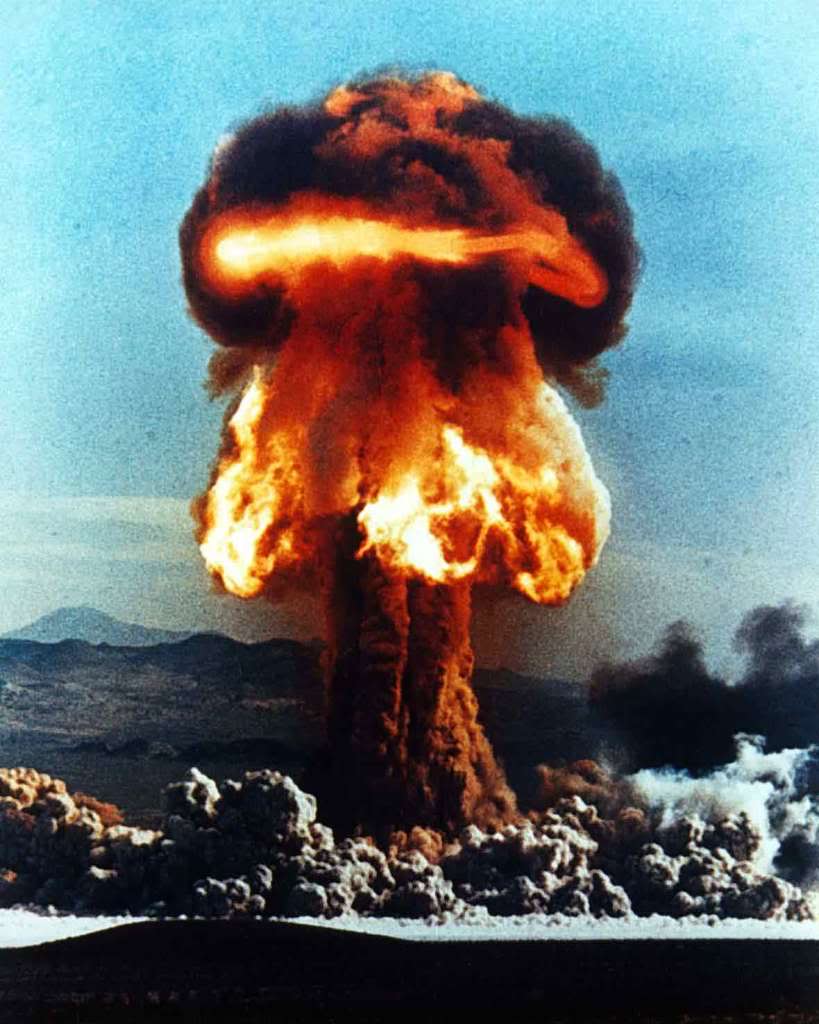
Basically, my new strategy is something like Japan or Saudi Arabia’s approach to nuclear weapons: they don’t have an explicit nuclear program (since that would violate the nuclear non-proliferation treaty), but they have gathered the equipment, resources, and expertise together so that if they decided to go nuclear, they could do it in a year or less.

First, though, I attended Brandon Sanderson’s class lecture this Thursday, in which he had some very interesting things to say about ebooks and the publishing industry.  This was part I of his “how to get published” lecture, and here are some of the more interesting points he made:

  • Almost all the indie writers who are making it big have at least one loss leader ($.99 or less) on their list.
  • No one really knows whether indie publishing will be viable for large numbers of writers, or whether authors like Amanda Hocking and Joe Konrath are outliers.
  • Successful indie published books are typically:
    1) short (70k to 80k words)
    2) written in a pulp genre (thriller, romance, paranormal, sword & sorcery, etc)
    3) promoted very well through social networking
  • We have not yet seen any indie successes in epic fantasy, young adult / middle grade, historical fiction, or non-fiction.
  • The produce model vs. unlimited shelf space argument for going indie doesn’t apply as much to science fiction & fantasy as other genres, because:
    1) sf&f stays on the shelves in bookstores longer than other genres
    2) sf&f series grow better with a big push on the first book
    3) sf&f makes a lot of money on hardcover, unlike other genres

A lot of these points tend to mesh with what I’m hearing from my other sources–and Brandon really represents the last of the successful writers to make it big on the old model, before the ebook revolution began to take off.  He doesn’t make as big a deal on the current 25/75 split on net ebook sales as I would make, but then again, he’s making most of his money through print.

So anyways, here is what I plan to change about what I’m doing in order to better position myself to best take the ebook plunge, if/when I decide to do so:

1) Write at least 2 polished novels per year

Kris Rusch and Dean Wesley Smith make very good arguments about how being able to write well quickly is a huge asset for a writer these days.

There are many good reasons for this:

1) Writing faster gives you more practice with craft, which tends to improve quality.
2) The best way to promote  your books is to constantly write new books.
3) The limited shelf space argument against writing quickly is now moot with ebooks.

In particular, I want to increase my writing speed in order that I can have a larger list to put out if/when I decide to go with indie publishing.  It’s much harder to be successful if you’ve only got one book available for sale; if/when I decide to take the plunge, I want to have at least three.

So far this year, I’ve finished one (Bringing Stella Home), but that’s because it was already sitting in the queue and only needed a quick touch up.  I would like to get Worlds Away from Home polished before the end of the year, and possibly one other project, such as Edenfall.

2) Reduce production time to as close to one year as possible

Right now, it takes me on average about two years to write a polished, salable novel.  That’s not a problem, because I have a lot of projects in the queue, but it’s not as fast as I would like.  I wrote Genesis Earth and Bringing Stella Home while I was still a journeyman writer, figuring out my craft.  I should be able to produce a lot faster.

Towards that end, I’m going to try to get Edenfall finished and polished within a year.  Since it’s already March, that might mean getting it polished by February of next year, but I still want to try.

My biggest weakness is first drafts; I always tend to get stuck midway and drop the project for a while before I feel ready to finish it.  That’s something I would like to change.  Then again, that might just be part of my writing process, and shouldn’t be forced.  However, I certainly could go through my revisions much faster.

3) Write out the direct sequels while the first book is still unpublished

Previously, I thought it was a bad idea to write out all the books in a series or trilogy before the first one is ever picked up.  After all, a rejection from a publisher on the first book is a rejection on all the other books in the series as well.  Using this reasoning, it was much better to write the first book of another trilogy, in order to maximize how much I could submit at any given time.

With indie publishing, however, it’s much better to release the whole trilogy all at once, so that readers who finish the first book can immediately pick up the others.  Again, the paradigm here is that the best way to sell books is with other books; if they loved the one, they’ll buy the others, especially to find out what happens next.

Of course, the best model is probably to have an open series with several indirect sequels with recurring characters in the same world.  With the Gaia Nova books, that’s exactly what I plan to do: Worlds Away from Home is set in the same universe as Bringing Stella Home, but with different characters and different story arcs.

However, Genesis Earth has serious trilogy potential, and with Edenfall I’ve decided to actually write the other books.  If/when I decide to take the plunge, I want to be able to release at least the first two books in that trilogy at the same time.  In fact, Genesis Earth is perhaps the biggest reason why I’m thinking so seriously about going indie, but that’s a subject for a whole other post.

4) Experiment with pulp genres such as space adventure stories

When Brandon said that the pulp genres tend to do better, I wasn’t sure whether that includes what I write.  I write primarily science fiction, but not the kind of stories you’d read only for entertainment and promptly forget once you’re finished.  If anything, I want to write more like Ursula K. Le Guin, whose stories are so meaningful they stick with you long after you’ve finished them.

Then again, there tends to be a lot of overlap in science fiction between the thoughtful, meaningful stuff and the pulps.  Ender’s Game and Starship Troopers immediately come to mind as awesome, entertaining stories that also have a lot of depth.  In his lecture, Brandon made it clear that “pulp” does not necessarily conflict with high art–just that the primary purpose of the story is to entertain.

I can live with that–and I actually have several story ideas that would translate well with the pulp mentality.  I’d like to do a novel (or a series of novels) with Danica from BSH and her mercenary team, perhaps as a sort of origin story for Roman, Anya, Artyom, and the others.  I’d like to revisit the Hameji as well, with a sort of “Ain Jalut in space” involving Sholpan’s son (BSH was basically the Mongol conquest of Baghdad in space).  I’ve already started an “Odyssey in space,” as told from a female Telemachus character–that’s To Search the Starry Sea.  All of these are, at their core, space adventure stories, and might translate well as pulps.

5) Commit to releasing one book every 6 months if/when I take the plunge

This is related to the first strategy on the list, but it’s more of a business plan than a personal writing goal.  Basically, if/when I take the plunge, I want to:

1) have at least 3 finished, polished books to put out at first,
2) know that I can put out one book every six months at least.

This not only means developing a backlist, it means doing some soul searching as a writer to find out how difficult it is to keep up with this pace–and adjusting my writing habits accordingly.  I’m optimistic that I can, but it’s something of a paradigm shift, and I want to make sure I’ve made that shift before I take the leap.

Anyhow, these are my thoughts on how to alter my current writing strategy.  I haven’t yet decided to go indie, but when the time comes, I think that these things will help me to maximize my potential if/when I decide to do so.

Of course, what do any of us really know?
Paradigm shifts and finding balance

Yesterday, I was going to write a post about how pathetic this past week was: I only wrote about 1.5k per day (while unemployed), and spent most of my time on the internet reading blogs.

However, after reading some more of Dean Wesley Smith’s blog series, Kililng the Sacred Cows of Publishing, I have to admit that this week wasn’t a total loss.  Because of what I’ve read this week, I’m starting to have a major paradigm shift about the publishing world, and that likely will have a huge impact on my writing career, hopefully for the better.

If I can sum up how my views have changed into one statement, it would be this: that in order to succeed in this business and avoid the common pitfalls, I need to learn how the entire publishing system works as a whole, so that I can game it to my advantage.  A lot of the hard and fast “rules” of the industry are actually myths that make for bad business, for writers as well as editors and agents.  But when you look at the system from a rational choice perspective, the flaws become obvious.

Take, for example, the “rule” that editors only accept unagented submissions.  What does that do for the industry?  It turns agents into the first tier of gatekeepers that new writers need to get past.  But agents don’t pay writers; they get a 15% commission off of the books they manage to sell (which, according to DWS, is excessive, but that’s another topic).  And they don’t get paid at all for reading slush.

So agents are spending more of their time doing things that pay less money, pressuring them to take less risks and work only with what they “know” will sell.  This leads them to ignore the fresh, unconventional voices that turn the tropes on their heads and have the power to take the market by storm.

Furthermore, because of their newly christened gatekeeper status, they make their writers rewrite their manuscripts until they read just like clones of Harry Potter or The Davinci Code.  And when the agents’ three or four closest buddies turn the book down, they come back to the writer and tell them to write something else.

It’s an extreme view, for sure, but it has a few good points.  The incentives are all in the wrong places, with too many opportunities for the gems to fall between the cracks.  And while the response from everyone in publishing is to cling to the myth and scream “the system works!” I have to wonder, does it really?

This comment from one of the threads struck me with particular force:

“The biggest mistake you can make is giving complete power over to someone who will never care as much as you do.”

Youch.  And yet, it makes so much sense.  How many writers’ careers have been ruined by doing just that?  Ceding too much power to people who simply don’t care as much as they do, all in the name of some “rule” of publishing?

Of course, that’s not to say that the publishing industry is full of cheats and sleazebags.  I’ve spent some time with professionals at World Fantasy and other conventions, and I’ve been very impressed with all of them.  It’s just to say that writing is a business, and that writers need to approach their careers in the same way as anyone who’s self-employed.  Certainly it’s important to work with other professionals, but that doesn’t mean handing over the fate of your business to them.

So anyways, what with all the business research I’ve been doing, I suppose the last week isn’t a total loss.  However, I definitely feel a need to get back into writing.  My deadline for WAFH is in two weeks, and the next 40k are going to require the biggest changes.  So here’s my plan for the next two weeks:

  • Get up at 7 am every day.
  • Write at least 2.5k words per day (500 during LTUE).
  • Fill out at least 5 job applications per day.
  • Take a week-long Halo fast.

Probably the single biggest thing killing my creativity right now is the angst that comes from money woes.  I redid my budget yesterday and realized I can get by this month without dipping too deeply into reserves, but still, that’s no substitute for a reliable source of income.  Trouble is, it’s hard to find motivation to apply for jobs when most employers don’t even respond to your application, but hopefully a concrete goal will make that easier.

As for Halo, as much as I love the game, I just don’t have time for it right now.  Personal writing deadlines are coming up, LTUE is just around the corner, and I’m falling too far behind to spend my time on video games.

I’m also going to make a concerted effort to get up earlier.  If I stay up past midnight, I’m usually just dicking around on the internet, whereas my mornings are almost always productive.  Plus, I hate sleeping in–hate it.  Gotta get up earlier.

So anyhow, that’s the plan.  Now, if you’ll excuse me, I’ve got some writing to do…

Deceptively unproductive day

Man, where did the day go?  I don’t feel like I was lazy, yet I only wrote about 1.2k words for the whole day.  And things were going so well the day before…

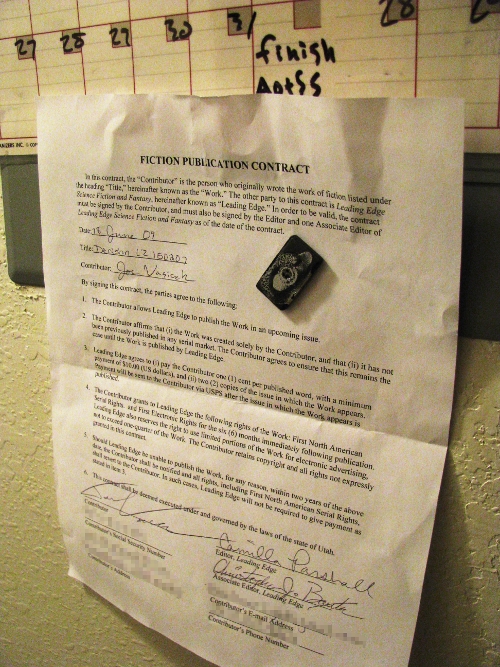
Well, I guess I was busy, just with a whole lot of other things.  Donated plasma (which took all morning), got some groceries, started GMing another round of werewolf on the quark forums, did some more research into ebooks, started the online TEFL course, went to Leading Edge and signed a contract for a poem they’re going to publish–

Oh yeah, check it out!  I signed my second publishing contract today–again, with Leading Edge.  They’re going t0 publish a short poem I wrote about Gliese 581g, otherwise known as Zarmina’s World.

(which reminds me, I’ve been meaning to blog about NASA’s Kepler mission since forever.  It’s an incredible mission which, I believe, will lead to some revolutionary astronomical discoveries–and may even rejuvenate interest in science fiction.  But more on that later…)

So yeah.  My goal is to finish WAFH before the end of February, which is going to require a lot of work.  Two and a half weeks, with LTUE 2011 sucking up one of the weekends…it’s going to be tough.

Numbers-wise, though, it’s still quite doable.  I want to keep this draft pretty close to 90k (no more than 100k), and I’m already at 53k words.  With sixteen days left in the month, I need to write between 2.3k and 2.9k words per day to make it.

In the meantime, it’s 2 am, and I’d better get some sleep. Waking up late is definitely bad for productivity, and I hate it. If I could train myself to wake up every morning at 5 am like Aneeka, that would be awesome. Actually, I’d probably just complain about how much it sucked to get up early every day, but hey–the grass is always greener…

Looking for alpha readers and planning the next project

Worlds Away from Home 2.1 is going along well.  I had a hard time switching from Bringing Stella Home back to this other project, but I’ve got some good momentum going and assuming no major interruptions, should be able to do about 3k words a day for the rest of the week.

Then again, if I get interrupted by work, that might be a good thing…

The second draft is going to be pretty rough, but good enough to start sending out to alpha readers.  Anyone want to volunteer?  It’s basically a far future love story on a planet with desert-dwelling tribal nomads who drive micronuclear powered dune buggies and centuries-old arcologies under giant continent-sized domes.  Earth is an ancient, mythical legend, and roving bands of starfaring nomads stand poised to crush the galactic empire.

I hope to be finished with the second draft by March 1st, and I’d want to get feedback no later than the end of April.  If you’ve been one of my alpha readers before, or if we’re friends IRL, let me know if you’re interested.

So earlier today, I was thinking about the project I want to do after WAFH–a sequel to Genesis Earth.  I’ve been toying with the idea of releasing GE as an ebook, but I don’t want to do that until I have a sequel in the works.  Anyhow, I was thinking of ideas for the title, and out of the blue, it struck me:

EDENFALL.

Kind of plays on the subtle Adam and Eve theme of the first one (and no, Genesis Earth isn’t technically a sci-fi Adam and Eve story…but it kind of evokes one).  I like it because it fits well with my ideas for the story, which basically center around shattering the Edenic paradise that Michael and Terra reach at the end of GE.

I’ve got a lot of ideas for this book, and I think they’re reaching a critical mass.  Just last month, I came up with a great name for the main female protagonist: Estee.  She’s the eldest daughter of Terra and Michael, and kind of takes after her mother’s personality.  The male protagonist will be a young soldier from the military force sent out by panicky Earth officials to neutralize any threat on Icaria–which gives the commanders of the expedition a broad mandate to do whatever the hell they want. As you can imagine, conflict ensues.

I know how this story begins, and I know how it’s supposed to end (and thereby set things up for an awesome third book in the trilogy), but I have no idea how to build things up to the crazy twist ending.  It’s going to require some serious worldbuilding, and that’s going to take some time.  Daydreaming is such hard work, after all.

Anyhow, I should be ready by the time I finish WAFH 2.1.  As an experiment, I’m going to write the rough draft entirely in longhand.  Am I crazy?  Perhaps.  But I also want to spend some time in the Utah wilderness for inspiration while I’m writing it, so pen and paper is probably the best medium for that.

So those are my plans.  To close, let me link to this awesome cover of “Something About Us” by Daft Punk.  Now that’s some sweet theremin action…enjoy!

You have no idea…

…how happy this makes me:

At some point this year, I want to put together an album of original 8-bit music. I don’t really care if it’s good or not, I just want to do it. Apparently, there’s a growing chip tune scene, mostly centered around New York and Tokyo. I saw this documentary the other day about it, and it looks really awesome.

The only thing is, I have no idea where to start. A lot of these guys use the actual NES and Game Boy hardware…yeah, I don’t think I’ve got the technical knowledge for that. But some kind of music editing program…are there any good freeware ones out there? I don’t have a lot of money to drop on this, though hopefully that’ll change soon…

Anyhow, this post is mostly to say that 8-bit music is awesome, and I want to start writing and composing it soon.  Expect to hear more about this in the future.