Without AI, I would probably not be writing

I recently got another anti-AI one-star review that I want to pull apart, because it’s pertinent to what I want to say. I actually came up with the title for this post before I received the one-star review, so I’m not just fisking this one for the sake of fisking. With that said, though, there is definitely a lot to pull apart.

I was prepared to rate this as 2 stars. It is repetitive with no real character depth or development and a sincere lack of dynamic or engaging writing. 

Two stars… so magnanimous! In all seriousness, though, it’s worth pointing out that in spite of all the book’s flaws, she did read it all the way through. That’s important for later.

Then I read the “author” note at the end of the book that was defending their use of generative AI in their writing process…. not only that but also seemingly insulting other writers who are anti-AI claiming that readers dont seem to care about it.

You know what’s insulting to any author, whether or not they are “anti-AI”? Putting scare quotes around the word “author” when referring to them Though I suspect that she did that on purpose, fully intending to insult me, whereas I did not intentionally insult anyone. For the record, this is the passage from the author’s note that she claims is “insulting” to authors by saying that “readers dont [sic] seem to care about [AI writing]”:

Besides which, after sharing The Riches of Xulthar with lots of readers, I’ve found that most of the rage and vitriol against AI-assisted writing is on the writer side of things, not the reader side.

The other thing is that I was not trying to “defend” my pro-AI stance through the author’s note, just explaining my writing process and sharing the story behind the story like I do in the author’s notes I write in the back of all my books. That’s not me being “defensive,” that just me sharing my story.

But there is something profoundly narcissistic about the way this reader is framing her review. Because I stated something about readers that contradicts her anti-AI worldview, I must be intentionally “insulting” her (or the anti-AI authors she’s white knighting for, which amounts to the same thing). Because I wrote about how I used AI to help write the book, I must be “defending” myself against her anti-AI views. This kind of narcissism can only really come from someone who lives in an echo chamber and is not used to having their worldview challenged.

Well Joe, you are wrong. This book was lifeless and dull and the use of AI showed. Everything was one dimensinal and flat. Word choises were even static. We (readers) get it… FMC had auburn hair. There are other words besides auburn to describe it….

I’m not going to deny, there is some legitimate criticism here. Rescuer’s Reward was one of my earlier AI-assisted books, when I was still experimenting a lot and learning how to incorporate AI into my creative process while still preserving my voice and writing multi-“dimensinal” [sic] characters and stories. So it doesn’t surprise me all that much that I missed the mark with this particular reader for this particular book. Lesson learned. Thanks for the feedback and the useful data point.

With all of that said, though… I can’t help but notice that she read the whole book.

I have yet to hear a compelling AI argument in the reralm of artistic expression and this “book” just exemplified everything yet again. No heart. No depth. Not good.

This is the crux of the issue, and the reason I wanted to frame this post as a line-by-line response to this review. Is there “a compelling AI argument in the reralm [sic] of artistic expression”? Or is any author who uses AI committing an unforgivable transgression against their art?

Here’s the thing: most of the other authors I know gave up writing a long time ago. We all started out with bright-eyed dreams about telling great stories and creating great art, but the hard truth is that it’s almost impossible to make it as an author.

There are many reasons for this: people don’t read very much in today’s culture (I personally blame the public school system for that), and the publishing industry has always been brutally rapacious and exploitive of writers (just read The Untold Story of Books by Michael Castleman—it’s a really fantastic history of the written word).

But the writing itself is also very hard. There’s a reason why even many succesful writers are like this guy, single and living in what amounts to a glorified shack. Most of my writing friends quit when they got married and starting having kids. I sincerely hope that they’re just on a 20+ year hiatus, and plan to get back to writing again someday, because some of the stuff they wrote was really, really good (I’m looking at you, Nathan Major!) But sadly, that won’t make up for the stuff they would have written, but never did.

My wife and I just had our third child. Writing with small children is very difficult, especially when your wife has a full-time job. I love them all to death, though. If I had to choose between being a single writer, or putting my writing on hold for 20+ years and having to restart my whole writing career from zero, just to be able to raise a family, I wouldn’t hesitate for a moment to make that choice. But it would put a huge burden of guilt on my wife, because my writing was one of the key things that drew her to me back when we were dating. And while our marriage is probably strong enough to survive that, I can’t deny that it would be an incredible strain.

Without AI, I probably would be facing this choice right now. Even though I had managed to streamline my writing process in the last few years, I’ve never been an especially fast writer. Without AI, it took me about a year to write each novel—and that’s before all the demands on my time and energy that come with having small children.

But AI has enabled me to continue to pursue my career and my art, even through this period of life. Not only does this help me to be a better husband and father (which is ultimately the most important thing), but it also means that my readers don’t have to wonder about the things I would have written, but never did. I can write those books now. I can give those stories to the world.

I’m not talking about AI slop. I’m talking about incorporating AI into the creative process deeply enough that it enhances, rather than replaces, my human creativity. We don’t have to be afraid of AI. It makes so many things possible—including running a profitable indie author business while raising (and soon homeschooling) 3+ small children. But it takes a lot of practice to get to that point. And generative AI is still so new that I don’t think there’s anyone who’s truly mastered the art of AI-assisted writing.

My Sea Mage Cycle books are mostly for practice. They’re meant to be fun, light reading. If it gives my readers a satisfying respite from all the doom and gloom in the world these days, I consider that book a success. The experience of writing each of them has helped me to be a better AI-assisted writer. And while the earlier ones may read like AI slop, that won’t be the case for long.
2019-08-08 Newsletter Author’s Note

This author’s note originally appeared in the August 8th edition of my email newsletter. To subscribe to my newsletter, click here.

A couple of days ago, Mrs. Vasicek and I had an old friend of hers over for dinner. This friend was visiting from out of state, and Mrs. Vasicek made it clear that politics was a subject which we would have to avoid, or at least tread very lightly. Among other things, I’d have to drop my tailgate to make sure it didn’t make a bad first impression.

(One of these days, I’ll have to share a photo of my tailgate. I despise political correctness in all of its forms, so my tailgate has become something of a monument to the first amendment. Frequently at stop lights, people will take out their phones to snap a picture.)

The dinner went really well, and we had good conversations well into the evening. Surprisingly enough, this wasn’t because we outright avoided politics, but because when the issues came up, we were able to find common ground in spite of our obvious differences. In this way, we were able to connect in a much more genuine way than if we had avoided those difficult subjects entirely.

One of the things we talked about was the destructive influence of social media outrage. Our friend told us how the relationship between her father and her sister has been destroyed, because Facebook is the only way that they can connect with each other. Those interactions have become so politically toxic that they’ve lost all of the love that they once had for each other.

That’s sad, but it’s becoming an all-too-common occurance here in the United States. Some people believe that we’re on the verge of a second civil war. I don’t know what the future holds, but if it’s anything like the first civil war, I know that there will be honorable people on both sides. That’s the tragedy. I have ancestors who fought on both sides of the American civil war, and when people ask which side I think was right, I answer “the American side.”

I’m fascinated by Robert E. Lee and his decision to fight for the Confederacy, when Lincoln himself offered him command of the Army of the Potomac. He opposed both slavery and secession, yet his conscience couldn’t allow him to stand at the head of an invading army. Neither could it allow him to stand by idly while his friends and family were slaughtered—not when he was in a position to make a difference.

Did he make the right choice? I don’t know. However, I do believe that he tried his best to do so. I try to keep that in mind when I talk with people across the political divide. No matter how much we may disagree, it’s refreshing to meet people who are sincerely striving to do what’s right as best as they know how.

In these troubled times, when the public discourse is rapidly deteriorating and outrage is the social currency of the day, it’s important to recognize the good in people, no matter which side they line up on.

Coming right along

I’m making good progress on The Sword Keeper, but I keep having to push it back to help a friend remodel his basement. His wife is having a baby in a couple of weeks, and he needs to get things finished before his mother-in-law comes over. There have been a ton of setbacks and delays, mostly having to do with the shoddy construction work done by the guys who built the place, but we seem to have passed the biggest hurdle which is to install the bathtub. Now, it’s mostly a matter of installing insulation and putting up drywall.


There’s this really fantastic game that I’ve been looking at called Stellaris. It seems like a combination of Masters of Orion and Europa Universalis. Really really tempted to play it, but as of right now, I’m holding back. When I finish this WIP, though, I may just treat myself.

Also, I recently signed up for a 30 day trial of Instafreebie, a site that (among other things) lets authors do ebook giveaways in exchange for readers’ email addresses. I’m running a giveaway for Genesis Earth, which you can pick up here if you haven’t already gotten a copy. Depending on how things go, I may sign up and run a few more campaigns in the future.

I’m really, really itching to get back to work on Gunslinger to the Stars. That will probably be the next full-length novel that I publish. In the meantime, I’ve got a bunch of short stories that should be coming out soon, starting with a Sad Puppies related piece that is sure to make a lot of people smile. Look for that one in June.

That’s pretty much it for now. Thanks for reading!

The next big dream

When I graduated from college, my goal for my writing career was this: to make a living telling stories that I love. It seemed, at the time, like an impossible dream–something so far out of my reach that I couldn’t possibly achieve it without years and years of constantly frustrated effort.

Well, guess what? For the past six months or so, I’ve more or less been doing it. I live below the poverty line in a basement with two other guys, and I have to donate plasma to cover the difference in my expenses each month, but writing is my main gig and I’m making enough to pay all my bills with it. Barely.

There’s more to life than making a living, though, even doing something that you love. My current month-to-month lifestyle isn’t particularly well suited for anything except, well, living month-to-month. So I need to make some changes, and to do that, I first need to dream a little bigger:

A really good dream should be–or at least seem to be–a little bit impossible. That way, you don’t have to worry about achieving it too soon. At the same time, it shouldn’t be too impossible. If you can’t see myself ever achieving it, then what’s the point?

For example, one of my bucket list goals is to look down on this planet from space. With the awesome advances in spaceflight that companies like SpaceX and Virgin Galactic are making right now, I can totally see that happening in my lifetime. But setting foot on an alien world? Nah, I don’t think that’s in the cards for me.

(Then again, if we figure out how to live forever, maybe it could actually happen. Even just adding another 50 or 100 years to my life would probably let me live to see a permanent base on the Moon or Mars. So maybe impossible is actually better–I don’t know.)

A friend of mine is building a business that he hopes will one day make him a cool seven figures. His mom makes six figures, but her name is also on six mortgages, so she’s pretty much tied to her job. One of his big dreams is to pay off all those mortgages for her so that she can retire.

When that happens, he’s going to celebrate by getting a bunch of friends together on a road trip to Texas. We’ll take a big refrigerated meat truck down there and go wild boar hunting until it’s packed full of pork. Then we’ll come back to Utah and have the mother of all barbecues. 😀

That’s the kind of dream I need to shoot for: something specific and personal that sounds kind of crazy but is still just barely within reach. In other words, it should be something that’ll make a good story when I finally achieve it. Or maybe I won’t achieve it–maybe the dream itself be so awesome that just the act of striving for it will make all the difference. As David Gemmell once wrote:

May all your dreams come true save one, for what is life without a dream?

It’s going to take more than one blog post to figure this whole dream thing out, so I’ll just leave that here for now. It’s definitely going to be on my mind for the next little while. If you have any impossible dreams of your own, please do share!

Still alive, still writing

One of my friends asked why I don’t post on my blog anymore, and I realized that I haven’t posted anything here in forever. It’s not that I’m not doing anything worth blogging about, it’s just that it keeps slipping my mind to post something. So hopefully that will change.

On the writing side of things, I’ve decided not to give myself any specific direction for the rest of the month other than to write at least 2k words per day (or revise at least 10k words). After my last WIP took a month longer to finish than I’d expected, I’ve come to realize that I might be able to be more productive if I changed up which projects I’m working on. So for the next couple of weeks, I’m giving myself permission to work on anything, just to see what excites me the most right now.

I’ve been spending a lot of time with my writing friends recently. We’ve had some very interesting discussions, such as whether the 2nd amendment should apply to nukes and which modern cities are most likely to be abandoned in the next 200 years (Detroit doesn’t count, since it’s pretty much already there). It’s fun to get together and burn things, especially when you have a cast iron skillet and bacon. Good times–maybe I’ll post a couple pictures from the next bonfire.

I just finished all the new covers for Desert Stars, Stars of Blood and Glory, and Sholpan, so you can expect to see a few cover reveals soon! I’m keeping the artwork, but updating the typography to look more, well, professional.

Also, I just got an email from the Writers of the Future contest that they should have the finalists for the 4th quarter decided in about a week, and my story is still in the running! I’m super super nervous about this, because I think the story may actually be good enough to have a decent chance. You never can tell about these things, though–writers are horrible judges of quality when it comes to their own work. In any case, either way, I’ll probably self-publish that story once I hear back.

Winter is here, and I haven’t stocked up on LDS cannery hot chocolate yet. The shame! If the apocalypse happens between now and April, I’ll be broke (I am convinced that the LDS church offers hot chocolate as a food storage item so that we’ll have some form of currency in the event of the apocalypse).

In any case, I’d better get back to writing. Take care!

Cooking with cast iron

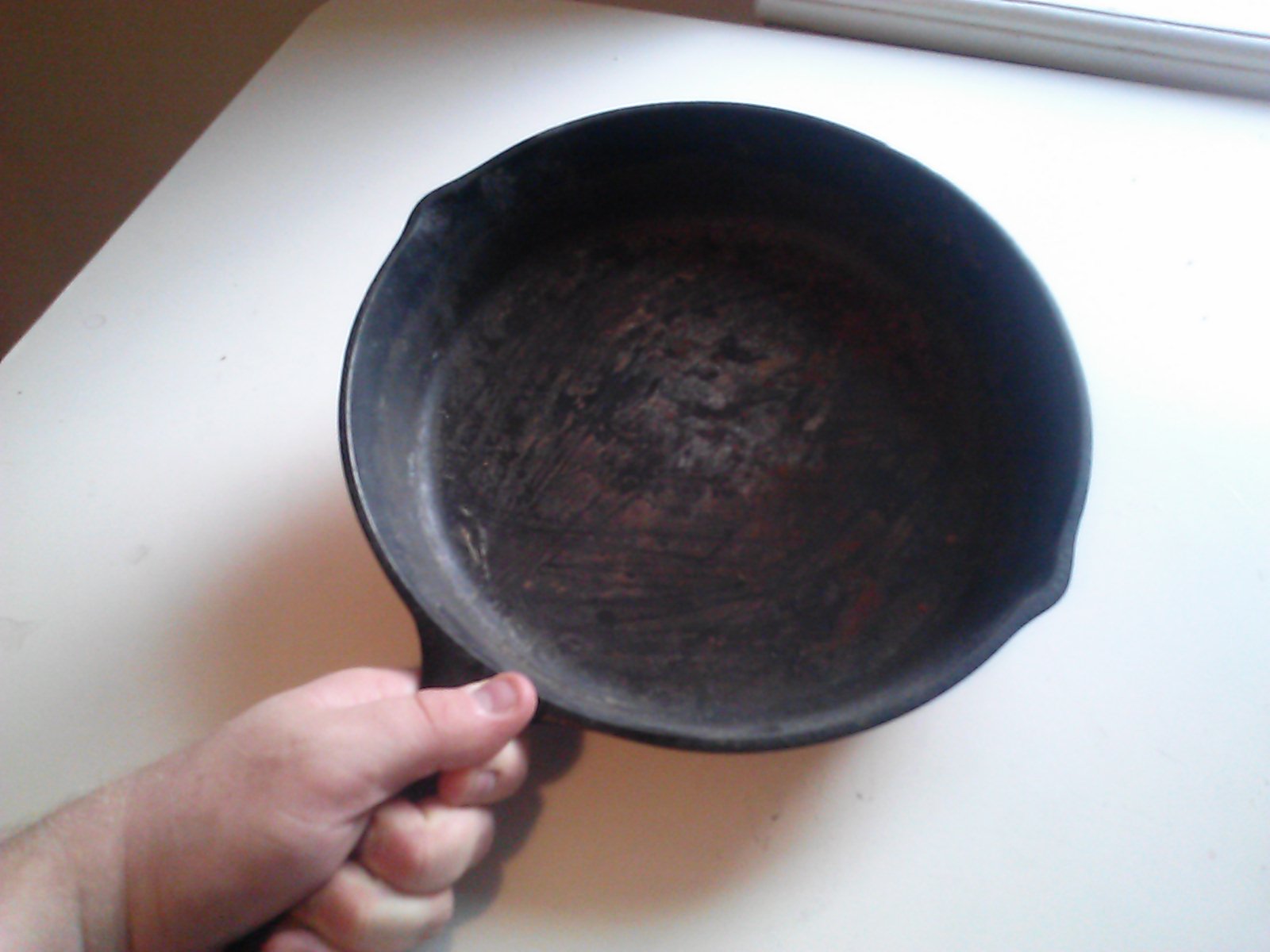
So a little while ago, I mentioned how my parents had sent me their old cast-iron skillet. It had been sitting in the basement unused for the better part of a decade, and had gunked up pretty bad with rust and other stuff.

CAM00207Well, I’m happy to say that I got it cleaned up! Toad, a friend from my short story writing group, helped me out with it. We poured a bunch of salt into the bottom as an abrasive and scrubbed it down with a rag and some oil. After that, we fried some eggs up, seasoning the skillet with oil both before and after (we didn’t even bother seasoning it in the oven, just did it all on the stove top).

Right away, we could tell that this was a good quality piece of cast iron. You can tell by how smooth the surface is. The cheaper modern and/or Chinese stuff has a fairly rough surface, so that food tends to get stuck in it. The good old-fashioned skillets are much smoother.

I’ve been cooking regularly with it ever since, and I can confirm that these things only get better with use! Here are a couple of things I’ve been cooking with it:

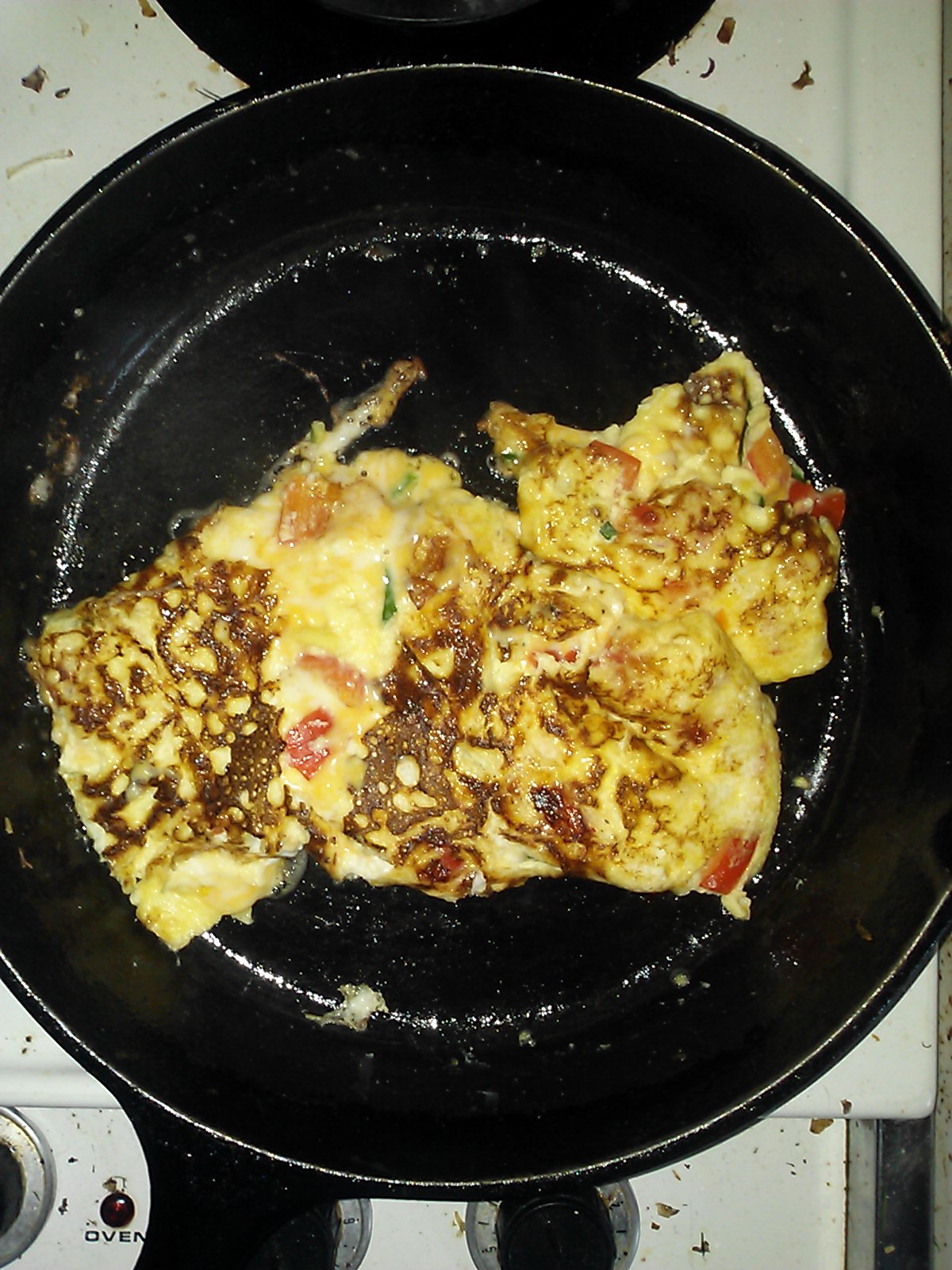
CAM00211I love omelettes, but it’s hard to cook them in old teflon pans because the eggs tend to stick (or worse, the teflon peels off into the food). However, in my cast-iron skillet, it’s not a problem at all! In the picture above, I mixed two eggs with chives, red pepper, garlic salt, and a splash of milk. Later, I added a sprinkling of cheddar and mozzarella. To oil the pan, I used about 2/3rds tablespoon of butter.

CAM00212I’m not very good at turning these things over, but as you can see it’s not really sticking to the pan at all. If it does, it’s not hard to scrape it off. I use only metal cookware with this skillet, so I don’t have to worry about melting plastic (ever notice how an old plastic spatula tends to have a sharp edge with bits of plastic peeling off?). And honestly, it doesn’t take much work to scrape food off of this thing, even when it does stick.

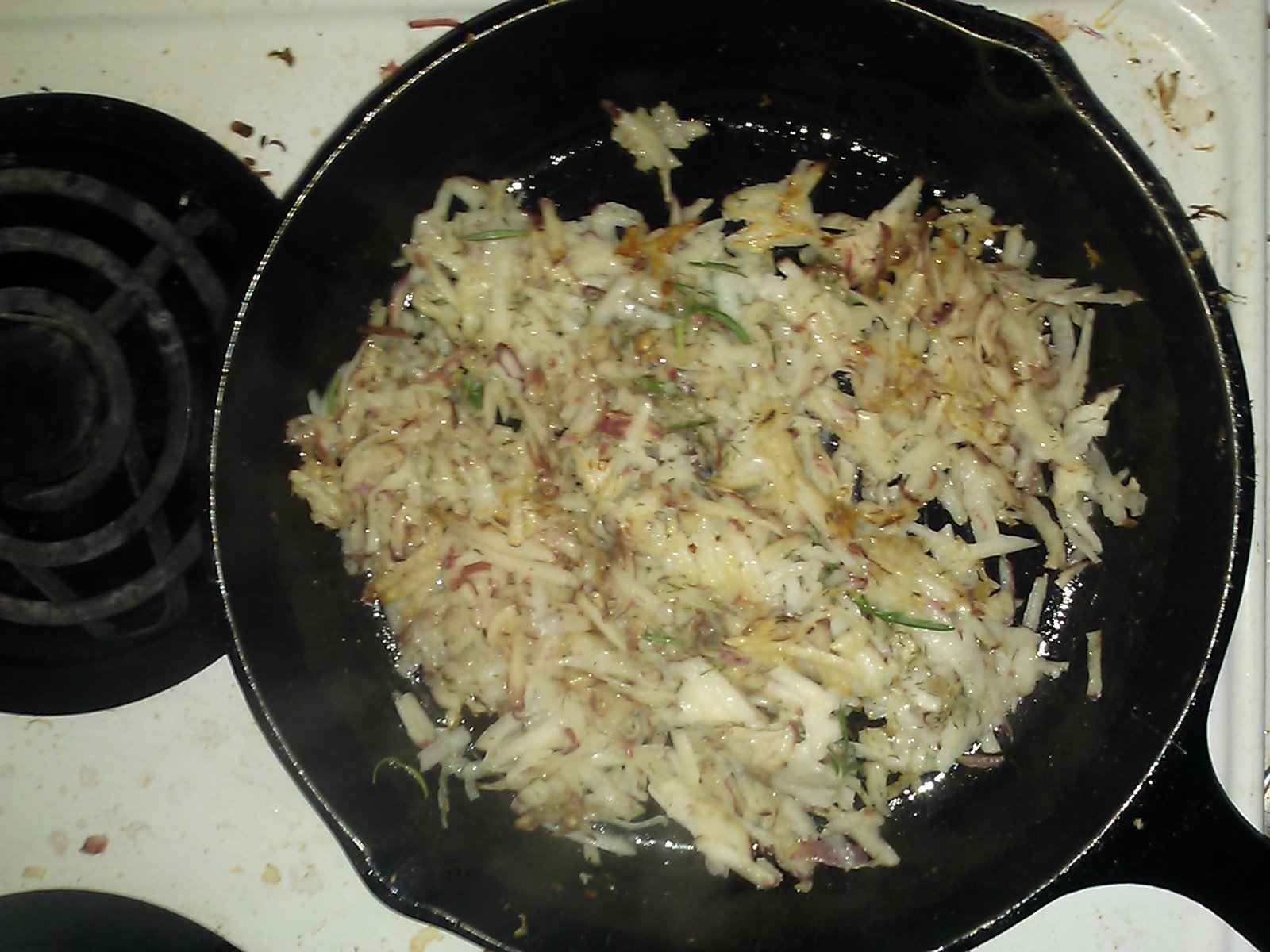
CAM00227Another thing I love to cook in my cast-iron skillet is hash browns. I’ve got a small herb garden in my kitchen window, so I fry up my potatoes with rosemary, chives, and dill. It tastes FANTASTIC.

With my old second-hand teflon pans, I could never get the potatoes very crispy because they’d always stick to the pan if I cooked them for too long. But with cast iron, that isn’t a problem at all! As you can see in the picture above, these potatoes are browning quite nicely.

But that isn’t even the best part.

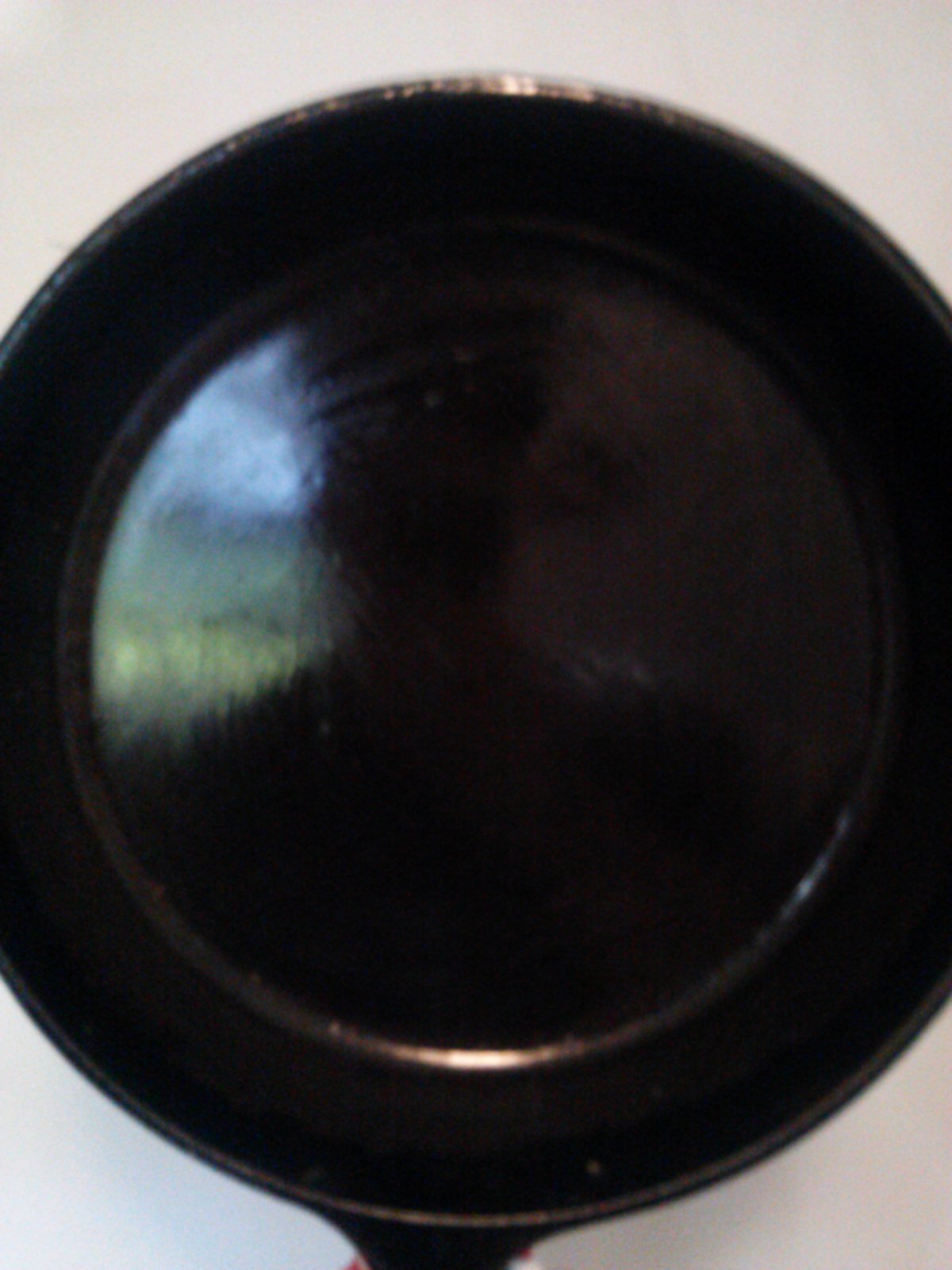
CAM00219See that? It’s a selfie I took in the bottom of the pan after cooking all the stuff above! I didn’t wash it at all, I just dropped a little bit of oil on it and used a paper towel to wipe it down.

I’m telling you, this cast-iron skillet is AMAZING. I can cook whatever I want in this thing! Even better, I fully expect that this skillet will outlive me. It’s WAY more durable than any other piece of kitchen equipment that I’ve ever seen. And it’s versatile, too–I can hardly wait to go camping with it!

Quick update and a funny thing

SW-VII Reproach (thumb)First, just a quick update on my latest writing projects.  I got the feedback from my second round of test readers for Star Wanderers: Reproach (Part VII), and while I think the story still needs work, it’s getting closer. I probably won’t be able to get it out by the end of September, but first or second week of October it should be ready.

It’s funny–I sent it to a guy and a girl, and while the guy thought it didn’t need any changes (and he’s studying to be an editor), the girl pointed out a few things that need a little more reinforcement and development.  It’s mostly just minor changes I think, getting more into Noemi’s viewpoint and figuring out exactly what she’s going through, and making that clear to the reader.  So yeah, it shouldn’t be too hard.

In some ways, writing this book has been like writing myself out of a corner.  The story in Reproach runs parallel with the events of Sacrifice, and some of the stuff that happens there is pretty complicated.  For example, it’s got a sixteen year old girl who feels like her only hope at happiness is to convince her best friend to share her husband, and the best friend actually kind of comes around to it by the end, though the whole ordeal is almost unbearable for her.

Writing about monogamous relationships is hard enough when you’ve always been single–it’s doubly hard when you’re writing about polygamy.  But I’m actually fairly pleased with the way it’s come out so far–even though it’s not quite ready to be published, everyone who’s read it has really gotten into it, even the readers who haven’t yet read the earlier books in the series.  It’s been a challenging book to write, but it’s been a gratifying one, and I think you guys are going to enjoy it.

Of course, all of this is yanking me away from Sons of the Starfarers, which is really kind of aggravating.  On an interview I listened to recently, Jim Butcher said that writers are either writing, thinking about what they’re writing, or thinking about what they’ve written.  The way my brain is wired, I can only really do one of those things at a time, and I’d much rather write or think about what I’m writing than think about what I’ve written.  But yeah, Reproach is more important, so after finishing the current chapter I’ll put Sons of the Starfarers on hold for a couple weeks.

Also, I’m working to get print editions out for all of my Star Wanderers books before Christmas.  Part of this is because of the new Matchbook program from Amazon, but mostly it’s just because … well, why not?  For those of you who want paperback versions of these novellas, that will soon be an option.  I’m having a little trouble figuring out the cover art (RBG vs. CMYK, getting the covers to print attractively instead of turning out way too dark, etc), but that shouldn’t take longer than a few weeks to iron out.  Expect to see parts I-IV out by November.

Finally, a funny thing happened to me at Leading Edge.  For those of you who don’t know, it’s a student-run science fiction & fantasy magazine where student volunteers read every story submission and write a critique for the author.  Well, while sitting in the slushpile, one of the editors came in and showed me a story that I’d critiqued … twice!  The first time, I’d given it a rejection.  The second time, I’d actually recommended that the editors buy it!

Well, I racked my brain a little bit to figure out what had happened, and as close as I can tell the only real difference was in how distracted I’d been when I’d read it.  The first time, it had been fairly noisy and there’d been a lot of distractions.  The story had some good parts to it, which I mentioned in the letter, but I didn’t really pick up on the character motivations well, so I rejected it based on that.  The second time, though, it had been quiet enough for me to really pay attention to the story, enough to really get what was going on.  I finished it, and the ending moved me so much that I knew I’d have to recommend that we publish it.

The editor wanted to keep the rejection sheet anyway, but I tossed it in the garbage since really it wasn’t all that helpful anyway.  And the moral, if there is one, is to pick up every story with the idea firmly in mind that you’ve got a potential gem in your hands.  Too often, I think we read stuff flippantly, as if we already know that it’s not worth our time and attention.  Well, don’t do that!  Who knows but what you’ve got your new favorite story of all time sitting right in front of you?  Give it a chance!

And on that note, I leave you with this:

See you guys around!

Q is for Quark

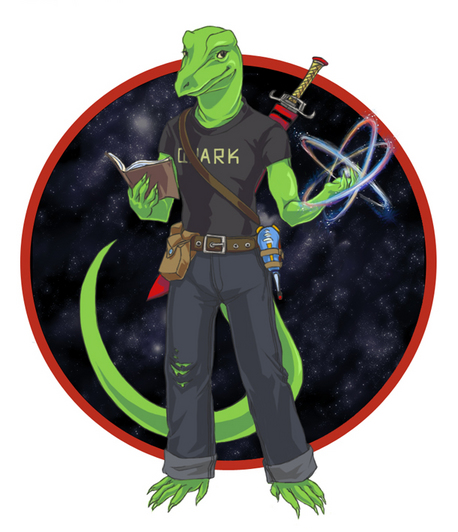
Quark_Mascot_by_OrphneIf it takes a village to raise a child, does it take a group of like-minded creative souls to raise a writer? I don’t know, but in my case, having a writing community around me really helped.  That community was Quark, BYU’s Science Fiction & Fantasy club.

I joined Quark my second semester of college.  I’d heard about the writing group, and on a whim I decided to check it out.  This was when Ben Hardin was the writing group leader, back before the current iteration of the club was really well-organized.  Aneeka Richins had basically built the writing group from scratch only a year or two before, and Kindal Debenham and Annaliese Lemmon had each spent a year as president shortly after that.  They were all still around, workshopping their stories and adding to the community.

We met on the second floor of the Harold B. Lee library, in one of the study rooms way in the back near what is now the classical music area (2520 was the room number, I think).  Looking back, it seemed like a weird place to meet, since we were always so LOUD.  However, back in those early days Quark didn’t get a lot of respect from the BYU student administration (BYUSA, known more familiarly as BYUSSR), so we kind of organized under the radar.

The spring semester of 2007 was a lot of fun!  I fit in very well with the group, and made a lot of friends.  It wasn’t until they made me the writing group president that I started attending regularly, though.  In retrospect, accepting that post was probably the best extracurricular decision I could have made.  I lead the writing group for two years, from fall of 2007 to spring of 2009, and that’s when I really became a writer.

When I first started back in 2007, I had a couple of hobby projects kicking around here and there, but the main thing I wanted to write was a Final Fantasy VI fanfic.  At the same time, I had a great idea for an original novel, but I’d never written a complete novel before, so I wasn’t sure what to do.  Aneeka convinced me to go with my own project, and that became The Lost Colony, also known as Ashes of the Starry Sea.

Around that time, I also started this blog, mostly so my writing friends could keep me honest.  I finished the first draft in 2008–a whopping 168k word manuscript that barely held together.  After coming back to the US from a study abroad program in the Middle East, I started revising it, but soon decided to trunk it in order to work on other projects.  Shortly thereafter, I finished the first draft of Genesis Earth, and the rest is history.

I later wrote up a detailed post on the origins of Quark, one that was published in a short-lived magazine called Mormon ArtistYou can find that article here.  Orson Scott Card himself commented on it, which really made my inner fanboy squee. 😀 For me, though, Quark was all about surrounding myself with like-minded friends who could foster my natural sense of creativity.  I probably would have become a writer anyway even without them, but it would have happened a lot later, and the road would have been much more rocky.

And now that we’ve all graduated and moved on, I’m happy to say we still keep in touch!  Kindal is a self-published indie writer much like me, with some excellent books out there.  He’s organized an online writing group that is mostly made up of us old-time Quarkies.  Aneeka’s got her webcomic, which seems to be fairly successful, and the others who chose to go a more traditional path are having success there as well.  But mostly, it’s just great to keep in touch.

After my time as president, Quark really exploded in popularity and became officially sanctioned by the BYUSA.  It’s really thriving right now, with a book club, a board/video gaming group, a film forum, and a bunch of other stuff.  Most of that was there when I was in the writing group, but it was floundering, and the writing group was much more autonomous.  But the guys who have carried on the torch seem to have done a great job making things even better, and that’s encouraging.

B is for Space Battles

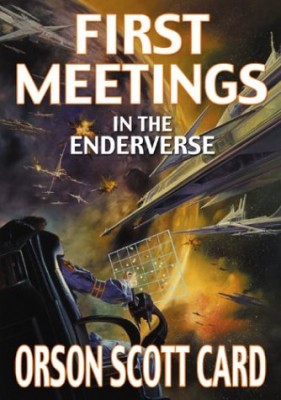
osc_first_meetingsIf you fell in love with science fiction when you were twelve, chances were it was because of the awesome space battles.  That was certainly the case with me.  When I saw Star Wars for the first time, I spent hours running around the house pretending I was flying my own starfighter.  In some ways, I’ve never really stopped. 😛
Ever since space opera became its own subgenre, space warfare has featured prominently in it, probably for the same reasons that Homer and Tolstoy framed their sprawling epics with a tale of war.  Where else are you going to find enough drama to fill volumes?  The fact that it’s set in space makes it so much cooler.

There are a lot of things about the space setting that make war stories different from those set here on Earth.  For one thing, there’s a huge element of exploration and unknown.  Even before we took the first photographs of Earth from space, there pretty much isn’t any corner on this planet that hasn’t been discovered by somebody.  In space, though, it’s still possible to stumble on a hidden planet, or find a mysterious alien artifact that can turn the tide of the war (Halo, anyone?).

For another thing, the dynamics of battle are completely different.  Sure, some stories treat space like an ocean, and there’s certainly a place for that kind of story, but the more interesting ones (at least to me) take into account all the profound differences.  For one thing, the zero gravity means that there is no “up” or “down,” which means that you have to deal with the possibility of attack coming from any direction, not just along a horizontal plane.  That concept alone drives the battles in Orson Scott Card’s Ender’s Game series, where “the enemy’s gate is down.”

One thing that really tickles me is when the story takes things a step further and incorporates things like orbital mechanics and delta-v.  I haven’t seen many books or games that do this, but the ones that do have really engrossed me by making the world feel that much more real.  Glen Cook did it in Passage At Arms, and the new Battlestar Galactica did it in the viper dogfights (though I’m not sure if they did it on the ship-to-ship scale).

The implications of real-world space physics on warfare are quite fascinating.  Rocketpunk Manifesto is an excellent blog that’s almost entirely dedicated to exploring them all, with all sorts of fascinating discussions on what the “plausible mid-future” may look like.  But even if all you’re looking for is an entertaining romp through space, the story telling possibilities are so much greater when you take the constraints of physics into account.

For example, if it takes months or even years to travel between planets, and orbital trajectories are fairly straightforward to figure out, how does it affect things if you can see the enemy fleet coming at your planet that long in advance?  If escape velocity from a gravity well like Earth is so difficult to achieve, what does that mean about the possibility of long-term planetary sieges?  And if starships are so far apart and moving so fast as to make full-on broadsides unlikely, how does that shape the battle tactics and strategy?  In spite of the physical constraints (or indeed, perhaps because of them), the possibilities are endless.

Man, I love me some good space battles.  One of my recent sci-fi favorites that features some epic battles is Wolfhound by my friend Kindal Debenham.  In my own work, you’ll find lots of them, especially in the Gaia Nova series (Bringing Stella Home, Stars of Blood and Glory, and to a lesser extent Desert Stars).  They say that the golden age for science fiction is about twelve years old, and that’s definitely true for me.  Expect to see lots more space battles from me in the future.

Well, that was a quick revision

SW-V Dreamweaver (thumb)First of all, sorry for forgetting to do a Trope Tuesday post (again!).  I guess I’m really flaky about doing those.  Oh well–better to be flaky about blogging than flaky about writing, right?

In fact, the reason I didn’t write-up the post was because I was busy doing a 2.0 revision pass for Star Wanderers: Dreamweaver.  This is the novella that retells the events of Outworlder, but from Noemi’s point of view.  I hadn’t looked at it in the eight months since I wrote it, but sometime over the summer I gave it to Laura to alpha read, and she just got back with her comments a couple of days ago.

Well.  Reading through those comments was simultaneously the most excruciating and most invigorating thing I’ve been through in a while.  I’ve changed a lot since I wrote the first draft, and a lot of things about it are horribly embarrassing, but the story … the story is actually pretty solid.  Oh, some of Noemi’s motivations weren’t close enough to the page, and some other elements needed a bit of pruning, but the structure, the bones–it all seems to be there.

So, long story short: I got Laura’s comments on Monday, and finished the revisions today.  TODAY.  Of course, it still needs to be proofread, and I’d like to send the new version out to some other first readers … but I don’t anticipate making any major, earth-shattering changes to the story.  In fact, I could publish it tomorrow, and most of you would probably love it.

So far, my Star Wanderers books are selling much better than any of my other titles.  They’re also much shorter, which means that I can put them out a lot faster–or should, at least.  I probably angst over them more than I should, trying to make everything perfect.  But I’ve got the extended series planned out to Part X, and I’ve already written half of Part VI.  Some of those might get moved up or down, depending on demand, but the more I write in this universe, the more stories present themselves.  And hey, if that’s what you want to read, I’ll be more than happy to write more of them.

If all goes well, Dreamweaver will be out in the first half of April, perhaps as early as the end of March.  As always, newsletter subscribers will get a two-week coupon code to download the book for free on Smashwords.  This also provides access to all future editions, in all ebook formats, completely DRM free.  If you enjoy it, I hope you’ll review it or tell a friend about it.  I’m not sure how I’ll end up pricing it, but I don’t anticipate going higher than $2.99.

In the meantime, here’s something to leave you with: an awesome remix of Jewel by Solarstone & Clare Stagg.  Man, I love Solarstone’s work.  I picked up his newest album, Pure, over the summer, and have been pulling songs from it for book soundtracks ever since.

Night! 🙂