Back into writing!

So we are more or less moved into our new (old) house, though there is this overdue kid’s book from the library that somehow got lost during the move, and we haven’t been able to find it… but aside from that, we are more or less settled in. Our five year-old has started kindergarten, my wife is starting her new job, and by the time this post goes live, we will have acquired office chairs from the BYU surplus sale, so I won’t have to be standing all the time like I am as I write this.
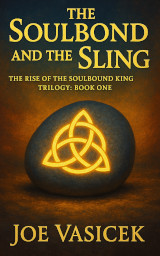
I’ve already gotten back into writing my epic fantasy, The Soulbond and the Sling, and am making steady progress on it again. The AI draft is about 66% complete, and it’s good enough that if I were writing it under a secret AI-only pen name, I would feel comfortable publishing it as-is. But my personal standard of quality is higher than that, especially for epic fantasy, so after the AI draft is complete, I will rewrite the whole thing without any AI, to put it in my own voice (and will probably add a whole lot of other stuff to it too—you know, the kind of setting and character details you’d expect in a proper epic fantasy, giving it much more depth).

(Also, as a side note, I do not have a secret AI-only pen name… though I must admit, a part of me kind of wants to start one. With a little bit of market research to figure out the pulpiest genres where I could really excel… but no, with two (soon to be three) small kids and a wife who works full-time, there are only so many projects I can work on at a time.)

I’m also working on The Road to New Jerusalem for my J.M. Wight pen name, though that one has been going much more slow. I really have no idea how much market appeal this one is going to have, and doubt it will do much more than help me to flesh out the world for a potential series in the same universe (a post-apocalyptic Mormon polygamist romance, which also probably has limited market appeal). However, I feel impressed that this is a book I need to see through to the end, so my goal is to finish it before October, at which point I will probably focus on The Soulbound King.
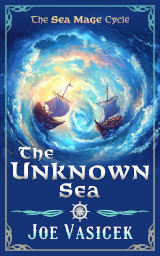
Beyond that, I’m also working on two other novels that I hope to finish before the end of the year (or, more realistically, sometime early next year, since I’m sure the new baby will throw things off for a while. The first is The Unknown Sea, a Sea Mage Cycle book, which is going to be a lot of fun. The rough AI draft is already done, and I had a real blast writing it.
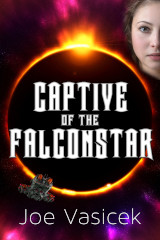
The other one is Captive of the Falconstar, the sequel to Queen of the Falconstar. The rough AI draft is also done for this one, but the revised AI draft is going to take a bit more work. Also, I need to redo the cover and blurb. But I’m really looking forward to getting this one out, and completing the trilogy, which has stood unfinished for nearly a decade now. Yes, I really need to finish these unfinished series, and fully intend to do so—not just with this one, but for all of them.
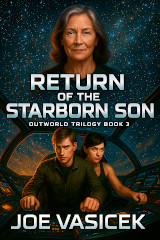
Over the next year, I hope to transition from being a science fiction writer who occasionally writes fantasy, to a fantasy writer who occasionally writes science fiction. My two big unfinished sci-fi series are the Falconstar Trilogy and the Outworld Trilogy. The plan right now is to finish Falconstar first, knocking out the last two books almost at the same time (the rough AI draft for Lord of the Falconstar is also complete), and then spend a little more time on Return of the Starborn Son to finish that trilogy strong. For a long time, Star Wanderers was my flagship series, so I want to do right by it. But I haven’t even outlined book 3 yet, so it’s going to be a while.

And when Return of the Starborn Son is done, I will probably release another volume of my author’s notes, since hey, why not? But that won’t be for a while—probably not until this time next year, at the absolute soonest. However, Return of the Starborn Son probably will come out before The Soulbond and the Sling, since for marketing reasons I don’t want to release an epic fantasy trilogy until all three books are ready to rapid release. And yes, I fully blame George R.R. Martin for conditioning epic fantasy readers not to try out a new series until it is complete. It is what it is.

So that’s the long-term plan. I will probably start a few new projects as well, including a relaunch of my Christopher Columbus stories, once I figure out what I want to do with that series. But for now, I’m just going to focus on The Road to New Jerusalem and The Soulbond and the Sling, until we are back into a new routine. BYU classes start on September 3rd, so it will probably be a little crazy until then. And the way things are shaping up, I half-expect they will induce my wife at the tail-end of September. So maybe we won’t actually get into a new routine until sometime next year. But either way, I’ll do my best to keep writing.
Where do you keep your books?

Now that we’ve moved back into our old house, unpacking all of our stuff and finding places for it, I just have to wonder… where in the heck do bookish normal people keep all of their books?

My in-laws have a dedicated library in their house, and while we were house-sitting for them, they were gracious enough to clear out several shelves for us so that we could put all of our books (more or less) within easy reach. But our house is a fairly small single family home, with a main floor and a basement. It’s about 2,300 square feet, with four bedrooms and three bathrooms—which is plenty of room for our small family—but there isn’t much space for bookshelves.

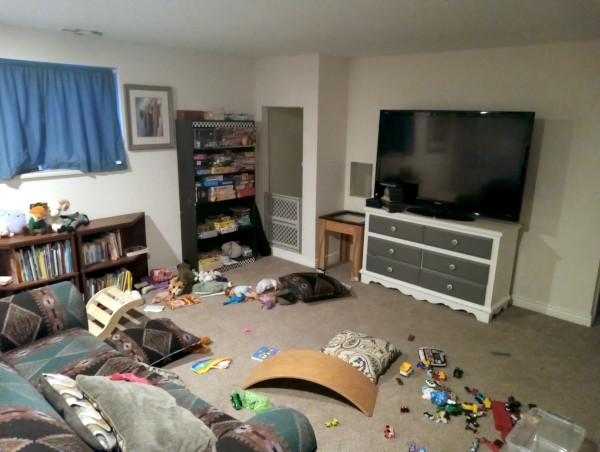
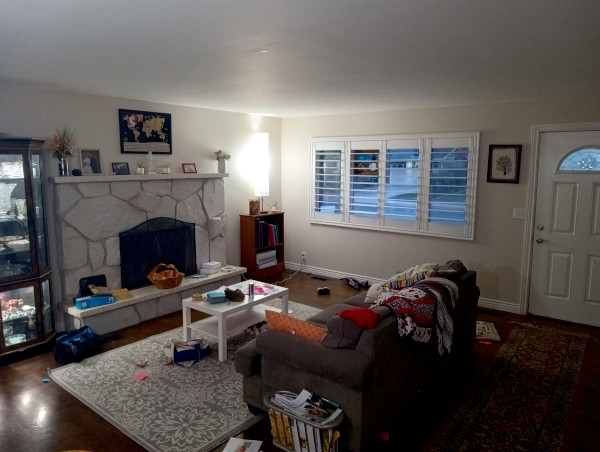
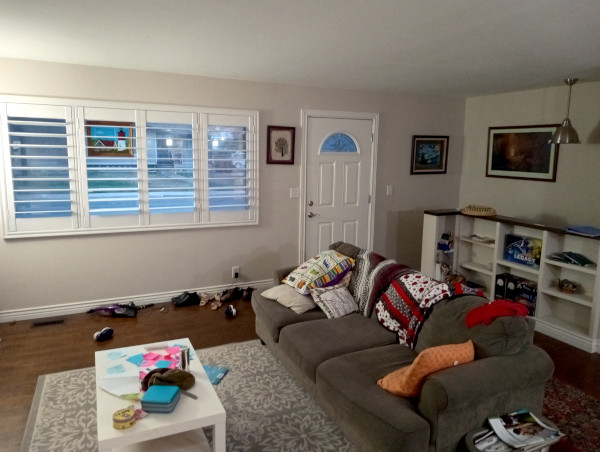
This is our main family room (please excuse the mess—small children and all). It has a little bit of shelf space by the stairs, which we could use for maybe a few dozen books, but we have a lot more than that. Boxes and boxes more. Behind the camera is the kitchen/dining area, so there isn’t much space for books there. And everything else on this floor is already taken, with bedrooms for the kids and a master suite for my wife and me—and my wife doesn’t want to cram all our books in our bedroom. With another small child on the way, I can’t blame her.

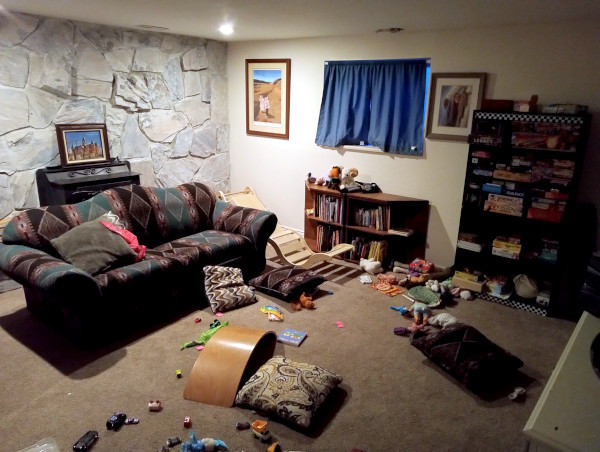
This is the downstairs main room. Again, please excuse the mess—we’re currently using this area as the kids’ play room. The bookshelves either have games or kids’ books, so those are taken. Behind the camera is a kitchenette area that we’re currently using to hold our food storage (and we have a lot of it, so that’s probably not going to change). Besides the main room here, there are two bedrooms, one of which is currently for storage, and the other is an office for my wife and me. Again, there’s not much space for shelves in either of those… and besides, we’d rather have our books out where people can see them (or at least where our kids can easily browse them).

What I suppose we could do is get rid of the massive TV (my wife won it from her work during a holiday raffle, and we don’t use it much, so it wouldn’t be a big deal to downsize) and move the dresser into another room, so that we could use that whole wall for shelves. That might fit all of our books, if the shelves stretched from floor to ceiling. It would be a big project, since we would have to use all of that space—and would probably also have to move the light switch—but it could be done.

Another idea I’ve had is to install shelves in the family room up above the main window. We could probably wrap it around most of the room, even into the dining room area if we had to. Have any of you done something like that? I’m a little bit worried it would make the room feel cramped, but it is a place where we could put a shelf.

Other than that, I’m kind of at a loss. I could try to get rid of most of my books, but I have no idea how successful that would be, since I tend to acquire new ones as quickly as I lose the old ones. It’s a blessing… and a curse. I’m sure that most of you can relate.

In any case, what do you do with all of your books? Where do you keep them? What would you do if you lived in our house?

Fantasy from A to Z: U is for Unicorns

If you were expecting a post on unicorns or other mythical beasts, I hate to disappoint you again, but that’s not what this is going to be. Instead, I want to write a bit about that most mythical of all human creatures: the full-time fiction writer.

Okay, perhaps we’re not that mythical. After all, Brandon Sanderson estimates that of all his students over the years, perhaps as many as 10% of the ones who set out to become full-time writers actually make that dream into a reality. I sometimes wonder: would Brandon count me as one of those 10%? Should he? The answer to that is… complicated. 

One of the first questions I get whenever I tell people that I’m a writer is “oh, wow—how is that working out for you?” Which is really a roundabout way of asking how much money I make, and whether I’ve been able to turn it into a full-time career. I am not (yet) a major bestselling author, and the closest thing I’ve had to a breakout thus far has been my (now unpublished) Star Wanderers novella series, which managed (mostly by accident) to hit the algorithms correctly back when a permafree first-in-series with lots of direct sequels was the best path to success. Then the publishing landscape changed, the algorithms shifted to favor pay-to-play advertising, and my books got left behind.

I will admit that if it weren’t for my wife’s income, I wouldn’t be able to pursue writing full-time. As a family, we’re following a path very similar to my Scandinavian ancestors, where the wife tends the farm while the husband goes off a-viking. In other words, my wife has the stable, traditional career that provides our family with some degree of security, while I have the more risky career that has the potential to catapult us into transformative levels of wealth and prosperity. We’re doing just fine, but it does sometimes feel like my Viking ship has yet to land ashore.

Because here’s the thing: something like 90% of the money in book publishing (after the booksellers and publishers and other middlemen take their often-exorbitant cuts) goes to less than 1% of the writers who actually make any money (and something like 30% of kindle books never sell a single copy). 

For every Brandon Sanderson, there are thousands—perhaps hundreds of thousands—of published authors who write on nights and weekends while holding down a day job to pay the bills. My writing contributes enough to the family budget to justify pursuing it, but if I were still single, I would need at least a part-time job.

Indie publishing has created a lot of opportunity for authors to make a career out of their writing, and there are many successful indies who are making a decent living at it. At the same time, indie publishing has also massively exploded the number of books that are published, so the proportion of full-time to still-aspiring authors is probably about the same (and may have actually tilted the other way). 

In recent years, it has very much turned into a zero-sum pay-to-play game, especially with advertising. From what I can tell, most authors lose money on advertising, and most of those who are making money are spending upwards of $10,000 each month to make $11,000. The elite few who learn how to successfully game the algorithms to blow up their books often put their writing on the backburner to launch their own companies or provide publishing services, leveraging their expertise to make a lot more than they otherwise would.

The algorithms are changing books in some very strange ways. If J.R.R. Tolkien or Roger Zelazny or Robert E. Howard were writing today, would they be able to make it in today’s publishing environment? 

Howard’s Conan stories would either have to be a lot sexier, or else would have to include the sort of tables and character stats you find in LitRPG. His covers would also be a lot more anime, and show a ridiculous amount of cleavage (which he actually might not have had a problem with, judging from some of the old Weird Tales covers). 

Zelazny’s Chronicles of Amber would all be far too short to make it in Kindle Unlimited—to make it in that game, you have to have super long books that max out on page reads, in order to maximize advertising ROI so that you can outbid your competitors. And if you aren’t winning the pay-to-play advertising game, your KU books will sink like rocks. Also, Zelazny took way too much time between books. Gotta work on that rapid release strategy, Roger.

As for Tolkien… hoo boy, there’s an author who did everything wrong. Decades and decades spent polishing his magnum opus, with a short prequel novel that falls squarely in the children’s category (totally different genre) as the only other fantasy book published in his lifetime. I suppose he could have serialized Lord of the Rings, except nothing really happened in episode 1: A Long-Expected Party. Certainly not anything that would adequately foreshadow all the dark and epic battles to come. Perhaps if he followed a first-in-series permafree strategy, and just gave away Fellowship of the Ring for free… and then made The Hobbit his reader magnet for signing up for his email list… maybe that could have worked? After all, there’s always BookBub…

I jest, of course. Each of these authors’ books became classics, not because of their marketing strategy, but because they hit the cultural zeitgeist in exactly the right way. But is it possible for an author to do that today without also getting a boost from the algorithms? Or do the algorithms have more power to shape our culture than anything else? Those are disturbing questions, and I honestly do not know the answer.

And then there’s the question of AI, which is massively disrupting all of the creative fields. In the interest of full disclosure, I am actually quite sanguine about generative AI, and have already been working to incorporate it into my creative process. I’m not a fan of AI slop, but I don’t feel particularly threatened by it. I decided a long time ago that if AI ever became good enough to write an entertaining book, it still would never be able to write a Joe Vasicek book. That’s insulated me from most of the doom porn out there.

Right now, there is a HUGE fight happening between authors like me who are embracing AI, and authors who treat it all as anathema, and have vowed to never use any sort of AI in any of their books (except Grammarly, of course, because… reasons. And Microsoft Word. And…) Frankly, it reminds me of the big debate between indie and traditionally published authors, back before self-publishing had lost its stigma. The biggest difference is that the level of online outrage has been ramped up to 11, mostly as a result of the social media algorithms (which weren’t as robust or as powerful back in the early 2010s). I suspect that we will ultimately settle on a “hybrid” approach, much like we did with publishing, but the sheer level of vitriol has made me wonder about that. 

On the reader end of things, though, it seems like most readers don’t really care if a book was written with or without AI assistance, so long as it’s actually a good book. Which means that there is a real opportunity for authors who 1) know how to tell great stories, 2) have already found and honed their voice, and 3) know how to strike the right balance between the AI and the human elements. 

Which describes my own position almost perfectly. Over the last fifteen years, I’ve read, written, and published enough books that I have a pretty good handle on what makes a great story. I’ve also honed my voice well enough that I can write in it quite comfortably. And as for the balance between AI and human writing, I’ve been working hard on that since ChatGPT burst onto the scene in 2022. Half a dozen books and about a million words later, I’ve learned quite a lot about how to best strike that balance.

Will AI replace authors entirely, making this particular unicorn extinct? I don’t think so. But AI may radically change our concept of what “books,” or “writers,” or “writing” really are. A long time ago, I realized that even if AI became good enough to write a decent book, it would never be able to write a Joe Vasicek book. Only I can do that. Whether or not that’s worth something is up to the readers to decide.

Moving this week

We’re moving this week, so the posts are going to be a bit sparse. I’m not going on hiatus, but I probably won’t post much else for the next week.

We moved from Orem to Provo (the next town over) when my in-laws left for their mission. They were going to be gone for 18 months, and they didn’t want to deal with the hassle of renting out their house, so they let us house-sit for them while we rented out our house.

That was back in 2022. They moved back in 2023, but offered to let us stay while my wife was getting her PhD (though the real reason was probably to spend more time with the grandkids). The arrangement worked out really well for us, but my wife is finishing up her dissertation and starting a new job, so it’s time to move back to our old house.

If all goes well, we should be living in the new house by the end of this week. It will probably take at least another week to move all of our stuff over, and maybe the rest of the month to get settled down, but the big stuff is all going in the next couple of days.

I’ll still try to write a little whenever I can, but the move is going to take priority. And since the writing takes priority over the blog, the blogging will be a bit sporadic for a while. I did my best to schedule some posts over the road trip to Canada, but I wasn’t able to write and schedule them all through the move. But if you leave a comment, I’ll still see it though, and do my best to respond.

Fantasy from A to Z: S is for Sanderson

Brandon Sanderson is, without a doubt, the most popular fantasy writer currently living and writing today. He is also one of the classiest and most gracious authors you will ever meet, in any genre. I’ve also got a personal connection to him, from taking his writing class at BYU.

Brandon decided to become a writer when he was very young. The way he explains it, the bug really bit him when he read Dragonsbane by Barbara Hambly. Depression runs in his family, and growing up, he always felt emotionally monotone and distant—until he read that book. From then on, he became obsessed with fantasy, both with reading and with writing it.

The way I heard Brandon explain it, that emotional monotone has been both a personal struggle and a great asset. It’s part of the reason he’s able to write so much, since where other writers tend to have huge emotional swings that affect their ability to write, Brandon is able to just sit down and do the work, day after day after day. It’s also part of what gives him an even keel that makes him such a gracious and generous person. Where other writers tend to get worked up on social media or join outrage mobs, Brandon avoids all of that. I don’t think I’ve ever seen or heard of him becoming outraged about anything.

Brandon was one of the last major authors to break into book publishing before the indie revolution began turning everything upside down. He broke in by researching agents and editors, attending all the important conferences, and networking with everyone who’s anyone in the genre. He also wrote a lot of really good books—as well as a lot of crappy ones. I believe that Elantris, his debut novel, was actually the sixth novel he wrote, and Mistborn: The Final Empire was something like the 13th. He landed his agent, Joshua Bilmes, from attending World Fantasy, and his agent eventually got him his publisher, Moshe, at Tor.

Elantris and Mistborn were good, but not immediate bestsellers. In fact, Brandon was on track to be an average mid-list fantasy author with a relatively unremarkable career, until Robert Jordan died, leaving the Wheel of Time unfinished. By that point, a lot of readers felt frustrated with the series and used his death as an opportunity to write scathing screeds about how it had gone off of the rails and grown far too bloated and large. But Brandon was much more classy and gracious than that, and wrote a tribute to the man instead, praising his work and the impact it had had on his life. When Robert Jordan’s widow read Brandon’s post, she decided that he was the one who should finish the Wheel of Time.

Personally, I’m not a huge Wheel of Time fan. I read the first three books and enjoyed them, but I got lost midway through the fourth book. My wife read them all and feels like the series is overrated, and I generally trust her judgment. But I can appreciate how a lot of people really love the series—and really, there is a lot to love. Just because it isn’t to my personal taste doesn’t mean that it isn’t good. 

My friends who are Wheel of Time fans tell me that Brandon not only finished the series—he rescued it. Apparently, the last three books rejuvenated the series, wrapping things up in an incredibly satisfying way. Of course, Brandon would defer and say that it wasn’t his genius that turned the series around, but Robert Jordan’s original vision and the detailed notes and outlines that Brandon followed. But there’s no denying that Brandon really stuck the landing.

It was around this point in the story that I met Brandon. I was a student at BYU at the time, and I had an opportunity to take his writing class. From the time when I was eight, I had wanted to be a writer, but I didn’t think I would ever turn it into a career. Brandon’s writing class changed all that, and helped me to see that I could pursue writing as a career. He also taught me the nuts and bolts of writing fiction, vastly improving my writing skills. I had started several novels in high school, but never finished anything until I took his class. And while my first finished novel was a disaster that I promptly locked in the trunk, my second novel attempt (which I started writing in Brandon’s class) ultimately became my debut, Genesis Earth.

(As a side note, my wife was also in that ‘08 class with Brandon Sanderson, though we didn’t actually meet each other until almost a decade later when we matched on Mutual. She also started a writing group with her college roommate, who won the Writers of the Future and married into Brandon Sanderson’s writing group. Our writing group has also got one of Brandon’s college roommates.)

Brandon’s success with Wheel of Time was what catapulted Brandon from a midlist author to a bestselling phenomenon. But even then, if he wrote at the same slow pace as most other fantasy authors, he would have forever been known as “the guy who finished Wheel of Time.” Instead, he became famous for writing and publishing massive +300k word doorstopper tomes at an unprecedented rate, leading fans to joke about his writing super powers. Then the pandemic happened, and he wrote four “secret” novels with all of the extra time he had from not traveling anywhere. The fans went crazy, and his kickstarter blew everything out of the water.

I haven’t read all of Brandon’s books. I really loved the Mistborn era I books, and the first Stormlight Archive book was good, but my favorite is Emperor’s Soul, because I think that Brandon is at his best when he writes shorter novels rather than the massive +300k word doorstopper tomes. In my experience, Brandon is a 3-star author who writes 5-star endings. His writing tends to meander, especially in the early middle, but around the 3/4ths mark there’s usually a twist that brings things together, and the conflict escalates consistently until it builds into a really satisfying ending.

Brandon is also known for his hard magic systems, which have become a signature trait of his books. Some readers feel that clearly explaining the rules of magic defeats the sense of wonder that a fantasy novel should have, but that’s not been my experience with his books. When I read a Brandon Sanderson novel, I feel almost like I’m reading a video game. Knowing the ins and outs of the magic helps me to see the possibilities for the characters to use it, and Brandon is usually really good at adding an unexpected twist, exploiting the rules of magic in a surprising yet inevitable way. This creates its own sense of wonder that really adds to his books.

Brandon also is known for how all of his books are tied together into the same transdimensional “cosmere” multiverse, though I actually think this is the least remarkable thing that makes his books so distinctive. For one thing, he’s not the first one to do it—David Gemmell also discretely linked all of his books, which blew my mind when I discovered that particular easter egg. For another thing, Brandon has turned his cosmere from a delightfully hidden easter egg and nod to the fans to the grand key that you must possess in order to understand and appreciate his later books. As a result, the cosmere is becoming an obstacle to new readers, even as his most ardent fans all swoon over the cosmere connections.

I think Brandon’s ultimate goal is to turn his books into a massive cinematic universe, kind of like the MCU. From what I understand, he was really close to signing a Hollywood deal, but it fell through at the last minute, leaving him back at square one (I don’t know all the details, though Jon Del Arroz did some interesting reporting on that). This is also probably why his books have become more woke in recent years. 

I’ve already written at length about that subject, so I won’t belabor the point here. But I really do feel that this represents a betrayal of his more conservative fans, many of whom turned to Brandon precisely because his books tend to be free of all of the gratuitous language and sexual content of most modern fantasy. Also, one of Brandon’s really great strengths during the gamergate and puppygate fannish controversies of the 2010s was his strict neutrality. While the culture wars were raging all around them, he continued to be his classy and gracious self, refraining from picking sides or wading into the mudfest. With the LGBTQ romantic subplot in Wind and Truth, that appears to have changed.

I hope he turns away from all of that. What the world really needs right now are books that transcend the whole woke vs. anti-woke divide, bringing us together and healing the artificial (and in many cases subversive) divisions that pit us against each other. Maybe Brandon will surprise me, and accomplish exactly that, just from the left side of the aisle. But as of Wind and Truth, I can’t help but wonder if we’ve reached peak Sanderson. Only time will tell.

Regardless, I will always be grateful to Brandon Sanderson for the things he taught me, and for all of his graciousness and generosity that he showed in his writing class. Without that experience, I probably would have pursued a different career, and not written nearly so many books. I also probably would not have married my wife, since one of the big things that drew her to me was my love and dedication to my writing craft. 

Back from the Great White North

We just got back yesterday from our second family road trip this summer, this time to Alberta for a family reunion. My wife’s grandmother passed away in the winter, and it wasn’t a good time for us all to get together (not to mention that we didn’t have passports for the kids yet), so we scheduled a family event for the summer to get together and remember her.

I’ve been to Canada before, but only to Quebec. This was my first time driving through Alberta. It was interesting. About as similar as you can get to the United States while still being a foreign country. Alberta itself feels kind of like a cross between Nebraska and Pennsylvania, with Hutterites instead of Amish, and more rapeseed (for canola oil) and alfalfa than corn and soy. This was especially true up in the northern part of the province where we were going, where there were also lots of little lakes, and all of the trees were high-altitude trees (aspen and pine, mostly). Even though it was summer, the air was pleasantly cool, which makes me wonder what the winters are like. Probably brutal.

At the reunion itself, we had lots of food and outdoor games. Had a big campfire both days and roasted marshmallows for s’mores, which the kids really enjoyed. There was also a LOT of pie, including saskatoon pie, which was a new thing for me. Saskatoon berries are kind of like blueberries, except tart, and they grow in large bushes a little like currants. We picked our own saskatoons for the pies.

Overall, it was a very good trip. About sixteen hours of driving, split across two days, so that wasn’t too bad. There were a couple of times where we had to change poopy diapers on the side of the road. There aren’t really any rest stops in rural Alberta, just roadside pullouts with trash cans for throwing away your garbage. Lots of cows too. We drove up route 36, which feels more like a state highway than a true highway. As far as I can tell, there aren’t any American-style highways in Alberta, except perhaps around the major cities. And the speed limit was 100 km/hr for most of the way (about 65 mph), so it was kind of nice to get back into the States where we could drive faster.

I didn’t get much writing done on the trip, but now that we’re back, that’s hopefully going to change. However, we do have a bunch of stuff going on. My wife is starting her new job at BYU, and also finishing up her dissertation, so that’s the priority right now. I’ll be watching the kids for most of the time, which limits how much I can write (though the family study room on campus is good for working while letting the kids run around). Also, we’re going to move back into our house in Orem over the next couple of weeks, so that’s going to be another big project. But we should hopefully be settled down before the end of the month.

Long story short, things are going to be crazy for a little while, but I should still be able to make at least a little bit of writing progress each day. The two big WIPs I’m working on right now are The Road to New Jerusalem, which I hope to finish before October, and the AI draft of The Soulbond and the Sling, which is more than halfway finished but is still a massive epic fantasy novel. No idea when those WIPs will be done, but for now I’m just going to keep chipping away at them a little at a time, and make more definitive plans later once things are a little more settled.

Fantasy from A to Z: Q is for Quests

What is your quest in life? What is your driving goal, the thing that gets you up in the morning? What do you hope to accomplish before you go the way of all the Earth and depart this mortal coil?

Quests are huge in fantasy literature, because they resonate so much with our own lives. Most of us are not just merely existing, drifting aimlessly from one life event to another—or, if we are, there is something deep within us that yearns for greater meaning and purpose in our lives. Quest stories give us that sense of meaning and purpose.

I asked Grok to define “quest” in the context of fantasy literature, and this is what it told me:

In fantasy literature, a quest is a narrative framework where a protagonist or group embarks on a challenging journey to achieve a specific goal, often involving adventure, trials, and personal growth.

Grok then gave me a list of five things that all quest stories typically include:

  • a clear objective,
  • a journey,
  • challenges and trials,
  • some kind of character transformation, and
  • some kind of symbolic meaning.

One of the best-known examples of this is Frodo’s quest in Tolkien’s Lord of the Rings, which is actually a subversion of the traditional quest story, because instead of seeking to acquire the object of the quest (in this case, the ring of power), Frodo is seeking to destroy it. 

The objective is to take the ring to Mount Doom and drop it into the lava, because that is the only place where it can be destroyed. 

The journey takes Frodo far from his home in the Shire, across nearly the whole length of Middle Earth to the desolate lands of Mordor, where the Dark Lord is gathering his forces. 

Frodo faces all sorts of challenges and trials, from the attack of the ringwraiths at Weathertop to the near-death experience with Shelob the spider. But perhaps the greatest challenge comes from the ring itself, which is constantly tempting him to submit to the Dark Lord’s will.

The story transforms Frodo so completely that by the end, he finds that he cannot return to his former life in the Shire. He leaves Middle Earth for the Grey Havens and sails with the last of the elves to the Undying Realms beyond the western sea.

As for symbolic meaning, the whole book is rife with it, from Gandalf as the Christ figure to the ring as a metaphor for the temptation of absolute power.

But what does an epic story like this have to do with us? How and why does a quest story like this one resonate so deeply with us? After all, very few of us have been attacked by giant spiders, or had a murderous experience with a ghost-like entity from beyond the veil. So why do we resonate with the idea of a quest? 

I can only speak to my own experience, but this is how my own life has resembled something of a quest:

My objective, ever since my college days, has been to make it as a professional fiction writer.

The journey has been more of an internal one than an external one, though I have traveled a bit for conventions and the like. I also spent a year teaching English overseas, not only to make ends meet, but to gain the sort of life experience that I thought would lead to better writing. In fact, I’ve taken a lot of odd jobs along the way, all of which have given me experiences that I’ve later drawn on.

As for challenges and trials, it’s been an extremely difficult road, because the vast majority of aspiring writers never manage to make a living at it. I’ve made just about every mistake that it’s possible to make (except writing porn—though some people would argue that not writing porn is the greater mistake). Overall, I can say that pursuing this writing career has been one of the most difficult things I’ve ever done in my life.

Has it transformed me? Yes, it has—and I know this because one of the major things that attracted me to my wife was my passion for writing, and the diligence with which I have pursued it. If I’d taken the path of least resistance instead of pursuing this difficult quest, I probably would have ended up as a morbidly overweight slob, addicted to porn and video games—in other words, the kind of person my wife would have never given a second glance.

As for symbolic meaning, I’ll say this: when my first child was born and I held her in my arms for the first time, I had the distinct impression that “this is her story now.” As a writer, I’ve pored over lots of writing advice, and one of the best pieces of advice I’ve received is to remember that every character is a hero in their own story. So when I had this powerful experience of holding my child for the first time, is it any surprise that one of the lessons I’d learned from my quest to become a professional writer helped me to understand the deeper meaning of that moment?

Those are some of the ways that quest stories resonate with me. I’m sure it will be different in your own life, but the main points are likely all there—which is why the quest story has become such a powerful archetype.

Of course, not all fantasy books involve a quest of some kind. In recent years, “cozy fantasy” has become something of a thing, where the story is less of a quest than a low stakes, slice-of-life sort of tale. Perhaps the most successful example of this is Travis Baldree’s Legend and Lattes.

Why do those stories resonate so much? Frankly, I think it’s because so many of my fellow Millennials feel like they have failed to launch. We came of age during the Great Recession and the Global Financial Collapse, saddled with way too much student loan debt. With all of the bankruptcies, mass layoffs, hiring freezes, and delayed retirements, many of us struggled to find meaningful work. As a consequence, many of us were forced to move back in with our parents and put off major life decisions like buying a home, getting married, and starting a family. Far too many of us have sadly put off those decisions indefinitely. And things haven’t gotten much better in the decades since. Indeed, our Boomer parents have the dubious distinction of being the only generation in American history to enjoy more prosperity than every generation before and since.

But I do think that is changing with the rising generation. There are a few key ways in which Zoomers are the diametric opposites of Millennials, and one of them has to do with this hunger for stories about quests. Just compare Epic: The Musical to Legends and Lattes. The contrast is stark. So as Zoomers come into their own, I think this subgenre of cozy fantasy is going to fade. It may stick around for a while, but I don’t think it’s going to be more than a tiny niche.

After all, what is your driving goal in life? What is your own personal quest?

Mid-July Update

The heat of the summer is upon us, and our air conditioning is… struggling. Hopefully we get it fixed soon, because my wife really can’t stand the heat, and if she can’t sleep, neither can I.

Not much happening around here. We’re just plugging away, me at my writing, Piper at her thesis. She just finished her user study, so all she needs to do is write up the thesis itself and defend it. That’s currently the top priority in the household, so I’m doing my best to write around it.

I’ll be at Writers Cantina later this month, where I’ll be on a panel about AI and writing, and moderating a couple of other panels, including one with Larry Correia. That one should be fun. Writers Cantina is a fantastic little convention, started by a bunch of us local writers who occasionally get together at the IHOP up in American Fork. We started after Life, the Universe, and Everything went a little crazy in 2020, mandating vaccines at the very last minute and pulling all sorts of other woke shenanigans. Writers Cantina isn’t explicitly anti-woke, but it’s definitely not woke either. It is a lot of fun, though! Kind of like what LTUE was back in the 00’s, except without a dealer’s room, and the hallway is the main attraction. Oh, and lots of great snacks.

Other than that, there’s not much going on around here. We’re going up to Canada right after Writers Cantina, and as soon as we get back, we’re moving back to Orem. I am both looking forward and really not looking forward to that. Hopefully we can get everything moved over with a minimum of chaos (especially since my wife is starting her new job at the same time). And then we’re having a baby. Yay!

Independence Day update

Happy 4th of July, everyone! It’s Independence Day here in America, when we celebrate our nation’s birthday by doing all of the most American things possible: fly our flags, eat lots of meat, and blow things up. God bless America!

It’s been a busy month so far, with family visiting from out of town all last week, and lots of kids all over the place. Great for our kids, who got to play with their cousins, but not the best for writing. Oh well. It looks like things are going to settle down for the rest of the month, which is really good, especially for my wife, who is racing to finish her PhD before she starts her new teaching job. So I will definitely be helping her with that.

On the writing and publishing side of things, I am actually going to take advantage of this time to catch up on all of the non-writing things, like publishing tasks, that I’ve fallen behind on. When August rolls around, things are going to get really crazy, with our move back to Orem as my wife starts her new job, so I want things to be set up really well for that.

I will continue writing, though: just at a slower pace. If I plan to do about an hour a day, and make that a consistent thing, I think I can keep that up through the crazy times that are coming. Not only are we moving and starting a new job, but we also have a new baby due to be born very shortly after all of that. So I fully anticipate that it’s going to be a crazy year.

(still not the final cover)

My plan right now is to keep plugging away at The Soulbond and the Sling, slowly but surely, until the AI draft is complete. At the rate that I plan to go, however, it probably won’t be finished until August or September.

I’ll also be working on the human draft of The Road to New Jerusalem, but since my plan is to submit that to the Ark Press contest in October, I’m not too worried about rushing that one. Besides, it’s a much shorter novel, so it shouldn’t be that hard. A part of me wonders if I’ll finish that one before The Soulbond and the Sling.

In the meantime, I plan to publish Bloodfire Legacy in paperback, ebook, and audiobook as soon as I go through the edits and get it formatted! In fact, that’s the next big thing I plan to work on in the next two weeks. With luck, it should be out very soon.

So those are the big things that I’m working on right now. I’m also going to try and finish all the blog posts for Fantasy from A to Z before the end of the month, though they will probably run through the first half of August or so. And once Fantasy from A to Z is done, I will turn that into an ebook exclusive for my newsletter list, and make my current newsletter exclusive, Science Fiction from A to Z, available as a regular ebook (and maybe audiobook and paperback as well).

All of this is part of my plan to pivot toward being more of a fantasy author. Right now, I’m a science fiction author who occasionally writes fantasy. In the future, I want to be known as a fantasy author who occasionally writes science fiction. Most of my science fiction leans heavily into fantasy tropes anyway, so it shouldn’t be too difficult to make the change. Hopefully most of my readers follow me over as I make the transition.

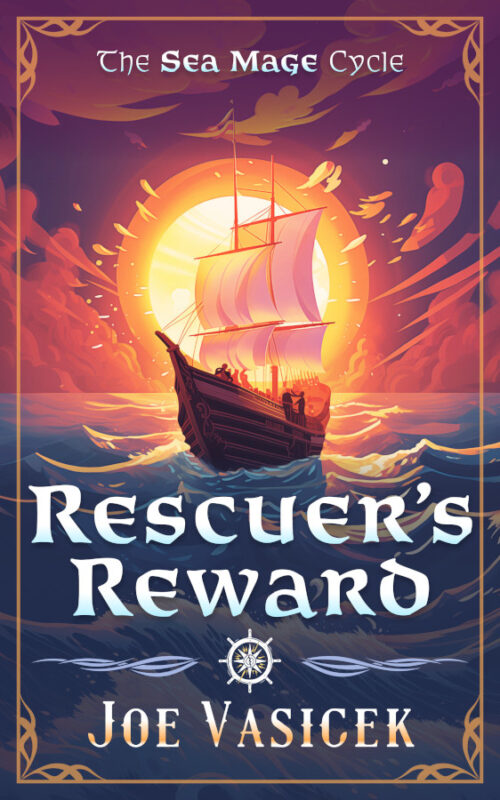
Toward that end, I’m happy to report that Rescuer’s Reward, the first novel in the Sea Mage Cycle, is now available as a permafree book! If you like fun quick fantasy adventures with a touch of romance, I think this will be right up your alley. All of the Sea Mage Cycle books are pretty short, and they all stand alone, though they often have recurring characters. Check it out and give it a read!

Back from Arkansas

So we’re finally back from our family vacation to Arkansas! My youngest sister manages cabins over at the Buffalo River National Park, which means she’s busy over there all summer, so we all decided to go over to her.

It was a looong drive. Took us three days to get down there, mostly because we stayed with my brother-in-law in Omaha for a couple of nights (just long enough for our five year-old to fall in the shower and bust open her head. Took her to the emergency room, where she got a couple of staples. She’s fine.) On the way back, we busted our butts and did it in two days. We must have listened to the Tarzan and Mulan soundtracks thirty or forty times each.

Arkansas is almost like another world. Very beautiful, but mostly jungle, and full of all sorts of venemous things that want to suck your blood. The first day, I made the mistake of walking around in shorts without any bug spray, and I got nearly a dozen deer ticks on me, including one that had crawled up into my unmentionables. My wife and both our kids also had ticks on them. Needless to say, we did very thorough tick checks every day after that.

Other than that, it wasn’t too bad. I heard from one of the locals that there are copperheads and water mocassins in the river, but we didn’t see any of those. Also, the black widows like to roof in the awning and lower themselves down in the evening, but we didn’t see any of those either (thank goodness). And apparently, there’s an annual tarantula migration, which sounds absolutely terrifying. In fact, it sounds like someone in the Ozarks started a game of Jumanji some 150 years ago, and it’s never been finished.

But the people are all friendly and generous, and there’s a tiny little country church almost every other mile in the back country. Also, driving through Branson and southern Missouri was like driving through the heart of Trump country. The Twelve Days War was raging the whole time, and there were MAGA billboards and billboards saying “we stand with Israel.” Kind of surreal.

It was good to spend some time with family, but it’s good to be home now. We just got the staples out of our daughter’s head, and it’s healed just fine. She’s really glad to be able to swim now (too bad she couldn’t swim while we were at the park). For the next week, my brother-in-law from Couer D’Alene is down here with his wife and eight kids for a family vacation. Our kids are having a blast, though our littlest just came down with a stomach bug… hopefully it ends with him, but I’m not holding my breath.

The plan for now is to finish writing all the blog posts for Fantasy from A to Z, hopefully before the end of next week. I’ll also do my best to finish up the rough AI draft of Lord of the Falconstar (book 3 of the trilogy) by the end of this week. So far, it’s going really well. After that, it’s back to the revised AI draft of The Soulbond and the Sling, which I hope to finish before we go on our next road trip to Canada for my wife’s family. And after Fantasy from A to Z is finished, I’ll work on the rough human draft of The Road to New Jerusalem, hopefully finishing it in time for the Ark Press contest.

That’s the plan, anyway. I have a lot of thoughts on the Twelve Days War and the situation in the Middle East, but I’ll save all that for now. If the ceasefire holds and it truly is the end of the war, I think President Trump will go down as the greatest American president of the 21st century.