J is for the Joys of Self-Publishing

Brandon Sanderson teaches an English class at Brigham Young University, and I was one of his students back in 2008 and 2009. At LTUE this year, he asked me to come in and speak to his class about what it’s like to be an indie writer, so I prepared a short ten minute presentation on the things that I love the most about self-publishing. They are:

1. I have complete creative freedom.

As an indie, I don’t have to worry about agents, editors, marketing departments, interns, or anyone else who could kill my project before it has a chance to get out into the world. If I can write it, I can publish it. If I want to write something crazy like a story about Amish vampires in space, or steampunk Mormon airships, or orcs falling in love on the battlefield, I can do it without having to worry whether it will ever find a home outside my hard drive.

Of course, if I write stuff that’s more niche, chances are that it’s only going to find a niche audience. But that’s okay, because:

2. I don’t have to be a bestseller to find success.

With the way that the royalty numbers for indies work out, I don’t have to be a mega blockbuster bestseller to have a viable career. In fact, all I really need is to sell a thousand or so books per month–which seems like a lot until you realize that there are 1.4 billion English speakers in the world (over 300 million of whom are native). Plus, if I have thirty or forty books out, I can make a comfortable living selling no more than double digits on each one.

It’s the thousand true fans principle at work, and for indie writers, it really does work. I only started self-publishing three years ago, and I’m already making enough to keep my head above water. And to everyone except my small handful of fans (who don’t even come close to a thousand), I’m just another nobody.

3. I have the flexibility to reinvent myself and try new things.

As an indie, I’m not locked down by any contracts that I can’t get out of. That gives me a great deal of flexibility in how I can run my career. If I wanted to unpublish everything and start over under a different name, I could do that. If I wanted to try out a new genre, or dabble in something experimental like serials, I could do that. At any time, I can completely remake myself however I want.

That flexibility is crucial because of how quickly the market is changing. Publishers are consolidating and going bankrupt, bookstore chains are struggling, and new technologies and business models are opening the doors to all sorts of new opportunities. As an indie, I’m in a great position to take advantage of them.

4. I can connect directly with my readers and fans.

Not just in the sense of connecting through social media, but connecting through my books as well. If my fans are clamoring for a sequel, I can write it and get it out to them while it’s still fresh in their minds. If they have trouble finding my books somewhere, I can clear the problem up myself without getting tied up in the bureaucracy of a large publisher.

The two most important people in the book world are writers and readers. As an indie, I can make sure that no one comes between my readers and me.

5. I’ve learned to treat my career like a small business.

A lot of writers view this as a downside, or at least a hassle they’d rather not deal with. They decide not to self-publish because all they really want to do is write. After all, isn’t it better to get someone else–an agent, for example–to handle the business side of things? Isn’t it better not to have to worry about all that stuff?

For me personally, the answer is a clear and resounding NO. The business stuff isn’t a hassle–it’s actually kind of fun! Plus, the fact that I know exactly where all the money is, how much I’m getting paid, and how much I owe gives me much more peace of mind than trusting all that stuff to an agent ever would. Far from taking away from my writing time, it’s actually given me more time since the only real person I have to deal with is myself.

Besides, freelancing is just AWESOME. I love being self-employed! True, my boss is a jerk and all of my coworkers are boring, but that’s okay because

6. I have no one to blame for my failures, but my successes are all my own.

This, more than anything else, is what I love the most about self-publishing. If my books flop, it’s on me. If they hit the top 100 lists for their subcategories and garner dozens of positive reviews, that’s on me too. I’ve had books that have done both–in fact, I’ve got a book right now that’s currently #263 Free in the Kindle Store.

Yes, there are a lot of ways that I can screw up as a self-published writer. But there are a lot of ways that I can succeed, too. Like everyone, I have to deal with the fear of failure, but I don’t have to worry about not getting the credit–or the reward–for my success. As an indie, it’s all on me, and that’s exactly the way I want it to be.

Slow, but still making progress

Sorry for neglecting the blog this week.  I took a temp job to earn some cash, and that’s been sucking up most of my time lately.  Fortunately, it should be over sometime next week.

In the meantime, I found a place to live for the next few months.  I’m in the basement of an old house, rooming with a former classmate from Brandon Sanderson’s English 318 class.  So far, it’s actually been pretty awesome.  The rent is dirt cheap and you get what you pay for, but there aren’t any rats and the heater works fine.  It should be a good place to spend the winter.

Progress on Stars of Blood and Glory has slowed down somewhat, mostly due to the temp work, but it’s still coming along steadily.  If all goes well, I’ll have it polished and sent out to my editor by the end of next week, which leaves only the cover art to figure out.  I’m going all out for this one, just like I did with Desert Stars and Bringing Stella Home.

Also, I just (re)started Lifewalker, a post-apocalyptic novel previously titled The Chronicles of Lifewalker.  I know, I should be putting more time into getting Stars of Blood and Glory ready for publication, but this project has been begging to be written since 2011.  I wrote a first chapter two years ago, but the narrative voice wasn’t working too well.  Basically, I was trying too hard to imitate 19th century prose without having read enough to know how to do it well.  Instead, I decided to toss all that stuff out and write the dang story without being overly restrictive.  I think it’s going to turn out well.

Blah blah blah oh did I mention that I checked out a couple of David Gemmell books from the Provo Library?  Well, I did.  They are the last two books in the Drenai series that I haven’t read, and I am soooo excited to sink my teeth into them.  Just started The First Chronicles of Druss the Legend last night, and it is AMAZING.  Expect to see a review here soon.

Speaking of which, I should probably reread Wool and review it sometime.  Hugh Howey really took the publishing world by storm last year, and he’s doing some truly amazing things for indie writers.  His books are great, too–definitely worth picking one up.

That’s just about all right now.  I’ll probably put in another hour of writing/revising, then turn in for the night.  Later!

If you’re thinking of self publishing, read this. All of it.

I just read a fascinating Q&A on Reddit with Hugh Howey, author of the self-published phenomenon Wool.  After six trancelike hours reading through all the comments, all I can say is “wow.”

Okay, I guess I can say a little more.  Yesterday, I listened to Brandon Sanderson’s lecture on self-publishing from his English 318 class this year.  While I agree with much of what he says, a lot of it is already out of date.  Probably the biggest thing is whether it’s still advantageous for indies to go with a traditional publisher after making a name for themselves.  In 2011, Amanda Hocking had some good reasons for going traditional.  In 2012, Hugh Howey has some very good reasons not to.

The other big thing, though, is this idea of author platform–that to be a successful indie, you have to find some way to drive large numbers of people to your books.  Well, not necessarily.  Hugh Howey was a nobody for three years, and the title that finally pushed him over the tipping point was the one he promoted the least.  To me, that shows:

  1. current sales are not a predictor of future sales, and
  2. a great book will grow into its audience independent of its author.

Granted, there may be a threshold that needs to be crossed before word-of-mouth really starts to kick in, but if a nobody with passable cover art and no author platform can cross it, that threshold isn’t very high–and that’s good news for all of us.

The way I see it, there are three big myths that writers struggle with in making the shift from traditional to indie publishing:

1) The flood of crap books will keep you from getting noticed

This grows out of the paradigm of limited shelf space–that the best way to get noticed is to have your book occupy more space relative to all the other books on the shelf.  This might be true in the brick and mortar world, but the rules are much different in the digital realm.

Think about it: how many new blogs are launched every single day?  Thousands, if not hundreds of thousands.  And yet people still find the good content amid the sea of crap.  On Youtube, an average of one hour of video content is uploaded every single second.  And yet there are still entertainers making a lot of money through their Youtube channels.

The rules in the digital realm are completely different from everything in the physical world.  Figuring that out requires a huge paradigm shift, one that even indie writers struggle with.

2) Publishing a book is an event that must be promoted

This grows out of the paradigm of velocity, or as Kris Rusch puts it, the “produce model” of publishing:

Every month publishing comes out with brand new product. Shelf space is limited in every single brick-and-mortar bookstore.  Big Publishing makes the bulk of its money during the first few months of a book’s existence.  So if a book sits on a bookstore’s shelf until the book sells and that sale takes six months to a  year, the bookstore and the publisher lose money.

Better to dump the old inventory on a monthly basis—for full credit for unsold items—than it is to have the inventory sit on the shelves and grow “stale.”

Of course, the flaw in this logic is that digital shelf space is unlimited, therefore books do not “spoil.” No matter how much time passes, an ebook can still be found in the same place.

Therefore, does it really make sense to make a big deal over an indie book release?  Maybe to jump start some word-of-mouth, but it’s not like your career is going to be harmed if you do nothing.  In fact, it might be better to hold off until you have a few more titles up, so that when you give the first one that push, readers will have something else to read once they’ve finished it.

3) To succeed you need to find a way to “break in”

This grows out of the gatekeeper paradigm, where the system is closed and the few entry points are guarded by a select group of taste makers whose job is to bestow legitimacy on those who meet the qualifications to get in.  It’s the concept of patronage, where success comes from being chosen by a wealthy benefactor, and it’s connected with the idea that you haven’t truly “arrived” until <fill in the blank>.

The flaw with this paradigm, of course, is that publishing is no longer a closed system.  The gates haven’t just been flung open, the walls themselves have been torn down.  The job of the taste makers is no longer to protect readers from the dross, but to lead them to the gems–which is honestly much closer to what it should have been in the first place.

So what does this mean for creators?  It means that there’s no longer a system to break into.  You don’t need to write better than everyone else, you just need to find (and keep) your 1,000 true fans.  Success isn’t bestowed upon you by some higher authority, it’s something that you discover on your own as you hone your craft and build your business.

Honestly, this is one that I still have a lot of trouble with.  When I left to teach English in Georgia, in the back of my mind I had this vague notion that I was going into a self-imposed exile, and wouldn’t come back or settle down until I’d “broken in.” Of course, this made me quite discouraged, because it felt like things were out of my control–or worse, that I’d somehow failed.

But listening to Brandon’s lecture and reading Howey’s Q&A session helped me to remember that it’s all still in my control.  I don’t need a benefactor, I just need a good plan, if that makes any sense.  So right now, I’m thinking things through and making the necessary revisions to that plan.  There probably won’t be any big ones–I still think I’m more or less on the right track–but it will be good to update my paradigm.

By the way, the title of this post applies to the Q&A with Hugh Howey, not to the post itself.  Though if you are thinking of self publishing, I hope it’s helped out in some way.

Also, I just finished part I of Wool, and it deserves every bit of praise that it’s got.  Expect to see a review of the omnibus shortly.

Trope Tuesday: The Cavalry

Things look bleak: the Big Bad is on the verge of conquering the world, and the heroes have gathered for one last stand.  Just when it looks like all hope is lost, a horn sounds in the distance, and the cavalry arrive to save the day.  Whether a ragtag bunch of minor characters, an army of unlikely heroes, or the ultra-heroic Eagle Squadron, the timely reinforcements use their overwhelming force to crush the villains and save the day.

When done right, this trope can be one of the defining moments of greatness of the entire work.  When done wrong, however, it becomes little more than a Deus Ex Machina of the most unsatisfying kind.  How, then, can this moment be done right?

As with any Deus Ex, one of the keys is to adequately foreshadow the end.  This often takes the form of Gondor Calls For Aid, when the heroes petition the cavalry for assistance before going into battle. To make things interesting, the relationship between the two parties is often complicated and ambiguous, making it doubtable that the cavalry will actually show up.

However, I think it goes deeper than this.  In order for the arrival of the cavalry to be satisfying, it needs to not invalidate everything that the heroes have already gone through.  If the cavalry shows up after the heroes have defeated the Big Bad, and essentially rescue them from a heroic sacrifice, that’s satisfying.  If the heroes are still fighting the Big Bad and the cavalry comes out of nowhere to hand them an unearned victory, that’s cheap.

In English 318R, Brandon Sanderson often used the film versions of the Lord of the Rings Trilogy to illustrate this.  The Battle of Helm’s Deep was satisfying, because the entire premise was to hold out until the third day.  When Eomer arrived with the Rohirrim on the morning of the third day and swept away the Uruk-Hai, that didn’t invalidate King Theoden’s efforts because all he was trying to do was survive.

In the Battle of Minas Tirith, however, Aragorn’s arrival with the unbeatable army of the dead was kind of cheap, because the premise was to defeat the orcs, not to hold out for reinforcements.  Gondor could have just stood down and let the orc army capture the city, and they still would have won in the end.

The two genres where you’re most likely to see this trope are westerns (trope namer) and heroic fantasy. Just about every David Gemmell novel involves a cavalry moment of some kind, and I looove it.  It’s also quite common in military science fiction, too–basically, any story where war is a major part of the narrative.

The variations on this trope are also quite fascinating.  For example:

plot vs. PLOT and an interesting serial publishing idea

Back in English 318 at BYU, Brandon Sanderson used to tell us that there was a big difference between “little-p plot” and “big-p Plot.” The first applies mostly to chapters and scenes, which he said he could teach us.  The second refers to the overall story structure, which he couldn’t teach in a classroom setting and said we’d have to discover on our own.

I’ve been thinking a lot about this recently, because it seems that my books are starting to fall into a recognizable pattern–and that pattern has some interesting potential for serials and other alternate forms of publication.  Each book is divided into 3-4 parts, each part is divided into 3-6 chapters (typically 5), and each chapter is divided into 3-5 scenes.  Here’s how it works:

Chapter 1: Setup for the basic story arc.  Introduction of the characters and setting, the prominent theme or premise, and a little foreshadowing of the coming conflict.
Chapter 2: The inciting incident, a discovery or event that starts the plot rolling and puts the characters in motion and conflict.
Chapter 3: Complications arise, the problem gets worse, the first attempt at a solution fails, generally leaving the characters at a loss.
Chapter 4: Setup for the resolution.  The characters discover or build something that will help them to settle the conflict.  They stop reacting and start to be more assertive.
Chapter 5: The resolution.  The characters either succeed or fail, but the arc comes to a close either way.  The story question is answered, the thematic elements come full circle, and the story either closes or moves on to the next part.

Basically, it’s the 3-act format divided into five chapters.  When I wrote Heart of the Nebula, all four parts fell into this pattern, and now that I’m writing Star Wanderers, I’m finding myself  falling into the exact same pattern again.  Stars of Blood and Glory is a little bit different; there are three parts instead of four, and each part is divided into six chapters instead of five.  But still, it’s all very structured.

In short, Brandon was right.  It took me a few books to really learn “big-p Plot,” but now that I’ve found a story structure that works for me, it’s starting to come quite naturally.

The cool thing about this particular structure is that it’s very conducive to serialization.  Each chapter is between maybe 3,000 to 5,000 words, so each complete sub-arc is between about 15,000 to 25,000.  That’s the length of a short novella, and it takes me only a month or two to write (sometimes three, depending on how much revision it needs).

The only reason I haven’t done more with serialization up to this point is because I’ve found that sharing my work while it’s still unfinished tends to throw a wrench in my creative process.  The idea of publishing a work in progress on a chapter-by-chapter basis scares me, because if one of the story arcs has a flawed beginning, I wouldn’t be able to fix it.

However, by following a five-chapter arc format (with bits and pieces here and there to hint at a larger overarching structure), I can see myself publishing a novel or epic in a serial format.  It would be something like the Perry Rhodan series, which follows an arc structure of 25 to 100 issues (each a small novella) per cycle.

So here’s how I’m thinking of doing it:

  1. Publish the first installment and price it at free while writing the second one.
  2. Publish the second installment and price it at free, raise the price of the first installment to $.99 and write the third one.
  3. Publish the third installment and price it at free, raise the price of the second installment to $.99 and write the fourth one.
  4. Publish the fourth installment for $.99, drop the price of the first installment to free and publish the completed novel for $2.99.

So what do you think?  Does it seem like a good way to publish a book?  It gives the reader a reason to keep coming back, and rewards those who got in early by charging them less for the completed work.  By selling the novel in shorter chunks, I would be able to put more work out and hopefully gain more visibility, especially by making a portion of it free at any given time.

I’m seriously thinking about publishing Star Wanderers this way, once I hear back from Writers of the Future.  I’ve already finished the rough draft for the second part; it probably needs a good revision or two before it’s ready, but since it’s shorter, it shouldn’t take more than a few weeks to get feedback from some first readers and finish the next draft.  And if the third part is already finished by then…

So many awesome possibilities! 🙂 What do you think?

Trope Tuesday: Space pirates with Kindal Debenham

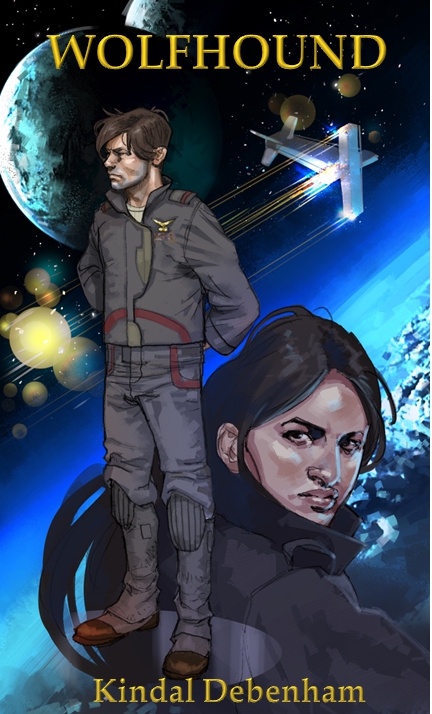
For today’s Trope Tuesday post, I thought it would be fun to bring on my friend Kindal Debenham to speak about one of the tropes in his new book, Wolfhound.

Kindal and I were in the same writing group in college, and attended Brandon Sanderson’s English 318 class together.  I just picked up a copy of his book, and it’s pretty good–definitely the kind of science fiction that I love.  You can currently find Wolfhound on Amazon, as well as Kindal’s self-publishing site.

So anyhow, here’s Kindal’s discussion of space pirates in Wolfhound.

==============================

Space pirates are kind of a staple in science fiction. We’ve seen them in all sorts of different forms since the genre came into being. As the trope states, though, there are basically two main classes. The first class is basically a bunch of violent criminals on a spaceship, kind of mirroring the behavior of modern day pirates in Somalia or Southeast Asia. The second are a corny recycled in space variant of the eighteenth century Caribbean pirate with robotic peg legs and a space parrot. Obviously one is a bit more realistic than the other. 🙂

The version I went for leans a lot more heavily on the first class of space pirates rather than the second. I wanted a smaller scale conflict in order to introduce my main character, and pirates seemed to be a good opponent to use for that purpose. Since the ship that Jacob Hull is on was partially based on the USS Constitution, I decided that I could use some of the pirates that ship fought during its history: the Barbary pirates.

These pirates weren’t your clichéd corsairs with parrots and a desire for plunder. The Barbary pirates were a collection of raiders that operated out of northern Africa. Their motivation was to support their nations by taking ships and capturing crews, which they then added to their fleet and put to work as slaves. In addition to raiding ships, the Barbary pirates also went on slave raids throughout southern Europe. They would accept tribute to ignore the ships of certain countries (think ‘protection money’ for a mob equivalent). The US had to pay about a fifth of the early national budget in tribute to these pirates until the politicians decided that guns were cheaper to buy—which led directly to the creation of the USS Constitution.

Building off of those ideas, I created the Telosian pirates. Vicious, more interested in valuable ransom for prisoners and well armed ships than simple cargo, and willing to do just about anything to satisfy their greed. With an utter ruthlessness only matched by their subtle plots, they made quite a good enemy for Jacob Hull and the rest of Wolfhound’s crew, and they were a much more interesting enemy to fight than a stereotypical Pirate-with-an-Eyepatch would have been. In my opinion at least, though I’m a little biased.

So those are the bad guys of Wolfhound—at least, they’re the majority of the bad guys—and believe me, they live up to their reputation as nasty pieces of work. Hope you guys enojoyed the background, and I hope I didn’t get too history nerd on you guys. See you around!

Trope Tuesday: Pet the Dog

Awwwww!!

The basic principle behind this trope is that when you want your readers to feel some kind of sympathy toward a character, have them pet a puppy / puppy equivalent.  Often used to show who the good guy is, but can also be used to add depth to a villain.

I first learned about this trope in Brandon Sanderson’s English 318 class, where he taught it as a way to build immediate sympathy when introducing a major character.  A good example from his own work is Mistborn, where Kelsier’s first scene shows him giving the manor lord’s food to the skaa.  From that moment on, there’s never really any doubt that Kelsier is the good guy.

Although often used to introduce a good guy, this trope can also be used quite effectively in the middle of the story, especially in a gray and black world where it seems that everyone’s a bad guy.  A good example of this is Shadow from American Gods, who flips a coin with a hitchhiker to see who pays for dinner.  Even though he’s a thief and an ex-convict, he rigs the coin toss so that he can pay for her.  Through little gestures like this, Gaiman maintains rooting interest in his protagonist, even though everyone else in the novel is basically a jerk.

Another good example from a darker work is Angelo Osic from On My Way to Paradise.  On the very first page, a fugitive shows up at his pharmacy booth, asking him to grow her a new hand.  Even though he knows it’s dangerous, he takes her in and does what he can to help her.  Later on, this same character rips out a man’s testicles and guts him like a fish.  As repulsive as that is, however, I still keep rooting for him because I know that at his heart, he’s a good person.

Of course, when used most effectively, the pet-a-puppy moment has to grow naturally out of a person’s character.  Even though Shadow is an ex-con, he served his time and feels genuinely sorry for what he did.  Angelo Osic is a doctor, so it’s natural for him to try to help others; whenever he commits an act of violence, a part of his humanity dies, which becomes a major driving conflict throughout the book.

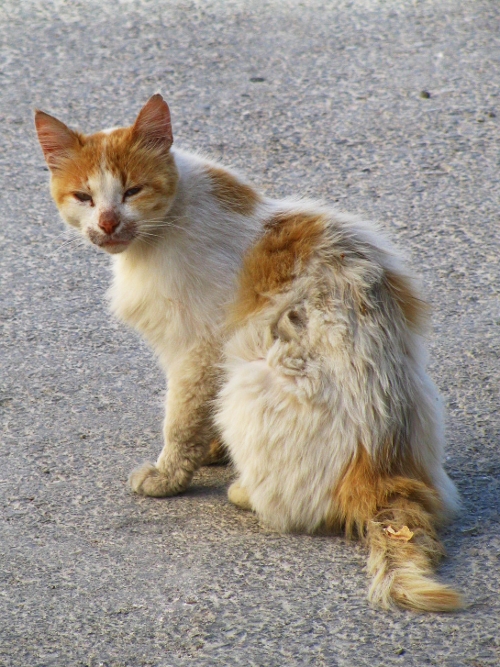
Don't. Touch. Me.

Finally, though this trope is often used to create rooting interest in a protagonist, it can also be used to add depth to a villain.  A prime example for this is Captain Nemo from 20,000 Leagues Under the Sea.  The first moment happens when he rescues the main characters after their ship sinks, but it happens many more times too, such as when Arronax finds him weeping over a picture of his family.  At the end of the book, even though we know that Nemo is the bad guy, we can’t help but feel a little sorry for him after he’s gone.

Puppy image courtesy Wikimedia.  Cat image taken by me.

Plans for Edenfall

I’m trying something a little different with Edenfall: I’m writing the first draft entirely in longhand.

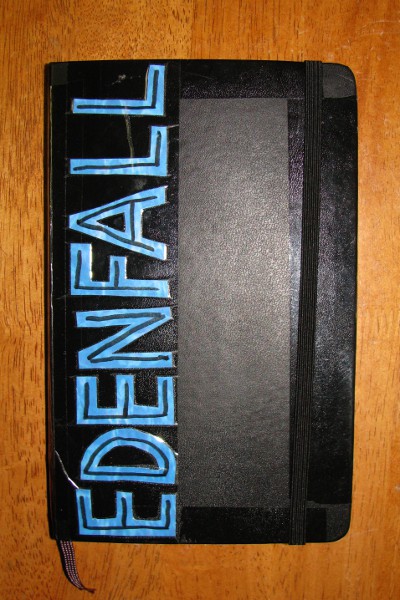
I first got the idea a couple of years ago, when I was camping in Moab.  The beautiful landscape of southern Utah made me realize that I wanted to write Edenfall while experiencing that sort of connection with nature, and pen and paper seemed to be the best format in which to do that.  This year, when I decided that I’d definitely write it, I ordered the notebook on the left and fitted it out for the project.

With every novel I write, I like to challenge myself in some new way.  In Genesis Earth, I tried out a first person POV with an unreliable narrator.  In Bringing Stella Home, I tried to write a believable female viewpoint character.  I also like to experiment with my writing process, trying out different outlining techniques and writing schedules.  Sometimes, these experiments fail spectacularly, but they also teach me a lot and keep me sharp.

The goal with this experiment is to see how divorcing myself from my computer (with all its myriad distractions) and getting out in nature changes my writing.  I live a short bike ride from the Provo River Trail, and weather permitting, that’s where I’ll probably spend most of my writing time in the next few days. Besides, I want to see how much of a difference the format makes.

Books existed long before word processors, so I have no doubt that writing a novel longhand is entirely possible.  How much of an adjustment it will be remains to be seen.  My handwriting is messy, and I can’t write as fast as I can type, but that hardly matters since rough drafts are slow going for me anyways.

In any case, it’s going to be interesting to see how it turns out.  It’s been a little slow so far, but that’s mostly because I haven’t settled into a routine yet.  By the end of this week, I hope to be fully immersed in the world of this story.

In other news, I sent off the manuscript for Sholpan to my editor, and he just got finished with his first pass, so I’m hoping to get the edits back in a couple weeks and have it epublished by mid-September.  More on that as things develop.

Also, an old friend from Brandon’s 318 class posted a favorable review of Bringing Stella Home up on Amazon.  He was one of my first readers back when the story had a lot of problems, so I’m glad he enjoyed the final version.  Thanks Stephen!  And yes, I’ve got a lot more novels forthcoming in the Gaia Nova universe, including a direct sequel to Bringing Stella Home.  Will the McCoy family save the universe from the Hameji?  Well…you’ll see. 🙂

Finally, I plan on participating in the Out of This World blog tour being organized by the SFR Brigade, which means you’ll be seeing some guest posters in the near future.  That’ll probably wrap up the Genesis Earth blog tour too, since it’s been winding down for the last month or so.  If I agreed to write a guest post for your blog and haven’t done so yet, let me know and I’ll do my best to get that out to you.  Sorry to be a bit of a flake these past few weeks; I’ll try to organize my next tour a little better.

And that just about does it for now.  I’ll be sure to keep you posted on how things go with Edenfall.  Until then, take care, and thanks for reading!

More thoughts on indie publishing

Since my last post on indie publishing, I’ve been thinking a lot about this subject.  I haven’t decided to take the plunge into self published ebooks yet, but I have decided to make some changes in my writing and my career strategy, in order to position myself more favorably if/when I choose to do so.

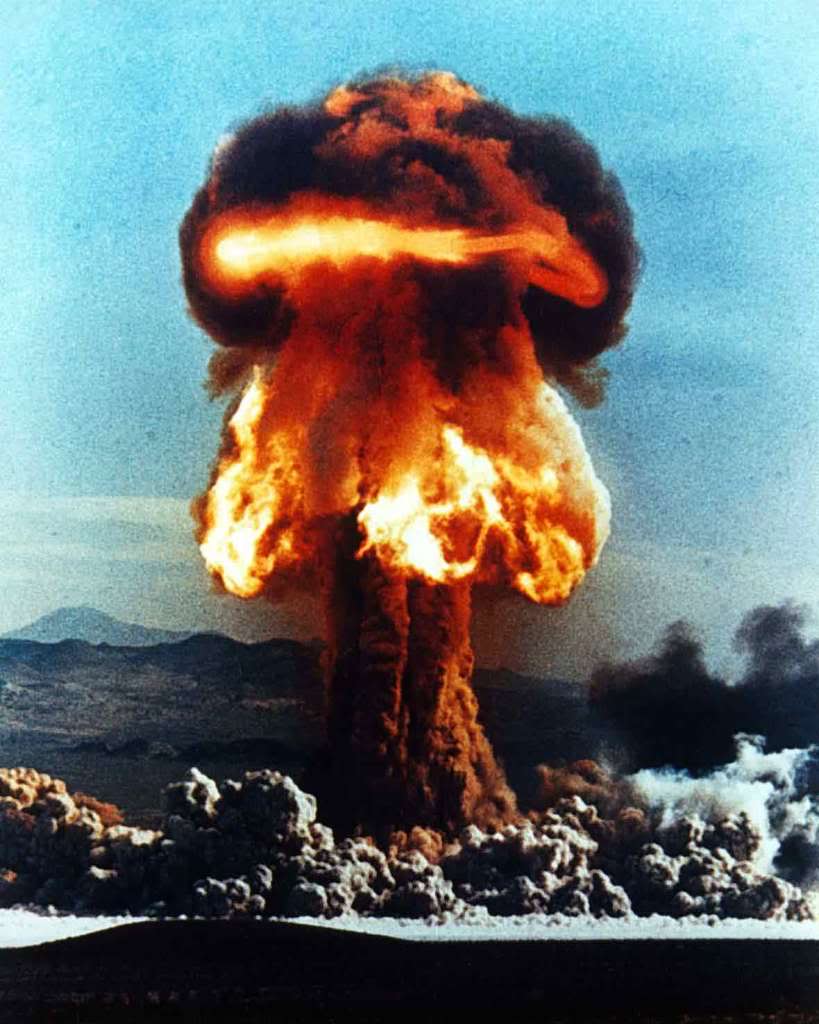
Basically, my new strategy is something like Japan or Saudi Arabia’s approach to nuclear weapons: they don’t have an explicit nuclear program (since that would violate the nuclear non-proliferation treaty), but they have gathered the equipment, resources, and expertise together so that if they decided to go nuclear, they could do it in a year or less.

First, though, I attended Brandon Sanderson’s class lecture this Thursday, in which he had some very interesting things to say about ebooks and the publishing industry.  This was part I of his “how to get published” lecture, and here are some of the more interesting points he made:

  • Almost all the indie writers who are making it big have at least one loss leader ($.99 or less) on their list.
  • No one really knows whether indie publishing will be viable for large numbers of writers, or whether authors like Amanda Hocking and Joe Konrath are outliers.
  • Successful indie published books are typically:
    1) short (70k to 80k words)
    2) written in a pulp genre (thriller, romance, paranormal, sword & sorcery, etc)
    3) promoted very well through social networking
  • We have not yet seen any indie successes in epic fantasy, young adult / middle grade, historical fiction, or non-fiction.
  • The produce model vs. unlimited shelf space argument for going indie doesn’t apply as much to science fiction & fantasy as other genres, because:
    1) sf&f stays on the shelves in bookstores longer than other genres
    2) sf&f series grow better with a big push on the first book
    3) sf&f makes a lot of money on hardcover, unlike other genres

A lot of these points tend to mesh with what I’m hearing from my other sources–and Brandon really represents the last of the successful writers to make it big on the old model, before the ebook revolution began to take off.  He doesn’t make as big a deal on the current 25/75 split on net ebook sales as I would make, but then again, he’s making most of his money through print.

So anyways, here is what I plan to change about what I’m doing in order to better position myself to best take the ebook plunge, if/when I decide to do so:

1) Write at least 2 polished novels per year

Kris Rusch and Dean Wesley Smith make very good arguments about how being able to write well quickly is a huge asset for a writer these days.

There are many good reasons for this:

1) Writing faster gives you more practice with craft, which tends to improve quality.
2) The best way to promote  your books is to constantly write new books.
3) The limited shelf space argument against writing quickly is now moot with ebooks.

In particular, I want to increase my writing speed in order that I can have a larger list to put out if/when I decide to go with indie publishing.  It’s much harder to be successful if you’ve only got one book available for sale; if/when I decide to take the plunge, I want to have at least three.

So far this year, I’ve finished one (Bringing Stella Home), but that’s because it was already sitting in the queue and only needed a quick touch up.  I would like to get Worlds Away from Home polished before the end of the year, and possibly one other project, such as Edenfall.

2) Reduce production time to as close to one year as possible

Right now, it takes me on average about two years to write a polished, salable novel.  That’s not a problem, because I have a lot of projects in the queue, but it’s not as fast as I would like.  I wrote Genesis Earth and Bringing Stella Home while I was still a journeyman writer, figuring out my craft.  I should be able to produce a lot faster.

Towards that end, I’m going to try to get Edenfall finished and polished within a year.  Since it’s already March, that might mean getting it polished by February of next year, but I still want to try.

My biggest weakness is first drafts; I always tend to get stuck midway and drop the project for a while before I feel ready to finish it.  That’s something I would like to change.  Then again, that might just be part of my writing process, and shouldn’t be forced.  However, I certainly could go through my revisions much faster.

3) Write out the direct sequels while the first book is still unpublished

Previously, I thought it was a bad idea to write out all the books in a series or trilogy before the first one is ever picked up.  After all, a rejection from a publisher on the first book is a rejection on all the other books in the series as well.  Using this reasoning, it was much better to write the first book of another trilogy, in order to maximize how much I could submit at any given time.

With indie publishing, however, it’s much better to release the whole trilogy all at once, so that readers who finish the first book can immediately pick up the others.  Again, the paradigm here is that the best way to sell books is with other books; if they loved the one, they’ll buy the others, especially to find out what happens next.

Of course, the best model is probably to have an open series with several indirect sequels with recurring characters in the same world.  With the Gaia Nova books, that’s exactly what I plan to do: Worlds Away from Home is set in the same universe as Bringing Stella Home, but with different characters and different story arcs.

However, Genesis Earth has serious trilogy potential, and with Edenfall I’ve decided to actually write the other books.  If/when I decide to take the plunge, I want to be able to release at least the first two books in that trilogy at the same time.  In fact, Genesis Earth is perhaps the biggest reason why I’m thinking so seriously about going indie, but that’s a subject for a whole other post.

4) Experiment with pulp genres such as space adventure stories

When Brandon said that the pulp genres tend to do better, I wasn’t sure whether that includes what I write.  I write primarily science fiction, but not the kind of stories you’d read only for entertainment and promptly forget once you’re finished.  If anything, I want to write more like Ursula K. Le Guin, whose stories are so meaningful they stick with you long after you’ve finished them.

Then again, there tends to be a lot of overlap in science fiction between the thoughtful, meaningful stuff and the pulps.  Ender’s Game and Starship Troopers immediately come to mind as awesome, entertaining stories that also have a lot of depth.  In his lecture, Brandon made it clear that “pulp” does not necessarily conflict with high art–just that the primary purpose of the story is to entertain.

I can live with that–and I actually have several story ideas that would translate well with the pulp mentality.  I’d like to do a novel (or a series of novels) with Danica from BSH and her mercenary team, perhaps as a sort of origin story for Roman, Anya, Artyom, and the others.  I’d like to revisit the Hameji as well, with a sort of “Ain Jalut in space” involving Sholpan’s son (BSH was basically the Mongol conquest of Baghdad in space).  I’ve already started an “Odyssey in space,” as told from a female Telemachus character–that’s To Search the Starry Sea.  All of these are, at their core, space adventure stories, and might translate well as pulps.

5) Commit to releasing one book every 6 months if/when I take the plunge

This is related to the first strategy on the list, but it’s more of a business plan than a personal writing goal.  Basically, if/when I take the plunge, I want to:

1) have at least 3 finished, polished books to put out at first,
2) know that I can put out one book every six months at least.

This not only means developing a backlist, it means doing some soul searching as a writer to find out how difficult it is to keep up with this pace–and adjusting my writing habits accordingly.  I’m optimistic that I can, but it’s something of a paradigm shift, and I want to make sure I’ve made that shift before I take the leap.

Anyhow, these are my thoughts on how to alter my current writing strategy.  I haven’t yet decided to go indie, but when the time comes, I think that these things will help me to maximize my potential if/when I decide to do so.

Of course, what do any of us really know?

Some thoughts on the future

I went to the first class of English 318 yesterday, and the lecture got me to thinking about my mid- to long-term future as a writer.

Brandon spent most of the period organizing the class, which was made doubly difficult by the ridiculously small classroom size.  I swear, bureaucracies exist only to make life difficult.  This year, for the sole sake of screwing with everyone, they are trying to limit his class size to thirty people (twenty students, ten auditors), but that’s a whole other rant in and of itself.

Oh well–at least there’s still room on the floor.

Anyhow, after getting all the administrative stuff done, Brandon talked about the practicalities of being a writer.  He made the very interesting point that as a writer, it doesn’t matter where you live–moving further away from the city won’t negatively affect your earnings, unlike most jobs.  That means you can save a lot of money on a house if you’re willing to live 50 to 100 miles away from a major population center.

That got me to thinking: maybe, once my writing career starts taking off, I’ll move down to southern Utah for a while.  The country is absolutely gorgeous down there, and the people don’t seem hard to live with.  Small house with lots of space, maybe a garden, lots of outdoor stuff all over, plenty of privacy–sounds great!

So here’s a tentative map of the next few years:

present–fall 2011: Get a job, build some credit, get TEFL certified.  Keep writing, attend some cons (LTUE, Worldcon), develop new projects.

fall 2011–2012: Teach English abroad for a while (Korea, Japan, etc), build up some savings, have some adventures.  Keep writing and submitting.

2013–2014: Get a teaching job in the Middle East (gulf region), have some adventures down there, continue to build savings and gain experience.  Hopefully I’ll have broken in to publishing at this point; if not, keep on trying.

2015–2020: Come back to Utah (maybe Salt Lake), live off of savings for a while and really focus on building the writing career.  Attend cons and workshops, network, write like crazy (the adventures will probably give me lots of material), work on promotion if I’ve already got a publishing deal, etc.

2020–????: Hopefully, somewhere along the line I’ll meet my wife and get married.  Also by this time, my writing career will hopefully be earning me a living–enough, at least, to support a family.  With all these things in place, we’ll select a home out in southern Utah, settle down, and start having kids.

That’s one plan, at least.  When 2020 rolls around, I’ll probably laugh at my naive and short-sighted view of the future–but at least it’s something to work with.

Brandon did make the point that it’s not as hard to make a living as a science fiction & fantasy writer as most people say–which isn’t to say it’s easy, but it is possible.

According to Brandon, about 1,000 to 2,000 writers in sf&f are currently making a full-time living.  Most of them are mid listers–authors you probably haven’t heard of, but see their books occasionally in the stores.  If your books sell about 5,000 copies in hardcover over the first three years in print, your publisher won’t cut you–and with the way ebooks are changing things, new business models will certainly evolve, presenting a whole new host of challenges and opportunities.

Bottom line, this is something achievable, so long as I keep producing consistently and work hard to improve my craft.  I’m very optimistic about the long-term.

Now, all I need is to find a job…ugggggggh.

(image courtesy Postsecret)