Stormrider by David Gemmell

I thoroughly enjoyed the Rigante series. It has everything that I’ve come to love about David Gemmell’s books: scarred but good-hearted people struggling to do the right thing in the face of great hardship and evil, some of which lies within. Every chapter is compelling and filled with conflict, and while you know that most of the characters are going to die, none of them is beyond redemption.

There were a lot of things in particular that I liked about this book. One of them was the early-modern feel and aesthetic to the world-building. A lot of fantasy worlds are locked in a perpetual state of medieval technology, with very little growth or development. In Stormrider, however, Gemmell advances the world of the Rigante a couple of steps up the tech tree, to a tech-level more on par with the 30 years war.

It’s not just window dressing, either, because the introduction of things like gunpowder has a direct effect on things like battle tactics and duels for honor, which directly affect the story. And yet, there’s still the same undercurrent of magic that made the other books in the series so great. The Sidh may have left the world, but their influence remains, and their magic has not yet faded completely.

My one big issue with the book had to do with the climactic battle leading up to the ending. It wasn’t exactly a deus ex machina, but in some ways it felt very much like it came out of left field and wrapped things up in a way that was just a bit too neat and tidy. That said, it wasn’t nearly as unsatisfying on a character-based level—on the contrary, it brought several of the character arcs full circle in a way that I thoroughly enjoyed. It just wasn’t as good as some of Gemmell’s other endings.

For that reason, I’m only giving this book four stars. However, a 4-star Gemmell book is like a 5-star book from anyone else. Stormrider may fall just short of the standard that Gemmell sets with his other books, but it still clears the bar for truly a truly great fantasy novel.

Now I have the perfect ending

Guys, I just plotted out the last two books in the Genesis Earth trilogy, and it is going to have the most fantastic ending ever. I can’t tell you anything about it, since that would spoil everything, but it’s going to be amazing.

Perhaps it wasn’t such a bad idea to wait ten years to write the next book after all. I’m still loosely following the original outline I made for Edenfall, but there are some key changes to it, and all the other background stuff I’m sure I would have done differently. Sometimes, it really does help to put some distance between you and the story, and to let it simmer for a long, long time.

In any case, I know what I need to do now to turn Genesis Earth into a proper trilogy. Also, I’ll probably go through the first book at some point to remove all the swearing. It’s far too jarring and doesn’t really add anything to the story. At the time I wrote it, I was itching to write a grittier book, but that’s not Genesis Earth.

Edenfall is going to be good, but The Stars of Redemption is going to be amazing! The secondary plot with the third timeline is going to blow your mind. I can hardly wait to write it!

Only two more chapters!

I’m only two chapters away from finishing the first draft of Gunslinger to the Stars! This book was supposed to be finished a month ago, but life got busy and my chronic disorganization got in the way.

Of course, these last few chapters are taking WAY longer to write than I thought they would, just like all of my books. It’s like Zeno’s paradox for writers: no matter how close you are to finishing the damn thing, you’re still only halfway to the end.

The ending for this book is going to be awesome, though. Truly awesome. How do I know? Because I started this book with Chekhov’s armory, and the only gun that hasn’t been fired is called Charity. Why? Because Charity is the greatest of all, Charity never faileth (even when all things fail), and whosever shall be found possessed of it at the last day, it shall be well with him.

So yeah, I’m really excited for Gunslinger. It’s probably the funnest, most entertaining book I’ve written to date. I tell people it’s like Monster Hunter International meets Guardians of the Galaxy. I actually told Larry Correia that at LTUE back in February, and he got a kick out of it.

In other news, I’ve decided to publish a bunch of short stories in the next couple of months. These stories have been out on submission for a while, but it’s time to put them out there for you guys to read.

I’ve decided that any short story market that takes longer than 60 days to respond with a form rejection is not worth my time. If the magazines were the only way to get these stories out, then sure, I’d grin and bear it, but in an age of indie publishing it just doesn’t make sense. Why should I wait three, four, or five months for each market to make a decision? Multiply that by ten or fifteen markets, and my stories can be tied up for years. I don’t need that, and my readers don’t need that either.

Stand-alone short stories have always been hit or miss for me. A few, like Starchild and Worlds Without Number, sell at a small but consistent rate. Others, like Decision LZ1527, haven’t performed as consistently. I’m never quite sure whether to publish a short story as a stand-alone, so I’m going to just throw them all up there and see how well they perform after three or four months. Let the market decide.

As for the ones that don’t perform well, I’ll take down the stand-alones and republish them in bundles and short story collections instead. No sense keeping an individual title up if it isn’t selling. I’ve already taken down a couple of the old ones, which will definitely go up later in some of these bundles. Trouble is, I just haven’t had stories availabe to bundle them with.

So you can expect to see that in the next few months, as well as (hopefully) Gunslinger to the Stars. The first draft is pretty rough, but I don’t think the revision process is going to take that long. Mostly I just need to run it past my gun nut friends to make sure I got all the details right, and find an awesome artist to design the cover.

I’ll leave you with Shostakovich’s Second Waltz, because it’s a fantastic waltz that’s been stuck in my head for several days now. Enjoy!

Operation SB #4: The Curse of the Lifewalker

Title: The Curse of the Lifewalker
Genre: Post-Apocalyptic
Word Count: 4,340
Time: 1 day (sort of)

So after “L’enfer, c’est la solitude,” I was kind of in a short story mood for a couple of days and decided to bang out another one. This one is actually an adaptation from my novel Lifewalker, a post-apocalyptic tale where a global pandemic kills everyone older than 25. The story takes place several hundred years after the apocalypse, where a society of children and teenage adults has evolved to fill the void left over by the collapse. It’s told from the point of view of a “lifewalker,” someone who is naturally immune and lives out a normal lifespan. Normal to us, at least–not to anyone else in the new society.

It actually wasn’t that hard to adapt the first chapter to a short story. It very much has its own narrative structure, with a beginning, middle and end. Obviously, it finishes on a rather open-ended note, but I think I was able to turn it around and focus on the premise: “when all the world is afflicted by the plague, sometimes the greater curse is to be whole.” Touched up the first couple of pages quite a bit, setting the stage for a short story and not a full novel, then went over the rest of it with a light pass and wrote a summation paragraph at the end to wrap things up.

Obviously, it took me more than one day to write the bulk of the chapter–in fact, I think it’s been through a couple of drafts now. But the adaptation to short story form went fairly well, and I’m quite pleased with the result.

Since I’ve already got stories at the top three markets (Writers of the Future, Asimov’s, Analog) and Clarkesworld is on cool-down, I sent the story to the next magazine on the list, Fantasy & Science Fiction. They only take snail mail, though, so I had to print out the story, print out a cover letter, take it to the post office, buy a letter envelope, stamp, manila envelope, fill out the SASE, etc etc. It was like a blast from the 00s or something.

Anyway, as I was walking over to the post office, I had this AWESOME epiphany in which the end of the novel came to me. It’s SO MUCH BETTER than what I’d originally had in mind, and actually got me excited to work on Lifewalker again. I probably won’t pick it up until I’ve finished the first three Sons of the Starfarers books, but now I have an awesome, amazing ending to work toward.

All I have to do is write it. 😛

Trope Tuesday: Fridge Logic, Fridge Horror, and Fridge Brilliance

It's amazing how many existential story questions arise from this view.
It’s amazing how many stories suddenly stop making sense from this point of view.

You know that moment after the end of the show, when the credits are rolling and the glory of that crowning moment of awesome is just beginning to fade?  When you go to the fridge to get something to eat, and all of a sudden that gaping plot hole or internal consistency problem with the story hits you?  Yeah, that’s fridge logic.

The key, though, is that it’s not something you normally question while you’re reading the book or watching the show.  While you’re in the story itself, the narrative is so compelling that you just don’t question it–that, or rule of cool is in play.  It’s only after the story is over that those questions start to arise.

It doesn’t have to come from bad writing.  Sometimes, it’s a result of values dissonance, especially for stories written in a different time or culture (although by no means is this phenomenon immune to bad writing).  Sometimes, it’s a result of a tomato surprise, where a reveal of something the characters have known all along completely changes the audience’s understanding of the story (though certainly, this isn’t immune to bad writing either).

Not all fridge logic is bad.  Fridge horror happens when a story becomes even more terrifying the more you think about it.  Some of the scariest horror stories have done this to me, as well as some that weren’t really intended to finish on downer endings but kinda sorta did.  Cracked.com did an interesting article on six movies that went that way.

But the best is when a story turns around and gives you fridge brilliance–that moment when you realize that that thing that bothered you actually changes the nature of the story in a way that suddenly makes it your favorite.

My favorite novel of all time, The Neverending Story, totally did this to me.  When I first read it in fourth grade, there were so many things that made the story awesome: the Temple of a Thousand Doors, the test of the three gates, the old man who is the exact opposite of the Childlike Empress in every way, and of course the signature phrase “but that is another story and shall be told another time.” But when I reread it in college, I realized that the real story–the underlying story that brings everything together–isn’t about a loser kid having all sorts of adventures in a fantastic world, but about the power of storytelling itself, and how it can fill the world with love.

Another moment of fridge brilliance came to me when I learned the story behind the writing of Legend, my favorite novel by David Gemmell, my favorite fantasy writer.  The book is about a hopeless battle that everyone knows cannot be won, and the people who decide to go and fight it anyway.  That’s all well and good, except that David Gemmell wrote it immediately after he was diagnosed with terminal cancer.  The story of the battle itself was a metaphor for his own life, and his struggle with his own impending death.  Lucky for all of us, after he finished writing it the doctor came back and told him that the first test was a false positive–that he was going to live after all.  He then went on to write almost thirty more books, all of them off-the-charts awesome.

So yeah, there you have it.  These are more reader tropes than writer tropes, but as a writer it’s good to keep them in mind.  Don’t be lazy, otherwise your fans will pick your stories apart (or if you have to leave a hole, be sure to hang a lampshade on it).  And if you find yourself smacking your forehead over something you’ve already written and published, see if you can’t revisit it in later books in the series and turn it into fridge brilliance.

On the verge of another story

So with Star Wanderers coming to a close, at least as far as the actual writing is concerned, I’ve recently found myself back in that weird writerly place where I don’t have any pressing projects to work on.  Whenever this happens, I find that it’s generally a good idea to start something new.

Until just a couple of days ago, though, I wasn’t sure which project to start.  At first, I thought I should do the sequel to Stars of Blood and Glory, since I’m currently getting that one ready to send off to my editor, but beyond a tentative title (Empress of the Free Stars) and a really awesome opening scene, nothing has really sparked for that one.  With time, I’m sure my ideas will come together, but for now it’s just not ready to come out of the incubator.

So then I went back to The Swordkeeper, going back over the ideas that had sparked that one.  I started the opening scene back in March, but it’s currently lackluster, and none of my attempts at worldbuilding have gotten me anywhere.  For the past six months, I haven’t really touched it.

But when I took the time to just think about the story, something amazing happened.  All my ideas came together, and the ending just came to me–not just for the first book, but for the entire series.  Seriously, I must have spent hours staring out across the Georgian countryside from my farmhouse balcony, totally in awe of the story in my head.

A similar thing happened to me last summer with Stars of Blood and Glory.  It took me a few months to finally get around to writing it, but when I did, the first draft flew out in just a matter of weeks.  I’ve since made a few relatively minor fixes to the beginning and added some scenes that were missing, but otherwise haven’t made any substantial changes, and the comments from my first readers so far confirm that that’s the right decision.

So if all goes well, I’ll finish up with Stars of Blood and Glory by the end of this next week, and restart The Swordkeeper soon after that.  Things are looking good, and I can’t wait to get immersed in this next story.  It’s a fantasy, so that’s going to be a major shift, but I think it will help to keep things fresh.

Anyhow, that’s all for now.  More later.

Trope Tuesday: Deus Ex Machina

God from the machine. Literally.

This one is by request.  A Deus Ex Machina, or “God from the Machine” ending, is basically when the author writes himself into a corner and pulls something out of his butt to resolve the story.

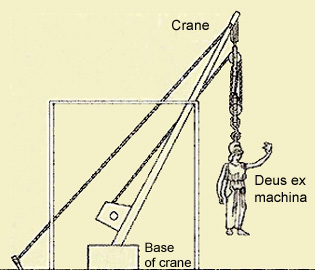
The term comes from ancient Greek theater, which often employed this technique–probably because the audience was known to get violent when the show didn’t end the way they wanted it to.  Basically, a crane–the “machina,” or machine–would lower an actor playing the role of one of the gods–the “deus”–who would then resolve everything and tie up all the loose ends without the heroes having to do anything.

Sound unsatisfying?  Yeah, I think so too.  That’s why it’s often used as a derogatory term, much like Mary Sue.  HOWEVER, it can be done well.  As always, your mileage may vary, but here are some examples that pull it off:

WARNING! SPOILERS!

  • Watership Down:  A girl saves Hazel from her cat.  Satisfying because it makes sense from the girl’s point of view, and humanizes the story by showing that it really does take place in our world.
  • The Hobbit:  The eagles arrive out of nowhere to turn the tide of the Battle of Five Armies just at the critical moment.  Satisfying because it’s a cavalry ending as well, though some fans don’t like it.
  • Lord of the Rings:  Again, the eagles swoop down and save the day, this time by rescuing Frodo and Sam from the fires of Mount Doom.  Satisfying because after coming this far, we really don’t want a downer ending.
  • Harry Potter and the Sorcerer’s Stone:  Harry is saved by his mother’s love.  Satisfying because of the symbolism and the power of love.
  • Lord of the Flies: Just as the boys are about to kill each other, a military ship arrives out of nowhere and rescues them.  Again, satisfying because of the symbolism, as well as the collective “what have I done” moment.
  • Schlock Mercenary:  Many, many occasions.  Satisfying because it’s brilliantly lampshaded.
  • Monty Python and the Holy Grail: “…the animator had a fatal heart attack!  The cartoon peril was no more!”
  • Raiders of the Lost Ark:  The Nazis capture Indiana Jones and get the Ark of the Covenant, but when they open it, a supernatural force kills them all.  Satisfying because it squares with Indy’s general MO and his pattern of spectacular failures.
  • The War of the Worlds:  The humans are utterly powerless to stop the aliens, but they all die off from germs.  Satisfying because of the underlying message.

Does this mean that it’s a good idea to write off any criticism that your own work suffers from a Deus Ex Machina?  Probably not.  This is one of those things that readers tend not to notice when it’s done well.  If your readers notice it, chances are that something is broken.

As you might guess, there’s a lot of gray area as to what constitutes a Deus Ex Machina, and what is actually something else.  Generally, if the ending is properly foreshadowed, either by a Chekov’s Gun or by good character development, it’s not a Deus Ex.  The foreshadowing removes the “out of nowhere” aspect that readers find so unsatisfying.

Foreshadowing is one way to fix a Deus Ex Machina.  Another way is to toss out the ending and rewrite it from scratch, starting at the point where hero starts getting sidelined.  According to Dan Wells’ seven point story structure, the hero should typically spend the first half of the story reacting to the villain, and the second half getting the villain to react to him.

There are lots of other ways to fix a Deus Ex Machina, but those are probably the biggest ones.  If you have any other suggestions, by all means, suggest away.

Trope Tuesday: Hoist By His Own Petard

One of the most satisfying ways to defeat the villain is to have his own nefarious scheme bring about his downfall.  In Hamlet, Shakespeare described this as “hoist by his own petard,” or blown up by his own bomb.  Basically, it’s a self-deposing villain whose evil plans have gone horribly right.

Not only is this a delicious form of death by irony, it’s also a satisfying way to show cosmic justice in action while allowing the heroes to keep their hands clean.  When done best, the villain keeps the tension notched up to eleven and only commits his fatal mistake after the heroes have made their last stand.  Bonus points if the petard takes the form of a minion who decides to switch sides.

Perhaps unsurprisingly, you’ll often find this trope in stories geared towards a younger audience, which generally try to avoid messy endings and shades of gray.  In some ways, it almost resembles a Disney Villain Death, in that the heroes often come out with clean hands and an unambiguously clear conscience.

However, this isn’t always the case–sometimes, it’s precisely because of the shades of gray that the villain’s plans become self-defeating.  Case in point, Pride and Kimblee from Fullmetal Alchemist: Brotherhood.  You’d think that both characters are totally evil–and perhaps they are–but that doesn’t stop the one from undermining the other at just the right moment.

When done right, this is an incredibly satisfying way to defeat a bad guy.  When done poorly, however, it undermines the villain altogether, or turns the story into just another Aesop.  As always, your mileage may vary, so when writing one of these stories it’s important to keep your audience in mind.

In my own books, it’s probably more common for this to happen to the heroes, which probably makes it a form of Two Rights Make A Wrong or Nice Job Breaking It, Hero.  I do enjoy hoisting the villains as well, though, and will almost certainly use this trope in the future.

Trope Tuesday: The Cavalry

Things look bleak: the Big Bad is on the verge of conquering the world, and the heroes have gathered for one last stand.  Just when it looks like all hope is lost, a horn sounds in the distance, and the cavalry arrive to save the day.  Whether a ragtag bunch of minor characters, an army of unlikely heroes, or the ultra-heroic Eagle Squadron, the timely reinforcements use their overwhelming force to crush the villains and save the day.

When done right, this trope can be one of the defining moments of greatness of the entire work.  When done wrong, however, it becomes little more than a Deus Ex Machina of the most unsatisfying kind.  How, then, can this moment be done right?

As with any Deus Ex, one of the keys is to adequately foreshadow the end.  This often takes the form of Gondor Calls For Aid, when the heroes petition the cavalry for assistance before going into battle. To make things interesting, the relationship between the two parties is often complicated and ambiguous, making it doubtable that the cavalry will actually show up.

However, I think it goes deeper than this.  In order for the arrival of the cavalry to be satisfying, it needs to not invalidate everything that the heroes have already gone through.  If the cavalry shows up after the heroes have defeated the Big Bad, and essentially rescue them from a heroic sacrifice, that’s satisfying.  If the heroes are still fighting the Big Bad and the cavalry comes out of nowhere to hand them an unearned victory, that’s cheap.

In English 318R, Brandon Sanderson often used the film versions of the Lord of the Rings Trilogy to illustrate this.  The Battle of Helm’s Deep was satisfying, because the entire premise was to hold out until the third day.  When Eomer arrived with the Rohirrim on the morning of the third day and swept away the Uruk-Hai, that didn’t invalidate King Theoden’s efforts because all he was trying to do was survive.

In the Battle of Minas Tirith, however, Aragorn’s arrival with the unbeatable army of the dead was kind of cheap, because the premise was to defeat the orcs, not to hold out for reinforcements.  Gondor could have just stood down and let the orc army capture the city, and they still would have won in the end.

The two genres where you’re most likely to see this trope are westerns (trope namer) and heroic fantasy. Just about every David Gemmell novel involves a cavalry moment of some kind, and I looove it.  It’s also quite common in military science fiction, too–basically, any story where war is a major part of the narrative.

The variations on this trope are also quite fascinating.  For example:

plot vs. PLOT and an interesting serial publishing idea

Back in English 318 at BYU, Brandon Sanderson used to tell us that there was a big difference between “little-p plot” and “big-p Plot.” The first applies mostly to chapters and scenes, which he said he could teach us.  The second refers to the overall story structure, which he couldn’t teach in a classroom setting and said we’d have to discover on our own.

I’ve been thinking a lot about this recently, because it seems that my books are starting to fall into a recognizable pattern–and that pattern has some interesting potential for serials and other alternate forms of publication.  Each book is divided into 3-4 parts, each part is divided into 3-6 chapters (typically 5), and each chapter is divided into 3-5 scenes.  Here’s how it works:

Chapter 1: Setup for the basic story arc.  Introduction of the characters and setting, the prominent theme or premise, and a little foreshadowing of the coming conflict.
Chapter 2: The inciting incident, a discovery or event that starts the plot rolling and puts the characters in motion and conflict.
Chapter 3: Complications arise, the problem gets worse, the first attempt at a solution fails, generally leaving the characters at a loss.
Chapter 4: Setup for the resolution.  The characters discover or build something that will help them to settle the conflict.  They stop reacting and start to be more assertive.
Chapter 5: The resolution.  The characters either succeed or fail, but the arc comes to a close either way.  The story question is answered, the thematic elements come full circle, and the story either closes or moves on to the next part.

Basically, it’s the 3-act format divided into five chapters.  When I wrote Heart of the Nebula, all four parts fell into this pattern, and now that I’m writing Star Wanderers, I’m finding myself  falling into the exact same pattern again.  Stars of Blood and Glory is a little bit different; there are three parts instead of four, and each part is divided into six chapters instead of five.  But still, it’s all very structured.

In short, Brandon was right.  It took me a few books to really learn “big-p Plot,” but now that I’ve found a story structure that works for me, it’s starting to come quite naturally.

The cool thing about this particular structure is that it’s very conducive to serialization.  Each chapter is between maybe 3,000 to 5,000 words, so each complete sub-arc is between about 15,000 to 25,000.  That’s the length of a short novella, and it takes me only a month or two to write (sometimes three, depending on how much revision it needs).

The only reason I haven’t done more with serialization up to this point is because I’ve found that sharing my work while it’s still unfinished tends to throw a wrench in my creative process.  The idea of publishing a work in progress on a chapter-by-chapter basis scares me, because if one of the story arcs has a flawed beginning, I wouldn’t be able to fix it.

However, by following a five-chapter arc format (with bits and pieces here and there to hint at a larger overarching structure), I can see myself publishing a novel or epic in a serial format.  It would be something like the Perry Rhodan series, which follows an arc structure of 25 to 100 issues (each a small novella) per cycle.

So here’s how I’m thinking of doing it:

  1. Publish the first installment and price it at free while writing the second one.
  2. Publish the second installment and price it at free, raise the price of the first installment to $.99 and write the third one.
  3. Publish the third installment and price it at free, raise the price of the second installment to $.99 and write the fourth one.
  4. Publish the fourth installment for $.99, drop the price of the first installment to free and publish the completed novel for $2.99.

So what do you think?  Does it seem like a good way to publish a book?  It gives the reader a reason to keep coming back, and rewards those who got in early by charging them less for the completed work.  By selling the novel in shorter chunks, I would be able to put more work out and hopefully gain more visibility, especially by making a portion of it free at any given time.

I’m seriously thinking about publishing Star Wanderers this way, once I hear back from Writers of the Future.  I’ve already finished the rough draft for the second part; it probably needs a good revision or two before it’s ready, but since it’s shorter, it shouldn’t take more than a few weeks to get feedback from some first readers and finish the next draft.  And if the third part is already finished by then…

So many awesome possibilities! 🙂 What do you think?