Trope Tuesday: Chaotic Neutral

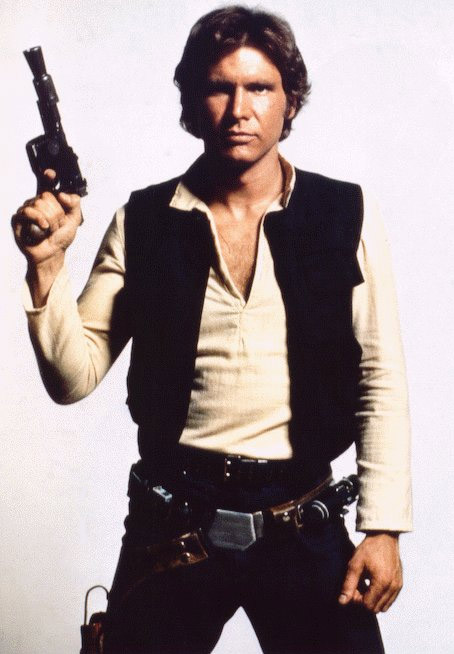
Look, I ain't in this for your revolution, and I'm not in it for you, Princess. I expect to be well paid--I'm in it for the money.

If you’ve ever read a space adventure with smugglers and pirates, or a sword & sorcery with rogue thieves and master-less swordsmen, or a western with gritty outlaws and mountain men, you know this character alignment.  If you’re a fan of any of these genres, chances are you love him, too.

The Chaotic Neutral‘s one consistent rule is to always look out for #1.  Beyond that, he’s a free spirit who believes in individuality and resists anyone or anything that tries to control him.  Rebellious spirits and lovable rogues tend to fall into this alignment, but so do tricksters and wild cards.  Their resistance to any form of personal restriction makes them unreliable allies, despite what Jack Sparrow says.

From the easydamus alignment page:

A chaotic neutral character follows his whims. He is an individualist first and last. He values his own liberty but doesn’t strive to protect others’ freedom. He avoids authority, resents restrictions, and challenges traditions.

A lot of characters start out as this but tend to shift as the story progresses.  Han Solo, for example, shifts from Chaotic Neutral to Chaotic Good as he becomes more and more involved with the Rebellion.  The Jägers from Girl Genius are Chaotic Neutral until they have a Heterodyne to lead them.  But in other stories, such as Pirates of the Caribbean and Schlock Mercenary, the Chaotic Neutral serves as an anchor.

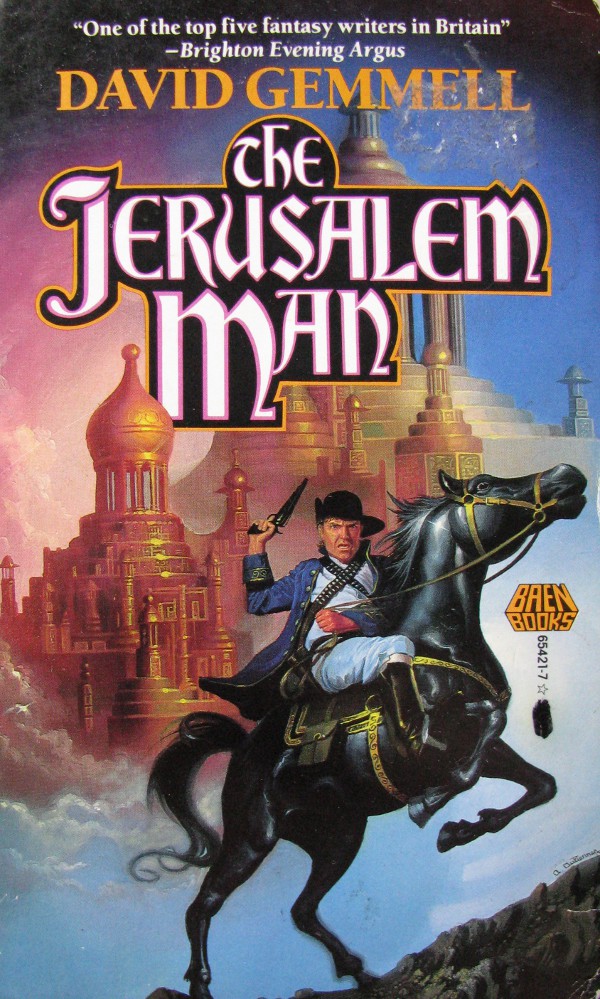
My favorite Chaotic Neutral is probably Waylander from David Gemmell’s Drenai series.  The Jerusalem Man is another good one–in fact, just about every one of his books has a Chaotic Neutral that I love.  Haruhi Suzumiya is an excellent example of a female Chaotic Neutral–in fact, she’s probably the queen of this particular character alignment.

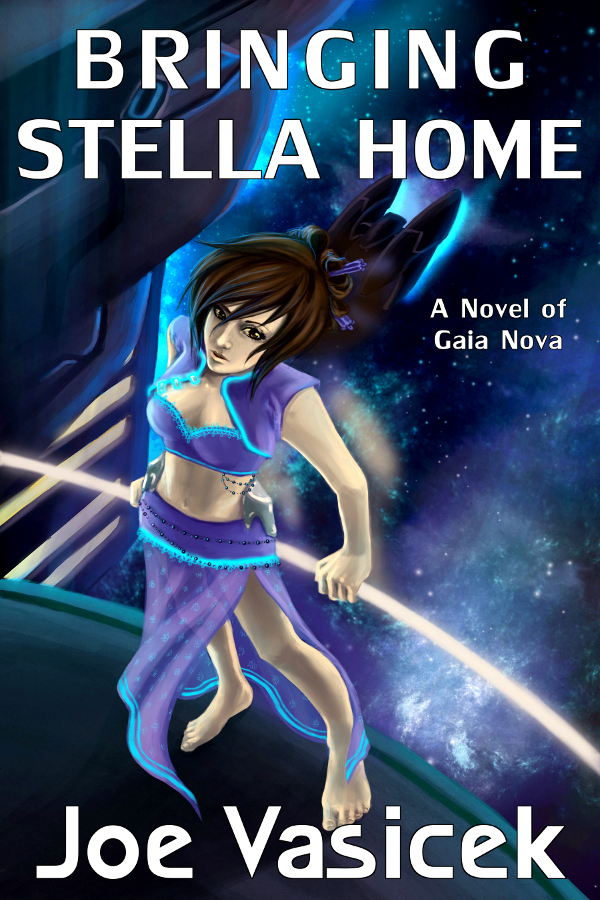
In my own work, the best example of a Chaotic Neutral would probably be Tamu from Bringing Stella Home / Sholpan.  Even though she’s technically a slave, she doesn’t really mind it because she has everything she wants and doesn’t have to be beholden to anybody (not even Qasar, really, since she’s his favorite).  Amina from Desert Stars is also Chaotic Neutral, in contrast with Surayya, who is more of a Lawful Neutral, though sometimes it’s hard to tell.  And in Genesis Earth, Terra is definitely a Chaotic Neutral at the beginning, though she shifts a little somewhere around the middle.

I’m hesitant to admit this, but when I took the character alignment test for myself, I tested out as a Chaotic Neutral.  As to what that means, exactly…I’m not going to say. o.0

Trope Tuesday: Big Damn Heroes

You know the drill.  The clock is ticking down to zero, the evil hordes are swarming through the gates, the virgins are about to be sacrificed and the damsel in distress is about to be lost forever–and then the  heroes show up in all their glory to save the day.

This happens all the freaking time, which means that if you want to make a living telling stories, this is not a trope that you should ignore.  And with good reason.  Not only does it give the writer ample opportunity to play with suspense and action, but it arguably lies at the very core of what makes a hero a hero:

David Gemmell, according to this interview with Ian Graham, defined a hero simply as “someone who does heroic things.” They might not always take the right side, or they might not even care about doing what is right, but when the universe conspires to bring them to a moment of decision, they make the choice that all of us would like to think that we would take and do something extraordinary.

I like this definition of a hero.  It strikes me as a lot more honest than the perpetual do-gooder whose only motivation is Truth, Justice and the American Way (though those characters can–and do–have Big Damn Hero moments of their own).  Also, it means that true heroism is not contingent upon actually winning.  History may be written by the victors, but that doesn’t cheapen the experience of those who actually lived it.

Of course, if the heroes don’t save the day, it’s pretty hard to pull off a crowning moment of awesome without bringing in the Bolivian Army.  Either the heroes find out that they’re too late, or they make things worse, or (as is so common with Othar Tryggvasson of Girl Genius) they just prove that their ego is too big for its own good.  When taken to the extreme, the heroes may even be in danger of turning to the dark side.

The biggest danger with this trope is turning it into a Deus Ex Machina.  The thing that makes Big Damn Heroes so incredibly satisfying is the sense of climax when they show up to save the day.  Thus, proper foreshadowing is key.  Yes, the rule of cool still applies, but if that’s all you rely on, you’re not going to be able to pull it off to maximum effect.

One of my favorite examples of this trope is Liam Neeson in Taken.  Plenty of action movies are more violent, but few are more satisfying.  It’s the perfect pick-me-up after a long crappy day at the office–not that I work in an office anymore.  I wonder why…

In any case, this is a great trope to look out for, and definitely one to master, especially if you’re writing any sort of action-adventure story.

Trope Tuesday: New Year Has Come

Just like a story, every year has a beginning and an end.  For this reason, New Years has become a time to celebrate change, renewal, and the setting of impossible goals which we will all probably break by March.  Over time, this tradition has become so ingrained in our culture that it’s only natural for it to pop up in our fiction.

Most stories that feature a New Year subplot are episodic, such as cartoons, comics, anime/manga, and television shows.  They usually reflect real-world holiday traditions, such as the practice of setting New Year’s resolutions.  Because all stories need conflict (but also because fiction sometimes reflects reality), the characters in these stories are often just setting themselves up for failure in some hilarious way.

At first glance, this might seem depressing.  After all, if most of us will never reach our goals, why do we even bother setting them?  Why torture ourselves with guilt when, in all likelihood, we’re just setting ourselves up for failure?

In some ways, I think it comes down to this quote from David Gemmell:

May all your dreams come true save one; for what is life without a dream?

One of the things that makes us human is that we all need to have some impossible dream to strive for, some sense of hope for the future.  Through our New Year’s resolutions, we tap into that sense that anything is possible, and that we can change who we are and become better people.

For some of us, those resolutions are an effective tool to turn their lives around.  For those of us who lack that kind of will or self-discipline, the act of setting resolutions still helps us reflect on our lives and change in ways that perhaps we don’t immediately perceive.  After all, the truest measure of success isn’t whether you’ve accomplished all your goals, but how much you’ve changed through striving to meet them.

That’s my take on it, anyway.  In any case, a New Year’s story is a great way to give your characters some time for reflection, since it’s probably the most introspective holiday in our Western culture.  It’s a time for beginnings, endings, and chasing impossible dreams.

Happy New Year!

The Jerusalem Man by David Gemmell

The old world is dead, destroyed by nuclear fire.  The old ways are long forgotten–except by one man in search of the Holy City.  He wanders the Earth with two guns and a Bible, leaving a trail of death and ancient prophecy in his wake.  Brigands fear him, honest men pity him, and the Hellborn hunt him.  He is John Shannow–the Jerusalem man.

This is some vintage David Gemmell.  In fact, I think this particular edition has been reprinted as Wolf in Shadow, and can no longer be found except in used bookstores and book trading sites.  Regardless, the book is awesome, right on par with Gemmell’s other work.

David Gemmell has the uncanny ability to suck you in almost as soon as you open the book, making you emotionally invested in the characters and conflicts to the point where you can’t stop thinking about it.  My favorite part of this book was in the first few chapters, when John Shannow found a frontier woman and briefly settled down.  It only lasted a handful of pages, but it was so powerful and moving that I felt compelled to read almost nonstop until I’d finished the book.

The later half gets a little outlandish, with magic stones, the lost city of Atlantis, and a Satanic cult bent on world domination.  It was a fun adventure, but not as compelling for me as the personal story of John Shannow.  In fact, it seems as if Gemmell unconsciously fell back on all the old tropes of the Drenai series, turning his post-apocalyptic western into a sword and sorcery romp, like Waylander with guns.  It wasn’t bad, but at times it did feel a little over the top.

This might have to do with my own personal tastes, however.  I tend to enjoy stories that have more to do with the personal lives and intimate struggles of the characters than grand quests to save the world.  I don’t know if it’s always been like that, or if it’s just something that’s changed as I’ve gotten older.

Regardless, The Jerusalem Man was a great book, and I thoroughly enjoyed it.  If you’re a fan of fantasy-western mashups, or post-apocalyptic fantasy in general, then this is a must-read.  And even if that’s not your usual fare, if you’re drawn to loner heroes who don’t pull any punches, you’ll almost certainly love this book.

The interior designer’s approach to story

I recently read a fascinating post on John Brown’s blog with an interesting exercise for analyzing the kinds of stories you most like to read.  By finding out what really turns you on in a story, you can have a much better idea what to write, and how to make your own stories better.

He prefaced the exercise with a story about the interior designer who helped them to decorate their house.  The designer spread out a number of home magazines in front of them, and told them to go through and tear out the pictures that most turned them on.  After doing this, they analyzed the pictures to see what they had in common, and thus discovered how to best decorate their house.

The exercise works much the same way.  First, pick out five books you really like that immediately come to mind.  Mine are:

As many of you know, these are some of my favorite books of all time.  I’ve reread three of them, and I intend to reread the other two at some point.

Next, pick out the elements that these books have in common.  Here’s what I came up with:

1) Set in a different time and place.

Not all these books are science fiction, but the all take place in a world far removed from our own.  Only Spin takes place largely on Earth, but the events of the story transform the world as we know it so much that by the end of the novel, it’s completely different. SPOILER (highlight to see) Besides, at the very end, the two main characters leave Earth by going through the giant portal to another planet, so the novel is arguably about escaping the world as we know it.

2) Stakes that are much more personal than global.

This was interesting, and highlights something I realized when I compared Merchanter’s Luck with Downbelow Station.  In all of these stories, the central driving conflicts are extremely intimate and personal.

To be sure, many of these stories also have an epic backdrop; Mistborn certainly does.  However, I was much more interested in Vin’s growth and development than I was in how the Ska would overthrow the Lord Ruler–in fact, Mistborn is my favorite book in the trilogy for that very reason.

3) Encourages deep introspection.

This shouldn’t come as too much of a surprise if you’ve followed this blog for a while, but I love love LOVE stories that make me see the world in a new way.  Thrillers and adventures are all fun and good, but if it doesn’t make me think, I’m usually like “meh” at the end.

4) Female characters who aren’t weak or passive.

This one might be a bit more controversial, but in all of these stories, I’ve noticed that the female characters are pretty strong, even if they aren’t all kick-butt Katniss wannabes (ugh…I hate Katniss).  Even in Legend, which is largely dominated by men, you still have the earl’s daughter, who is one heck of a spirited woman.

5) Life and death conflicts.

This is interesting: in all of these books, the threat of death is immanently real.  Some of them, such as Legend and On My Way to Paradise, are among the most violent books I’ve ever read.  I’m not sure what it is, but there’s something about life and death struggles that really draws me.

6) Romantic in a broad sense.

I’m using Tracy Hickman’s definition here, in which romance is all about teaching us to feel and bringing us in touch with our deepest feelings.  That’s the central theme of On My Way to Paradise: learning how to be a man of passion after witnessing some of the worst atrocities of war.

All of these books not only make me feel, they are about the feelings that they inspire.  In other words, the emotional elements of the story are both a part of and deeply embedded in the story’s central theme.

The exercises isn’t complete after this, though.  For the last part, take another five books and analyze them to see how they compare.  My second list includes:

So how does the list stack up?  Let’s see…

  1. Definitely true.  NONE of these stories take place in the world as we know it–and that’s awesome.
  2. A Canticle for Leibowitz might seem like an exception, since it follows the broad rise and fall of human civilization after the nuclear apocalypse.  But the things that really drew me to the story were the more personal elements: the novice who makes the illuminated manuscript of the electrical diagram, for example, or the abbot at the very end who SPOILER tries desperately to convince the single mother not to take her baby to the mercy killing station after the bomb fatally irradiates them.  In any case, it’s telling that A Canticle for Leibowitz made this list, whereas none of Arthur. C. Clarke’s books even came to my mind.
  3. Definitely true.  Even Citizen of the Galaxy, which is more adventure fiction than high concept sf, features a fascinating society of interstellar traders that really made me sit back and think about the way we structure our society.  Heinlein has a really awesome way of doing that with everything he writes.
  4. The only possible exception here might again be Heinlein, who had some very extremist views of women (putting it lightly).  However, if I recall, Citizen of the Galaxy has a female character at the end who helps pull out the main character from his indigent circumstances and helps him to come into his own.  Again, they might not all be kick-butt tramp-stamp vampire slayers, but they certainly aren’t weak.
  5. Less true of The Neverending Story and The Dispossessed, but while the central conflicts might not be about life and death, the threat of death (or a total loss of identity) certainly comes into play.
  6. Definitely true.  Few books have taught me to feel more deeply than The Neverending Story.  An absolutely magnificent piece of literature.

So there you have it.  According to this exercise, I should write books set in another time and place, where strong female characters face life and death decisions that personally impact the people in their lives and make the readers think and feel.  Interestingly enough, that is a PERFECT description of Bringing Stella Home, as well as Desert Stars and Into the Nebulous Deep.

Cool stuff.  Makes me want to write.  So on that note, I think I will.
Birthday wish list

So my birthday is coming up a little later this week, and my family has been asking what’s on my wish list.  In order to help them out, as well as anyone who might feel inclined to give me stuff, I thought I’d post it here on my blog.  Some of the stuff might be reaching a bit, but what the heck, might as well throw it out there.

Item One: Signed First Edition Hardcover Copy of Legend by David Gemmell
This is the ultimate gift of all time for me.  It is my life’s goal to obtain a signed copy of Legend, which is made all the more difficult by the fact that David Gemmell passed away in 2006.  He is, by far, my favorite fantasy author, and this book is my favorite of everything he’s written.

I don’t expect to fulfill this life ambition on this particular birthday, but in the unlikely chance that it lies within your power to help me obtain a copy, know that I will be your slave for life in exchange for this priceless gift.  Literally.  With chains and everything (or caramel topping and whipped cream, if that’s your preference).

Item Two: Göttmann Dress Cap

Specifically, the Dallas-2 design pictured here.  I have no idea how or where you’d get it, but that’s what I want–specifically from Göttmann Caps and Hats, in Germany.  I’ve got a similar cap right now and it’s pretty spiffy, but it’s from Ross so the quality is pretty cheap.  I need an authentic writerly cap like this to give me x2 pretentiousness and +5 charisma.

Item Three: Kant Stop The Music T-Shirt

This one’s a little pricey for a T-shirt, but I absolutely love the design.  What better way to combine your love of music with your love of 19th century philosophy?

Item Four: Beginnings, Middles, and Ends by Nancy Kress

Nancy Kress is one of my favorite people to listen to at a con, and I’ve heard a lot of good things about this book.  If you want to get me a book on writing, this would probably be the best one (or, alternately, either of Orson Scott Card’s books: Character and Viewpoint or How To Write Science Fiction & Fantasy).

Item Five: Anything by Hiyao Miyazaki

You simply can’t go wrong with this awesome Japanese director.  I already own Princess Mononoke, Kiki’s Delivery Service, and Castle in the Sky.  Even though it was done by Miyazaki’s son, I wouldn’t mind a copy of Tales of Earthsea either. 

Item Six: Interstella 5555

My favorite anime ever!  Now out on Blu-Ray!

Item Seven: Mirage: the Remixes by Armin Van Buuren

Recently, I’ve really gotten into trance & progressive music, and Armin Van Buuren is one of my favorite artists.  I skip lunch each week just so I can listen to his radio show, A State of Trance.  His latest album, Mirage, is really good, and so I’d like to pick up a copy sometime of the remixes.  Alternately, you could get me the Imagine remixes album, or anything by Cerf, Mitiska, & Jaren.

So that’s pretty much my wish list.  Of course, if for some reason you’re not in a position to get me any of this awesome swag, I’ll take a gift card or a sweater or a homemade whatever <grumble>.  But if you do get me a gift card, please make it an Amazon gift card, so I can buy more books and music.  And if it is within your power to get me a signed hardcover first edition copy of Legend…let’s just say, I’m only partially joking about the slave thing.

NPR’s Top 100 Science Fiction & Fantasy

In case you didn’t know, NPR just put together a list of the Top 100 Science Fiction and Fantasy novels of all time.  The list had a panel of judges who vetted nominations, but the voting was public and turnout–over 60,000–was pretty high.

I usually don’t like top 100 lists, but this one did a pretty good job representing the genre.  I recognized about 2/3rds of the titles, and most of my own personal favorites were included.

There were a few notable exceptions, however.  David Gemmell wasn’t represented at all–a travesty of the highest proportions.  Neither was C.J. Cherryh, which I find very surprising.  Robert Charles Wilson has certainly written some books worthy of the list, and Dave Wolverton’s On My Way to Paradise–which, I would argue, is one of the best science fiction novels ever written–was notably absent.

Also, a few of the titles were further down on the list than I would have put them.  The Dispossessed by Ursula K. Le Guin came in at #78, while I would have put it at least in the top 20.  A Canticle for Leibowitz did better at #35, but was it really an inferior book to The Handmaid’s Tale?  Come on, people.

One thing I don’t think this list represents well (or top 100 lists in general) is the way in which sf&f fandom has split into dozens of communities and tribes, almost like Darwin’s finches on the Galapagos Islands.  Before science fiction went mainstream, it was possible to follow all the various titles and developments.  Now, however, there’s so much out there that it’s impossible to be fully cognizant of everything.

I think fandom has split into some very distinct communities clustered around the popular authors and sub-genres, and there’s not a whole lot of overlap between them.  None of them are large enough to spawn an entirely new genre (with the possible exception of paranormal romance), but lumping them all into science fiction & fantasy can be a bit problematic.

That said, I think this is a pretty good list.  What do you think?

Bringing Stella Home is now up on Amazon!

That’s right–after a whole lot of work, my novel is now up on Amazon for $3.95.  Check it out!
This novel is the first of a much larger series that I have planned.  It’s not a series like Ender’s Game or Song of Ice and Fire, though; all of the novels are supposed to stand alone, though they share the same setting and feature recurring characters.  In that sense, it’s more like Gemmell’s Drenai series.

Even though the series is space opera, I tried to keep the science plausible at least on a high school level.  So while there’s “magic” like FTL and artificial gravity, I’ve tried to bend rather than break the laws of physics.

At its core, the story is more about the characters than the setting or even the plot.  It follows a young boy who is determined, at all costs, to save his brother and sister, even as his world quite literally falls to pieces all around him.  Along the way, he meets up with a mercenary captain who is running from some demons of her own.  The way they help each other overcome their personal challenges is a major driving force throughout the book.

Anyhow, I suppose that’s enough.  I could ramble on forever, but I don’t want to get in the way too much.  Thanks so much, and I hope you enjoy it!

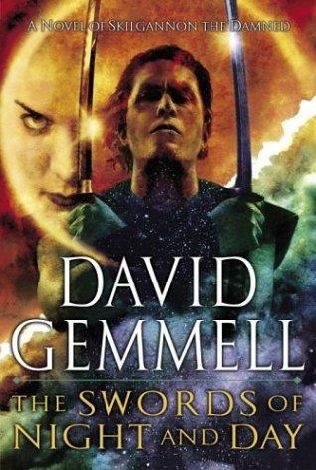
The Swords of Night and Day by David Gemmell

A thousand years ago, a young warrior named Skilgannon helped the princess Jianna escape an attempt on her life.  They became lovers, and when she retook her throne, she made Skilgannon her chief general.  When she ordered the abject annihilation of her enemies, he loved her too much to refuse her–and thus became Skilgannon the Damned.

Now, the wizard Landis has recalled Skilgannon back from Hell to defeat the tyrant queen known as the Eternal.  For hundreds of years, the Eternal has ruled the world, using the arcane arts of a fallen civilization to achieve immortality and crush all who oppose her.

When the Eternal learns of Landis’s treachery, the only hope for freedom lies with Skilgannon, the axeman Harad, the huntress Askari, and the Drenai ranger Alahir.  But how can they defeat an enemy who commands nearly all the armies of the world?  Who has lived a dozen lifetimes and simply steals the bodies of her clones whenever she is killed?

But most of all, how can Skilgannon defeat the Eternal when she is none other than Jianna, his beloved?

The Swords of Night and Day is a direct sequel to White Wolf, the first David Gemmell novel that I read.  I have to admit, I wasn’t particularly impressed with White Wolf; it meandered a lot and didn’t seem to have any clear direction.

That is most certainly not the case with The Swords of Night and Day, however.  I was hooked from the very beginning, and could hardly put it down until the shocking, mind-bending twist at the end.  It tied up all the loose ends from White Wolf and completed Skilgannon’s character arc in a surprising yet satisfying way.

One of the reasons I think I love David Gemmell so much is because he captures so perfectly the experience of being a man.  In that, I suspect that Gemmell is to me what Jane Austen is to most women.

But even though Gemmell’s characters might be crass, vulgar, chauvanistic, and downright detestable at times, there is always something heroic deep inside of them–something worth redeeming.  And when he does redeem them, it surprises me how powerful it is–even when he redeems someone I don’t want him to.

With The Swords of Night and Day in particular, one of the things that particularly fascinated me was the fictional cosmology of the Drenai universe.  With magic that can resurrect people’s spirits from hell, the story must inevitably deal with questions of the afterlife.  Yet even so, there’s still enough ambiguity and latent potential that it never felt stilted or labored.  If anything, it felt a bit like Tolkien’s cosmology in The Silmarillion, where all the stuff about gods, angels, and the undying lands only added to the sense of wonder.

I love just about all of David Gemmell’s books, but this one in particular was well worth the time and experience reading it.  I wouldn’t recommend starting with this one, though: better to read Legend, White Wolf, and The King Beyond The Gate first.  But if you’ve read and enjoyed those ones, you will DEFINITELY love this one.  I certainly did.

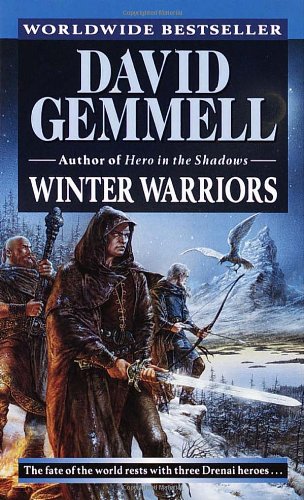
Winter Warriors by David Gemmell

Eons ago, in the Days of Fire, demons feasted upon the souls of men the way that men feast on cattle.  Those days ended when the second most powerful demon betrayed his people, damning them to purgatory so that men could inherit the Earth.

Four thousand years have passed, and the demons are beginning to come back.  The dread Kreyakin, advance guard to the demon invasion, have already passed into the world of men.  In order to open the portal to the other world, however, they must cast a spell requiring the lives of three kings.

Two of the kings have already been sacrificed.  The third lies within the womb of the Princess Axiana.

The fate of the mortal world now lies in the hands of three aged warriors–Nogusta the swordsman, Kebra the bowman, and Bison the brute–and a handful of unlikely fugitives.  Together, they must stand against the dread Kreyakin and all the forces of hell.

Alright, my attempt at a jacket blurb really doesn’t do this book justice.  I want to say it was one of the best Drenai books I’ve ever read, but the truth is it’s just like every other book in the Drenai saga, which is to say that it’s awesome.

I think I’ve figured out why I love David Gemmell’s books so much.  It’s because his books so perfectly capture what it means to be a man.  Women read Twilight because it perfectly captures the experience of being a teenage girl in love, and Gemmell’s books–all of them–capture what it means to be a man.

I’m not just talking about the platonic ideal of manhood–I’m talking about the everyday reality as well. Two men sitting together in “companionable silence.” A warrior who scoffs when his commander sends some lesser men to accomplish a mission, then after getting chided says “I spoke in haste,” and the matter is dropped.  Guys who tackle problem after problem, from fighting duels to fleeing from armies from helping the inexperienced princess with her messy childbirth, and do so without flinching, because hey, someone’s got to do it.

But the ideal is definitely there too, because in every single one of Gemmell’s books, circumstances conspire to push his characters right up to the very limits of their abilities.  When that happens, their true character shines out, and the most unlikely ones rise to great feats of heroism, often sacrificing their lives in the process.

Indeed, if there’s one underlying theme in all of Gemmell’s books, it’s about heroism and what makes a true hero.  It’s awesome.

The best part, though, is how Gemmell redeems even the darkest characters.  I can’t say much about this book without giving away the ending, but let me just say it was extremely satisfying.  Evil is not some slimy b-movie monster–it’s a quality that everyone possesses in varying degrees, alongside the potential for greatness.

In this way, I think Gemmell is the antithesis of George R. R. Martin.  While both authors write in shades of gray, Martin emphasizes how even the noblest, most honorable people have an ugly black stain somewhere in their character, whereas Gemmell focuses on the potential within all of us to rise above the darkness in our souls and accomplish feats of greatness.  His heroes are dark and gritty, but at the end of the day, they are heroes nonetheless.

In short, this book was awesome. If you’ve ever read a book by David Gemmell and loved it, I guarantee you’ll love this one.  I certainly did.