Back in English 318 at BYU, Brandon Sanderson used to tell us that there was a big difference between “little-p plot” and “big-p Plot.” The first applies mostly to chapters and scenes, which he said he could teach us. The second refers to the overall story structure, which he couldn’t teach in a classroom setting and said we’d have to discover on our own.
I’ve been thinking a lot about this recently, because it seems that my books are starting to fall into a recognizable pattern–and that pattern has some interesting potential for serials and other alternate forms of publication. Each book is divided into 3-4 parts, each part is divided into 3-6 chapters (typically 5), and each chapter is divided into 3-5 scenes. Here’s how it works:
Chapter 1: Setup for the basic story arc. Introduction of the characters and setting, the prominent theme or premise, and a little foreshadowing of the coming conflict.
Chapter 2: The inciting incident, a discovery or event that starts the plot rolling and puts the characters in motion and conflict.
Chapter 3: Complications arise, the problem gets worse, the first attempt at a solution fails, generally leaving the characters at a loss.
Chapter 4: Setup for the resolution. The characters discover or build something that will help them to settle the conflict. They stop reacting and start to be more assertive.
Chapter 5: The resolution. The characters either succeed or fail, but the arc comes to a close either way. The story question is answered, the thematic elements come full circle, and the story either closes or moves on to the next part.
Basically, it’s the 3-act format divided into five chapters. When I wrote Heart of the Nebula, all four parts fell into this pattern, and now that I’m writing Star Wanderers, I’m finding myself falling into the exact same pattern again. Stars of Blood and Glory is a little bit different; there are three parts instead of four, and each part is divided into six chapters instead of five. But still, it’s all very structured.
In short, Brandon was right. It took me a few books to really learn “big-p Plot,” but now that I’ve found a story structure that works for me, it’s starting to come quite naturally.
The cool thing about this particular structure is that it’s very conducive to serialization. Each chapter is between maybe 3,000 to 5,000 words, so each complete sub-arc is between about 15,000 to 25,000. That’s the length of a short novella, and it takes me only a month or two to write (sometimes three, depending on how much revision it needs).
The only reason I haven’t done more with serialization up to this point is because I’ve found that sharing my work while it’s still unfinished tends to throw a wrench in my creative process. The idea of publishing a work in progress on a chapter-by-chapter basis scares me, because if one of the story arcs has a flawed beginning, I wouldn’t be able to fix it.
However, by following a five-chapter arc format (with bits and pieces here and there to hint at a larger overarching structure), I can see myself publishing a novel or epic in a serial format. It would be something like the Perry Rhodan series, which follows an arc structure of 25 to 100 issues (each a small novella) per cycle.
So here’s how I’m thinking of doing it:
- Publish the first installment and price it at free while writing the second one.
- Publish the second installment and price it at free, raise the price of the first installment to $.99 and write the third one.
- Publish the third installment and price it at free, raise the price of the second installment to $.99 and write the fourth one.
- Publish the fourth installment for $.99, drop the price of the first installment to free and publish the completed novel for $2.99.
So what do you think? Does it seem like a good way to publish a book? It gives the reader a reason to keep coming back, and rewards those who got in early by charging them less for the completed work. By selling the novel in shorter chunks, I would be able to put more work out and hopefully gain more visibility, especially by making a portion of it free at any given time.
I’m seriously thinking about publishing Star Wanderers this way, once I hear back from Writers of the Future. I’ve already finished the rough draft for the second part; it probably needs a good revision or two before it’s ready, but since it’s shorter, it shouldn’t take more than a few weeks to get feedback from some first readers and finish the next draft. And if the third part is already finished by then…
So many awesome possibilities! 🙂 What do you think?



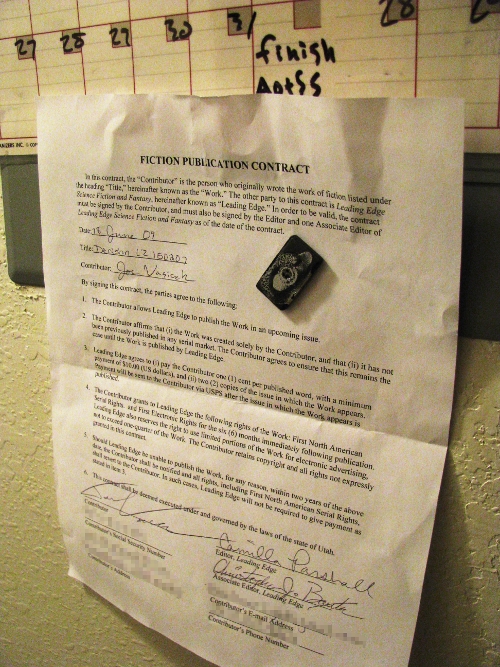


 Today was an awesome day, which is weird considering everything that happened. Woke up at 4:45 am to catch an early morning flight back to Utah, took public transport back to Provo, and ran around on errands until attending the midnight Way of Kings signing at the BYU Bookstore.