Laying the groundwork for a couple new series

So I just got back from vacation at Cape Cod, which turned out completely different from what I’d expected.  When I left, I said that I’d probably just write like I usually do, except in a different place.  Instead, I took a break from my WIPs long enough to catch a new vision for my career and come up with a really good idea for a new spin-off series in the same universe as Star Wanderers.

The story idea is really awesome.  I don’t want to talk about it too much, since I haven’t even written it yet, but the main characters will be Isaac and Aaron from Benefactor, and the basic premise will start out fairly similar to Outworlder.  From there, though, I expect it to take shape in some very different ways, turning into much more of an epic space opera.

I plan to stick with the novella series format, since I’ve had a lot of success with that so far.  I know that some readers complain about shorter works, but when doing a series of this type, it’s important to put out new titles regularly, and I can do that much easier with novellas than with novels.  Besides, there are a lot of other reasons why I prefer novellas, as I pointed out in this post.

That said, I expect these ones to run a little longer, such as the 30k-40k word (90-140 page) range.  But I won’t really know until I’ve written them.

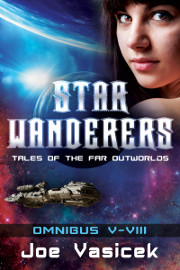
Before that, I’ve got two more Star Wanderers stories to put out: Reproach (Part VII) and Deliverance (Part VIII).  Both of those are already written; I just have to run them by my first readers and make some revisions before putting them out.  If all goes well, Reproach should be out in September and Deliverance should be out in October.

So that’s the plan.  Career-wise, what I really need to do is replicate the success of Star Wanderers by starting some new storylines that follow the same series format.  It’s a little unnerving, since I don’t know what will stick, but I don’t want to be dependent on just one series–you’ve got to have multiple entry points.  Besides, this new series is a spinoff, so hopefully readers from the first one will carry over.

It’s at this point that I’m hitting myself, because what I really need is to have three books that I can release before Christmas.  In general, I’ve found that it’s better to wait until you have three books out before you make the first in a series permanently free.  I wish I’d spent a lot more time this summer writing new things, rather than revising old stuff or finishing up old series.  But oh well–better to start now than wait until next year.  And who knows?  Maybe I can still pull it off.

For this new series, I plan to invest a little more in cover art.  The NASA images have been good for Star Wanderers, but to really hit the publishing trifecta (title, cover, blurb), I need to commission some original art.  I have the money now, and probably the best thing I can do at this point is reinvest it.  Expect those covers to be awesome.

Oh, and the other elements of the trifecta?  I don’t have a blurb yet, but the working title is Sons of the Starfarers.  Pretty cool, eh?

So there’s that.  I’m currently revising Reproach, but I think I can finish that on the train and send it out to my beta readers before the end of August.  As for The Sword Bearer, I’m going to put that project on hold again, mostly so I can focus on this.  I’ve also been running into some problems with that project, mostly having to do with the worldbuilding.

For that reason, I’m thinking of doing a series of prequel novellas in order to flesh out that world and the backstory.  If it goes well, that should turn into its own thing, kind of like how Star Wanderers fleshes out the background for my Gaia Nova books.  I’m thinking of something along the lines of David Gemmell: heroic fantasy with a real focus on courage, valor, and unlikely heroism.  I’ve already got the first scene of the first book in my head, and it’s pretty dang awesome.

So many stories, so little time … I’d better get back to writing!

Trope Tuesday: The Beach Episode

I’m so glad my Mom doesn’t read this blog.

I’m at Cape Cod this week, at a condo that doesn’t have internet, so it’s going to be a quick and dirty Trope Tuesday post this week (no, not like that) because I’d rather be on the beach than at the Dennisport Public Library.  Speaking of beaches …

One of the commonest beach tropes, at least for most anime and TV shows, is to take the cast of characters and put them on the beach for an episode.  This rarely has anything to do with the actual plot of the show, and is usually just an excuse to parade the characters in swimsuits and/or give the audience a little fanservice.

Actually, that’s not entirely fair.  There’s a bunch of ocean related recreational activities that the characters may participate in, such as beach volleyball (or other games), surfing, making sand castles, burying each other in sand, and getting a suntan (or an embarrassingly painful sunburn).  There may even be a single-episode romantic subplot that results in a beach kiss.

Basically, the beach episode is a chance for the audience to take a breather from the main story arc and hang out with their favorite characters at the beach.  Because really, who doesn’t like to go to the beach every now and then?  And if you can tag along with a bunch of fictional characters who have come to feel like friends, so much the better.

I’ve got to admit, most of the books and series that I’m a fan of don’t really have a beach episode.  The only one that comes to mind is the Melancholy of Haruhi Suzumiya, and that one’s a bit unusual because the beach episode(s) turn into a murder mystery that actually ties in pretty well with the main plot.  Also, the episode is based off of one of the original Japanese novels, so it’s a lot closer to canon than what you’ll see in most anime adaptations from manga (or so I’ve heard).

The beach episode doesn’t pop up in science fiction or fantasy a whole lot, probably because of the secondary world aspect.  I’m sure there are beaches on Middle Earth, but if I see a bunch of hobbits playing beach volleyball in bikinis, I’m sorry but I’m going to have to throw up.  Most fantastical worlds don’t have room for modern-style vacations, because so much of the setting is so far removed from the world we live in.  The last thing you want to do is throw your reader out of the story, so for most sci-fi and fantasy, a trip to the beach is probably a bad idea.

Of course, there are exceptions, depending on the story and the appropriateness for such an excursion in the fictional universe.  If you guys have any favorite examples, please let me know.

Needless to say, since most of my stories take place on alien worlds in the far-distant future, you won’t usually find this trope in my own stories.  However, there is a beach chapter in Desert Stars, where Mira spends some time out in nature, walking along the ocean and taking in the gulls and the waves.  She doesn’t wear a swimsuit, though.  In Stars of Blood and Glory, there’s a planet that’s nothing but ocean, with giant floating cities populated by people who are half Japanese, half Polynesian.  Not any beaches, though–at least, not natural ones.

Quick update from Massachusetts

Hey guys, this is just going to be a quick update since it’s midnight here on the east coast and I’m  pretty tired from the three-day train ride.  Sleeping on the train is like skipping stones, where all you’re really doing is seeing how far you can go before you crash (and I’m due for a crash).  So anyways, here goes.

First, I didn’t get a whole lot of writing done on the train, partially because of the sleep issue but mostly because I started reading STRAY by Andrea K. Höst and holy crap, I could not put it down.  Seriously.  It got to the point where the only thing I wanted to do was read this book, which was fortunate because riding the train, there’s not much else to do anyway.  So I finished it in a little over 24 hours, which means you can expect to see a review here soon, either before or after I get back from vacation (probably before, because I plan to read the next couple books in the series at the beach and on the ride back).

Second, I’ve decided to spend the next week or so working exclusively on Star Wanderers: Reproach (Part VII), while the feedback is still fresh and my enthusiasm is still strong.  Also, after burning through the first chapter in the last couple days, I think I can get this done pretty fast.  After that, I’ll send it out to a couple of other first readers, probably make another pass, then figure things out from there.  If all goes well, it should be out by mid-September-ish.

Third, I’m thinking about releasing print editions of the Star Wanderers series.  At first, I thought I’d limit the print editions to the omnibuses (omnibi?), but now I think it would be cool to do little pocket-sized editions of each novella.  What do you guys think?  If there’s demand, I’ll try to put them out a little sooner, hopefully before Christmas.  And since they’re small, I can probably price them lower, like around $6 to $7 or so (and of course, Amazon will discount them).

Third point one, before I do that I need to release a print version of Stars of Blood and Glory.  Which shouldn’t be too difficult, since I’ve already typeset about half of it.  Mostly I’ve just been lazy and/or busy with other stuff, but now that I check CreateSpace it seems that people are actually buying my print books, hmm.  Better get on top of that.

Fourth … actually, there is no fourth.  I guess I should say I’m on vacation, which means doing what I usually do except from Cape Cod, spending my non-writing time doing fun things with family.  But since I’m home, I plan to go through my high-school / middle-school papers and hunt down my first novel attempt, if for no other reason than to destroy it.  I may keep a page or two as a curiosity/souvenir, but that abomination really needs to die.

And that’s about it.  The stone has begun to sink, and I really need to hit the sack.

No Trope Tuesday this week

Hey guys, sorry but no Trope Tuesday post this week. I’m on the train, traveling from Utah to Massachusetts. Right now we’re at Grand Junction Colorado, about to head into Glenwood Canyon in a few hours. Lots of beautiful country out here.

One of the nice things about traveling by train is that it gives you lots of time to relax and do things without any outside pressure. Hopefully I’ll get some good writing done before I arrive at my destination on Thursday. The Sword Bearer is coming along slowly, and I just got the notes back on Star Wanderers: Reproach (Part VII) so that should be enough to keep me busy.

Anyhow, the train is about to leave again, so I’d better cut this short. See you guys around!

Writing at a stroll

I haven’t been writing too much these past few days, or revising much either, but I have been rereading a lot of stuff and getting myself back into the fantasy world of my next big novel. I’ve made a few changes, but decided to keep most of the stuff that I wrote while in Georgia, and that amounts to about 50k words.  Just today, I finished the chapter where I’d left off, so now I’m ready to go full steam ahead.

I changed the title from The Sword Keeper to The Sword Bearer, since the story is more about Tamuna than Ivanar, and I may end up adding a subtitle since this is going to turn into a series.  Right now, the tentative deadline for the first draft is September 30th, which should be plenty of time to finish it, even with all the traveling I plan to do for the rest of the month.

The projected total word count at this point is 120k words, but I’m not so sure about that anymore.  I’m in the middle of Part II, at about 52k words, and while I’ve got a pretty good idea of what happens in the next three chapters, there’s a lot in the middle that I don’t know about.  I know how the book is supposed to end, but how to get there is the question, and I’m not sure if it will take me 120k words or 90k words, or upward of 150k words (though I doubt it).  I’ll probably have to discovery write most of it.

I’m looking forward to that, though.  Some of the best stuff pops out of my head when I have no idea what’s supposed to happen next.  Characters take on a life of their own, and reveal some really surprising things about themselves that end up becoming central to the rest of the story.  But to do it well, I need to spend some time just thinking about things in a loosely structured way, allowing myself to get immersed in this world.  That’s why I haven’t been pushing myself too much.

At the same time, I’ve picked up work on another Star Wanderers story, mostly as a way to keep putting words on the page when I just don’t feel up to working on The Sword Bearer.  This is either going to be Part IX or Part X, and frankly I’m really worried about botching it up.  A lot of you have really enjoyed the Star Wanderers stories so far, and I’m pretty sure you’ll like this one too once I’m done with it, but I’m going some places in this book that really make me uncomfortable, and I’m not sure how to do it without crossing the line that makes me never want to make it available for the world to read.

I dunno.  I’m probably angsting about it too much, and should just write the thing and see how it turns out.  But for now, that’s a background project to keep things fresh while I work on The Sword Bearer.  And really, I should probably work exclusively on the novel for the next week or so, just to get some momentum going.  One day, I’ll be really excited to work on it, while the next, I can barely bring myself to open the manuscript.  That’s how I tend to be when I haven’t yet latched onto a project, which seems to be most of the time.

SW-VII Reproach (thumb)Star Wanderers: Reproach (Part VII) is in the alpha reading stage right now, though if you would like to give it a read, feel free to shoot me an email.  I only let people I know in real life read my unpublished stuff, though, and even then only if we’re close friends.  Depending on the feedback, it could come out anywhere between the end of August (unlikely) to the end of September (more likely).

This is another one I’ve angsted a lot over, so I’m not sure when it will be ready but I know it will be before the end of the year.  Part VIII, on the other hand … Part VIII is probably on the verge of being ready right now, and I really want to get that one out soon, so all the more reason to publish Reproach!

That’s about it for now.  I’m heading on the train back to Massachusetts on Tuesday, where I’ll be for most of the rest of the month.  I might put together that A to Z blogging challenge thing as an ebook, just to publish something while I’m on vacation.  That would be a good diversionary project, something to do while on vacation.  Though I certainly plan to write as well–at least 2k words a day, hopefully.  Gotta build up that momentum.

Speaking of which, it’s 2am and I should get some sleep.  Gnight!

The Dying Earth by Jack Vance

the_dying_earthDo you remember those creepy-weird montages from those old 60s and 70s era Disney movies?  The ones like Dumbo, or The Three Caballeros–or heck, the entire thing of Fantasia–where all these weird kaleidoscopic shapes and psychedelic colors just move in and out of each other in twisted, convulsing ways?  Well, guess what?  Jack Vance’s The Dying Earth is like one of those montages in written form, and I loved it.

I picked up this book in order to familiarize myself a little better with the Sword & Planet subgenre, which I’d like to write in (as you may remember … my WIP is currently on hold, but I’d like to pick it up again soon).  This one is a lot different from the Princess of Mars series, with an eerie apocalyptic feel, arcane magic and forbidden knowledge, weird, monstrous creatures, and above all else, a decidedly un-Disney fairy-tale feel that pervades the book with doom and danger.

If you’re looking for straight-up Science Fiction, you’re better off looking elsewhere.  This book is even more fantastic than Ray Bradbury’s stuff, and while there’s a little bit of a sci-fi dressing thrown in, there really is no scientific justification for anything.  The basic premise is that the Earth is dying, meaning that the sun is growing dimmer and dimmer and will soon go completely out.  The last few people eking out an existence on this planet are mostly wizards and witches, each one intent on building their own little empire and cheating or stealing from everyone else.  There are a few pure-hearted souls, but the world is completely lawless, and the only way to survive is through magic or brute force.

The chapters are really more like interconnected short stories, where each one stands on its own, and yet may feature a recurring character, or be set in the same place as another.  There were only six chapters in the version I read (the 1977 Pocket Book edition), which makes me wonder if I missed any.  If I did, I would definitely like to read them, because the stories were absolutely mesmerizing!

Because I read this book to get a feel for the sub-genre, I’m going to list some of the things I really enjoyed about it.  Here they are:

  • The fairy-tale story structure.  None of the chapters started out with “there once was a …” but it certainly felt like they did.  Each character started off with a quest or dilemma, and then went on a journey of some sort where they faced trials, made friends, and defeated enemies in order to attain some sort of boon at the end.
  • Lots and lots of world-breaking magic.  Seriously.  One of the guys sets out on his journey with a spell that basically keeps him from any danger whatsoever, so long as he stays on “the path.” Since he really has no idea where he’s going, “the path” is basically any path he chooses to travel.  Since all the rest of the magic is just as world-breaking, you have no idea what could happen next.  There’s always a sense that anything could happen.
  • An elevated sense of diction.  The characters don’t speak like we do, they speak like people from the 18th or 19th centuries, with words like “thus,” “whence,” “wherefore,” and grammatical structures like “I know not,” and “half yet remains.” It’s not just the characters, either–the whole book is like that.  It really adds to the fantastic, otherworldly feel.
  • Lots of contrasting extremes.  The demons are truly perverse and sadistic, with death and brutality on every other page.  At the same time, though, the moments of beauty and love are just as great.  My favorite line from the whole book, which practically made me cry, is “My brain is whole! I see–I see the world!” If I explained it any more, it would be a spoiler.
  • High adventure.  LOTS and LOTS of high adventure.  There isn’t a viewpoint character in the book who doesn’t leave home to go on some sort of quest through all sorts of wild and creepy dangers.  Every character is seeking something, and not in a “meh” kind of way–they are so wholly focused on what they’re seeking that they put their very lives in peril just to obtain it.  Almost all the romance is rescue-romance, of the pulpiest possible kind.  It’s awesome.

There are more, but those are the big things.  Overall, I’d say that this book is about 50% Fantasy, 30% Horror, and 20% Science Fiction, with none of the more modern conventions of any of those genres.  It was first published in 1950, but it feels a lot closer to Robert E. Howard and Jules Verne than J.R.R. Tolkien and Arthur C. Clarke.  If you’re looking for a good spec-fic throwback with lots of magic and adventure, this is a great one to check out.

Trope Tuesday: Curiosity is a Crapshoot

curiosity
Is there life on Mars? NOT ANYMORE!

Is curiosity a bad thing?  Well, it depends how genre savvy you are.  It seemed to work out pretty well for Alice, but not quite so well for Pandora (or the rest of the ancient Greek world, for that matter).  Curious monkeys seem to come out all right, and their constantly curious counterparts also seem to do okay in the end, but anytime you run into schmuck bait you know that things aren’t going to turn out well.

The truth is, for just about every stock Aesop warning about the perils of being overly nosy, you can find another one exalting it as a virtue.  In fact, you could say that curiosity is a crapshoot.

But what is curiosity exactly?  The Merriam-Webster dictionary defines it as “desire to know,” and “interest leading to inquiry.” As you can imagine, there are situations where this could be good or bad.  Thus, what a story says about curiosity often changes depending on its genre.

For example, in most horror stories, curiosity and nosiness are usually bad, leading the protagonists to go places where they shouldn’t and uncover things that should never have been uncovered.  At the same time, a lack of curiosity can also be fatal … in fact, a lot of things can be fatal in a horror story.

In mythology and folklore, curiosity is often even worse.  From Pandora to Eve, Psyche to the proverbial cat, curiosity leads to Very Bad Things.  Perhaps this is because these kinds of stories are mostly tales of warning, passed on from generation to generation as a way to preserve our collective knowledge about the dangers of the world, rather than inspire us to go out and face them.

(As a side note, there are a few exceptions in the realm of folklore.  In the Bluebeard myth, curiosity killed off all of Bluebeard’s previous wives, but combined with cleverness, faith, and friendship, it saved the last one’s life.)

In fantasy, curiosity is often a mixed box bag.  For example, take the hobbits: most of them are perfectly content to live out their lives in the shire, but the few who are inquisitive enough to venture outside end up saving the world in a way that the elves, dwarves, and humans never could.  At the same time, it puts them through a great deal of pain, even after the world is saved–neither Bilbo nor Frodo are ever able to be content in the shire again.

Curiosity, in other words, is complicated.  It’s not just a quirk or a character flaw–it’s an underlying quality of the hero’s journey.  Without curiosity, either of the world around him or the internal struggles within, the hero would be content to live out an unremarkable life.  Certainly he wouldn’t have the capacity for the cleverness, guile, wisdom, and sensitivity that he needs in order to descend into the darkest dungeon, face his own nadir, and return with the elixir of life.  Curiosity may lead to sorrow, pain, or even death, but it also leads to adventure.

As a subgenre of fantasy, many of these issues carry over into the realm of science fiction.  And yet, as a genre unto itself, science fiction has a distinctly positive view of curiosity compared to other genres.  Science is nothing if not the primary process of human inquiry, where curiosity is not only a virtue but the virtue, one of the most important aspects of humanity.  Consider these words from Adam Steltzner, one of the leading engineers of the NASA Mars Curiosity mission:

Likewise, curiosity is a staple of science fiction.  In Star Trek, it’s the basis of the entire mission: “to explore strange new worlds, to seek out new life and new civilizations, to boldly go where no one has gone before.” In Doctor Who, it’s how the Doctor finds his companions.  In Babylon 5, it’s Delenn’s curiosity about the humans that ultimately saves all the alien races.  And in 2001: A Space Odyssey, it’s the gift from the black monolith that helps monkeys to turn bones into space stations (well, not literally, but you get the idea).

Curiosity isn’t a central theme in most of my books, but it is a major part of Genesis Earth.  If anything, that book is about the importance of balancing curiosity about our universe with curiosity about ourselves and what it means to be human.  In Star Wanderers, Noemi’s curiosity is a huge part of her story, helping her to turn around a horrible (not to mention awkward) situation.  In Desert Stars, curiosity is complicated; it leads Jalil far away from home and puts a schism between him and the girl who loves him, but it also leads him to discover the truth about who he is, giving him the strength to return.

In general, I suppose it all comes down not only to genre, but to the underlying worldview of the author of the story.  Since I have a very positive and enthusiastic view of curiosity, it usually works out for the best in the stories that I write. Then again, perhaps that’s why I’m drawn to science fiction … how about you?

Why I don’t like George R.R. Martin

I was thinking today about George R.R. Martin’s A Game of Thrones and the fact that I’ve more or less given up on the series after reading the first book.  A lot of my friends are rabid-at-the-mouth crazy about it, both the books and the TV miniseries, but I’m just not all that into it.

Don’t get me wrong—I can see why other people like it so much.  The story is engaging, the political intrigue is deliciously complex, the world building is wonderful and immersive, and the fantasy tropes are played quite well.  I enjoyed a lot of things about the first book, and intended to read the rest of the series after finishing it.  After all, it’s one of the most important works of epic fantasy to come out in the last few decades, with people calling George R.R. Martin an American Tolkien.

But the truth is, I just wasn’t all that into it.  And the more I think about it now, the more I’ve realized that this isn’t the kind of series I would enjoy at all.

The strange thing is, I’m a HUGE fan of David Gemmell, who writes almost the exact same sort of thing.  Immersive fantasy worlds, dark and gritty characters, shades of gray, lots of fighting, lots of sex, lots of brutality, the realization that anyone can die off at any time … the list goes on and on.  And yet, there’s something about David Gemmell’s books that turns me rabid-at-the-mouth and has me squeeing like an otaku fangirl, whereas with George R.R. Martin, all I can manage is “meh.”

I think the reason for this is that Martin’s characters basically fall into one or both of two camps: victim or victimizer.  There isn’t any middle ground—at least, none that anyone can stand on for long without dying in some horrific and brutal way.  The story requires the characters to all become monsters, and anyone who isn’t willing to do that meets a horrible, tragic end.

There were only two characters in A Game of Thrones that I really cared about: Arya and Ned Stark.  Ned was the only character who really tried to stand for something, and Arya was just a spunky little girl who resisted all the stupid girly stuff in favor of more practical stuff like street smarts.

<spoilers ahoy>

The trouble was that Ned was a complete idiot, trusting in the honor of a guy who explicitly said “do not trust me” and making stupid decisions that ended up getting half of House Stark killed or captured.  It’s almost as if Martin purposefully set him up to be a straw man character—that he wanted this one character to represent all the goody-goodies of the world, and knocked him off in the most brutal way possible.  It’s like Martin killed him off to make a point, and had the story drive the character rather than the character drive his own story.

And Arya … I forget exactly what happened to her, but she basically became a victim in such a horrible, twisted way that I could tell she’d be scarred for the rest of the series.  If she didn’t die off herself, she’d probably become a dirty street rat—the slit-your-throat-for-a-copper kind, not the Disney version.  So yeah, I pretty much gave up on her.

Jon Snow was okay, but he was so far removed from everything else in the story that I just got bored with him.  Tyrion was funny, but he was also a pervert, and all the reasons to sympathize with him basically revolved around “I’m a dwarf, everyone mistreats me”—again, the victim vs. victimizer thing.  Lady Catelyn was pretty cool, but I always saw her as more of a supporting character, and while I found myself rooting for Daenerys at the end, it was only out of frustration with all of the other douchebags in Westeros—I just wanted her to come over the sea and claim the throne so that everyone else would die.

It was a pretty good book, I’ll admit—other than the fact that I didn’t really like any of the characters, everything else was quite enjoyable.  It certainly held my attention long enough to finish the thing.  But I didn’t really feel compelled to read the next one because I frankly didn’t care what happened to any of the characters.  You could give me a list of all of the ones who die off, and I would just shrug and say “oh well.”

In contrast, with every David Gemmell book I’ve read, I fall in love with the characters after reading just a paragraph or two in their viewpoint.  Drenai or Nadir, civilized or barbarian, I not only like the characters, I fall deeply in love with them.  I care about them right from the outset, even the ones with a dark past, like Skilgannon or Waylander.  In fact, Waylander is probably my favorite of them all.

The fact that I know that some of these guys are going to die only makes me more invested, because even though Gemmell kills of most of his characters in any given book, the main characters’ deaths almost always mean something.  Maybe they have some awful secret that they finally are able to give up, or maybe they’ve been running from a fate that they finally gather the courage to face.  Or maybe they just happen to be in a circumstance that requires them to give up their lives, and they rise to meet the occasion.  Not every death is cathartic, but Gemmell never kills off a character merely for the sake of killing off a character, whereas with Martin, I get the sense that that’s sometimes the only reason.

But the biggest difference between the two is that with Gemmell, the victim vs. victimizer paradigm just doesn’t exist.  Gemmell’s books are all about unlikely heroism—characters in situations that require them to be something more, or do something beyond looking out for just themselves.  Anyone can be a hero, because a hero is nothing more than someone who does something heroic.  No matter your past, no matter your fears, no matter your weaknesses, when the chips are down, we’re not all that different.

The counter argument I’ve heard is that all of this heroism stuff is superfluous, and Martin is trying to get beyond it, kind of like the 19th and 20th century philosophers who were trying to get beyond morality.  The thing is, if that’s the case, then Martin has to have the darkest and most depressing view of human nature of almost any fantasy writer alive.  If his point is that there’s nothing intrinsically heroic about anyone, that being a hero is just a matter of rising to a role and becoming a figure in one of the stories that people tell to make sense of the world—if his point is to show that every hero is really just a douchebag, there’s something about the world that he’s really missing.

In Gemmell’s books, there are douchebags who rise to the heroic roles required of them—but in the act of filling that role, something about them changes, and you see that they’re really not as evil as you thought they were.  Because in Gemmell’s view, people are essentially good and everyone is redeemable, even the rapists and murderers.  One of his darkest characters, Skilgannon the Damned, learns at the end of his story that the difference between salvation and damnation is allowing yourself to receive the light—that the only thing damning you is yourself.  Whether or not you agree with that, you have to admit that’s a pretty optimistic way of seeing the world.

In the end, that’s why I love David Gemmell’s books so much—not just because anyone can die, but because anyone can be redeemed too, sometimes at the very same time.  From what I’ve read of George R.R. Martin, it seems that he redeems no one—that to the extent I’m rooting for any one character, it’s only because I can’t wait for them to kill or brutalize all the other horrible monsters in the book.  And frankly, I find that pointless and tiresome.

There are moments in almost every David Gemmell book I’ve read that stand out to me with great clarity, so that sometimes while I’m standing in line at the grocery store, or walking down the street to the library, they pop into my head completely unbidden.  With George R.R. Martin, that has never happened to me, even for the books of his that I’ve enjoyed.

I dunno.  Everyone is different.  Maybe George R.R. Martin really strikes a chord in you, so that you feel for him like I do for David Gemmell.  Maybe you actually like some of the characters whom I’ve dismissed as douchebags.  Or maybe you don’t read fantasy for the same things I do.  This post isn’t to knock you for that, it’s just to point out and analyze why I don’t like George R.R. Martin’s stuff as much as most other fantasy fans seem to.  And if you do feel about this the same way that I do, then my point is to declare that that’s all right.  You can still be a fantasy geek and not like A Sword of Ice and Fire or anything else by George R.R. Martin, no matter how much it’s hyped.  That’s perfectly okay.

I’m writing an epic fantasy right now, and it’s not going to be anything like A Sword of Ice and Fire.  It’s probably not going to be much like any of David Gemmell’s books either, but Gemmell is certainly a bigger influence on me than Martin.  We’ll have to see how it turns out.

Do you like your chapters named or numbered?

There’s an interesting article linked on The Passive Voice blog about the importance of a table of contents, especially in ebooks.  The article is geared mostly for non-fiction, which is a whole different beast from novels and novellas, but the discussion on TPV got me thinking: for ebooks, is it better to name chapters or to merely number them?

In the comments section on TPV, Jamie makes an interesting point:

With e-books in particular I think there needs to be more care taken with the TOC. I can easily find my place with a print book even without a book mark, but with an e-reader, it’s possible to lose your place very easily, and “loc 4950″ is not going to be committed to my memory banks. I know what happens in the chapter titled “His Grace of Avon Takes Command of the Game,” but I’m not sure if that was chapter 16 or 15 “loc 1730″ or what. I won’t remember the number.

For organizational purposes for my own use I title my chapters, and I believe that readers will appreciate that habit, too, and will be more forgiving if they use the Look Inside feature and see those headers vs. if they just see “1, 2, 3.”

I try to make sure the titles are enticing and pique the curiosity of anyone who would see them in a TOC. They’re not spoilers, because unless you’ve made it to the end of the previous chapter, you’ll likely have no idea what the next chapter’s title is referring to (and if it is obvious, it simply increases the suspense/curiosity). The titles Makes Sense in Context (TM).

When I first learned how to make an ebook, the concept of a table of contents for a novel seemed pretty weird.  I was used to reading print books, which you can flip through much easier and find what you’re looking for just from the feel of the pages.  But with ebooks, obviously that’s much different.  A table of contents is more than just a list of chapters, it’s an important navigational tool that can’t be overlooked.

But if chapter hyperlinks are perhaps the only way to flip through the middle of the book, does that mean that merely numbering the chapters is insufficient?  I have to admit, the concept of naming each chapter seems a bit old-fashioned, but the technology has changed and as writers, we need to change with it.

In the context of a hyperlinked table of contents, numbers are practically meaningless.  They can even be quite ugly, if there’s a huge list of them that sprawls beyond the screen.  Chapter titles can sprawl even more, but they at least provide some idea of what lies on the other side of the link.

I’ve done it both ways.  For example, the table of contents for Genesis Earth looks like this:

Table of Contents

Copyright Page
Table of Contents

The Wormhole | The Mission | Terra | Cryothaw | The Ghost Ship | Trust and Deception | Betrayal and Discovery | Arrival | First Contact | Call and Answer | Earth | Rescue | Emotion and Reason | Planetfall | The Natives | Origin and Destiny | A New Genesis | Epilogue

Author’s Note | Acknowledgments

Most of the chapter titles are pretty mysterious, but I was kind of going for that.  And in any case, is it possible to make them completely unambiguous without spoiling key parts of the story?  It seems like the art of naming chapters is much subtler and more complex than you’d think at a first glance.

In contrast, the table of contents for Desert Stars looks like this:

Table of Contents

Copyright Page
Table of Contents

Prologue
Book I: Dome and Desert
1 | 2 | 3 | 4 | 5 | 6 | 7 | 8 | 9 | 10
Book II: Sand and Stars

11 | 12 | 13 | 14 | 15 | 16 | 17 | 18 | 19 | 20 | 21 | 22

Author’s Note | Acknowledgments

I kept the numbers for the chapters, but divided the novel into two sections or “books” and listed the numbered chapters as minimally as possible, to save space.  I suppose it looks all right, but as a guide to navigating the book, I’m not sure how useful it is–not to mention how hard it can be to click on a hyperlink that’s only one character long, especially on a touchscreen.

For Journey to Jordan, there were so many entries that I didn’t bother listing them all in the table of contents.  Instead, I divided each part into sections based on location, then listed the locations in the table of contents and the posts/chapters at the head of each section, complete with hyperlinks.

As a side note, it’s actually pretty amazing how internal hyperlinks can change the experience of the book.  For one thing, it opens up all sorts of possibilities for alternate endings and “Choose Your Own Adventure” type stories.  Is it possible to list a chapter in the <manifest> without including it in the <spine>?  I don’t think it is (at least, not in a well-formatted ebook), but if you could find a way to do that, you could add all sorts of hidden content and Easter eggs …

In any case, for my shorter Star Wanderers novellas, I think I actually prefer numbered chapters.  The stories are short enough that the numbered subdivisions still have meaning, and the chapter lists aren’t long enough to look too cluttered.  Besides, I’ve already started the series in this particular format so I think it will be better to keep it this way.

But for future books and future series … I don’t know.  What do you think?  Are ebook chapters better off named or numbered?