W is for Wagon Train to the Stars

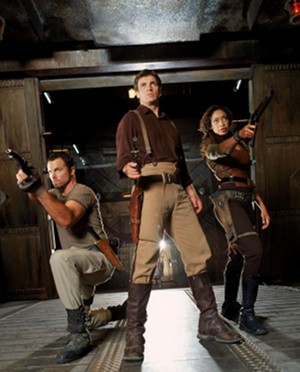
big_damn_heroes_moment_smallWhen Gene Roddenberry pitched the original Star Trek series back in the 60s, Westerns were all the rage.  Consequently, he pitched his show as a “wagon train to the stars,” where a bunch of quirky characters on an awesome starship travel from adventure town to interstellar adventure town, exploring and pioneering the final frontier.

Sound familiar?  Yeah, I thought so.  The concept proved so catchy that it’s been redone time and again, from Battlestar Galactica to Firefly to Doctor Who.  Even though Westerns aren’t nearly as popular as they used to be, many of its tropes are so well suited to Science Fiction that they drive the genre even today.

For example, adventure planets.  In a typical Western, the characters travel from town to town, with a different adventure in each one.  Well, in Science Fiction, the characters do the same thing, except that they’re traveling from planet to planet.  And really, if you’ve got the ability to travel to other worlds, how can you not have an adventure in each one?

A large reason for the Western / Science Fiction crossover is the whole concept of space as the final frontier, which we explored earlier in this series with I is for Interstellar.  There’s a very real sense of manifest destiny in the space exploration community, not because of humano-ethnocentrism (heck, we don’t even know we’re not alone in our local stellar neighborhood), but to ensure humanity’s long-term survival.  The parallels between that and the westward movement in 19th century America aren’t perfect, but they do exist.

Similarly, as we explored in R is for Rebel, the notion of space as the final frontier has a special resonance with the American audience.  The days of the old frontier may be over, but its spirit lives on in our culture, from guns to road trips to our glorification of the rugged, self-made individual.  Today’s Science Fiction, especially the space-focused SF of Space Opera, grew out of the adventure fiction of the pulps, which thrived on that frontier American ethos.

In fiction, the frontier can still be found in two major genres: the Western, which is historical and therefore more backward-looking, and Science fiction, which is futuristic and therefore more forward-looking.  Because Science Fiction isn’t burdened with all of the historical baggage of the traditional Western, it’s a much more flexible medium for story, readily adaptable to contemporary issues and concerns.

For example, where Star Trek echoes the large-scale nation to nation conflicts of the Cold War (Federation vs. Klingons and Romulans), the new Battlestar Galactica series echoes the much more asymmetrical conflicts of the post-9/11 world (Cylon agents who are indistinguishable from humans and may not even know that they are cylons).  At the same time, the wholesale co-opting of Western tropes enables a latent sense of nostalgia, evident in the look and feel of Firefly, or the famous opening lines from Star Wars: A long time ago in a galaxy far, far away.

My first real experience with a wagon train to the stars type of story was probably Star Trek: Voyager, which I watched religiously with my dad every Wednesday night until maybe 9th or 10th grade.  The Western-borrowed tropes are somewhat more muted in that series, but they exist, especially the planetville / adventure towns stuff.  However, it wasn’t until Firefly and Serenity that I really experienced the awesomeness of a true Space Western.  There were a lot of things in Firefly that I really loved, especially the character interactions, the gun-toting action scenes, and especially the starship Serenity.  There were some things I didn’t like so much, like the fact that every planet is basically Wyoming, but overall I really enjoyed the show.

It wasn’t until I started getting more acquainted with straight-up Westerns that I saw the real potential for crossover between the genres.  Stories about mountain men like Jeremiah Johnson really captured my imagination–what would this look like if it were set in space?  In that sense, I came to the Space Western more from the classic Science Fiction side first, rather than the pulp adventure stuff.  But once I discovered the crossover connection, it naturally found a way into my own work.

That’s basically how the story idea for Star Wanderers first came to me.  I was lying on my bed, daydreaming about having my own starship like the Serenity, when I wondered what it would be like for a starship pilot to get roped into an accidental marriage like in the movie Jeremiah Johnson?  The collision between the two ideas was like a supernova exploding in my brain.  I rolled out of bed and started writing, coming up with chapter one of Outworlder almost exactly like it’s written today.  And the more invested I became in those characters and that world, the more the story grew.  I’m writing Part VII right now (Reproach, from Noemi and Mariya’s POV), and so long as people read them I’ll keep writing more.

Genre mash-ups and crossovers are a great way to keep things fresh and come up with some really interesting stories.  Some genres aren’t very well suited for each other (Erotica and Middle Grade, for example), but others come together so well that they seem almost complementary.  That certainly seems to be the case with Westerns and Science Fiction, at least here in the United States where the spirit of the frontier still echoes through the popular culture.

U is for Universal Translator

In science fiction, whenever two characters from different planets or different alien races have to interact with each other, they almost always speak the same language or have some sort of universal translator that magically makes them able to communicate with minimal misunderstandings.  This is especially common in Star Trek, though it happens in just about every franchise involving a far-future space opera setting of some kind.

I’ve got to be honest, I think this is a cheap plot device that almost always weakens the story.  As a writer, it’s tempting to have something like this so you don’t have to deal with any pesky language barriers, but when you do this, you remove a major potential source of conflict, thus violating the rule of drama.  Also, you make your fictional universe feel a little less grand, your aliens a little less alien.  After all, if everyone can perfectly understand each other, then there must not be a huge difference between Earth and the far side of the galaxy.

There are some times when having a universal translator allows you to broaden the story and focus on other conflicts.  For example, if some sort of interstellar legislation is under review in the grand galactic council, you can’t spend all your time focusing on basic communication difficulties.

However, if this is the case, then you can usually overcome the language barrier through other means–a galactic lingua franca, for example, or translation tools that may or may not misfire on occasion (much like Google Translate).  Of course, if you’re writing a comedy like Galaxy Quest (or parts of Star Control II), then falling back on a universal translator is forgivable.  But if you’re going for believability and a sense of wonder, this trope isn’t going to do you any favors.

While linguists and technologists have been working on translation programs for some time (and admittedly making some significant breakthroughs), I’m extremely skeptical that we will ever develop a perfect universal translator in real life.  If we do, I expect we will have to develop a sentient AI as a prerequisite, since the nuances of language are so inseparable from the things that make us human.

Here’s how translation services like Google Translate work:

  1. They amass an enormous database of language material by scanning websites, newspapers, and other documents.
  2. They analyze this database to look at word combinations and frequencies, observing the likelihood that any one word will appear in combination with any others.
  3. They compare these combinations and frequencies with those in other language databases to match words and phrases.

This data crunch method of translation works fairly well for simple words and phrases, but it falls apart in the more complex grammatical structures.  I see this any time I try to use Google Translate with an Arabic source.  Arabic is an extremely eloquent language, with all sorts of structures that simply don’t work in English.  One mistranslated word can completely change the meaning of the entire text, and even when it works, the technically correct English translation sounds as if it’s full of errors.

The methodology also falls apart for languages that are too small to have much of an electronic database.  The Georgian language is a good example of this.  It’s spoken by only about 4.5 million people worldwide, most of them in the country of Georgia, which is predominantly rural.  Internet access for most of the population is very limited, and most Georgians who do communicate online tend to use the Roman or Cyrillic alphabets more often than their own.  As a result, Google Translate for Georgian is utterly useless–seriously, you’re better off just sounding out the letters and guessing at the meaning.  There are some other sites like translate.ge that try to fill the gap, but they seem to rely on actual lexicons, not databases and algorithms.

All of this is between entirely human languages that developed in parallel on the same planet–indeed, languages between human cultures that have traded and shared linguistic influences for thousands of years.  What happens when we encounter an alien race whose biology makes it impossible for them to make human-sounding noises?  Or an alien race that communicates through smell or electromagnetic impulses instead of sound?  What happens when humanity is spread out across hundreds of star systems, each of which periodically becomes isolated from the others for hundreds or even thousands of years?  When our definition of human is stretched so thin that we would not even recognize our far-future descendents as anything but alien?

There is so much wasted potential whenever a science fiction story falls back on a universal translator.  Case in point, compare Halo I, II, and III with Halo: Reach.  In the first three games, the Master Chief’s universal translator enables him to hear exactly what the enemy Covenant troops are saying.  This is great fun when you’re chasing down panicked grunts, but it tends to get old after a while.  In Halo: Reach, however, the human forces haven’t yet developed a universal translator, so everything the Covenant say is in their original language.  All of a sudden, the game went from a hilarious joyride to a serious war against aliens that felt truly alien.  That one little change did wonders to the tone and feel of the entire game.

Needless to say, you won’t find a universal translator in any of my books.  In Star Wanderers, the language barrier is the heart and soul of the story–it’s a science fiction romance between two characters from radically different worlds who don’t speak the same language, and yet overcome that to develop a strong and healthy relationship.  In Sholpan and Bringing Stella Home, Stella knows a language that is fairly similar to the one spoken by the Hameji, but there are still words and phrases that elude her.  This detail is critical because it impedes her ability to understand and adapt to the Hameji culture, leading to some major conflicts later in the book.

As someone who’s lived for significant periods of time in Europe and Asia and learned languages very different from English, I can say that the language barrier is not something that we as writers should avoid, but something that we should embrace.  There are so many interesting stories that can be told when two characters don’t speak the same language.  Please, don’t be lazy and write that out of the story through a cheap plot device!  Let your aliens be truly alien, and your worlds and cultures so fantastic that we can’t help but feel hopelessly lost in them.

R is for Rebel

rebel_allianceJust as sprawling interstellar empires are a staple of space opera, so are the plucky rebels that fight against them.  From Star Wars to Battlestar Galactica, Firefly to FTL, there’s no shortage of characters in science fiction trying to stick it to the man.

I’m not sure how it is in other cultures, but in America, it seems like science fiction upholds a host of values closely related to rebel tropes, such as self-reliance, individualism, freedom and independence, frontier justice, enterprising self-made men, etc.  A lot of this probably grew out of the genre’s early ties with pulp-era adventure fiction, which often featured former Confederate soldiers leaving the civilized world for the realms of adventure following the US Civil War.  That’s certainly the case with John Carter in A Princess of Mars, and echoed to some extent with the Browncoats from Firefly.

It may go even further, though, to the revolutionary origins of the United States itself.  The frontier has always loomed large in our culture, shaping our values in the early days of settlement and, now that the age of the frontier is largely over, standing for an idealized nostalgic past.  Americans have always favored the self-made individual who stands up to injustice and corruption in high places, and we’ve always had an aversion to the centralization of power and authority.

Back in the days of the Cold War space race, when writers like Heinlein and shows like Star Trek really started to popularize the genre, there seems to have been a real push to promote American identity and values.  The science fiction of that day certainly got caught up in all that, which is weird because as pro-Americanism became the establishment, a genuinely rebellious counterculture began to push back.  To its credit, though, there was plenty of science fiction that embraced the counterculture, especially in the New Wave movement that followed the Golden Age.

So why are we so enamored with rebels?  Probably for the same reason that we all love a good rogue.  Since space is the final frontier, it’s naturally the kind of place that would attract a more rugged, individualistic type.  At the same time, rogues and rebels are much more likely to have exciting adventures than the more mild-mannered folk who are apt to stay at home and conform.  Let’s not forget that most people who read science fiction are adolescent boys (of all ages), hungry for adventure and often a little rebellious themselves.

Though the rebels are often the good guys, that’s not always the case.  It all depends on who they’re fighting against, and how black and white the story is trying to be.  If they’re fighting against the Empire, then they’re almost always courageous freedom fighters standing up for truth and justice and all that, but if they’re fighting against the Federation, things can be a lot more gray.  In FTL, for example, the rebels are the outright antagonists, and you have to save the galaxy by defeating them.

The rebels don’t always win, either.  In stories like Star Wars that skew towards idealism, then in the end they usually do, but in darker, grittier tales (such as most cyberpunk), they may or may not.  And even in some happy-go-lucky adventure stories, the rebels are apt to be martyrs for a lost cause–again, think of the Browncoats from Firefly.

The wide variety in the role of rebels in science fiction is a good indication of a healthy, vibrant back-and-forth in the genre that’s been going on for some time.  It also means that there’s plenty of room for a new writer to take these old, worn tropes and shake them up in a new and exciting way.  As much as we love Luke Skywalker, we love Han Solo just as much, and if you combine him with John Carter to get Mal, then you’ve got a rebellious character that a whole new generation can come to know and love.

I love playing around with these tropes, and do so quite often in my own fiction.  In Bringing Stella Home, James McCoy is very much a rebel, though it’s not the Hameji that he’s fighting against so much as everything standing between him and his brother and sister.  In that sense, he’s kind of a martyr without a cause, a determinator who shakes his fist at the universe even when the more sensible thing is to learn how to cope.  Similarly, Danica and her band of Tajji mercenaries all fought in a failed revolution and have been wandering the stars ever since.  Their backstory features much more prominently in Stars of Blood and Glory, in which things come around full circle.  And then, of course, there’s Terra from Genesis Earth, who isn’t about standing up to the man so much as giving him the finger and running off somewhere where none of that even matters–the frontier ethic taken to its furthest extreme.

So yeah, I’m a fan of this trope, and have been ever since I saw Star Wars and fell in love with the genre.  You can definitely expect to find lots of rebellious characters throughout my books in the future.

Q is for Quark

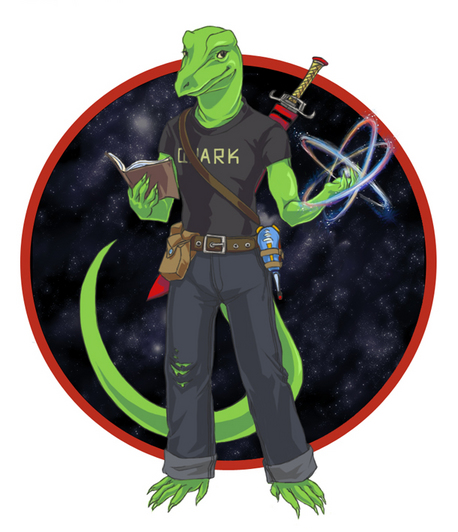
Quark_Mascot_by_OrphneIf it takes a village to raise a child, does it take a group of like-minded creative souls to raise a writer? I don’t know, but in my case, having a writing community around me really helped.  That community was Quark, BYU’s Science Fiction & Fantasy club.

I joined Quark my second semester of college.  I’d heard about the writing group, and on a whim I decided to check it out.  This was when Ben Hardin was the writing group leader, back before the current iteration of the club was really well-organized.  Aneeka Richins had basically built the writing group from scratch only a year or two before, and Kindal Debenham and Annaliese Lemmon had each spent a year as president shortly after that.  They were all still around, workshopping their stories and adding to the community.

We met on the second floor of the Harold B. Lee library, in one of the study rooms way in the back near what is now the classical music area (2520 was the room number, I think).  Looking back, it seemed like a weird place to meet, since we were always so LOUD.  However, back in those early days Quark didn’t get a lot of respect from the BYU student administration (BYUSA, known more familiarly as BYUSSR), so we kind of organized under the radar.

The spring semester of 2007 was a lot of fun!  I fit in very well with the group, and made a lot of friends.  It wasn’t until they made me the writing group president that I started attending regularly, though.  In retrospect, accepting that post was probably the best extracurricular decision I could have made.  I lead the writing group for two years, from fall of 2007 to spring of 2009, and that’s when I really became a writer.

When I first started back in 2007, I had a couple of hobby projects kicking around here and there, but the main thing I wanted to write was a Final Fantasy VI fanfic.  At the same time, I had a great idea for an original novel, but I’d never written a complete novel before, so I wasn’t sure what to do.  Aneeka convinced me to go with my own project, and that became The Lost Colony, also known as Ashes of the Starry Sea.

Around that time, I also started this blog, mostly so my writing friends could keep me honest.  I finished the first draft in 2008–a whopping 168k word manuscript that barely held together.  After coming back to the US from a study abroad program in the Middle East, I started revising it, but soon decided to trunk it in order to work on other projects.  Shortly thereafter, I finished the first draft of Genesis Earth, and the rest is history.

I later wrote up a detailed post on the origins of Quark, one that was published in a short-lived magazine called Mormon ArtistYou can find that article here.  Orson Scott Card himself commented on it, which really made my inner fanboy squee. 😀 For me, though, Quark was all about surrounding myself with like-minded friends who could foster my natural sense of creativity.  I probably would have become a writer anyway even without them, but it would have happened a lot later, and the road would have been much more rocky.

And now that we’ve all graduated and moved on, I’m happy to say we still keep in touch!  Kindal is a self-published indie writer much like me, with some excellent books out there.  He’s organized an online writing group that is mostly made up of us old-time Quarkies.  Aneeka’s got her webcomic, which seems to be fairly successful, and the others who chose to go a more traditional path are having success there as well.  But mostly, it’s just great to keep in touch.

After my time as president, Quark really exploded in popularity and became officially sanctioned by the BYUSA.  It’s really thriving right now, with a book club, a board/video gaming group, a film forum, and a bunch of other stuff.  Most of that was there when I was in the writing group, but it was floundering, and the writing group was much more autonomous.  But the guys who have carried on the torch seem to have done a great job making things even better, and that’s encouraging.

N is for Nebula

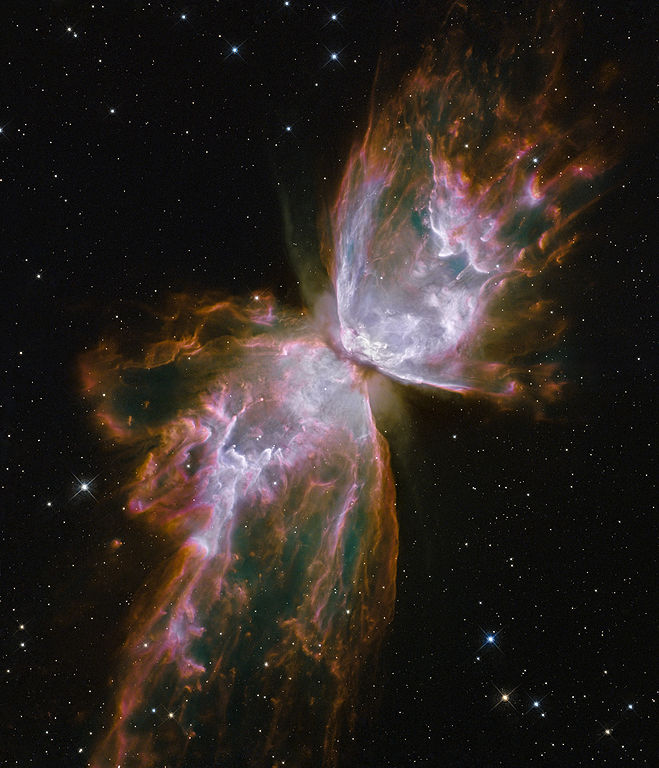
659px-NGC_6302_Hubble_2009.full

Of all the objects in space, nebulae are some of the most beautiful and awe-inspiring.  These giant clouds of gas and dust span light-years, and often contain stellar nurseries where new stars (and with them, new planets) are born.  Few things can fill me with a greater sense of wonder than a detailed, high-res image of a nebula.

Many of the classic nebulae images come from the Hubble Space Telescope, which has probably done more to bring that sense of wonder to the general public than any other telescope.  These images, all of which are released by NASA into the public domain (with very few restrictions), have been shaping the pop culture dialogue about space and astronomy for more than a generation.  They’ve certainly had a tremendous impact on me.

There are many different kinds of nebulae.  The largest and most stunning ones are mostly diffuse, meaning that they have no clear boundaries where they begin and end.  These come in two basic flavors: emission nebulae, which glow on their own due to ionized hydrogen gas, and reflection nebulae, which consist mostly of dust and don’t glow on their own, but reflect the light of nearby stars.

The Witch Head Nebula is a classic reflection nebula.  Doesn’t it look eerie?  It’s probably because of the way it reflects blue and purple.  Many reflection nebulae share those same colors.

The Orion Nebula, one of my personal favorites, is a massive region of star formation visible just below the three iconic stars of Orion’s Belt.  It contains large regions of both reflection and emission.  In the center of the thickest clouds are dozens of young stars with protoplanetary disks–new solar systems in the process of being born.  How many of these will go on to form planets capable of hosting life?  Just a few billion years ago, our own sun may have been born in a cloud of gas and dust like this one.

The Helix Nebula, also known as the Eye of God, is apt to make you do a double-take the first time you see it!  It looks almost like an eye, watching you from the midst of the heavens.  Just as clouds here on Earth tend to form shapes and patterns that look like other things, so do nebulae.

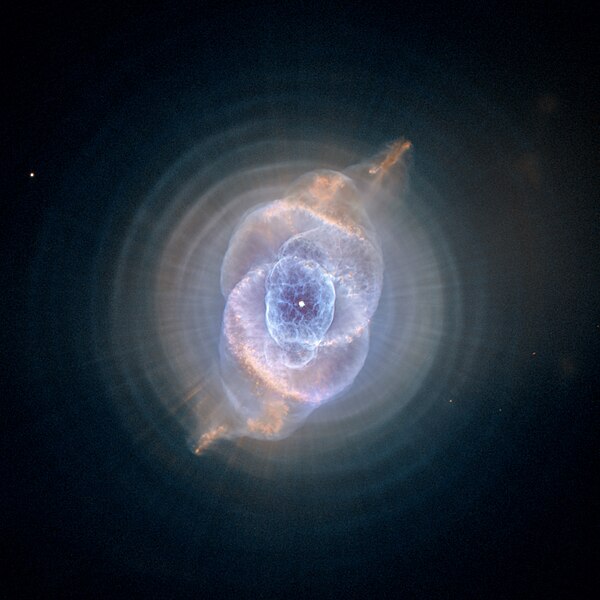
The Cat’s Eye Nebula is another one of those gorgeous space objects that’s apt to give you a double take.  Both the Cat’s Eye and the Helix are Planetary Nebulae, which form after a star burns off its outer layer and collapses into a white dwarf.  The name is kind of misleading, because they don’t really have anything to do with planets at all–they just look a bit like them, when all you’ve got is a low powered telescope to view them with.

One of the most famous Hubble images is the Pillars of Creation, a close-up image of a stellar nursery within the Eagle Nebula.  Stars form when clouds of gas and dust become so dense that they collapse on themselves, creating a gravity well that sucks up more of the surrounding dust and gas.  As enough matter accumulates, the pressure and heat at the center grow until the whole thing goes nuclear.  When nuclear fusion begins, the newborn star sends out a strong stellar wind that pushes away any remaining dust and gas from the rest of the nebula.  After several million years, the whole cloud is blown away, leaving us with a star cluster like the Pleiades.

In the Pillars of Creation, the long, finger-like clouds of the nebula are so dense that they appear dark and opaque, blocking out any light from the other side.  These kinds of structures are called molecular clouds, after their ability to form molecules due to their increased density.  In this image, though, we can see a group of newborn stars just starting to blow away the cloud’s outer shell.  Once the cloud is completely blown away (in just a few thousand years or so), these stars will shine clearly enough for us to see–but for now, they’re hidden inside those pillars where they were born.

The Crab Nebula is particularly fascinating, not only for the stunningly complex structures visible in this image, but because less than a millennium ago, it used to be a star.  In 1054, medieval astronomers in Europe, Asia, and the Americas reported the appearance of a new star, bright enough to be seen even in daylight.  What they actually saw was a supernova, the spectacular death of a massive star.  When a star goes supernova, it explodes with as much energy in just a few days or months as it put out during its entire lifetime.

The outer layers were blasted out to form this nebula, while the inner core collapsed and formed a neutron star–an object so dense that it contains as much as three times the mass of the sun in a sphere roughly the size of New York City.  If the supernova is really big, the star might even collapse into a black hole.

Because of how fascinating and gorgeous nebulae can be, it should come as no surprise that they often show up in science fiction.  When you have a starship and can travel at ease across the stars, nebulae become a part of the geography of space, just like forests and mountain ranges in a fantasy setting.  I haven’t played any of the Mass Effect games yet, but apparently they do this quite a lot.  In the re-imagined Battlestar Galactica series, the colonists are able to set a course for Earth after using the Lagoon Nebula to orient themselves relative to the stars of the zodiac.  And of course, who can forget the classic battle between Kirk and Khan at the end of Star Trek II: The Wrath of Khan?

In real life, though, it’s much more likely that nebulae like the ones above wouldn’t even be visible if you got up close to them.  Even though they’re much denser than other regions of space, they’re still for the most part much less dense than our planet’s own atmosphere.  From a distance, they appear bright because we can see the entire structure in one field of view, but up close, it’s possible that you wouldn’t even know you were in one.

That being said, it sure makes for more exciting fiction when the nebulae are these giant mysterious clouds capable of hiding an entire space fleet.  And really, who knows what these things are actually like up close?  For now, all we can do is watch them from afar.  But someday, if science fiction becomes reality, we may be able to be firsthand witnesses to the births and deaths of stars.

I is for Interstellar

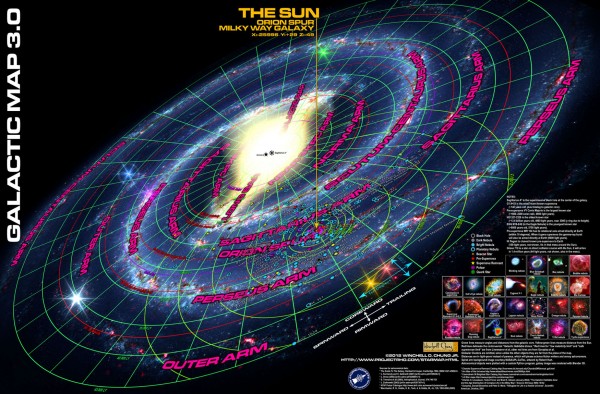
winchgalmap3SampleRight after I went through my Dinosaur phase, I saw Star Wars IV: A New Hope for the first time.  Instantly, all that childlike excitement and exuberance was transferred from paleontology to astronomy.  We had a series of about twenty astronomy books in my elementary school’s LRC (Asimov’s astronomy series, I believe–the ones with the gray dust jackets), and in about a year I’d read them all.

Star Wars was fun, but what was really fascinating was learning about the stars.  When I started to grasp the scale of our galaxy–that if our solar system was the size of a milk carton, the Milky Way would be the size of North America–my mind was totally blown.  Quasars, pulsars, black holes, white dwarfs, red giants–it was so amazing!  And then, when I started thinking about all the other worlds out there, and what it would be like to visit them–that’s when I became a science fiction fan for life.

It goes without saying that you can’t have space opera without setting the story somewhere in space.  But the best space opera goes much further than that–it’s about space as the final frontier, and humanity’s ultimate destiny among the stars.  After all, if we as a species stay put on this pale blue dot, sooner or later we’ll kill ourselves off or suffer another mass extinction event that wipes us all out like the Dinosaurs.

For that reason, classic space opera often takes undertones of manifest destiny, except on a galactic scale.  The stars are not just interesting places to visit, they’re absolutely crucial to our survival, and no matter what alien dangers await us, we will face them boldly and either conquer or be conquered.

Of course, not all space opera stories take place during the exploration and colonization phase of human interstellar expansion.  Plenty of stories take place thousands of years later, once humanity has comfortably established itself among the stars.  Even so, there are still more than enough wonders remaining to be explored–if not for the characters, then for the readership.  The vastness of space is so great that there really is no end to it, and the possibilities are only bounded by the writer’s imagination.

One of my favorite space opera computer games is Star Control II, also know as the Ur-Quan Masters.  In the game, you’re the captain of a giant starship built with alien precursor technology.  The races of the Federation, including humanity, have been defeated and enslaved by an aggressive warrior race known as the Ur-Quan.  You must travel from star to star, gathering resources to upgrade your starship and convincing the other alien races to join the new alliance.

By far, the best part about that game is the starmap.  It’s HUGE!  More worlds than anyone can possibly visit in any one playthrough, or five, or even ten.  And each alien race has its own history, its own culture, its own set of goals and objectives–and oftentimes, most of these goals have very little to do with the actual conflict of the game.  In fact, there are some races like the Arilou which don’t even seem to know that there’s a war going on.  They’re much more interested in something frightening and mysterious from another dimension that they never quite explained, but that may involve the Orz somehow…

With each new world that you discover, you learn that the galaxy has a very, very, very long history.  So long, in fact, that the human race has only really existed for a blip in time.  The other races are involved in their own disputes, and many of these go back to the times when our ancestors were swinging through the trees somewhere in central Africa.  But whether or not we want to be a part of it, we’re involved, simply by virtue of where our star happens to be located.

The best space opera isn’t just about our world: it’s about our place in a much wider universe.  Whether it’s a serious tale about humanity’s ultimate destiny, or an action-packed intergalactic romp, there’s always that sense of something greater than us–that same sense of wonder that gripped me as a boy when I first started to learn about the stars.

Image by nyrath at Project Rho. I highly recommend checking out his excellent starmaps!

G is for Gravity

cmdr_hadfield_juggling
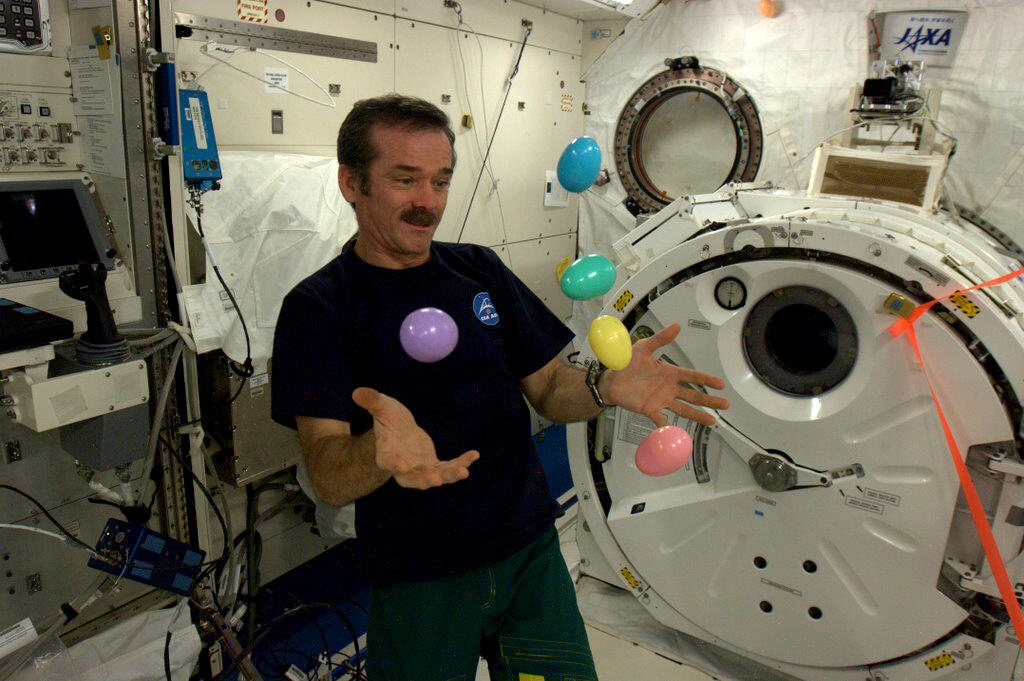
Commander Hadfield planning a zero-g easter egg hunt earlier this month on the ISS.

Possibly one of the most defining aspects of space is the sensation of free fall.  Of course, gravity exists in space, the same as it does everywhere else in the universe (probably), but in space we feel its effects differently because we aren’t close enough to a body of sufficient mass to feel a strong pull.  That, and our spaceship itself is also in free fall, so if that’s our frame of reference we feel no weight because there’s nothing for weight to push back on … but that’s a concept probably best left for O is for Orbit.

The thing is, as fun as weightlessness can be, in the long-term it can have some negative health effects, such as deterioration of bone and muscles, weakening of the immune system, etc.  The effects of micro gravity on human fertility are not very well-studied, but there’s some speculation that conception and gestation would be impossible, since embryos need gravity in order to implant properly.  Humans are adapted to live on the surface of Earth, and that means living with a constant 10 m/s2 or so of gravitational acceleration.

For future space colonies and spacefaring civilizations, this means we need to find a way to simulate the effects of gravity in a micro-gravity environment.  There are a few common ways to deal with this problem:

  • Artificial GravityApplied phlebotinum that creates a field within which the gravity is normal.  A necessary weasel hand wave that you’ll see most often in soft sci-fi and space opera, where the plot and characters are more important than the science.
  • Centrifugal GravityThe illusion of gravity created by spinning a can-like spaceship or space station in a circle, pressing the humans against the inside wall.  You’ll see this in both hard and soft sci-fi.  Scale it up, and you get Ringworld Planets.
  • Powerful Starship DriveIf your starship drive is powerful enough, it can accelerate you at 10 m/s2, effectively creating the sensation of gravity.  Your starship will be like a flying skyscraper, where “down” is in the direction of the engines.  At this rate of acceleration, you should reach 99.9% the speed of light in about a year, which opens up all sorts of possibilities for relativistic space travel (provided you have a sufficiently massive energy source to sustain that reaction).  Just be sure to give yourself the same amount of time to decelerate, otherwise bad things may happen.
  • Baby PlanetAn asteroid no larger than a small asteroid that still, for some reason, has normal Earth-like gravity.  Think Le Petit Prince.  Not nearly as common as the other three, but the existence of gravitational waves means that it may be possible (or at least plausible) to create gravity generators that work this way.
  • Roll with itYeah, so everything is weightless in space.  So what?  Deal.

Another problem related to gravity is rapid deceleration.  Unless you don’t mind splattering everyone in your starship all over the walls and ceilings, you can’t go from zero to near-light speeds (or vice versa) without some way to counteract the sharp change in momentum.  Space opera and soft sci-fi gets around this by using inertial dampers–basically, magical devices that give the starship a nice, soft ride (unless you want the bridge to explode, of course).  As you might expect, stories on the harder side of sci-fi tend to play around with this a lot more.

My first exposure to artificial gravity came when I read a comic book version of The Norby Chronicles by Isaac Asimov.  The characters had a device that would basically allow them to levitate, and I thought that was so cool.  It wasn’t until I read the Corellia Trilogy by Roger Allen McBride that I realized that every starship in the Star Wars universe had a machine that could manipulate gravity like this.  At one point, the artificial gravity generators on one of the ships failed.  My mind was blown, and I’ve never looked at gravity the same since.

I tend to write stories where the characters and plot are more central than the science, so I’ll often just fall back on the standard artificial gravity field like most space opera.  During combat maneuvers, though, things get a bit more tricky, with dampers on the bridge that mitigate (but don’t erase) the worst effects of rapid deceleration, and special coffin-like chambers for the crew below decks to keep them from getting splattered.  In my Star Wanderers series, I also use centrifugal gravity for the larger space stations, since I figure the energy costs of artificial gravity tend to scale up.

In short, science fiction stories that address the problem of gravity in a real and thoughtful way tend to be a lot more believable and immersive, even if the solution to the problem is basically magic.  As with anything in science fiction, there are so many imaginative ways of dealing with the problem that it’s actually more of an opportunity than anything else.

C is for Cryo

halo_cryochamber

I think every science fiction writer has a cryo (aka “human popsicle“) story sitting around somewhere, even if it’s just in the back of their head.  It’s one of those tropes that keeps coming back, just like the alien invasion, the robot apocalypse, and the Adam and Eve plot.

The basic concept is pretty simple, even if the technology is a bit more complex: a human or animal undergoes rapid freezing in order to put themselves into stasis for an extended period of time.  Months, years, or even centuries later, someone thaws and resuscitates them so that they wake up in a completely different time and place.

There are a lot of good reasons why going into cryo makes sense in a science fiction universe.  One of the more common ones is that the characters are colonists on a mission to an alien star, and their spaceship doesn’t have a faster-than-light drive.  Rather than go through all the trouble of building a generation ship, the designers instead built a series of cryo chambers to put the colonists into stasis for an extended period of time.  It might take centuries or millennia for the ship to reach its destination, but when it does, the colonists wake up as if it’s just been a long, dreamless night.

In The Worthing Saga, Orson Scott Card has a somewhat unusual rationale behind the prevalence of cryo in his universe (though they call it “hot sleep,” and it’s induced by a drug called soma).  Only the rich can afford the technology, and the imperial overlords very carefully regulate the use of it so that there’s a clear hierarchy based on who goes under for the longest amount at a time.  It’s a way for the citizens to achieve a simulated form of immortality, by skipping five or ten years every year or two of their lives.

In the Halo video game series, the UNSC uses cryo as a way to preserve their greatest military assets, the Spartans, for the times when they’re needed.  The first game in the series starts when John-117, aka the Master Chief, is awakened just as the starship Pillar of Autumn crash lands on a mysterious alien structure.  Like something from an old Norse legend, the third game ends when the Master Chief seals himself into the cryo chamber of a derelict starship, telling the AI Cortana “wake me when you need me.” (highlight to view spoilers).

So why are cryo stories so prevalent in science fiction?  For one thing, they’ve been floating around in our cultural subconscious a lot longer than the genre has been in existence–just think of Sleeping Beauty or Rip Van Winkle.  For another thing, the science is not that far-fetched.  Certain animals can be revived after extended periods of frozen stasis, and according to the New York Times, it’s happened at least once with a human being.  Science fiction has a long history of turning fiction into fact (for example, Arthur C. Clarke and communication satellites), so perhaps it’s only a matter of time before human cryotech becomes a reality.

I’m definitely a fan of this trope in my own writing.  Genesis Earth has a chapter with a rather horrific cryothaw scene, which I later spun off into a short piece titled “From the Ice Incarnate.” I haven’t played with it much in my latest books, but in Heart of the Nebula which I hope to publish later this year, the cryotech plays a very important role in the plot.  And if I ever write a prequel to my Gaia Nova series showing how that universe got started, it will feature a cryo colonization story.  The main premise of that series is that a group of human colonists fled 21st century Earth and went into cryo to colonize a distant corner of the galaxy, but when they woke up, they couldn’t find Earth anymore, so it became something of an ancient holy legend (which is a major driver for Desert Stars).

Trope Tuesday: Fridge Logic, Fridge Horror, and Fridge Brilliance

It's amazing how many existential story questions arise from this view.
It’s amazing how many stories suddenly stop making sense from this point of view.

You know that moment after the end of the show, when the credits are rolling and the glory of that crowning moment of awesome is just beginning to fade?  When you go to the fridge to get something to eat, and all of a sudden that gaping plot hole or internal consistency problem with the story hits you?  Yeah, that’s fridge logic.

The key, though, is that it’s not something you normally question while you’re reading the book or watching the show.  While you’re in the story itself, the narrative is so compelling that you just don’t question it–that, or rule of cool is in play.  It’s only after the story is over that those questions start to arise.

It doesn’t have to come from bad writing.  Sometimes, it’s a result of values dissonance, especially for stories written in a different time or culture (although by no means is this phenomenon immune to bad writing).  Sometimes, it’s a result of a tomato surprise, where a reveal of something the characters have known all along completely changes the audience’s understanding of the story (though certainly, this isn’t immune to bad writing either).

Not all fridge logic is bad.  Fridge horror happens when a story becomes even more terrifying the more you think about it.  Some of the scariest horror stories have done this to me, as well as some that weren’t really intended to finish on downer endings but kinda sorta did.  Cracked.com did an interesting article on six movies that went that way.

But the best is when a story turns around and gives you fridge brilliance–that moment when you realize that that thing that bothered you actually changes the nature of the story in a way that suddenly makes it your favorite.

My favorite novel of all time, The Neverending Story, totally did this to me.  When I first read it in fourth grade, there were so many things that made the story awesome: the Temple of a Thousand Doors, the test of the three gates, the old man who is the exact opposite of the Childlike Empress in every way, and of course the signature phrase “but that is another story and shall be told another time.” But when I reread it in college, I realized that the real story–the underlying story that brings everything together–isn’t about a loser kid having all sorts of adventures in a fantastic world, but about the power of storytelling itself, and how it can fill the world with love.

Another moment of fridge brilliance came to me when I learned the story behind the writing of Legend, my favorite novel by David Gemmell, my favorite fantasy writer.  The book is about a hopeless battle that everyone knows cannot be won, and the people who decide to go and fight it anyway.  That’s all well and good, except that David Gemmell wrote it immediately after he was diagnosed with terminal cancer.  The story of the battle itself was a metaphor for his own life, and his struggle with his own impending death.  Lucky for all of us, after he finished writing it the doctor came back and told him that the first test was a false positive–that he was going to live after all.  He then went on to write almost thirty more books, all of them off-the-charts awesome.

So yeah, there you have it.  These are more reader tropes than writer tropes, but as a writer it’s good to keep them in mind.  Don’t be lazy, otherwise your fans will pick your stories apart (or if you have to leave a hole, be sure to hang a lampshade on it).  And if you find yourself smacking your forehead over something you’ve already written and published, see if you can’t revisit it in later books in the series and turn it into fridge brilliance.

1000 posts and counting

1000dollars
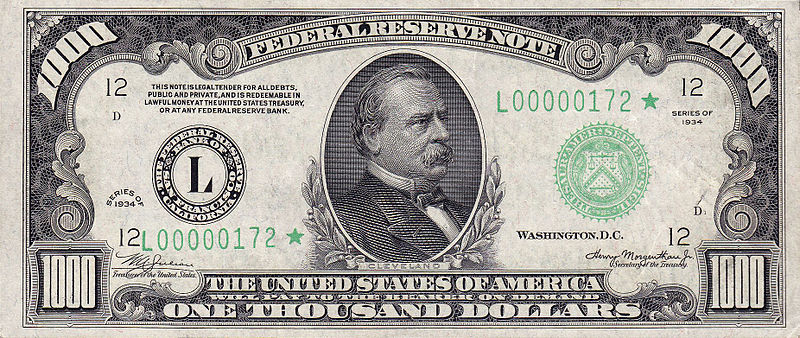
Not quite the same, but we’ll run with it anyway.

According to my WordPress dashboard, this is the 1,000th post on this blog.  I was going to hold off and do something big and momentous for the occasion, but then I figured it would be better to do a quick footnote and get on with the regular program.

Nine hundred ninety nine blog posts ago, I was a college student at BYU who had just decided to write my first novel instead of a massive Final Fantasy VI fanfic.  The year was 2007, I had a bunch of unfinished novels and stories left over from high school, but I’d never actually finished anything.  I started this blog so that my writing friends could keep me honest.

If I could have seen myself now, I probably would have thought that I’m crazy (I think I got those verb tenses right…).  Back in 2007, writing was still a hobby.  I had dreams of turning it into something a little bit more, but I never intended to try and make it my full time career–though if you’d asked me what I wanted to do for a career, I couldn’t have given you an answer.

A thousand blog posts from now, where will I be?  Married, probably, with a couple of kids (or at least one on the way).  Hopefully by then, I’ll have turned this writing dream into a full time career–heck, I’m not all that far from making it happen right now.

The 2013 me hopes that I’ll be living somewhere exotic, having an extended overseas adventure with my lovely wife.  But the truth is that I’ll probably be settled down somewhere, trying to pay off a house and raise a family the responsible way.  If that’s the case, I’ll probably look back on my 2013 self and think he’s crazy.

But hey, who knows what the future will bring?

One thing that’s almost certainly true is that I’ll still be blogging.  I don’t just blog to promote my books, or to build my “platform” (oh how I hate that word), or anything slimy like that.  I’ve been blogging since before I decided to turn this writing thing into a career, and I keep on doing it because I love doing it.  Because really, how in the heck can you get to a thousand of anything without loving it?

On that note, I should add that I’ve signed up for the Blogging from A to Z Challenge for the month of April.  Every day (except Sundays), I’ll do a post that starts with a different letter of the alphabet, starting at A and going down to Z.  My theme is going to be things I love about science fiction and fantasy, and it’s going to include a number of common tropes.  It’s going to be fun!

So yeah, here’s to the first thousand posts on this blog.  It certainly won’t be the last! 🙂