Operation SB #4: The Curse of the Lifewalker

Title: The Curse of the Lifewalker
Genre: Post-Apocalyptic
Word Count: 4,340
Time: 1 day (sort of)

So after “L’enfer, c’est la solitude,” I was kind of in a short story mood for a couple of days and decided to bang out another one. This one is actually an adaptation from my novel Lifewalker, a post-apocalyptic tale where a global pandemic kills everyone older than 25. The story takes place several hundred years after the apocalypse, where a society of children and teenage adults has evolved to fill the void left over by the collapse. It’s told from the point of view of a “lifewalker,” someone who is naturally immune and lives out a normal lifespan. Normal to us, at least–not to anyone else in the new society.

It actually wasn’t that hard to adapt the first chapter to a short story. It very much has its own narrative structure, with a beginning, middle and end. Obviously, it finishes on a rather open-ended note, but I think I was able to turn it around and focus on the premise: “when all the world is afflicted by the plague, sometimes the greater curse is to be whole.” Touched up the first couple of pages quite a bit, setting the stage for a short story and not a full novel, then went over the rest of it with a light pass and wrote a summation paragraph at the end to wrap things up.

Obviously, it took me more than one day to write the bulk of the chapter–in fact, I think it’s been through a couple of drafts now. But the adaptation to short story form went fairly well, and I’m quite pleased with the result.

Since I’ve already got stories at the top three markets (Writers of the Future, Asimov’s, Analog) and Clarkesworld is on cool-down, I sent the story to the next magazine on the list, Fantasy & Science Fiction. They only take snail mail, though, so I had to print out the story, print out a cover letter, take it to the post office, buy a letter envelope, stamp, manila envelope, fill out the SASE, etc etc. It was like a blast from the 00s or something.

Anyway, as I was walking over to the post office, I had this AWESOME epiphany in which the end of the novel came to me. It’s SO MUCH BETTER than what I’d originally had in mind, and actually got me excited to work on Lifewalker again. I probably won’t pick it up until I’ve finished the first three Sons of the Starfarers books, but now I have an awesome, amazing ending to work toward.

All I have to do is write it. 😛

Operation SB #3: L’enfer, c’est la solitude

Title: L’enfer, c’est la solitude
Genre: Science Fiction
Word Count: 6,962
Time: about 40 days

I can’t stand people who humbrag, so I’m just going to come out and say that this story is awesome. Seriously. Kickass freaking awesome. It may be the best short story I’ve written to date. Six months from now, I may come to hate it (like I’ve come to hate some of my other stories), but I seriously doubt that will be the case with this one. This represents some of my best work, and I’m extremely proud of it.

Now that that’s out of the way, I guess I should explain a little what this story is about. The title (which I didn’t figure out until after I’d written the story) is a play on the Sartre quote: “L’enfer, c’est les autres” (“hell is other people”). The story basically takes the exact opposite point of view, by showing how two people from opposing planets stranded on an isolated post basically go through hell because of their isolation, and the way it both brings them together and pits them against each other.

The idea for the story came to me years ago, when I was studying political science and modern philosophy. I imagined a situation where two worlds in a cold war type standoff both claimed an isolated, unpopulated planet somewhere, where each maintained a tiny outpost with only one person in order to stake the claim. Even though they’re enemies, the two opposing soldiers would, in many ways, be closer to each other than to their other comrades. Or would they?

The balance of power changes when one soldier’s station goes down in a meteoroid collision and he’s forced to go over to the other soldier’s station in order to survive. On the way, though, he gets a transmission from his superiors that their two worlds are now at war, and he has orders to kill the enemy soldier who has just saved his life. Can he carry them out? Is it right for him to do so? Or did the other soldier receive the same order, and is he now planning to kill him?

The idea for this story bounced around in my head for a long, long time, but I never sat down to write it because I didn’t know how to resolve it. Then, a little over a month ago, I got a crazy awesome idea for how to do it. All the other details came together, and I knew exactly what was supposed to happen.

I wish I could say that the story practically wrote itself from there, but unfortunately that was not the case. I started it back in early February, but kept putting it off because the story in my mind was so awesome, I didn’t know if I could do it justice on the page. That fear was absolutely crippling, and it’s the main reason I didn’t write any short stories at all for the month of February. It wasn’t that what I had written was bad–in fact, the beginning was pretty good. It was the fear that my skills just weren’t yet up to writing this one.

Well, those fears were pretty unfounded. While talking about the story with some friends this last Tuesday, I realized that the whole thing was silly and I should just sit down and write it. Two days later, the story was finished–and it was actually pretty good.

I know as a part of this short story challenge, I’m supposed to keep Heinlein’s rules, including rule 3 which states “you must refrain from revising, except to editorial order.” I mostly kept to that rule for this one, but not entirely. I did a lot of cycling–reading through and tweaking previous sections before putting new words on the page–as well as some significant cutting. The original draft clocked in at about 7,700 words, and Analog puts a cap at 7,000, so I went through and cut about 10%. Hopefully, though, that will just make it stronger.

I really, really like this story. It’s in first person, and the voice is quite a bit darker than some of my other stuff, but I really connected with the viewpoint character and I think it shows. Besides that, the buildup and suspense was just a ton of fun. I really hope this story gets picked up soon, because I think you’re really going to enjoy it!

This brings the number of short stories on submission now to three. I’ve garnered two rejections for “The Infiltrator,” but that’s it so far. I’m honestly not sure whether to just trunk that one, but I’ll keep it on submission for a while just in case. As Kris Rusch said in a recent blog post, you should let the editor decide what goes in her magazine without pre-editing for her.

That’s just about it. One short down for March–seventeen days to write the second one. Let’s do it!

Operation SB #2: The Open Source Time Machine

Title: The Open Source Time Machine
Genre: Science Fiction
Word Count: 3,247
Time: About 10 days

I felt really good after finishing this short story. The last line in particular surprised me, which is always a good sign. I think this story is going to go places.

The idea for this one actually came about 4 months ago. I imagined an inventor trying to convince a bunch of investors to fund his time travel development project by calling on his future self to appear to them. He fails–his future self never shows up–but after the meeting has ended in failure, he goes home and finds his future self waiting for him there. Why wouldn’t he go back in time to help himself get the funding to develop his project? That was the core idea that became this story.

I wrote out a couple of pages of that one before getting frustrated and trunking it. Then, about ten days ago, I broke my operating system (Ubuntu) and had to upgrade/reinstall it three times before it would work again. For Linux users, that’s kind of like a rite of passage. It was frustrating, but also kind of awesome because of all the stuff I learned from it. Open source technology is really, really cool.

Around the same time, I read Program or Be Programmed: Ten Commands for a Digital Age by Douglas Rushkoff. Fascinating book, especially if you’ve got a job/lifestyle where you spend +50% of your waking life in front of a screen. Rushkoff is a technology theorist, and this book is about all the subtle ways in which computers, social media, the internet, and other modern technologies can be used to manipulate us if we aren’t careful. His ideas are brilliant and his perspective is fascinating, so his book definitely got me thinking about things.

With both of these things on my mind, I went for a long walk while taking a break from my writing. Short stories were also on the mind, since I was wondering what I should write about for the month of January. The old time travel idea popped up, and everything just sort of melded together until I had the story.

I wrote the first half of it the next day … and then sat on it for a little over a week. I’m not sure why I did that–maybe I was just nervous about screwing it up or something. By far, the hardest part about writing is getting out of your own damned way. Yesterday, I finally buckled down and forced myself to finish the thing, and it actually turned out pretty well. Took the whole day to finish it, but it’s finished and that’s what’s important.

So after touching it up this morning, running a spell check and tweaking a couple of relatively minor things, I put it out on submission. That’s two stories I have on submission now: “The Infiltrator” got rejected from Clarkesworld, but it’s out at Analog now so we’ll see how that goes.

I think my short form is getting better, though there’s still a lot of room for improvement. I’m going to start running these stories through Kindal’s writing group, even though I’ll put them out on submission as soon as they’re finished. The feedback will be useful in writing the next one.

No idea what the next short story is going to be about. Maybe I’ll go through some of my old story idea notebooks and see what comes together. Or maybe a story will just come to me, and I need to position myself so that I’m ready to capture it on paper when it comes.

We’ll see. In the meantime, I’m very pleased with this one.

Operation SB #1: The Infiltrator

Title: The Infiltrator
Genre: Science Fiction
Word Count: 3,945
Time: 2 days

For my first story for Operation Short Blitz, I took a story idea that’s been bouncing around in my head for some time: that one of the best way for aliens to spy on us without being detected would be to send an infiltrator disguised as a homeless person.

I tried to do something with this idea before, but like many of my short story attempts, it turned into something longer.  For that one, I tried to tell the story from the point of view of a normal twenty-something single guy living in an apartment close to where the alien infiltrator had his base.  But then it started turning into a story about the guy, leaving the alien as the impact character, and the story became about something else.  I eventually lost interest and trunked it.

For this one, I kept it simple, telling it straight from the point of view of the alien.  I resisted the urge to put in extra subplots and instead focused on the core idea itself, making sure that everything in the story was directly connected to it.  That definitely helped to keep it short and focused.

I think it turned out pretty well.  It was hard not to self-edit as I wrote it, which was part of the reason it took two days to write instead of one.  I started it on Saturday, tried to finish it but went for a two-hour midnight walk instead.  Picked it up on Monday and finished it up then.

So now, after doing a quick proofread to fix typos and grammer, I’m going to put it on submission, sending it to Writers of the Future first and working my way down.  I don’t expect it to place, but maybe it will get honorable mention, which would be cool.  And who knows?  Nothing ventured, nothing gained.

Operation Short Blitz

Primary Objective: To master the art and craft of short-form storytelling.

Secondary Objective: To achieve name recognition in the speculative fiction field through publication in the major short story magazines.

For some time, I’ve wanted to branch out and learn how to write well in short form.  I’ve written several novels, and I feel I have a pretty good understanding of that form, but short stories have always eluded me.  I want to turn that around and really gain a degree of proficiency with short fiction, so that it’s not a big blind spot for me and that I can really master that aspect of storytelling.

My purpose in doing this isn’t to make money, though I certainly hope to make something (I write for a living, after all).  Rather, it’s to expand my storytelling capabilities and build a name for myself.  Most working SF writers have a short story component to their careers, so I figure it’s time to work on my own.

Since prestige is more important than money, I’m going to focus on getting published in the major magazines, and won’t self-publish unless either the story fails to sell anywhere (at which point I may just trunk it) or the first publication rights have already been exercised.  I do expect to self-publish my stories eventually, but not until I’ve gotten as much mileage out of them as I can.

Strategic Outline:

The Science Fiction & Fantasy Writers of America (SFWA) keeps a list of qualifying markets for membership, which is useful for picking out the best magazines to submit to.  If I can get my stories published in these magazines, which pay the highest rates and have the widest circulation within the field, I figure that Operation Short Blitz can definitely be considered a success.

In addition to the SFWA qualifying markets, there are a number of semi-professional markets that would be good to submit to as well.  I’ve heard that Ralan.com is a good site for finding those, as well as Duotrope (though the site now requires a subscription).  I won’t submit to the semi-pros until I’ve exhausted the professional markets first, though.

Even if I seriously doubt that a story is good enough to get picked up by the best markets in the field, I’ll still start at the top and work my way down.  I remember hearing that the editor of Analog (or was it Asimov’s?) once got really mad at a writer who told him that he didn’t have a story that was good enough for his magazine, since that writer was basically trying to do his job for him, and writing his own rejections instead of giving his stories a chance.  That isn’t going to be me.

(Although, there are some markets like Tor.com that have ridiculously long response times.  For those, I suppose it’s better to wait until I’ve really got a zinger of a story to send them, since I can only send one submission to a place at a time.)

I fully expect to get rejected by everybody, multiple times for multiple stories.  That’s okay–it’s all part of the process.  I’ll probably get a sidebar widget or something to track my progress, with total rejections as a prominent stat.  Maybe when I hit 500 or 1,000 or something, I’ll do something special.  It’s a milestone of progress, or at least of effort, so I definitely plan to own it as such.

Even though my goals aren’t financial, I probably won’t submit to markets that only pay in contributor copies (or don’t pay at all, for that matter).  Those publications aren’t really going to help me make a name for myself, and if I wanted to write for exposure, I could just as easily publish my stories myself.  There’s no sense in writing for exposure unless you’re the one who has the control.

Of course, I’m going to have to write a lot in order to have a lot to submit.  My goal for now is to write at least two short stories per month, preferably one every week.  I figure that’s a good balance to strike between this and my other writing projects.  My novels and novellas still take priority, but I’ll make time for Operation Short Blitz as well.  Besides, sometimes it helps to take a break and work on something that you can start and finish quickly.

For fun, I’ll post a quick summary of each story I write, with the word count, genre, how long it took me to write, and what my thoughts are on it.  If you guys can keep me honest and make sure I don’t slack too much, that would be awesome.  I won’t be posting them, though, or really any excerpts either, since I need to keep the first publication rights in order to sell them (almost no-one takes reprints, unfortunately).

Logistical Considerations:

In order to do this as efficiently as possible, I’ve put together a spreadsheet of all of the magazines I hope to submit to, ranking them in order of preference and listing all of the relevant information about them.  This information includes:

  • Name of the publication.
  • Word count requirements.
  • Genre qualifications.
  • Payment rates.
  • Expected response time.
  • Name(s) of the editor(s).
  • Link to their guidelines.
  • Link to their submission system.
  • Whether they accept reprints.
  • Whether they accept multiple/simultaneous submissions.
  • Whether they’re a SFWA qualifying market.
  • The length of any exclusivity period in their contracts.

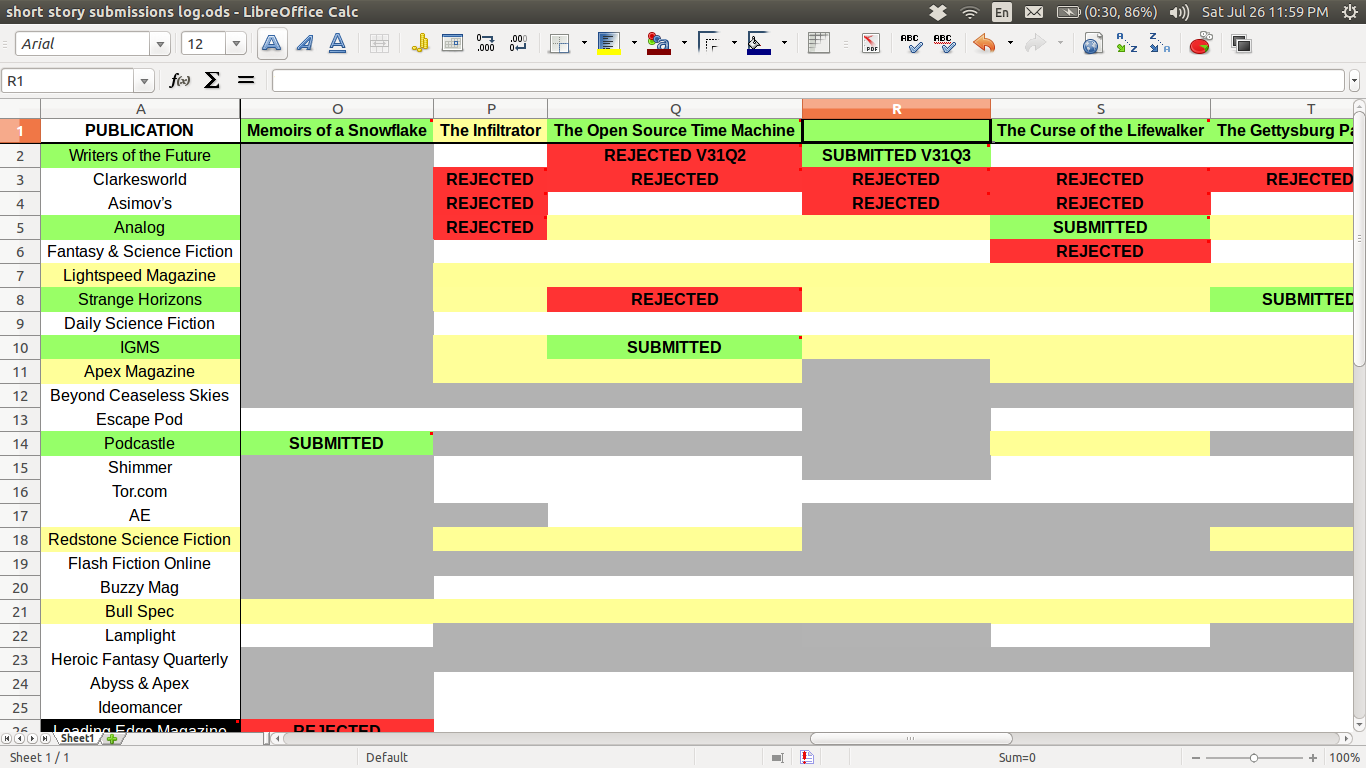
In addition to everything listed above, I’ll also keep a column for each story I’ve written, to indicate which markets I’ve sent them to and any result.  I’ll keep things color coded for convenience: red = standard form rejection, yellow = personalized rejection, green = currently on submission, blue = published, white = haven’t submitted yet, and gray = doesn’t qualify for submission.

Basically, it looks something like this:

Screenshot from 2013-12-10 22:17:50Whenever I write a new story, I’ll list it in a new column on the spreadsheet, gray out any markets that I don’t plan to send it to, and immediately send it out on submission, starting with the market at the top and working my way down.  If it goes through all the markets and doesn’t get picked up by any of them, then I’ll either trunk it or self-publish, but not until I’ve gone through all the markets first.

I’ve got to admit, one of the big motivations for me is this spreadsheet.  There’s something about having all of my stories organized and color coded in a place where I can see them all that makes me want to write more of them.  What can I say?  I’m a nerd.

Tactics:

For the duration of this operation, I’m going to adhere strictly to Heinlein’s rules, which are:

  1. You must write.
  2. You must finish what you write.
  3. You must refrain from rewriting, except to editorial order.
  4. You must put what you write on the market.
  5. You must keep it on the market until it has been sold.

No matter how great the temptation, I will not revise a story after it’s finished.  If it’s broken, I’ll just trunk it and write something else, or rewrite it from scratch.  If I workshop it, I’ll do it the way Dean Wesley Smith advises, which is to workshop it after you’ve sent it out, in order to learn how you can improve on the next one.

The reasons for this are twofold.  First, a lot of writers I whom respect (especially short story writers) swear by Heinlein’s rules, so I plan to try them out and see just how well they work for me.  Second, I don’t want to become a master reviser or editor, I want to become a master writer.  I wrote almost all of my college essays the night before they were due, and could easily pound out an A+ essay on a first draft by the end of my college career.  I wouldn’t be surprised at all if short stories are similar.

Since I have a lot of other writing projects to deal with, I’ll probably limit myself to two or three days at most for each story.  I average around 2,500 words a day when I’m on project, so if it takes me a week to write a 5,000 word short story, I’m probably doing something wrong.

Like I said above, my goal is to write at least two stories per month, preferably one per week.  I usually take Sundays off, so I figure that Friday/Saturday would be a good time to work on a short story.  It’s at the end of the week, so it won’t interrupt my normal work flow too much, and gives me a chance for a nice break.  If I don’t finish it in one weekend, I can put it off until the next one.  I’ll try that out and see how it goes.

Of course, the only way to get great at writing short stories is to read a lot of them too.  I already subscribe to Escape Pod and the Clarkesworld podcast, and just signed up for Daily Science Fiction as well.  If any of you guys have good recommendations for short stories or magazines, let me know–I’m definitely interested in reading as much great stuff as I can.  And of course, I’ll still keep working at the slushpile for Leading Edge.

That just about does it, I think.  This is definitely uncharted territory for me, so I expect I’ll be learning a lot of great stuff along the way.  For now, though, this is how I plan to go about doing it.  It will probably take a couple of years before Operation Short Blitz really comes to fruition, but I plan to stick with it until it does.

Wish me luck!  And if you want to join me by doing something similar, let me know how it goes!

Revisions, X-COM, and working on my short game

So I finished putting together the revision notes for Heart of the Nebula on Monday, and started working on those today.  It was interesting to compare the original rough draft (which was completely broken) with the incomplete revised version that I’d worked on about a year ago (which was also completely broken, but in different ways).  Fortunately, even though both drafts are train wrecks, they’re not unsalvageable.  In fact, I think there’s a pretty good story underneath it all.

Usually when I write a big novel like this, the first draft works pretty well up until about the middle, then either it falls apart or the scenes start getting out of order, or both.  In the first revision pass, I take out all the stuff that isn’t working, but struggle to come up with new stuff to replace it.  Usually, I’m just recycling the old stuff, and the result ends up a bit out of place and watered down.  On the third pass, I say “screw it” and come up with a bunch of new stuff, which helps me to see where the story is actually going and arrange the scenes in the correct order.  It’s not always as straightforward as that, but that’s the pattern.

In fact, I’ve learned a lot of interesting things from this revision, which I’ll probably save for another blog post when my thoughts on this are a lot clearer.  The big takeaway is that I need to clearly separate the tasks that should be done in my creative mind (like writing new words and coming up with story) and the ones that should be done in my critical mind (like mapping out what to cut and what to keep or recycle).  But more on that later.

About a week ago, I got X-COM: Enemy Unknown on a Steam sale and I’ve been playing it like crazy.  It’s a really awesome game!  I love the complex tactical thinking and how it really puts you there on the ground with your troops.  And then, an enemy pops out of nowhere, flanks you, gets a critical hit, and the next thing you know your favorite soldier who you’ve been meticulously leveling up over the last thirty missions is DEAD!  NOOOOO!!!

So yeah, that’s been eating up a lot of time–probably too much of it, to be honest.  But I’m still working on various writing projects, including a plan to improve my short game.  I put together a spreadsheet of all the major short story markets in the speculative fiction field, and ranked them in order of preference.  My plan is to write a short story every week (or at least twice a month) and put it on submission, going right down the line until I’ve exhausted all the appropriate markets.  No revisions, no holding stuff back because I think it’s not good enough–just writing and submitting until I’ve mastered that side of the art.

This is something I’ve been wanting to do for a long time, but I’ve been holding back because … well, I don’t know why I’ve been holding back.  Maybe I’ve just had it in my head that I’m not any good at short stories?  Well, maybe right now I’m not, but I’m sure that it’s something I can learn.  It’s a side of creative writing that I haven’t really explored yet, which means that there’s a lot of opportunity to learn and grow.  And if/when I do start getting picked up by the major magazines, that’s going to do a lot to advance my career.

Don’t worry, I still plan to keep working on novels and novellas.  This short story thing is something I’ll probably do when I need a quick break, to start something that I can finish in a day when I’m stuck in the middle of a gargantuan project.  I’ll probably limit my short story writing to Saturdays, so it doesn’t interrupt things too much, and try to write them in one or two sittings if I can.

So that’s what I’ve been up to in the past week.  In other news, it has gotten RIDICULOUSLY COLD out here in Utah, and I love it.  Cold weather means hot chocolate, borscht, and oatmeal!  It also means I need to get myself a bomber jacket–the kind with the awesome pockets on the arm.  It’s been years since I had one of those, and they are good quality jackets.

In any case, that’s enough for now.  I’ll do what I can to keep this blog updated as I move on with revisions and other stuff.  In the meantime, stay warm!

Why I love writing novellas

Star Wanderers I (thumb)Star Wanderers II (thumb)Star Wanderers III (thumb)Star Wanderers IV (thumb)SW-V Dreamweaver (thumb)SW-VI Benefactor (thumb)thumb (Sholpan)

For the first half of this year, almost every project I’ve worked on (with the exception of an unfinished short novel) has been a novella.  It’s not a form I was familiar with when I first started writing, but I’ve come to enjoy it immensely, and look forward to writing much more in the future.

The technical definition of a novella is pretty simple, at least according to SFWA.  It mainly has to do with word length:

  • Novel — 40,000 words or more
  • Novella — 17,500–39,999 words
  • Novelette — 7,500–17,499 words
  • Short Story — 7,499 words or fewer

That one simple distinction leads to a host of other differences, though, since words and story length are so crucial to the different types of stories you can tell.

Short stories tend to be more situational.  A good short story writer (which I am not) can use the form to explore all sorts of other story elements, but there’s always something of a tradeoff.  A good short story will have strong characterization but a simplistic or nonexistent plot, or center around a compelling concept but not provide an immersive setting.  It’s a very minimalistic form–there’s always something of a sacrifice.

A good short story can pack a real punch, but it doesn’t really immerse you in another world.  It might resonate for a long time after you read it, but you finish it almost as soon as you start it.  It’s a form that I enjoy in audio form, but don’t actually read very much.  It’s great for the commute or a road trip, but not so great when I’m curled up in the lovesack looking to get lost in a book.

That’s just me, at least.  And as for writing them, I need a lot more practice before I have anything useful to say on that.

With novels, it’s exactly the opposite.  They are so expansive that they tend to have multiple viewpoints, subplots, character arcs, and setting elements all woven together in one sprawling whole.  There are differences, of course, between a 200k word fantasy epic and a short 60k word thriller, but complexity is an important part of the form.  It’s not enough to have an interesting situation, or a single mind-blowing idea–you have to have several, and they have to work together.

When done well, the effect can be tremendous.  A good novel is much more than just the sum of its parts, and the climactic moments when everything comes together can be truly spectacular.  They’re incredibly immersive, too–I’m pretty sure that some of my childhood memories are things that never happened except in the pages of a book.

But sometimes, it can be hard to get into a novel, either because it starts off slow or because from the very beginning it’s so complex.  Also, it requires much more of an investment, especially in time.  I can’t tell you how many novels I’ve checked out from the library, only to return a few weeks later with a hefty overdue fine on my account–not because I didn’t like them, but because I just couldn’t find the time to finish.

In terms of writing, all of that storytelling complexity can make the task positively gargantuan.  It depends on the length of the novel, of course, but the longer it gets, the harder it is to keep everything straight.  And when something is off and the story just doesn’t seem to be coming together, it can be incredibly difficult to figure out exactly what is broken.  Even if it’s small, or something that’s easy to fix, you can easily find yourself revising in circles.

The novella falls more or less in the “Goldilocks” zone of these other forms.  It’s long enough to give you the space you need to play with things on a novelistic scale, but short enough that you don’t have to worry about bringing all that complexity to the page.

Generally, I’ve found that there isn’t much of a difference between novellas and novelettes.  I’ve dabbled with both, and found that the difference has more to do with brevity and less to do with actual structure or form.  A well-written novelette can do all (or at least most) of the things a novella can do, just in a slightly more economical fashion.  And of course, the differences in all of these forms is subjective and fuzzy.  Your experience could very well be different.

But personally, I find novellas (and novelettes) much more fun to write because it allows me, sometimes even forces me, to get a lot more intimate with my characters and their individual points of view.  A situation or idea alone is not enough to carry the story for the required length, but exploring multiple viewpoints (or at least more than two) tends to push the story too far.  Consequently, I find myself really diving into my characters and trying to see things from their perspective.

It’s similar with novels, but without all the other subplots or character arcs, there are fewer distractions–and fewer ways to screw up.  I can stay in the character’s head without having to break out to fix something else.  Also, my first drafts tend to be a lot cleaner, with less need for massive substantial revisions.  And even if the draft is irredeemable, I can toss it out and rewrite from scratch with a lot less pain, since it’s only 30k or 40k words.

So yeah, I really love writing novellas, which is something that would have surprised me only three or four years ago.  There aren’t a whole lot of traditional markets to sell them to, but that doesn’t matter because they’re perfect for ebooks and self-publishing.  It’s also a lot easier to take a loss on a perma-free novella than it is on a full-length novel.

I’ve found that I can write a good first draft of a novella in anywhere between two and six weeks.  I wish I could do it quicker, but I’m not a very fast writer, so thirty days is a pretty good cap for a deadline.  And because they’re shorter, they tend to be quicker to revise, and easier to hand off to alpha readers who will give you a good turn-around time for feedback.

For those of you who prefer more long-form stories, don’t worry–I haven’t given up on writing novels.  In fact, I’ve got a half-finished epic fantasy novel that I’ll probably work on next, once Star Wanderers: Benefactor (Part VI) has gone through a major revision pass.  But if you enjoy reading novellas as much as I enjoy writing them, then you’ve got a treat, because I’ve got a bunch of Star Wanderers novellas that will be coming out in the next few months!

And after that?  Who knows …

C is for Cryo

halo_cryochamber

I think every science fiction writer has a cryo (aka “human popsicle“) story sitting around somewhere, even if it’s just in the back of their head.  It’s one of those tropes that keeps coming back, just like the alien invasion, the robot apocalypse, and the Adam and Eve plot.

The basic concept is pretty simple, even if the technology is a bit more complex: a human or animal undergoes rapid freezing in order to put themselves into stasis for an extended period of time.  Months, years, or even centuries later, someone thaws and resuscitates them so that they wake up in a completely different time and place.

There are a lot of good reasons why going into cryo makes sense in a science fiction universe.  One of the more common ones is that the characters are colonists on a mission to an alien star, and their spaceship doesn’t have a faster-than-light drive.  Rather than go through all the trouble of building a generation ship, the designers instead built a series of cryo chambers to put the colonists into stasis for an extended period of time.  It might take centuries or millennia for the ship to reach its destination, but when it does, the colonists wake up as if it’s just been a long, dreamless night.

In The Worthing Saga, Orson Scott Card has a somewhat unusual rationale behind the prevalence of cryo in his universe (though they call it “hot sleep,” and it’s induced by a drug called soma).  Only the rich can afford the technology, and the imperial overlords very carefully regulate the use of it so that there’s a clear hierarchy based on who goes under for the longest amount at a time.  It’s a way for the citizens to achieve a simulated form of immortality, by skipping five or ten years every year or two of their lives.

In the Halo video game series, the UNSC uses cryo as a way to preserve their greatest military assets, the Spartans, for the times when they’re needed.  The first game in the series starts when John-117, aka the Master Chief, is awakened just as the starship Pillar of Autumn crash lands on a mysterious alien structure.  Like something from an old Norse legend, the third game ends when the Master Chief seals himself into the cryo chamber of a derelict starship, telling the AI Cortana “wake me when you need me.” (highlight to view spoilers).

So why are cryo stories so prevalent in science fiction?  For one thing, they’ve been floating around in our cultural subconscious a lot longer than the genre has been in existence–just think of Sleeping Beauty or Rip Van Winkle.  For another thing, the science is not that far-fetched.  Certain animals can be revived after extended periods of frozen stasis, and according to the New York Times, it’s happened at least once with a human being.  Science fiction has a long history of turning fiction into fact (for example, Arthur C. Clarke and communication satellites), so perhaps it’s only a matter of time before human cryotech becomes a reality.

I’m definitely a fan of this trope in my own writing.  Genesis Earth has a chapter with a rather horrific cryothaw scene, which I later spun off into a short piece titled “From the Ice Incarnate.” I haven’t played with it much in my latest books, but in Heart of the Nebula which I hope to publish later this year, the cryotech plays a very important role in the plot.  And if I ever write a prequel to my Gaia Nova series showing how that universe got started, it will feature a cryo colonization story.  The main premise of that series is that a group of human colonists fled 21st century Earth and went into cryo to colonize a distant corner of the galaxy, but when they woke up, they couldn’t find Earth anymore, so it became something of an ancient holy legend (which is a major driver for Desert Stars).

Random updates before leaving

I’m spending Thanksgiving with my parents this year, which means I’m leaving for Massachusetts tomorrow…by train.  Well, technically, Sunday morning, since the cross-country trains come through Salt Lake City in the wee hours, but to my way of thinking it’s tomorrow and not Sunday.  Either way, I won’t be posting anything until Tuesday night, since that’s when I arrive.

You may have noticed that Amazon recently bumped the price of my two short stories, Memoirs of a Snowflake and Decision LZ1527,” back up to $.99.  I decided to raise the price because giving them away for free wasn’t having any sort of effect on sales of my other novels.  Sure, it exposed my work to more readers, but I want to be known for my science fiction series, not because of a couple of cute stories that aren’t a whole lot like anything else I’ve written.

However, after reading Kris Rusch’s recent post on this subject, I decided to drop the price of Sholpan to free for the next couple months.  Sholpan is a novella taken from Bringing Stella Home, and is a great place to start for my Gaia Nova series.  It’s a complete story on its own, but I’m hoping it will drive interest in the full length novel, and later in Desert Stars.

If the price dropping process is anything like it was for the short stories, though, it will be a while before Sholpan is free across all platforms.  Amazon doesn’t allow you to set the price to free yourself; you have to get all the other places to do it first, so that Amazon’s bots will detect it and price match.  To do that, you have to drop the price on Smashwords first and wait for it to trickle down.

In short, it will probably take three to five weeks for Amazon to make Sholpan free.  Hopefully it’ll happen in time for the holiday season, and probably for a month or two afterward.

In the meantime, I just noticed that Memoirs of a Snowflake is on both the science fiction anthology and fantasy anthology top 100 lists on Amazon.  Woot!  It’s not going as fast as it was when it was free (I think I’ve had just five sales in the past 48 hours), but it’s still going.  It will be interesting to see how long it holds up; it would be awesome to crack the top 10 on either of those categories!

And that’s about it.  I’ll leave you with the following quote:

All journeys have secret destinations of which the traveler is unaware.

–Martin Buber

Story Notebook #7

All right, it’s been forever since my last story notebook post, so I figure it’s time to do another one.

Last time, I shared the story ideas I from my fifth story notebook, during my time in Washington DC.  This next notebook is pretty tattered, and it covers my time from graduation to winter of last year.  One of the reasons it’s falling apart is probably because I didn’t have a car and had to bike everywhere.  That’s probably why I weighed fifteen pounds less, too.

EDIT: This notebook actually covers the end of summer to the the winter, after I’d gotten a car.  Minor point, but it’s worth noting to clarify.

Anyhow, here we go:

Machu Pichu…IN SPAAACE!!!  Seriously, an exploration mission that finds abandoned ruins on another planet.

Happens fairly often in science fiction, though it isn’t something I’ve tried my hand at yet.  Although I guess there was some of that in Genesis Earth, and I’ve got a couple of ideas for something similar in the Gaia Nova Universe…moving on!

A knight sets out to rescue the damsel from the dragon, but the damsel slays the dragon and becomes the monster that the knight must slay.

Hmm, this one sounds promising.  Of course, “knight,” “dragon,” and “damsel” are all archetypes, not literal characters.  For example, if Raoul is the knight, the Phantom is the dragon, and Christine is the damsel in distress…wow, that would be disturbing.

What if Earth is a wildlife preserve for an interstellar species that is far more advanced than us?

Kind of like “They’re Made of Meat”?  I think Predator might have done something like this, except that Earth was a hunting preserve.

A society where people achieve immortality by uploading their consciousnesses to a normal human fetus through a process called “reconception.” They do this because computer hardware is incompatible with human wetware.

I’m pretty sure I retrofitted this story idea from a play on the word “inception.” Man, that was a good movie.

Planetary colonization scheme: send down a group of genetically modified humans, who are hardy, extremely fertile, have shorter gestation periods, etc, and have them do the dirty work of building the first settlements.  Then send the regular humans after a couple of generations, when they’ll be revered as gods for their superior technology, and have the two cultures intermarry.

I had a long involved dream about this story idea shortly after I had it.  Sounds like a good idea for a series; one of these days, I’ll have to write it.

A character who sees right through all the pretenses and lies of society to know people for what they are–a magnificent judge of character who isn’t swayed by power, position, or pretend honors (eg high paying jobs)

In other words, Captain Moroni–IN SPAAACE!!!

An offworld version of Australia or Siberia, where convicts create their own country.

This idea could single handedly save the US space program.

A society in which everyone must remarry every X number of years.

Wow–I want to use this right now in my current WIP!  Okay, maybe that would be a bad idea.

What if dreams are not only the subconscious working through the events of the past day, but of events that our consciousness perceives as lying in the future?  That the subconscious transfers information non-linearly through time and space?

So shiny…must..resist…

A character who can read minds, knows every dirty thought inside your head, and isn’t disgusted by it.

If I ever met a girl like that, my first question for her would be “will you marry me?”

What if the evolution of our society in the information age is like simple celled organisms evolving into complex ones?  Where the AI overmind will organize into a giant organism as complex as a human being?

Reminds me of an excellent story on Escape Pod titled “Endosymbiont.” You should drop whatever it is that you’re doing and listen to that story right now!

An evil overlord who wants to unite mankind under the overmind instead of under his own rule

Kind of like a mashup between Sauron and Javier.

Perhaps every generation has an impossible battle, and whether they rise to meet it or fail to overcome it defines that generation’s place in history.

If that’s true, I’m pretty sure my generation is failing.

A fantasy that romanticizes the minion.

An AI that falls in love with its creator.

A person who appears schizo but actually jumps between close possible universes.

Better yet, a story that mashes all of those ideas together!

A character who loses the mental ability to translate sounds into words and language–who sees everyone else as animals.

I’m pretty sure this happened in The Silmarillion at some point.

A character who believes that existence itself is an epiphanic prison.

…and appears schizo but actually jumps between close possible universes…

What if war and terror is normal everywhere else in the world, and all of us Americans living our quaint middle class lives are ridiculously sheltered?

Uh, I’m pretty sure that’s not fiction…

A fast food place that uses time travel to delver full course meals.

<facepalm> Oh man, there are so many ways that could go wrong.

And finally:

A future world in which smiles have been turned into a commodity.

WE…ARE..THE NINETY NINE PERCENT!

And that concludes my sixth story notebook.  I sense an encouraging trend; some of these ideas were pretty good!  Or maybe I’m still too close to them…in any case, there’s no telling until someone actually sits down and writes the story.

So if you feel like taking one of these ideas and running with it, feel free!