What’s going on here?

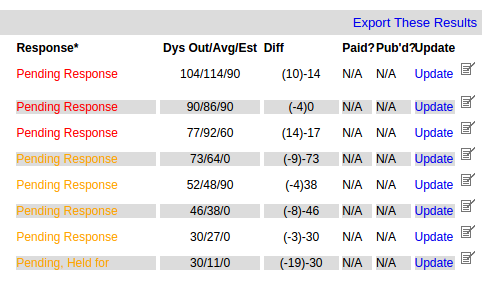
grinder screenshotAccording to The Submission Grinder, I currently have 8 short stories on submission. Right now, ALL of them are overdue for a response. I haven’t submitted a story anywhere in the past 30 days, and that’s highly unusual.

Either things are slow because it’s the end of the summer, or…

In related news, I have a new Star Wanderers short story that’s coming out at the end of the week! After submitting it to the major markets for the past year, I’ve decided to self-publish. The story fleshes out the Star Wanderers universe in some interesting ways, which I think you’ll appreciate if you enjoyed the original series.

Nothing Found

Playing with cover art

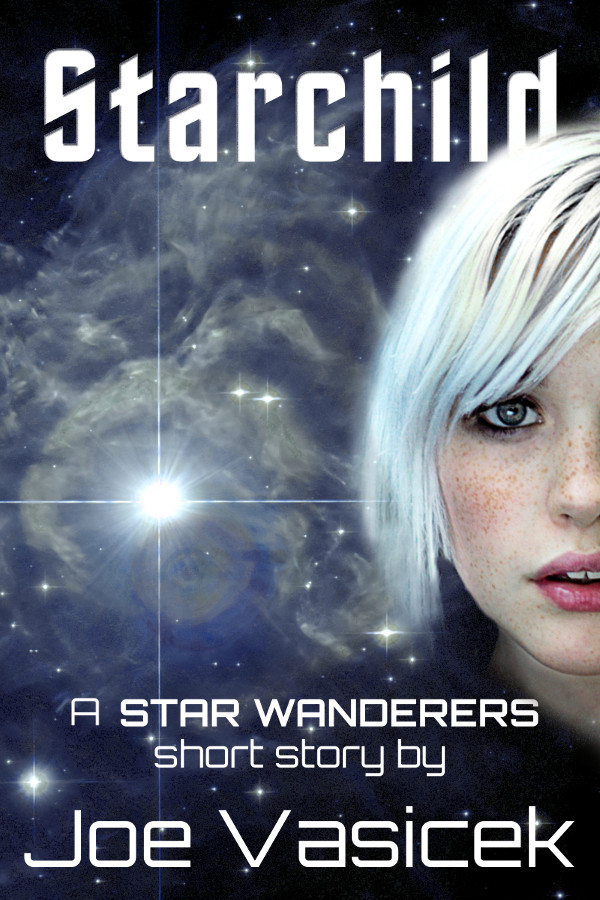
So last week, I was dinking around with some images, making a cover mock-up for a Star Wanderers short story that’s currently on submission to Orson Scott Card’s Intergalactic Medicine Show. This is what I came up with:

Starchild (cover)The model is Devon Jade, photographed by Aaron Tyree on Deviantart (CC BY 2.5). The background image is variable star RS Puppis, photographed by NASA (public domain).

The story itself is set in the same universe as Star Wanderers, around the same timeline. It’s very short, only 15 pages, and follows the coming of age and loss of innocence of a girl on an isolated space station in the Far Outworlds. It’s on submission to the major SF&F markets right now, but in a few months I anticipate that it will be available to self-publish. I think I blogged about it when I wrote the story last year.

So far, I’ve sent it out to Clarkesworld, Asimov’s, F&SF, Strange Horizons, IGMS, and Escape Pod. All of them except for IGMS have rejected it so far, which isn’t too unusual for short stories (you tend to accrue a LOT of rejections before anything gets published). After I hear back from IGMS, I’ll probably send it out to a couple more pro markets and a handful of semi-pro markets before I publish it myself.

I’ve got to be honest, I’m really really tempted just to put it out right now. But I want to give the magazines a try first. I can always self-publish it after I’ve exhausted all the markets, but once it’s self-published, none of the magazines will take it. Better to be patient and keep it on submission for now.

You can probably expect to see this story sometime early next year, either in a sci-fi magazine (fingers crossed), or on Amazon. When I do publish it, I’ll make it free for my email list subscribers.

Just in time!


Orc Chieftain by Wulfgnar on deviantART

So yesterday was the deadline for the fourth quarter of the Writers of the Future contest. I’d submitted the Gettysburg time paradox story waaay back in July, but after workshopping it with some friends, I realized that it wasn’t quite up to par. On Monday, though, I workshopped another story with the same group of friends, and got some amazing feedback that helped me to turn a great story into an awesome one.

I originally wanted to submit that story to Tor.com, which opens up to submissions again today, but after finishing it up I wondered if maybe I could withdraw the Gettysburg story from WOTF and submit the better one instead. The thing about Tor.com is that they have a ridiculously long wait time–145 days average, up on The (Submission) Grinder. Since WOTF has a much shorter wait time (no longer than three months, since they announce the winners each quarter), I wasn’t too keen on taking this story out of the loop for more than a quarter.

So I emailed Joni yesterday afternoon, just a few hours before the deadline, but I didn’t think she’d respond in time to submit it. To my surprise, she responded in fourteen minutes (fourteen minutes!) and told me that the old story was withdrawn, so I was free to submit the other one! Awesome!

So now I’ve got a story in the contest that I’m super super proud of and think might actually have a shot at placing. And even if it doesn’t, the sooner I can run it through WOTF, the sooner I can run it through the other markets I want to submit it to (there’s only three more after this), which means the sooner I can self-publish it and get it up for you guys to read. It’s kind of hard talking about a story when none of you guys can read it, but trust me, I think you’re really really going to like this one.

Workshopping it Monday gave me an AWESOME idea for another short story / novelette in the same universe, about a runtling orc who uses his wits to free the hero from the dungeon and get him to kill the orc high commander, freeing all the disgruntled warriors to desert the Witch King’s army and return to their clans (which is what all of them want to do anyway). I am super super excited to write this story!

For those of you waiting for the next Sons of the Starfarers book, though, don’t worry, that’s coming along as well. I’m about halfway through Book IV: Friends in Command right now, and it should be finished (the rough draft, anyway) by October 15th. If all goes well, I’ll have it up for pre-order sometime in November, with a release date of January 1st.

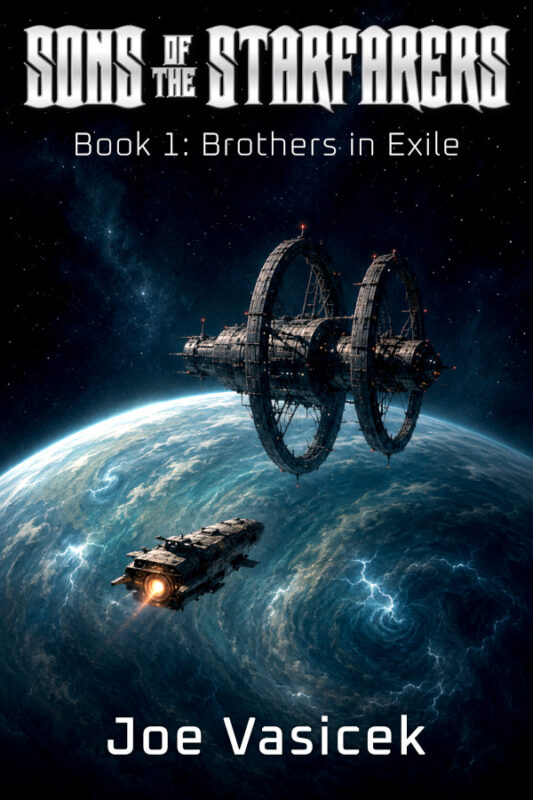
Brothers in Exile

Brothers in Exile

eBook: free!

Isaac and Aaron are nothing if not survivors. Their homeworld lost and their people scattered, all they have left is each other. Then, in the Far Outworlds, they find a dead colony with a beautiful young woman frozen in cryostasis. She is also a survivor—and she needs their help.

More info →

Also, I’m happy to report that Book I: Brothers in Exile is now free on the main Amazon store! If you haven’t read it yet, feel free to pick up a copy, and if you have read it, I would appreciate it immensely if you could post an honest review. In order to feature it on a couple of sites, I need to get at least ten reviews, preferably with a high-star rating, but more than that I think it’s important just to have reviews that are honest and thoughtful. Anything you guys can do to help with that, I would appreciate it.

And that’s just about it. I have a lot of writing to do, so I’d better get back to that. See you guys around!

Short Blitz #7: Starchild

Title: Starchild
Genre: Space Opera
Word Count: 3,000
Writing Time: about two weeks

I haven’t trimmed or polished this story yet, but I’m calling it at 3,000 words. If I were stricter about following Heinlein’s rules, I would only give it a proofreading pass, but with shorts I’ve heard that it’s best to cut out as many unnecessary words as possible, so I’ll give it a solid pass before sending it out.

Unlike all of my other short stories so far, this one takes place in the same universe as my novels and novellas. Specifically, it takes place in the Star Wanderers universe, at an unspecified system deep in the Outworld frontier. It’s about a girl in the strictly regimented society of an isolated space colony, who decides to be the first from their outpost to win the heart of a star wanderer. More generally, it’s about the cycle of life on a frontier space station and the inevitable loss of innocence from contact with the outside.

The idea came to me while I was on vacation, so I didn’t do much with it for the first week. I dabbled with it while I was out at the Cape, writing a little here and there, but it wasn’t until I was on the train headed back that I dedicated some serious time and effort to it.

My sister lives in Iowa, at almost the exact midway point between Massachusetts and Utah, so I decided to stop by and pay her a visit along the way. I finished the story this afternoon at her house, and I plan to print it out and submit it to F&SF while I still have access to their printer. What can I say … I’m cheap. :p

I don’t think this will be the last short story that I write in the Star Wanderers universe. If I could write a few good ones that get picked up by a major magazine like Asimov’s or Clarkesworld, that would be a great way to bring in more readers. I figure a story in the same universe as my other books will be much better at that than a generic short story, and since self-publishing is my bread and butter, the more I can get my short stories to serve that, the better.

In any case, now that thing one is done, I can focus all of my attention on Sons of the Starfarers. If all goes well, Book III: Strangers in Flight will be published in the next couple of weeks, and Book IV: Friends in Command
will be finished (at least the rough draft) by mid-October. This was a nice project to work on during vacation, but now that it’s finished, it’s time to get back to work!

Almost back from vacation

So I’m in Massachusetts now, getting ready to head back to Utah by way of my sister’s in Iowa. I spent the last week on Cape Cod for family vacation, which was a lot of fun! Cape Cod is one of my favorite places, and it was good to sit back and take a break from things.

Of course, that doesn’t mean I haven’t been writing. While on the beach, I reread Nancy Kress’s Beginnings, Middles, and Ends (an excellent writing book), and in the evenings I tinkered a little with a short story in the Star Wanderers universe. I also sent out several short story submissions, and even received a couple of rejections. I’ve got seven stories out on submission right now, and I hope to push that number even higher before the end of the summer.

But short stories aren’t the main focus. The main focus right now is Sons of the Starfarers, specifically, getting Strangers in Flight published. The final draft is currently with my editor, and the cover art is ready to go. Check it out!

SSF-III (cover)I am definitely looking forward to getting this book out. But if you haven’t read the other books in the Sons of the Starfarers series yet, I would advise you to wait until the first omnibus comes out. I should have that up for pre-order by the middle of September, and I’ll price it slightly lower than all three books put together.

I’m not sure when the fourth book will be out. At this point, all I have is a rough outline. However, I expect that it will be out before Christmas. I don’t think it will take more than a couple of months to write, and I’m really excited to write the fifth book, so once I get started I expect it will go quickly. The title for book four is Friends in Command, and it will be primarily from Mara’s point of view.

That just about does it for now. I’d better get back to packing so that I can get some sleep before the night is over. Take care!

Short Blitz #6: A Hill On Which To Die

Title: A Hill On Which To Die
Genre: Epic Fantasy
Word Count: Word Count: 15,000
Writing Time: About a month

IT IS FINISHED.

Ugh, this story took forever. What started as a short story soon turned into a novelette, and then that novelette got longer and longer … and then life got crazy busy, and I suddenly had a lot less time to write. And then all these weird writerly anxieties started taking over, and I found myself procrastinating during what little writing time I had …

In any case, it is finished now. IT IS FINISHED! And even though it needs a revision, and a couple of scenes need to be changed or rewritten entirely, I can take care of all that tomorrow.

Anyways, this story is about a band of orcs that leaves their clan to start a new one. The main character is an old veteran war chief who has lived beyond his prime and fully expects to die. There’s blood, carnage, rape, and all sorts of violence. There’s also courage, loyalty, hope, sacrifice, and devotion to a higher cause. It’s a bit like Watership Down, except with orcs instead of rabbits.

In spite of all the trouble this story gave me, I had a lot of fun with it. I’d like to self-publish it, but first I suppose I should send it off to the relevant markets. According to my spreadsheet, there are only five pro-markets that take stories over 15,000 words:

  • Writers of the Future
  • Asimov’s
  • Fantasy & Science Fiction
  • Orson Scott Card’s Intergalactic Medicine Show
  • Tor.com

Leading Edge is a semi-pro market that takes stories up to 15,000 words, but I know for a fact that the content in this one is not BYU appropriate. It’s a lot darker than I usually write, with some sexual violence that almost certainly needs a trigger warning if/when I self-publish.

But even though it depicts a lot of violence, I don’t think it crosses the line into glorifying it. Certainly not the sexual violence, which even the main character admits is wrong. And it’s not like the women are in there just to get raped, either–there’s actually a band of female orc warriors who beat the male orcs at their own game.

In any case, with only five markets that I know of that accept stories of this kind, I figure it won’t be too long before this story returns to me and I can self-publish it for you all to read. If any of you know of any other markets to send this place, let me know!

Yay for short stories!

So for the past three weeks while waiting for my first readers to get back to me with their comments on Strangers in Flight, I’ve been working on short stories. It’s a great way to stay busy and productive between projects, and feels really gratifying too because it only takes a week or two to finish things.

Screenshot from 2014-07-26 23:59:19The really gratifying thing for me, though, is sending off my stories to the magazines and having half a dozen or more on submission at any time. I love self-publishing, but for short stories, it makes a lot more sense to shoot for publication in one of the traditional markets first. They don’t buy exclusive rights, so you’re free to self-publish later, and they put your writing in front of a new audience, giving you some great exposure–all while paying you!

So far, the only market I’ve cracked has been Leading Edge. But the more I write, the sooner that will change! And since I still have the option to self-publish, the rejections don’t feel quite so discouraging. Instead, it’s almost like a friendly competition with myself to see how many rejections I can rack up, and how many stories I can have on submission at one time.

Lately, I’ve been working on a Sword & Sorcery story titled “A Hill On Which To Die.” It started off as a short story, but then it morphed into a novelette–not quite as long as Star Wanderers: Outworlder (Part I), but long enough that most of the markets won’t take it. It’s also long enough that it will probably need a revision once it’s done, and I may run it past a reader or two. It’s definitely turned out to be more work than I’d bargained for.

There’s another story I’m working on about a naturally occurring time portal in rural Pennsylvania, and how the Amish are so isolated from modern society because they’re the ones guarding it. Then I’d like to rewrite “The Infiltrator,” to cut out most of the stuff at the beginning and dive straight into the action. That should take only a day or two. And then, there’s that story about the uplifted Deinonychus that my girlfriend really wanted to read …

Gah! So many ideas to play with! I cannot possibly write fast enough to keep up with them. It’s the most frustrating thing in the world!

I suppose for most of my readers, this talk of short stories is kind of frustrating too, since they probably won’t be available for you to read for a while. But one way or another, they will come out eventually! And it’s definitely better to write something while in that weird space between projects. At least I’m finishing stuff.

So that’s what I’ve been up to lately. I’ll probably finish “A Hill On Which To Die” in a day or two, then work on “That Which Is About is” until it’s finished. It’s an Amish sci-fi romance–I can barely wait to get it all down on the page!c And after that, I’ll probably move on to Strangers in Flight, making the revisions and getting it ready to publish in August.

Short Blitz #5: The Gettysburg Paradox

Title: The Gettysburg Paradox
Genre: Science Fiction
Word Count: 3,650
Writing Time: about 1 week

Ever since I read The Killer Angels, I’ve been something of a Civil War geek. For July 4th this year, I rewatched Gettysburg and read Gods and Generals. I’m also reading Gone with the Wind right now, and plan to read The Last Full Measure after that. Needless to say, the Civil War has been on my mind.

The basic premise of this story is that a time tourist at the Battle of Gettysburg discovers that most of the combatants are time travelers–that the battle is actually a clash of competing timelines and futures. Appalled, he runs out onto the field in the midst of Pickett’s Charge shouting “We’re all time travelers!” but no one pays him any heed. They don’t find it disturbing at all that the battle–indeed, the entire war–may be a fabrication from time travelers desperate to change their future.

This was a fun one. The idea came to me a few months ago, though I didn’t associate it with Gettysburg until just a few weeks ago. Originally, I thought I’d have someone from the far future come back to a battle in the near future, since that would be easier to write. But I’m glad I decided to go with a real historical battle, because that makes it a lot more interesting.

Here’s a passage that I’m particularly proud of:

It was madness–sheer madness. Soldiers from the future fighting a battle in the past. And did Gettysburg even belong to the nineteenth century anymore? Had it ever? States’ rights and the Union, secession and the constitution, slavery and equality, freedom and independence, the clash of American civilizations and the baptism by fire of democracy and the modern world. Never before and perhaps never since would so much of the future hang on so brief a moment in history. And so, here they were, men of the twenty-second and twenty-third centuries disguised as natives of the nineteenth to give their lives for the future they had never had. How much of it was even real anymore? How much of it was meddling from so many broken timelines? And what if the war itself was merely a fabrication to bring about this great and terrible day?

I wrote this story in three days over the course of about a week. At first, it seemed daunting, considering all the historical details that I wanted to get right. Fortunate, Gettysburg is right up my alley, and I had a lot less trouble with it than I’d thought I would. The rough draft came in at about 4,000 words, so I gave it a quick revision and cut 10% to make it closer to 3,600.

It feels good to write a short story for a change. I’m particularly satisfied with this one and would love to see it in a magazine. The plan for now is to keep it on submission until it finds a home. Then, when it does, I’ll self-publish.

On to the next one!

Short stories and switching to Fantasy

Sorry to drop off the face of the Earth for the past couple of weeks. My parents were in town, and between spending time with them, introducing my girlfriend, celebrating my sister’s birthday, and a whole bunch of other family-related things, my blogging has kind of fallen by the wayside.

But don’t worry–I’m still writing! I finished the first draft of Strangers in Flight (Sons of the Starfarers: Book III) in the first week of July and sent it out to my first readers. With luck, I’ll be hearing back from them in time to make any necessary revisions and publish that book in August. The first series omnibus (books I-III) will be out six weeks later in September, and book IV will be out … well, it will be out after I’ve written it.

In the meantime, I’ve started a couple of short stories and been making some good progress on those. The first one should be finished in the next day or so: it’s titled “The Gettysburg Paradox” and involves a time tourist at Gettysburg realizing in horror that most of the combatants on both sides are actually time travelers.

The other one is an orc story partially inspired by my friend Sarah’s orc story. This one, though, is less of a love story and more a brutally violent tale of orcs being orcs. It’s probably going to go long, perhaps up to novelette length, though not any further–I’ll trim it fairly aggressively if it does.

Besides short stories, I’ve picked up work on The Sword Keeper again. This is the epic fantasy novel with the enchanted swords, which I started while I was living in Georgia. I haven’t worked on it much since coming back to the States, but last month I basically told my girlfriend the whole story arc of the trilogy, and she really got into it. So that’s my current WIP now, and I hope to finish it before the end of the summer (famous last words, right?).

There are other things I’d like to blog about, but I’ll save those for later. Here are some of my ideas for blog posts:

  • Gods and Generals by Jeff Shaara
  • Why I quit Facebook
  • Thoughts on character development and likability
  • Thoughts after watching Divergent
  • Dating someone on the autism spectrum (I’ll have to run that one by my girlfriend first!)
  • Y Mountain hike
  • Random poetry
  • Places I like to write

Goodnight!

H is for Hybrid Author

Is it worth seeking traditional publication if you’re an indie writer? Are there advantages to going with a legacy publisher after you’ve published yourself?

A lot of writer throw around the word “hybrid” as if that’s their ultimate goal–the thing that’s going to make their career. A hybrid author is an author with their feet in both sides of the publishing world: the legacy world, with corporate publishers or small but reputable houses, and the indie world with their self-published books.

This might be a bit controversial, but I’m going to throw down the gauntlet and argue that most of the praise of the hybrid path is either hype or wishful thinking. From what I’ve seen, most hybrid authors fall into one of three camps:

  • Veteran authors who are disillusioned with the legacy industry and are doing everything they can to self-publish everything. They still have contracts that they can’t get out of, though, so technically they are considered ‘hybrid,’ even though many would rather not be.
  • Indie authors who haven’t been disillusioned about traditional publishing yet and believe that a legacy publisher would carry some of the burden for things like marketing and promotion. In other words, indies who believe that the grass is greener on the other side of the fence.
  • Unpublished writers who have been submitting to traditional publishers for years, and have deer-in-the-headlights syndrome with all the new publishing options available to writers. They’ll dabble with self-publishing, but their heart is still set in the old world.

So would I ever consider signing with a traditional publisher? I’ve thought about it quite a bit over the last few years, and I’ve come up with four conditions that have to be met before I’d do so. Please keep in mind, though, that I am not a contract lawyer, and that the following is my opinion and not legal advice.

Three of them are deal breakers on my side. They are:

1. Non-compete clauses

This is absolutely non-negotiable. In fact, if I see any sort of non-compete clause in a contract sent to me, I’ll pull out of negotiations altogether since it shows to me that the publisher is negotiating in bad faith.

A non-compete clause is a contract clause that says something like “the author shall not publish or cause to be published anything that may compete with the work.” Basically, it’s a publisher’s way of clamping down on you and saying you can’t publish anything without their approval. There is no f****** way I would ever tie myself up like that–not only would it kill the self-publishing side of my career, but it would also be unfair to my readers who have come to expect regular releases from me.

Let’s flip this on its head and say that I put in a non-compete clause for my publisher. For example, suppose I signed a contract with Tor Books that said “the publisher (Tor Books) shall not publish or cause to be published anything that may compete with the author’s work.” Can you see how ridiculous that is? How insanely one-sided it makes the contract out to be?

A publisher would never sign one, and neither will I.

2. Rights reversion clauses

If I’m going to sign a contract with a traditional publisher, I want to know when that contract is going to end. Life of copyright is life of the author plus 70 years, and that is far too long for me. But a lot of traditional publishing contracts contain loopholes that keep the rights from ever reverting back.

There are reasons why a publisher would want to hold onto your rights without actually publishing your book. Copyright is an intellectual property, and shows up on a corporate publisher’s ledger as an asset. Just by sitting on your rights, they’re able to show an accounting gain. So if they can hold onto your rights, they probably will.

I won’t sign a contract unless it includes an explicit date when the rights will revert to me. The length of the term and the options for renewal are open to negotiation, but having an explicit date is not.

3. Any payment terms based on net

Right now, the industry standard for ebooks is 25% of net. What does that mean? It means “we’ll pay you 25% of the revenue from your ebooks, after costs.” What costs, you may ask? There’s the rub–they aren’t specified.

“Net” is how Hollywood screws people over. It’s how a rockstar can go on a multi-million dollar tour and end up owing the record label money. It’s a dirty trick of creative accounting that the large corporate publishers are now starting to employ. In the old days, they used to base royalty payments off of the list price of the book. Now, though, New York is becoming more like Hollywood and less and less author friendly.

The fourth condition is a deal breaker for most publishers, on which I don’t see myself giving any ground. It is:

4. Ebook rights

Ebooks are where the money is. Legacy publishers understand this, and they’re doubling down on them. Hugh Howie, who signed a print-only deal with Simon & Schuster, has since said that the publishers are not open to considering that sort of deal now–not even for a massive bestseller like him.

The thing is, what value does a legacy publisher bring to epublishing? In less than an hour, I can craft an ebook that’s formatted better than most of the ebooks coming out of New York. As an indie, I have access to all the same online bookstores and distribution channels as the big publishers. And by self-publishing, I have control over the critically important metadata–a ball that legacy publishers often drop by relegating it to the lowest employees on the corporate ladder.

When it comes to ebooks, I do not see a single item of value that legacy publishers can bring to the table. Rather, I see a host of liabilities, and for what? With self-publishing, I can earn up to 70%-80% for every ebook I sell. With a publisher, I’d be lucky to get 15%–and that’s if they’re being generous.

For novels and other book-length works, it simply does not make sense to me to sign with a traditional publisher. Not in today’s industry, at least. And with the way legacy publishers are clamping down and making rights grabs, I don’t see it ever making sense in the foreseeable future either.

HOWEVER …

For short stories, the situation for authors is much more favorable. The magazines have no inclination to tie you up with non-compete clauses, the rights to the story revert back to you soon after publication, the payment is usually based on word count and specified in the contract, and the ebook rights stay with you (the magazine might purchase non-exclusive digital rights, but that won’t prevent you from republishing it as an ebook on your own).

I can see myself going hybrid by publishing short stories through the traditional markets. In fact, that’s exactly what I’m trying to do. Besides the chance to refine my craft by working on my short game, I figure that getting picked up by the major magazines will help to draw new readers to my other books. I have no idea how much it will help, but I figure it’s worth trying out. Besides, science fiction is a genre where reputation can make a big difference to your career, and you can build a reputation a lot more effectively through traditional short story markets than through self-publishing.

At the same time, though, that’s more of a side project than anything. My bread and butter is self-publishing, and that’s where my feet are firmly planted. I don’t see that changing anytime soon.