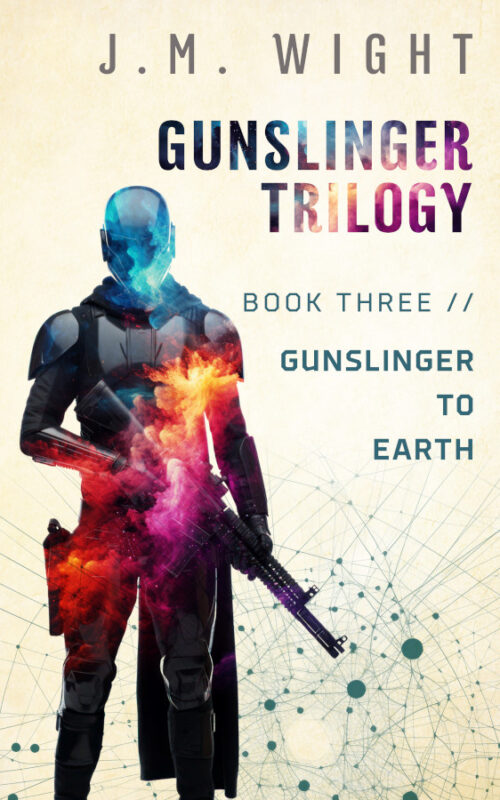
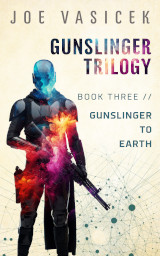
At its core, Gunslinger to Earth, the space-opera finale of the Gunslinger Trilogy, asks a simple but lifelong question: What do you choose to believe when the universe refuses to give you certainty? When Earth vanishes into an impossible anomaly—and later reappears transformed—no one can prove exactly what happened. The characters must decide for themselves what is true, what is worth fighting for, and who they will become in the face of the miraculous.
Where the Idea Came From
The theme grew out of a major turning point in my own life. I started this book just after I began dating the woman who would become my wife and while I was reinventing my writing process to tell better stories. It was a season of uncertainty, hope, and change, full of questions I didn’t know how to answer. That personal crossroads naturally shaped the theme of the story into one about faith, conviction, and choosing a future even when you can’t see what comes next.
How the Choice to Believe Shapes the Story
Throughout Gunslinger to Earth, every major character is confronted with a moment where proof is impossible, but a choice is required. Rex must decide whether to trust Charlotte, whether to follow Sam and Jane, whether to cross the wormhole, and ultimately whether to stay in paradise or return to a mortal life with someone he loves. No one can make these choices for him—not Sam, not Jane, not Charlotte—because the heart of his journey is learning to choose his own truth instead of waiting for certainty that will never come.
On a cosmic scale, the entire plot turns on the same dilemma—an end-times science fiction mystery wrapped in the language of prophecy. The anomaly that swallowed Earth may be the fulfillment of ancient prophecies, or it may be an alien event we don’t yet understand. Mahijah may be exactly who he claims to be, or something else entirely. No lab test or political briefing can answer those questions. Sam, Jane, Rex, the empaths, and the remnants of Earthfleet all have to decide for themselves what they believe—and those choices lead them to the endings they earn. The story isn’t about proving the miracle; it’s about how people respond when the miraculous breaks into their lives—the heart of the choice to believe.
What the Choice to Believe Says About Us
We all live in a world where certainty is rare, where conflicting stories demand our loyalty, and where the most important truths—love, faith, family, hope—are things you commit to long before you can prove them. Gunslinger to Earth reflects that deeply human reality in a character-driven science fiction way. It suggests that belief isn’t about having perfect evidence; it’s about having the courage to choose who you’re going to be and what kind of future you want to build. At the end of the day, the world is shaped not just by what happens to us, but by what we decide to believe about ourselves, about others, and about the meaning of our lives.
Why This Theme Matters to Me
When I wrote Gunslinger to Earth, the closing volume of the Gunslinger Trilogy, I was learning to make those kinds of choices in my own life—about faith, about love, and about the kind of writer and person I wanted to become. It was a moment when I had to step forward without seeing the whole path. That experience shaped the story in ways I couldn’t fully articulate at the time, but I can see clearly now. This book matters to me because it’s ultimately about hope: the hope that even in chaos, even in uncertainty, we can choose what we believe—and those choices can lead us somewhere good.
Gunslinger to Earth is a character-driven space opera adventure about crossing a cosmic no-man’s-land to discover what happened to the home you thought was lost forever. It blends gunslinger-style starship action, found-family dynamics, political revolution, and end-times mystery as Rex Carter, Sam Kletchka, and Jane Kletchka risk everything to follow Earth into an impossible anomaly. It’s a fast, hopeful, and surprisingly tender finale that wraps up the Gunslinger Trilogy with both high stakes and a genuine sense of homecoming.
What Kind of Reader Will Love This Book?
If you love…
Space opera that feels like Firefly meets end-times science fiction, with a gunslinger pilot, a loyal found family, and a war-torn galaxy trying to pull them apart
Stories where faith, prophecy, and cosmic mystery actually matter to the plot, not just as window dressing
Coming-of-age under fire, as Rex Carter tries to decide who he is and where he belongs while revolutions, wormholes, and vanished planets rearrange the map of human history
Character-focused military SF with moral clarity, loyalty, and hope, rather than grimdark cynicism
…then Gunslinger to Earth is probably your kind of story.
What You’ll Find Inside
Gunslinger to Earth is a story rooted in space opera adventure, end-times science fiction, and prophecy-driven mystery. The hero of this third book in the trilogy is Rex Carter, a cadet still reeling from the day Earth and Luna vanished into an impossible anomaly. Torn between his patriot girlfriend Charlotte, his loyalty to Sam and Jane, and his fear for his family back home, Rex has to grow up fast as he’s swept into a mission to follow Earth across the “world-bridge” and find out what really happened.
The mood balances tense, boots-on-the-deck action (derelict ghost ships in the anomaly, desperate battles near wormholes, claustrophobic escapes from Luna) with a deep, almost awe-struck sense of wonder as the crew finally confronts a transformed Earth and the fulfillment of ancient prophecies. The style is fast-paced, voice-driven, and accessible—more “frontier adventure with big ideas” than hard-science textbook—with a strong throughline of family, faith, and the search for home.
What Makes It Different
Fans of classic space opera and military SF—think Firefly, The Expanse, or David Weber—will recognize the starship battles, political tensions, and ragtag crews, but Gunslinger to Earth takes those ideas in a very different direction. Instead of treating religion and prophecy as background flavor, this book leans straight into them: the disappearance of Earth isn’t just a physics problem, it’s tied to the City of Enoch, the fulfillment of Latter-day Saint-style millennial prophecies, and a literal “new Earth” where history has turned a corner.
Where many space war stories focus on winning the next battle or installing the next regime, this one asks what happens when the war is suddenly dwarfed by something much bigger—when the homeworld itself is renewed and taken off the game board. It’s less about toppling empires and more about how ordinary, stubbornly decent people respond when God, history, and politics all collide at once. And because it’s the capstone of the Gunslinger Trilogy, it doesn’t just raise the stakes; it actually lands them with a clear, hopeful ending.
Readers who enjoy the moral backbone of Lois McMaster Bujold, the frontier grit of Firefly, and the cosmic mystery of The Expanse will find familiar elements here—but woven together in a way that feels genuinely new.
What You Won’t Find
You won’t find grimdark nihilism, graphic sex, or wall-to-wall gore here. The story has violence, war, and real loss—this is a revolution and an end-times crisis, after all—but it’s written at about a PG-13 level, with the camera panning away from anything needlessly explicit. You also won’t find a sneering, anti-religious tone; faith and prophecy are treated respectfully and sincerely, even when characters struggle to believe them. This is a cleaner-but-still-intense sci-fi adventure that focuses more on meaning, loyalty, and wonder than shock value.
Why I Think You Might Love It
I wrote Gunslinger to Earth during a major turning point in my own life—just after I started dating the woman who would become my wife, at a time when I was reinventing my writing process so I could tell better stories more consistently. In a lot of ways, this book is about that same kind of turning point on a galactic scale: the moment when old patterns break, a long-promised future finally arrives, and you have to decide who you’re going to be on the other side of it. My hope is that if you care about loyalty, about home, about the possibility that history is going somewhere meaningful, then this story will leave you with the same feeling it gave me while I was writing it: that even in the middle of chaos, there’s a way through—and it leads somewhere worth fighting for.
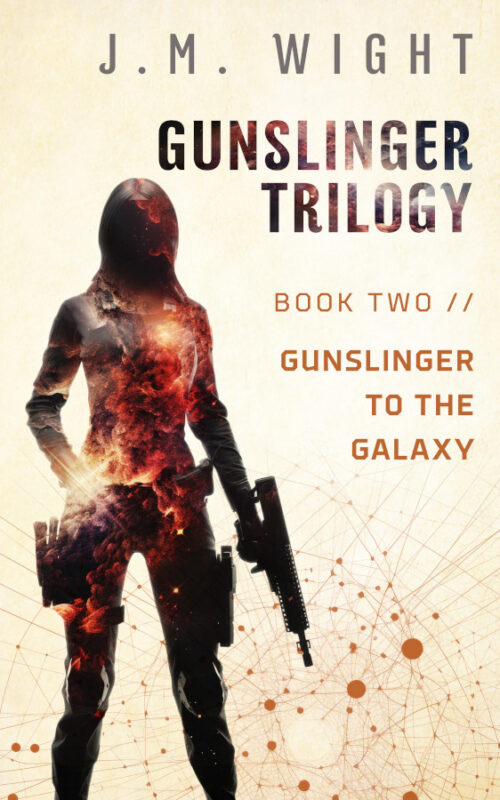
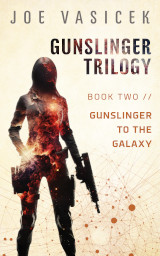
At its core, Gunslinger to the Galaxy is a space-opera story built around a deceptively simple question: what does it mean to be equally yoked when the universe is coming apart at the seams? Jane Kletchka isn’t just trying to save Earth; she’s trying to build a marriage, a family, and a vocation that all matter in an honest, eternal way. The story keeps circling back to this tension: how do you stay true to your gifts, your faith, and your partner when war, politics, and Immortal-sized crises keep demanding more?
Where the Idea Came From
When I wrote Gunslinger to the Galaxy, I was working part-time at a warehouse in Iowa and later grinding through a 40+ hour per week construction job in Utah. I wasn’t married yet, but it was something I definitely wanted in my life, and I poured that into my writing, forcing myself to write a few hundred words a day even when I was exhausted and everything around me felt like a dump.
That experience of trying to build something meaningful in the middle of chaos is baked into Jane and Sam’s story. At its heart, Gunslinger to the Galaxy is about two people trying to be a force for good while the universe keeps trying to knock them flat. I kept that theme close even through the difficult circumstances surrounding its writing—and, fittingly, around the time I finished the book, I also met the woman who would become my wife.
How Being Equally Yoked Shapes the Story
“Equally yoked” isn’t just a passing phrase in this book; it’s the backbone of Jane’s entire arc. From the early garden conversation with her mother—where Mom worries that Jane will end up standing in Sam’s shadow instead of using her own God-given talents as a xenolinguist—the story keeps pressing on a single pressure point: is this marriage helping both partners become what they’re meant to be, or is one being swallowed by the other’s path?
When the jumpgate network collapses and the Immortal civil war throws the galaxy into crisis, Jane has every excuse to curl up and let events happen to her. Instead, the story turns when she realizes she can’t just be “the gunslinger’s wife.” Drawing on Sam’s blunt insight about control and trauma, she chooses to use her training, her languages, and her brain to actually shape events—digging into logs, mapping networks, and turning her grief and fear into concrete action that can save lives and maybe bring Sam home. Being equally yoked here means more than just sharing a last name; it means each partner brings their full self to the fight, and the marriage becomes a shared mission instead of a sacrifice of one person’s calling to the other’s.
By the end, when Jane and Sam are sealed in the temple and begin building a family, the book circles back to that original fear: will motherhood and marriage erase Jane’s larger purpose? The answer is no—but not because the galaxy gets easier. Instead, the story shows her finding ways to balance remote work for the Andromedans and the Intergalactic Council with raising John Moses, weaving vocation, faith, and family into a single, hard-won whole. The adventure isn’t over; it’s just moved into a new phase where “equally yoked” means building a life that can withstand both warp drives and diapers.
What Being Equally Yoked Says About Us
In science fiction, we often see lone-wolf heroes or solitary saviors, but Gunslinger to the Galaxy takes a different path by centering a married-couple partnership in a space-opera setting. Under all the jumpgates and Immortals, this is a story about something very human: the fear that love will cost us our calling—or that our calling will cost us love. Most of us aren’t piloting starships, but we know what it feels like to worry that marriage, family, career, or faith will pull us in different directions until something breaks. Gunslinger to the Galaxy suggests a different model: the people we love most should help us become more ourselves, not less. Being equally yoked doesn’t mean never struggling or never disagreeing; it means pulling the same direction when the load gets heavy, and trusting that God can turn two flawed people into a team that does more good together than either could alone.
Why Being Equally Yoked Matters to Me
I wasn’t married when I wrote Gunslinger to the Galaxy, but it was definitely something I was looking forward to. I wrote it during a season of my life that was chaotic, exhausting, and frankly not very glamorous, but I pushed forward anyway, trusting that the kind of woman I hoped to marry someday would value that dedication. And sure enough, when I finally met her, one of the things that drew her to me was my hard work and dedication to my writing—a dedication that I have also channeled into our marriage and family life.
For me, Gunslinger to the Galaxy is a story about faith, marriage, and the stubborn belief that ordinary people can still choose to do the right thing together, even when it hurts. If this book resonates with you, I hope it’s because you see a bit of your own struggle to be “equally yoked” in a world that always seems on the brink—and you feel a little more hope that it’s worth the fight.
Gunslinger to the Galaxy is a character-driven space opera about two gunslingers and the interstellar war that forces them to risk everything for Earth. It’s a fast-paced space-opera adventure told through the sharp, heartfelt, often hilarious voice of Jane Kletchka—a xenolinguist newly married to a mercenary gunslinger whose moral stubbornness keeps getting them both into trouble. This is a story about love, loyalty, danger, and the terrifying size of the galaxy when everything collapses at once. Expect a cinematic blend of military sci-fi, first-contact intrigue, and found-family courage.
What Kind of Reader Will Love This Book?
If you like…
Jack Campbell’s Lost Fleet
Lois McMaster Bujold’s Vorkosigan Saga
Character-driven space opera where the heart of the story is a loyal crew that refuses to quit
Western-flavored sci-fi heroes who charge headlong into impossible odds (with big guns and bigger convictions)
Xenolinguistics, alien politics, and intergalactic mystery woven into a sweeping adventure
Married-couple banter, warm emotional stakes, and a hero/heroine partnership forged in fire
High-stakes battles, warp-drive exploration, and cosmic consequences
…then Gunslinger to the Galaxy is absolutely your kind of story.
What You’ll Find Inside
You’ll follow Jane Kletchka, a brilliant xenolinguist, as she returns to Earth with her gunslinger husband Sam—only to be swept into a galactic crisis involving shattered jumpgate networks, Immortal civil wars, refugee swarms, and a catastrophic threat to Sol itself.
The tone blends romantic adventure, military sci-fi tension, and classic space-opera wonder, all grounded by Jane’s warm, honest, often funny narrative voice. Expect tight pacing, big emotional beats, and a story that moves from intimate family moments to galaxy-spanning stakes without missing a beat.
What Makes It Different
Fans of The Expanse, Honor Harrington, or Firefly will recognize the blend of frontier grit, military realism, and cross-species politics—but Gunslinger to the Galaxy takes those ideas in a fresh direction by placing a married couple at the emotional center of the story. Where many space-opera series focus on lone-wolf heroes, this book leans into the dynamics of partnership, trust, and being “equally yoked” in the middle of interstellar chaos. It combines xenolinguistic problem-solving, Immortal cosmic lore, and Western-style gunslinger ethos in a way no other space-opera series does.
What You Won’t Find
This isn’t grimdark, dystopian, or nihilistic sci-fi—there’s hardship and tragedy, but the story is ultimately hopeful, heroic, and rooted in family and faith. There is no gratuitous violence, no graphic romance, and no cynical “everyone is corrupt” worldview. If you’re looking for bleak anti-heroes or hard-SF technobabble at the expense of character, this won’t be the right fit.
Why I Think You Might Love It
At its core, this book is about ordinary people thrown into extraordinary crises who choose—over and over—to do what’s right, even when it costs them everything. Jane and Sam aren’t superheroes; they are a married couple trying to build a life together while the galaxy falls apart around them. Their courage, humor, and stubborn devotion give the story its heartbeat. If you’ve ever wanted a space-opera that delivers big adventure without losing its humanity, Gunslinger to the Galaxy was written for you.
In short, if you’re looking for a hopeful, high-adventure space opera filled with alien civilizations, military sci-fi battles, found-family warmth, and a fiercely devoted married couple, Gunslinger to the Galaxy delivers exactly that.
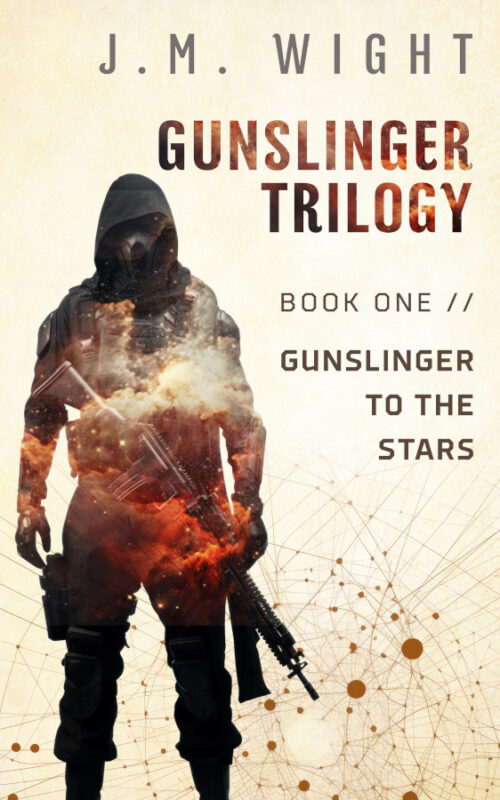
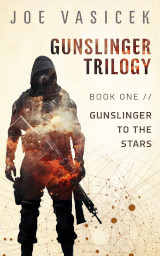
What does it mean to do the right thing when the galaxy around you is chaotic, corrupt, or outright absurd? Gunslinger to the Stars takes that question and drops it squarely in the lap of Sam Kletchka—a mercenary gunslinger navigating a dangerous galactic frontier who keeps choosing responsibility even when no one is watching, rewarding, or deserving. At its heart, this space-western adventure is about moral courage: the stubborn, unfashionable insistence on doing the right thing in a universe that rarely makes it easy.
Where the Idea Came From
This theme grew out of a mashup of influences—long conversations with writer friends, a subplot from Schlock Mercenary, and the realization that a “rogue Immortal” character needed a counterweight with a strong personal code. Around the same time, I was watching Breaking Bad, fascinated by characters like Mike Ehrmantraut—tough, pragmatic men who do terrible things for complicated reasons. To push back against such a villainous force, I imagined Sam Kletchka: a gunslinger in a messy, morally gray universe who lives by a code and keeps choosing the harder path simply because it’s right, even when the galaxy doesn’t care.
How Moral Courage Shapes the Story
At every major turning point in Gunslinger to the Stars, Sam Kletchka’s choices are defined by moral courage—the instinct to protect others even when it’s dangerous, inconvenient, or unwinnable. He charges after kidnapped empaths when walking away would be safer; he shields Jane’s diplomatic idealism with his hard-won pragmatism; he survives abandonment in the desert through sheer stubborn responsibility; and he repeatedly throws himself into battles around war rigs, jumpgates, and alien war parties because no one else can or will. His personal code drives the story’s conflicts, shapes the character dynamics, and pushes this space-opera adventure toward a climax where courage isn’t about glory but about doing the right thing in a lawless, unpredictable, morally gray galaxy.
What Moral Courage Says About Us
Sam’s story reflects something deeply human: we don’t get to choose the worlds we’re born into, but we do get to choose what kind of people we become. In a galaxy run by Immortals, riddled with slavers, warlords, and manipulative telepaths, Sam’s personal code becomes his anchor—the thing that keeps him from becoming the very wolf he warns Jane about. His courage isn’t flashy heroism; it’s the uncomfortable, everyday kind that demands sacrifice, loyalty, and integrity when it would be easier to look away. In that sense, the book becomes a mirror for readers who love character-driven science fiction that asks what we stand for when the world pushes back.
Why This Theme Matters to Me
I wrote this book at a very different time in my life—years after Genesis Earth, when my own view of the world had shifted. I still believed in cultural understanding and bridging divides, but I’d also seen enough to know that evil doesn’t always yield to good intentions. Like Sam, I firmly believe in the right to defend oneself and others, and I’ve had long debates about the responsibilities that come with that. I wanted to write a character who lives at the intersection of those values—someone who understands violence, hates it, but won’t walk away when others depend on him. That tension, that conviction, is why moral courage felt like the beating heart of Gunslinger to the Stars.
Gunslinger to the Stars is a character-driven space opera novel that blends Western adventure, first-contact science fiction, and pulpy action. It’s fast-paced, voice-driven, and built around a loyal, reluctant hero navigating a dangerous galactic frontier. It’s told in the unmistakable voice of Sam Kletchka—half gunslinger, half star-hopping troubleshooter, and 100% fun.
What Kind of Reader Will Love This Book?
If you like…
Classic space adventure with modern voice and humor, where the hero solves problems with grit, guts, and an outrageous arsenal of lovingly described guns
Found-family dynamics between a rough-around-the-edges gunslinger, a principled xenolinguist, a telepathic outcast, and a trio of shapeshifting empaths
Galaxy-spanning mysteries, alien politics, and first-contact stakes that push characters to their limits
The feel of a Western gunslinger dropped straight into a richly imagined galactic frontier
…then Gunslinger to the Stars is absolutely your kind of story.
What You’ll Find Inside
Gunslinger to the Stars (Book 1 of the Gunslinger Trilogy) follows Sam Kletchka, a New Texas gunslinger stranded in the Gorinal Cluster just as the local jumpgate—the only way out—mysteriously goes dark. What starts as a simple job escalates into a battle for survival involving hidden alien races, shape-shifting empaths, worldships, and a rising threat the Immortals never wanted anyone to discover. The tone blends wry humor with escalating danger, and the style is fast-paced, voice-driven, and cinematic—equal parts action romp and big-idea sci-fi. The result is a story that feels both classic and fresh: a pulpy, heartfelt adventure that’s as much about loyalty and moral clarity as it is about space battles and exotic technology.
What Makes It Different
Fans of Firefly and Schlock Mercenary will recognize the snappy banter, the found-crew dynamic, and the blend of humor with high-stakes action. But Gunslinger to the Stars pushes those familiar ingredients in new directions: the gunslinger-as-space-ranger angle gives the book a distinctive American-frontier voice, while the empath culture, the Immortals’ centuries-deep manipulations, and the emergence of the Draxxians create a myth-arc that feels simultaneously expansive and personal. Where many space operas lean on military hierarchy or techno-fetishism, this one leans into character, moral philosophy, and the uneasy tensions between peacekeeping and necessary force—all told through Sam’s dry, self-aware perspective.
This story blends classic space western tropes — the reluctant hero, the ragtag crew, and the dangerous frontier — with a deeper mystery about ancient alien powers. If you enjoy space western stories with a strong first-contact throughline, you’re going to enjoy this book.
What You Won’t Find
If you’re looking for grimdark bleakness, heavy technobabble, or a cynical antihero who never grows, this isn’t that. And if you want romance-heavy sci-fi or endless political intrigue, this book doesn’t go down those roads either. But if you want hopeful, character-focused adventure with humor, heart, and a hero who takes responsibility for his choices—sometimes reluctantly—you’ll feel right at home.
Why I Think You Might Love It
I wrote this story at a time when I needed to shake things up creatively, by writing something fun, energetic, and different from what I had been writing at the time. I was also going through a time when my worldview was changing, and I was questioning a lot of my old assumptions. This book grew out of a number of things: from my conversations with close friends, my love of classic pulp sci-fi, and from the idea of a lone wanderer who tries—however imperfectly—to do the right thing. The result, I believe, was a book with a lot of heart that captures that spark of wonder that made me first fall in love with science fiction. If that’s what you’re looking for, I think you’re going to love it!
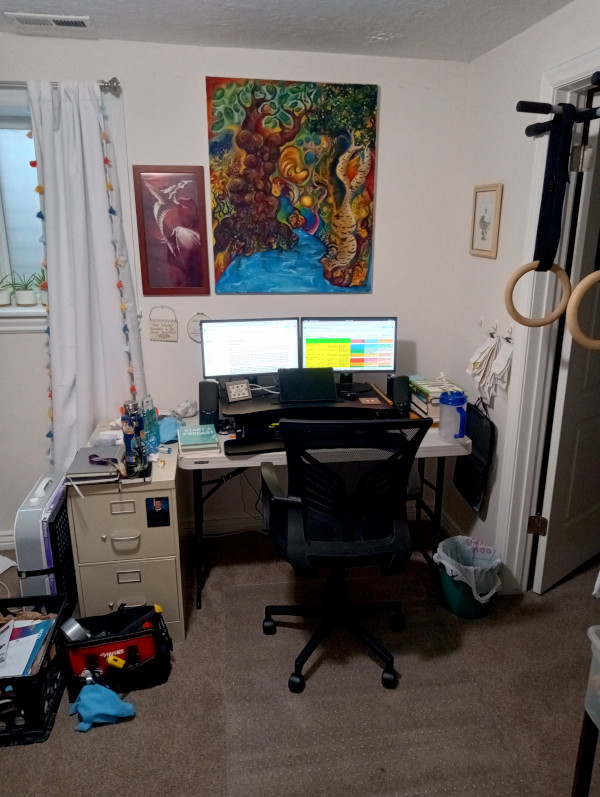
This is my current writing setup. The top of the filing cabinet already needs to be decluttered, but the rest is actually working out pretty well. The nice thing is that the computer can be raised into a standing desk, which works out really great for writing, since I tend to write better when I’m standing or pacing.
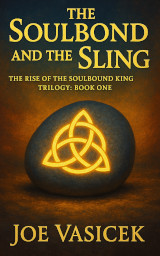
I am almost finished with the AI draft of The Soulbond and the Sling. It looks like it’s going to be about 140k words total, which is on the short end for an epic fantasy novel, but longer than anything else I’ve written (except for the first novel I ever finished, which shall never see the light of day).
The human draft will likely be longer than that, though. I’m going to add more details as I humanize it, which is easier to do just by writing it yourself than it is to get an AI to write it. Though parts of it will likely be shorter, since I’m sure there are places where I let the AI overwrite. Most of the skill in AI-assisted writing consists of knowing what to cut out, since generating words is the easy part.
I have also finished the outline for The Soulbond and the Lady, the second book in the Soulbound King series. It should clock in at about 20 chapters, 100 scenes, and 165k words. The next step is to fill out all the prompts and generate a rough AI draft, but because of how Sudowrite works, I don’t want to do that until the AI draft of The Soulbond and the Sling is complete (since it would require tweaking a bunch of the worldbuilding and character prompts). So that will probably wait until the end of the month.
In general, I have found that I tend to work best when I have two current WIPs: one human and one AI. This is because the two different kinds of writing exercise different parts of my brain, and I can rest the one part while I’m using the other. However, it only really works if both WIPs are in the same series. If I have to mentally switch from one universe to another, that adds friction that makes things difficult.
So the key is to pair up different WIPs together, such that I’ve always got both a human WIP and an AI WIP in the same series. With The Soulbound King, that’s not so difficult, because the AI draft of The Soulbond and the Sling is complete enough for me to start the human draft. And once the AI draft is complete, I can move on to the AI draft of book 2 while I finish up the human draft of book 1. It might become a problem if I finish one of the drafts well before the other, but that won’t be a problem for a while.
With the Falconstar Trilogy, that’s also not a huge problem. I will probably human-write a reader magnet while I work on the AI draft of Captive of the Falconstar, then humanize Captive while I work on the AI draft of Lord of the Falconstar.
With Return of the Starborn Son, the last science fiction novel I plan to write for a while, it’s going to be more tricky because that is the last book in the trilogy, and I still haven’t generated the AI draft. What I’ll probably do is start work on the human draft after I’m about 15% done with the AI draft, and see if I can’t work on both simultaneously. That hasn’t worked as well for me in the past, since I actually prefer to write the human draft out of order, but if it starts to break down I’ll just hold off on the human draft until the AI draft is more complete.
With the Sea Mage Cycle, I’ve currently just got one WIP in that series (The Unknown Sea), and it’s in the AI drafting stage. But it’s short enough that I can probably finish it in just a couple of weeks. At that point, I’ll take my wife out to dinner and have her pick out the next one I’ll write, then work on the AI draft for that one while I’m humanizing The Unknown Sea.
Which brings me to my J.M. Wight pen name. After a lot of thought and some careful deliberation, I’ve decided to put The Road to New Jerusalem on the back burner for now. I was going to try to finish that one in time for the Ark Press contest in October, but I don’t think this is the right time to work on that particular WIP. In the first place, it probably won’t win, and even if it did, that might actually be more of a liability, since it’s a near-future post-apocalyptice novel, and I’m currently trying to establish myself as a writer of epic fantasy.
From now until 2030, I plan to write epic fantasy almost exclusively. The only exceptions for that are the two sci-fi series (The Falconstar Trilogy and the Outworld Trilogy) that I haven’t yet finished. Also, I will probably write some zany space adventure-type stuff under my J.M. Wight pen name, more in the vein of my Gunslinger books (which I have republished under J.M. Wight). But aside from that, I plan to focus on writing fantasy—specifically, epic fantasy.
In my blog series Fantasy from A to Z, I wrote about how epic fantasy has fallen into decline in recent years, due to reader fatigue with big name authors like George R.R. Martin and Patrick Rothfuss failing to finish their series, and how this has put newer authors in a conundrum, because epic fantasy novels are way too big to rapid release, but most readers aren’t willing to start a new series until after it’s already been finished. I hope that my new AI-assisted writing method will help me to crack that particular nut, writing and releasing epic fantasy books fast enough to satisfy readers. Because even though there haven’t been a ton of new epic fantasy authors in recent years, I don’t think the reader demand for epic fantasy has gone down at all. There may still be an opportunity there for writers who can deliver.
That’s what I’m hoping, at least. So I’ll keep plugging away at The Soulbound King, and hopefully release the first all three books of the first trilogy around this time next year.
Right now, I’m a science fiction writer who occasionally writes fantasy. I want to transition to being a fantasy writer who occasionally writes science fiction. But I also have a pen name (J.M. Wight) for more religious-themed books, since there are a lot of science fiction readers who have a serious ick with that.
As I set things up for this transition, I’ve been looking at the books I’ve already published and trying to decide what to do with them. The Gunslinger Trilogy is one series I’ve been looking at particularly hard. It’s kind of an edge case, because the religious themes become more pronounced as the series progresses. One of the more consistent themes in one-star reviews is that people don’t like the “Mormon” stuff in the later books, such as the part where the main character meets with the missionaries (and ultimately gets baptized), or the alien twist in the last book that’s pulled right out of the Books of Enoch/Jasher/Moses.
If I’d planned out the whole series before I wrote the first book, I probably would have published them under my J.M. Wight pen name for that reason. But the first book was a straight-up space opera, with minimal religious themes. It was only after I’d published the first book (under my main Joe Vasicek name) that I wrote the next two books and decided to throw in the more religious stuff. And while I was careful to write it in such a way that the books never come out and say whether all that religious stuff is actually true, the fact that it’s in there at all has turned off some readers who weren’t expecting it.
The trouble is that the first book has a lot of profanity in it, and religious readers tend to be just as icky about profanity as sci-fi readers are about the religious stuff. Even more so, in fact. So before I make the switch, I will probably have to make an extensive rewrite to tone down the swearing and make it more palatable for that audience.
It’s a fairly common mistake, especially among inexperience writers: you write the first book for a certain audience, but as the series progresses, the later books appeal to a different audience, betraying some of the expectations of the first audience. When taken to extremes, it’s the sort of thing that torpedoes careers and forces writers to reinvent themselves. So given that fact, I’m kind of surprised that these books have done as well as they have.
What do you think? Should I switch them to my J.M. Wight pen name, editing them to remove the profanity and lean into the audience that isn’t turned off by religious themes in their science fiction? Or should I keep them as they are?
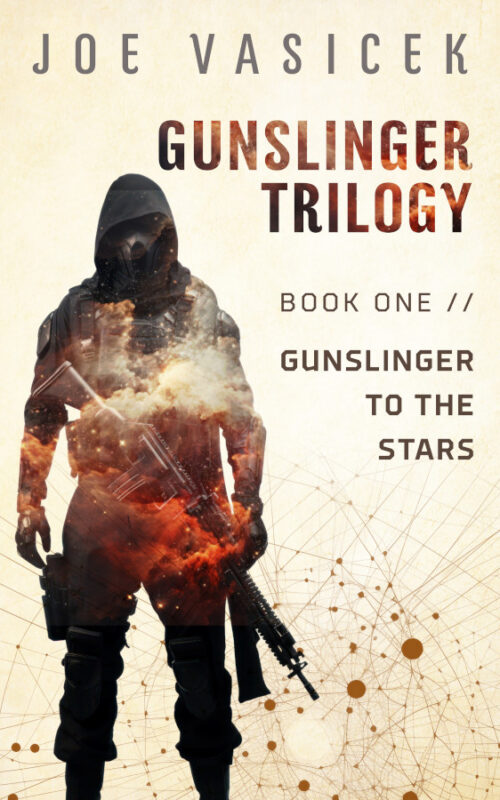
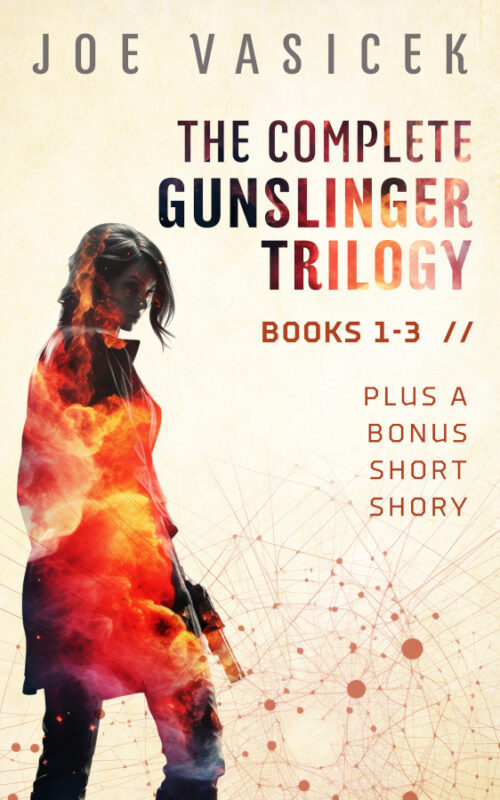
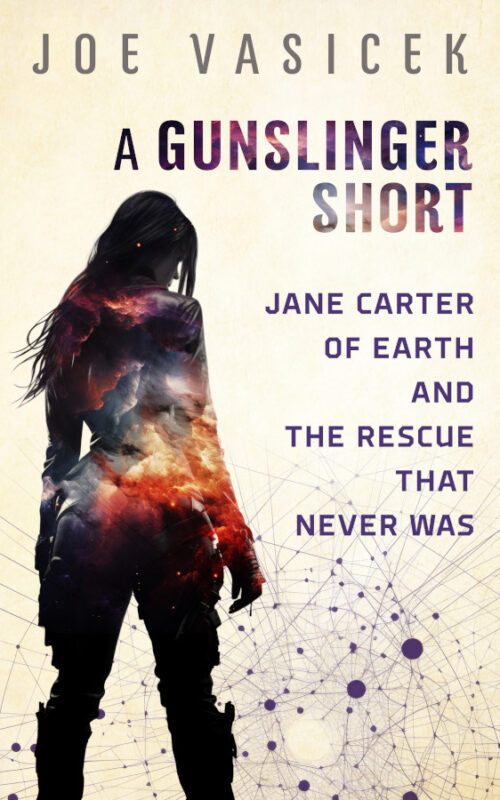
From time to time, it’s a good idea to put up new book covers—especially when the originals were ones you made yourself. I realized last year that it was high time to get new covers for my Gunslinger novels, and this month I went ahead and got it done. Check them out!
I will try to get them up before this post goes live, but there might be some delays. Regardless, they should all be up everywhere within a week or two.
Also, if you’re curious, these covers are done by James at GoOnWrite. He does really good work!