P is for Parenthood

I’m currently in the process of writing the second edition of my newsletter exclusive, Science Fiction from A to Z, adding a bunch of new chapters and rewriting all of the old ones. For a blog post this week, I thought I’d share one of the new chapters. Let me know what you think!


I was going to make this section “P is for Pulp,” rounding out “G is for Golden Age,” “N is for New Wave,” “D is for Dark Age,” and “I is for Indie.” But I have to admit, I’m not as familiar with the pulp era of science fiction as I would like to be. I’ve read all of Robert E. Howard’s Conan and Solomon Kane stories, and Edgar Rice Burroughs’s A Princess of Mars (though not the rest of the Barsoom series, unfortunately. It’s on my TBR!) but that’s pretty much it. From what I understand, Jules Verne, H.G. Wells, and (of course) Mary Shelley all preceded this era, and I’m a little more familiar with them, but all I know about the pulp era is what I’ve heard from other sources, and I’d rather not regurgitate that without first exploring it myself.

Instead, I want to write about a major influence on every writer that gets almost no play whatsoever in public treatment of their work, but is arguably the single most important aspect of their lives: parenthood.

Becoming a parent really changes you. When I held my first child in my arms for the first time, a distinct thought came into my mind, almost like a voice: “this is her story now.” They say that we’re all the hero of our own story, and to a certain extent that’s true, but anyone who has brought a child into the world (or adopted a child as their own) has a much more complex and nuanced understanding and perspective. Even a terrible, abusive parent has still experienced what it’s like to become a link between the generations. That experience reshapes everything you do and are in ways that are impossible to appreciate until you’ve had it for yourself.

There is a subtle but distinct difference between books written by authors who have experienced parenthood vs. authors who are childless. I wasn’t as conscious of it until I became a parent myself, but even back in my days as a bachelor, I think I could still sense it, even though I didn’t know what it was. I suspect it’s why I’m a huge fan of David Gemmell, but not of George R.R. Martin, even though on the surface, they write the same kind of book. Both of them write dark and gritty fantasy, both of them are known for killing off major characters and doing horrible things to the ones who survive, and both of them are written quite well—in fact, on an artistic level, Martin is probably superior. But where Martin tends to obsess over themes of victimhood and victimization, Gemmell focuses more on heroism and what makes a hero. Gemmell had two children; Martin (so far as I can tell) has none.

In 2022, I made a new year’s resolution to read or DNF every novel that has won either a Hugo or a Nebula award. To prep for this resolution, I made a spreadsheet of all the novels, along with other pertinent information that interested me, such as each author’s gender, their approximate age when they won the award, and whether or not they have any children. I found some very interesting patterns. There were 110 novels in all, and fifty of them were written by authors who were childless (or at least did not have any mention of children in their author bios and/or Wikipedia entries). After 2015 and 2016 respectively, every Hugo and Nebula award-winning novelist (not counting the Retro-Hugos) has been childless—more specifically, childless women in their 40s and 50s, with one exception who is transgender (Charlie Jane Anders), one exception who is in her thirties (Arkady Martine), and one whose age I cannot determine (Sarah Pinsker). But all three of them are still childless, at least according to the internet.

Now, this is not to say that not having children makes you a terrible writer. In fact, it may actually make you a better writer, since you have more time and energy to devote to learning and improving the craft. But whether for good or ill, I do think that it gives you a handicap in terms of life experience. That handicap is going to influence both the subjects you choose to write about, and how you choose to write about them. I say this not just from my experience as a reader, but as a writer.

My wife and I married a little late, and by the time we had our first child, I’d already been writing professionally for about ten years. Up until that point, the reader I’d had in my mind was basically a younger version of myself. Bringing Stella Home is not a YA book, but a lot of my Amazon reviews assume that it is, probably because I was in college when I wrote it and was writing the sort of book that I wish I’d discovered back when I was in high school and reading things like Ender’s Game and Dune. After I’d experienced the real world and become sufficiently red-pilled, I wrote books like Gunslinger to the Stars for my naive college self. But since becoming a parent, my perspective has begun to change, and I find myself writing less for myself and more for my daughter—or rather, the kind of person I expect my daughter to grow up to be. I’m a lot more conscious of certain kinds of content, and while that doesn’t mean that I shy away from it, I do find myself asking: “What am I really trying to say here? What purpose does this really serve?”

The Genesis Earth Trilogy is a good example of this evolution in my own work. The first book, Genesis Earth, was my first published novel, and really was written for a young adult version of myself, which is why I chose to categorize it as YA science fiction. The whole story revolves around two young scientists on a mission to an alien planet, and how they come to discover just as much about each other as the planet they’ve been sent to explore. It took me ten years to write the next book, Edenfall, not because I didn’t know what would happen next, but because I didn’t feel like I was ready to write it. Then I got married, and that was the experience I needed to break through the block and finish the book—and it went in a much different direction than it would have, if I had written it while I was still single. But the conclusion to the trilogy, The Stars of Redemption, was the book that I wrote after my daughter was born, and that experience had a very profound impact not just on the story itself, but on the characters, the thematic elements, and the way the last book brought everything together from the first book to a meaningful conclusion. I know for a fact that I would not have been capable of writing such a book without the experience of becoming a father.
2019-09-26 Newsletter Author’s Note

This author’s note originally appeared in the September 26th edition of my author newsletter. To subscribe to my newsletter, click here.

So for this newsletter’s author’s note, I thought I’d do a roundup of all the magazines that have published my short stories in the last six months. There’s a surprisingly large number of them. They’re all great publications, so if any of them look interesting, feel free to give them your support and pick up a copy or two.

(As a side note, I’ve found that some email clients break my hyperlinks if I have too many of them in one email. I’m going to put the links in anyway, but if they’re broken for you, please let me know.)

First, my story “The Janus Anomaly” appeared in Kasma Magazine in May. It’s still up on the website, if you want to read it. They did a great illustration for it too!

The story is about a science officer on a scout ship that encounters an alien anomaly, and she can’t tell if she’s losing her mind or if she’s the only sane one while everyone else is crazy. Also, the story takes place in the same universe as the Gunslinger Trilogy.

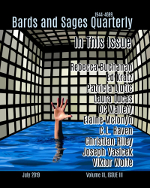
Second, my story “The Gettysburg Paradox” appeared in the July issue of Bards and Sages Quarterly. The ebook copy of the magazine is available on most ebookstores, and you can find the link here.

The story is about a time traveling tourist at the Battle of Gettysburg who learns that almost all of the combatants are (not so secretly) time travelers themselves. In their efforts to reshape the world, they’ve all converged on this one turning point in history, making it the largest battle ever fought on American soil.

Third, my story “The Curse of the Lifewalker” appeared on The New Accelerator just last month. This is my third story that the good folks at TNA have picked up, and they publish new stories weekly with a very reasonable subscription model to their site.

The story takes place in Utah Valley a couple of hundred years after the apocalypse. Humanity has been afflicted with a blight that shortens all of our lifespans to 25 years, but the main character is one of the few people who is immune. But because of how things have changed in the intervening centuries, his immunity turns out to be more of a curse than a blessing, as he gradually becomes an outsider in his own community.

Fourth, my story “Lizzie-99XT” appeared in last month’s issue of Serial Magazine. The digital copy of the magazine is $2.99, and the print copy is $4.99. There are a bunch of other stories in this issue, and all of them are about life and death decisions.

Next month, I have a couple more stories coming out. “Starchild” will appear as a reprint in Bards and Sages Quarterly, and “The Infiltrator,” a never before published story, will appear in the anthology Not Far From Roswell. So be sure to keep an eye out for those!

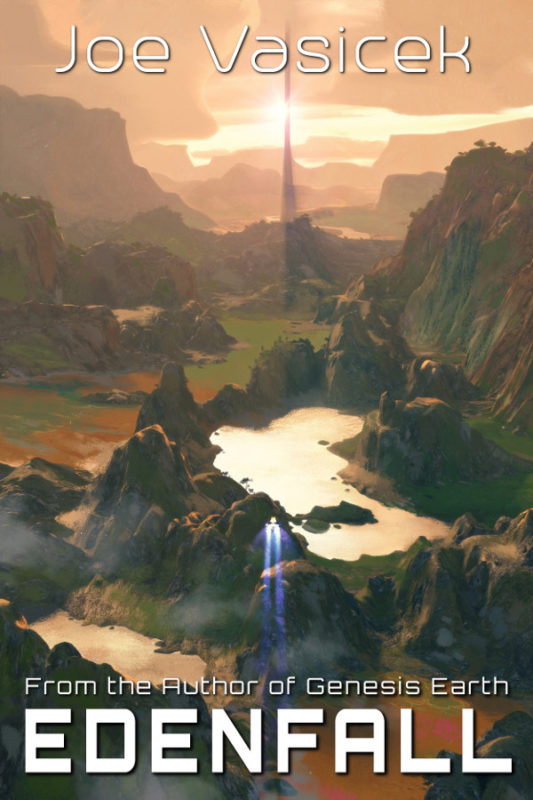
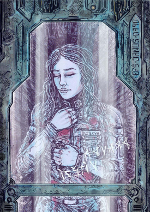
Finally, here is the cover art for Edenfall. Check it out!

I’m very happy with how it turned out. The illustration is by Hideyoshi, aka Lorenz Ruwwe, who did the cover art for Genesis Earth. I still have to go through the edits, but that shouldn’t take longer than a week, and the ebook will be up for preorder shortly after. The release date will be in December.

Edenfall cover reveal!

Last week in my author newsletter, I revealed the cover art for my next big novel release, Edenfall. This is the sequel to Genesis Earth and the second book in that trilogy.

Without any further ado, here is the cover!

The art is by Lorenz Ruwwe, aka Hideyoshi. I’m really happy with how it turned out. He did the art for Genesis Earth, so I’m really glad I was able to get him for this one too.

Edenfall will be up for preorder soon. To keep up with all of my new releases, as well as writing updates, special offers, book recommendations, and other cool stuff, be sure to sign up for my author newsletter! I’ve scaled back my blogging, so that’s the best way to keep up with me now.

Trope Tuesday: Future Primitive

From tvtropes:

Evolution isn’t goal-directed. Sometimes …a species (often but not limited to humanity) will sometimes evolve into a more feral, less civilized, sometimes even non-sapient variety, regaining “primitive” characteristics. These “primitive” characteristics can include behaviors and/or physical traits…

Most basic is the scenario common to Post-Apocalyptic settings After the End, where humanity (or another species) is still physiologically more or less the same, but society has collapsed and technological and cultural regression have set in… In more extreme scenarios, the population may have evolved into a new subspecies or another species altogether… Most Scavenger World-type future settings are not far enough removed from the Present Day for natural selection to favor such drastic changes.

May overlap with Was Once a Man. Sometimes, it’s the motivation of an Evilutionary Biologist to try and take control of evolution in order to avert this fate.

Common to After the End settings. Likely to exist in Humanity’s Wake. Contrast Evolutionary Levels, Ultimate Lifeform and The Singularity (all of which tend to assume evolution’s a linear, goal driven process). Has nothing to do with the effects of a Devolution Device.

This trope has been on my mind as I write Edenfall, the sequel to Genesis Earth. In that book, this trope featured prominently, and drove the main character to question his faith in the progression of the natural world from chaos to order, entropy to complexity, and ignorance and barbarity to knowledge and civilization.

Perhaps the most prominent example of this trope is the Morlocks and Eloi from H.G. Wells’s The Time Machine. In the far future, the children of the rich elites of society have evolved into dainty, helpless, childlike creatures, while the descendants of the lower classes have evolved into dark and predatory monsters. As different as they are, though, they have both lost the drive and ingenuity that makes us human: the Eloi because it was pamperd out of them, and the Morlocks because they were repressed for so long. Both of them have lost their humanity and devolved into little more than animals.

In the Victorian era, people generally had faith in the slow and steady march of progress: that ignorance and superstition inevitably gave way to the light of science and reason, each successive age tended to be more advanced and scientific that the previous ages, and that humanity represented the pinnacle of evolution, the crowning achievement of the natural world. They rejected the notion that catastrophic and violent upheavals had any significant effect on the development of cilivization or humanity, and believed that the world was in a state of constant, unstoppable improvement.

Well, the two worlds wars pretty much shattered that notion forever. And since that time, we’ve discovered all sorts of evidence that in history and evolution, catastrophic change and violent upheaval are the rule, rather than the exception. From the bronze age collapse and the black death to supernovae and the extinction of the dinosaurs, the Victorian concept of the slow, steady, and inevitable march of progress looks very quaint indeed.

That was what I wanted to deconstruct in Genesis Earth. But now that I’m writing the sequels, I plan to subvert this trope. I can’t say how without giving spoilers, but it’s going to be a major plot point, especially in the third book.

What happens when humans meddle in evolution? When we hack into our genetic code and rewrite our place in the natural order? Can time heal the scars of our broken world, or will it take something else to fix us? Something more than human, or something so fundamental to our humanity that it lies in every heart?

Anyways, those are the things on my mind as I finish up Edenfall and get ready to write The Stars of Redemption. With luck, they will both be out by the end of this year!

WIP excerpt: Edenfall

I’m a little less than halfway done with Edenfall, so I figure it would be good to share a couple of excerpts with you. If all goes well, it should be out by September.

As a reminder, this is the sequel to my first novel, Genesis Earth, so you may see a couple of familiar characters in this excerpt, which is taken from the first chapter. I’ve already got plans for the third book, and will hopefully complete the trilogy by the end of the year.

Enjoy!


The boulder felt rough and warm under Estee’s bare feet, the hot air dusty and dry. She scrambled up its face, laughing as her little sister struggled to keep up.

“Slow down!” Celeste cried. She lost her footing and began to slip. “Help!”

Estee turned around and dropped to her stomach. A warm breeze tousled her hair as sweat ran down the side of her face. With the grainy sandstone hot against her skin, she caught Celeste and pulled her up.

“You’re okay. Come on!”

Celeste’s face was pale, but she recovered quickly. Together, they stood atop the massive boulder, panting to catch their breath.

“Race you to the next one!”

In an instant, Estee was off, laughing at her sister’s cry of dismay. Thankfully, the next boulder wasn’t so hard. She panted for breath as she scrambled up it with Celeste following closely behind, her terror forgotten as she struggled to keep up. In less than a minute, they had both conquered the rock.

From the top, they had a majestic view of the wide, golden-green savannah and the tabletop mountains all along the horizon.

“It’s hot,” Celeste complained.

“Here,” said Estee, leading her to the northward facing side. “It’s not so bad over here.”

They both laid down with their backs against the slickrock. Estee closed her eyes and breathed deeply, the sun warming her dust-caked skin and drying the beads of sweat on her forehead. It was wonderful.

“Hey, look!”

She opened her eyes and looked where Celeste was pointing, in the direction of the beanstalk. A thin, familiar line rose from the ruins of the ancient ones into the blue sky, disappearing high above the clouds. But the thing that caught Estee’s attention was a point of light, shining like a star where the beanstalk disappeared from view.

“What is it?” she asked.

“I don’t know,” said Celeste. “Look, it’s moving.”

Indeed it was. A light breeze whistled around the boulders as the star drifted soundlessly toward the south. Estee rose to her feet, shielding her eyes with her hand as she traced its curious progress across the sky. Beside her, Celeste stood up as well.

“Is it a falling star?” Celeste asked.

Estee didn’t think so. Falling stars only happened at night, and they usually flickered out in the blink of an eye. Mama liked to study them. She always knew when the best times were to look for them, and sometimes took Estee out with her to see. Mama and Papa both knew a lot about stars, because that was where they’d come from. But Estee had never seen anything like this.

“Is it?” Celeste repeated.

“I told you, I don’t know.”

“Where is going?”

The star grew brighter as it moved closer to the horizon, leaving a bright yellow streak. It was falling to the east, past the village of the little people. Estee thought it would pass out of view beyond the tabletop mountains, but then it turned abruptly north. Falling stars never did that.

“Look!” said Celeste. “It’s making a cloud!”

Sure enough, a thin whispy cloud cut a line in the star’s wake. It reminded Estee of the smoke from a candle. As the star dipped lower, it passed in front of the tabletop mountains and alighted in the nearby foothills. A shiver of excitement ran down Estee’s spine.

“Come on—let’s go!”

“No,” Celeste protested. “It’s too far away.”

“Don’t you want to find it, though?”

“The daylight is fading. We’ll get in trouble.”

Estee groaned, but her sister was right. Besides, Mama wanted them back before dark, and the sun was already starting to get low.

“Race you home. Last one back is a lazy sun-dragon!”

“Hey!” Celeste cried as Estee scampered down the boulder. “Wait for me!”


The high grass tickled Estee’s legs as she ran across the plains. Fine, red dust caked her sweaty skin, but she ran until her lungs burned and her heart pounded, simply for the joy of it. She startled a swarm of leaping locusts grazing nearby, and shrieked in surprise as they leaped high above her, rattling their wings as they sought somewhere more peaceful to graze.

“Celeste! Where are you?”

“Back here!” her sister called.

“Well hurry up!”

By the time they made it back, the beanstalk was already beginning to shimmer in the light of the setting sun. Smoke had started to rise from the adobe oven—that meant Mama was cooking, which meant that they were late.

“Oh, dungheaps,” Estee swore.

Celeste ran up beside her, still out of breath. “What?” she asked—then, noticing the smoke, “Oh.”

“Come on,” said Estee, “let’s go to Papa’s workshop.” If they came in with Papa, then maybe Mama would think they’d been with him the whole time. Papa was always late.

They snuck as quietly as they could out through the hedgerow gate, making a wide circle until they reached Papa’s workshop about fifty yards away. The thatchwork patches in the plasteel dome roof waved in the afternoon breeze.

Five of the little people rose to their feet as Estee and Celeste rounded the corner. Two of them rose swiftly to their feet, brandishing spears, but their leader scolded them and they stepped aside.

“That’s right,” said Estee, holding her palms outstretched. “It’s just us. No need to fear.”

The leader was one of the chiefs of the little people, his rich orange mane bearing jewelry carved from bone. Estee squatted so as not to seem taller than him. In just the last year, she’d grown so much that all but the strongest hunters were shorter than her. She still hadn’t gotten used to that.

The chief stepped forward and put his hand on Estee’s chest in a gesture of peace. She did the same, leaning forward so that they stood cheek to cheek. His furry skin was hard and tough, his mane so long that it tickled her arm. They both took a deep breath together, and the scent of sweat and musk filled her nostrils. She closed her eyes and let it seep into her, until his heartbeat echoed hers.

Opening her eyes, she stepped back to let Celeste greet the chief in like manner while the others stood back. It wasn’t every day that they met the little people like this, but it happened often enough that they both knew what to do.

Satisfied, the little people bowed and let them pass. Estee knocked once, then parted the heavy rug door and stepped inside.

“Papa?” she called. The workshop was brightly lit. Bottles of various chemicals sat on the counter among baskets of dried leaves and flowers. Papa was on the far side of the room, next to the operating table.

“Shh,” said Papa, gesturing for them to stay quiet.

The two girls crept forward to watch. One of the women of the little people sat on the operating table, trembling with fear. She held an infant child on her chest, limp and unconsious.

Papa rinsed off a bloody pair of tweezers in the sink, then returned to the mother and child. “There, there,” he whispered. “Just one more—got it!” From the baby’s leg, he pulled out a black sliver as long as Estee’s pinky finger and dropped it into a nearby bowl.

“Gauze,” he ordered without looking up from his work. Estee rushed to assist him. After carefully cleaning the wound, he applied an herbal dressing before taking the offered gauze and wrapping it around the baby’s leg. “That should help with the infection,” he muttered, then held up one of the smelling salts to the baby’s nose until it began to whimper and cry. The mother clutched her baby to her chest and jumped off the table, rushing out the door to her waiting companions.

“What was that?” asked Celeste.

“Just a splinter,” said Papa. “But they didn’t come to me until the infection had already set in.” He emptied the wash basin and scrubbed his hands with soap and pumice.

“Why?” Estee asked.

“Because they were afraid. They see us as gods, you know. Because we came from the sky.”

“We didn’t,” Celeste said, pointing to Estee and herself.

“But you are our children,” said Papa. “And in their eyes, that makes you gods like us.”

“But why does that make them afraid of us?” Estee asked.

Papa smiled. “Let’s go see what your mama is cooking, shall we?”

“Yeah,” said Celeste. “Let’s go!”

Estee groaned. She hated it when he ended their conversations without giving her a clear answer. Recently, it seemed he did that more and more often. It was especially bad when she asked if Mama would have another baby. Hermes had already seen his first winter.

They followed Papa outside, squinting in the evening sun. Mama was waiting for them at the door of the hut, arms folded across her chest.

“You were out late,” she said, looking Estee in the eye.

“No we weren’t,” Estee lied. “We were with Papa in the workshop.”

“Were you?”

She fidgeted under Mama’s knowing glare. “No,” she admitted. “But we didn’t stay out that long—and we didn’t go far.”

“Yeah,” said Celeste, backing her up.

Papa gave Mama a kiss. “Evening, dear. You look gorgeous.”

“And you look exhausted,” she answered him back. Still, she smiled and ran her fingers through his hair.

Estee rolled her eyes. “Come on! Are we going to eat or what?”

“Hold on, you ravening locust,” said Mama. “We’ll eat soon enough.”

Now I have the perfect ending

Guys, I just plotted out the last two books in the Genesis Earth trilogy, and it is going to have the most fantastic ending ever. I can’t tell you anything about it, since that would spoil everything, but it’s going to be amazing.

Perhaps it wasn’t such a bad idea to wait ten years to write the next book after all. I’m still loosely following the original outline I made for Edenfall, but there are some key changes to it, and all the other background stuff I’m sure I would have done differently. Sometimes, it really does help to put some distance between you and the story, and to let it simmer for a long, long time.

In any case, I know what I need to do now to turn Genesis Earth into a proper trilogy. Also, I’ll probably go through the first book at some point to remove all the swearing. It’s far too jarring and doesn’t really add anything to the story. At the time I wrote it, I was itching to write a grittier book, but that’s not Genesis Earth.

Edenfall is going to be good, but The Stars of Redemption is going to be amazing! The secondary plot with the third timeline is going to blow your mind. I can hardly wait to write it!

Seven years of ebook pricing data

Last October, Dean Wesley Smith wrote an interesting blog post on the subject of pricing. As an indie writer (or really, as a small business owner in general), pricing is one of those things that’s constantly on my mind. Pricing too high can be fatal for any business, but pricing too low can be a terrible mistake as well.

Dean Wesley Smith’s pricing strategy basically went like this:

Novels

  • $3.99 to $6.99
  • Price according to genre, not length
  • Romance on the lower end
  • Mystery on the higher end
  • SF&F in the middle

Short Stories

  • $1.99 to $3.99
  • Price according to length, not genre
  • $1.99 for under 3k words
  • $2.99 for 3k to 10k words
  • $3.99 for 10k to 20k words
  • Over 20k words price as a novel

From November until now, I’ve basically followed this strategy, with a few tweaks for short stories. Under 1k words, I’ve priced at $.99, and between 3k and 20k words, I’ve priced at $2.99. It’s only at 30k words that I’ve priced my books as novels.

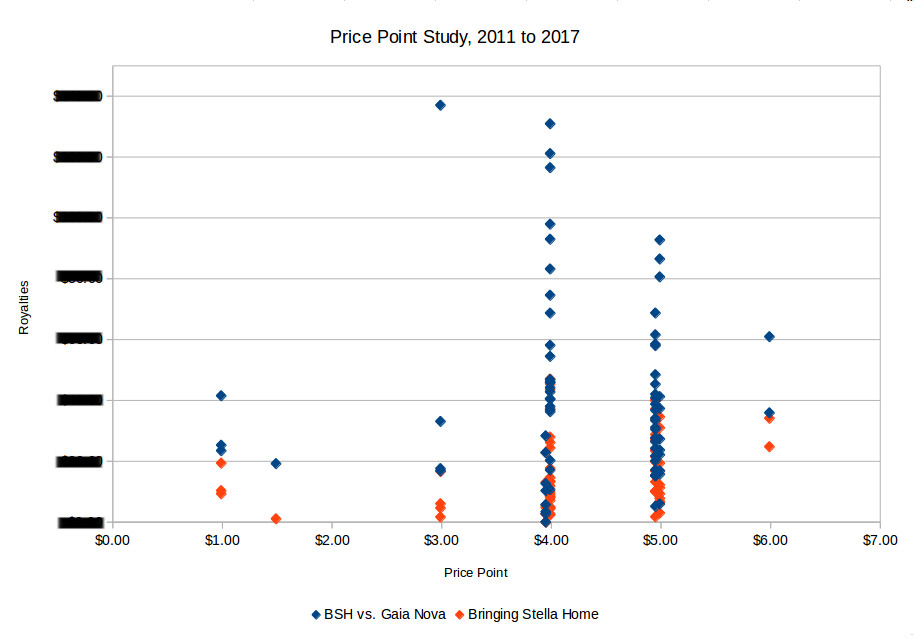
This isn’t my first time experimenting with prices. I’ve been publishing since 2011, and have all of the sales reports and other data in one form or another. So last week, I decided to crunch that data and compare it with the last four months.

Genesis Earth is my first novel, and the book on which I have the most data. It’s a 70k word YA science fiction novel.

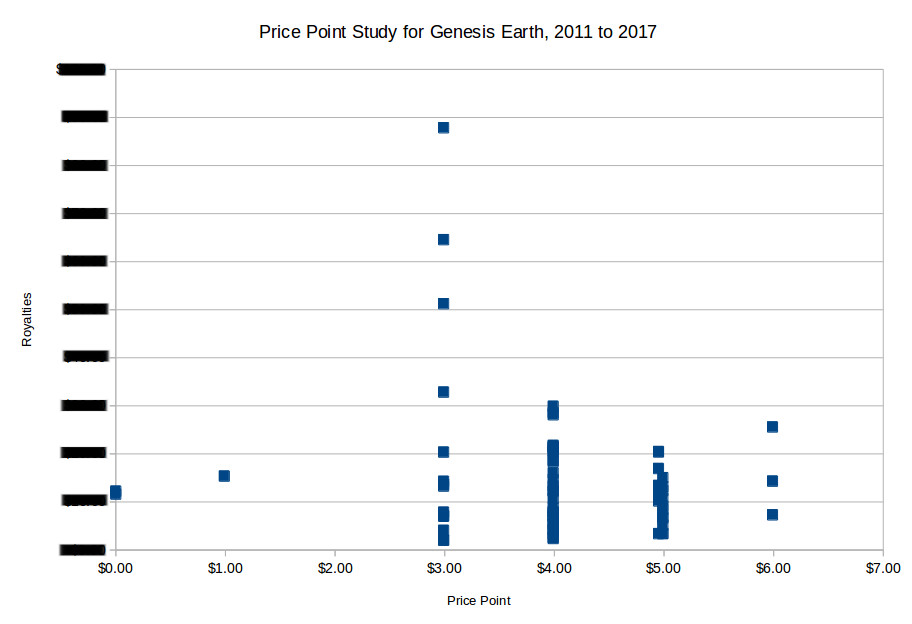
Crunching the data, I found that on average, the book performed best when priced at $3.99, with a few outliers at $2.99. However, most of those outliers are from 2011, before Kindle Unlimited or KDP Select, and before the book had fallen off of the 90 day cliff. Excluding the first two quarters of 2011, those outliers fall away.

Bringing Stella Home is the first book in the Gaia Nova series, and the book for which I have the most data that is also part of a series. It is a 110k word space opera novel.

Interestingly, the book appears to perform differently as a standalone than it does as part of a series. As a standalone, it appears to perform best at $4.99, but the series as a whole performs best when it’s priced at $3.99.

By the way, I tend to price all the Gaia Nova books at the same price point, so except for $.99 and $1.49, it’s fair to assume that all the books share the same price as Bringing Stella Home for any given datapoint.

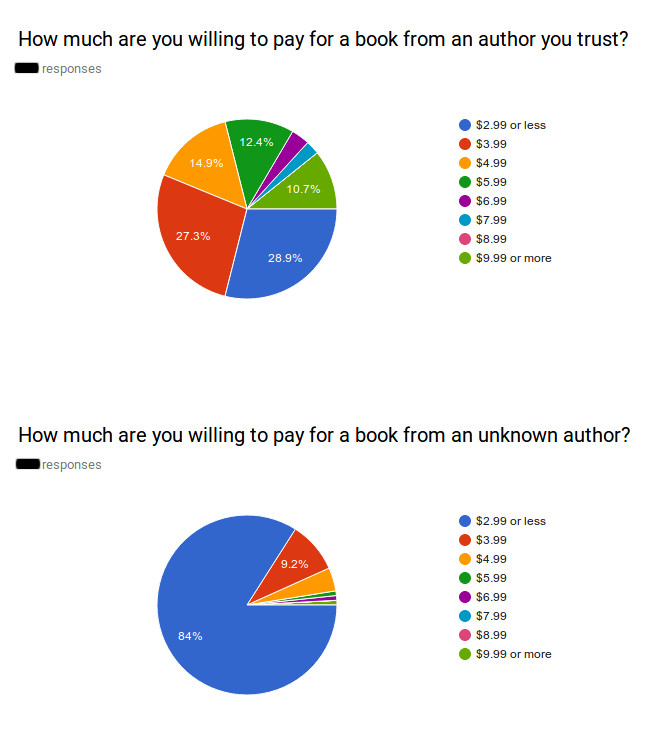
Interestingly,  the data tend to confirm the results of an ebook pricing survey I sent out to my email list about a year ago. The results are pictured above. More than half of respondents said that they were only willing to pay $3.99 or less for an ebook from an author they trust, and more than 80% weren’t willing to pay more than $2.99 for an unknown author.

Unfortunately, I don’t have enough pricing data for my novellas and short novels (under 50k words) to draw conclusions for any other price points besides $.99 and $2.99. Obviously, the $2.99 price point performs vastly better than $.99. There’s a little more nuance than that when it comes to series pricing, but I’m keeping that data close to the chest.

I have yet to crunch the data for my short stories. When I do, that will probably be the subject of another blog post.

From these results, it appears that $3.99 is the sweet spot, both for series and for standalone novels. The data from the last three months are not included in the graphs, but from what I’ve managed to gather my books do not perform as well when I use Dean Wesley Smith’s pricing strategy. It was worth trying out as an experiment, but four months during the prime bookselling time of the year is enough to conclude that it doesn’t work, at least for my books and my readership.

Here’s the pricing strategy I’ll be using from now on:

Novels (over 50k words)

  • $4.99 to $5.99 for frontlist and new releases
  • $3.99 for backlist
  • 99¢ and free for promotions

Novellas and Short Novels (10k to 50k words)

  • $2.99 for frontlist and backlist
  • 99¢ and free for promotions

Short stories (under 10k words)

  • I have no idea. Still need to figure that out.

Early January Update

The holidays are over. Blergh.

I don’t generally do well when my routine gets broken up by outside forces, which is why this blog has fallen by the wayside for the last week or so. I’m also not very good at creating structure in my life where none exists, so during times like the holidays I don’t tend to do very well. This is definitely a skill that I need to work on.

In any case, the holidays are over, which means it’s time to get back to work. Thank goodness!

I am about 10,000 words from finishing my current WIP, An Empire in Disarray. With the work on my friends’ basement finished and my roommate starting school in Salt Lake today, there shouldn’t be any more interruptions between now and the end of next week. This bodes well.

When that’s done, I’ll jump right into work on Victors in Liberty. I’ve got to admit, there are other projects I’d really like to work on right now, but finishing Sons of the Starfarers takes priority.

The series was supposed to be finished way back in 2015. But I underestimated the volume of work I’d taken on—and that was before I got a girlfriend. I fell behind on my writing as the relationship got really serious, and then we broke up, which didn’t help with productivity either.

Long story short, I did a lot of things wrong back in 2014. But I learned from my mistakes, and I think my books are better because of it. So instead of finishing up Sons of the Starfarers in 2015, I’m finishing it now in 2018. And then I’m moving on to other projects.

Edenfall is at the top of that list. It’s been years since I started the Genesis Earth trilogy, which is another ball that I’ve dropped. Genesis Earth does stand alone, but I’ve been promising to finish the trilogy since I published it in 2011, and judging from the reviews (as well as the slow but remarkably steady trickle of sales), this is a WIP that deserves to get priority.

One thing I’m really trying to do this year is to get better at structuring things: my writing, my publishing and marketing efforts, my daily routine, etc. Towards that end, I’ve put together a publishing schedule for 2018. Here it is as it stands at the beginning of the new year:

  • JANUARY — Patriots in Retreat (Sons of the Starfarers, Book 6)
  • FEBRUARY — The Janus Anomaly: A Short Story
  • MARCH — A Queen in Hiding (Sons of the Starfarers, Book 7)
  • APRIL — Time and Space in Amish Country: A Short Story
  • MAY — An Empire in Disarray (Sons of the Starfarers, Book 8)
  • JUNE — Lizzie-99XT: A Short Story
  • JULY — Victors in Liberty (Sons of the Starfarers, Book 9)
  • AUGUST — Edenfall (Genesis Earth Trilogy, Book 2)
  • SEPTEMBER — Sholpan
  • OCTOBER — The Sword Bearer (The Twelfth Sword Trilogy, Book 2)
  • NOVEMBER — In the Beginning: A Short Story
  • DECEMBER — Gunslinger to the Galaxy (Gunslingers Trilogy, Book 2)

Lots of book 2s and finishing series. I suppose you could say this is the year where I start to finish what I’ve started.

And while the schedule may seem a bit daunting, the first four books are already ready to go, with Patriots in Retreat and A Queen in Hiding already up for preorder. Of the ones that are left, half are already written. So even though it seems ambitious, it’s actually quite doable, even if something crazy happens and I end up eloping to Mongolia before the end of the summer.

So that’s what I’m up to. I’ll get back to blogging as I can, but my first priority is writing, followed closely by publishing. Lots of behind the scenes stuff happening which I don’t have time to get into right now.

Take care, and thanks for reading!

Joe

Late November Update

Is it time for another update? Why yes, I suppose it is.

Sons of the Starfarers is coming along quite well. Book 6, Patriots in Retreat, is up for preorder right now with a release date of January 19th. My editor just got back with the edits for book 7, A Queen in Hiding. Haven’t had a chance to look through those yet, but I will in the near future. Come January, that book will be up for preorder as well, with a release date of March 16th.

Right now, I’m writing book 8, An Empire in Disarray, with a hard deadline of 22 December (just before Christmas). Normally, I’d be panicking right now, but I’m trying out a new outlining method that seems to be working quite well. If everything works out the way I hope, I’ll finish up book 9 sometime in February and move on to other projects.

Looking back, it was a mistake to set out to write a nine-book series before knowing how the first one would do. If I could go back to 2009 and do it all over again, I’d stick to trilogies, where the first book stands well enough alone that I can abandon the other two books if it doesn’t gain much traction. That’s going to be my modus operandi from here on out.

So here are the trilogies I need to finish:

Genesis Earth Trilogy

This one has been outstanding for a long time. The first book did much better than I was expecting, and while its popularity has fallen off in recent years, it still gets very good reviews. For a first novel, I’m honestly surprised that this book has done as well as it has.

The second book, Edenfall, is still on the back burner for now. Partially written, partially outlined, it shouldn’t take more than a couple of months to get it done when I finally sit down to finish it.

As for book three, The Stars of Redemption, I have no idea because I haven’t even outlined it yet. Perhaps that’s what I need to get the ball rolling: outline the last book, so I know what has to happen in the second book. In any case.

Gunslingers Trilogy

Gunslinger to the Stars hasn’t done as well as I would have liked, but I enjoy this universe so much that I’m going to finish the trilogy if for no other reason than the fun of it. I’ve already written the first four or five chapters of Gunslinger to the Galaxy, and it’s coming along swimmingly. In fact, I’ll probably go right back to it after finishing up Sons of the Starfarers and call it a vacation. Expect to see more Jane Carter soon!

The Twelfth Sword Trilogy

I am super super excited to finish this trilogy—which is good, because the way the first book ends, it’s definitely not a standalone. Definitely not. Haven’t formally outlined it yet, but there’s a ton of stuff I’m going to throw into the second book, The Sword Bearer. Mercenaries, sorcerors, death mages, winged cataphracts, desert ruins, and mountain strongholds—it’s going to be great fun!

The Outworlds Trilogy

For a while now, I’ve been playing around with the idea of condensing all of Star Wanderers into a novel and then turning it into a trilogy. The first book will basically be made up of bits and pieces from all of the Star Wanderers novellas, spliced together to make a coherent novel. In particular, I’d like to expand on Noemi’s viewpoint and trim out some (or a lot) of the extraneous stuff that made the series drag on. Basically, turn it into less of a sci-fi romance and more of a classic space opera.

I’ve already started the sequel, Children of the Starry Sea, though I haven’t gotten past the first chapter. Where Star Wanderers is a series of novellas, though, Children of the Starry Sea is definitely a proper novel, and it would probably work a lot better to frame it as a trilogy than anything else.

I suppose it’s a bit like how Orson Scott Card turned a bunch of his early short stories into The Worthing Saga, which in my opinion is his very best book. I won’t unpublish any of the old Star Wanderers stuff, but I may just let it fade into obscurity as I push the other stuff.


These are the books that are on my mind. I’ve got to be honest: Sons of the Starfarers feels a bit like a ball and chain, but I’ve committed to finishing it and I’ll do my best to finish it well.

On the publishing front, there’s so much stuff I want to do that I’m having trouble keeping up with it all. My main goal is to get to 10k subscribers on my email list. Currently, I’m just shy of 4k. InstaFreebie has been hugely useful for that, but I’ve got to try other strategies as well. One of those strategies involves a new signup incentive, so if you’re already signed up for my email list, I’ve got a surprise for you soon.

So much stuff going on. I swear, this is the best depiction of what it’s like to be an indie author:

Beginning of September Update

It’s September, my favorite month of the year! Maybe I’ll revisit that post in a blast from the past or something. So many reasons why September is awesome.

Things are going well on the writing front. I’ve switched up my daily routine to make more writing time, and it’s working well so far. My alarm goes off at 5:45 am (just after oh-dark-thirty) and I write for about an hour before heading off to my part time job. I’ve found that I tend to write a lot more when I start first thing in the day, so the earlier I can start, the better.

I won’t bore you with the rest of my routine, unless you want me to write a post about it. There’s a bunch of interesting lifestyle tweaks I’ve been trying out, like reading a couple chapters from one of the books I’m reading as soon as I get back from work in the afternoon, in order to refill the creative well and not get caught in a Youtube / general internet trap. Stuff like that.

My current WIP is A Queen in Hiding (Sons of the Starfarers, Book 7) which is proving to be a surprisingly difficult book. It’s definitely one of the weirdest things I’ve ever written, and that’s saying a lot. In Captives in Obscurity, Reva and Isaac get assimilated into a hive mind, and things only get crazier from there.

Sometimes, stories come really easy, almost like they spring fully formed from the mind. Other times, I’ve found I have to throw out almost the entire first draft before I discover the story.

The weird thing is that it has nothing to do with actual book length. Stars of Blood and Glory and Outworlder are totally different lengths, but they both came out almost perfect in the first draft. However, almost all of the Star Wanderers novellas took multiple drafts filled with stuff that had to be cut. Heart of the Nebula took years to finish, and I had to throw out multiple characters and subplots. I struggled for a long time with Genesis Earth, until I decided to throw the whole thing out and start with a blank page. The book was finished less than four weeks later.

The holy grail, of course, is to write a perfect book in four to six weeks (or less!) every time I set off to start a new one. But as awesome as it would be to barf rainbows and poop gold, all of those things sadly remain out of reach.

My goal at this point is to publish the last four Sons of the Starfarers books in 2018, two months apart from each other. Ideally, I’d like to have the next one up for preorder in time for the previous one’s release. It’s going to take some coordination, but I already have all the covers, which leaves just the writing and editing (metadata and formatting doesn’t take more than a day).

Unfortunately, that isn’t going to happen unless I can get A Queen in Hiding ready to go by December. So that’s what I’m trying to do.

Gunslinger to the Galaxy is on hold for now, though so far it’s coming along very nicely. I should be able to pick it up and finish without too much trouble. Edenfall is also on hold, for how much longer I really don’t know. Before the end of 2018, I’d like to publish either the one or the other, but publishing them both is probably a bit of a stretch.

Also, I haven’t even started The Sword Bearer yet (second book in the Twelfth Sword Trilogy), though I have lots of great ideas for it. Since The Sword Keeper is coming out in just a couple weeks, I should probably get on that.

On the publishing side, I dropped the ball a bit in August. It took so much energy to get The Sword Keeper ready for publication that I totally spaced publishing anything. I do have a bunch of shorts that are nearing the end of the submissions gauntlet, and some bundles that can go up too.

I don’t sell many print books, but I want to get print versions of all of my books up, including short stories. That’s going to be an ongoing project for a while. I also want to put up audiobook versions eventually, but it’s going to take some time to get that ball rolling. However, it has moved up the priority list.

That’s pretty much it. So much stuff I want to do, so little time to do it. Time, money, or youth: you can only pick two (and one of them isn’t your choice).

Take care, and thanks for reading!