Still alive, still writing

One of my friends asked why I don’t post on my blog anymore, and I realized that I haven’t posted anything here in forever. It’s not that I’m not doing anything worth blogging about, it’s just that it keeps slipping my mind to post something. So hopefully that will change.

On the writing side of things, I’ve decided not to give myself any specific direction for the rest of the month other than to write at least 2k words per day (or revise at least 10k words). After my last WIP took a month longer to finish than I’d expected, I’ve come to realize that I might be able to be more productive if I changed up which projects I’m working on. So for the next couple of weeks, I’m giving myself permission to work on anything, just to see what excites me the most right now.

I’ve been spending a lot of time with my writing friends recently. We’ve had some very interesting discussions, such as whether the 2nd amendment should apply to nukes and which modern cities are most likely to be abandoned in the next 200 years (Detroit doesn’t count, since it’s pretty much already there). It’s fun to get together and burn things, especially when you have a cast iron skillet and bacon. Good times–maybe I’ll post a couple pictures from the next bonfire.

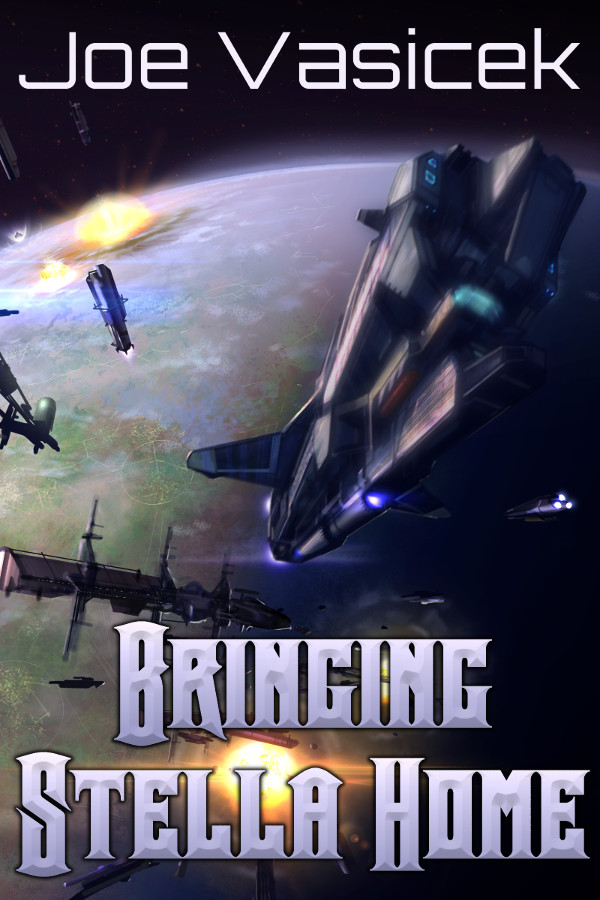
I just finished all the new covers for Desert Stars, Stars of Blood and Glory, and Sholpan, so you can expect to see a few cover reveals soon! I’m keeping the artwork, but updating the typography to look more, well, professional.

Also, I just got an email from the Writers of the Future contest that they should have the finalists for the 4th quarter decided in about a week, and my story is still in the running! I’m super super nervous about this, because I think the story may actually be good enough to have a decent chance. You never can tell about these things, though–writers are horrible judges of quality when it comes to their own work. In any case, either way, I’ll probably self-publish that story once I hear back.

Winter is here, and I haven’t stocked up on LDS cannery hot chocolate yet. The shame! If the apocalypse happens between now and April, I’ll be broke (I am convinced that the LDS church offers hot chocolate as a food storage item so that we’ll have some form of currency in the event of the apocalypse).

In any case, I’d better get back to writing. Take care!

How going indie is like driving a manual (plus a cover reveal)

A couple of weeks ago, I got a new (to me) car. It’s a 2005 Ford Focus / Saleen: a two-door hatchback that drives like a racing car and gets about thirty miles per gallon (WA-A-AY better than the gas guzzler I was driving before). It’s also a manual transmission, which is perhaps the biggest difference between this and my previous car.

This is my first time driving stick shift, and I have to say, it is a lot of fun! When you drive a stick, each hand and each foot is doing something different. There’s a lot more to keep track of, and if you do things in the wrong order (like braking without engaging the clutch, or starting without giving it some gas), you run the risk of making the car stall or doing nasty things to your transmission. On the other hand, driving a manual gives you a much better feel for the engine and what it’s capable of. You can feel when you’re putting too much stress on it–or alternately, when you can push it a little further.

I usually like to walk everywhere, but ever since I got this car, I just want to drive it! It’s way more fun than driving an automatic, even with (or indeed, because of) the extra challenge. So today, while I was walking to BYU campus (alas, the parking situation there makes driving a major pain), I got to thinking about it, and I realized that driving a manual is a lot like being an indie author.

When you’re an indie, you have a lot more things to juggle, just like driving a manual. This gives you much greater control of your career, but it also makes it easier to stall or screw up. At the same time, because of that extra control, you’ve got a much better feel for the market, and probably a better connection with your readers. And for me at least, the extra challenge doesn’t make it less enjoyable, it actually makes me enjoy it more!

Nothing Found

This week, I had the first day where I sold 100+ books in a 24 hour period. That was pretty awesome! I’ve been running a $.99 sale for Star Wanderers: The Jeremiah Chronicles (Omnibus I-IV), and it got picked up by a couple of ebook sites that really pushed it in the right way. Now that I know how to run a sale like that, I hope to do it again, perhaps for Black Friday. And if you haven’t picked up this one yet, it’s on sale for $.99 through Friday.

Marketing and promotion is one of the harder parts about going indie for me, kind of like how finding the clutch point and starting without stalling is hard when you first drive a manual. The more that I practice, though, the better that I get at it, and the more I enjoy it.

Another area where I think I’ve more or less stalled is in my covers. When I put out the first few Gaia Nova novels, I spent a fair amount of money hiring out artists to do the illustrations, but I did the typography myself. On those earlier covers, it definitely shows. For my later books, I worked with a bunch of cover designers, and seeing their work made me realize that there’s definitely room for improvement on those earlier ones, especially for the print editions.

I’ve decided to redo the covers for those three novels (Bringing Stella Home, Desert Stars, and Stars of Blood and Glory), keeping the illustrations but changing the typography. I tried to find a cover designer to do it, but I wasn’t able to find one that did satisfactory work, and after playing around with them for a bit I think I can actually do them myself. I’ve got a lot more experience with covers and cover design now than I did when I was starting out, and I’ve learned a few photoshop tricks as well.

In any case, here is what I came up with for Bringing Stella Home:

BSH (cover)How do you like it? I rather like how it turned out, though I’ll admit I’m still learning. I did the new design just this morning, so I figure I ought to wait a couple of days and maybe seek out some feedback from professional designers before I go through with it.

I hope to have the new edition out before the end of the month. The content and story will all be the same, but the cover and metadata will be updated, and some minor errors such as typos will be fixed. I also hope to do the same thing with Desert Stars and Stars of Blood and Glory. Once the new editions are out, I’ll probably run some sales and giveaways with them, so definitely stay tuned!

As for my other projects, the next book in the Sons of the Starfarers series is out with my first readers, so it’s on track for a January release. My next WIP is The Sword Keeper, a fantasy novel I think I’ve mentioned before, and I hope to get that one knocked out in about a month or so. It’s already halfway finished, so the hard part is just ahead. There are also a couple of Gaia Nova novels that I’ve been meaning to get around to, and probably will before the end of the year.

That just about does it. Look out for more covers soon! I’m definitely having fun with the new ones. 😀

I love these trailers

Holy cow, I cannot get enough of this trailer for Civilization: Beyond Earth! It’s like something from a book I would write. There’s the classic Science Fiction story about leaving Earth to colonize the stars, but there’s also a deeply human element to it. And I love the religious element to it, how the colonists take the old religions of Earth with them to the new world. Awesome.

This definitely looks like a game I want to play. I grew up with Civilization 2, perhaps the most classic title in the series, and discovered Sid Meier’s Alpha Centauri in college. In a lot of ways, Alpha Centauri shaped my love for Science Fiction, and gave me many ideas that later influenced my stories. Genesis Earth is, in some very key ways, a response to the vision of humanity’s future presented in SMAC.

While on the subject of awesome trailers, it’s worth pointing out this one for the new Christopher Nolan film, Interstellar:

Again, this looks like a fantastic story–the kind of one that I’d love to tell just as much as I’d love to hear. And with all of our modern problems like climate change, resource depletion, wealth disparity, terrorism, and global war, it strikes frighteningly close to home. Are we as a species on the verge of driving ourselves extinct? What will we do if our home planet can no longer support us? Where could we go, and what could we hope for?

So much awesomeness. I really, really, REALLY want to see this movie and play this game! But even more, these trailers make me want to write an awesome story along those same lines. I’ve already written at least one novel that addresses these issues, and it’s definitely part of the background of the Gaia Nova universe, but I want to revisit these same issues again.

Maybe in Starship Lachoneus? Who knows?

Goodreads giveaway for BRINGING STELLA HOME!

My cover designer is working on some new covers for Bringing Stella Home, Desert Stars, and Stars of Blood and Glory, so I figured I’d do a few Goodreads giveaways to get rid of the old versions that I have lying around. If it goes well, I may do some more giveaways in the future!

To sign up for a chance to win a copy, check out the widget below. The copies will be signed, though I’m not sure if I’ll be able to personalize them.

Thanks for reading!

Goodreads Book Giveaway

Bringing Stella Home by Joe Vasicek

Bringing Stella Home

by Joe Vasicek

Giveaway ends November 20, 2014.

See the giveaway details
at Goodreads.

Enter to win

Don’t worry, I’m still alive

Wow, has it been more than a week since my last post? I think this is the longest I’ve gone without updating this blog since coming back from Georgia.

I wish I could say life has been busy, but it hasn’t really. Just another lazy summer in Utah. I did start dating someone recently, which probably explains where all my time has gone. But don’t worry, I’m still writing–in fact, the first draft of Strangers in Flight (Sons of the Starfarers: Book III) should be finished next week. It’s taken me a lot longer to write this one than I’d expected, but now that I’ve buckled down, it’s really coming together.

Comrades in Hope (Sons of the Starfarers: Book II) should be out by the end of the month, barring something crazy like my editor or cover designer dropping off the face of the Earth. Once they get back to me, all I’ve got to do is run through the edits (which shouldn’t take longer than a day or two) and format the thing (which also shouldn’t take longer than a day or two). So if you’ve read the first book and are eagerly awaiting the second, you shouldn’t have to wait longer than a couple of weeks!

I’m not sure what cons I’ll be attending this summer/fall. I thought I was going to Westercon, but it turns out my parents are going to be in town that week, and considering that it falls on the fourth of July (which also happens to be my sister’s birthday–who also happens to be pregnant), it looks like I have more important things to do that weekend. Besides, I want to start a new 4th of July tradition with my girlfriend this year: watching Gettysburg.

In any case, it looks like I won’t be doing too many cons this year. Maybe Salt Lake Comic Con, but I don’t know about that one yet either.

Once I’ve finished Strangers in Flight, I’ll probably take some time to work on a novel. There are three projects that I’m thinking about working on:

Star Wanderers: Children of the Starry Sea — I’ve been wanting to write a Star Wanderers novel for some time, but haven’t actually started it yet. It would definitely be fun to revisit the characters from that series, and it seems that a lot of my readers would really be interested in it too. It would also be a good way to tie things in with Sons of the Starfarers, and give some direction to the later books in that series.

The Sword Bearer — I explained the plot of this one to my girlfried, and she really liked it. That got me excited about it again, so I’m thinking very seriously about taking that project off of the back burner for a while. It’s a long-form epic fantasy that will probably turn into a trilogy–very different from the stuff I’m writing now. Still, it has a lot of potential, and the story is definitely solid. If I do pick it up, I’ll probably rename it The Sword Keeper, so that book 2 will be The Sword Bearer, and book 3 will be The Sword Wielder.

Star Wolf, AKA Heart of the Nebula — I’ve been meaning to finish this one for some time, so I might as well knock it off. With the last round of revisions, I got about halfway through, but it’s still very messy, so this would definitely be a project. However, this is the one that is closest to actually being publishable.

So that’s what I’m up to right now. I’ve got a lot more to say, especially about my girlfriend, but for now, I think I’d better get back to writing.

X is for Expectations

What sort of expectations should or shouldn’t you have when you start self-publishing? What is plausible, and what is unrealistic?

Honestly, it’s probably a good idea to go into it with expectations that are fairly low. Most books don’t sell more than a handful of copies, and there’s no way to tell what will and will not take off (if there was, publishing would be a whole lot more lucrative). There’s nothing wrong with dreaming, but it will save yourself a lot of trouble and heartbreak (not to mention, money) if you go in expecting things to be kind of rough for the first few years.

When I started out with “Memoirs of a Snowflake” and a couple of other shorts, they didn’t hardly sell at all. Then I published Genesis Earth, and while I saw maybe 50 sales in the first three months, after that they fell off to single digits for the next two years (and yes, zero is a digit). I made my shorts free for a while, and they got tens of thousands of downloads, but that didn’t really translate into sales.

I didn’t expect to be a runaway bestseller right out of the gate, so I wasn’t too disappointed, but still it was kind of a blow. It was worse when Bringing Stella Home only got about ten sales in its first month before falling off to single digits just like Genesis Earth. I suppose things could have gone differently if I’d promoted a bit more aggressively, but that seemed like such a crap shoot that I channeled that energy into writing instead.

And it paid off eventually. When Star Wanderers took off, it generated some interest in all of my other books–not as much as I was expecting, but enough to bring them up to double digits every other month or so. My Star Wanderers books are all selling in the double and triple digits, and I couldn’t tell you why other than that the story just seems to strike the right chord with enough people. Those books would probably be doing better if I promoted them more, and since it looks considerably better than a crap shoot now, that’s something that I plan to be more aggressive about.

I think there’s an important difference between dreams and expectations. Dreams can suffer through setbacks considerably better, and help to maintain a sense of optimism that is perhaps one of the most important things an indie writer can have. Expectations, though, are much more practical and down to Earth, and can provide a useful yardstick for measuring progress. They can also provide an anchor in the face of uncertainty. Those are important things for an indie writer to have as well.

Expectations can be negative, though. If you don’t expect a book to do well, then perhaps you won’t put as much effort into it, sabotaging and self-rejecting your own work to the point where it really can’t do well. If you expect a book that hasn’t been selling at all to continue not to sell, you may lose sight of important opportunities to put it in front of the people who are most likely to fall in love with it.

Every genre is different, every book is different, and every writer is different. Because of this, no one can tell you exactly what to expect–including me. Like me, you might be stuck making nothing but pizza money for the first two years–or your books might take off fantastically well right from the start. There’s no way to know what will happen until you get your feet wet.

C is for Cover Art

They say not to judge a book by its cover, but the truth is we all do. In fact, the cover probably sells a book more than the book blurb does. Whether in print or in digital format, it’s the first part of the book that readers see, and often makes the difference between “meh” and “hmm, what is this? I want to find out more!”

So how do you do cover art when you’re an indie? Is it better to make your own, or hire a designer? If you do hire a designer, how much can you expect to pay?

Honestly, when I started out, I think I invested a little too much into my covers. The first novel I published was Genesis Earth:

thumb (Genesis Earth)The cover art is gorgeous, and from an artistic view I’m very, very happy with it, but it took a long time for the book to earn that money back–far longer than the expense really justified. I would love it if all of my books could have awesome covers like this, but when you’re first starting, not every project justifies that sort of expense.

The thing to keep in mind when you do covers as an indie is that you can always change them. When you first start out and you don’t know how well a book is going to do, there’s nothing wrong with doing it on a shoestring budget and reinvesting those earnings later. There is a bit of a feedback loop, where a bad cover will hold a book back, but it’s not that hard to make a cover that’s not great, but acceptable.

Case in point, check out the first cover I did for Star Wanderers: Outworlder (Part I):

Star Wanderers I (thumb)The cost for this art was $0. I made it myself, using freeware fonts and public domain space art from NASA. It’s not nearly as gorgeous as the cover for Genesis Earth, but it says “space!” in a sci-fi sort of way, and that’s what I was going for. And even with a mediocre cover, this was the book that really started to take off.

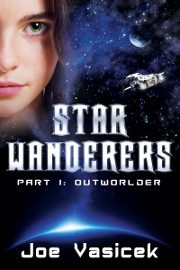
Of course, as soon as those books were earning enough, I made plans to reinvest that money in proper cover art. Here is the new cover for Outworlder:

SW-I alt (thumb)I’m working with a cover designer right now to redo all the other ones in the series along a similar vein. In the next couple of weeks, expect to see some cover reveals!

In general, I’ve found that there are three approaches to cover art: doing it completely yourself, hiring a cover designer to make an cover from stock art, and hiring an illustrator to paint an original illustration. The last is probably the most expensive, though it does depend on the illustrator–you can find good illustrators on sites like Deviantart whose rates are quite reasonable. But the quality varies a lot.

Besides the art itself, a key part of the cover is the typography. One thing I’ve learned from working with cover designers is that they can do amazing things just with the fonts and font effects for your title. That’s probably the biggest benefit of going with a cover designer as opposed to an illustrator.

In fact, if you can afford to commission an original illustration, you can probably find a cover designer who will give you a deal on the typography. It is something you can learn yourself, but the difference between you and a cover designer is often the difference between acceptable and awesome.

Like anything with self-publishing, cover design is something you can learn–perhaps something you can excel at–but you probably can’t excel at that and everything else at the same time. What I’ve found is that I’m okay at doing my own cover art, but not awesome. From here on out, I expect I’ll be hiring cover designers.

At the same time, my books are earning enough that I can justify that expense. If I were first starting out, I’d probably DIY it or barter with other writers who do their own covers. A cover isn’t static–you can always change it later.

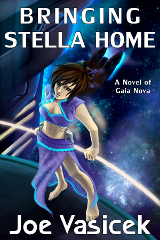
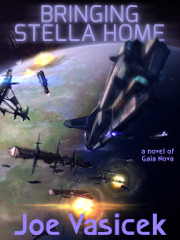
Case in point, check out the covers for Bringing Stella Home:

thumb (Bringing Stella Home)thumb 2 (Bringing Stella Home)

I got a good deal on the illustration for the first cover, but frankly, it’s not that great. The second cover was more expensive, but I’m much happier with it. What I’m probably going to do next is find a cover designer who can redo the title/author typography, since I did that myself and it kind of shows.

So that’s been my experience with cover art. It’s important to get it right, but you do have to work to find the best solution that works for your budget. Fortunately, when you’re an indie, your cover is something you can always upgrade.

Crazy ideas and other updates

I had the craziest idea today while taking a late-night walk around Provo. It’s for the new series that I’m working on, Sons of the Starfarers, and it’s going to take six or seven books to get there, but it’s going to be AWESOME. Unfortunately, I can’t say much about it because the first book isn’t out yet, but I think you guys are going to be wowed.

I still remember the moment when the final PAGE of Desert Stars came to me. I was driving back to Provo from the Salt Lake Airport (alone, fortunately), and when it popped into my head I must have screamed for five minutes straight. The way that Mira’s final observation wraps everything up–both the overarching story her own personal growth arc–it was just awesome.

Those moments of insight are rare, but when they happen, they illuminate everything. It’s as if the whole story is unfolded to you, so that you can see how everything that came before ties into everything that happens later. It also opens you up to the heart of the story itself, so that you can see what it’s all about. As a writer, I live for that kind of insight. It’s one of the most powerful things that makes the whole endeavor worthwhile.

So yeah, Sons of the Starfarers is coming along nicely. The first book, Brothers in Exile, should be out May 10th, with the next two coming out six weeks apart from each other. That’s the plan, anyway. For updates on when those books come out, you can either follow my blog or sign up for my email list. I’ll post a few excerpts in the lead up before and after Brothers in Exile is published.

For April, though, I’ll be participating in the Blogging from A to Z challenge. Every day except Sundays, I’ll have a post for a different letter of the alphabet, all following a common theme. Last year, I blogged about the science fiction genre and some of my favorite tropes. This year, I’ll be blogging about my experience as an indie writer and what I’ve learned from it over the past three years.

I’ve already written and scheduled the first couple of posts: A is for Algorithm and B is for Book Blurb. Beyond that, I’ll be doing stuff like D is for Discoverability, P is for Pricing, S is for Serials, etc. Whether you’re a writer from one of the indie author communities I’m a part of, or a fan who discovered this blog after reading one of my books, I hope you’ll find this behind-the-scenes series of blog posts interesting. I can already tell I’m going to have a lot of fun with it!

That’s just about it for now. This week, I hope to finish up Book II: Comrades in Hope and get ready to dig into Book III: Strangers in Flight. The stuff in that third book is going to set the stage for some major wow moments later on in the series, and I can hardly wait to dive into it!

Juggling projects (and trying not to drop them all)

Many, I wish I could write faster. I probably can, but there are times when writing is an uphill slog, and you can’t put your foot on the accelerator too hard or your tires will spin out.

Right now, I’m about halfway through Star Wolf (formerly HEART OF THE NEBULA), and I’m in the part of the manuscript that needs the most work. I’ll probably be throwing out 60%-70% of what’s in there now and rewriting it from scratch, at least until the last five chapters. That’s not the hard part, though–the hard part is untangling the storylines that need to be kept from the storylines that need to be thrown out. I’ve already outlined the basic structure, but for the next couple of chapters, I’ve decided to abandon my revision notes. Now, everything is murky.

So that’s what I’ve been up to in the last few days. Star Wolf is a novel in the Gaia Nova series, and will probably end up around 120,000 words or so. That’s around the same length as Bringing Stella Home, or perhaps a bit longer. Definitely a change of pace from the novellas I’ve written in the last couple of years. As much of a slog as it is now, though, it’s got a lot of good stuff in it. Action, adventure, political intrigue, hard moral choices–not to mention space battles, generation ships, and cryonics gone horribly right.

But really, I want to get this one finished so that I can work on Sons of the Starfarers Book II: Comrades in Hope. I’m so excited about this one, I’m thinking about putting Star Wolf on hold for a few weeks so that I can just write it. Of course, a few weeks will probably turn into one or two months, and by the time it’s finished I’ll want to move immediately on to book 3.

Which actually might not be a bad thing, since I want to launch Sons of the Starfarers as soon as I can. It seems like you guys have really enjoyed Star Wanderers, so I think that you’re going to enjoy Sons of the Starfarers even more. I’m already getting the feedback from my first readers for Book I: Brothers in Exile, and while there are a few minor fixes to make, the story itself seems pretty solid. And the places I want to go with this series … man, it’s going to be awesome.

Just to give you a taste, here’s an excerpt from the first chapter of Brothers in Exile. Isaac and Aaron have just arrived at a derelict station on the fringes of settled space, light-years away from the nearest human being.

“So this is Alnilam station,” he mused as he peered out the forward window. The station’s hull was a dark gray, the beacons at the ends of the antennae a deep flashing red. Though it shone a little as it reflected the stars, their light was too dim to give anything more than the basic shape of the structure. On the inside of the wheels where the windows should have been, there was a blackness as dark as the night on the planet below.

“I’m picking up something,” said Aaron.

“Is it a transmission?”

“No, it’s something else. Radiation signatures, concentrated mostly at the hub.”

Isaac’s heart fell. “That would be one of the station reactors, probably leaking fuel or coolant internally.” Proof that no one’s alive in there after all.

“Well, it can’t be that big, since the wheel engines are obviously still working. And I’m only picking up radiation immediately around the reactors, so it’s not like it’s leaked down to the rim. If anyone’s still alive—”

“They can’t be. If they were, they would have fixed the leak.”

Aaron bristled. “How do you know that? For all we know, the engineers are gone and none of the survivors knows what to do about it.”

“If there are any survivors, why haven’t they hailed us?”

“How should I know? All I know is that it’s possible. You can’t refute that.”

I guess I can’t, Isaac thought. Instead of admitting that, though, he kept silent, peering at the ghostly derelict as if lost in thought.

“We should dock and go in there,” said Aaron. “Peek inside, take a look around. Even if there aren’t any survivors, maybe we can at least find out what happened to them.”

“Are you crazy?” said Isaac, his heart beating a little faster at his brother’s suggestion. “We have no idea what’s in there. For all we know, the place is infested with some sort of disease.”

“So we go in EVA suits and take a quick sterilizing spacewalk before coming back. No big deal.”

“It’s still a dumb idea. We’re not going.”

Aaron scowled and rolled his eyes. “So what, you just want to turn around and leave? Abandon this place without finding out what happened?”

“That’s right. We know that the station is dead, and that’s enough.”

“But we don’t know that,” said Aaron, raising both of his hands. “We don’t know hardly anything. All we know is that no one has answered our transmissions and there’s a small reactor leak at the hub, but everything else looks fine.”

It does not look fine, Isaac thought to himself. His palms felt clammy, and he was already beginning to regret his decision to come to this system at all.

“Listen,” Aaron continued, “even if there aren’t any survivors, maybe we can find some fuel and supplies to make this trip worthwhile. It’s more than a parsec to the nearest settlement, and even if we go straight there we’ve already burned through so much that we’ll have to sell half our cargo hold just to resupply.”

That much was true. Even with the credit they’d built up around this sector, they’d be dangerously low on fuel if they turned around now. The Medea was a small ship, and it could take them almost a year to make up their expenses if they cut their losses now. Still, the thought of setting foot on that derelict made Isaac’s skin crawl.

“It isn’t safe,” he muttered. “Whatever happened here, we shouldn’t get involved.”

“But we are involved,” said Aaron. “We’re involved just by being here. And since we’re already involved anyway, we might as well find out what happened to these people so that we can get their story out. They deserve that much.”

That’s right, Isaac thought. They certainly do.

“Okay, I’ll bring us up to one of the rimside docking nodes so we can go in. But I want you to stick with me, Aaron—understand? No running off—we do this together.”

“Yeah, yeah. Together. Got it.”

I hope you do, Isaac thought as he stared out the forward window at the derelict station. Down below in the planet’s atmosphere, lightning flashed silently, illuminating the tempest for a single instant before the lifeless world returned to darkness.

Oh man … so much awesome stuff to write! When the first three books are written, I’ll publish the first one, and publish the other two soon thereafter. I don’t want there to be a long gap between releases. But between book 3 and book 4, there will probably be a bit more time, since I intend to organize this series in groups of threes.

That’s just about it. Tomorrow, I’ll probably spend most of the day working on short stories, since there’s a story idea that’s screaming at me to be written. With short stories, you’ve got to move fast, because they will get away from you if you don’t write them immediately. But if I get a chance I’m probably going to start Comrades in Hope, because that’s the one I really want to be writing.

So many projects to juggle … I just hope I don’t drop them all!

Lindsey Stirling, Nichieri, Susan Boyle, and thoughts on discoverability and greatness

I saw a couple of things on Youtube that made me think recently about the importance of quality work, especially in the arts.

I’m a casual fan of Lindsey Stirling–I’ve watched most of her videos, put them on in the background from time to time, and get a kick out of following her career. For those of you unfamiliar with her, she’s a Youtube sensation who combines violin music, dance, and dubstep/electronica, often in some interesting and beautiful places. This is her most popular video, and probably her best work so far:

Her career is interesting because it follows a path very similar to a lot of self-published authors. She started by putting out videos on Youtube, built up a huge following that way, turned down a number of deals from traditional record labels and put out her first album herself. Now, she’s touring all over the world, collaborating with a bunch of other Youtube artists, and doing a lot of other amazing stuff completely independently.

The other day, I was really surprised that she was on America’s Got Talent back in 2010. Apparently, this was before she got really big, and the connections she made while on the show helped her find success later on:

Two things stood out to me from that video.  First, the judges were right–even though she was pushing herself, this was not her best work, and it showed in a way that was rather glaring. I hate to say that because I like so much of her stuff, but it’s really true–her performance fell short.

The second thing that stood out to me was her response to the criticism. It must have been incredibly painful to stand up there in front of everybody and get hammered like that, but she still managed to smile, be gracious, thank the judges, and focus on the positive without being confrontational. That takes class.

When I was in Georgia, I watched a lot of TV, especially on the Rustavi 2 channel. One of the most popular shows is Nichieri (ნიჭიერი), a talent competition show set up much like The X Factor or America’s Got Talent. Even though I didn’t really understand anything the people were saying, I could still really tell when a contestant did some truly amazing.

There’s something about greatness that makes you sit up and pay attention–something that makes it stand out on its own. It’s something timeless and stirring, something that drives you to keep coming back to it, or at least to remember it long after it’s passed. With poor quality stuff, like bad writing, clumsy performance, or the like, you tend to forget it (unless of course it’s a spectacular failure, which in a weird way gains a sort of greatness of its own to a certain extent). But good quality stuff sticks with you–indeed, it’s almost like it becomes a part of you. It certainly becomes part of the culture.

When it comes to talent shows like Nichieri, The X Factor, and America’s Got Talent, the greatest moment has to be Susan Boyle. Everything about it is just perfect, from the awkward, homely way she started out to how she blew everyone away with her stellar performance. She didn’t look like she had it, and she certainly didn’t act like she had it, but she did, and she knew it. She didn’t settle for anything less than her best, and she didn’t let anyone else put her down.

In a lot of my discussions with other indie writers, we talk a lot about discoverability. We’re all anxious to be read, to be heard, to be discovered–to get our shining moment. The thing is, though, that moment is not enough if you don’t have quality work. It’s not going to keep you down or “ruin” your career, necessarily–Lindsey Stirling has come a long way since her disappointing performance on America’s Got Talent. But that’s only because she produces quality work.

I think I need to spend a lot less time trying to boost my discoverability and a lot more into producing the best work that I possibly can. The thing to remember, though, is that quality is subjective and you can’t please everyone. As Lindsey later said, “A lot of people have told me along the way that my style and the music I do … is unmarketable. But the only reason I’m successful is because I have stayed true to myself.” You can’t compare yourself against others, either–you can only really compete against yourself.

How do you know when you’ve done your best? That can be a little tricky, partly because it’s a moving target. I think Genesis Earth and Bringing Stella Home represent my best work at the time, though when I look back at those books I see things that could be improved. I tend to think that Desert Stars is my best work to date, though I’m not so sure anymore. Do I only think that because I struggled so much and for so long with that book? Just because something is a joy to create doesn’t mean that it’s any less than something you toiled and suffered over.

Star Wanderers was both a gift story and an experiment. The novella format was new to me at the time, so I did a lot of learning on it. Outworlder, Dreamweaver, Homeworld, and Deliverance came to me in a white-hot creative heat, but Sacrifice and Reproach were a real struggle. Is there a discernible difference in quality between them? Not that I can tell. I do think that the later stories hold together better on their own, though. I didn’t really hit my stride with the novella format until I started branching off into other characters’ viewpoints.

This is all on my mind because my next big project, Sons of the Starfarers, is something that I really want to do right. I don’t just want to write it for the sake of putting it out there (though I recognize that writing quickly doesn’t always mean sacrificing quality). I don’t just want to put it out so that I can make my work more “discoverable,” though that’s certainly a motivation. I don’t even just want to do my best. I want to improve my writing and storytelling so much that this becomes the best thing that I’ve ever written.

At LTUE a few years back, Tracy Hickman said that as writers, it is important for us to believe that we have not yet written our best book. That’s so incredibly true. You have to always believe that you can do better, not to make you depressed when you look back, but to make you enthusiastic as you look forward. Imagine what would have happened if Lindsey Stirling thought that her performance on America’s Got Talent was the best that she’d ever do! Her career hadn’t even dawned yet.

I think it’s the same with me. I’ve gained a little exposure, suffered a few setbacks, and experienced a small measure of success, but the big stuff is yet to come. And even though I may not want to be the next Brandon Sanderson or Orson Scott Card in terms of popularity, I do need to shoot high in terms of quality. Before I work on my discoverability, I need to make sure that I’m putting out some truly amazing stuff. I need to shoot for greatness.