L is for Lost Colony

worthingsagaAs we discussed in I is for Interstellar, space colonization is a major theme of science fiction, especially space opera.  Of course, things don’t always go smoothly.  Space is a really, really, really big place, and sometimes, due to war or famine or simple bureaucratic mismanagement, colonies get cut off from the rest of galactic civilization.  They become lost colonies.

Some of my favorite stories are about lost colonies: either how they became cut off, or how they reintegrate after so many thousands of years.  In many of these stories, the technology of these colonies has regressed, sometimes to the point where the descendents may not even know that their ancestors came from the stars.  When contact is finally made, the envoys from the galactic federation may seem like gods or wizards.

Because of this technological disconnect, stories about lost colonies often straddle the line between science fiction and fantasy.  After all, Clarke’s third law states:

Any sufficiently advanced technology is indistinguishable from magic.

Of course, the line between science fiction and fantasy has always been a fuzzy one.  Hundreds of attempts have been made to define it, but they all fall short.  In the end, it often breaks down to certain recurring tropes, like dragons and wizards versus ray guns and rockets, but even that doesn’t always work.

For example, Anne McCaffrey’s Dragonriders of Pern is technically about a lost colony far into the future, but it’s got dragons and castles and other tropes that belong squarely in fantasy.  Then again, the dragonriders have to fight alien worms who invade every few dozen years from a planet with a highly elliptical orbit, so there’s still a strong science fiction basis undergirding the whole thing.

And that’s just Dragonriders of Pern.  What about Marion Zimmer Bradley’s Darkover series, or C.S. Lewis’s Space Trilogy?  Trigun is more western than fantasy, but it’s also full of sci-fi tropes like giant sand-crawling monster ships and a weird post-apocalyptic backstory.  And then there’s all the Japanese RPGs that combine magic with mechas, with Xenogears as one of the best examples.  For a distinct Middle Eastern flavor, look no further than Stargate.

It’s no coincidence that all of these stories feature a lost colony of one kind or another.  When the characters don’t know that they’re living in a science fictional universe, it’s very easy to throw in tropes from other genres.  By no means is it required–Battlestar Galactica and Dune are evidence enough of that–but they certainly present the opportunity to do so.  After all, lost colony stories basically present a hiccup in humanity’s march of progress, breaking the essential science fiction narrative for all sorts of interesting side stories and tangents.

One perennial favorite of science fiction writers is to suggest that Earth itself is a lost colony from some other galactic civilization.  That forms the entire premise behind Battlestar Galactica: the original twelve colonies have been destroyed in the human-cylon wars, and the last few survivors are searching for the legendary thirteenth colony of Earth, hoping to find some sort of refuge.  Apparently, Ursula K. Le Guin’s Hainish cycle also plays with this trope, though she’s never very explicit with her world building.  It can be a bit tricky to twist the lost colony trope in this manner, but if pulled off right it can really make you sit back and go “whoa.”

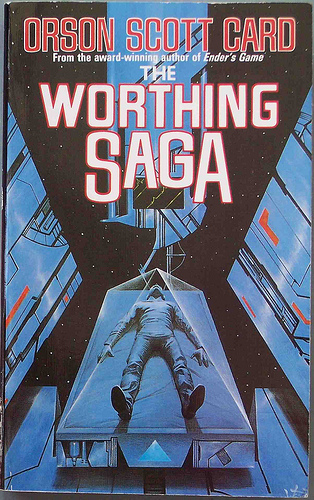
My personal favorite is probably Orson Scott Card’s The Worthing Saga, about a colony of telepaths that breaks off from a collapsing galactic empire and actually becomes more advanced than the rest of humanity.  When Jason Worthing and Justice re-establish contact, the descendents of the galactics are basically pre-industrial subsistence farmers who view them as gods–which, in a certain sense, they almost are.

It’s a great story that really entranced me, not just for the science fictional elements but also for the distinct fantasy flavor.  Orson Scott Card’s handling of viewpoint in that book is truly masterful, so that I felt as if I were viewing everything through the eyes of his characters.  Since the farmers don’t know anything about their spacefaring ancestors, all the parts from their point of view feel like a completely different story.  It was really great.

My first novel was actually a lost colony story, combined with a first contact.  I trunked it a long time ago, but many of the earliest posts on this blog are all about my experience writing it.  As for my other books, Desert Stars contains elements of this, though the lost colony in question is actually a nomadic desert society that lives on the capital planet of the galactic empire, just outside of the domes where all the more civilized folk live.  Heart of the Nebula is basically about a society that puts itself in exile in order to escape the privations of the Hameji.  And in… no, I’d better not spoil it. 😉

The lost colony isn’t one of the flashier or more prominent tropes of science fiction, but it’s definitely one of my favorites.  It’s a great way to add depth and intrigue, as well as bend genres.  For that reason, I think this trope does a lot to keep science fiction fresh.
Trope Tuesday: The Three Faces of Eve

Why do so many character combinations come in groups of three?  Unlike love triangles, where the combo is primarily a way to build conflict, the characters in power trios all build on each other in some way.  They might be foils for each other, but as complementary archetypes, they do far more to drive the story together than they ever would apart.

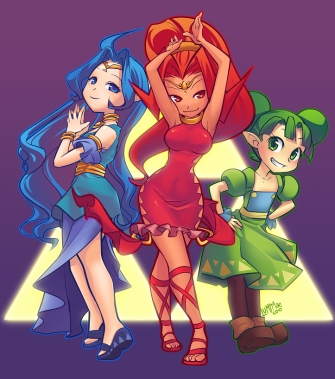
One of the most interesting all-female power trios is the Three Faces of Eve, which combines the archetypes of child, seductress, and wife:

The “child” (who does not have to be a child literally) will be seen as innocent, perhaps to the point of naïveté. The wife, the wiser, calmer aspect, someone around whom one could build a home life. The third, the seductress, is sexually experienced and independent.

Roughly speaking, the characters in the trio correspond to:

  • The Ingenue: A naive, innocent, childlike girl who is just setting out into the world.  In a Freudian Trio, this would be the Ego.
  • The Femme Fatale: A seductive, alluring, mysterious woman who is experienced in the ways of the world.  Unlike the Vamp, she may or may not use her feminine wiles for evil.  In a Freudian Trio, this would be the Id.
  • The Yamato Nadeshiko: A calm, steady, faithful wife, who provides the kind of marital stability and maternal strength that is ideal for settling down and raising a family.  In a Freudian Trio, this would be the Superego.

You’d be surprised to see how often this trope shows up, even in works of science fiction.  In Star Wars, Leia was the child in A New Hope, the wife/mother in Empire Strikes Back, and (what else?) the seductress in Return of the Jedi.  Just about every Star Trek series featured some alignment of these archetypes.

Squaresoft played with this trope a lot in their Final Fantasy series, which may be illustrative to examine in greater depth.  I’ve only played through FF IV, VI, VII, and Chrono Trigger, but each  of these titles features some interesting variations (warning: spoilers!).

Final Fantasy IV: Porom (child), Rydia (seductress), Rosa (wife).

Porom is pretty solidly the child, though Rydia starts out as this and later grows up into the seductress role.  She doesn’t get the guy in the end, though: that would be Rosa, who pretty much starts out with him as well.

In terms of story, the characters don’t really seem to build much on each other, though in terms of gameplay you definitely want to have Rydia and Rosa/Porom in your party (though not Rosa and Porom together–you only need one white mage, after all).

Final Fantasy VI: Relm (child) , Celes (seductress), Terra (wife).

This is my personal favorite in the series.  Unlike IV and VII, which both center around male protagonists, Final Fantasy VI revolves around Terra (world of balance) and Celes (world of ruin) as the central protagonists.  Because they also play a role in the power trio, their characters are quite complex, especially in the second half of the game.  Relm is arguably more of a Mary Sue, but her relation to the other characters, especially Shadow, also makes her role more complex and interesting.

In the end, the romantic subplot is fulfilled by Celes, not Terra, which was something of a surprise to me in my first playthrough.  It works really well, though, because of Celes’s heel face turn and subsequent reformation (in which Locke is arguably a Manic Pixie Dream Girl Spear Counterpart).  Does that also translate into a shift from seductress to wife as well?  I’m not sure, but I’d probably say no–after all, it’s Terra who takes on the mother role in the world of ruin.

Final Fantasy VII: Yuffie (child), Aeris (seductress), Tifa (wife).

The main twist with this one is that visually, you’d think Tifa is the seductress and Aeris is the wife.  In terms of story archetypes, however, it’s just the opposite: Tifa is the one whom Cloud depends on, the one who helps him work through his problems, while Aeris is the shifty, mysterious one.

Unlike IV, where Rosa and Cecil are set up from the very beginning, for a while it actually looks like Aeris and Cloud are going to end up together.  But then, in perhaps the most tragically gut-wrenching moment in all of video game history, Aeris dies (and doesn’t come back).  Since Yuffie is kind of, well, crazy, Tifa and Cloud are pretty much garanteed to get together after that point (and as for Sephiroth…I don’t even want to go there).

Chrono Trigger: Marle (child), Ayla (seductress), Lucca (wife).

Chrono Trigger is interesting because the girl who ends up with the guy in the end (Chrono) is actually the one who fulfills the child archetype, Marle.  It works, though, because of the childlike feel of the story.  Unlike FF VI and IV, Chrono Trigger is not a dark or an edgy tale–it’s heartwarming innocence at its best.  I always did feel that Lucca got the short end of the stick, though–but she did get a cameo in Xenogears, so perhaps the last laugh was hers after all.

Ah, Xenogears. <sigh>

Anyhow, long story short, the Three Faces of Eve power trio is a fascinating way to play with feminine archetypes.  Recently, I’ve become quite interested in it because it showed up quite inadvertently in my current project, Heart of the Nebula.  It’s funny how tropes can sneak up on you like that, especially some of the more archetypal ones.

Anyhow, in its current form the novel is a piece of trash, but now that I’ve recognized the potential to set up this particular power trio, I think I can really make it shine.  If you have any insights, please share–I’m very interested in this trope right now!

An interesting concept

Last night, I was hanging out with a friend of mine and a couple of girls in the apartment complex where I currently live.  We got to talking about books, and one of the girls said something really interesting:

Every book needs to have one thing that the main character knows that the reader doesn’t know, and one thing that the reader knows that the main character doesn’t know; otherwise, it’s too boring.

That’s a fascinating concept.  I know that both things are important, but I’ve never connected them together.

When the reader knows something that the main character doesn’t, it can make for great suspense.  A good example of this is this scene from Xenogears, when the characters are trying to hunt down a monster in the sewers (skip to 6:37):

It’s harder to pull off having the characters withhold information from the readers, but it can be done. I think a good example of this is the scene from Star Wars V: The Empire Strikes Back when the Millenium Falcon arrives at Bespin and C3PO gets shot:

Granted, nothing really vital is withheld here, since by this point Master Yoda has seen Luke’s friends in danger, and Bobba Fett has clearly followed them to Bespin–but the audience still doesn’t know exactly what’s going on, and so it creates suspense.

In terms of Orson Scott Card’s MICE quotient, this would definitely fall under the “information” component of stories. In Brandon Sanderson’s class (and in my own reading), I’ve focused a lot on character, setting (milieu), and plot (event), but I haven’t thought a lot about information.

I wonder how my own novels measure up to this principle. Let’s see…

In Genesis Earth, there are a lot of things that Michael and the reader doesn’t know, but not much that one knows and the other doesn’t. There are, however, quite a few things that Terra knows that the reader doesn’t. Those all come out in the middle, though. In terms of information withheld from the reader, I suppose you could count Terra’s feelings for Michael, in the buildup before the climax, but that’s about it.

In Mercenary Savior, the reader knows a TON of stuff that James doesn’t know–it’s a major source of the suspense in that novel. In terms of things the characters know that the reader doesn’t, there’s much less, but I can think of a few things Danica knows that are kept mysterious until a key climax. Those aren’t foreshadowed until maybe 50 or 100 pages before the reveal, but I suppose it still counts.

Thinking WAY back to my first practice novel, Ashes of the Starry Sea (which I will probably never publish), there is, again, a TON of stuff the reader knows that the characters don’t. Basically, every character is clueless in some crucial way, and the resulting comedy of errors drives the plot. In terms of information withheld from the reader, though, there’s not as much. There is a point where Ian runs off without an explanation, but I’m not sure if that’s just my own poor writing. I could probably pull it off in a revision, but I don’t know when or if that will ever happen.

So yeah, I suppose I’ve done that in my own writing. I suppose it’s much easier to do this in third person, however–Genesis Earth is entirely in first person, and there isn’t anything Michael thinks about that the reader doesn’t see. He is an unreliable narrator at times, but he’s not the character withholding the information–and if he was, I don’t think it would have worked very well.

In any case, it’s a very interesting principle. I’ll have to keep it in mind.