How I hacked my ADHD to triple my daily word count

Writing with ADHD can be tough. It’s easy to beat yourself up for being “undisciplined” or “lazy” when the greater problem is that you’re trying to work against your ADHD instead of finding ways to make it work for you. It’s like swimming against a rip current instead of swimming sideways to get out of it.

In the last month, I’ve made a really fantastic breathrough that I think will change the way I write from here on out. So far, it’s helped me to double or even triple my usual word count. The novel I’ve been wrestling with for more than a year now—the longest one I’ve written since I started indie publishing—now looks like it will be finished in just a few of weeks, when I expected it to take a couple of months. Needless to say, I’m really excited.

What changed? I found a way to make my ADHD work for me, rather than against me.

In my previous post, A reading hack for the ADHD addled brain, I explained how I exploited my ADHD to read more books. Basically, I did the same thing, but for writing. There was a lot that had to happen first, though, and the biggest of those was that I had to learn how to make and keep an outline.

Step 1: Learn how to outline properly

For years, I just sort of assumed that I was a discovery writer, probably because of the ADHD. Most of creativity has to do with finding novel or unexpected ways to combine two or more ideas, and when you have ADHD, your brain naturally jumps from idea to idea. That was why I always hated taking meds when I was a kid: I felt that it stifled my creativity. And since most of this idea jumping happened subconsciously, I assumed that outlining would also kill that process.

But after a few years of struggling as an indie author, I realized that my writing process was too slow. In order to succeed, I needed to publish more frequently, but in order to do that, I needed to produce more content regularly. Back then, I would usually write a novel from start to finish, laying it aside for a month or two if I ran into a serious block, and also after finishing each draft. A typical novel would go through two or three revision drafts, so it would literally take years before a +70k word novel was ready to publish.

I decided that the best way to shorten my writing process was to “cycle” through the book, combining all the drafts so that I was working on revisions while simultaneously writing the rough draft. In order to keep track of all that, I needed to keep an outline. So I tried out a few different methods and tweaked them until I came up with a method that worked well for me.

The thought of outlining can scare a lot of writers who consider themselves “pantsers” or “discover writers,” but the thing to keep in mind is that there is no one right way to keep an outline. In fact, there are probably as many ways to outline as there are writers. For some, a couple of quick sketches on the back of a napkin is enough, while for others, it turns into a massive story bible that’s just as long (or longer) than the actual book. But without trying out a lot of different methods, you’ll never figure out what works for you.

It took me a couple of years, but I eventually developed a method that worked really well for me. With it, I was able to write Edenfall and The Stars of Redemption, as well as the last two Gunslinger books, in much less time than it took for my other ones. I was also able to combine all eight of the Star Wanderers novellas into a novel—something I probably wouldn’t have been able to do very well without a solid outline to keep it straight.

But I still would run into blocks that would occasionally derail the project, at least for a little while. I ran into that a lot with my current WIP, Children of the Starry Sea. Sometimes, they were genuine story problems that I needed to work through. More often than not, though, the problem was one of momentum: I was having too many bad writing days interspersed with the good writing days, so that each day felt like I was starting from zero. After a while, that becomes difficult to keep up.

Step 2: Allow yourself to write out of order

When I came back from my second hiatus to work on Children of the Starry Sea, it was clear that my new method wasn’t working as well as I needed it to work. Children of the Starry Sea is much longer than anything I’ve published so far, and I found that I just wasn’t producing enough new words consistently to make my “cycling” process of revisions work.

Around this time, I remembered something I’d heard on a recent convention panel, where one of the authors shared how he collaborated with another author. Instead of going back and forth, he told his cowriter: “how about you just write all the odd chapters, and I’ll write the even chapters, and when we’re both done we’ll combine it all together and see how it turns out.” To their surprise, it actually turned out really well.

So with that in mind, I decided to experiment with skipping around my current WIP, rather than writing it in order from start to finish. If I woke up and felt like I wanted to write an action scene, I would pick one of the action scenes out of my outline and write that. If I felt like I wanted to write the ending, I would skip ahead and write that. If I felt like I wanted to write the next scene, I would go back to where I’d left off and write that.

The outline was the key. Without it, there’s no way I’d be able to keep everything straight and know where each part is supposed to go. The outline also had the added benefit of dividing the novel up into smaller chunks, making the overall project much less intimidating. The way to eat an elephant is to take one bite at a time, just like the way to climb a mountain is to take one step at a time. Same thing with novels.

That’s all well and good, you may be thinking, but what happens when you’ve written all the stuff that you want to write, and all that’s left is the stuff you didn’t want to write? Isn’t that a bit like eating your dessert first, and leaving your vegetables for last? Not really, because chances are that if you really don’t want to write a particular scene, the reader probably won’t want to read it either. So if you can find a way to rework your story so that scene becomes unnecessary, you’re probably better off doing that.

But I actually haven’t had that problem yet. The thing about ADHD is that it actually feels right to jump around all over the place like that. Just because I don’t want to write a particular scene on one day doesn’t mean that I won’t want to come back to it sometime later. And more often than not, writing a later scene actually makes things fall into place with the earlier scenes, and makes me more excited to write them.

It’s as if the project itself is a puzzle. Can you imagine trying to put a puzzle together in linear order, starting from the top left corner and moving to the bottom right? That would be pure torture! Instead, you pick up whatever pieces catch your eye, and try to fit them in with other, similar pieces, until the puzzle itself begins to take shape.

There a lot of disadvantages to writing with ADHD, but there are some areas where the ADHD can actually become a strength, if you learn to work with it instead of against it. I’ve already mentioned how it can help with creativity, since your mind is always bouncing around between different ideas. What I’ve learned in the last month is that writing out of order is another great way to harness ADHD as a strength, since something that leaps out from writing one scene can often lead to a breakthrough in another. Writing out of order gives your ADHD brain the space it needs to make those intuitive leaps, and harnesses the “oh, shiny!” toward something productive, rather than driving you to procrastinate.

Step 3: Start in the middle, not the beginning

For me, the hardest part of writing is getting started. That’s probably my ADHD: it’s always easier to get distracted than it is to settle down and do what you’re supposed to do. Once I’ve settled down, though, and gotten into a groove, I can usually stick with a task until it’s done. In fact, once you’re in something of a flow state, the ADHD can actually make you hyperfocus.

So if the hardest part of writing is getting started, how do you turn that from a weakness into a strength? By leaving the next scene(s) unfinished, so that the next time you sit down to write, the scene has already been started and you just need to figure out the next word. One word leads to the next, and before you know it, you’re in the groove again.

By far, this has been the biggest part of my breakthrough: realizing that I don’t have to write every scene from start to finish in one sitting. In fact, it’s better if I don’t. Instead, I’ll typically finish one or two scenes in the morning, then pick out three to four scenes in the afternoon and write the first couple hundred words or so, deliberately leaving them unfinished so that I have a variety of scenes to choose from the next day.

If the hardest part of writing is getting started, then the hardest part of getting started is feeling overwhelmed at how much you have to do. But if all I have to do is write a couple hundred words, that’s easy! It also works with my ADHD instead of against it, since I get to jump from scene to scene instead of getting bogged down.

With the way that I used to write, most of my “writing blocks” had less to do with the actual writing and more to do with working myself up to write. Many times, I found that if I just sat down and opened up my WIP without thinking too much about it first, the writing would come a lot easier. Starting in the middle is a great way to harness that, because you aren’t confronted with a blank page the moment you sit down. It takes a lot less effort to find the next word than it does to find the first word.

So with where things stand right now, I just need to start four new scenes every day this week and I’ll have every remaining scene in my novel WIP started by Saturday. From there, if I can finish two or three scenes a day, I can easily finish the rough draft stage of this novel WIP before the end of February—which will be amazing, since I’m only at the 65% mark right now, and historically that’s always the part where I find it most difficult to write.

I’m really looking forward to writing a whole novel from start to finish using this method. As soon as Children of the Starry Sea is finished, I’ll start outlining the sequel, Return of of the Starborn Son, and write it the same way. If things go well with my current WIP, I’ll be very optimistic about finishing the next one before the end of the year—perhaps even before the end of the summer.

I do expect things to get crazy around here soon, though. Our second child is due in the early spring, which means enduring a month or two of chronic sleep deprivation. I’ve gotten to be pretty comfortable with writing at 4AM, but we’re also getting a lot more uninterrupted sleep than we were when Princess Hiccup was a newborn. I anticipate that we’ll have at least a month where nothing gets productively done.

So it will be really fantastic if I can finish Children of the Starry Sea NOW, before the baby comes—and not just the rough draft, but the revisions too. Fortunately, I don’t think I’ll have too much difficulty with the revisions. I’ve already cycled through the first half of the book a couple of times, and it’s working pretty well. Also, revisions come a lot easier to me than writing new words. I’m not sure why that’s true, but it is.

And for the record, I don’t advocate jumping around all over the place while doing revisions. It’s probably best to do that part in sequential order, if nothing else than to make sure that all the scenes and chapters flow properly. I haven’t gotten to that part of this writing method yet, so it will be interesting to see how it goes. So far, the stuff I’ve cycled through actually seems to flow pretty well, but I need to take it from the beginning to really be sure.
Extra Sci-Fi S3E1: Tolkien and Herbert, the World Builders

So I really enjoyed the first two seasons of Extra Sci-Fi, and since they’ve just started up with season three, I’d like to do a blog series where I react to the episodes.

From the first episode, it looks like the main focus of this season is on Lord of the Rings and Dune, two SF&F classics which I’ve read twice. While I have read The Silmarillion as well, I have to admit that I haven’t read any of the Dune sequels yet. Ah, the woes of a horribly massive TBR list.

In any case, the discussion of intentionality in world-building is quite interesting. The way they contrast it with the pulps got me to thinking about the direction science fiction and fantasy are headed in right now.

With the advent of indie publishing, the era we are living in right now is much more akin to the age of the pulps. The way most indies make a living is by following Kevin J. Anderson’s advice to be prolific—really, really prolific. That doesn’t mean that all books published these days lack the intentionality and depth of the great classics of the genre, but the pendulum seems to have swung in the other direction.

Here’s the problem: I’m sure there are books that are just as finely crafted as Lord of the Rings that are sitting on someone’s hard drive right now, or perhaps hanging out somewhere above the 500,000 ranking on Amazon. Perhaps some of these books are even more masterfully crafted, with greater intentionality and even more depth. Why aren’t they selling?

Lots of reasons. Perhaps the author hasn’t yet mastered the craft of writing. Perhaps the story isn’t compelling enough—the equivalent of a 50 cc engine in the body of a Harley.

Or perhaps it has nothing to do with the quality of the writing or storytelling, but the author’s lack of marketing acumen. The greatest product in the world is worth nothing if nobody knows it exists. Likewise, the worst product is worth at least something if everyone knows about it.

Harsh truths, but that’s the world we live in. I’m not so cynical that I believe that writing is a zero-sum game, but there is a lot of competition, especially with how many books are being published these days. That’s why I say that the pendulum has swung back in favor of pulp-style writing: because the writer who can put out a book a month and put it out to an email list of 10k or more has a decisive advantage over the writer who painstakingly crafts a magnificent epic over the course of an entire lifetime, as Tolkien did.

When will the pendulum swing back? I don’t know, but it’s actually not as daunting of an issue as the guys at Extra Credits make it seem.

The first time I read Dune, I was in high school. The second time, I was in college, where I’d already studied Arabic for a couple of years and become somewhat proficient at it. Studying Arabic pulled back the curtain a bit, and made me realize that Herbert’s world-building wasn’t quite as intentional as it seems at first glance.

There was still a lot of depth and intentionality in the major stuff, like the Bene Gesserit, the mentats and Orange Catholic Bible, and of course the ecology of Arakkis and the Spacing Guild. However, on some of the minor details, he occasionally cribbed or made up stuff, he just did a really good job of disguising it. Even the wider arcs of his world-building have borrowed heavily from the real world, such as the rise of the Fremen (which is basically the Rashidun Caliphate in space) and the politics and economics of the spice trade (which is basically a sci-fi version of the petrodollar).

This is why I’m not too worried. A masterful writer can produce on the level of the pulps, and still write with depth and intentionality—or at least, fake it so well that it feels that way. Writing that well requires skill, but once you’ve figured out all the levers behind the curtain, you really can pull off some truly amazing stuff.

I’m not quite there yet, but I’ve seen behind the curtain, and I’m figuring out how it works. Until now, I’ve leaned more toward the pulp-style of writing, just to get my writing career off the ground, but I hope to get to the level of Herbert and Tolkien before too long. It’s definitely possible, but can it be profitable too? That’s the tricky part.

So it’s the end of another month, and I’m happy to report that things are going well. Gunslinger to the Stars has had a decent release, and seems to be on its way to grow into its natural readership. I don’t want to push it too hard just yet, better to wait until a few reviews and also boughts come in. But I can push the short story, “Jane Carter of Earth and the Rescue that Never Was.” Will be interesting to see whether that garners interest in the novel.

On the writing front, I’m making good progress on Patriots in Retreat, my current WIP. The plan is to finish the last four Sons of the Starfarers books in quick succession, in order to release them one after another in the beginning of 2018. The covers are all done, and the editing shouldn’t be too expensive, so if I can knock all these books off over the summer, I’ll be in good shape.

The goal is to write each one of them in four weeks, with a week-long buffer between each draft. I’m trying out a new writing method—actually, a method I used to use when I was a kid but laid aside when I wrote my first novel. Instead of writing several distinct drafts, I’m cycling through the previous day’s work in order to produce a more clean first draft.

When I wrote my first novel, the goal was just to finish the thing, so instead of trying to fix all the problems with it as I went along, I prioritized getting to the end. Needless to say, that hot mess of a novel will never see the light of day. But for some reason, I’ve stuck with that method of writing ever since, sometimes to great detriment. Heart of the Nebula took several years to complete because the first two drafts were full of plot holes, worldbuilding inconsistencies, and totally useless characters.

Of course, back then I was a much less experienced writer and needed some emotional distance in order to figure out how to fix my own work. But now, I think I’ve got a pretty good handle of it. So we’ll try out the cycling thing with these books and see how it goes.

I did recently reread the first book, Brothers in Exile. Have to say, it’s not my best work. Not that the story itself is bad, but the writing is pretty poor and needs a good polish. Also, some of the character reactions are off. There’s a bit more melodrama than I’d like, and not enough consistency.

Again, nothing in need of a complete overhaul. Just a touch up. And maybe this is more just a recognition of how much my writing has improved over the last couple of years (at least, I hope that’s what it is). But once the last four books are done, I plan to take a couple of weeks to really touch it up.

In other news, The Sword Keeper, my first fantasy novel, is just about finished and on track for a September release. There’s a couple of issues my first readers have pointed out, but it’s more a question of patching the sails than bringing her into drydock and building a new hull. The next big step after sending it off to the editor is to find a good cover artist. I’ll probably post a classified on Deviantart, see who bites.

I really want an illustrated cover, not one of these photo-realistic things that all tend to blend together (or worse, copy the same stock photos). Those do tend to be a bit more expensive, but for my first fantasy novel, I’m willing to pay a little more.

On the publishing side of things, I’ve got a short story single and a short story bundle lined up for June. It didn’t seem fair to release the one story as a single only to release it a couple months later in a bundle, so I’m doing them both together. The cover is pretty spiffy—I’ll be sure to do a reveal later this week.

And that just about does it. Lots of things to do on the publishing side, lots of stories to write on the writing side, but it’s all coming together and I think you’ll really enjoy how it turns out. Take care!

Resolution: 10k in 2016

Back in 2012, I set a resolution to write 10k words of fiction in a single day. I had read Rachel Aaron’s semi-famous blog post about it, and decided to give it a shot myself. The most I managed, however, was a handful of 5k writing days—impressive, but still far short.

In the years since, my writing pace has slowed down a lot more than I would like—not because of writing-related reasons, but because of things like procrastination, poor time management, and general disorganization. Well, it’s time for a change, and the new year seems like the best time to shake things up.

Rather than set a goal like “write every day” or “write X,XXX words per week,” I think this goal will do a lot more to put me in the right direction. It’s the difference between setting a goal to go to the moon vs. put something new in orbit every few months. When NASA set the moon as their primary goal, it not only provided them with the single-minded focus that they needed to get stuff done, but it led to a tremendous amount of scientific and engineering breakthroughs in the process. I’m hoping that something similar will happen with me.

So here’s the deal:

I can type at a maximum speed of about 100 WPM. Logistically, that means that the absolute minimum time needed to physically hit 10k words is 100 minutes, or 1:40 hours. That’s typing at top speed with no breaks, no mistakes, and no time to slow down and think.

I’ve measured my writing in the past, and found that my typical fiction writing speed is between 800 and 1,000 words per hour. To hit 10k words at that rate, I would have to work for an excruciating 10 to 12 hours a day—and that’s pure writing time. It doesn’t include things like breaks, water cooler chats, dinking around on social media, or any of the numerous other ways that regular employees waste time while on the clock.

Clearly, if I’m ever going to hit 10k words in a single day, I need to increase the speed at which I write. But how?

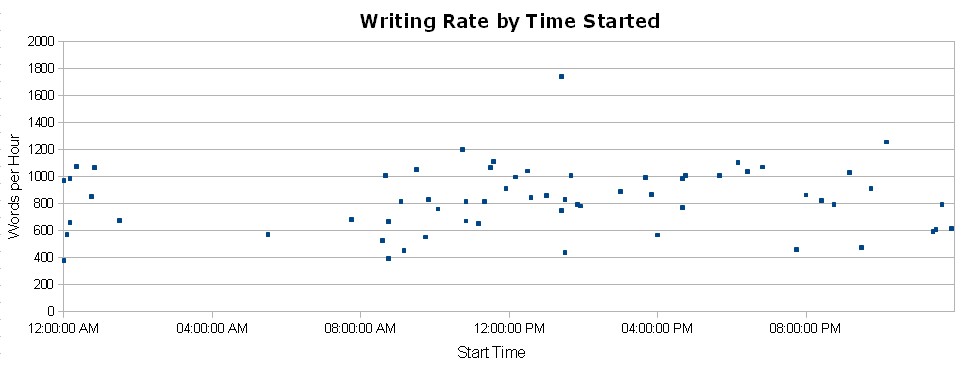
writingrate_by_starttimeWell, I know from my writing log experiment that the time of day doesn’t really affect my writing speed. That means I can start as early as I need to, and the earlier I can start the better. So that pretty much sets up the first step to achieving this 10k goal:

Step 1: Start off each day by writing as soon as possible.

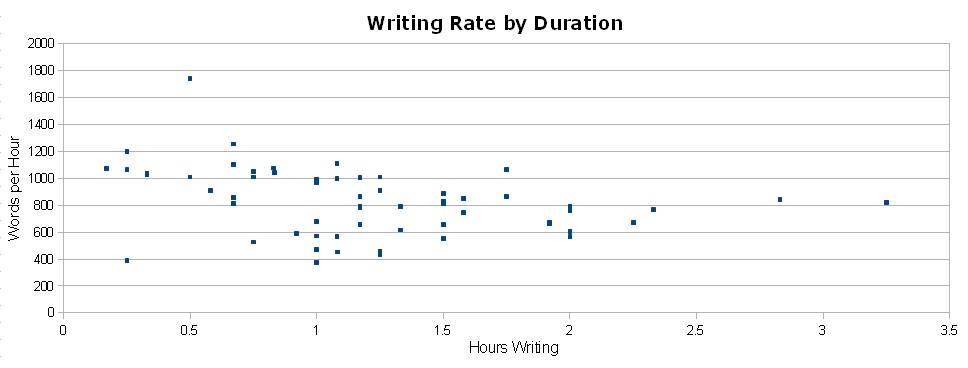
writingrate_by_durationFrom the writing log, it looks like I tend to write fastest in short sprints that are less than one hour. That makes sense: the longer the writing session, the easier it is to get distracted and fall into the procrastination trap.

I have a hunch that the best way to increase my writing speed is to write in short, focused bursts. I’ve never actually tried to limit my writing time before, but it seems that I could really achieve a lot more focus by doing so. It will take some experimentation to figure out the optimal session length, but judging from the data it will probably be less than one hour.

Step 2: Increase speed by writing in short, focused sessions.

Obviously 10 to 12 hours of pure writing time is unreasonable. Even without a day job or other time obligations, burn-out would be a major issue. A much more reasonable amount of time to plan for would be 4-6 hours of pure writing time per day.

At 6 hours, to reach 10k words I would have to write at about 1.6k words per hour, which is reasonable. At 4 hours, I would have to write 2.5k words per hour, which is a lot tougher but still well below the 6k WPH physical limit, especially if I’m writing in short, focused bursts. From this, it’s not difficult to derive the next couple of steps.

Step 3: Increase average writing speed to 2,000 words per hour.

Step 4: Structure each day to achieve 6+ writing sessions.

The real trick to achieving this, as Rachel Aaron and numerous others have pointed out, is to take care of all the non-writing things that make the writing possible. This involves having an outline of some sort, or at least some idea of what is going to go on the page.

I’m a pantser, so I don’t write detailed outlines. However, I’ve found that it can help a lot to sketch out the next few scenes before I write them, and to browse tvtropes like a menu. In addition, long walks really help me to flesh out the story in my head. Without these pre-writing activities, the blank page can be really oppressive.

In more specific terms, I think it’s reasonable to allot 1-2 hours each day to pre-writing activities. Anything more than that would encroach on my actual writing time. Fortunately, I can usually hit two birds with one stone: for example, using my time on tvtropes to find material for blog posts, or outline the next few scenes in my head while hiking or exercising. But it’s important to make time for these things.

Step 5: Spend time each day in pre-writing activities for the next day.

These five steps seem like a good place to start. I’ll post them on my wall and revisit them in a month or so to see how they’re working out.

Ten thousand words in a single day is going to be tough, but if I can hit it at least once this year, I think it will remove a major block in my head and allow the words to really flow. It’s not just about writing faster, it’s about proving to myself that this is something I can do, and to use that as motivation to accomplish much more.

Best of luck with your own resolutions in 2016!

Thoughts on outlining

I’m on track to finish my fifth novel in a couple days, and surprisingly, the writing has been going very smoothly.

Usually by this point, my eyes are bleeding and I feel as if I have a hundred caltrops in my pants.  Finishing a rough draft is still the hardest part for me, since by the end everything seems to suck and I just want to trash the whole project.

I still feel a little bit of that with Into the Nebulous Deep, but not nearly as much as with my previous stuff.  Part of that is probably because I feel confident that I can fix whatever I screw up, but the other part probably has to do with the way I’ve learned to outline.  In one short sentence, here’s what I’ve learned:

An outline is simply the story you tell yourself to help you tell the story.

I don’t think there’s any mortal writer on this planet who can keep a whole novel in their head at one time.  Scenes, yes; chapters, maybe; novels, absolutely not.

However, since everyone’s creative mind works a little differently, everyone has to find the process that works for them.  Brandon Sanderson, for example, writes story bibles that are almost 100k words long.  If I were to try to do that, I’d get bored halfway through and spend the rest of the day dorking around on youtube.  Other people prefer to fly by the seat of their pants, and while there’s something to say about trusting your subconscious, I need a little structure to keep from getting totally lost.

It took me a while to figure out the process that best works for me, but based on how ITND has been going, I think I’ve hit my stride.  Breaking it down into plot, setting, and character, here’s how I basically do it:

Plot

For me, the basic plot of the story comes in a flash of creative insight once all the ideas in my head have reached a critical mass.  It’s like watching a fissure shoot across a smashed window pane, or lightning arcing from the ground to the sky.

If I don’t have time to start the project right away, I’ll let the plot mull around in my head for a couple days, then open up notepad and free write the basic structure of the story in an unedited stream of consciousness.  When I do start the project, I’ll look back to the free write to refresh my memory, but otherwise work out of what’s in my head (which may have changed).

While the project is ongoing, I’ll divide the whole novel into parts, chapters, and scenes.  For the chapter I’m currently working on, I’ll have the various scenes listed in bold with their corresponding point of view character (eg: “1.1: James“), followed by a brief one or two line description of the action and plot significance.  If I introduce a new character in that scene, I’ll write their name in ALL CAPS (I believe that’s a screenwriting convention I picked up from my old college roommate).

For chapters I haven’t written yet, I just write a few lines of description for what I envision happening in them.  When I first start out, I usually have a clear idea where I want the story to end, but I don’t bother outlining all the stuff in the middle since that usually changes based on stuff that comes before.  I only keep my outline a few chapters ahead of where I currently am, and may change things completely if something new comes up.

This process works very well for me.  I use it for every draft, and refer to it often.

Character

I’ve found that I need to do a lot more outlining to figure out my characters than I do with my plot.  However, it’s like Tracy Hickman said with the marbles: don’t hold onto your outline too tight, or all the marbles will slip out between your fingers.

The things I absolutely need to know about my characters are:

  • back story
  • motivations
  • first impressions
  • flaws & handicaps
  • strengths & advantages
  • why the reader should care about / sympathize with them

For some odd reason, I find it most helpful to write this out longhand, usually while taking a walk.  For additional help, sometimes I’ll take a personality test on behalf of my character and get a handle on them through their personality type; for that, I prefer the Meyers-Briggs typology.

But once I feel I have a solid handle on a character, I’ll throw everything out if it feels instinctively right for a character to do something completely different.  Thing is, I need the outline (especially the motivations and back story) to get to the point where I know the character well enough to let them take over.

And for some reason, all my main characters feel too…generic.  I’m not sure why, but that’s something I’ve got to work on.

Setting

Setting, for me, is all about discovery writing.  I’ve tried using wikidpad to worldbuild my universe before I start, but that’s never worked.  Instead, I daydream a lot and trust my subconscious to give me what I need when I need it.

That’s not to say I don’t do research–just that most of my research is on the fly.  If I only stay on wikipedia and the footnotes and references, no problem; if I get sidetracked on facebook, however…

Often, when I’m doing setting descriptions, I’ll run a quick google image search to pull up pictures to give me a better visual idea of what I’m describing.  I especially use this for clothing; that’s why, if you check my search history (please don’t), you’ll find all these weird, girly terms like “ottoman dress,” “jumpsuit,” “leather jerkin,” and “full frontal snogging” (whoops, where did THAT come from??).

The big problem is when I figure something at the beginning of the book and then forget about it halfway through.  For that reason, I should probably invest in a good copy editor when I start to publish.  I should also take the time to draw out a starmap, since it’s getting REALLY hard for me to remember where the Belarian system is in relation to Tajjur and Karduna Prime…hmm…

I should probably figure out a better system to keep track of my settings, but as far as outlining them goes, the less the better.  I love waving my hand and creating stuff–it’s one of the main reasons why I’m a science fiction writer.

So anyways, that’s more or less the outlining system I currently use.  I might end up outgrowing certain aspects of it, or finding a better system, but this is what works best for me now.

Of course, I still have a lot to learn.

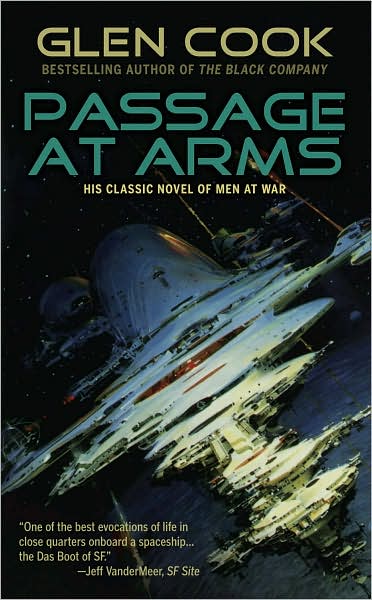
Passage at Arms by Glen Cook

Humanity is losing a long, bloody war of attrition against an alien race.  Our only military advantage lies in the climbers–small, guerrilla style gunboats that can cross into a higher dimensional plane.  Under the right conditions, this technology enables the ships to pass through space undetected.

As the war reaches a critical juncture, one former soldier, now a journalist, joins with the crew of a climber to get the inside story.  What he finds is a far cry from the brave, clean-shaven heroes portrayed by the official war propoganda; the climbers are a gritty, dirty-minded lot of soldiers, cursing the higher ups and living from leave to debaucherous leave.

When worst comes to worst, however, and crap hits the fan, everyone’s true colors come out.  When that happens, who will hold together, and who will fall apart?

I enjoyed this book a lot.  Parts of it were a little raunchy, but never too much for my taste, though your mileage may vary.  Glen Cook leans more towards flowery writing than pure storytelling, and while I had a few minor qualms with his writing style, the book was quite compelling.

Glen Cook really excels at character voice and viewpoint.  Even though the book was military sci-fi set almost entirely in space, it had a very distinct, almost noire feel to it.  Everything that happened was heavily filtered through the main character’s point of view, which made the narrative feel very intimate and personal.  When Charlie dances the foxtrot, you feel like you’re right there in the thick of it.

My favorite thing about this book, however, is the level of scientific realism in the combat systems.  Obviously, things like hyperspace and trans-dimensional drives are entirely speculative, but the orbital dynamics of the planetary siege and visual effects of the nightly bombardment gripped me from the first page.  It didn’t feel pulpy or cartoonish at all–in fact, it felt disturbingly reminiscent of news footage from the ’91 Gulf War, which haunted me for a while as a kid.  This isn’t your typical humans vs. aliens sf adventure novel–it’s like a firsthand account from someone who was there.

My biggest issue with the book was more stylistic than anything else; Cook tends to rely on one-sentence paragraphs to add extra punch–which can be effective, when done sparsely.  However, every page would have at least two or three of them, often occurring one after another.  For me personally, that was a bit too much, but obviously it didn’t keep me from finishing the book, or enjoying it.

So yeah, if you like your science fiction with a heavy dose of gritty realism, you’ll probably like this book.  Even if you don’t, it’s worth checking it out for the orbital dynamics and other interesting details.  Even though it probably isn’t perfect, it feels a lot more accurate than most of the other books out there.