Worldcon 2011: Saturday

Alright, I should just write this up and finish my convention report before life sweeps me away completely.

Saturday was the main day of the con.  To be honest, I forgot all the panels I went to, except this really awesome one by a guy at NASA on near Earth objects (NEOs).  Holyfreakingcow there are thousands of these objects AND WE ARE SENDING MISSIONS TO THEM!!!  So cool!

I went to a kaffeklatsch with Nancy Kress, which turned out to be quite an interesting experience.  She’s an extremely gracious person, much like Tracy Hickman, and gave some excellent career advice: 1) no matter the obstacles or difficulties, always find a way to keep writing, and 2) always be true to the story.

Had dinner with some other Utah writers, and I wish I could say it was pleasant, but for some reason it got very antagonistic.  I know it takes two to tango, but I honestly don’t know what I did to make it that way.  Perhaps stress levels were running high, or people misread my tone, but the conversation at our table completely fell apart at least twice.  It was very wierd.

Part of it might have to do with the fact that I’ve become something of a trailblazer for indie publishing within the SLC / Utah Valley writing community.  Which brings me to another side note: everyone talks about how militant and polarizing self publishers are, when in my experience it’s the advocates of traditional publishing who tend to adopt an us vs. them attitude.  To be sure, there are plenty of desperate to be published writers who take the indie path just to “stick it to the man,” but those people tend to fade away once they realize it isn’t a silver bullet.

Anyway, the Hugo Awards in the evening were great!  Robert Silverberg presented the award for Best Novella, and for fifteen minutes he was my favorite person in the world.  So hilarious!  I’ve tried to find a video, but there doesn’t seem to be one up yet.  Utah writers were nominated in six categories, and even though none of them won, the competition was pretty dang good, so I don’t feel so bad about losing.

All in all, it was a great convention!  I had a lot of fun, even if I did feel a little exhausted by the end of it.  I’m not sure if I’ll be attending future worldcons in my current capacity as a beginning writer, but I most likely will buy supporting memberships in order to vote in the Hugos (and download the voting packet).  It’s a good community, and I’m glad to be a part of it.

Killing the sacred cows while doing data entry

Sorry for the lack of blog posts; I’ve been working 40 hours a week at this temp job, which doesn’t leave a lot of time for other things outside of writing.  I’m still plugging along at about 1k to 2k words per day, but a lot of other stuff is falling behind.  Fortunately, the job only lasts another two weeks, and that should earn me enough to take the next month off and focus on writing.  I’m really looking forward to that.

This job isn’t too bad; it’s tedious, but I can read blogs and listen to podcasts and music while I do it, so I’ve been catching up on a lot of business research.  Last week, I read all of Kris Rusch’s The Business Rusch Publishing blog series, and right now I’m working my way through Dean Wesley Smith’s Killing the Sacred Cows of Publishing.

Let me just say, this stuff is pure gold.  Every post (and a surprising number of the comments, especially those by Laura Resnick) have been extremely eye opening.  At the outset, almost everything Dean or Laura say about the industry seems absolutely blasphemous…but it all makes so much sense.

Like the post about how agents shouldn’t be giving authors any career advice… because they’ll usually advise you to write to the market, not to what you’re passionate about (and can therefore write well). Or how if you’re a midlister, it’s usually in the agent’s best interest to side with the editor, since they may have ten or more clients at stake in this house and you only represent a $3k annual revenue stream to them (or less).

The best piece of advice across the whole series so far comes from Dean:

Don’t listen to rules (myths) and do what works for you and if it doesn’t work, try something else, and when that stops working, try something else. Don’t do it my way or Larry Brooks way or Laura’s way or Harlan’s way. Steal parts from all of us and do it your way.

The thing I find most gratifying, however, is the fact that I figured out on my own that submitting to agents first probably isn’t the best way to break in. But man, there is so much awesome, paradigm-shifting stuff in these posts, it is amazing.  Pure gold.

In the meantime, Into the Nebulous Deep is going surprisingly well.  I should have it finished by mid-May, and though it will probably need some serious revision (unlike Dean, my creative mind gets more fired up in the revision process than the drafting process), the major story arc is coming along very nicely.

I wonder if that has to do with the fact that ITND will be my fifth completed novel.  My first one, Ashes of the Starry Sea, was mostly smooth to write, but it was also a practice novel and as such royally sucks.  Genesis Earth went through an EXTREMELY convoluted writing process, but it was good enough to get to the quarter-finalist stage of the 2011 ABNA contest (and in two days, I’ll find out if it made the semi finals…<fingers crossed>).  Bringing Stella Home was also pretty tough to write, as was Worlds Away from Home, though the revisions have been more straightforward so far.

So does this mean I’m starting to come into my stride as a novelist?  I hope so, because I want to start pushing myself.  After ITND, I want to revise WAFH in six weeks or less–and I’ll probably throw out 1/3 to 1/2 of the material and completely rewrite it.  After that, I want to do Sholpan in two or three weeks–but that shouldn’t be hard, because the material is mostly there already.  Whether Genesis Earth wins or loses the ABNA contest, I’ll want to write Edenfall–before August, if I can manage it.  And then, there’s always that post-apocalyptic blight project…

Anyhow, sorry for the rambling.  The point is, I want to take my writing to a new level this summer, and after this temp job is finished, I’ll be in a great position to do it.  In the meantime, I’ll merrily watch Dean kill the sacred cows while I fill out UPS shipping data for the next two weeks.

And now, here’s some candy for your ears:

A year later

So a year ago, I came back to Utah after a terrible internship experience, with no idea where I was going to live, how I was going to support myself, or what I was going to do with my life.  I was leaving the cloistered halls of academia and venturing for the first time out into the “real world.”

Now, a year later, I can honestly say that even though there have been ups and downs, overall it’s been a great experience.  I’ve learned a ton, both about myself and this “real world” business, and I’ve changed in some surprising ways.

How, you may ask?  Well, let’s see…

1) I never want to be salaried.

This was probably the most surprising thing I learned.  Even if my writing career never takes off, I would rather work for myself and own the value I create than work for someone else and have them own me. Even if it means not knowing where my next paycheck is coming from, I’d rather have the control, the independence, and the satisfaction of working for myself doing what I love.

Sometimes I wonder if we’ve unwittingly become a nation of wage slaves.  So many people work at jobs they hate, only to have the illusion of financial security.  Well, that’s not me, and it’s never going to be me.  I’d rather work for myself and love it than spend the rest of my life counting down the days to my next vacation, or the years to my retirement.  I’m a smart, resourceful guy; I’m sure I can figure things out.

Which brings me to the next point…

2) The idea of being an entrepreneur excites me.

Writing is not just an art, it’s a business, and the more I research the business aspect of it–or indeed, business in general–the more excited I’ve become.  Leaving academia has helped me get in touch with my entrepreneurial side, and surprisingly it’s a lot stronger than I’d thought it would be.

As a writer, I see myself as a self-employed small business owner who creates intellectual properties and licenses the rights to publishers, film makers, game designers, etc.  With ebooks, now I can sell my work directly to readers, and you have no idea how excited that makes me.  It’s not just because of all the hype surrounding Amanda Hocking or Joe Konrath–it goes much deeper into who I am.  All things being equal, I’d rather be an indie author because I see myself as an entrepreneur.

Those are probably the two biggest things I’ve learned.  I can probably summarize the others with a simple list:

  • It’s not possible to work two careers and focus all your effort on only one.  If you really want to be a writer, get a job, but focus on the writing.
  • Temp and part time jobs are much better for balancing creative pursuits, even though they offer less security (which may be an illusion anyway).
  • It takes a long time to naturally grow a blog readership, but once you hit a certain point, it grows very fast.  I assume it’s the same with books and stories.
  • Social media, when used correctly, can work magic.
  • Cheap/free headphones can sometimes work remarkably well.
  • Budgeting is not hard.  Neither are taxes (if you’re poor).
  • Never turn down a job because you think you might get a different one.
  • A creative career won’t give you security, but you can still make it work.

So, looking back, would I change anything?  Not really.  I kind of wish I’d applied earlier to teach English in Korea, but if I had, I’d have started in February, and I wouldn’t have been in a good position to take advantage of the ongoing ebook revolution.  In fact, I might not have even noticed it until I got back to the states.

My plans for now are to focus on my writing over the summer, leave in August to teach English abroad (probably in Korea, though I’m toying around with other places), spend a year or two traveling and earning money to live off of until the writing takes off.

And marriage and family…who knows?  That’s an adventure that still lies beyond my ability to foresee.  One thing is for sure, though; I’d better avoid getting trapped in any comfort zones if I want to make progress on that front.  In terms of work and career, the past year has definitely not been a comfort zone, but it’s also helped me to see what I want to do with my life–more than college, even.

The future is uncertain, but that’s what makes it so awesome.  Even if my writing career never gives me a “secure” source of income, I’m more confident now than ever that I can make it work.  Until then, I’ll be writing.

Some thoughts on the future

I went to the first class of English 318 yesterday, and the lecture got me to thinking about my mid- to long-term future as a writer.

Brandon spent most of the period organizing the class, which was made doubly difficult by the ridiculously small classroom size.  I swear, bureaucracies exist only to make life difficult.  This year, for the sole sake of screwing with everyone, they are trying to limit his class size to thirty people (twenty students, ten auditors), but that’s a whole other rant in and of itself.

Oh well–at least there’s still room on the floor.

Anyhow, after getting all the administrative stuff done, Brandon talked about the practicalities of being a writer.  He made the very interesting point that as a writer, it doesn’t matter where you live–moving further away from the city won’t negatively affect your earnings, unlike most jobs.  That means you can save a lot of money on a house if you’re willing to live 50 to 100 miles away from a major population center.

That got me to thinking: maybe, once my writing career starts taking off, I’ll move down to southern Utah for a while.  The country is absolutely gorgeous down there, and the people don’t seem hard to live with.  Small house with lots of space, maybe a garden, lots of outdoor stuff all over, plenty of privacy–sounds great!

So here’s a tentative map of the next few years:

present–fall 2011: Get a job, build some credit, get TEFL certified.  Keep writing, attend some cons (LTUE, Worldcon), develop new projects.

fall 2011–2012: Teach English abroad for a while (Korea, Japan, etc), build up some savings, have some adventures.  Keep writing and submitting.

2013–2014: Get a teaching job in the Middle East (gulf region), have some adventures down there, continue to build savings and gain experience.  Hopefully I’ll have broken in to publishing at this point; if not, keep on trying.

2015–2020: Come back to Utah (maybe Salt Lake), live off of savings for a while and really focus on building the writing career.  Attend cons and workshops, network, write like crazy (the adventures will probably give me lots of material), work on promotion if I’ve already got a publishing deal, etc.

2020–????: Hopefully, somewhere along the line I’ll meet my wife and get married.  Also by this time, my writing career will hopefully be earning me a living–enough, at least, to support a family.  With all these things in place, we’ll select a home out in southern Utah, settle down, and start having kids.

That’s one plan, at least.  When 2020 rolls around, I’ll probably laugh at my naive and short-sighted view of the future–but at least it’s something to work with.

Brandon did make the point that it’s not as hard to make a living as a science fiction & fantasy writer as most people say–which isn’t to say it’s easy, but it is possible.

According to Brandon, about 1,000 to 2,000 writers in sf&f are currently making a full-time living.  Most of them are mid listers–authors you probably haven’t heard of, but see their books occasionally in the stores.  If your books sell about 5,000 copies in hardcover over the first three years in print, your publisher won’t cut you–and with the way ebooks are changing things, new business models will certainly evolve, presenting a whole new host of challenges and opportunities.

Bottom line, this is something achievable, so long as I keep producing consistently and work hard to improve my craft.  I’m very optimistic about the long-term.

Now, all I need is to find a job…ugggggggh.

(image courtesy Postsecret)

Braving the unexpected rough spots

Right now, I’m going through this unexpected rough spot in my novel, where I know what’s supposed to happen (or at least I have enough of an idea to wing it fairly well), but the writing just isn’t coming.  This happens every time I hit the two thirds mark, and it really sucks.

Currently, I’m using two methods to get through it: 1) keep a running chapter-by-scene outline of the next few scenes, and 2) use a loose adaptation of story theory models (such as the hero’s journey) to keep perspective on things.  Right now, this is what my chapter-by-scene outline looks like:

Chapter 14
14.1: Jalil
Jalil meets LARS, who with Michelle shows him the ship. Jalil learns that Lars has a connection with the Farlen family and that the Stewarts are from his parents’ home.
14.2: Mira
Mira returns home an outcast. Sheila rails at her for failing to seduce Jalil, while Sathi pulls her into his quarters to tell her that he’s arranged for her speedy marriage.
14.3: Jalil
The Bridgette launches from GN-2 using a gravity whip maneuver. The ship heads out for the L2 point, using a second gravity whip around GN-2b. Jalil realizes this is goodbye.

Chapter 15
15.1: Mira
While Mira prepares herself to get ready to meet her cousin Ibrahim, Tiera approaches her in private to apologize for calling her a whore. Tiera advises her to stand up for herself.
15.2: Mira
IBRAHIM’s convoy arrives. As Sathi and Ibrahim’s father conduct negotiations, Mira meets him and is surprised to find that she’s attracted to him.
15.3: Mira
Mira, Surayya, Amina, and Tiera discuss Ibrahim in the women’s quarters. Tiera advises Mira not to pursue him, but Surayya and Amina convince her to go ahead with it.

Chapter 16
16.1: Jalil
Lars and Michelle tell Jalil about the Colony. They show him pictures, and he has flashbacks.
16.2: Jalil
While making maneuvers around GN-2a, the Bridgette receives news of Hameji movements near Karduna. Jalil learns a bit of the Hameji.
16.3: Jalil
The Bridgette arrives at the L2 station and enters the starlane. Jalil’s first experience as an adult making the jump.

Chapter 17
17.1: Mira
???

As you can see, I’ve broken down each chapter by scene, with the viewpoint character indicated as well as a short one or two line description of what happens. When a new character comes along, I mention them by name in ALL CAPS. I use the auto font color for story that I’ve already written, and the stuff that remains to be written in red. Also, I only outline a handful of scenes ahead of my current position.

That’s the method that works for me.  I have no idea if it will work for you, but feel free to give it a try or let me know what methods you’re using.

I’m finding that even though I’m more of a “discovery writer,” certain methods of outlining give me much greater flexibility to discovery write than simply winging it all on the fly.  In particular, I find that outlining my characters and keeping a running scene-by-scene map for the next couple days helps to keep me on track.

I ran into this problem earlier in the week: without any kind of outline, and no previously written material to fall back on, I had no idea what to do.  Instead of sitting at my keyboard doing nothing, though, I plotted out the next few scenes to give me some idea what to do.

That helped me out for a while, but now…man, it’s still rough.  I did 3,251 words yesterday, but today I only hit 1,555.  It’s a lot, I know, but with all my free time, I should be hitting more.  Much more.

I suppose the only way out of this slump is to write–and write I certainly must.  I seriously need a real job, and right now I’m looking into the field staff position at Wilderness Quest.  If they hire me, I’ll need to finish this novel before I start work, since I’ll be out in the wilderness for three weeks at a time and the last thing I want is to pick up a half-finished project after it’s gone cold–especially when I’ve got to rewrite Mercenary Savior for World Fantasy 2010.

So that’s what I’m looking at right now.  Three weeks, inshallah, and Worlds Away from Home 1.2 will be finished.  Hopefully by then, I’ll have a real job too.

To close, check out this awesome version of the Corridors of Time song (Zeal theme) from the Chrono Trigger soundtrack.  I’ve heard maybe twenty or thirty different arrangements of this excellent composition, and this one takes the cake.  Beautiful.

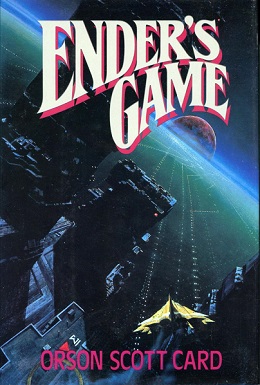
Ender’s Game by Orson Scott Card

“I’ve watched through his eyes, I’ve listened through his ears, and I tell you he’s the one.  Or at least as close as we’re goign to get.
“That’s what you said about the brother.”

“The brother tested out impossible.  For other reasons.  Nothing to do with his ability.”

“Same with the sister.  And there are doubts about him.  He’s too malleable.  Too willing to submerge himself in someone else’s will.”

“Not if the other person is his enemy.”

“So what do we do?  Surround him with enemies all the time?”

“If we have to.”

“I thought you said you liked this kid.”

“If the buggers get him, they’ll make me look like his favorite uncle.”

“All right.  We’re saving the world, after all.  Take him.”

Thus begins one of the greatest SF classics of all time, Ender’s Game. With such a spectacular beginning, it only keeps getting better.

I decided to reread Ender’s Game because a friend of mine in Washington was reading it.  I read this book back in high school in only two sittings–the first twenty pages in the library, and the rest back home, where I finished it wide-eyed at three in the morning.  I didn’t regret a single moment of it, then or now.

One of the most fascinating things to me about this book is the way that Orson Scott Card breaks almost all of the rules of writing.  On every page, he “tells” much more than he “shows”–some of the battles he glosses over in only a couple of paragraphs.  He gives only minimal setting details, and very few of these are visceral or concrete–it’s very hard to “get into” the world of Ender’s Game the way you would with a fantasy novel.  Most of the characterization consists of “navel gazing”–Ender thinking to himself about how bad things are, rather than taking action.

Breaking these rules, however, is exactly the thing that makes this a good book.  The story isn’t in the setting, or in the nitty gritty of the battles–it’s in Ender’s mind, how he reacts to the forces around him, and how those forces change him. “Telling” rather than “showing” allows him to keep the pace at a breakneck, thrilling speed while cutting out unnecessary details, and the “navel gazing” allows us to get an intimate picture of Ender’s mind.

It goes to show that good writing isn’t just about knowing the rules, but knowing how to break them.  And when it comes to plot, character, pacing, foreshadowing, thematic elements, and the hero cycle, Orson Scott Card proves his masterful brilliance in this work beyond a doubt.

One of the most fascinating things about this book is that it hits all eight points of the Campbellian monomyth.  This excellent article (originally published in Leading Edge) explains how.  The most incredible thing to me is that the year after Ender’s Game came out, Orson Scott Card did it all again–wrote a blockbuster book hitting all eight points of the monomyth–with Speaker for the Dead, which I think is a superior book.

Ender’s Game is a true classic of the science fiction genre.  Not only is it a highly entertaining story, it is deeply meaningful and insightful as well.  It’s one of those books you can reread multiple times, and it only keeps getting better.  Whether or not you’re a fan of science fiction, this is a book you will deeply benefit from reading.

Thoughts on writing characters

A couple months ago, I was listening to one of my personal recordings of Brandon Sanderson’s English 318 lectures from last  year’s class.  The topic was writing characters.

Brandon outlined several techniques for making characters sympathetic.  He also outlined how to round them out: give them flaws and handicaps, as well as little quirks to make them unique and memorable.

However, I couldn’t help thinking that something was missing in his formulation.

Before I continue, let me say that I’m not disparaging or criticizing Brandon Sanderson’s abilities to write compelling, well-rounded characters.  As his novel Mistborn shows, writing characters is one of his strengths.

At the same time, I feel that the “checklist” approach to writing characters can be dangerously counter-productive.  Too often, characters in sub-par novels feel like a patchwork of characteristics and personality traits, not like actual, real people.

When I asked Brandon about this, he said that his techniques should be seen as tools, not as fundamentals.  He then went on to say that the most important thing to keep in mind is the character’s motivations–why they want what they want.  Beyond that, you just have to tweak the character until they fit into their role.

After thinking about it for some time, I came to the conclusion that the best way to write characters is to keep two essential rules in mind:

Rule #1: Every character is the hero of their own story.

Rule #2: Every story is composed of three parts: beginning, middle, and end.

The first rule is straightforward: every character sees their life as a story in which they are the main character.  This is because all of us, as human beings, view our own lives in this way.  We may look at other people and consider them nothing but extras in the story of our life, but they certainly do not think of themselves in this way.

To apply this rule, however, we need to understand what it exactly means to be the hero of one’s own story.  We can only understand this when we realize that a story is composed of three basic parts: beginning, middle, and end (or, as we see ourselves: past, present, and future).

Every hero has an origin and a destiny.  Without these, they don’t have a story; they don’t have a beginning and they can’t have a meaningful end.  This is why the hero cycle begins with the miraculous birth and ends with ascension and apotheosis.

Writers should keep this in mind as they sketch their characters.  If you don’t know where your character came from–who their parents are, where they  grew up, what were their major formative experiences, etc–your characters are going to fall flat because they’re just extras in someone else’s story; they have no story of their own.

Likewise, your characters need to have a destiny.  If you’re a discovery writer (like me), this might be harder because you don’t know, from the outset, where everyone’s going to end up.  Keep in mind, though, that rule #1 applies to the story the characters tell themselves just as much as the story you’re telling the reader.

Each character’s individual story is like a thread, which the writer weaves together with other threads to form a beautiful tapestry.  That tapestry is the novel; without the individual characters’ stories, the work would feel week, shallow–threadbare.

Of course, it’s not always possible (or a good idea) to reveal everything about every character.  It’s also not always possible to outline every character in great depth–not without catching “worldbuilder’s disease.” Instead, the rules of worldbuilding should apply–only use 10% of your worldbuilding in the actual story, no info dumps, etc.

I don’t think that’s a comprehensive theory of character just yet, but I think it’s a step closer to one.  If you have any ideas or suggestions of your own, please do share.

Image courtesy Postsecret

Thank you readers

I appreciate my first readers very much, even when it hurts.  Especially when it hurts.

Today I got the comments back from a longtime Quarkie friend on Genesis Earth, and she told me that, in her opinion, the book still needs a lot of work.  However, she made it very clear when (and why) she was bored, when (and why) she was interested, and where (and why) she would stop reading.  Thankfully, she kept reading and gave me useful feedback right up to the end.

My friend’s comments helped me to rethink several weak points  of my novel.  In particular, her anthropology experience helped her to pick up on some racist undertones that I didn’t intend and hadn’t realized were there.  If my story would have appeared in print like that, I would have been flamed up and down the sf community!  Without her feedback, I probably wouldn’t have picked up on that.

The feedback did more than point out problems, however; it helped me to rethink these problems and begin to find new, innovative solutions.  Rather than getting me angered or depressed, the criticism stoked my creative engines by getting me to take a step back and rethink my story from the ground up.  Though the feedback was harsh (basically, “I’d throw this book across the room at this point”) it was extremely helpful and got me more enthused than ever to write.

Receiving criticism and advice is a very delicate thing, especially for a budding writer.  If you try to follow every peice of feedback you recieve, your book will inevitably tank.  However, rejecting criticism is also tough because you don’t always know why you’re doing it.  There is a fuzzy grey area between rejecting a comment because it’s not right for your story, and rejecting it because it rubbed your ego in the wrong way.

I don’t ever want to reject critical feedback because it hurts.  After all, it’s not about me at all–it’s about the story.

Criticism is never “right” or “wrong,” “good” or “bad.” It is only “useful” or “not useful.” To pick out the useful feedback, you always have to listen to–and appreciate–every piece of feedback that you get.  Only after you’ve done this can you can say (in private!) “no, this isn’t right for my work.”

In the meantime, thank everyone who takes the time and effort to read your work and comment on it.  They’ve done you a huge service, and the last thing they deserve is to be attacked by an egocentric, peurile, self-righteous amateur.  Honest criticism, no matter how much it hurts, is the best thing any writer can receive.

On that note, I want to thank all my first readers for helping me with my novel, Genesis Earth!  I genuinely appreciate all of your comments. You’ve helped me to step back and see my work for what it is.  You are helping me to make this novel a stronger, better book, and that means more to me than you know.  So thank you!

Heaven’s library

2,943 words today, even though today was the first day of Writing and Illustrating for Young Readers.  I’ve reached the major climax of the book–the moment I’ve been replaying over and over in my head.  Perhaps this novel is not as bad as I’d thought–perhaps I can pull this off.  The current incarnation is terrible, but I can see in my mind how good it can be in its second or third incarnation.  Inshallah, I’ll pull it off.

Today was the first day of BYU’s writing conference, and it was great!  The speaker in the last workshop I attended, Dandi Mackall, was exceptional.  I don’t have my notes with me and the BYU library closes in twenty minutes, so I’ll recap the best part of her presentation, the story she told in the last five minutes.

She said that once she had a dream where she died and went to heaven (thank goodness!).  When she got there, the angel who greeted her offered to show her around, and asked what she wanted to see first.  Her answer?  The library, of course!

In heaven’s library, she found shelves stretching as far as she could see, full of the very best books.  She picked out a few and recognized some of her favorites, the ones that had impacted and changed her life.

After a while, though, she started to get a little disappointed: all of the books in heaven’s library were books we already had down on Earth.  Why was that?  Didn’t heaven have anything new–anything we hadn’t already seen down below?

“But all these books were here first,” said the angel.

Still, she couldn’t accept that as an answer, so the angel took her down a long, winding, narrow corridor.  The deeper she went, the narrower and dustier it became, until she started to feel uneasily.  This part of the library was dark and dirty.  It was clear that hardly anybody every came down here

Finally, the angel led her to a door covered in cobwebs.  He brushed them aside and opened the door, leading her inside.  Here was a room many times larger than the first, with old, dusty bookshelves stretching higher than she could see.

She picked out a book and started reading through it.  It was one she’d never heard of, but it grabbed her.  She could tell that it was really good.  She picked up another one, and realized that it was just the kind of book that one of her friends would have loved to read.  She picked up another one, and realized that this one could have helped out another friend when she’d gone through a terrible life crisis.

All of this made her angry. “Why didn’t we have these books?” she asked the angel. “They are just as good as the ones in the other room.  Why didn’t they make it down?”

“These are all the books that remain unwritten,” said the angel. “Each one of these is a book that a writer, somewhere below, has in them but fails to write down.

“This one is by a writer who just won’t let anyone touch her writing and give her the criticism she needs to improve her craft.  This one is by a writer who doesn’t have the discipline to write consistently and finish what he starts.  This one is by a writer who doubts her story and doesn’t think she can ever get it to work.”

At this, she nodded and let the angel lead her back out to the main room.  As she left, she saw one final book near the door.  It had her name on it.

What a great, encouraging story.  I didn’t do nearly as good a job retelling it as Dandi did the first time, but it had a tremendous impact on me. I hope sharing it with you, it does something of the same. 

For some reason I don’t understand, fate, God, or genetics (or some malicious combination of the three) conspired to turn me into a writer.  I don’t write for fame or fortune; I write because I can’t not write.  Sometimes, I wonder if I’m making a mistake trying to turn this into a career, into something that will feed myself and my future family.  Looking at the millions of other floundering writers like myself, it’s easy to feel anxious.  After all, only a tiny fraction of us will ever get published, let alone make a professional career out of this.  Do I even have a fighting chance?

But then I hear a story like this one and I remember why it is that I write.  Not for fame, fortune, publication, personal gratification, or even just because I can’t not do it.  It’s because storytelling itself is important.  It helps us connect with the world around us, to see its beauty and wonder.  It helps us to appreciate ourselves and understand others.  It stimulates our imaginations and, by so doing, helps us to life our eyes from the ground and see the divine  potential that is all around us.  It helps us to grow through vicarious experience–it helps us to live and to love.  

Writing, at its best, is a sacred act, an important act, and if by grace we have been touched by inspiration and given a story to write, we should consider it noble and honorable to bring that story incarnate into the world, to touch the lives of others and lead them to what is good and true.

…and they all lived evily ever after.

Today we had a quark writing group party, and it was lots of fun! We all went up to drek‘s new house, up in Draper, and read some of our really old, really bad first attempts at writing stories. Good times!

Drek, Nick, lexish, slipperyjim, jakeson, gamila, aneeka, and one of my friends from the FLSR writing group all came up. Jakeson and his crew got lost on the way, but we had a good time hanging out, chatting, eating the pita bread and hummous that I’d cooked (I figured everyone else would bring sugar-heavy treats, so I cooked something a little more on the healthy side–still delicious, as evidenced by how much everyone ate!), and talking about how we’d gotten started writing.

I think a lot of us had similar stories–while we all wrote for different reasons, we all tried to do something big in high school, something that marked a turning point of some sort. The other common thread that ran through our stories was…how laughably bad they were! There were gradations, of course (Nick’s story that started with the word “Gandalf” and only got worse was pretty ridiculously crazy), but all of our stuff was pretty bad.

It can be both fun and painful to look back on past stuff, especially the stuff you wrote back in high school. It’s like, all the painful awkwardness of high school is not limited to your social life, it seeps into your writing as well, especially if that’s when you first try out your hand at the craft. So many cliches, so much bad grammar, so many viewpoint errors and info dumps…ARGH!!!

Of course, that is precisely what made it so entertaining. The awkward, emo, immature teenage grasp of the universe, combined with dozens of stale cliches and atrocious grammar–brilliant! I’m glad we were all at a point where we could look back on this stuff and laugh. It can do you good to air out your closet and let go of some of the old stuff you are sure would destroy you if you ever let it saw the light of day.

My first writing attempt was a novel that has since been entirely lost. I printed up a hard copy, once a long time ago, but I’ve lost that one and really have no desire to try and dreg it up. Of course, all the digital copies haven’t survived. My second novel attempt, however, I have in both digital and hard copy. That’s the one that I dipped back into for this writing party.

I actually sent out a copy of this to my aunt in Washington DC, who is/was an editor for a magazine. She read about the first twenty or thirty pages and sent me this letter, which I will use to finish off this post. The only places I’ve used ellipses are when my aunt described problems specific to certain passages and quoted them.

October 14, 1999

Dear onelowerlight [name, obviously, has been changed 😛 ]

The manuscript your mom sent home with Evan has proven to be an interesting read in many ways. It is wonderful to see people take an interest in writing. This pastime has given me many hours of satisfaction. I find that the joy is in the journey and that the process is as important to me as the finished job. However, it is always satisfying to have a finished product that I feel good about.

What it looks like you have is a wonderful outline for a novel. Your language is colorful and descriptive. The battle scene held my interest and made me want to know what was going to happen next. My intent was to read the manuscript from beginning to end purely for the joy of reading it. The urge to edit, an urge that often gets in my way as I write a first draft, got in my way as I read. Hence I was not able to follow through. I have written on some of the pages. What follows are a few other observations.

A really good writer named John Gardner said that a piece of fiction opens up a dream to the reader. Anything that causes the reader to become aware of the author or that jolts him out of the fictive dream does not belong. It is always helpful to let a manuscript cool for several days and then begin to read it. This will help you be more objective. Sometimes the things that seem marvelous turn out to be less enchanting than one thought during the rapture of creation.

Titles are difficult. Would anyone have read Catch 22 by another name? Some people don’t think so. It has been postulated that the reason the story about The Man Who Went Up A Hill And Came Down A Mountain didn’t do better as a movie–and presumable a book–was because of the length of the title. For many authors the title is the last thing to be written.

Your first two or three pages contain a good deal of “throat clearing.” An opening needs to grab the reader so he will continue. There needs to be a problem, action and change. It should be action that is vital to the story. Someone is going on a trip. Someone is going into battle. someone is getting married. Someone is being born. Unless you want to write erotic literature it would be better not to start with conception. Work the background in later. In The Gospel of John the first few verses talk about the Word. Immediately the Word is identified with the Son of God and the story of his baptism. The problem of establishing himself as a teacher is presented. In episode IV of Star Wars the force is not explained to us at the beginning, rather we see what it can do. It isn’t until Solo talks about fools who believe in an ancient religion that we begin to have some idea th at the force is more than magic. The characters give all this information to us.

Point of view is the perspective that the story is told from. T he most difficult and therefore least used these days is the omniscient narrator. A good rule of thumb is to see the story through the eyes of the person with the problem. Many authors write in first person. One can also use second or third person. Third person is similar to first person except the pronoun I isn’t used as much. (Actually it is more complicated than that, but that will suffice for now.) Sometimes a narrator who doesn’t see into anyone’s mind tells a story. Most fiction that looks like omniscient narrator is actually being told from the point of view of one of the characters. The narrator can then see into the mind of one person and all the other action is viewed through his eyes. Sometimes a novel will contain oone person’s point of view in one chapter and that of another character in another. This seems to work. It is confusing when shifts occur without warning.

Psychic distance has to do with how close you want your reader to be to the story. Stephen King wants to inspire terror. He gets his readers as close as he can. You hear breathing, feel sweat, hearts race. Jane Austin keeps her readers at a great distance. You see the lights, you hear the conversation, it is all very proper–no sweat, no breathing, no racing hearts. Just as with the point of view, the important thing is that the narrative remains consistent. It must not switch in the middle of a sentence, paragraph, or chapter.

Write in active voice as much as possible. Your English teacher will tell you all about this. Be aware that verbs ending in “ing” do not help your story. (Running up the hill after Jill and tripping over a rock Jack stumbled.) This slows the action of the story down but when used sparingly can add emphasis. The following construction works better (Jack ran up the hill after Jill. He tripped over a rock and stumbled. “D___!” he grumbled. Jill took water from her bucket and soap from her pocket and washed his mouth out.)…

…You have many long sentences. Your writing will be tighter and stronger with shorter sentences and fewer prepositional phrases…

…There are lots of ways to deal with dialogue. You can put the dialogue first and description second…you can put the dialogue at the end…you can break it up the way you have in your manuscript or you can put description on either sie of it…Like every other element of your story, you don’t want it to call attention to itself.

I believe you changed fonts to show a change in viewpoint or in who is speaking. For me this is very distracting. There are other good ways that work. Also it is easier for me to read when it is double-spaced.

Two books that I have found most helpful are John Gardner’s The Art of Fiction. It is out in paperback. John Gardner also wrote a wonderful fantasy called Grendal. It is not very long. It is told from the point of view of the monster. The other book is The Elements of Style by Strunk and White.

Thank you for sharing your manuscript with me. It takes great courage to share one’s work. I admire you for starting out early. Remember free advice is worth what you pay for and don’t let anybody discourage you. You learn to write by writinig. You have a good start.

Your’s truly,

Aunt Yvonne