Laying the groundwork for a couple new series

So I just got back from vacation at Cape Cod, which turned out completely different from what I’d expected.  When I left, I said that I’d probably just write like I usually do, except in a different place.  Instead, I took a break from my WIPs long enough to catch a new vision for my career and come up with a really good idea for a new spin-off series in the same universe as Star Wanderers.

The story idea is really awesome.  I don’t want to talk about it too much, since I haven’t even written it yet, but the main characters will be Isaac and Aaron from Benefactor, and the basic premise will start out fairly similar to Outworlder.  From there, though, I expect it to take shape in some very different ways, turning into much more of an epic space opera.

I plan to stick with the novella series format, since I’ve had a lot of success with that so far.  I know that some readers complain about shorter works, but when doing a series of this type, it’s important to put out new titles regularly, and I can do that much easier with novellas than with novels.  Besides, there are a lot of other reasons why I prefer novellas, as I pointed out in this post.

That said, I expect these ones to run a little longer, such as the 30k-40k word (90-140 page) range.  But I won’t really know until I’ve written them.

Before that, I’ve got two more Star Wanderers stories to put out: Reproach (Part VII) and Deliverance (Part VIII).  Both of those are already written; I just have to run them by my first readers and make some revisions before putting them out.  If all goes well, Reproach should be out in September and Deliverance should be out in October.

So that’s the plan.  Career-wise, what I really need to do is replicate the success of Star Wanderers by starting some new storylines that follow the same series format.  It’s a little unnerving, since I don’t know what will stick, but I don’t want to be dependent on just one series–you’ve got to have multiple entry points.  Besides, this new series is a spinoff, so hopefully readers from the first one will carry over.

It’s at this point that I’m hitting myself, because what I really need is to have three books that I can release before Christmas.  In general, I’ve found that it’s better to wait until you have three books out before you make the first in a series permanently free.  I wish I’d spent a lot more time this summer writing new things, rather than revising old stuff or finishing up old series.  But oh well–better to start now than wait until next year.  And who knows?  Maybe I can still pull it off.

For this new series, I plan to invest a little more in cover art.  The NASA images have been good for Star Wanderers, but to really hit the publishing trifecta (title, cover, blurb), I need to commission some original art.  I have the money now, and probably the best thing I can do at this point is reinvest it.  Expect those covers to be awesome.

Oh, and the other elements of the trifecta?  I don’t have a blurb yet, but the working title is Sons of the Starfarers.  Pretty cool, eh?

So there’s that.  I’m currently revising Reproach, but I think I can finish that on the train and send it out to my beta readers before the end of August.  As for The Sword Bearer, I’m going to put that project on hold again, mostly so I can focus on this.  I’ve also been running into some problems with that project, mostly having to do with the worldbuilding.

For that reason, I’m thinking of doing a series of prequel novellas in order to flesh out that world and the backstory.  If it goes well, that should turn into its own thing, kind of like how Star Wanderers fleshes out the background for my Gaia Nova books.  I’m thinking of something along the lines of David Gemmell: heroic fantasy with a real focus on courage, valor, and unlikely heroism.  I’ve already got the first scene of the first book in my head, and it’s pretty dang awesome.

So many stories, so little time … I’d better get back to writing!

F is for Faster Than Light

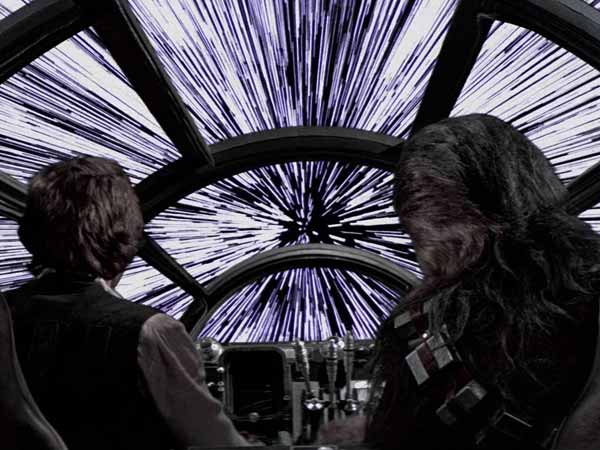
falcon_startrailsRemember that moment in Star Wars when the Millennium Falcon went into hyperspace?  When Harrison Ford shouted “go strap yourselves in, I’m going to make the jump to light speed,” and the sky lit up as the stars streaked by?  That was my first introduction to faster-than-light (FTL) travel, and I haven’t looked back since.

FTL is a major recurring trope in space opera, and not just because of how cool it is.  If you’re going to have a galactic empire, you need some way to get around that empire–or at least some way to transmit information without too much difficulty.  The distance between star systems is measured not in miles or kilometers, but light years–that is, the distance that a particle of light can travel in one year.  Considering how the nearest star to Earth, Proxima Centauri, is ~4.24 ly away, you can see the need for some sort of magical technology to bridge the distance.

FTL travel comes in four basic flavors:

  • Warp Drives — The ship breaks the speed of light as easily as our modern fighter jets break the speed of sound.  Impossible to justify, except through hand-waving.  The most prominent example of this is Star Trek.
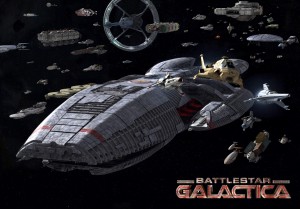
  • Jump Drives — The ship disappears from its current position and reappears somewhere else.  Also requires hand-waving, but is at least a little easier to justify.  Battlestar Galactica is a good example of this, as is Schlock Mercenary.
  • Hyperspace Drives — The ship enters an alternate dimension which allows it to travel faster through our own.  The alternate dimension is called ____space, usually “hyper” but also “quasi,” “x,” etc.  Star Wars is the classic example, though Star Control II took things a step further by having a hyperspace dimension within hyperspace.
  • Wormgate Network — The ship (or maybe just the passengers) enters a portal which transports it to a portal somewhere else.  A network of these portals allows travel throughout the galaxy.  Stargate and Babylon 5 use this method.

An alternate way to do it is to make FTL travel impossible, but hold the galactic empire together through FTL communication.  This technology, known as the ansible, features prominently in Ursula K. Le Guin’s books and the Ender’s Game universe.  It has some really interesting implications: for example, even though planets can communicate instantaneously with each other, it takes almost 40 or 50 years to go from one to another, but at near-light speeds, it feels as if only a few months have gone by.  Thus, if you’re going to travel to another world, you have to leave everything behind, including your family and loved ones.  By traveling from world to world, you can skip entire generations, spreading your natural lifespan across thousands of years of normal time.

In writing FTL, one thing you have to be really careful about is to keep in mind ways in which the system can be abused.  For example, if jump drive technology makes it possible to instantaneously transport anything anywhere in the universe, then you can bet that someone is going to send a bomb into the White House (or whatever the equivalent is in your fictional universe).  Thus, the invention of unrestricted jump drive technology will lead to a very short and brutal war.

This actually happened in Schlock Mercenary, and the solution was Terraport Area Denial (TAD) zones, or broad areas of space where a force field prevents anyone from either jumping in or out.  Thus, anyone who wants to visit a planet in a TAD zone has to jump to the edge of the field and travel the rest of the way at sublight speeds.

FTL isn’t always appropriate for a science fiction story.  If the story is supposed to lean more toward hard sf, then it’s probably better to stick with our current understanding of the rules of physics, which state that nothing can travel faster than the speed of light.  Still, with things like quantum entanglement and other recent discoveries, if you know the science well enough, even the speed of light might not be an upper limit.  But for the rest of us mortals, FTL is basically just magic–a sufficiently explained magic, perhaps, but magic nonetheless.

Personally, I’m a fan of the jump drive form of FTL.  That’s the one I use the most in my own books.  The cost is that the further distance you try to jump, the harder it is to pinpoint exactly where you’ll end up.  To overcome this, you can use jump beacons to draw out anyone trying to jump into your particular sector and have them exit jumpspace next to the beacon.  This comes in handy in combat, when the enemy tries to jump a nuke onto your ship.

In the later Gaia Nova books, FTL is facilitated by jump stations spread out in a line across space, with reactors powerful enough to jump ships rapidly to the next point along the line.  In the earlier Star Wanderers books, that technology hasn’t been invented yet, so there’s still an Outworld frontier.

It gets kind of complicated, but it’s lots and lots of fun to world build.  For example, how does a particular change in the FTL tech alter the galactic balance of power?  When settlers try to colonize a new system, what do they establish first–starlanes, jump beacons, Lagrange outposts, or what? As with any magic, changing one thing affects everything else, which also affects everything else, which … yeah, you get the picture.

Stars of Blood and Glory coming out soon

So last year about this time, I wrote a novel in the Gaia Nova universe.  Usually when I sit down to write a novel, it falls apart about midway through the first draft, or I have some kind of a break down, or something else comes up and I have to put it on hold for a while.

From start to finish, this one came out in about six weeks.

Even the title, Stars of Blood and Glory, really seemed to stick (usually, I go through three or four lame titles before finding one that works).  It took a lot of energy to write it, but the writing process itself was fun.  Seriously, everything just came together and the story practically wrote itself.

However, writers can often be notorious judges of their own work.  For that reason, I set it aside and tried not to touch it for a few months (I did rework the first couple chapters, but later ended up cutting out most of that stuff and going back to the original version, which was better).  Over the summer, I picked it up for the first revision, and while the scenes were out-of-order and a few of them were missing, but for the most part, everything that was there seemed pretty good.

Just to be safe, I sent it out to some first readers and laid it aside for another six months.  I didn’t hear back from everyone I sent it to, but those who did read it said it was pretty good.  The problems they found were relatively minor, or could be fixed relatively quickly, without having to overhaul the story.

To be perfectly honest, this blew me away.  My first drafts are usually really messy, and require a lot of work before they’re any good.  But this one…this one seems different.  This one, I might have just nailed it <fingers crossed>.  And if that’s indeed the case, it’s probably better not to risk revising it to death, or polishing the voice right out of it.

It’s always a scary thing to send a book out into the world.  However, I think the time to send out this one has come.  I’m going to do one last revision pass, just to make sure there isn’t anything too egregious, and then I’ll send it out to my editor and commission the cover art.  If all goes well, I’ll finish the revision next week, and publish it in ebook and print-on-demand sometime in February.

As an indirect sequel to Bringing Stella Home and Desert StarsStars of Blood and Glory has a lot of recurring characters.  Here are some of them:

  • Captain Danica Nova
  • Master Sergeant Roman Andrei Krikoryan
  • Rina Al-Najmi
  • Stella McCoy, aka Sholpan

Besides that, here are some of the other cool things you can expect to see:

  • A far future Japanese-Polynesian society on an ocean planet with giant floating cities.
  • A Hameji offensive, with massive space battles and planetary slaggings.
  • A lonely boy emperor who fears that he’ll never live up to his father’s dying wish.
  • A runaway princess who wants to experience everything the universe has to offer.
  • A young Hameji prince who yearns to prove himself in the field of battle.
  • A cyborg mercenary who feels like his humanity is slowly fading into irrelevance.
  • An unlikely assassin whose mind and body are not completely her own.

All of this comes together in a war of epic proportions that will determine the fate of the last free worlds in the galaxy.

So yeah, I’m really excited about this story.  It’s a departure from some of the more intimate (and less action-y) science fiction romances I’ve been putting out lately, but in all of the right ways.  If you read Bringing Stella Home and wondered when you’d get a worthy sequel, well, this is it.  And hopefully, it’s just the first of many.

Expect it to be out in ebook and print-on-demand sometime next month.

Trope Tuesday: Space Cossacks

I’m going to take a break from the hero’s journey trope posts for a while, until I have the time to do them justice.  In the meantime, let’s have a little fun.

Some of my favorite science fiction stories are the ones about a culture of nomadic starfaring people wandering the universe in search of a new homeworld.  Earth is usually a half-forgotten legend, and their starships have probably seen better days.  On tvtropes, the page for these stories is Space Cossacks, named after a real world culture in historic Russia that basically experienced the same thing, albeit on a terrestrial scale.

The description of this trope on the tvtropes page is so good, I’m just going to repost it here.  Seriously, every one of those cross links is worthy of your click.

There is no hope and You Can’t Go Home AgainThe Empire is spreading out. Even The Federation has too many Obstructive Bureaucrats. There is no way for free men to get out of the reaches of The Government and even mounting La Résistance will be of no avail.

So what do you do? You become Space Cossacks.

You flee to the border and live in a tough area where you all have to be sharp. You set up as Space Pirates or as Hired Guns or as Intrepid Merchants. Or all of these at once.

With you are various dissidents like people who feared being Made a Slave. There might be a Noble Fugitive or two, perhaps even a Defector from Decadence. You and your brave band of Fire-Forged Friends will struggle on to survive and maintain your freedom and heed no laws but your own.

One of the things that I think should qualify a story for this trope is that the society of space cossacks is just that: a community of people who share at least a few cultural bonds.  Battlestar Galactica definitely qualifies, but I’m a little on the fence as to Firefly, since that story is more or less about a ragtag band of failed revolutionaries.  Are the Browncoats all from the same culture, like the Kurds or the Circassians or the Ossetians, or are they just a pologlot group of frontiersmen from all over the settled worlds?  Does it even matter?

In the end, I suppose it doesn’t.  The spirit of this trope is a lot like that of Fighting for a Homeland: a bunch of displaced underdogs on the fringes of civilization trying to make their way in the universe.  The nature of the conflict is such that by the end, they can’t help but form their own distinct subculture.

I don’t know why I love this trope so much.  Maybe it has to do with the way it blends elements from the Western genre in a classic Science Fictional setting.  Maybe it’s because I was born in the wrong century and naturally dream of settling the frontier.  Maybe it’s because this is one of the best ways to get awesome space battles.

Whatever the reason, I can’t get enough of it, as you can probably guess from reading my books.  In Bringing Stella Home, Danica and her band of Tajji mercenaries fit this trope to a T.  Stars of Blood and Glory delves quite a bit deeper into their background, with Roman as a major viewpoint character.  In Heart of the Nebula, the people of the Colony basically become Space Cossacks over the course of the novel.  Both of those novels are currently unpublished, but I hope to put them up in the next year.

On the subject of roving bands of displaced Eastern Europeans, I listened to this Circassian folk song maybe a dozen times while writing this post:

Awesome stuff–I’m totally putting it in the soundtrack for my next Gaia Nova novel.  Also, I’ll have to name a moon or a planet in the Tajjur system after Mount Elrus or something.  Space Cossacks indeed!

New Kindle! And some new old projects as well

So I came out to Tbilisi today, because MY NEW KINDLE PAPERWHITE JUST ARRIVED!

Okay, sorry for the all-caps shouting, but I’m really happy that it finally got here.  My old kindle broke down a few months ago, leaving me stranded in my tiny village without any books.  With the weather getting worse and the power outages becoming more frequent, cabin fever has started to become a problem.  So really, it couldn’t have come at a better time.

It shipped out almost a month ago, but Georgia (the country, not the state) is a fairly remote place, so it’s taken a looong time to get here.  The wait has definitely been worth it, though.  I love this device, especially the cover browsing function.  And the backlight is going to be very, very useful, what with all the power outages we get in the village.

So I’m about 100 pages into The Sword Keeper, my latest project, and I realized that I need to do a lot more worldbuilding before I can continue.  I’ve got a good handle on the characters and have more or less figured out the plot, but there are still a lot of holes in the setting.  This new project is a fantasy novel, and it seems to be leaning more towards epic than heroic, so I probably should take the time to really build the world before trying to finish the story.

I’ve been drawing a lot of inspiration from my experience here in Georgia, but right now, I feel like I’m too close to it to really take it in the right direction.  The time I spent in Jordan was a huge influence in Desert Stars, but I didn’t start it until I came home (and didn’t finish the first draft until almost two years later).  Ideas are like wine: sometimes, you just need to let them sit in the back of your head and age for a while.

So long story short, I’ve decided to put The Sword Keeper on the back burner for a while.  I’m  sure I’ll come back to it, though–the story is far too interesting to let go.  Magical thinking swords that meld with the minds of those who wield them, ancient prophecies and a secret order of warrior monks–and that’s just the backdrop.  The characters themselves are much more interesting–I have got to tell their story!

But for now, I’m going to revisit the Gaia Nova universe and finish the revisions for Heart of the Nebula.  This one is a direct sequel to Bringing Stella Home, and while it definitely still needs work, I feel like it’s almost there.  The first draft had some major problems and needed to be revamped, especially toward the end.  If all goes well, I should finish this pass before the end of November, with enough time to write another Star Wanderers story before the end of the year.

Stars of Blood and Glory is still with my first readers, but if they give it the green light, I hope to publish it sometime in February.  This one is also a direct sequel to Bringing Stella Home, with Danica, Roman, Stella, and Stella’s son Abaqa, and a couple of characters from Desert Stars as well.  I’m really excited about this story, but I figure it’s best to get some more feedback first before putting it out.

Which brings me to Star Wanderers: Homeworld (Part IV).  I can’t promise that it will be out before the end of November, but that’s what I’m shooting for.  Of course, I’m not going to put it out until I’m satisfied that it represents my best work, but even my first readers do come back with problems, I’m 99% confident I can fix them all by December at the latest.  There is nothing–absolutely nothing–like the feeling you get when you finish a story where everything just comes together.  I may not be the best judge of my own work, but I know that feeling.  You can definitely expect to see this story come out before the end of the year.

That’s about all for now.  Internet is spotty out in the village, but I’ve got a couple of interesting posts brewing in the back of my mind.  I’ll probably write them up in the next few days, and post them the next time I get a chance.  Until then, see you around!

Tomorrow, tomorrow

So, I was going to finish Stars of Blood and Glory today…and then I went and spent some time with an old friend, had some dinner and spent the evening with the missionaries…long story short, I think it would be better just to wait until tomorrow than to do a rush job tonight.

I’ve only got two scenes and an epilogue left, which is very strange, because the novel isn’t even 75k words long yet.  Something definitely seems to be missing, and it probably has to do with the storyline of the new characters I introduced.  They’re the prince and princess of a futuristic Japanese culture (with a mix of Polynesian elements) that’s built on giant floating cities on a water world that never fell to the Hameji.  I think I skipped a little too much on the research, so the culture doesn’t feel fleshed out enough at this point.  Also, there’s a whole host of minor characters that I neglected to even give names; in the next draft, I’ll have to work out who they are and how they fit into things.

I’ll definitely finish this book tomorrow, though.  There’s nothing stopping me, and I really need to get it done.

After that, the plan is to immerse myself in the world of Star Wanderers.  I’ve got to be honest, I’m really looking forward to it.  This story came to me like a love child: completely unexpected at a time when I was supposed to be working on other things.  And yet, few other projects I’ve worked on have given me so much satisfaction.  When I let my mind wander, I inevitably find myself daydreaming about it.  And yet, it’s not a story I can force.  I tried that once, and it was as if the characters just refused to cooperate; the answer, quite firmly, was “no.”

As for my next publishing project, I’m going to try to get the illustrated version of Journey to Jordan formatted and up on Amazon and Barnes & Noble before the end of the week. It’s a little intimidating, because I don’t yet know how to add pictures in html such that they turn out well in ebook format.  However, I think it will be a good learning experience, once I climb the learning curve.  Expect to see some news about that very soon.

And as for my New Year’s goal to read a book every week…I know, I know, I missed it last week.  But I plan to make up for it with a couple of really good books in the next couple of days.  Both of them are indie published, and they’re both really fun reads.  The only reason I haven’t finished them is because I’ve been too busy working on my own projects.

So on that note, I think I’m going to retire for the evening with a good book while I wait with baited breath for Kris Rusch’s next Business Rusch post to go live.  Have a good night!

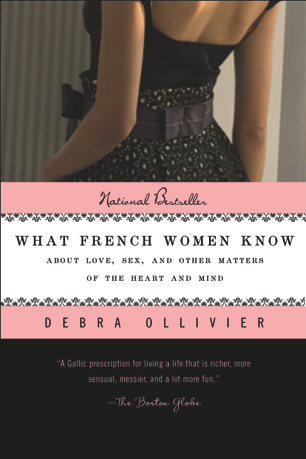
What French Women Know About Love, Sex, and Other Matters of the Heart and Mind by Debra Olliver

I have a confession to make: when I was at my sister Kate’s for Christmas, I saw this book on her shelf and stole borrowed it without permission.  I finished it just yesterday, and at the risk of embarrassing myself, I’m going to review it as my second book of this year.

This book presents a fascinating perspective on French lifestyle, attitudes, and culture.  Even though it’s geared more for women than for men, I enjoyed it in the same way I enjoyed Twilight–as an interesting anthropological experience.

It goes beyond that, though.  The picture Ollivier paints of French culture is fascinating in and of itself, if nothing else for the contrasts she points out between us (Americans) and them.  According to Ollivier, the key difference is that the French have a deep understanding of “the brevity of time and the immediacy of pleasure.” Ollivier follows this philosophy out to its logical conclusions to show that everything in French culture is an outgrowth of this–and it makes sense.

For a non-fiction book, the writing itself is quite entertaining, with constant pop culture references and a playful, humorous style.  It was a delight to read, and fairly easy as well.

However, I did get the feeling that it was a little too enthusiastic and non-critical to present a comprehensive or truly accurate picture of French culture.  Between the lines, Ollivier seems to be saying that if we Anglos would just be a little bit more like our “French sisters,” most of our problems (like our obsession with marriage, our frustrations with perfection, and our general lack of passion) would be solved.

I take issue with this: as much as we have to learn from the French, their culture has a lot of issues as well.  For example, I personally believe that Laïcité is fundamentally incompatible with a multicultural society, and leads to de facto state repression of legitimate religious expression in the public sphere (such as the wearing of the headscarf).

Also, whenever Ollivier described American culture, I always felt as if she was describing something completely alien to my own experience.  There might be a good reason for this, considering how for the past six years I’ve lived in Utah Valley, a bastion of Mormon culture so unlike the rest of the American mainstream.  However, it might also be that Ollivier exaggerates the worst excesses of this continent in order to more sharply contrast the subject matter of her book.

As a writer, though, I found this book inspiring–particularly as a writer of science fiction.  In my novels, I’m constantly inventing new cultures to populate the many worlds in my science fictional multiverse.  This book, with its clear and entertaining analysis of some very real-world cultural differences, gave me an excellent world-building prototype and a whole plethora (oh how I hate that word) bunch of new ideas for ways to enrich my stories.  In fact, this book gave me just what I needed to get through the block that had kept me from writing Star Wanderers, so if nothing else, there’s that.

So yeah, if you’re interested in world cultures or world-building cultures of your own, it’s worth your time to check out this book.  It’s perhaps not the most thorough or comprehensive book, but it is entertaining, and fairly insightful as well.  I mean, hey, if a science fiction geek like me enjoyed it, it’s got to be doing something right.

Edenfall update

So I haven’t exactly gotten into a good writing routine yet, but Edenfall is coming along pretty well.  I’m just about finished with the first chapter, and the dominoes are already starting to fall.

It’s fun to revisit the world of Genesis Earth, but I’m not going to get too bogged down in recapping the events of the first book or setting things up.  I hate it when sequels do that.  Fortunately, since the majority of this story is going to be from a new character’s point of view (Michael and Terra’s oldest daughter), I don’t really have to do that, except to lampshade some of the worldbuilding.

One thing I need to do is get more in the mood of the first book, which was a lot more introspective and big-picture than my other science fiction.  To do that, I found an excellent collection of videos called The Sagan Series.  Here is my favorite:

Man, I get shivers every time I watch that. “Sailors on a becalmed sea…”

Another good video is this one from The Piano Guys:

I know it says “Southern Utah,” but you could substitute that for “Icaria” and it wouldn’t be that far off.  In particular, the night clip from the bottom of the slot canyon at 2:05 looks like something straight out of Genesis Earth.  Throw in some primitive natives, a few giant lizards and various avians and insectoids, and you’re pretty much there.

I’m still adjusting to writing in longhand, but so far I think it’s going to work out well.  Because the writing process itself is much slower, it’s much more time intensive but surprisingly easy to jump in and get started.  Once I’ve got some momentum going, I think the story will practically write itself.

I do have a confession to make, though.  A couple days ago, I had an idea for another science fiction story that was just so awesome I decided to run with it.  At first, I thought I could keep it down to a short story, or perhaps a novella at most, but…well, I think it’s going to be a bit longer than that.

Don’t worry: Edenfall is still my primary project, and if juggling them both becomes too difficult (which it probably will), I’ll put this new one on the back burner until Edenfall is finished.  It’s kind of a guilty pleasure anyways, a sci-fi romance that draws heavily on tropes from old westerns (Jeremiah Johnson in particular).  I have no idea where it’s going to go (well, nothing more than a vague idea about the twist at the end), but that just makes it all the more exciting to write.

So anyhow, that’s what I’ve been up to these last few days.  Now if you’ll excuse me, I need to get back to writing.  See you around!

Guest post: Developing Characters in a Fantasy Setting

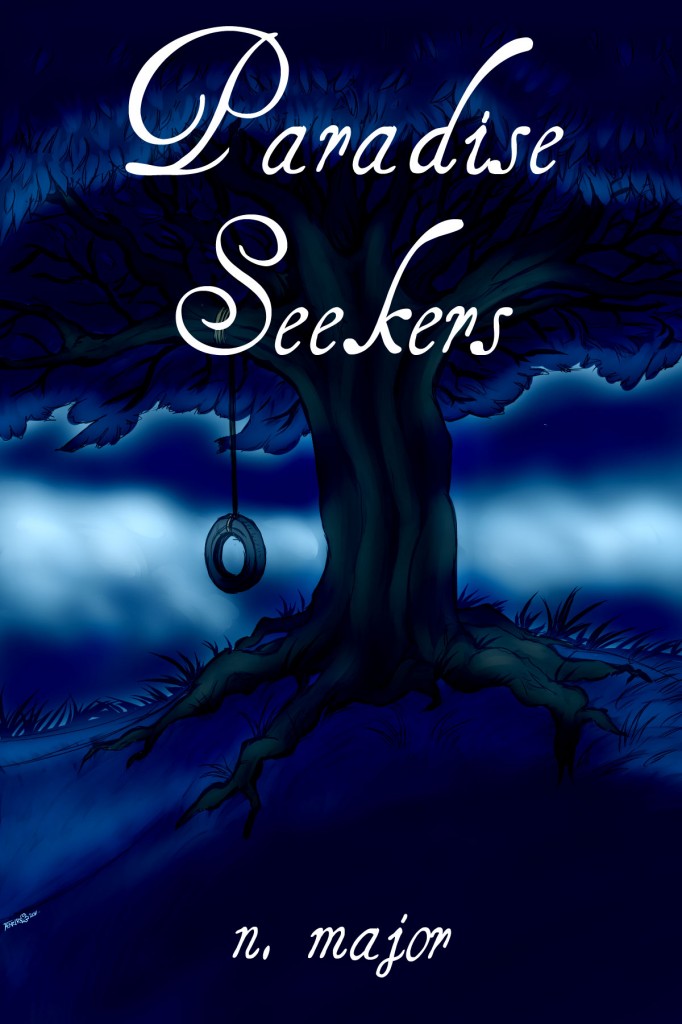
Nathan Major is a friend and fellow writing who, like me, has taken the epublishing route for his first novel, Paradise Seekers. I met him through our mutual friend Charlie at Brandon Sanderson’s English 318 class.  His book is pretty good; I’m only partway through it right now, but he’s playing with some interesting fantasy concepts and I’m definitely looking forward to seeing how he pulls it off.

I recently appeared on his blog with a guest post on how I develop my characters; for his appearance here, I decided to throw the question back at him.  Like a true fantasy author, he answered it with a multi-part epic that is probably only the first installment of a trilogy.  He makes some good points, though, and it’s definitely worth reading (and not just for the snarkiness, heh).

On a tangentially related note, I also appeared recently on Charlie’s blog with a post on ebook formatting and book DIY.  When you’re finished here, be sure to check it out!

And now, I give you Nathan Major…

================================================
When you think of fantasy, what is the first thing that comes to your mind? Mystical worlds populated with elves, dwarfs, and other magical races? Kingdoms and castles, dark lords and noble heroes? Perhaps you entertain a world that is more supernatural and more interesting than our own, one that would allow you to escape to its enchanted forests and sweeping vistas.

The fantasy genre differs from other forms of fiction (except perhaps science fiction) in that the worlds they take place in tend to be the stars of the stories. Middle-earth and Prydain. Oz and Earthsea. And within these worlds, a classic clash of good vs evil is expected. The characters and story can often take a backseat, with many authors spending years of their lives crafting the perfect magic system, most precise system of fantastical government, and the means to make their elves the best damn elves you’ve ever seen.

This drives me crazy.

I’ve been reading fantasy my entire life, but it wasn’t until a few years ago that I got fed up with the whole thing. I loved The Hobbit and The Lord of the Rings, but as I dug deeper and picked up more modern fantasy, it all seemed to start blending together. Here is our noble hero, beating the odds to fight against a nameless, oft-hidden dark lord. Here is his spunky princess sidekick slash love interest, his old mentor who dies in act two, and the hardened warrior with a dark secret. While not all books contained these tropes, the main issue still persisted: I wasn’t seeing any new characters.

That was actually what drove me to writing. After reading through a particularly popular fantasy book that was also atrociously generic, I remember tossing the book on the couch and thinking, “I could do better than this!” So I set out to try my damnedest to write a fantasy novel that, yes, was in a fantastic worlds that we wish we could live in, but was populated by people just as interesting and well-developed as the world.

Since I’m severely ADHD, I’m going to break this up into a few key ideas that (hopefully) will get my point across. These aren’t just applicable to fantasy, but it’ll be my main focus.

1) Plan your characters first, before you plan the world.

Simple enough, right? When speaking with most other fantasy authors on the subject of brainstorming, the first things they say are, “Oh, I got the coolest idea for a magic system!” or “This world is going to be amazing…it’s made entirely out of White Chedder Cheese-its!” To which I say, “Ok, but what’s the story? And who are the people influenced by the story?” This is usually met with a, “I don’t know, I’ll figure it out later!” Then I defriend them on Facebook and pretend they never existed.

Ok, so the last part was an exaggeration. But the point still stands: you may have the greatest world ever devised, but so do map-makers, and theirs looks better. What is actually in the book is the plot and the characters, and the world is just what it takes place in. You might have the greatest appendix ever at the end explaining how the Haku-Bula Wolf Tribe’s language is actually a combination of grunts and Swedish, but that doesn’t matter to the average reader. Figure that stuff out after you’ve got a story, because it’s less important.

2) Don’t fall into cliches.

This is a hard one, as discovered by me when writing my third book, Where Gods and Mortals Dance. If you’ll excuse a moment of self-indulgence, when writing this book I had a female princess as the main character. She was a strong character, but due to circumstances beyond her control she was thrust into a situation that was almost impossible for her to fix. I remember trying to design her as strong but still fragile, as parts of her past haunted her and made her ability to rule difficult.

Then I took her to writing group, where the group was divided. Half said she was the, “generic, strong, masculine princess who takes charge,” and the other half felt she was the “weak, needy, spoiled princess” who has everything done for her.

It frustrated me, but also proved a point.

I was relying on two cliches and stereotypes to design my character. I drew from both in an attempt to be original, but that didn’t work. This happens all the time in fantasy. We have the old warrior, somehow inferior to our spunky young farmhand who picked up a weapon for the first time yesterday. We have a dark lord who never actually does any fighting or has any coherent plans, he just sort of sits on his throne of skulls and knives (which is probably black and on fire) and waits for farmhands to come and kill him.

Even in the most original novels, these cliches can become evident. They might not be as blatant as the ones said above, but keep them in mind when writing. Your book doesn’t have to star a teenager. It could star a forty-year-old man who wants to save the world. There doesn’t have to be a Dark Lord at all; the enemy could be something completely different. Stay the hell away from elves, dwarfs, or anything that Tolkien used. And taking Orcs, changing them slightly, and calling them “Orks” doesn’t count as being original, it counts as being a cop-out. Fight the cliché. Make your characters deep and unique.

3) Remember: Everyone is a hero in their own story

Sympathetic villains are a rarity in fantasy. Most of the time we have a group that is distinctly bad, and a group that is distinctly good. You can usually tell by how they live. If they live in trees, clouds, or anything that communes with nature: good. If they live in filth, a swamp, or basically anywhere that looks like it’s under the constant duress of a smoke-machine: evil. Usually bad-guy motives are just “they are bad and hate the good guys,” which is a freaking awful excuse. Oh, and don’t get me started on the “he’s insane, that’s why he wants to destroy the world!” villains. That’s the biggest cop-out of them all and if you use it I want to punch you in the face right now. You are cheapening your characters and your story to make things easier for you. Here’s a revelation: good books aren’t easy. It took Tolkien how long to craft the novel that essentially invented modern fantasy? I’m not saying you should take two decades to make your book, but you should at least have to take more than one sentence to describe your villain’s motives.

The best part about the above expression (which is probably my motto when it comes to developing characters) is that it changes the way you look at your book. Life isn’t black and white: it’s a whole lot of gray. You might see something in black and white, but if you were given a chance to enter someone else’s head, perhaps your view would switch entirely. Nothing is scarier than a completely sane, totally competent villain whose goals just so happen to be the exact opposite of our hero’s. In fact, it makes the reader uncomfortable, because many of them will no longer know who to root for. If you are doing it right, your villain’s motives and values should be just as convincing as the hero’s, which means the reader should be second-guessing their loyalties throughout the book. It makes for a hell of an engaging read, let me tell you.

But this little ditty isn’t just for main characters. Side characters also need to be their own heroes. Sam didn’t just tag along with Frodo because it was a fun thing to do. He knew what had to be done (probably even better than Frodo) and fulfilled that personal quest. Your side characters need to have their own motives and motivations, depth and personality. Don’t’ drag them to Mt. Doom with the only reason being “because the hero was heading that direction anyway.” They should be just as deep (or at least close to the level of depth) as your hero. Make them interesting, and your reader will love them even more.

4) For your characters to be successful, you must know them better than they know themselves

Wow, that’s a long one, and it is sort of off the theme of “broad, overgeneralizing statements” that these bullet points have been so far. At any rate, I’ll try and be brief with this one because it seems self-explanatory.

I have a friend author who, upon designing a character, takes an online “100 questions personality test.” While I’m not saying this is the “go-to” answer for everybody, it can be an extremely helpful tool in understanding a character better. What do they like to eat? What is their taste in women (or men)? If they magically appeared in our world and wanted to hang out, what would you do? These are questions that’ll maybe never be addressed in the story, but you should know these answers. If a character has a name and is in the book for more than a single chapter, you should know everything about them.

This can be hard work, especially if you like having a billion characters. But even if you just have one or two, you really need to be in their heads. Know them. Be them. Imagine them in other situations besides in your novel. And once you really understand what makes your spunky farmhand tick, then you’ll be able to write him in both a convincing and believable way.

5) Write characters you’d like to read about

Figured I’d end this on a simple one. It’s very easy when writing to get the rose-tinted glasses put on, and all of a sudden everything in your book seems perfect. Your characters are a little cliched, but whose aren’t? Your dark lord doesn’t really have a idiom, but he does have a badass axe carved from the ashen bones of the long-lost race of dragons. Who wouldn’t like this book?

Take a step back and think. And if you can’t think of yourself, think of me. A cynical, jaded red-head who writes fantasy only because most of the fantasy currently out there pisses him off. I am your audience. I am biased, blatant, and unbelievably good looking. What would I say?

If you know your characters (see #4!), and you know them well enough then this step shouldn’t be an issue. You’ll like them regardless, because any author gets attached to a character they know every aspect of. In my current novel, Effulgent Corruption, one of the viewpoint characters is complete scum. My initial development of him was a murderous, rampaging madman whose only reason for existence was to kill and destroy. However, as I dug deeper and began to understand the character, he became sympathetic. I realized the man’s goals, what emotional pains he’s been through, and what hurts him now. I knew who he relied on, and what parts of himself he hated.

He quickly became my favorite character.

This should happen with you. You should love your villains, and hope that, should this whole “world-saving hero” thing blow over, their goals will be accomplished. Your side characters should be entertaining and fun, people you’d want to hang out with, just like your hero does. You should know everybody and at least have a shred of sympathy for them. Then, you’ll have great characters.

This, of course, isn’t a complete guide to developing good fantasy characters. Hell, it isn’t really even a very specific one. But I’m almost 100% sure that, should you take these ideas to heart, you can beat the odds and write a fantasy novel that is as interesting in its ideas about elven politics as it is with its elaborate, three-dimensional characters. Fantasy as a genre deserves better, and you (yes, you!) can be the one to do it. So go forth, young author, and write the epic that will shake the Barnes and Nobles across the land!

Plus, it’ll increase your chances that I’ll actually read it, which is a perk in and of itself.

Copyright (c) 2011 by Nathan Major
Thoughts on outlining

I’m on track to finish my fifth novel in a couple days, and surprisingly, the writing has been going very smoothly.

Usually by this point, my eyes are bleeding and I feel as if I have a hundred caltrops in my pants.  Finishing a rough draft is still the hardest part for me, since by the end everything seems to suck and I just want to trash the whole project.

I still feel a little bit of that with Into the Nebulous Deep, but not nearly as much as with my previous stuff.  Part of that is probably because I feel confident that I can fix whatever I screw up, but the other part probably has to do with the way I’ve learned to outline.  In one short sentence, here’s what I’ve learned:

An outline is simply the story you tell yourself to help you tell the story.

I don’t think there’s any mortal writer on this planet who can keep a whole novel in their head at one time.  Scenes, yes; chapters, maybe; novels, absolutely not.

However, since everyone’s creative mind works a little differently, everyone has to find the process that works for them.  Brandon Sanderson, for example, writes story bibles that are almost 100k words long.  If I were to try to do that, I’d get bored halfway through and spend the rest of the day dorking around on youtube.  Other people prefer to fly by the seat of their pants, and while there’s something to say about trusting your subconscious, I need a little structure to keep from getting totally lost.

It took me a while to figure out the process that best works for me, but based on how ITND has been going, I think I’ve hit my stride.  Breaking it down into plot, setting, and character, here’s how I basically do it:

Plot

For me, the basic plot of the story comes in a flash of creative insight once all the ideas in my head have reached a critical mass.  It’s like watching a fissure shoot across a smashed window pane, or lightning arcing from the ground to the sky.

If I don’t have time to start the project right away, I’ll let the plot mull around in my head for a couple days, then open up notepad and free write the basic structure of the story in an unedited stream of consciousness.  When I do start the project, I’ll look back to the free write to refresh my memory, but otherwise work out of what’s in my head (which may have changed).

While the project is ongoing, I’ll divide the whole novel into parts, chapters, and scenes.  For the chapter I’m currently working on, I’ll have the various scenes listed in bold with their corresponding point of view character (eg: “1.1: James“), followed by a brief one or two line description of the action and plot significance.  If I introduce a new character in that scene, I’ll write their name in ALL CAPS (I believe that’s a screenwriting convention I picked up from my old college roommate).

For chapters I haven’t written yet, I just write a few lines of description for what I envision happening in them.  When I first start out, I usually have a clear idea where I want the story to end, but I don’t bother outlining all the stuff in the middle since that usually changes based on stuff that comes before.  I only keep my outline a few chapters ahead of where I currently am, and may change things completely if something new comes up.

This process works very well for me.  I use it for every draft, and refer to it often.

Character

I’ve found that I need to do a lot more outlining to figure out my characters than I do with my plot.  However, it’s like Tracy Hickman said with the marbles: don’t hold onto your outline too tight, or all the marbles will slip out between your fingers.

The things I absolutely need to know about my characters are:

  • back story
  • motivations
  • first impressions
  • flaws & handicaps
  • strengths & advantages
  • why the reader should care about / sympathize with them

For some odd reason, I find it most helpful to write this out longhand, usually while taking a walk.  For additional help, sometimes I’ll take a personality test on behalf of my character and get a handle on them through their personality type; for that, I prefer the Meyers-Briggs typology.

But once I feel I have a solid handle on a character, I’ll throw everything out if it feels instinctively right for a character to do something completely different.  Thing is, I need the outline (especially the motivations and back story) to get to the point where I know the character well enough to let them take over.

And for some reason, all my main characters feel too…generic.  I’m not sure why, but that’s something I’ve got to work on.

Setting

Setting, for me, is all about discovery writing.  I’ve tried using wikidpad to worldbuild my universe before I start, but that’s never worked.  Instead, I daydream a lot and trust my subconscious to give me what I need when I need it.

That’s not to say I don’t do research–just that most of my research is on the fly.  If I only stay on wikipedia and the footnotes and references, no problem; if I get sidetracked on facebook, however…

Often, when I’m doing setting descriptions, I’ll run a quick google image search to pull up pictures to give me a better visual idea of what I’m describing.  I especially use this for clothing; that’s why, if you check my search history (please don’t), you’ll find all these weird, girly terms like “ottoman dress,” “jumpsuit,” “leather jerkin,” and “full frontal snogging” (whoops, where did THAT come from??).

The big problem is when I figure something at the beginning of the book and then forget about it halfway through.  For that reason, I should probably invest in a good copy editor when I start to publish.  I should also take the time to draw out a starmap, since it’s getting REALLY hard for me to remember where the Belarian system is in relation to Tajjur and Karduna Prime…hmm…

I should probably figure out a better system to keep track of my settings, but as far as outlining them goes, the less the better.  I love waving my hand and creating stuff–it’s one of the main reasons why I’m a science fiction writer.

So anyways, that’s more or less the outlining system I currently use.  I might end up outgrowing certain aspects of it, or finding a better system, but this is what works best for me now.

Of course, I still have a lot to learn.