Trope Tuesday: Colony Ship

It’s been a while since I did the weekly Trope Tuesday posts, but those were a lot of fun and they still get a lot of traffic, so I’m going to bring them back with a couple of changes. Instead of focusing on the trope itself, essentially rewriting the description on the tvtropes page, I’m going to pick apart what I like about it and focus instead on the trope’s appeal. I’m also going to pick tropes that are in my own books, so that I can talk about how I’m using them.To kick things off, this week’s trope is the Colony Ship. A staple of space opera, this trope is exactly what it says on the tin: a giant starship, often a worldship or a starship luxurious, taking a band of colonists to settle the final frontier. Essentially, this trope takes the wagon train to the stars concept to its logical conclusion, since what is a wagon train but a band of hopeful colonists? And since this is space, there’s no limit to where you can take it!

I love this trope because it’s so hopeful. Even in dark post-apocalyptic stories like A Canticle for Leibowitz, the possibility of taking humanity to the stars shines like a beacon of hope, an interstellar ark that can fling a light into the future. No matter how badly we screw up Earth, we can still atone for our sins by starting over with a clean slate out among the stars.

One of the other things that makes this trope appealing is that it’s not that far removed from reality. On that other wiki, there’s an article on Generation Ships with a link to this very interesting academic paper on the feasibility of building giant worldships. Just as Science Fiction conceptualized satellites, robots, and cloning before they were actually built, this may very well be the case with interstellar colony ships as well. I doubt that NASA or SpaceX are currently working on any prototypes, but we’re definitely on a path that will lead us there, if we have the courage and tenacity to follow it through.

If faster-than-light travel is in play, then the people who set off on the colony ship are usually the same people who build the colony. If FTL is not in play, though, things get really interesting. Sanderson’s second law of magic states that the limitations of a magic system are inherently more interesting than the powers, and since sufficiently advanced space travel is itself a kind of magic (see Clarke’s third law), then it makes sense that sublight colony ships are more interesting than FTL ones.

Sublight colony ships come in two basic types: generation ships and sleeper starships. In a generation ship, the colony ship itself becomes something of a miniature world, often like a city in a bottle (with all of the juicy story implications that come with it). In a sleeper starship, the colonists freeze themselves in stasis, opening the possibility for stuff like lightspeed leapfrog.

In my current WIP, Heart of the Nebula, I’ve combined both of these subtropes to create a hybrid generation sleeper ship. The ships are designed for sublight travel through a region of space where FTL is impossible, but there are too many colonists to fit in all the cryotanks. Subsequently, those who don’t go to sleep have to turn their tiny little ship into a self-enclosed home. When the sleepers wake up, they find that they’ve become living relics to the great-great grandchildren of their friends and relatives.

The main character in Heart of the Nebula is James McCoy, who you might remember from Bringing Stella Home. Just before he goes into cryo, he rescues his people from a terrible enemy, so that when he wakes up he’s a living legend. People have been watching movies about his exploits and doing grade school reports on him for generations. But the thing that made him a legend also put a lot of lives at risk, so that he’s also an extremely divisive figure. To make things worse, most of his friends didn’t go into cryo, so they’re all gone by now. But their great-great grandkids are still around …

As you can see, Colony Ships can be a lot of fun to play with. I’m definitely having fun with it now, and I plan to return to this trope often in the future!
Trope Tuesday: Made a Slave

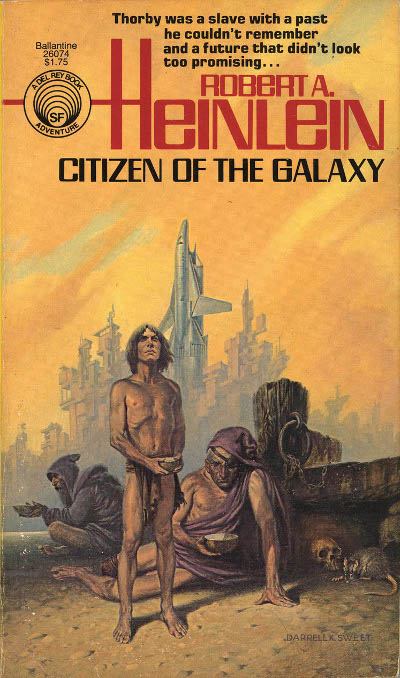
Citizen of the GalaxyJust because something is heinous doesn’t mean that it won’t make a good story.  In fact, the Rule of Drama practically guarantees that it will make a good story.  For some weird reason, we humans are fascinated by things in fiction that would horrify us in real life, and love it when our favorite characters are put into situations where we would never want to find our loved ones.  Perhaps there are many reasons for this, some of them better than others.

One of the worst situations in which anyone can find themselves is slavery, in which they basically become the property of someone else.  Slavery takes many different forms (and has many different tropes), but the thing they all have in common is the denial of freedom, dignity, and the basic human rights that most of us take for granted.  So when a character who’s free gets made a slave, you can usually expect to see some pretty high drama as a result.

As the tvtropes page for this trope explains it:

There is often a scene in which the character is being sold on the slave market, showcasing all the evils of slavery; the protagonist will witness how families are torn apart, will have to undress and be examined like an animal, and will perhaps be beaten … If he looks strong, he will be told that he will go to the galleys or the mines — a Fate Worse Than Death — or perhaps to the Gladiator Games. If she (or occasionally he) is attractive, she will be told that she will make a buyer very happy indeed.

If the main character is a slave, this is usually a part of his (or her) backstory; it’s fairly rare for a character to be born into slavery these days, probably because slavery is no longer considered an acceptable social institution in our modern Western society.  In older stories, the slave character may be of noble birth, setting up a sort of Cinderella story where they realize who they are and eventually come into their own.  That still happens, though usually it’s more about them taking power into their own hands to rise above their awful circumstances.

Surprisingly, this is a trope you’ll see with some frequency in science fiction.  Heinlein wrote a novel about it, pictured to the left (one of his better ones, in my opinion).  It happens quite a bit in the Sword and Planet subgenre, as well as any gladiator-type tale.  You’d think at some point our technology would become sufficiently advanced that we wouldn’t need to enslave each other, but apparently we will use manual labor in the future. Besides, at it’s core, slavery isn’t about acquiring cheap labor–it’s about owning someone, taking away their freedom and control.  Until human nature itself changes, we’re probably going to have to deal with slavery in one form or another for the forseeable future.

In any case, there’s something rousing–perhaps even inspiring–about the story of a character who rises above such an awful situation to win back, against all odds, their rights and freedoms.  That’s probably why we still enjoy retelling this trope.  A character can’t truly rise until they’ve bottomed out somewhere, and as far as hitting rock bottom goes, getting made a slave is pretty dang low.

I’ve played with this trope in a couple of my books.  In Sholpan and Bringing Stella Home, Stella goes through pretty much everything on the tvtropes page, which sets things up pretty well for … well, I won’t spoil it. 😉 In Stars of Blood and Glory, Abaqa tries to make the Princess Hikaru his slave, but since they’re both teenagers and he’s younger than her, it ends up being rather hilarious (she gets rescued soon afterward too, so it doesn’t stick long enough for the really bad stuff to happen.  And then the rescuers … well, I won’t spoil that either).

Right now, I’m playing with it a bit in Sons of the Starfarers, though I’m not sure where it’ll end up exactly.  Probably not so far as this trope, but I never really know what my characters will do–or what will happen to them.

Trope Tuesday: Foolish sibling, responsible sibling

Whenever you’ve got two characters who interact with each other a lot, chances are that one is a foil of the other.  There are a lot of reasons for this, but the big reason is that it helps to highlight certain character traits by providing contrast.  Because the contrast is the important thing, the relationship between the characters can take a variety of possible forms.  It may be that one is the hero and the other the sidekick, or (if they’re villains) perhaps one is the Big Bad and the other is the Dragon.  If enemy mine or one of the other frenemy tropes is in play, they might be on opposing sides.

Foolish sibling, responsible sibling is what happens when the character foils are siblings.  It’s a subtrope of sibling yin-yang that contrasts the character traits of responsibility and recklessness, duty and prodigality, and how the two opposites somehow manage (or not) to live together and stand up for each other in spite of their differences.

It may be used to set up an aesop, usually along the lines of “be like the responsible sibling, not the foolish one,” but that’s not always the case.  It might be that the younger sibling is closer to earth and the uptight responsible one needs to learn how to loosen up.  Simon from Firefly kind of fits that mold, though he learns to loosen up not from his sister River so much as from the rest of Mal’s crew.

In a lot of stories, it’s not necessarily meant to send a message so much as set up an interesting dynamic between two equally sympathetic characters.  In the movie Gettysburg, for example, Lawrence Chamberlain is the commanding officer of the regiment, and thus has to lead the men, follow military protocol, etc, while his annoying younger brother Tom calls him by name and forgets to salute him, runs around chatting it up with union soldiers and rebel prisoners alike, and generally seems a lot more loose and carefree.

Usually, the responsible character is the older sibling, for reasons that should be fairly obvious to anyone who grew up with siblings.  As the oldest child in my own family, I can readily sympathize with the dutiful son, since I more or less was one.  That’s not always the case, though.  In sitcoms where the middle child is the main character, usually it falls on them to thanklessly pick up the slack (yeah, being the middle child pretty much sucks).  Bart and Lisa from The Simpsons are a good example of this.

I played with this a little in Desert Stars with some of the minor characters: as the second oldest, Surayya generally tries to do things by the book, whereas Amina tends to be more mischievous and conniving.  Michelle and Lars also fall into this trope, with Lars a carefree academy dropout and Michelle a hardworking (though also fun-loving) mechanic on her father’s ship.  Between Desert Stars and Bringing Stella Home, though, Lars completely turns around, so that by Heart of the Nebula (not yet published) he’s quite possibly one of the most responsible characters in the book (and I still have yet to give him a viewpoint … hmmm).

In Sons of the Starfarers, I’m playing with this character dynamic a lot.  Isaac is the oldest son, who always knew he would leave on his father’s starship to fulfill the Outworld traditions and seek his fortune as a star wanderer.  Aaron, on the other hand, kind of got roped into the whole thing unexpectedly (see Star Wanderers: Benefactor) and hasn’t yet matured.  The events of the story will no doubt give him a growth arc, but in the meantime, the dynamic between the two of them is a lot of fun to write.

There are a lot of other issues in that relationship to play with too, such as promotion to parent and always someone better, but I’ll save those for another Tuesday.

Trope Tuesday: Forbidden Zone

For the next few Trope Tuesday posts, I’m going to pick apart some of the tropes I’m playing with in my latest WIP, Sons of the Starfarers.  One of the things I love to do when brainstorming a new story is to use tvtropes like a menu, finding the tropes that best fit my story ideas and combining them with other tropes to get even more ideas.

It’s not often hard to spot the forbidden zone in a fantastical world.  Perhaps it has an ominous name (bonus points if it has the word “doom” in it), or perhaps there’s some sort of sign saying “do not enter.” Either way, this is definitely a place where no one goes, and no one is supposed to go.

Of course, you can pretty much guarantee that the main characters are going to go there.  It’s like the forbidden fruit: the very fact that it’s off limits makes it more alluring.  If genre blindness is in effect, someone will probably make the mistake of saying “what could possibly go wrong?

There are many reasons why the zone may be forbidden.  Perhaps it’s a death world, where the characters will soon find themselves running for their lives.  Perhaps it’s not quite so dangerous, but once you go, you can never come back.  Or perhaps all the warnings were lies, and the so-called forbidden zone is actually the place that the characters needed to get to all along.  If that’s the case, then the mentor was probably a broken pedestal or the Svengali.

In any case, the forbidden zone definitely lies in the realm of adventure.  Depending on how soon or how late in the story the characters go there, it may lie just on the other side of the threshold, at the bottom of the belly of the whale, or at the very heart of the character’s nadir.

The Mines of Moria, the Toxic Jungle, Area 51, the Elephant Graveyard, and the Fire Swamp are all classic examples.  In C.S. Lewis’s Space Trilogy, Earth itself is a forbidden zone to all the other inhabitants of the solar system, which is why it’s called the silent planet.

In real life, there are plenty of these as well.  Just look at the DMZ on the Korean Peninsula, or the fallout zone around Chernobyl.  When I was living in Georgia, Abkhazia was off limits to the TLG volunteers, meaning that if you went there (and the Ministry of Education found out about it) it was grounds for immediate firing.  Of course, that only encouraged some of my TLG friends to go there even more–remember the forbidden fruit?  Others waited until their contracts were over and practically made a tour of the many forbidden zones of the Caucasus, including Nagorny Karabakh, which one friend described as safer than Philadelphia.

I’ve toyed with this trope in my own work, but never too explicitly.  The best example is probably the alien ghost ship from Genesis Earth.  It’s not exactly forbidden, since there’s no one around to tell Mike not to go there, but Terra definitely doesn’t want him to go.  Earlier in the same book, she forbids him from entering her workspace in the observatory, which leads to some complications and a major reveal when he inevitably does.  In the Gaia Nova series, the Outer Reaches qualify as a forbidden zone, since the only people who live out there are murderous barbarians like the Hameji.

In my new series, Sons of the Starfarers, the first book starts out with a forbidden zone–a derelict space colony, where everyone has died of an unknown cause.  Since the nearest settlement is light-years away (and because Aaron is perhaps too curious for his own good), that’s where Isaac and Aaron go.  What they find there propels the rest of the book–and quite possibly the rest of the series.

Check back next week for more!

Trope Tuesday: The Beach Episode

I’m so glad my Mom doesn’t read this blog.

I’m at Cape Cod this week, at a condo that doesn’t have internet, so it’s going to be a quick and dirty Trope Tuesday post this week (no, not like that) because I’d rather be on the beach than at the Dennisport Public Library.  Speaking of beaches …

One of the commonest beach tropes, at least for most anime and TV shows, is to take the cast of characters and put them on the beach for an episode.  This rarely has anything to do with the actual plot of the show, and is usually just an excuse to parade the characters in swimsuits and/or give the audience a little fanservice.

Actually, that’s not entirely fair.  There’s a bunch of ocean related recreational activities that the characters may participate in, such as beach volleyball (or other games), surfing, making sand castles, burying each other in sand, and getting a suntan (or an embarrassingly painful sunburn).  There may even be a single-episode romantic subplot that results in a beach kiss.

Basically, the beach episode is a chance for the audience to take a breather from the main story arc and hang out with their favorite characters at the beach.  Because really, who doesn’t like to go to the beach every now and then?  And if you can tag along with a bunch of fictional characters who have come to feel like friends, so much the better.

I’ve got to admit, most of the books and series that I’m a fan of don’t really have a beach episode.  The only one that comes to mind is the Melancholy of Haruhi Suzumiya, and that one’s a bit unusual because the beach episode(s) turn into a murder mystery that actually ties in pretty well with the main plot.  Also, the episode is based off of one of the original Japanese novels, so it’s a lot closer to canon than what you’ll see in most anime adaptations from manga (or so I’ve heard).

The beach episode doesn’t pop up in science fiction or fantasy a whole lot, probably because of the secondary world aspect.  I’m sure there are beaches on Middle Earth, but if I see a bunch of hobbits playing beach volleyball in bikinis, I’m sorry but I’m going to have to throw up.  Most fantastical worlds don’t have room for modern-style vacations, because so much of the setting is so far removed from the world we live in.  The last thing you want to do is throw your reader out of the story, so for most sci-fi and fantasy, a trip to the beach is probably a bad idea.

Of course, there are exceptions, depending on the story and the appropriateness for such an excursion in the fictional universe.  If you guys have any favorite examples, please let me know.

Needless to say, since most of my stories take place on alien worlds in the far-distant future, you won’t usually find this trope in my own stories.  However, there is a beach chapter in Desert Stars, where Mira spends some time out in nature, walking along the ocean and taking in the gulls and the waves.  She doesn’t wear a swimsuit, though.  In Stars of Blood and Glory, there’s a planet that’s nothing but ocean, with giant floating cities populated by people who are half Japanese, half Polynesian.  Not any beaches, though–at least, not natural ones.

Trope Tuesday: Curiosity is a Crapshoot

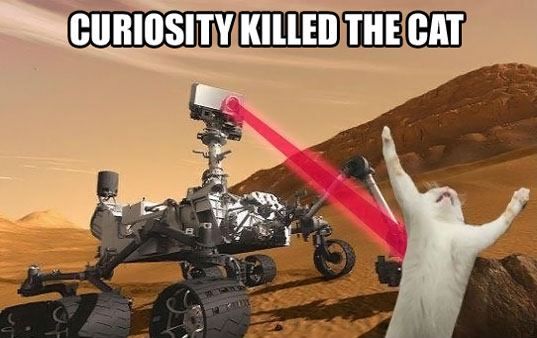
curiosity
Is there life on Mars? NOT ANYMORE!

Is curiosity a bad thing?  Well, it depends how genre savvy you are.  It seemed to work out pretty well for Alice, but not quite so well for Pandora (or the rest of the ancient Greek world, for that matter).  Curious monkeys seem to come out all right, and their constantly curious counterparts also seem to do okay in the end, but anytime you run into schmuck bait you know that things aren’t going to turn out well.

The truth is, for just about every stock Aesop warning about the perils of being overly nosy, you can find another one exalting it as a virtue.  In fact, you could say that curiosity is a crapshoot.

But what is curiosity exactly?  The Merriam-Webster dictionary defines it as “desire to know,” and “interest leading to inquiry.” As you can imagine, there are situations where this could be good or bad.  Thus, what a story says about curiosity often changes depending on its genre.

For example, in most horror stories, curiosity and nosiness are usually bad, leading the protagonists to go places where they shouldn’t and uncover things that should never have been uncovered.  At the same time, a lack of curiosity can also be fatal … in fact, a lot of things can be fatal in a horror story.

In mythology and folklore, curiosity is often even worse.  From Pandora to Eve, Psyche to the proverbial cat, curiosity leads to Very Bad Things.  Perhaps this is because these kinds of stories are mostly tales of warning, passed on from generation to generation as a way to preserve our collective knowledge about the dangers of the world, rather than inspire us to go out and face them.

(As a side note, there are a few exceptions in the realm of folklore.  In the Bluebeard myth, curiosity killed off all of Bluebeard’s previous wives, but combined with cleverness, faith, and friendship, it saved the last one’s life.)

In fantasy, curiosity is often a mixed box bag.  For example, take the hobbits: most of them are perfectly content to live out their lives in the shire, but the few who are inquisitive enough to venture outside end up saving the world in a way that the elves, dwarves, and humans never could.  At the same time, it puts them through a great deal of pain, even after the world is saved–neither Bilbo nor Frodo are ever able to be content in the shire again.

Curiosity, in other words, is complicated.  It’s not just a quirk or a character flaw–it’s an underlying quality of the hero’s journey.  Without curiosity, either of the world around him or the internal struggles within, the hero would be content to live out an unremarkable life.  Certainly he wouldn’t have the capacity for the cleverness, guile, wisdom, and sensitivity that he needs in order to descend into the darkest dungeon, face his own nadir, and return with the elixir of life.  Curiosity may lead to sorrow, pain, or even death, but it also leads to adventure.

As a subgenre of fantasy, many of these issues carry over into the realm of science fiction.  And yet, as a genre unto itself, science fiction has a distinctly positive view of curiosity compared to other genres.  Science is nothing if not the primary process of human inquiry, where curiosity is not only a virtue but the virtue, one of the most important aspects of humanity.  Consider these words from Adam Steltzner, one of the leading engineers of the NASA Mars Curiosity mission:

Likewise, curiosity is a staple of science fiction.  In Star Trek, it’s the basis of the entire mission: “to explore strange new worlds, to seek out new life and new civilizations, to boldly go where no one has gone before.” In Doctor Who, it’s how the Doctor finds his companions.  In Babylon 5, it’s Delenn’s curiosity about the humans that ultimately saves all the alien races.  And in 2001: A Space Odyssey, it’s the gift from the black monolith that helps monkeys to turn bones into space stations (well, not literally, but you get the idea).

Curiosity isn’t a central theme in most of my books, but it is a major part of Genesis Earth.  If anything, that book is about the importance of balancing curiosity about our universe with curiosity about ourselves and what it means to be human.  In Star Wanderers, Noemi’s curiosity is a huge part of her story, helping her to turn around a horrible (not to mention awkward) situation.  In Desert Stars, curiosity is complicated; it leads Jalil far away from home and puts a schism between him and the girl who loves him, but it also leads him to discover the truth about who he is, giving him the strength to return.

In general, I suppose it all comes down not only to genre, but to the underlying worldview of the author of the story.  Since I have a very positive and enthusiastic view of curiosity, it usually works out for the best in the stories that I write. Then again, perhaps that’s why I’m drawn to science fiction … how about you?

Trope Tuesday: Smart People Play Chess

Why?  Because Anastasia Gavrilova playing chess is HOT.
And if you’re Anastasia Gavrilova, chess gives you +10 charisma as well.

Want a fast and easy way to show that your characters are smart?  Not bookish, necessarily, or nerdy, or even the designated smart guy in the five-man band, but intellectually adept no matter what else their role in the story?  Well, you could indicate that through inordinate loquaciousness, but too much of that tends to make your dialog unreadable (not to mention, it’s way overdone).  You could have them rock a chalkboard, but not every story takes place in high school, and finding a chalkboard outside of academia is a bit of a challenge.  So what else can you do to indicate a high level of intelligence?

Show them playing chess.

It’s true.  Stereotypes aside, one of the most effective ways to indicate that your characters are intelligent is to show them playing chess.  From Star Trek to Discworld, Independence day to Doctor Who, Big Bang Theory to Harry Potter to Command & Conquer, chess is a fast, dirty, and effective way to show intelligence.  And while popular conceptions of chess nerds give the game a bit of baggage, it’s not as bad as you might think.  Sure, Sheldon might fit the stereotype, but Cain and Spock certainly don’t.  Even David Levinson from Independence Day turns out to be something of a badass in the end.

So why is chess such an effective way to show that a character is smart?  Probably because of all the other tropes associated with chess.  As one of the oldest and deepest strategy games of all time, chess is thoroughly embedded into our cultural consciousness.  Chess motifs are common in all sorts of stories, and the chess master is a significant character archetype.  There’s a reason we call the most complicated gambit pileup Xanatos Speed Chess.

Besides all the archetypal reasons for this trope, there are quite a few real-world reasons as well.  Playing chess can potentially do all sorts of interesting things to your brain, like stave off Alzheimer’s and improve your concentration and problem-solving skills.  All over the world, people associate chess skills with intellectual prowess, and after you’ve played a few games, it’s not hard to see why.  According to Carl Sagan, the game requires “strategy, foresight, analytical powers, and the ability to cross-correlate large numbers of variables and learn from experience.” If you’ve got all of those, chances are you’re at least above average.

Of course, this trope can be inverted in some clever and interesting ways.  In Bill and Ted’s Bogus Journey, for example, the ditzy main characters challenge Death to games of Battleship, Clue, Twister … basically, a whole host of non-cerebral games, in lieu of the expected trope.  In Foxtrot, the only character who loves chess is the Dad, who is rather dumb compared to his kids (maybe they all got bored of it?).  The classic example, though, has got to be Star Wars, where Chewbacca’s emotional impulsiveness is lampshaded over a game of <X> chess:

I haven’t used this trope a whole lot in my own work yet, but I just started work again on The Sword Keeper, an epic fantasy novel where chess tropes are going to be a major part of the story.  The mentor figure is something of a chess master, though because he’s a sentient sword he can’t experience or interact with the world except through his telepathic connection with the main character, a simple tavern girl.  She knows the basic rules of chess, however, (“chadrak” in this universe) and so one of the ways the sword trains her is through putting her through chess scenarios.  Later, it becomes apparent that the story itself is kind of like a game of chess, with the major characters loosely correlating with the different pieces, and the main character as the queen.  I’m excited–it’s going to be really cool. 😀

So yeah, this is definitely a trope you’re going to see from me in the future, and not just as a one-scene throwaway either.  Stay tuned for more!

Trope Tuesday: Knight Templar

For this one, I’m going to pull the description straight from tvtropes itself, since the whole page is pretty good:

Sometimes, the Forces of Light and Goodness get too hardcore. In a deadly combination of Well-Intentioned Extremist, The Fundamentalist and, generally speaking, not so different, they get blinded by themselves and their ideals, and this extreme becomes tyrannical sociopathy.

Usually, the Knight Templar’s primary step (or objective) to his perceived “utopia” is to get rid of that pesky “free will” thing that is the cause of crime and evil. Many Knight Templar types are utterly merciless in dealing with those whom they consider evil, and are prone to consider all crimes to be equal. The lightest offenses are met with Draconian punishments such as full imprisonment, death, brainwashing, or eternal torture.

It’s important to note that despite being villains/villainous within the context of the story, Knights Templar believe fully that they are on the side of righteousness and draw strength from that, and that their opponents are not. Trying to reason with one isn’t much good either, because many Knight Templar types believe that if you’re not with them, you’re against them. Invoking actual goodness and decency will have no effect, save for making Knights Templar demonize your cause as the work of the Devil. After all, they are certain that their own cause is just and noble, and anyone who stands in the way is a deluded fool at best.

Basically, this is what happens when the villain not only believes that he is the hero of the story, but a heroic hero.  It’s not himself he’s fighting for, but his cause–and because the righteousness of his cause is unassailable, anything that stands in the way of achieving it must be destroyed.

The name of the trope comes from the Knights Templar, the medieval military order established during the Crusades to maintain European dominance in the Middle East.  They were an elite fighting force that became associated with many of the atrocities of the Crusades.  When Saladin conquered the Kingdom of Jerusalem, he was careful to avoid civilian casualties but took no prisoners among the Templars and Hospitaliers.

Of all the story tropes I’ve studied, this one reflects reality more accurately than most.  When people believe unquestioningly that they’re right, they tend to stop listening to anyone who disagrees with them.  They turn the space around them into an echo chamber, like a one-sided Facebook feed or a narrow message board community.  When their beliefs reach a certain degree of fervency, they start to become angry not only with those who disagree, but with those who fail to agree with or support them.  Once their cause compels them to action, it doesn’t take long for the ends to justify the means.  Give them a little power, and you’ve got yourself a real life Knight Templar.

It’s precisely because this trope so closely reflects reality that it’s one of the better ways to create motivations for the villain.  It’s not enough to want to take over the world, you’ve got to have some reason to take it over–and what better reason than a cause you firmly believe in?  Assuming, of course, that the cause is believable–it’s still quite easy to botch things in the execution.

This is precisely the sort of thing Gandalf was trying to avoid when he refused to take the ring:

Understand. I would use this ring out of a desire to do good. But through me, it would wield a power too great and terrible to imagine!

Galadriel and Faramir refused the ring for similar reasons.  Boromir succumbed to the temptation, but repented for it by giving his life to defend the hobbits against the attack of Saruman’s Uruk-Hai.

In Christopher Nolan’s Batman trilogy, this is also a recurring trope.  It’s the main motivation behind Razalgul in Batman Begins, and describes Harvey Dent’s face-heel turn as he transforms from Gotham’s white knight into Two Face.  Come to think of it, it seems that the superhero genre in general is teeming with this trope.

There aren’t very many true Knights Templar in my own books, but I’m writing a fantasy series that should feature a few of them.  In The Sword Keeper, a brotherhood of sentient swords has passed on the fighting skills of generations of warriors, enabling their bearers to unite the world into a peaceful empire.  Then, one by one, the swords go insane, driving their bearers insane with them.  It all starts when one of them goes Templar, and ends when all the swords are lost or destroyed … all, that is, except the one whom the hero of prophecy will take up to save the world.  And that hero happens to be a backwoods tavern wench who isn’t even strong enough to lift it, much less wield it in battle.

So yeah, even though this isn’t a trope that I’ve played with much, it’s one that really irks me in real life, so that probably means you’ll be seeing it soon my own fiction.  If you have any other thoughts or examples to share, please be sure to drop a comment.  I’d be very much interested to hear your thoughts on this one.

Image source: Templar Knight in Battle Dress

Trope Tuesday: Gone Horribly Wrong

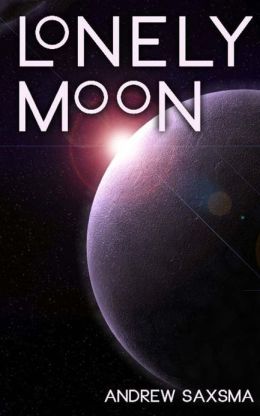
For this week’s Trope Tuesday post, I’ve invited a guest blogger to come on and discuss one of the tropes in his most recent book.  Andrew Saxsma is the author of Lonely Moon, a space opera / horror novel.  I haven’t read it yet so I can’t say much about it, but it looks interesting, and I’m a sucker for space opera.  So without further ado, here we go!

==================================================

saxsmaandrewThis trope is all about Science gone horribly, sometimes violently wrong.  Morality’s been thrown out of the window, compromised in favor of delicious success. Maybe the Mad Scientist played God; maybe mankind has accidentally awakened a Sleeping Giant.

This trope has many faces and masks and plays out in many different ways. In all cases, ethics are thrown to the wolves, and the big payoff is not as much a payoff as it is a new impeding doom the hero must now overcome.

Classically, this trope is mostly derived, if not invented, by Mary Shelley in her novel Frankenstein. Dr. Frankenstein’s obsession leads him to create what would eventually become the bane of his very existence. He unwittingly unleashes the mad dog from its dormant cage and makes it his mission to put it down. You might also recognize this trope from Deep Blue Sea, where scientists genetically enhance sharks for cancer research, but the predators get loose and begin eating their masters.

The key element is the backfire, the unforeseen consequence. It’s born of an innate character flaw, the inability to see beyond one’s good intentions. The character has a vision of a greater good in sight–to cheat death, to cure cancer. They’re so focused they never stop to think: was it worth it? Is this a line we should cross?

To make matters worse, this trope can become complicated when one’s intentions are infused with emotions. A dead loved one, revenge, a preemptive strike. Sometimes the choice is long decided before it is made.

In my book, Lonely Moon, the hero, Captain Hane, has a crisis of the monster. He faces a morally weighted fork in the road. Does he open a forbidden gate, opening our galaxy to a potentially devastating entity in an attempt to save us from an equally evil threat, or does he choose the path of uncertainty in hopes of finding a safer, less dangerous option?

Gone Horribly Wrong is a particularly fun trope to play with from a writer’s aspect, and I’m not sure if it’s a one and done. I plan on playing with this one again in the future.

lonely_moon

==================================================

Thanks, Andrew.  I think the Rule of Drama is one of the keys to doing this trope well.  Never pass up an opportunity to make things go wrong for your characters.  And if the problems are of their own making, that makes it all the juicier, especially when it adds the internal conflict of knowing that they’re the ones to blame.  We all love to watch a train wreck, especially in the world of fiction.

What do you guys think of bringing on more guest bloggers for the Trope Tuesday posts?  It’s something I’ve done occasionally in the past, but I’m thinking of doing it much more in the future.  I think it could be interesting to get some different points of view besides my own, and maybe introduce you guys to some new authors you might like.  Maybe it’s something I could rotate every other week.

Trope Tuesday: Sinister Surveillance

secure
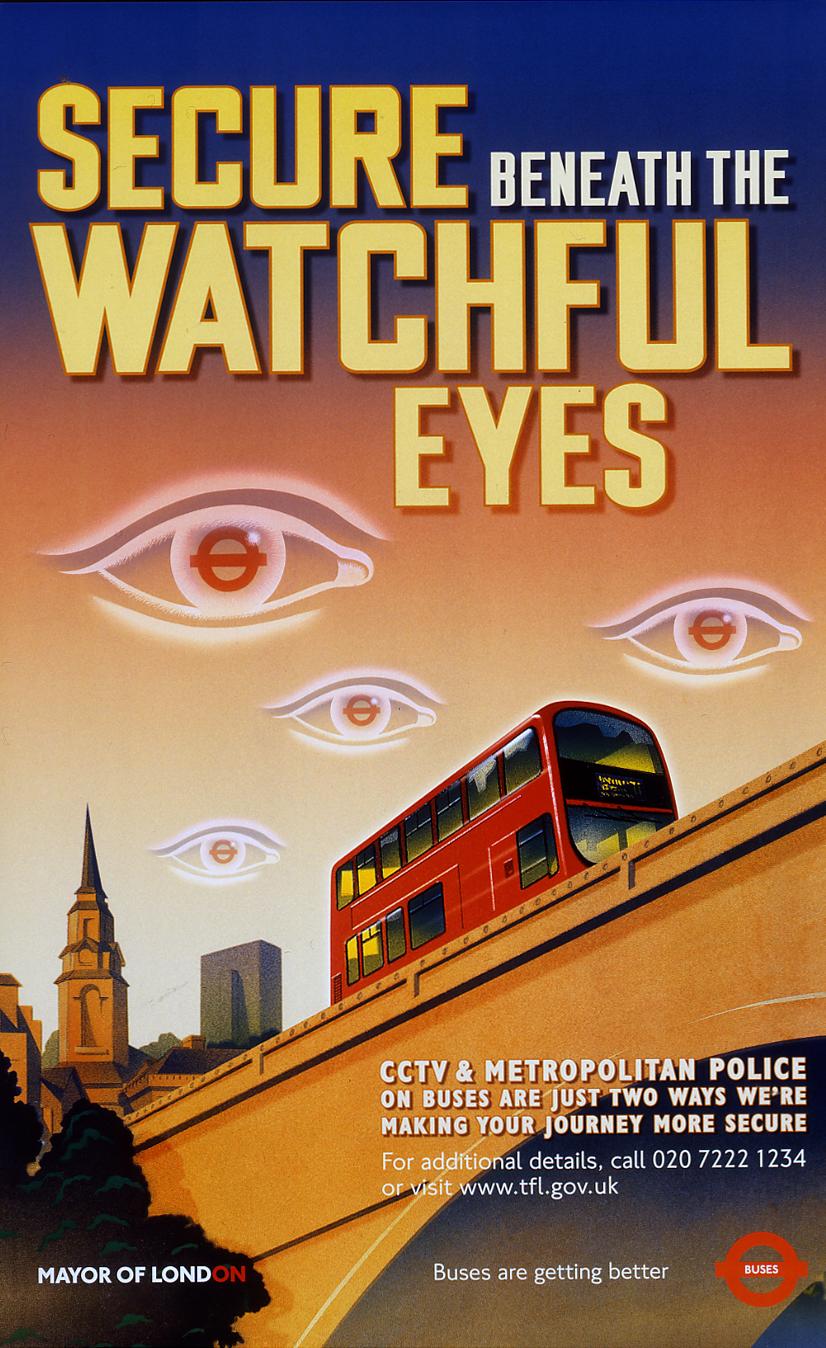
This was actually a real poster.

Someone is watching you.  Their eyes are everywhereEverything you do, everything you say … it’s all being recorded in a giant database.  But don’t worry–you can trust the ones watching youThey have your best interests at heartThey’re only after the bad guys.  You won’t even know that they’re there.

Sinister Surveillance is a hallmark of Dystopia, as essential to the genre as the Crapsack World and the Police Brutality tropes.  Often, you’ll find all three in the same story together.  It’s closely related to Big Brother is Watching, where the government is so powerful, and reaches into so many aspects of everyday life, that they see and record everything you do.  Where Big Brother shapes every aspect of the society, however, down to the language of the citizens and the basic truths accepted as facts, Sinister Surveillance is more about the surveillance itself, and the ulterior motives behind it.

It’s not enough for the government to simply watch you, though.  Even more important in some ways is the idea that you don’t know what they can and can’t see.  The reason for this is the same reason why, in horror stories, we almost never see the monster until the very end–because our imagination makes things a lot scarier than they really are.  If we the bad guys know the limitations of our government surveillance, we they can safeguard our privacy and basic rights game the system.  We’re all afraid of the dark, not because of what’s actually there, but what could be.

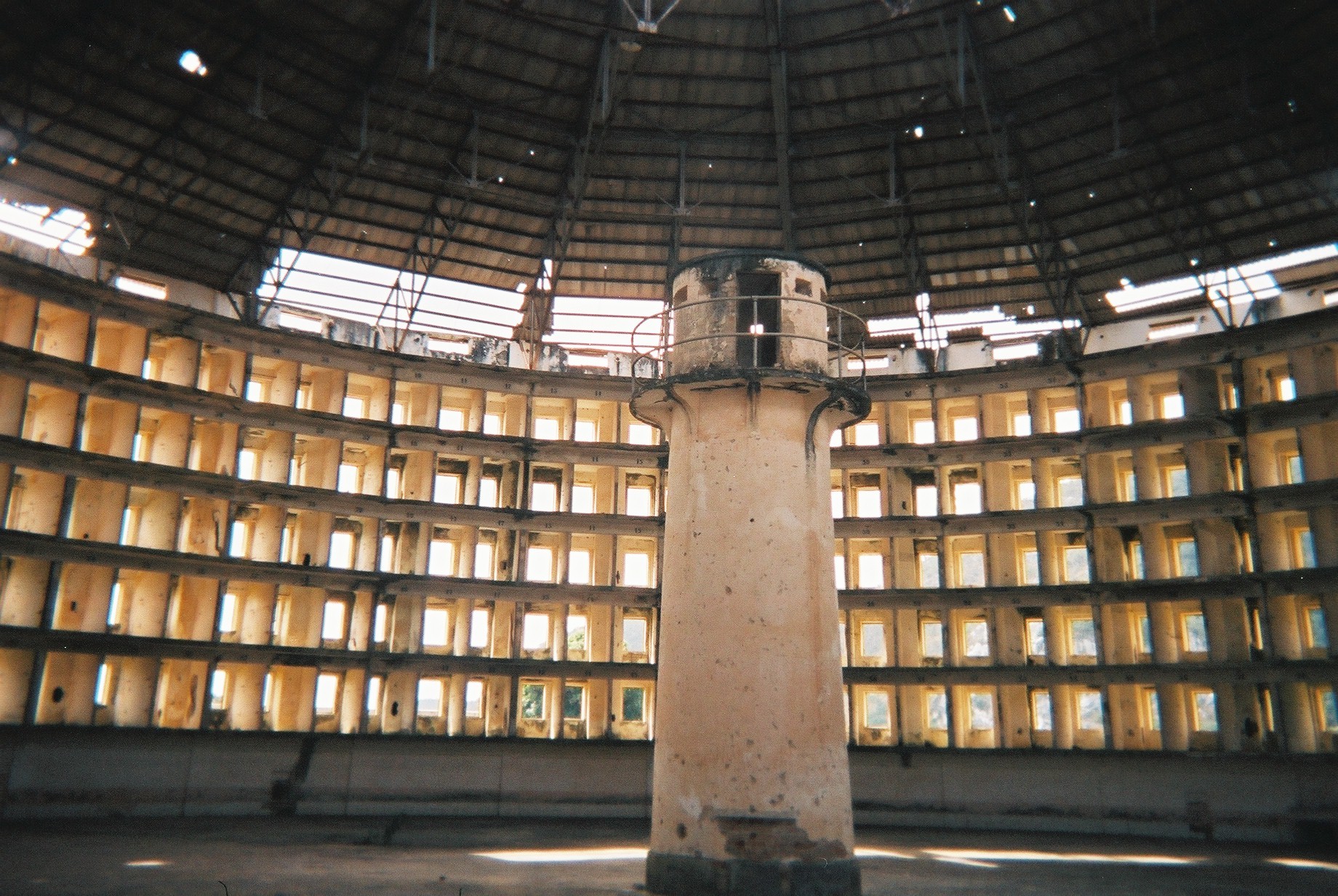
The concept behind all this goes back to the Panopticon, a hypothetical prison where the prisoners know that the guards are constantly watching them, but can’t actually see any of the guards themselves.  Proposed by the British philosopher Jeremy Bentham in the 1700s, the idea is to disempower the prisoners and empower the guards simply through the act of surveillance.  If everything you do can be seen, and you don’t know exactly who’s watching, that puts a tremendous amount of social pressure on you to conform.  As Michel Foucault put it:

The Panopticon creates a consciousness of permanent visibility as a form of power, where no bars, chains, and heavy locks are necessary for domination any more.

But if the prisoners are the citizens, and the guards are the government, how can such a system ever be democratic?  How can the citizens of such a society ever give their informed consent?  Well, that’s kind of the point.  The government in dystopian stories is rarely democratic–it’s usually a dictatorship of some kind, or a system that turns well-meaning people into Knights Templar, showing how even the best of us die like animals when the game is rigged.

As benevolent the intentions of the government may initially be, it is nonetheless true that power corrupts, and absolute power corrupts absolutely.  Just as the Panopticon takes power from the prisoners and concentrates it with the guards, so does universal surveillance grant dangerous amounts of power to the government–not because the act of surveillance is dangerous in itself, but because it brings out the worst in the people doing the surveillance.

In The Road to Serfdom, Freidrich Von Hayek pointed out that self-serving, ambitious, power-hungry people tend to rise in government a lot faster than people who have others’ best interests at heart, especially when so much power is concentrated in the government.  That’s one of the biggest dangers of surveillance–and in stories where Sinister Surveillance is in play, the government has already passed that point.

I wish I could say that this trope is limited mostly to the realm of fiction, but unfortunately, that does not appear to be the case.  These days, it’s impossible to talk about surveillance without getting political, even on a blog dedicated to books and writing.  Because everything these days is online, it’s easier now than ever before for our governments to watch us.  And if Edward Snowden’s claims are even partially correct, that’s exactly what they’re trying to do.  Even more worrying are the indicators that they’re trying to do it in secret, such as this recent letter from Senators Wyden and Udall.  The United States government has lied to us in the past about the extent of the PRISM surveillance program, and it would appear that they’re continuing to do just that.

Wherever you fall politically on PRISM or the Edward Snowden case, I think that Sinister Surveillance is a trope that we should all find profoundly disturbing.  When George Orwell took this trope to its extreme logical conclusions in 1984, he did so to prevent that horrific social order from ever coming to pass.  I wonder: only two or three generations after that book came out, have we forgotten its lessons already?  Or do we need a new retelling to remind us?  I fear that that retelling is taking place, not in the pages of a novel, but in real time on the major blogs and news sites.